


Voice AI: Essential Evolution of the Legal User Interface
Just two years ago, Eleanor Vance, the meticulous managing partner at Vance & Associates, faced a familiar morning ritual: sifting through dozens of voicemails, each a potential client or an urgent inquiry, often leading to missed opportunities or delayed responses. Her firm, like many mid-sized practices, struggled with the administrative burden of client intake and routine inquiries, a bottleneck that directly impacted their growth and reputation.
Fast forward to today, May 16, 2026, and Eleanor’s mornings are dramatically different. A sophisticated Voice User Interface (VUI) system, powered by advanced AI, now handles initial client calls, qualifies leads, schedules appointments, and even provides basic information, all with a human-like conversational fluidity. This transformation isn't just a convenience; it's a testament to the rapid evolution of Voice AI in the legal sector, as highlighted by recent reports like "Global Trends Overview: The Rapid Evolution of the Voice User Interface Market" from openPR.com.
The global market for Voice User Interface technology is not merely expanding; it's undergoing a seismic shift, with profound implications for professional services, particularly law. Analysts predict the market will reach unprecedented valuations, driven by advancements in speech recognition and natural language processing (NLP). Firms that are quick to adopt these AI-powered platforms are gaining a significant competitive edge, turning administrative overhead into streamlined, efficient operations.
This isn't about replacing human interaction, but augmenting it, allowing legal professionals to focus on high-value tasks while AI handles the repetitive, time-consuming ones. The narrative of legal tech is no longer about *if* AI will impact law, but *how quickly* and *how deeply* it will integrate into every facet of practice, from client intake to complex litigation support.
This market evolution is shaping a new paradigm for legal service delivery.
This blog post delves into the essential evolution of Voice User Interface technology within the legal industry, examining its current capabilities, strategic advantages, and the ethical considerations that must guide its implementation. We will explore how firms are leveraging AI Voice Assistants to enhance client engagement, optimize internal workflows, and navigate the competitive landscape.
Through real-world examples and expert insights, we aim to provide a comprehensive overview for law firm owners and attorneys looking to harness this transformative legal technology. The journey from Eleanor Vance’s cluttered voicemail inbox to a seamless, AI-driven client interaction system underscores a broader truth: the future of legal practice is conversational, intelligent, and increasingly, voice-activated.
The Rapid Evolution of Voice AI in Legal Practice
The trajectory of Voice AI has been nothing short of astonishing. From rudimentary command-and-control systems of the early 2010s to today's sophisticated, context-aware conversational agents, the technological leaps have been immense. This rapid evolution is largely due to breakthroughs in deep learning and vast datasets, enabling systems to understand nuances, accents, and even emotional inflections in human speech.
Companies like Google and Amazon laid the groundwork with consumer-facing products like Google Assistant and Alexa, demonstrating the power of speech recognition. However, the legal sector demands a far greater degree of accuracy, security, and domain-specific understanding. Legal language is notoriously complex, filled with jargon, Latin phrases, and precise terminology that general-purpose AI often misinterprets.
The shift has been towards specialized AI-powered platforms capable of handling this complexity, moving beyond simple transcription to true semantic comprehension, a critical factor for any legal Voice User Interface.
Leading the charge in developing these specialized applications are legal tech innovators and AI research giants.
At LegalTech NYC 2026, Sam Altman of OpenAI, though not directly focused on legal, spoke broadly about the future of conversational AI, emphasizing the need for robust, ethical frameworks—a sentiment echoed by legal professionals. Firms are no longer just looking for tools that *recognize* speech but those that *understand* intent within a legal context.
Learn more about Essential AI Website Builder Guide for Law Firms. This means Voice AI systems that can differentiate between a client asking for a case update and a prospective client inquiring about service fees. The global trends indicate a clear demand for industry-specific solutions that integrate seamlessly into existing legal operations.
The promise of a truly intelligent legal voice assistant lies in its ability to act as an extension of the legal team, not just a digital answering machine.
This surge in capability is also mirrored in investment. According to a recent Thomson Reuters Institute report on legal technology, venture capital funding into legal AI startups has seen a significant uptick, with particular interest in solutions that enhance client experience and operational efficiency.
The market evolution is fueled by this investment, enabling companies to develop more nuanced natural language processing models tailored for legal discourse. For instance, the AI Voice Assistants offered by platforms like HODOS 360 are designed to understand legal terminology, manage complex call flows, and integrate with AI Law Firm Management Systems, ensuring a holistic approach to legal innovation.
This level of sophistication is what transforms a generic voice assistant into a powerful Voice User Interface for a law firm, offering a distinct competitive advantage in the rapidly changing legal landscape.
Ready to transform your firm's client engagement and operational efficiency?
Beyond Siri: Advanced Voice User Interface Capabilities for Law Firms
The capabilities of modern Voice User Interface systems for law firms extend far beyond the basic functions of consumer-grade assistants. These are not just glorified answering machines; they are sophisticated AI-powered platforms designed to handle complex legal workflows. Consider the advanced speech recognition and natural language processing at play when an AI voice assistant qualifies a lead.
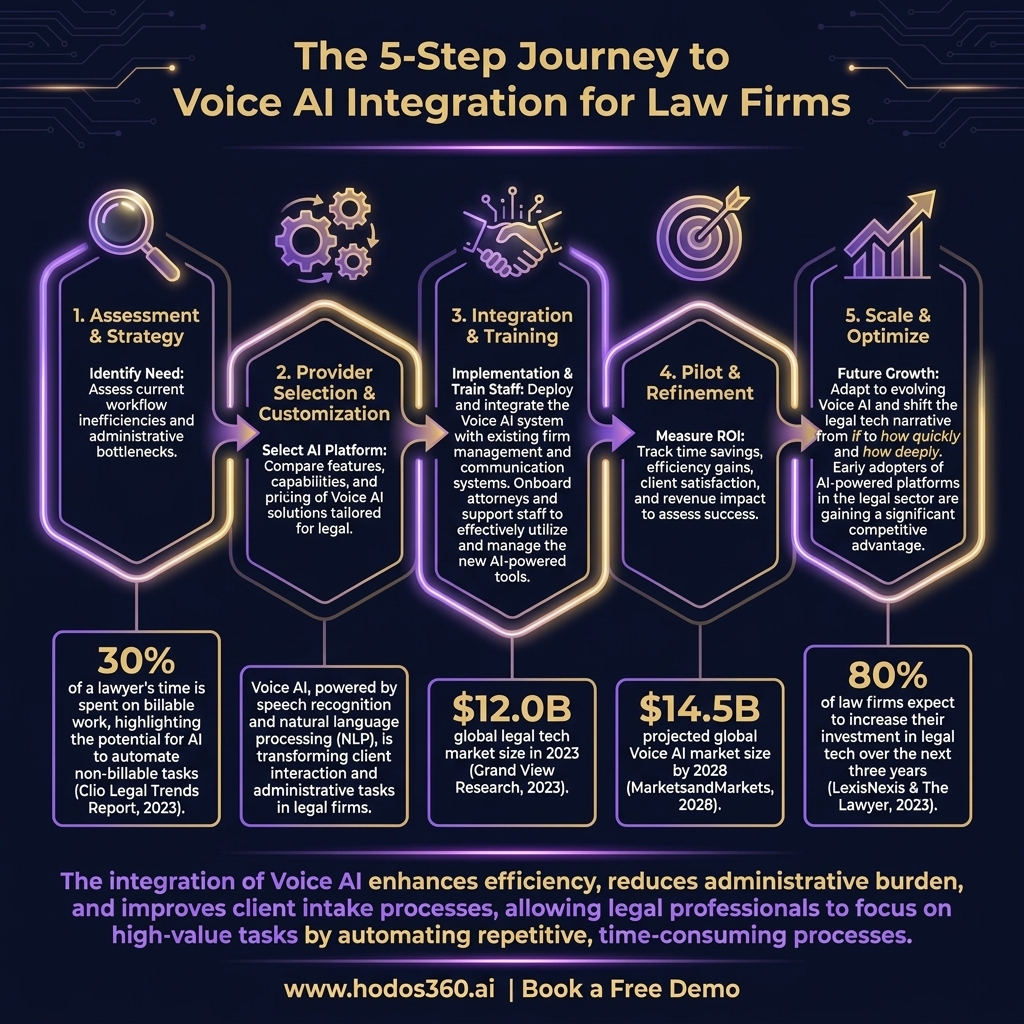
It can engage in a dynamic conversation, asking probing questions to ascertain the nature of the inquiry, the potential legal issue, and the client's urgency. This involves understanding context, remembering previous statements, and formulating relevant follow-up questions—all without human intervention. This level of AI automation means that attorneys and paralegals receive pre-vetted leads, allowing them to allocate their valuable time more effectively to substantive legal work, rather than initial screening calls.
The global market for such advanced solutions is witnessing rapid growth, as firms seek to optimize every touchpoint with clients and prospects.
### Enhancing Client Intake and Communication
One of the most immediate and impactful applications of advanced Voice User Interface technology in law firms is in client intake and communication.
Historically, this process has been a significant administrative burden, often leading to delays and frustration for prospective clients. An AI voice assistant can provide 24/7 availability, ensuring no call goes unanswered, a critical factor given the urgency often associated with legal issues. These systems can collect initial client information, explain fee structures, answer frequently asked questions, and even guide clients through self-service portals for document submission.
This drastically improves client engagement and satisfaction by providing immediate, professional assistance. Firms like Linklaters, while not explicitly using voice for this, have championed digital transformation in client interactions, showcasing the industry's readiness for such innovations. Learn more about Voice Search Optimization: The Ultimate Guide for Law Firms.
The ability of legal voice assistants to offer multilingual support further broadens a firm’s reach, catering to diverse client bases and ensuring equitable access to legal services, addressing a key aspect of modern practice.
### Streamlining Back-Office Operations
Beyond client-facing roles, Voice AI is revolutionizing back-office legal operations.
Imagine an attorney dictating case notes directly into a secure system, with the Voice User Interface transcribing, tagging, and filing the information automatically. This AI automation extends to scheduling, where an AI voice assistant can coordinate complex calendars across multiple attorneys and court dates, sending reminders and managing conflicts.
The integration with an AI Law Firm Management System means that billing, document automation, and case management tasks can be initiated or updated through voice commands, significantly reducing manual data entry and human error. This efficiency translates directly into cost savings and increased productivity. Dario Amodei, co-founder of Anthropic, often speaks about the potential of AI to augment human capabilities rather than replace them, and this is precisely what specialized legal voice assistants achieve in the administrative realm, freeing up legal staff for more strategic tasks and deeper analysis, a core component of firm management in the digital age.
Consider the operational impact for a firm like Allen & Overy, which famously partnered with Harvey AI for legal research. While Harvey focuses on generative AI for text, the underlying principle of leveraging AI for efficiency is the same. Extending this to voice means a seamless, hands-free interaction with complex systems, allowing lawyers to stay focused on their intellectual work.
This represents a significant leap in legal innovation, moving beyond simple dictation software to truly intelligent, responsive systems that understand and execute complex tasks based on spoken commands. The global trends towards greater AI automation in professional services are clear, and law firms are increasingly recognizing the imperative to adopt these technologies to remain competitive and deliver superior client service.
The evolution of these tools is not just about technology; it's about fundamentally rethinking how legal work is done.
Navigating the Global Market Evolution: Strategic Adoption of Voice Technology
The global market for Voice User Interface technology is experiencing exponential growth, with projections indicating valuations in the tens of billions by the end of the decade. A recent Gartner report on emerging technologies highlighted Voice AI as a top priority for investment across industries, including legal.
This rapid expansion is not uniform, however; successful adoption within the legal sector requires a strategic approach that considers both the technological capabilities and the unique demands of legal practice. Firms that rush into generic solutions often find themselves with tools that fall short of expectations, leading to frustration and wasted resources.
The key lies in selecting AI-powered platforms specifically designed for legal use cases, offering robust speech recognition and natural language processing tailored to legal terminology and ethical standards. This strategic selection is crucial for firms aiming to capitalize on the market evolution and avoid the pitfalls of early, unguided adoption.
Furthermore, the competitive landscape is intensifying. Firms that are early adopters of advanced Voice AI are already reporting significant improvements in efficiency, client satisfaction, and lead conversion rates. This creates a compelling case for firms still operating with traditional methods to consider their legal innovation strategy.
Learn more about Essential AI Legal Solutions: Freshfields' Gemini Integration. The pressure to adapt is palpable, especially as clients, accustomed to voice assistants in their daily lives, begin to expect similar seamless interactions from their legal providers. The evolution of client expectations is driving much of this change, pushing law firms to modernize their client-facing interfaces.
According to a 2024 ABA TechReport, firms leveraging AI for client communication reported higher satisfaction scores, underscoring the tangible benefits of adopting sophisticated Voice User Interface technology.
Strategic adoption also involves understanding the full spectrum of benefits that AI Voice Assistants can deliver across the firm.
It’s not just about one specific function, but how these tools integrate into a comprehensive AI Law Firm Management System to create a synergistic effect. This integrated approach allows for maximum impact on firm management and legal operations.
Key Strategic Advantages of Voice AI for Law Firms: * 24/7 Client Availability: Ensures no lead is missed, improving responsiveness and client satisfaction.
* Enhanced Lead Qualification: AI accurately screens and qualifies prospective clients, saving attorney time. * Automated Appointment Booking: Streamlines scheduling, reducing administrative overhead and conflicts. * Multilingual Support: Broadens client reach and improves accessibility for diverse populations. * Improved Internal Workflows: Voice commands for case management, document automation, and billing.
* Data-Driven Insights: Analytics on call volumes, client queries, and lead conversion to optimize strategies. * Cost Efficiency: Reduces the need for extensive administrative staff for routine tasks, reallocating resources.
**Discover how HODOS 360’s AI Voice Assistants can integrate seamlessly into your firm's existing workflows.
Get started today!**
Ethical Considerations and Future Trajectories of Legal Voice AI
As Voice AI continues its rapid evolution within the legal industry, ethical considerations become paramount. The legal profession is bound by strict rules of confidentiality, privilege, and professional conduct, which must be upheld even as technology advances. This means that any Voice User Interface deployed in a law firm must incorporate robust security measures to protect sensitive client data.
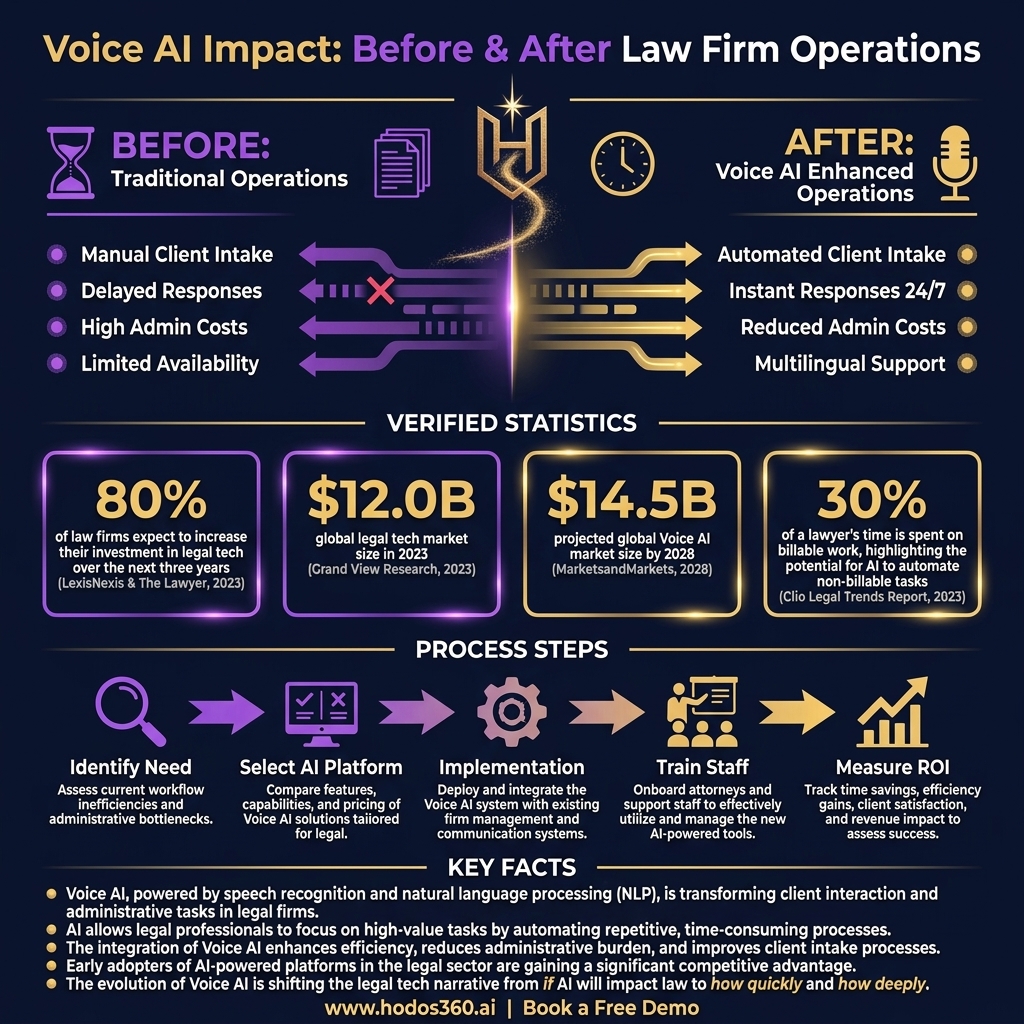
The risk of data breaches, unauthorized access, or misinterpretation of privileged information is a serious concern. Firms must conduct thorough due diligence when selecting AI-powered platforms, ensuring compliance with data privacy regulations such as GDPR, CCPA, and, importantly, the ABA Model Rules of Professional Conduct, specifically Rule 1.6 (Confidentiality of Information), which mandates that lawyers make reasonable efforts to prevent the inadvertent or unauthorized disclosure of, or unauthorized access to, information relating to the representation of a client.
This is not merely a technical challenge but a fundamental ethical imperative that guides the development and deployment of legal voice assistants.
### Addressing Data Privacy and Security
Data privacy and security are at the forefront of ethical discussions surrounding Voice AI. Every spoken interaction with an AI voice assistant generates data, which, if not handled properly, could expose sensitive client information.
Therefore, firms must prioritize solutions that offer end-to-end encryption, secure data storage, and clear policies on data retention and usage. The architecture of these AI-powered platforms should be designed with privacy by design principles, ensuring that client conversations are processed securely and confidentially. Law firms must also be transparent with clients about the use of Voice AI, explaining how their data is handled and offering opt-out options where appropriate.
Learn more about Ultimate AI Video Marketing: Legal Firms Master Content Creation. The ethical landscape of AI is still forming, with legislative efforts like the EU AI Act setting precedents for responsible development and deployment. As such, legal professionals must stay abreast of these developments and ensure their legal innovation aligns with evolving legal and ethical standards.
Beyond privacy, other ethical considerations include the potential for bias in speech recognition and natural language processing models. If AI models are trained on unrepresentative datasets, they may exhibit biases that could lead to unfair or inaccurate outcomes, particularly in areas like lead qualification or initial legal advice.
Firms must choose Voice AI providers committed to developing fair and unbiased algorithms, regularly auditing their systems for equitable performance. The future trajectory of legal voice assistants will undoubtedly involve increasingly sophisticated capabilities, potentially extending to real-time legal research assistance during calls or even drafting simple legal documents based on voice commands.
This market evolution demands a proactive approach to ethics, ensuring that AI automation serves justice and enhances legal practice responsibly. The ethical frameworks established today will dictate the trustworthiness and widespread adoption of these powerful tools in the years to come, shaping the very definition of firm management in the digital age.
As legal tech trends continue to accelerate, the integration of Voice User Interface technology will deepen, becoming an indispensable part of the legal ecosystem. The challenge for law firms will be to harness this power while meticulously adhering to the core ethical principles that define the legal profession.
This balancing act between innovation and responsibility is crucial for building trust and ensuring that Voice AI genuinely benefits both legal practitioners and the public they serve.

Key Takeaways and Next Steps
The rapid evolution of the Voice User Interface market presents an unprecedented opportunity for law firms to redefine efficiency, client engagement, and operational excellence. From enhancing client intake solutions with 24/7 AI Voice Assistants to streamlining legal workflows through voice-activated commands, the benefits are tangible and immediate.
Firms that embrace this legal innovation are not just adopting new tools; they are strategically positioning themselves for future success in a competitive global market. The narrative is clear: Voice AI is no longer a futuristic concept but a present-day imperative for modern firm management.
As demonstrated by leading firms and the accelerating pace of legal tech trends, the time to integrate these powerful AI-powered platforms is now, ensuring your practice remains at the forefront of legal service delivery and client satisfaction.
For law firm owners and attorneys contemplating their next steps, the path forward involves a careful assessment of current operational bottlenecks and a strategic exploration of how Voice AI can provide targeted solutions.
Learn more about Legal AI Software Market: An Essential $14.62 Bn Outlook. Prioritizing providers with deep legal domain expertise, robust security protocols, and seamless integration capabilities is paramount. Platforms like HODOS 360 offer a comprehensive suite of AI-powered legal workflows, from AI Law Firm Management Systems to dedicated AI Voice Assistants, designed to meet the specific needs of the legal industry.
By leveraging these advanced technologies, firms can not only overcome administrative challenges but also unlock new avenues for growth and client service excellence, ensuring a sustainable and prosperous future in the era of intelligent automation. Embrace the evolution and transform your practice today.
Frequently Asked Questions
What is a Voice User Interface (VUI) in the context of law firms?+
A Voice User Interface (VUI) in a law firm refers to an AI-powered system that allows users, such as clients or staff, to interact with legal technology through spoken commands. These systems utilize advanced speech recognition and natural language processing to understand and respond to queries, automate tasks like client intake, scheduling, and information retrieval, thereby enhancing efficiency and accessibility in legal operations.
How do AI Voice Assistants enhance client engagement for law firms?+
AI Voice Assistants enhance client engagement by providing 24/7 availability for inquiries, lead qualification, and appointment booking. They offer immediate, consistent responses, reducing wait times and client frustration. With multilingual support, they cater to diverse client bases, ensuring equitable access to information and a professional, responsive first impression, which significantly improves client satisfaction and trust.
What ethical considerations should law firms be aware of when using Voice AI?+
Law firms must prioritize data privacy and security, ensuring VUI systems comply with regulations like GDPR and ABA Model Rule 1.6 (Confidentiality). They must vet providers for robust encryption and data handling policies. Transparency with clients about AI use, addressing potential biases in AI models, and maintaining human oversight are also crucial to uphold professional conduct and client trust.
Can Voice AI integrate with existing law firm management systems?+
Yes, modern Voice AI platforms are designed for seamless integration with existing law firm management systems. This allows AI Voice Assistants to update case files, manage calendars, automate document generation, and streamline billing directly through voice commands. Such integration enhances efficiency, reduces manual data entry, and ensures a cohesive operational workflow across all firm management functions.
What are the long-term benefits of adopting Voice AI for legal operations?+
Long-term benefits include sustained operational efficiency, significant cost reductions through automation, and enhanced competitive advantage by offering superior client service. Firms can reallocate human resources to higher-value legal work, fostering innovation and growth. Furthermore, adopting Voice AI positions firms at the forefront of legal tech trends, attracting tech-savvy talent and clients, and ensuring resilience in an evolving market.