AI Agents: Ultimate Guide for Law Firm Marketing Adaptation
The digital marketing landscape for law firms is undergoing a seismic shift, accelerated by the recent emergence of sophisticated AI agents. The headline from Performance Marketing World, "Has Meta’s Muse started the agentic wars? ‘AI agents can bypass ads entirely’," reverberates through every industry, including legal services. This isn't just another tech trend; it's a fundamental re-architecture of how information is discovered and consumed. For law firms, historically reliant on established advertising channels and SEO, the rise of autonomous AI agents like Meta's Muse, designed to act on behalf of users, presents both an existential challenge and an unprecedented opportunity. These intelligent entities, capable of performing complex tasks from shopping to information gathering, threaten to render traditional ad placements obsolete by mediating the user's journey from query to solution, often without ever displaying a paid advertisement.
This new era, dubbed the 'agentic wars' by industry observers, forces law firm owners and legal marketers to critically reassess their client acquisition strategies. No longer is it sufficient to merely optimize for search engines or run targeted ad campaigns; the focus must now shift to becoming the authoritative, trusted source that an AI agent would recommend to its principal. Firms that embrace this paradigm shift and proactively adapt their digital presence and content strategies will be poised for significant growth, while those that lag risk becoming invisible in an increasingly agent-mediated world. The core tension lies between the traditional push model of advertising and the emerging pull model, where AI agents actively seek out the most relevant and valuable solutions for their users, often bypassing the very mechanisms that have sustained digital marketing for decades.
The implications for legal marketing are profound. Imagine a prospective client asking their AI personal assistant to "find a reputable family law attorney in Seattle who specializes in high-net-worth divorces." The agent, instead of presenting a list of ads, might synthesize information from reviews, thought leadership articles, case studies, and peer endorsements to recommend a specific firm or attorney. This scenario, once futuristic, is rapidly becoming our present reality. Firms must understand not just *what* these agents do, but *how* they make recommendations, and strategically position themselves to be the preferred choice. The challenge is clear: how do law firms ensure they are not only found but *chosen* by these powerful digital gatekeepers? This guide delves into the mechanisms of agentic AI, its impact on legal marketing, and actionable strategies for law firms to thrive in this evolving environment.
The Rise of Agentic AI: A New Paradigm for Digital Engagement
The concept of an AI agent extends far beyond simple chatbots or virtual assistants. These are autonomous systems designed to understand user intent, plan and execute multi-step tasks, and make decisions on behalf of their users. Meta’s Muse, for instance, isn't just answering questions; it's envisioned as a proactive entity capable of booking appointments, managing schedules, and even making purchasing decisions. This capability, at its core, represents a fundamental shift in how digital interactions occur. While early iterations like Google's Assistant or Amazon's Alexa were primarily reactive, modern agentic AI systems are increasingly proactive, anticipating needs and performing actions without explicit, step-by-step commands. This evolution is driven by advancements in large language models (LLMs) and sophisticated planning algorithms, allowing agents to navigate complex digital environments with unprecedented autonomy.
This shift is not confined to Meta. Companies like OpenAI, under the leadership of Sam Altman, have long explored the potential of more autonomous AI, as evidenced by the capabilities of advanced models and the discussions around truly agentic systems. Anthropic, led by Dario Amodei, also contributes to this frontier, focusing on safe and robust AI that can perform complex tasks. The competition is fierce, with major tech giants investing billions into developing their own agent ecosystems. For instance, reports from McKinsey Global Institute in 2024 highlighted that enterprise adoption of AI agents for various business processes has grown by over 30% year-over-year, indicating a rapid integration across industries. Learn more about AI Voice Assistants: Essential for Modern Law Firms. This widespread adoption means that individuals and businesses alike will increasingly rely on these agents to mediate their digital lives, from managing communications to making critical decisions, including those related to seeking legal counsel.
The implications for traditional marketing are stark. If an AI agent can identify a user's need, research solutions, and even complete a transaction without the user ever seeing an advertisement, the entire performance marketing model is disrupted. This phenomenon, sometimes referred to as 'zero-click content,' means that firms must now optimize for the agent, not just the human. As Amazon reportedly moved to block Meta's AI shopper agents from its platform, it underscored the immediate competitive tension and the potential for these agents to bypass established commercial gateways. The challenge is to provide content and a digital presence so compelling and trustworthy that it becomes the default recommendation of these powerful intermediaries, rather than relying on paid visibility that these agents are designed to circumvent.
Furthermore, the sophistication of these agents means they are not merely scanning for keywords but understanding context, sentiment, and authority. A legal AI agent tasked with finding a personal injury lawyer might prioritize firms with extensive case law publications, glowing peer reviews, and verifiable success metrics, rather than simply the highest bidder on a keyword. This pushes law firms to invest in deep, valuable content and genuine thought leadership. The future of digital engagement is less about shouting the loudest and more about being the most genuinely helpful and authoritative resource, a principle that aligns perfectly with the ethical standards of the legal profession. As these agents become more integrated into daily life, law firms must evolve their strategies to ensure their expertise is not just visible, but inherently discoverable and recommendable by these intelligent systems.
Navigating the 'Agentic Wars': Implications for Legal Marketing
The 'agentic wars' signal a critical inflection point for legal marketing. Law firms have historically relied on a mix of traditional advertising, SEO, and content marketing to attract clients. However, the rise of AI agents introduces a new layer of mediation between the potential client and the legal service provider. When an agent can filter information, compare services, and even initiate contact on a client's behalf, the traditional sales funnel is fundamentally altered. Paid advertisements, once a cornerstone of many firms' performance marketing strategies, may become less effective as agents prioritize organic, reputation-based recommendations over sponsored content. This forces firms to re-evaluate their entire marketing budget and strategy, shifting focus from direct ad spend to building an undeniable digital footprint that resonates with agent algorithms.
Consider the impact on lead generation. A 2023 survey by Thomson Reuters found that over 60% of law firms identified client acquisition as their top growth challenge, with digital marketing playing a crucial role. However, if AI agents increasingly facilitate the initial research phase, firms risk losing direct engagement with potential clients at the critical discovery stage. This necessitates a proactive approach to ensure a firm’s digital assets are optimized for agent comprehension. This includes not just technical SEO, but also the semantic quality and authority of content. Firms must move beyond simply ranking for keywords and strive to be recognized by agents as the definitive source of information for specific legal queries, building a robust 'entity' profile that agents can confidently recommend. The challenge lies in understanding the complex algorithms these agents use to evaluate trustworthiness and relevance.
Beyond Traditional Ad Bypasses (H3): The ability of AI agents to bypass ads is merely one facet of their disruptive potential. Learn more about AI Regulatory Monitoring: Essential for Law Firm Compliance. More broadly, they challenge the very notion of 'discovery' in the digital realm. Instead of a client actively searching and clicking through various websites, an agent might synthesize information from dozens of sources, presenting only a curated summary or direct recommendation. This means law firms must prioritize becoming a 'known entity' within the agent's knowledge base. This includes ensuring consistent information across all digital touchpoints, cultivating a strong online reputation through genuine client reviews and testimonials, and publishing highly authoritative content that agents can readily identify as expert-level. The legal industry, often slow to adopt technological shifts, now faces an urgent imperative to innovate its marketing strategies or risk becoming a casualty of this new digital paradigm. Firms that fail to adapt will find their client acquisition pipeline drying up as agents direct clients to more agent-optimized competitors.
Furthermore, the competitive landscape is intensifying. As firms like Allen & Overy partner with legal AI startups like Harvey AI, the legal industry is clearly signaling its intent to leverage AI for efficiency and competitive advantage. This extends beyond internal operations to client-facing strategies. The firms that are investing in sophisticated AI-powered tools for content generation, social media management, and data analytics will be better positioned to understand and influence agentic recommendations. The 'agentic wars' are not just about technology; they are about market share, client trust, and ultimately, the future viability of law practices in a rapidly evolving digital ecosystem. Firms must see this not as a threat to be resisted, but as a new playing field on which to strategically differentiate themselves.
Strategic Adaptation: Leveraging AI for Law Firm Visibility
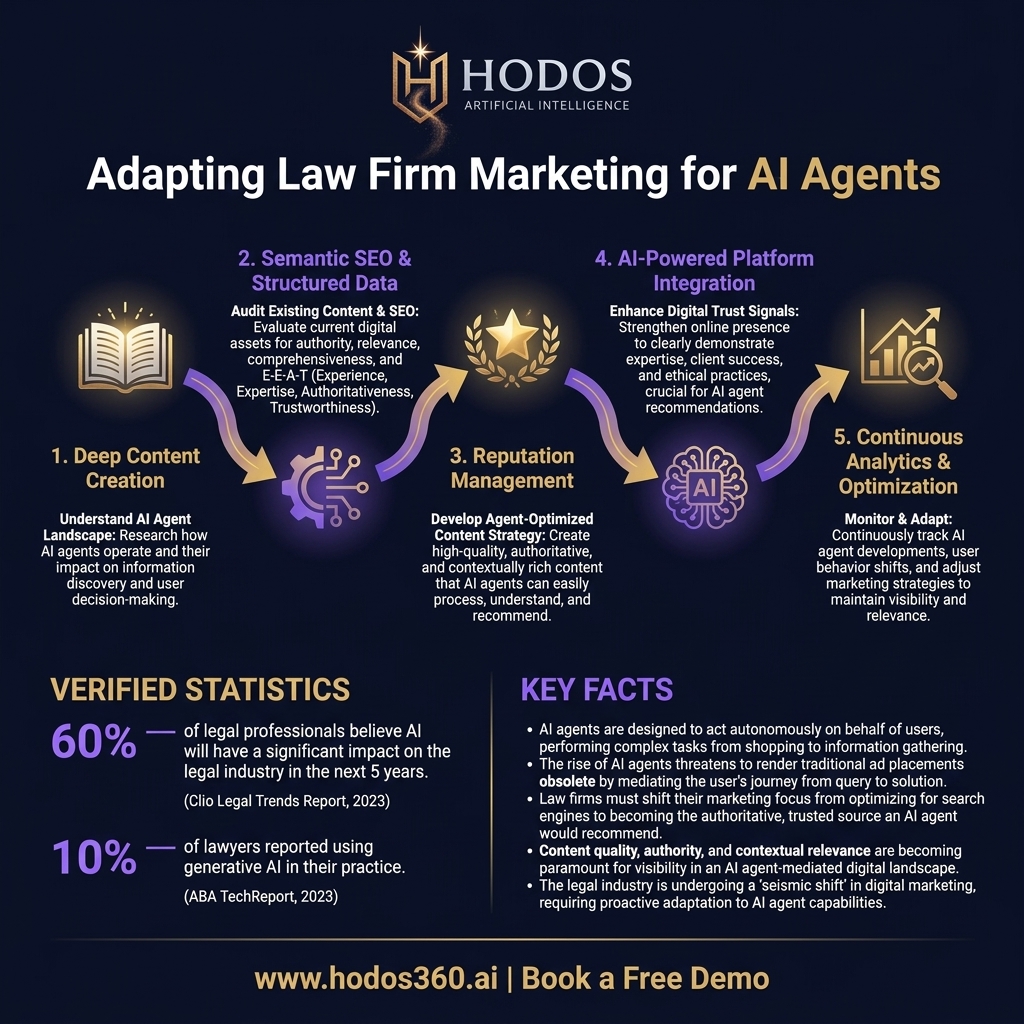
Adapting to the rise of AI agents requires a multi-faceted strategy focused on building undeniable authority, trust, and digital discoverability. For law firms, this means moving beyond a reactive stance to a proactive approach that anticipates how agents will evaluate and recommend legal services. At the core of this adaptation is content strategy. Firms must produce high-quality, in-depth, and evergreen content that directly answers specific legal questions and demonstrates profound expertise. This content should be structured logically, utilize clear language, and be factually robust, making it easily digestible and verifiable by AI agents. Think detailed legal guides, comprehensive whitepapers, and authoritative articles on niche practice areas, all designed to establish the firm as a leading expert in its field.
Secondly, SEO optimization for law firms must evolve. Traditional keyword stuffing is irrelevant to agentic systems. Instead, the focus shifts to semantic SEO, entity optimization, and structured data. Firms should implement schema markup (e.g., Organization, LegalService, Attorney) to explicitly tell AI agents what their content is about and who the experts are within the firm. Building a robust knowledge graph around the firm and its attorneys, ensuring consistent information across all online directories, professional profiles, and legal aggregators, will be paramount. This consistent, verifiable information helps agents confidently identify and recommend the firm as a trustworthy and relevant entity. Learn more about Siri AI's Enterprise Ascent: Essential Voice Assistant Strategies. This meticulous approach to digital presence is no longer optional; it's a fundamental requirement for visibility.
Cultivating a stellar online reputation and fostering genuine client testimonials become even more critical. AI agents are designed to prioritize user satisfaction and trust signals. A firm with a strong track record of positive client experiences, reflected in numerous genuine reviews and high ratings across platforms, will naturally rank higher in an agent's recommendation algorithm. This requires proactive reputation management, encouraging satisfied clients to share their experiences, and promptly addressing any feedback. Firms should view every client interaction as an opportunity to build a testimonial that will eventually feed into an agent's assessment of their standing and reliability. The human element of trust, translated into digital signals, remains invaluable.
Finally, integrating AI-powered tools into marketing operations is no longer a luxury but a necessity. Platforms that offer social media automation, content generation, and sophisticated analytics can help firms produce the volume and quality of content required to feed agentic systems, while simultaneously tracking their effectiveness. For example, using AI to analyze trending legal queries can inform content creation, ensuring firms are producing answers to questions agents are likely to encounter. Similarly, AI can help identify influential legal publications or forums where attorneys should establish thought leadership. The goal is to create an ecosystem of valuable, agent-friendly content that positions the firm as a go-to resource in the eyes of these powerful new digital gatekeepers.
- ✓Content Authority: Develop comprehensive, expert-level content (articles, guides, case studies) that answers specific legal questions with depth and accuracy, establishing your firm as a definitive source.
- ✓Semantic SEO & Structured Data: Optimize your website with schema markup and focus on semantic relevance, ensuring AI agents understand the context and authority of your legal expertise.
- ✓Reputation Management: Actively cultivate positive client reviews and testimonials across multiple platforms, as agents prioritize trust and social proof in their recommendations.
- ✓Omnichannel Presence: Maintain consistent, accurate firm information across all online directories, professional profiles, and social media to reinforce your digital entity for AI agents.
- ✓AI-Powered Content Strategy: Leverage AI tools for market research, content ideation, and distribution, identifying trending legal topics and optimizing content for agent consumption.
- ✓Thought Leadership: Encourage attorneys to publish in reputable legal journals, speak at conferences, and engage in public discourse, building a personal brand that agents can recognize as authoritative.
- ✓Internal Link Optimization: Create a robust internal linking structure on your website, guiding AI agents through your firm's areas of expertise and demonstrating content depth.
HODOS 360's AI Marketing Platform: Empowering Law Firms
In the face of the 'agentic wars,' law firms need more than just a marketing strategy; they need an adaptive, AI-powered ecosystem. This is where HODOS 360's AI Marketing Platform becomes an indispensable asset. Designed specifically for the unique demands of the legal industry, our platform integrates advanced AI capabilities to help firms not only navigate but thrive in this new digital landscape. From generating high-quality, agent-friendly content to automating complex marketing workflows, HODOS 360 empowers law firms to build the authoritative digital presence that AI agents will prioritize. Our platform directly addresses the challenge of ad bypass by enabling firms to create a wealth of valuable, discoverable content that agents can confidently recommend to their users, ensuring consistent client acquisition even as traditional channels diminish.
Our AI Marketing Platform offers a suite of tools tailored for this new era. The AI video creation feature allows firms to produce engaging, short-form educational content that can be easily consumed and processed by AI agents looking for concise, informative summaries. Coupled with social media automation, firms can maintain a consistent, high-impact presence across all relevant platforms, ensuring their thought leadership reaches a broad audience and strengthens their digital footprint. Our content generation tools help attorneys draft authoritative articles, blog posts, and legal guides at scale, ensuring a continuous stream of valuable information that positions the firm as an expert in its niche, directly appealing to the information-gathering capabilities of AI agents.
Beyond creation, HODOS 360 provides robust analytics and ROI tracking, allowing firms to understand which content and strategies are most effective in an agent-mediated environment. This data-driven approach ensures that marketing efforts are always optimized, adapting in real-time to the evolving algorithms of AI agents. Learn more about AI Hallucinations: Proven Strategies for Legal Research Accuracy. By tracking engagement, agent recommendations, and conversion rates, firms can refine their strategies to maximize visibility and client acquisition. Furthermore, our platform's integration with other HODOS 360 services, such as AI-powered legal workflows and client intake solutions, creates a seamless experience from initial client discovery by an agent to effective case management and billing. This holistic approach ensures that firms are not only found but are also equipped to handle the influx of new, highly qualified leads.
The Ethical Imperative in AI Marketing (H3): As law firms increasingly leverage AI in their marketing, ethical considerations are paramount. The ABA Model Rules of Professional Conduct, particularly Rule 7.1 concerning Communications About a Lawyer's Services, mandates that all communications must not be false or misleading. When using AI agents for content generation or social media outreach, firms must ensure that the output accurately reflects their expertise, avoids unsubstantiated claims, and maintains professional integrity. Transparency regarding the use of AI, where appropriate, also builds trust. Furthermore, the global regulatory landscape, exemplified by the EU AI Act, emphasizes the need for responsible AI deployment, highlighting data privacy, fairness, and accountability. HODOS 360 is built with these ethical guidelines in mind, providing tools that empower firms to market effectively and responsibly, ensuring compliance while embracing innovation.

Key Takeaways and Next Steps
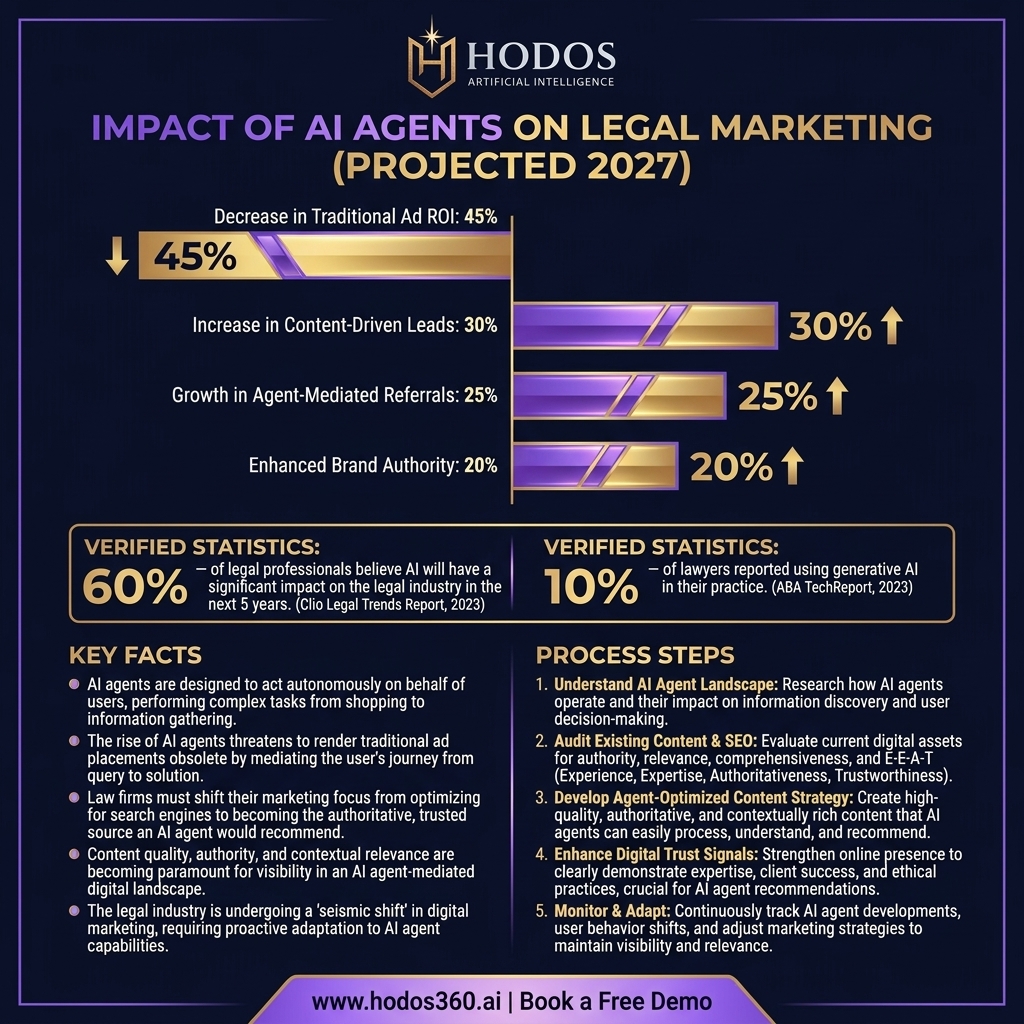
The emergence of AI agents and the ensuing 'agentic wars' mark a definitive turning point in digital marketing. For law firms, this isn't a distant future but a present reality that demands immediate and strategic adaptation. The ability of these intelligent systems to bypass traditional advertisements and mediate client discovery means that firms must shift their focus from vying for ad impressions to establishing themselves as undeniable authorities and trustworthy entities in the eyes of AI. This requires a profound investment in high-quality, semantically rich content, meticulous SEO for agent comprehension, and a robust online reputation built on genuine client satisfaction. Firms that embrace this shift will transform from passive advertisers to indispensable resources, recommended proactively by the very agents that are reshaping the digital landscape.
Proactive engagement with this new paradigm is non-negotiable for sustained growth and visibility. Law firms must recognize that the future of client acquisition will increasingly rely on their ability to provide value that AI agents can easily identify, process, and recommend. This means auditing current marketing strategies, investing in AI-powered tools that facilitate content creation and distribution, and fostering a culture of continuous learning and adaptation within the firm. The firms that will thrive are those that view AI agents not as adversaries but as sophisticated intermediaries, understanding their logic and optimizing their digital presence to become the most logical and authoritative choice for legal inquiries. Learn more about Legal AI Software Market: An Essential $14.62 Bn Outlook. The time to act is now, to ensure your firm is positioned at the forefront of this transformative era.
To navigate the complexities of this evolving landscape, law firms need powerful, integrated solutions. HODOS 360 offers a comprehensive suite of AI-powered services, including an AI Marketing Platform, designed to equip your firm with the tools necessary to adapt and excel. From generating engaging content and automating social media to optimizing your digital presence for agentic discovery and tracking your ROI, HODOS 360 empowers your firm to not only survive but to lead in the age of AI agents. Don't let the 'agentic wars' leave your firm behind. Embrace the future of legal marketing and secure your firm's place as a trusted, discoverable entity in the AI-driven world. Book a Free Demo with HODOS 360 today to future-proof your firm!
Frequently Asked Questions
What are AI agents and how do they impact law firm marketing?+
AI agents are autonomous systems that perform tasks and make decisions on behalf of users, often bypassing traditional ads. For law firms, this means agents may recommend services based on organic authority, content quality, and reputation rather than paid placements, fundamentally altering how clients discover legal services. Firms must optimize for agent comprehension and trust signals.
How can law firms adapt their SEO strategy for AI agents?+
Law firms need to move beyond traditional keyword SEO to semantic SEO, entity optimization, and structured data. Implementing schema markup, ensuring consistent firm information across all digital platforms, and building a robust knowledge graph around the firm's expertise will help AI agents understand and recommend the firm more effectively.
Why is content quality more important now with AI agents?+
AI agents prioritize high-quality, authoritative, and factually robust content to provide accurate recommendations to users. Firms must create in-depth articles, guides, and case studies that demonstrate profound expertise. This content acts as a primary signal for agents to identify and recommend a firm as a trusted source for specific legal inquiries.
How does HODOS 360's AI Marketing Platform help with agentic marketing?+
HODOS 360's AI Marketing Platform provides tools for AI video creation, content generation, and social media automation, enabling firms to produce high-quality, agent-friendly content at scale. It also offers analytics and ROI tracking to optimize strategies, ensuring firms remain visible and acquire clients effectively in an agent-mediated digital landscape.
What ethical considerations should law firms keep in mind when using AI for marketing?+
Firms must ensure that all AI-generated marketing content adheres to ABA Model Rule 7.1, ensuring it's not false or misleading. Transparency, accuracy, and professional integrity are paramount. Firms should also consider broader ethical guidelines, such as those in the EU AI Act, regarding data privacy, fairness, and accountability in AI deployment to maintain trust.