


AI for Law Firms: Essential Guide to Scaling Legal AI
Just a few years ago, the mention of artificial intelligence in a law firm often evoked images of sci-fi dystopias or, at best, experimental tech relegated to the IT department. Today, that narrative has fundamentally shifted. Consider the story of Elena Rodriguez, a managing partner at a mid-sized litigation firm in Miami.
For years, Elena's firm grappled with the sheer volume of internal knowledge—past case briefs, client communications, expert witness depositions—buried across disparate servers and individual attorney hard drives. The firm's competitive edge, she knew, lay hidden within this data, yet retrieving relevant precedents or identifying patterns across thousands of documents was a monumental, often impossible, task.
This challenge isn't unique to Elena; it’s a universal struggle for law firms aiming to maintain efficiency and deliver superior client outcomes in an increasingly data-rich legal landscape.
This evolving reality underscores the significance of recent industry developments, such as the DeepJudge partners with Epiq collaboration, which aims to help law firms apply AI at scale.
This partnership isn't just another headline; it represents a critical milestone in the legal tech evolution, signaling a mature approach to AI implementation where specialized advisory expertise meets cutting-edge AI search capabilities. It acknowledges that the journey to integrate AI isn't merely about acquiring software, but about strategically transforming how firms operate, manage internal knowledge, and deliver value.
For legal professionals, understanding this shift from cautious experimentation to strategic adoption of AI for law firms is no longer optional—it's an essential guide for future-proofing their practice and unlocking unprecedented operational efficiencies.
The Imperative of AI Implementation for Modern Law Firms
The collaboration between DeepJudge, an AI innovator focused on internal knowledge retrieval, and Epiq Advisory for Law Firms, a prominent legal consulting group, is a testament to the industry's pivot towards structured AI implementation. As Roger Pilc, President and General Manager of Epiq Legal Solutions, has emphasized in various discussions, the goal isn't just to introduce AI tools, but to ensure their 'governed adoption' and integration into 'operational infrastructure.'
This move addresses a significant pain point for many firms: the gap between acquiring promising AI software and actually achieving transformative results at scale. The 2023 ABA TechReport revealed that while interest in AI is high, actual widespread adoption remains moderate, often hindered by concerns over cost, data security, and a perceived lack of clear ROI.
This conflict between potential and practical application is what partnerships like DeepJudge and Epiq seek to resolve, providing a blueprint for successful integration.
Many law firms struggle with the sheer complexity of integrating new technologies into legacy systems. Data silos, resistance from attorneys accustomed to traditional methods, and a lack of in-house technical expertise often derail even the most well-intentioned AI implementation efforts.
This is where advisory services become invaluable. They help firms navigate the intricate landscape of data readiness, ethical considerations, and change management. Learn more about AI Voice Assistants: Ultimate Competitive Edge for Law Firms. For example, a firm might have terabytes of client data, but if it's unstructured or poorly tagged, even the most powerful AI search engine like DeepJudge will struggle to deliver optimal results.
Epiq’s role is to ensure that the underlying data infrastructure is prepared, that legal workflows are redesigned to leverage AI, and that attorneys are trained to use the new tools effectively, thereby transforming the firm's approach to internal knowledge management.
This strategic approach moves beyond the initial 'AI hype' that characterized earlier phases of legal tech adoption.
Instead of focusing on theoretical capabilities, the emphasis is now firmly on 'AI utility' – delivering tangible, measurable benefits. For firms like Elena Rodriguez's, this means not just having a tool that can search documents faster, but a comprehensive system that integrates seamlessly into their daily operations, from client intake to litigation support.
The drive is to make AI for law firms an intrinsic part of their competitive strategy, rather than a standalone experiment. This shift is critical for firms looking to stay competitive, especially as market leaders like Allen & Overy, through their partnership with Harvey AI, demonstrate the profound impact of well-executed AI strategies on efficiency and client service.
Ready to transform your firm's operations with intelligent automation? Learn how HODOS 360's AI Law Firm Management System provides an integrated solution for seamless AI adoption.
Unlocking Internal Knowledge: The Core of Legal AI's Promise
At the heart of the DeepJudge-Epiq partnership, and indeed much of the promise of AI for law firms, lies the critical need to unlock and leverage internal knowledge. Law firms are, by their very nature, knowledge factories, generating vast amounts of proprietary data in the form of legal documents, client communications, and research.
However, a significant portion of this valuable data often remains 'dark data'—unstructured, inaccessible, and underutilized. Traditional knowledge management systems, often reliant on manual tagging or rudimentary keyword searches, simply cannot cope with the scale and complexity of modern legal data. The result is duplicated effort, missed precedents, and attorneys spending valuable billable hours reinventing the wheel.
Advanced AI search and knowledge management systems fundamentally transform this paradigm. Companies like DeepJudge, founded by Dr. Michael Luggen, Dr. Andreas Thoss, and Dr. Yannic Keller, leverage sophisticated Natural Language Processing (NLP) and machine learning algorithms to understand the context and meaning within legal documents, rather than just matching keywords.
Learn more about AI Lead Flow: Essential Strategies for Law Firm Growth. This allows attorneys to quickly find highly relevant information, synthesize insights from vast datasets, and identify patterns that would be impossible for a human to discern in a reasonable timeframe. A 2023 Thomson Reuters report indicated that attorneys spend up to 25% of their time on non-billable administrative tasks, much of which involves inefficient information retrieval.
AI-powered solutions directly attack this inefficiency, freeing up attorneys for higher-value, strategic work.
The tangible benefits of effective internal knowledge management are profound. Beyond reduced research time, firms experience improved brief quality, more consistent legal advice, and ultimately, better client outcomes. Imagine a litigator preparing for a complex trial, able to instantly access every relevant motion, deposition, and expert report from the firm's entire history, cross-referenced with external legal databases.
This level of insight provides a significant competitive advantage. Furthermore, robust knowledge systems contribute to attorney development, allowing junior associates to learn from the collective experience of the firm's most seasoned partners. This transformation is about turning a firm's accumulated wisdom into a strategic asset, empowering every legal professional to perform at their peak.
From Data Silos to Strategic Assets: The Knowledge Transformation
For decades, law firms have operated with a fragmented approach to knowledge. Partners often held their own private repositories of precedents, associates reinvented legal arguments for similar cases, and critical insights remained trapped in individual email inboxes or local hard drives. This created significant data silos, where valuable information was isolated and inaccessible to the broader firm.

The advent of sophisticated AI for law firms offers a powerful solution to break down these barriers, creating a unified, intelligent knowledge base that serves as a central brain for the entire practice. This isn't just about storage; it's about intelligent organization, contextual understanding, and proactive retrieval.
AI's ability to process, categorize, and link disparate pieces of information means that a firm's collective experience can be leveraged instantly. Learn more about Voice AI Unleashed: Transforming Law Firms in 2026 with HODOS 360. Beyond simple document search, these systems can identify relationships between cases, clients, and legal arguments, suggesting relevant precedents or even predicting potential outcomes based on historical data.
Crucially, the transformation from data silos to strategic assets also involves robust data governance. Firms must ensure that sensitive client information is handled securely, adhering to strict confidentiality protocols and regulatory requirements like the GDPR or CCPA. AI tools, when properly configured, can aid in this by automating data classification and access controls, ensuring that the right information reaches the right person at the right time, while maintaining stringent ethical and privacy standards.
Practical Guide to AI Integration: A Phased Approach
Successful AI implementation in a law firm is not a single event but a journey best undertaken through a phased, strategic approach. Firms that attempt a 'big bang' adoption often face significant resistance and integration challenges. The first phase is Assessment and Strategy. This involves a thorough evaluation of the firm's current operational inefficiencies, identifying specific pain points where AI can deliver the most impact.
This might include repetitive document review, inefficient client intake, or time-consuming legal research. Crucially, firms must also assess their data readiness – is the existing data structured enough for AI to ingest and process effectively? Ethical considerations, such as data privacy and potential bias in AI algorithms, must be addressed upfront, often guided by principles outlined in the ABA Model Rules of Professional Conduct, particularly Rule 1.1 on Competence, which implies a duty to understand technology.
Following the assessment, the second phase involves a Pilot and Proof of Concept. Instead of deploying a firm-wide solution immediately, identify a specific, well-defined use case and implement AI on a smaller scale. For instance, a firm might pilot an AI search tool for a specific practice group or for a particular type of document review.
Measure the impact rigorously, focusing on key metrics like time saved, accuracy improvements, and user satisfaction. This iterative approach allows the firm to learn, refine the AI's configuration, and build internal champions. Learn more about AI Legal Research: The Ultimate Guide to legalgain & Beyond.
A prime example of this is Freshfields Bruckhaus Deringer, which piloted AI tools like Harvey AI in specific practice areas before considering broader deployment, ensuring that the technology was genuinely adding value and aligning with their complex legal workflows.
The final phase is Scaled Deployment and Training.
Once the pilot proves successful, the firm can gradually expand the AI solution across more practice areas or to the entire firm. This phase heavily relies on robust training programs to ensure user adoption. Attorneys and support staff must understand not only *how* to use the AI tools but also *why* they are beneficial and how they augment, rather than replace, human expertise.
As legal tech visionary Richard Susskind often articulates, AI is fundamentally about 'more for less,' enabling legal professionals to focus on higher-value, strategic tasks while automating routine processes. Continuous monitoring, feedback loops, and ongoing refinement are essential to ensure the AI remains effective and adapts to evolving firm needs, making the AI for law firms investment a sustained success.
Don't get left behind. Explore how HODOS 360's AI-powered solutions can streamline your firm's operations and empower your team. Schedule a free consultation today.
The Competitive Edge: Firms that Embrace AI at Scale
The legal industry is witnessing a clear divergence: firms that strategically embrace AI at scale are rapidly gaining a significant competitive edge over those that hesitate. This isn't just about marginal efficiency gains; it's about fundamentally reshaping business models and client expectations. Consider the narrative of disruption versus tradition.
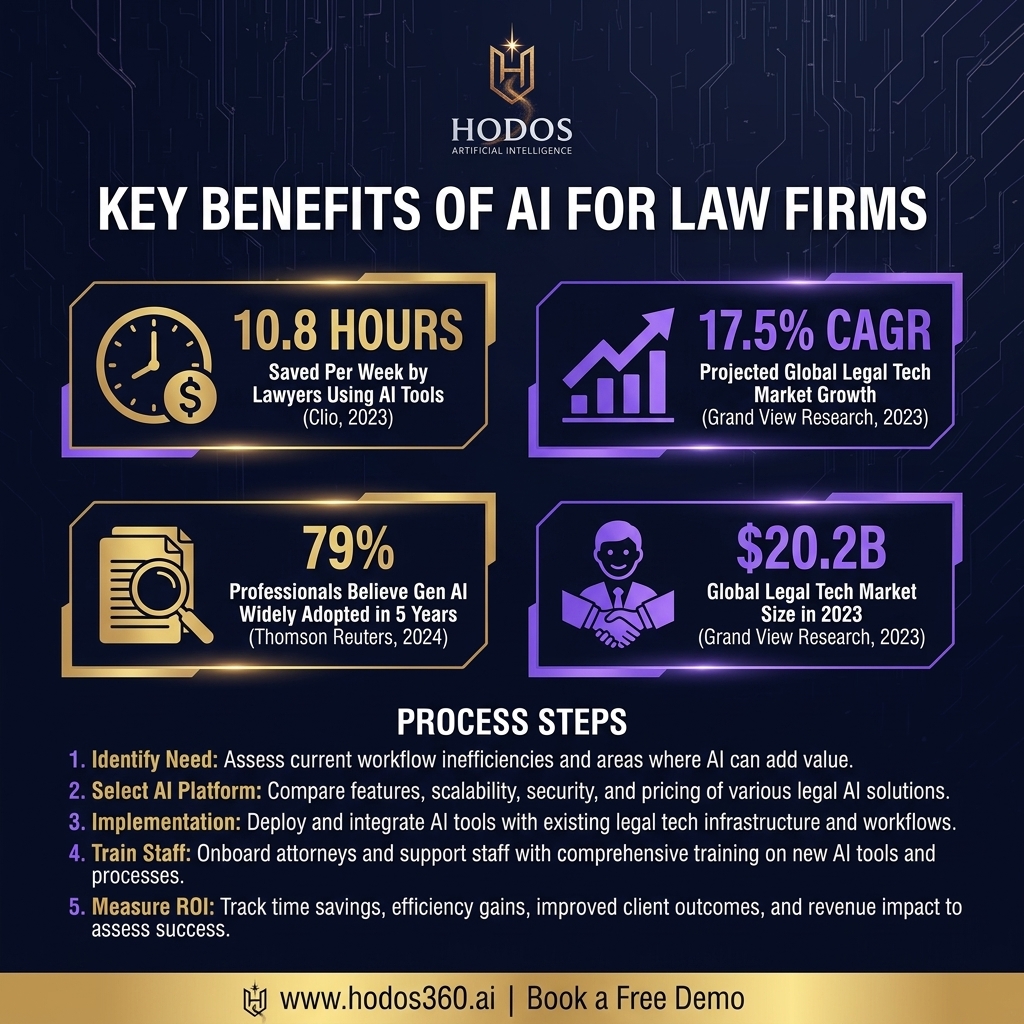
While some firms cling to legacy processes, others, like those investing in advanced platforms and advisory services, are positioning themselves as leaders. A 2024 McKinsey report on AI's impact on professional services projected productivity gains of up to 15-20% for early adopters, translating directly into enhanced profitability and the capacity to take on more complex, higher-value work.
This creates a compelling human conflict: the choice between maintaining the status quo and embracing transformative change.
Firms like the aforementioned Freshfields, and others that have invested in AI innovators like Harvey AI, are not just experimenting; they are redefining their service delivery. They are demonstrating how AI for law firms can lead to faster case resolution, more accurate legal advice, and ultimately, higher client satisfaction.
Learn more about AI Legal Startup Sandstone: Unlocking 2026's Legal Tech Future. Clients, increasingly accustomed to AI-driven efficiencies in other sectors, are beginning to expect similar responsiveness and precision from their legal providers. Firms that can offer sophisticated document automation, intelligent client intake, and rapid AI search capabilities will attract and retain top-tier clients, while those lagging behind risk being perceived as less innovative and efficient.
Beyond external client benefits, AI also plays a crucial role in internal talent management. Attorneys, particularly younger generations, are increasingly drawn to firms that offer cutting-edge tools and opportunities to work on more stimulating, less routine tasks. A firm that streamlines its workflows with AI can reduce burnout, improve job satisfaction, and retain top legal talent.
This creates a virtuous cycle: better talent leads to better client service, which in turn fuels growth and profitability. The investment in AI implementation thus becomes an investment in the firm's future, ensuring its relevance and resilience in a rapidly evolving legal market.
Navigating Ethical and Regulatory Landscapes in AI Adoption
While the benefits of AI for law firms are undeniable, the ethical and regulatory landscape remains a critical consideration that legal leaders must navigate with extreme care. The core principles of legal practice—confidentiality, competence, and avoiding conflicts of interest—are directly impacted by AI's capabilities. For instance, ABA Model Rule 1.1 (Competence) has been interpreted by various state bar associations to include technological competence, meaning attorneys have a duty to understand the benefits and risks of technology, including AI, that impacts their practice.
This extends to ensuring that AI tools do not introduce bias into legal analysis, maintain client data privacy, and uphold the attorney-client privilege. Learn more about Marketing Automation: Powering Law Firm Growth & Efficiency in 2026. The EU AI Act, for example, sets stringent requirements for high-risk AI systems, including those used in legal contexts, emphasizing transparency, human oversight, and robust data governance.
Firms must develop clear internal policies and oversight mechanisms to ensure their AI tools are used ethically and responsibly, preventing potential missteps that could lead to disciplinary action or reputational damage.
Future-Proofing Your Practice with AI-Driven Workflows
The true long-term value of AI for law firms lies in its ability to create seamlessly integrated, AI-powered legal workflows that touch every aspect of a practice. Beyond just internal knowledge management and AI search, AI is transforming case management, automating the generation of routine legal documents, streamlining billing processes, and enhancing the initial client intake experience.
Imagine a system where a new client inquiry triggers an AI assistant to qualify the lead, schedule an appointment, and automatically create a new matter in the case management system, pre-populating it with relevant data and initiating a document automation sequence for engagement letters. This level of integration frees up attorneys and paralegals from tedious administrative tasks, allowing them to focus on complex legal analysis, client strategy, and advocacy.
Firms that invest in comprehensive platforms capable of orchestrating these AI-driven workflows are not just adopting technology; they are fundamentally future-proofing their practice, ensuring agility, efficiency, and sustained growth in an increasingly competitive legal market.

Key Takeaways and Next Steps for Legal Leaders
The legal industry stands at an inflection point, and the message is clear: AI for law firms is no longer a luxury but an essential component of a modern, competitive practice. The partnership between DeepJudge and Epiq exemplifies the growing understanding that successful AI implementation requires not just innovative technology, but also strategic advisory and a phased approach to adoption.
Firms that prioritize unlocking their internal knowledge through advanced AI search capabilities will gain a significant competitive edge, improving efficiency, client outcomes, and attorney satisfaction. The journey involves navigating ethical considerations, investing in comprehensive training, and fostering a culture of innovation.
For legal leaders, the next steps are critical.
Begin with a clear strategy, identifying specific pain points that AI can address. Embrace a pilot program to test and refine solutions before scaling firm-wide. Most importantly, seek out partners and platforms that offer integrated, secure, and user-friendly AI solutions designed specifically for the legal sector.
Platforms that provide comprehensive AI Law Firm Management capabilities—from case management and document automation to AI-powered legal workflows—are invaluable for firms seeking to apply AI at scale. The future belongs to those who strategically leverage AI, transforming challenges into opportunities for growth and innovation. This proactive approach ensures your firm not only survives but thrives in the evolving legal landscape.
Ready to lead your firm into the future? Discover how HODOS 360's integrated AI platform can empower your practice. Visit HODOS360.ai to learn more and book your demo.
- ✓Strategic Partnerships: Collaborations like DeepJudge and Epiq highlight the necessity of expert advisory alongside cutting-edge AI for successful implementation.
- ✓Knowledge Unlocked: AI-powered search and knowledge management transform internal data from silos into a unified, accessible, and strategic asset, reducing research time and improving legal outcomes.
- ✓Phased Implementation: A structured, phased approach—from assessment and pilot to scaled deployment—is crucial for overcoming resistance and ensuring effective AI adoption across the firm.
- ✓Competitive Differentiator: Firms embracing AI at scale gain a significant edge in efficiency, client satisfaction, and talent retention, outperforming those relying on traditional methods.
- ✓Ethical Imperative: Navigating the ethical and regulatory landscape, including data privacy, bias, and professional competence (ABA Model Rule 1.1), is paramount for responsible AI integration.
- ✓Integrated Workflows: The future of legal tech lies in comprehensive AI-driven workflows that automate tasks across case management, client intake, and document generation, freeing attorneys for higher-value work.
- ✓Future-Proofing: Investing in robust, integrated AI platforms ensures long-term agility, efficiency, and sustained growth in a rapidly evolving legal market.
Frequently Asked Questions
What is the primary benefit of AI for law firms?+
The primary benefit of AI for law firms is enhanced efficiency and productivity. AI automates repetitive tasks like document review, legal research, and data extraction, freeing attorneys to focus on complex legal analysis and client strategy. This leads to faster case resolution, reduced operational costs, and improved profitability, ultimately enabling firms to deliver higher quality services to clients more consistently and cost-effectively.
How can law firms overcome resistance to AI adoption?+
Overcoming resistance requires a multi-faceted approach. Firms should start with pilot programs on specific, high-impact use cases to demonstrate tangible benefits. Comprehensive training, emphasizing how AI augments human capabilities rather than replaces them, is crucial. Involving attorneys in the selection and implementation process fosters buy-in. Clear communication about the long-term strategic advantages and addressing ethical concerns proactively also helps build trust and acceptance among legal professionals.
What ethical considerations are paramount when implementing AI?+
Paramount ethical considerations include maintaining client confidentiality and data privacy, ensuring AI systems do not introduce bias into legal analysis, and upholding the duty of technological competence (ABA Model Rule 1.1). Firms must implement robust data governance, understand how AI algorithms make decisions, and establish human oversight to review AI-generated outputs. Transparency with clients about AI usage and adherence to evolving regulations like the EU AI Act are also critical.
How does AI improve internal knowledge management?+
AI revolutionizes internal knowledge management by transforming unstructured data into intelligent, searchable assets. Through Natural Language Processing (NLP) and machine learning, AI can automatically categorize, tag, and link disparate legal documents, making past precedents, briefs, and client communications instantly retrievable. This eliminates data silos, reduces redundant research, and allows attorneys to leverage the firm's collective expertise more effectively, improving consistency and quality of legal advice.
Is AI primarily for large firms, or can smaller firms benefit?+
While large firms often have more resources for initial investment, AI is increasingly accessible and beneficial for smaller firms. Cloud-based AI solutions and platforms with scalable pricing models make advanced tools available to practices of all sizes. For smaller firms, AI can level the playing field by automating administrative tasks, improving client intake, and enhancing legal research, allowing them to compete more effectively and provide sophisticated services without needing a large support staff.
How can HODOS 360 assist with AI implementation?+
HODOS 360 offers a comprehensive, integrated AI platform designed to streamline AI implementation for law firms. Our AI Law Firm Management System provides tools for case management, document automation, and AI-powered workflows. Additionally, our AI Marketing Platform, AI Voice Assistants, and Web & Mobile Development services ensure firms can leverage AI across all operations, from client acquisition to efficient service delivery, providing a holistic solution for scaling legal AI effectively.