


AI Law Firms: Essential for Construction Contract Mastery
The construction industry, a colossal engine of global economies, faces an Everest of contractual complexity. Imagine Sarah Chen, General Counsel for 'Coastal Megastructures Inc.,' overseeing a multi-billion-dollar infrastructure project. Her legal team is inundated with thousands of pages: master agreements, subcontracts, change orders, and intricate compliance documents spanning environmental regulations, local zoning, and international standards.
Traditionally, manually reviewing this volume of documentation would take months, introduce human error, and inevitably lead to costly delays—a common scenario that has historically plagued the sector. This operational bottleneck isn't merely an inconvenience; it represents significant financial exposure and project stagnation.
Indeed, the stakes are remarkably high.
According to a 2024 report by Thomson Reuters, construction disputes account for nearly 20% of all commercial litigation, with an average dispute value exceeding $50 million for large projects. This creates immense pressure on legal teams to perform with impeccable accuracy and speed. Against this backdrop, the emergence of specialized AI Law Firm models, such as Superlegal—recently highlighted in ai news today for targeting the construction industry's contract challenges—signals a profound paradigm shift.
These innovative firms are not just adopting technology; they are fundamentally redefining legal service delivery, moving beyond basic automation to offer strategic advantage.
This article delves into how these advanced AI Law Firm structures are transforming construction law, from initial contract drafting and rigorous AI contract review to proactive risk mitigation and efficient dispute resolution.
They don't replace human lawyers but rather augment their capabilities, offering unprecedented speed, accuracy, and depth of analysis in an industry ripe for digital transformation. We will explore the specific applications, the competitive advantages, and the practical implications for law firm owners and legal professionals looking to thrive in this evolving landscape.
Ready to optimize your firm's legal operations? Discover how AI-powered solutions can transform your practice.
The AI Revolution in Construction Law: Beyond Basic Review
The legal landscape for construction projects is notoriously complex, requiring meticulous attention to detail across vast quantities of documents. From master agreements to intricate subcontracts and countless change orders, ensuring consistency and compliance is a Herculean task for traditional legal teams. Historically, manual review processes were not only time-consuming but also highly susceptible to human error, particularly when facing tight deadlines.
Learn more about AI Web Development: The Ultimate Advantage for Law Firms. This inherent inefficiency often translated into significant financial exposure, project delays, and the potential for protracted legal disputes, making effective AI contract review an urgent necessity for the industry. The sheer volume and interconnectedness of construction documentation demand a more sophisticated approach than ever before.
The evolution of legal artificial intelligence has been nothing short of transformative. Moving beyond early e-discovery tools, today's advanced natural language processing (NLP) models, powered by breakthroughs from companies like OpenAI—whose ChatGPT news regularly dominates headlines—are capable of understanding legal nuances with remarkable precision. Firms like Harvey AI, which garnered significant funding and forged a strategic partnership with Allen & O'Very, exemplify this shift.
Learn more about AI Website Design: Essential Prompts for Law Firms. Their platforms demonstrate how sophisticated AI can move beyond simple keyword searches to identify critical clauses, assess risks, and pinpoint obligations across hundreds of contracts simultaneously. This capability ensures consistency and dramatically reduces 'contract creep' across large, multi-faceted projects, providing a comprehensive and accurate overview.
Modern AI Law Firm models are structured as a powerful blend of human legal expertise and cutting-edge machine intelligence. They leverage integrated platforms, much like HODOS 360's AI Law Firm Management System, which seamlessly integrates case management, document automation, and sophisticated AI-powered legal workflows. This hybrid approach directly addresses the historical tension between the fear of job displacement and the urgent demand for operational efficiency.
Learn more about Essential AI Web Development: Build Legal Apps with Ease. Specific applications in construction include rapidly identifying force majeure clauses, scrutinizing indemnification provisions, analyzing dispute resolution mechanisms (arbitration vs. litigation), and verifying insurance requirements across an entire project's contract portfolio, ensuring no critical detail is overlooked.
Streamlining Contract Challenges with Advanced AI Workflows
Automated Contract Analysis and Drafting
One of the most immediate impacts of AI in construction law is its ability to analyze vast datasets of contracts, identifying patterns, inconsistencies, and potential liabilities with unprecedented speed. A 2023 Gartner report indicated that law firms leveraging AI for AI contract review reduced review times by up to 70%.
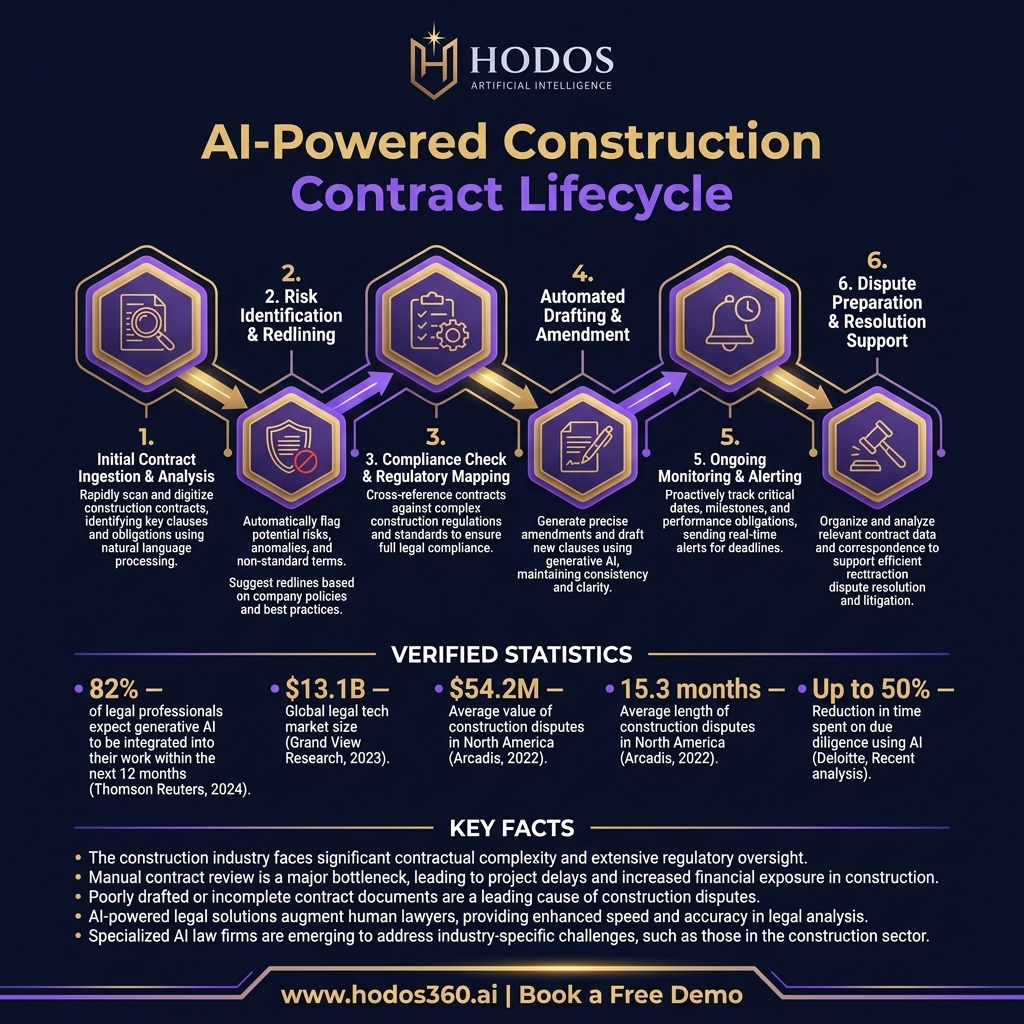
This technological leap allows AI to compare new contracts against a firm's historical data or industry best practices, flagging any deviations that could pose a risk. Learn more about AI Marketing Tools: Essential Strategies for Law Firm Growth. Such rapid, in-depth analysis was previously unimaginable, offering a significant competitive advantage to firms that embrace these advanced capabilities and transforming the efficiency of legal workflows.
Beyond analysis, AI significantly enhances document automation. It can generate first drafts of standard construction contracts—such as non-disclosure agreements (NDAs) or vendor agreements—based on pre-approved templates and client-specific inputs. This capability liberates legal professionals from the drudgery of repetitive tasks, allowing them to redirect their expertise towards high-value strategic advice, complex negotiations, and intricate problem-solving.
Learn more about AI Legal Management: The Essential Future for Law Firms. This directly addresses the inefficiencies faced by General Counsel Sarah Chen and her peers, enabling a more strategic and less clerical approach to legal practice within an AI Law Firm framework.
Predictive Risk Assessment and Compliance
AI's role in proactive risk management is invaluable. By meticulously analyzing contractual terms in conjunction with project schedules, evolving regulatory changes (e.g., new environmental laws or updated building codes), and historical dispute data, AI can predict potential compliance issues or contractual breaches before they escalate.
This foresight is absolutely crucial in the construction industry, where delays, non-compliance, or unforeseen legal challenges can result in massive financial penalties and reputational damage. Learn more about Ultimate AI Video Marketing: Legal Firms Master Content Creation. An AI Law Firm equipped with these capabilities can provide a robust shield against future liabilities, ensuring project continuity and legal integrity.
Furthermore, AI can continuously monitor contracts for key dates, deliverables, and performance metrics, issuing automated alerts to legal teams. This proactive monitoring helps firms maintain strict compliance with a myriad of regulations, such as the Occupational Safety and Health Act (OSHA) standards or specific state licensing requirements, thereby significantly reducing the likelihood of legal challenges. This vigilance, driven by advanced artificial intelligence, ensures that firms remain ahead of potential legal pitfalls, offering clients peace of mind and demonstrating a commitment to thorough risk management that traditional methods simply cannot match.
- ✓Enhanced Accuracy: Minimize human error in complex document review, ensuring precise legal analysis.
- ✓Accelerated Review: Drastically reduce the time spent on initial contract analysis, speeding up project timelines.
- ✓Cost Reduction: Lower legal overheads through automation and improved efficiency across all legal workflows.
- ✓Proactive Risk Mitigation: Identify and address potential issues before they escalate into costly disputes.
- ✓Improved Compliance: Ensure strict adherence to regulatory standards and all contractual obligations.
- ✓Strategic Focus: Free up legal talent to concentrate on high-value advisory work and complex problem-solving.
- ✓Data-Driven Insights: Leverage advanced analytics for better negotiation strategies and informed decision-making.
Mitigating Risk and Ensuring Compliance in a Dynamic Industry
The construction industry is inherently a high-risk environment, constantly exposed to variables ranging from supply chain disruptions to unforeseen site conditions. Legal teams must therefore be agile and adaptive. AI offers a dynamic solution, providing real-time analysis capabilities that significantly enhance risk management. For instance, in a large infrastructure project, sudden changes in material costs or labor availability can trigger complex force majeure discussions across numerous contracts.
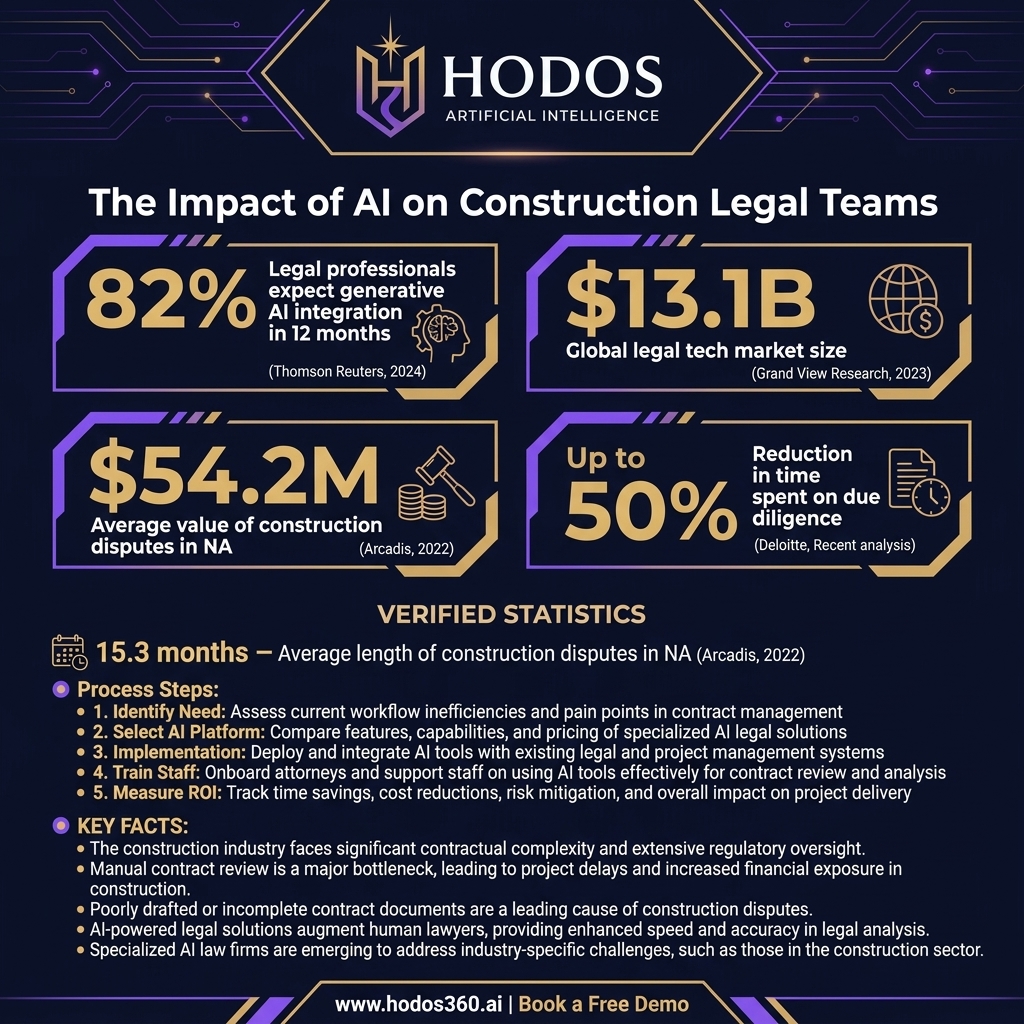
An AI Law Firm can rapidly analyze these clauses across all affected agreements, providing immediate insights and strategic options, a task that would be virtually impossible through manual means.
Compliance is another critical area where AI proves indispensable. With the rapid evolution of legal frameworks, such as the enforcement of the EU AI Act, new precedents are being set for how artificial intelligence is used, impacting data privacy and algorithmic transparency. Construction firms leveraging AI for project management or risk assessment must ensure their tools and processes align with these emerging global regulations.
AI-powered compliance tools can help navigate this new layer of legal complexity, monitoring for regulatory shifts and ensuring that all contractual obligations meet the latest legal standards, thereby safeguarding against potential penalties.
While AI will not argue cases in court, it significantly aids in preparing for arbitration or litigation. It can rapidly sift through vast amounts of project correspondence, emails, and change orders to build a compelling narrative, identify key evidentiary points, and even analyze past case law to predict potential outcomes.
This level of comprehensive preparation, historically constrained by time and cost, is now achievable. The competitive edge gained by firms that embrace AI for compliance and risk management, like those utilizing advanced AI Law Firm solutions, is substantial. They can offer clients faster, more accurate advice, differentiate themselves in a crowded market, and secure more complex, high-value projects, fostering a new era of legal competition.
The Future of Legal Practice: AI-Powered Efficiency and Growth
Enhancing Client Relationships and Business Development
AI's transformative impact extends far beyond internal legal operations, directly influencing client interaction and business development. With faster contract turnaround times, proactive risk alerts, and data-driven insights, law firms can deliver a superior level of service. This translates into stronger client relationships and a sterling reputation for innovation.
Furthermore, an AI Marketing Platform, such as that offered by HODOS 360, can empower firms to identify new construction industry clients, craft highly targeted content generation campaigns, automate social media outreach, and track ROI, ensuring sustainable growth for their AI Law Firm model.
The broader shift in legal tech is undeniable. Industry leaders like Jensen Huang, CEO of NVIDIA, have consistently emphasized the transformative power of artificial intelligence across all sectors, including highly specialized legal applications. This isn't a fleeting trend but a fundamental re-architecture of how legal services are conceived, delivered, and consumed.
Firms that resist this evolution risk being left behind, unable to compete effectively with the speed, accuracy, and efficiency of AI-augmented rivals. The legal tech market continues to attract significant investment, with startups regularly announcing major funding rounds, signaling sustained innovation and market expansion.
Investing in AI is, therefore, an investment in the future viability and growth of a legal practice. It's not merely about achieving cost-cutting measures but about unlocking new revenue streams, attracting top legal talent who are eager to work with cutting-edge tools, and expanding service offerings into previously unattainable areas.
AI Voice Assistants, for instance, can handle initial client inquiries 24/7, qualify leads, and book appointments, ensuring no potential client is missed. This immediate responsiveness is a crucial differentiator in a fast-paced industry like construction, allowing firms to provide unparalleled client service and operational efficiency.

Key Takeaways and Next Steps for Law Firms
The integration of artificial intelligence into legal practice, particularly for complex and high-stakes sectors like construction, is no longer merely an option—it has become an imperative for competitive survival and growth. Law firms must move beyond simply acknowledging AI's potential to actively implementing it within their operations.
The narrative of an AI Law Firm targeting the construction industry's contract challenges, as highlighted in recent news, is not just a compelling headline; it serves as a practical blueprint for achieving a sustainable competitive advantage in a rapidly evolving legal market. The time for proactive adoption is now, to avoid being outpaced by more agile, tech-savvy competitors.
For law firm owners and managing partners, the immediate next step involves a strategic evaluation of existing legal workflows to identify areas where AI can deliver the most significant impact. This journey might effectively begin with pilot programs focused on AI contract review, leveraging AI for initial client intake, or enhancing lead qualification processes.
The overarching goal is to incrementally integrate AI solutions, demonstrating clear and measurable returns on investment (ROI) that justify further expansion. This data-driven approach ensures that technology adoption is strategic and aligned with the firm's broader business objectives, fostering efficiency and innovation.
The path towards an AI-powered legal practice demands continuous learning and adaptation. Staying abreast of ai regulation news, actively engaging with legal tech communities, and forging partnerships with reputable technology providers are all crucial components of this evolution. The law firms that will not only survive but thrive in this new era are those that view AI not as an existential threat, but as a powerful, indispensable ally in serving their clients more effectively, efficiently, and strategically.
This proactive and forward-thinking stance ensures firms remain at the absolute forefront of legal innovation, ready to tackle the challenges of tomorrow.
Frequently Asked Questions
What is an AI Law Firm and how does it differ from traditional firms?+
An AI Law Firm leverages artificial intelligence tools and platforms to augment human legal expertise. Unlike traditional firms that rely primarily on manual processes, AI firms integrate AI for tasks like contract review, document automation, and risk assessment, enabling faster, more accurate, and cost-effective legal services while enhancing legal workflows and client outcomes.
How can AI specifically help with construction contracts?+
For construction contracts, AI can rapidly analyze thousands of pages, identify critical clauses (e.g., force majeure, indemnification), flag inconsistencies, ensure compliance with regulations, and even assist in drafting standard agreements. This significantly reduces review time, mitigates dispute risks, and improves overall project management efficiency for legal teams.
Will AI replace human lawyers in construction law?+
No, AI is designed to augment, not replace, human lawyers. It handles repetitive, data-intensive tasks, freeing attorneys to focus on strategic thinking, complex negotiation, client counseling, and courtroom advocacy—areas where human judgment, ethical considerations, and nuanced client relationships remain irreplaceable and paramount to legal practice.
What are the main benefits of adopting AI for contract management?+
Key benefits include enhanced accuracy in legal documents, significantly reduced contract review times, lower operational costs through automation, proactive identification of legal risks, improved regulatory compliance, and the ability to provide more strategic, data-driven advice to clients. These advantages lead to better project outcomes and increased client satisfaction.
What should law firms consider before implementing AI solutions?+
Firms should assess their specific needs, ensure robust data security measures, consider ethical implications (e.g., ABA Model Rules for technology competence), and choose AI platforms that integrate seamlessly with existing legal workflows. Starting with pilot programs, investing in proper training for staff, and understanding the long-term strategic benefits are crucial steps for successful implementation.