


AI Legal Management: The Essential Future for Law Firms
The legal world is experiencing a seismic shift, a transformation eloquently underscored by events like Stanford’s FutureLaw 2026. This year's conference, a beacon for what comes next as AI reshapes the law, brought together luminaries from across the legal and technological spectrum. Discussions ranged from the foundational shifts in legal practice to the ethical complexities introduced by advanced algorithms.
For law firm leaders and practicing attorneys, the message was clear: AI legal management is no longer a futuristic concept but an immediate, strategic imperative. Firms that embrace this evolution are not just adopting new tools; they are fundamentally redefining their operational models, client engagement, and competitive standing in a rapidly evolving market.
The tension between tradition and innovation has never been more pronounced. While some firms cautiously observe from the sidelines, others are aggressively integrating AI to gain a significant edge. This isn't just about automating mundane tasks; it's about harnessing predictive analytics, streamlining complex workflows, and enhancing decision-making at every level.
As Stanford Law School's CodeX center continues to explore the frontiers of legal informatics, the practical applications of AI in daily law firm management are becoming undeniable. The firms that champion this technological leap are poised to lead, offering unparalleled efficiency and a superior client experience, setting a new benchmark for legal service delivery.
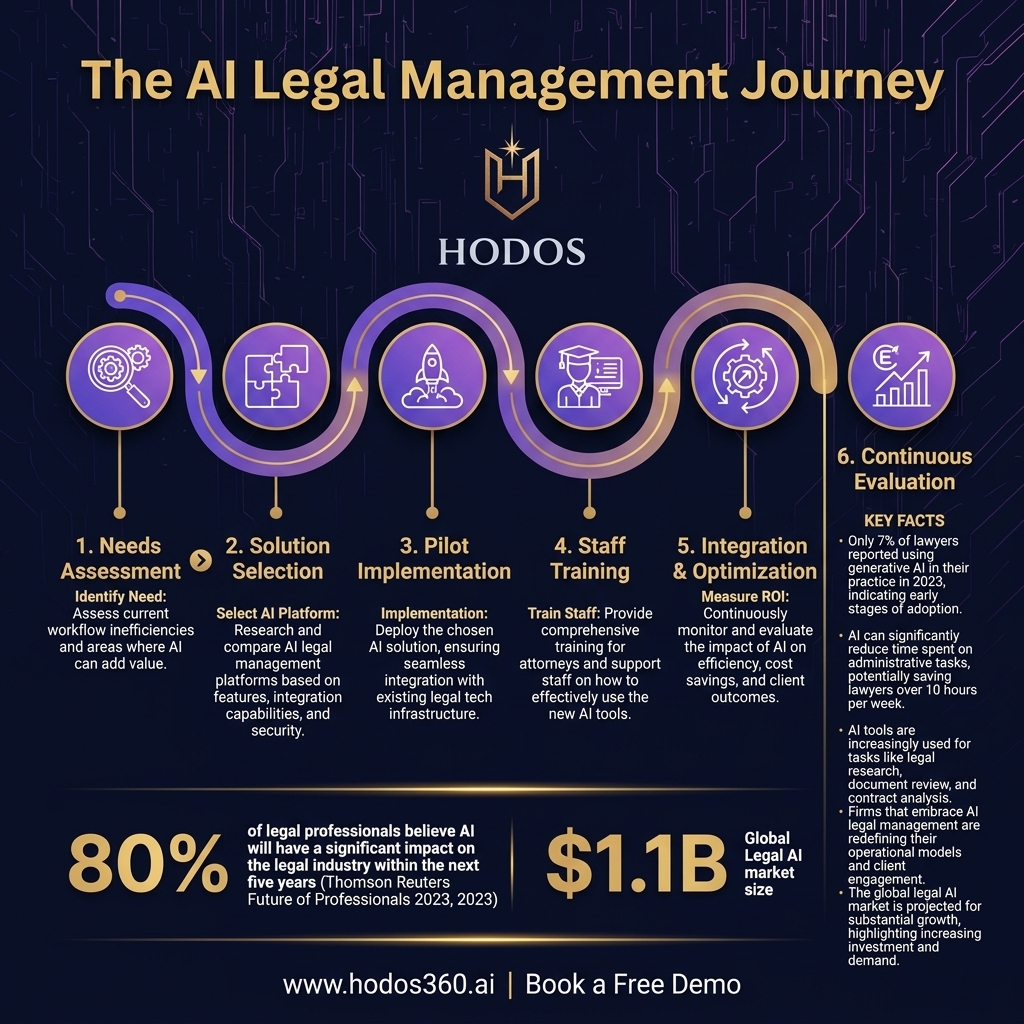
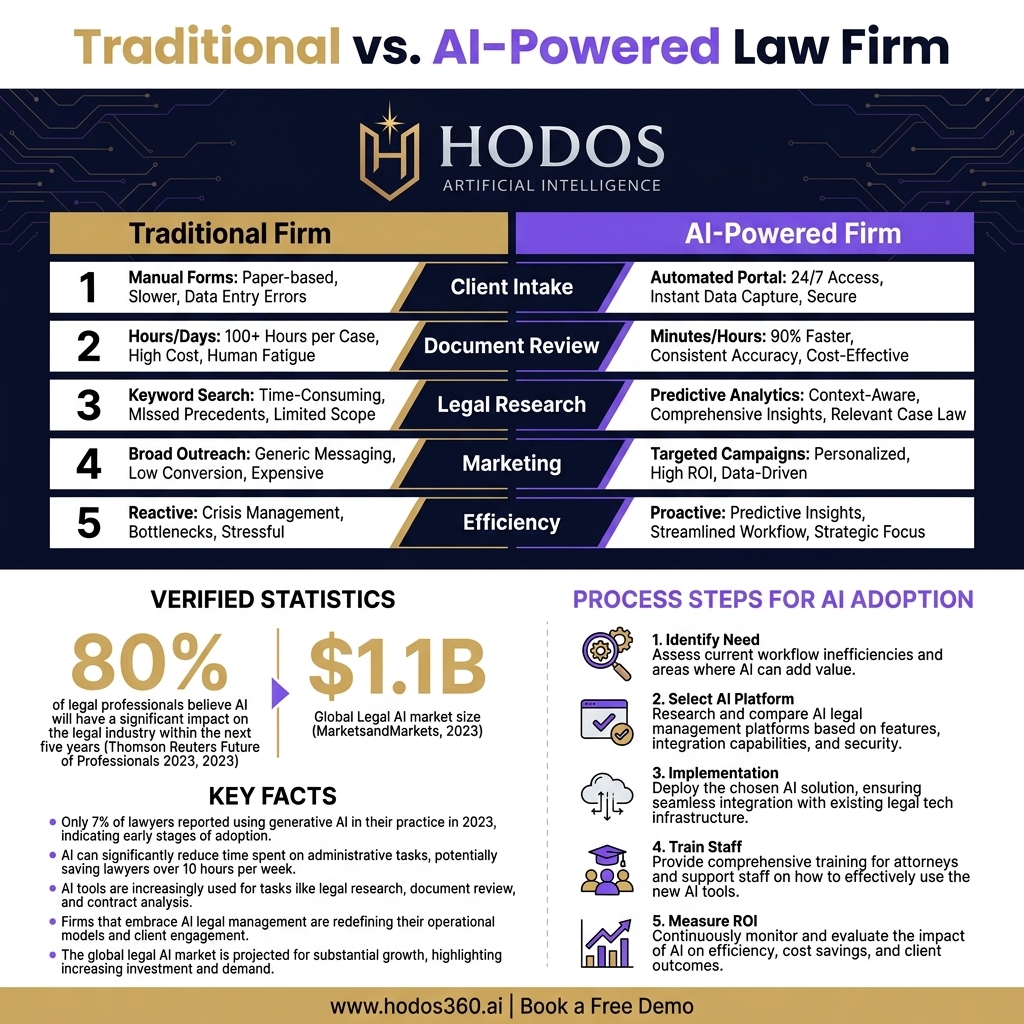
A recent report by Thomson Reuters revealed that over 80% of legal professionals believe AI will have a significant impact on the legal industry within the next five years, yet adoption rates for comprehensive AI legal management systems still lag in many small to mid-sized firms.
This disparity highlights a crucial opportunity. Pioneering firms, like Allen & Overy, which famously partnered with Harvey AI, are demonstrating the tangible benefits of integrating large language models into their core legal operations, from contract review to legal research. Learn more about Voice AI: The Essential Leap for Law Firm Client Engagement.
This collaboration exemplifies how bespoke AI solutions can augment human legal expertise, not replace it, by handling high-volume, repetitive tasks with unprecedented speed and accuracy. The competitive landscape is quickly dividing into those who leverage these powerful tools and those who risk being left behind.
Decoding the AI Legal Management Revolution
The current wave of AI legal management technology is far more sophisticated than previous iterations of legal tech. It encompasses everything from case management and billing to client intake and document automation, all powered by intelligent algorithms. This revolution is driven by advancements in natural language processing (NLP) and machine learning (ML), allowing systems to understand, analyze, and even generate legal text with remarkable proficiency.
Companies like OpenAI, under the leadership of Sam Altman, have pushed the boundaries of what's possible with LLMs, creating foundational models that legal tech startups are now tailoring for specific legal applications. This shift moves beyond simple digitization, enabling predictive analytics that can forecast case outcomes, optimize resource allocation, and even identify potential risks before they materialize.
The implications for law firm operations are profound. Consider the efficiency gains in document automation, where AI can draft complex legal documents, such as contracts or pleadings, by pulling relevant clauses from vast databases and customizing them based on specific case parameters. This capability, highlighted in sessions at LegalTech NYC 2026, frees up attorneys from tedious drafting work, allowing them to focus on high-value strategic tasks and client counsel.
Furthermore, AI-powered legal workflows can automate routine administrative processes, from scheduling appointments to sending follow-up communications, ensuring consistency and reducing human error. This comprehensive approach to AI legal management is not merely an incremental improvement; it is a fundamental restructuring of how legal services are delivered.
Historically, legal professionals have been wary of technology, often preferring established manual processes. Learn more about Law Firm Return on Investment: Maximize AI in 2026. However, the sheer power and proven benefits of modern AI are compelling even the most traditional firms to reconsider. The early adopters, often smaller, agile firms or innovative departments within larger institutions, are already reporting significant gains in productivity and client satisfaction.
As Dario Amodei, CEO of Anthropic, often discusses, the development of increasingly capable and reliable AI systems is accelerating, making it imperative for all sectors, including law, to engage thoughtfully with these tools. The future of law is inextricably linked to the intelligent integration of these technologies, transforming the very definition of a competitive law firm.
This transformative period is also witnessing a surge in investment, with legal tech startups securing significant funding rounds. For instance, companies focusing on AI-driven e-discovery and compliance solutions have seen their valuations soar, reflecting investor confidence in the sector's growth. This influx of capital fuels further innovation, leading to more robust and specialized AI legal management tools.
The ecosystem is maturing rapidly, offering law firms a diverse array of solutions tailored to their specific needs, from boutique litigation firms to multi-national corporate practices. The choice for law firms is no longer whether to adopt AI, but how and when to strategically integrate it to maximize its benefits.
From Manual Tasks to Intelligent Automation
The transition from laborious, manual legal tasks to intelligent automation is perhaps the most immediate and tangible benefit of AI legal management. Think about the traditional client intake process: stacks of forms, manual data entry, and fragmented information across different systems. An AI-powered system can automate this entirely, guiding clients through digital questionnaires, extracting key information, and populating case management systems instantly.
This not only reduces administrative overhead but also significantly improves the client's first impression, offering a seamless and modern experience. Learn more about Voice AI Assistant: The Ultimate Guide for Law Firms. Moreover, the system can flag potential conflicts of interest or identify specific legal needs based on initial data, ensuring faster and more accurate preliminary assessments.
This level of automation goes beyond simple forms, integrating with calendaring and document generation to create initial case files with minimal human intervention, dramatically speeding up the onboarding process and allowing legal teams to focus on substantive legal work from day one.
Elevating Efficiency: AI-Powered Workflows & Automation
The core promise of AI in legal practice is to elevate efficiency, transforming cumbersome workflows into streamlined, automated processes. This is particularly evident in areas like legal research, where AI platforms now leverage vast datasets to identify relevant precedents, statutes, and secondary sources far quicker than human researchers.
Companies like LexisNexis and Westlaw have integrated advanced AI into their platforms, offering features that can summarize cases, identify opposing arguments, and even predict judicial behavior, drastically cutting down research time and costs. This capability allows attorneys to delve deeper into complex legal issues, building more robust arguments rather than spending hours sifting through documents.
The impact on billable hours and firm profitability is substantial, allowing firms to handle more cases or reallocate resources to more strategic initiatives. The adoption of these tools is quickly becoming a differentiator in the market, enabling firms to deliver faster, more comprehensive legal advice.
Beyond research, AI-powered legal workflows are revolutionizing document review in litigation and due diligence. In large-scale e-discovery, AI can quickly analyze millions of documents, identifying privileged information, responsive documents, and key evidence with greater accuracy and speed than human reviewers alone. This significantly reduces the time and expense associated with discovery, a major pain point for clients and a significant cost driver in litigation.
The ability of AI to learn from human input and continuously improve its accuracy means that these systems become more effective over time, offering an unparalleled advantage in complex legal matters. Firms that harness this technology can offer more competitive pricing for discovery services, attracting larger and more complex cases that might otherwise be out of reach.
Consider the operational impact on a firm's bottom line. Learn more about AI Agents Marketing: Your Essential Guide for Law Firms. The ABA's annual TechReport consistently shows that firms struggle with efficiency in administrative tasks. AI legal management systems directly address this by automating routine billing, expense tracking, and time entry.
These systems can learn billing patterns, suggest appropriate codes, and even flag potential billing discrepancies, ensuring accuracy and compliance. This not only saves countless administrative hours but also improves cash flow by accelerating the billing cycle and reducing errors that can lead to client disputes.
The overall effect is a leaner, more agile, and more profitable law firm, capable of delivering high-quality legal services with optimized operational costs.
Moreover, the integration of AI extends to calendar management and deadline tracking, crucial for avoiding malpractice claims and ensuring timely client service.
AI-powered calendars can automatically populate deadlines from court filings and legal documents, send proactive reminders, and even suggest optimal scheduling based on attorney availability and case urgency. This proactive approach minimizes the risk of missed deadlines, a common source of professional liability, and allows attorneys to manage their caseloads more effectively.
The comprehensive nature of these systems means that all aspects of a law firm's operations, from the initial client contact to the final case resolution, can be seamlessly integrated and optimized by artificial intelligence, creating a truly intelligent legal enterprise.
Enhancing Predictive Power in Legal Strategy
One of the most exciting frontiers in AI legal management is its ability to enhance predictive power in legal strategy. By analyzing vast datasets of past case outcomes, judicial rulings, and settlement agreements, AI can offer insights into the probable success of different legal strategies.
While no AI can guarantee an outcome, it can provide data-driven probabilities that empower attorneys to make more informed decisions, advise clients more effectively, and negotiate from a position of strength. This capability moves beyond traditional legal research, offering a quantitative edge in strategic planning.
Learn more about AI Marketing Automation: Essential for Law Firms' Growth. For instance, in a complex M&A deal, AI can analyze regulatory filings and market data to predict potential antitrust challenges or identify optimal deal structures, providing invaluable foresight. This is a game-changer for risk assessment and strategic decision-making in high-stakes legal matters, offering a level of analytical depth previously unimaginable.
- ✓Automated Client Intake: Streamline onboarding with AI-driven forms, conflict checks, and initial data population, reducing administrative burden and improving client experience.
- ✓Intelligent Document Automation: Generate contracts, pleadings, and other legal documents instantly using AI-powered templates and clause libraries, ensuring accuracy and consistency.
- ✓Predictive Case Analytics: Leverage machine learning to analyze past case data, offering insights into potential outcomes, optimal strategies, and settlement probabilities.
- ✓Enhanced Legal Research: Utilize AI tools for rapid identification of relevant precedents, statutes, and expert commentary, significantly cutting down research time and costs.
- ✓Workflow Optimization: Automate repetitive tasks such as scheduling, deadline tracking, and communication, freeing up attorneys for higher-value legal work.
- ✓Integrated Billing & Financial Management: Streamline invoicing, expense tracking, and financial reporting with AI-powered systems that ensure accuracy and improve cash flow.
- ✓AI-Powered Legal Workflows: Create customized, intelligent workflows that adapt to specific case types, guiding legal teams through each step with automated prompts and resource allocation.
The Ethical Imperative: Navigating AI's Legal Landscape
As AI legal management systems become more pervasive, the ethical imperative to deploy them responsibly grows stronger. The legal profession, bound by strict rules of professional conduct, must grapple with issues of bias, transparency, and accountability inherent in AI. For example, the ABA Model Rules of Professional Conduct, particularly Rule 1.1 on Competence, implicitly require lawyers to understand the risks and benefits of technology, including AI.
This means attorneys must exercise due diligence in selecting and overseeing AI tools, ensuring they do not inadvertently lead to biased outcomes or compromise client confidentiality. The infamous case of lawyers citing fictitious cases generated by AI, though an extreme example, serves as a stark reminder of the critical need for human oversight and verification.
The principle of 'human in the loop' is paramount, ensuring that AI acts as an assistant and not an autonomous decision-maker, especially in matters of legal judgment and client advice.
Data privacy and security are another critical ethical consideration. Legal firms handle highly sensitive client information, and the use of AI systems, especially cloud-based ones, necessitates robust data governance policies.
Compliance with regulations like GDPR and CCPA, as well as evolving state-level data privacy laws, becomes even more complex when AI processes vast amounts of client data. Firms must ensure that their AI vendors adhere to the highest security standards and that client data is protected from breaches or misuse.
The EU AI Act, with its tiered approach to risk management, provides a glimpse into future regulatory frameworks that will govern AI deployment globally, placing significant responsibility on developers and users to ensure ethical and safe AI practices. Law firms must proactively establish clear policies for data handling, anonymization where appropriate, and the secure storage of information processed by AI systems.
Transparency in AI's decision-making process, often referred to as 'explainability,' is also a significant ethical challenge. Learn more about AI Marketing Automation: Law Firms' 2026 Growth Catalyst. If an AI system recommends a particular legal strategy or flags a document as relevant, lawyers need to understand the basis for that recommendation.
Black-box algorithms that provide answers without clear reasoning can undermine a lawyer's professional judgment and their ability to fulfill their duty to clients. This is where the development of 'interpretable AI' becomes crucial, allowing legal professionals to audit and validate AI outputs. Law firms must demand explainable AI features from their vendors and integrate internal review processes to ensure that AI-generated insights are thoroughly vetted by human experts.
The goal is not to blindly trust AI, but to leverage its analytical power while maintaining professional autonomy and accountability.
Ultimately, the ethical integration of AI legal management demands a cultural shift within law firms. It requires ongoing education for attorneys and staff on AI capabilities and limitations, clear guidelines for its use, and a commitment to continuous evaluation.
Firms must foster an environment where ethical considerations are at the forefront of technology adoption, ensuring that AI serves justice and client interests rather than compromising them. This proactive approach to ethical AI deployment will not only protect firms from liability but also enhance their reputation as responsible and forward-thinking legal service providers, building trust in an era of rapid technological change.
The proactive engagement with these ethical dimensions is not just a compliance issue; it's a foundation for sustainable innovation.
Beyond the Back Office: AI's Impact on Client Experience & Growth
While much of the discussion around AI legal management focuses on back-office efficiencies, its impact on the client experience and firm growth is equally transformative. AI-powered voice assistants, for instance, are revolutionizing how law firms handle initial inquiries and client support. These assistants can provide 24/7 phone answering, qualify leads, book appointments, and even offer multilingual support, ensuring that potential clients always receive a prompt and professional response.
This immediate availability and efficient handling of initial touchpoints significantly improve client satisfaction and reduce the chances of losing leads due to unreturned calls or delayed responses. Firms leveraging these tools report higher conversion rates and a stronger reputation for responsiveness, directly contributing to their growth and market share.
Furthermore, AI marketing platforms are empowering law firms to acquire new clients more effectively than ever before. These platforms can automate social media posting, generate targeted content, and analyze marketing campaign performance with sophisticated analytics and ROI tracking. For example, an AI can identify trending legal topics, draft blog posts, and then schedule their publication across various channels, all while monitoring engagement to refine future strategies.
This level of precision marketing allows firms to reach their ideal clients with highly relevant messages, optimizing their marketing spend and demonstrating a clear return on investment. The ability to quickly adapt marketing strategies based on real-time data gives firms a significant competitive edge in a crowded legal market, enabling them to expand their client base strategically.
Personalization is another key area where AI elevates the client experience. By analyzing client data and communication patterns, AI can help tailor legal advice, communication styles, and even service offerings to individual client needs. Imagine an AI system that flags a client's preference for email updates over phone calls, or one that identifies specific concerns based on their past interactions, allowing attorneys to proactively address issues.
This level of personalized engagement fosters deeper client relationships and builds loyalty, turning one-time clients into long-term advocates. The human element remains crucial, but AI provides the data and insights necessary for attorneys to deliver truly bespoke and empathetic service, enhancing the overall client journey and reinforcing the firm's commitment to individual client care.
The strategic integration of web and mobile development, powered by AI, further amplifies client engagement and growth. AI-powered website builders can create responsive, SEO-optimized sites with high-converting templates, ensuring a professional online presence that attracts and retains clients. These sites can incorporate AI chatbots for instant queries, client portals for secure document sharing, and personalized content delivery based on visitor behavior.
A robust online presence, seamlessly integrated with AI-driven marketing and communication tools, creates a cohesive digital ecosystem that serves clients efficiently and effectively. This comprehensive approach, exemplified by platforms like HODOS 360, ensures that law firms are not just technologically advanced but also client-centric, driving sustainable growth in the digital age.
Building a Future-Ready Firm with AI
Building a future-ready firm with AI means proactively investing in the right technologies and fostering a culture of innovation. This isn't a one-time deployment but an ongoing journey of adaptation and learning. Firms must assess their current workflows, identify pain points, and strategically implement AI solutions that address those challenges while aligning with their long-term growth objectives.
The process involves comprehensive training for legal staff, from paralegals to senior partners, ensuring that everyone understands how to leverage AI tools effectively and ethically. This commitment to continuous improvement and technological literacy is what will distinguish leading firms in the years to come, enabling them to not only survive but thrive amidst the rapid changes brought by artificial intelligence in the legal landscape.

Key Takeaways and Next Steps
The insights from Stanford FutureLaw 2026 and the accelerating pace of AI legal management innovation leave no doubt: the legal profession is at an inflection point. Firms that proactively embrace AI are poised to unlock unprecedented levels of efficiency, enhance client satisfaction, and gain a significant competitive advantage.
From automating routine tasks to delivering predictive insights and revolutionizing client acquisition, AI is redefining what it means to be a modern law firm. The journey requires strategic planning, ethical consideration, and a commitment to continuous learning, but the rewards—a more agile, profitable, and client-centric practice—are substantial.
The future of law is not merely about adapting to AI; it's about harnessing its power to shape a more effective and equitable legal system for all. Firms that invest in comprehensive AI solutions now will be the leaders of tomorrow, setting new standards for legal excellence and innovation.
Embrace this transformative era, and position your firm at the forefront of legal innovation.
Frequently Asked Questions
What is AI legal management?+
AI legal management refers to the integration of artificial intelligence technologies into various aspects of law firm operations. This includes automating tasks like case management, billing, client intake, document generation, and legal research. Its goal is to enhance efficiency, accuracy, and strategic decision-making, allowing legal professionals to focus on higher-value work and improve overall service delivery by leveraging intelligent workflows.
How does AI benefit small law firms specifically?+
Small law firms benefit immensely from AI by leveling the playing field against larger competitors. AI tools offer cost-effective solutions for automation, client acquisition (e.g., AI marketing platforms), and administrative tasks that typically consume significant resources. This allows small firms to operate with greater efficiency, provide competitive services, and manage a larger caseload without needing to expand their administrative staff, thus maximizing profitability and growth potential.
What are the primary ethical concerns of AI in law?+
Key ethical concerns include potential algorithmic bias, ensuring data privacy and security (especially with sensitive client information), maintaining transparency in AI's decision-making processes ('explainability'), and upholding professional responsibility. Lawyers must ensure AI tools are used competently, do not compromise client confidentiality, and always maintain human oversight for critical legal judgments, adhering to principles like the ABA Model Rules of Professional Conduct.
How can law firms effectively get started with AI adoption?+
Firms should begin with a strategic assessment of their current workflows and pain points to identify areas where AI can offer the most immediate impact. Starting with pilot programs for specific tools (e.g., document automation or AI voice assistants) can provide valuable insights. Investing in comprehensive training for staff and fostering a culture of innovation are crucial. Partnering with experienced legal tech providers can guide firms through a tailored, phased implementation process.
Will AI eventually replace human lawyers?+
Most experts agree that AI will not replace lawyers but rather augment their capabilities. AI excels at automating repetitive, data-intensive tasks like document review and legal research, freeing lawyers to focus on complex problem-solving, strategic thinking, client counseling, and courtroom advocacy. The legal profession will evolve, requiring lawyers to become adept at leveraging AI tools, but human judgment, empathy, and ethical reasoning will remain indispensable to the practice of law.