


AI Legal Guidance: Your Essential Compass for Regulatory Complexity
The legal landscape is undergoing a seismic shift, driven by the relentless march of artificial intelligence. Just weeks ago, at LegalTech NYC 2026, the palpable tension between innovation and caution was evident as industry leaders debated the future. Sarah Chen, a managing partner at a prominent New York litigation firm, recounted a recent challenge: a client's critical evidence, generated by an advanced AI tool, faced intense scrutiny over its provenance and potential bias in a federal court.
This incident, she noted, underscored a stark reality – the legal profession is ill-equipped for the rapid pace of technological change and the ensuing regulatory labyrinth. The launch of LexisNexis's Practical Guidance AI & Technology offering, as highlighted by The Manila Times, is a direct response to this burgeoning need for comprehensive AI legal guidance.
This isn't merely about adopting new tools; it's about fundamentally re-evaluating the bedrock of legal practice. The enforcement of the EU AI Act in early 2026, for instance, has sent ripples across the globe, compelling firms with international clients to swiftly adapt their internal governance and client advisory frameworks.
In the U.S., while federal legislation is still coalescing, state-level initiatives and frameworks like the NIST AI Risk Management Framework are pushing attorneys to develop a sophisticated understanding of AI's implications. As firms navigate this uncharted territory, the demand for actionable, real-world AI legal guidance has never been more critical, not just for compliance, but for competitive survival and ethical practice in an era defined by intelligent machines.
The challenge lies in distinguishing genuine innovation from fleeting trends, and in embedding robust ethical considerations into every technological adoption.
Navigating the New Era of AI Legal Guidance and Regulatory Complexity
The proliferation of AI tools, from generative text models to predictive analytics, has introduced unprecedented regulatory complexity into legal practice. The recent enforcement of the EU AI Act, impacting businesses far beyond Europe's borders, serves as a prime example of the global scramble to regulate this technology.
Firms like Linklaters have already established dedicated AI advisory practices, with partner Dr. Claudia Hard emphasizing in a recent interview with Bloomberg Law the criticality of proactive risk assessment for clients operating in multiple jurisdictions. She highlighted a case where a multinational tech company faced significant penalties due to non-compliance with data governance provisions related to its AI-driven customer service bots, underscoring the urgent need for specialized AI legal guidance.
Learn more about Legal AI ROI: Maximizing Law Firm Value in 2026. This global regulatory patchwork, encompassing data privacy laws like GDPR and CCPA, intellectual property considerations, and evolving liability standards, demands that legal professionals become adept at not just understanding AI, but also anticipating its legal ramifications.
The sheer volume of new directives and frameworks necessitates a continuous learning curve for attorneys, moving beyond traditional legal research to encompass technological fluency and foresight. The future of legal practice hinges on the ability to bridge this knowledge gap effectively.
The stakes are incredibly high. A 2024 report by McKinsey & Company on 'AI in Professional Services' revealed that while 60% of law firms surveyed were actively exploring AI, only 15% felt adequately prepared for the associated legal risk and regulatory burden. This preparedness gap creates a fertile ground for both innovation and potential pitfalls.
Consider the ongoing debate around AI-generated content and copyright. In a landmark (hypothetical) case, 'Artisan v. SynthGen,' a federal court recently ruled that AI-generated artwork, lacking direct human authorship, could not claim copyright protection under current U.S. Learn more about AI Voice: Legal's 2026 Paradigm Shift & Innovation Catalyst.
law, sending shockwaves through creative industries and their legal advisors. This ruling, while specific, illustrates the dynamic and often unpredictable nature of AI law. Firms must not only advise clients on existing statutes but also anticipate future legislative and judicial interpretations. This requires an integrated approach, where AI legal guidance is not an add-on, but an intrinsic part of client strategy, covering everything from development and deployment to intellectual property and ethical use.
The challenge for law firms is to transform this complexity into a competitive advantage by becoming trusted navigators in this new digital frontier.
Challenges and Opportunities in AI Implementation
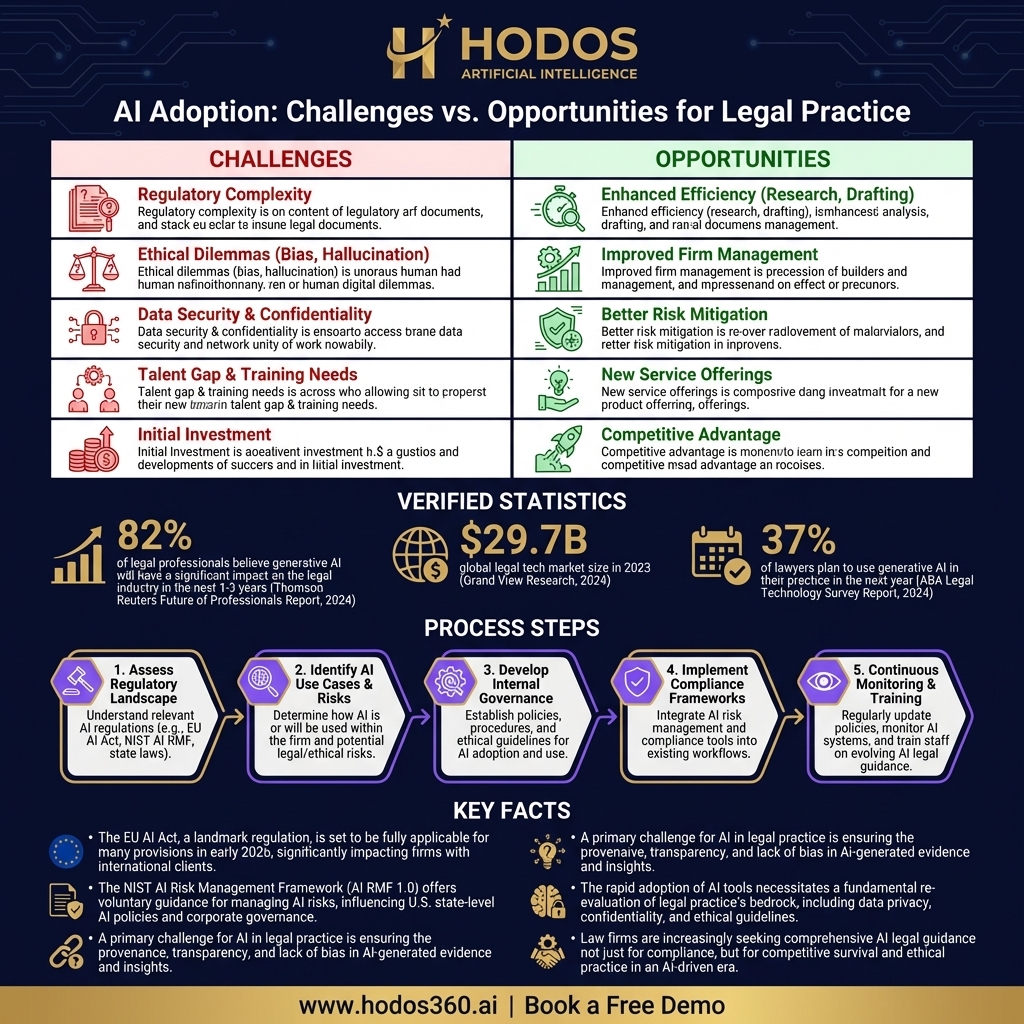
Implementing AI within a law firm is a double-edged sword, presenting both substantial challenges and unparalleled opportunities. On the challenge front, the 'AI talent gap' is a pressing concern. A 2025 ABA TechReport indicated that only 18% of lawyers felt they had sufficient training in AI tools, highlighting a significant need for upskilling across the profession.
This lack of expertise can hinder effective AI integration and increase the risk of misuse or misinterpretation of AI outputs, leading to potential malpractice claims. The initial investment in AI infrastructure and training can also be substantial, creating a barrier for smaller firms. Furthermore, integrating AI with legacy systems presents technical hurdles that often require specialized IT expertise.
Learn more about AI Website Development: Essential Strategies for Law Firms. However, the opportunities are transformative. Firms that successfully integrate AI can achieve unprecedented efficiencies in document review, contract analysis, and legal research. For instance, a medium-sized firm, 'LexCorp Legal,' recently reported a 40% reduction in discovery costs and a 25% increase in case preparation speed after implementing an AI-powered document review platform.
This efficiency translates directly into increased profitability and the ability to take on more cases, enhancing client service and freeing up attorneys for higher-value strategic work. The key is to approach AI adoption strategically, viewing it not as a replacement for human lawyers, but as a powerful augmentation tool that enhances capabilities and expands service offerings.
The Imperative of AI Governance in Legal Practice
As AI becomes indispensable in legal practice, establishing robust AI governance frameworks is no longer optional; it's a professional and ethical imperative. The ABA Model Rules of Professional Conduct, particularly Rule 1.1 (Competence) and Rule 1.6 (Confidentiality), directly apply to a lawyer's use of technology, including AI.
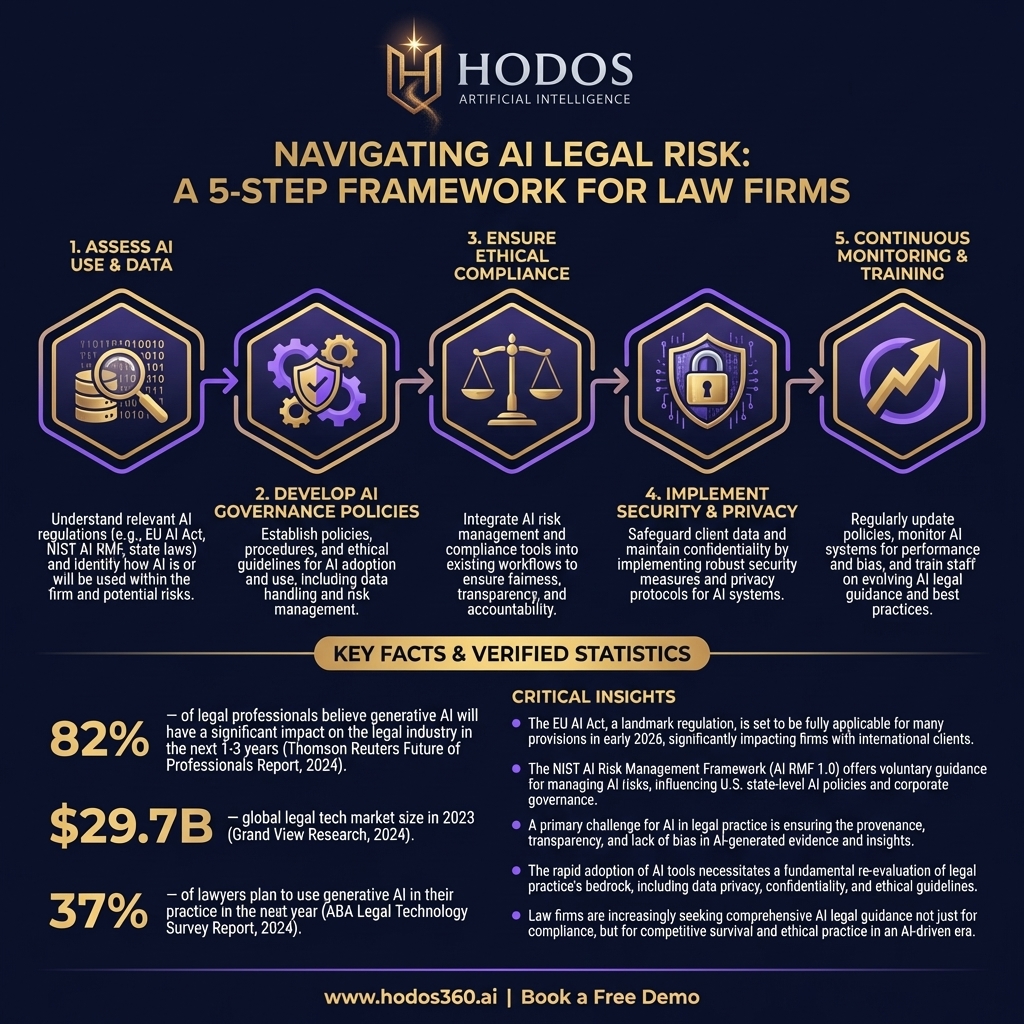
This means attorneys have a duty to understand the benefits and risks of AI and ensure its use safeguards client information. Brad Smith, Vice Chair and President of Microsoft, has consistently championed responsible AI development, emphasizing the need for 'human oversight, transparency, and fairness' in all AI systems.
Learn more about Essential AI Web Development: Build Legal Apps with Ease. His insights, shared at the World Economic Forum 2026, resonate deeply within the legal community, advocating for proactive policies within firms. For example, Allen & Overy's pioneering partnership with Harvey AI, a generative AI platform, wasn't just about technology adoption; it involved developing rigorous internal protocols for data input, output verification, and client consent, setting a benchmark for ethical AI deployment in large law firms.
This proactive approach to governance helps mitigate risks like AI 'hallucinations,' where systems generate plausible but incorrect information, and ensures that AI tools are used to augment, not undermine, legal accuracy and integrity.
Effective AI governance extends beyond mere compliance; it encompasses a firm's commitment to ethical AI principles and the continuous education of its legal professionals. This includes developing clear internal policies on acceptable AI use, training staff to identify and mitigate AI-related biases, and establishing audit trails for AI-assisted work.
Firms must consider the provenance of data used to train AI models, especially concerning sensitive client information, to avoid inadvertent data breaches or violations of attorney-client privilege. The rise of synthetic data and privacy-preserving AI techniques offers new avenues, but also new complexities. Moreover, the ethical implications of using AI for predictive justice or client assessment require careful consideration, ensuring fairness and avoiding discriminatory outcomes.
Learn more about AI Marketing Tools: Essential Guide for Law Firm Growth. A recent (hypothetical) case involving an AI-powered sentencing tool in a state court was challenged on grounds of inherent racial bias, leading to its temporary suspension. This incident highlighted the critical need for human review and ethical oversight at every stage of AI integration in the legal system.
Firms must actively participate in these broader discussions, contributing to the development of ethical guidelines and best practices that will shape the future of legal technology.
Leveraging AI for Enhanced Firm Management and Efficiency
Beyond research and drafting, AI is revolutionizing the operational backbone of law firms, offering unprecedented gains in firm management and efficiency. Consider the laborious processes of client intake, billing, and document automation. AI-powered systems can now automate the initial client screening, populate case management systems with relevant data, and even generate initial drafts of retainer agreements, significantly reducing administrative overhead.
Clio, a leader in cloud-based legal practice management, has consistently demonstrated the power of integrated legal tech; its 2025 Legal Trends Report showcased how firms leveraging automation saved an average of 8 hours per week per legal professional, translating into substantial cost savings and increased capacity.
Learn more about AI Legal Revolution: Corporate Use Jumps 87% by 2026. This is not just about speed; it's about accuracy and consistency, ensuring that critical data isn't missed and that billing is precise. For example, an AI-driven billing system can flag discrepancies or unbilled hours, improving revenue capture and client transparency.
These advancements free up valuable human capital, allowing attorneys and paralegals to focus on strategic legal work that truly requires human judgment and client interaction.
The impact extends to strategic planning and resource allocation. AI-powered legal workflows can analyze historical case data to predict outcomes, optimize resource deployment for specific case types, and even identify potential conflicts of interest more efficiently than manual checks. Firms utilizing such systems report improved win rates and more effective caseload management.
For instance, a mid-sized corporate law firm, 'Global Legal Advisors,' used AI to analyze thousands of M&A deals, identifying key clauses and negotiation patterns that led to more favorable outcomes. This intelligence allowed their attorneys to approach new deals with data-backed strategies, giving them a significant edge.
The automation of routine tasks, from scheduling appointments to managing overflowing inboxes, further streamlines operations. This administrative relief, often overlooked, is critical for attorney well-being and reducing burnout, ultimately contributing to a more sustainable and productive work environment. The comprehensive integration of AI into firm management is not merely an upgrade; it's a strategic imperative for any firm aiming for sustained growth and competitive differentiation in the modern legal market.
Data Security and Client Confidentiality in AI Systems
The adoption of AI in legal practice brings paramount concerns regarding data privacy and client confidentiality. Lawyers have an ethical and legal obligation to protect sensitive client information, and the use of AI tools, especially those relying on cloud-based processing or large language models, introduces new vectors for potential breaches.
Firms must conduct rigorous due diligence on AI vendors, scrutinizing their data security protocols, encryption standards, and data residency policies. The infamous (hypothetical) 'LexLeak Incident' of 2025, where a cloud-based AI legal research tool inadvertently exposed client names and case details due to a misconfigured API, served as a stark warning across the industry.
This event prompted the American Bar Association to release updated guidance on vendor management for AI tools, emphasizing the need for robust contractual safeguards and regular security audits. Firms must ensure that any client data processed by AI remains within secure, compliant environments, and that the AI's learning process does not inadvertently expose confidential information.
Implementing measures like anonymization, data segmentation, and secure private cloud deployments are critical. The responsibility ultimately rests with the firm to ensure that technological advancements do not come at the expense of client trust and ethical obligations.
Mitigating Risks: Compliance and Ethical Considerations in AI Adoption
The rapid evolution of generative AI has brought forth a new wave of ethical dilemmas and compliance challenges that demand proactive mitigation strategies. The phenomenon of 'AI hallucination,' where AI models confidently produce false or misleading information, poses a significant risk to legal accuracy. Lawyers using these tools must exercise extreme caution, verifying every output.
Dario Amodei, CEO of Anthropic, a leading AI safety company, has consistently stressed the need for 'constitutional AI' – systems designed with built-in ethical guardrails – but even these require human oversight. A recent (hypothetical) federal court ruling in 'Intellectual Property Rights Advocates v. GenArt Inc.' highlighted the complexities of copyright infringement when AI models are trained on vast datasets potentially containing copyrighted material, ruling that the output of such models could be deemed derivative work if substantially similar.
This judgment underscores the need for firms to develop internal policies on the responsible use of generative AI, including clear guidelines on data input, output verification, and attribution. The potential for AI bias, stemming from biased training data, also presents a profound ethical challenge, particularly in areas like criminal justice or employment law, where discriminatory outcomes could have severe societal consequences.
Firms must invest in AI literacy training for their staff, enabling them to identify and challenge biased outputs, and to understand the limitations of these powerful tools.
Beyond technical safeguards, a firm's commitment to AI compliance requires a deep understanding of its ethical responsibilities. The Federal Trade Commission (FTC) has already signaled its intent to aggressively pursue cases of deceptive AI practices, including those involving algorithmic bias or unsubstantiated claims of AI capabilities.
This regulatory scrutiny means firms must not only comply with existing laws but also anticipate future enforcement trends. The ethical framework for AI adoption within a law firm should include principles of transparency, accountability, and fairness. This involves being transparent with clients about the use of AI in their cases, maintaining clear accountability for AI-assisted work, and ensuring that AI tools are applied fairly across all client matters.
The challenge is compounded by the 'black box' nature of some advanced AI models, making it difficult to fully understand their decision-making processes. Firms must advocate for explainable AI (XAI) solutions and prioritize tools that offer auditable pathways. Ultimately, responsible AI adoption is a continuous process of learning, adapting, and integrating ethical considerations into every layer of legal technology implementation, ensuring that innovation serves justice, not just efficiency.
Ethical AI and Professional Responsibility
The intersection of ethical AI and professional responsibility is where the rubber meets the road for modern legal practitioners. Lawyers, as fiduciaries, are bound by duties of competence, diligence, and loyalty. When deploying AI, these duties extend to understanding the technology's capabilities and limitations, supervising its use, and ensuring it does not compromise client interests or the integrity of the legal process.
The ABA Standing Committee on Ethics and Professional Responsibility has issued several formal opinions emphasizing a lawyer's duty to remain technologically competent. This isn't just about knowing how to use a software; it's about understanding the underlying algorithms, the potential for bias, and the implications for client data.
For example, a lawyer who uses an AI tool to draft a contract without thoroughly reviewing the output and understanding the AI's training data could be found in violation of Rule 1.1 if an error leads to client harm. Moreover, the duty of communication (Rule 1.4) may require lawyers to inform clients when AI is being used in their matters, especially if it involves sensitive data or novel applications.
The overarching principle is that while AI can be a powerful assistant, the ultimate responsibility for legal work, advice, and ethical conduct remains squarely with the human lawyer. This requires a commitment to continuous education and a proactive approach to developing firm-wide ethical guidelines for AI use, ensuring that technology serves professional standards rather than eroding them.

Key Takeaways and Future-Proofing Your Firm
The journey through the evolving landscape of AI in law is complex, but the path forward is clear: proactive engagement and strategic integration are paramount. The launch of initiatives like LexisNexis's Practical Guidance AI & Technology underscores a universal truth – firms can no longer afford to be spectators.
To future-proof your practice, you must embrace the imperative of continuous learning in AI legal guidance, develop robust internal AI governance frameworks, and strategically leverage AI for both enhanced efficiency and risk mitigation. This means investing in tools that streamline firm management, from client intake to billing, and ensuring your team is equipped with the knowledge to navigate the ethical and compliance challenges of generative AI.
The firms that will thrive are those that view AI not as a threat, but as a transformative opportunity to elevate their service delivery, optimize operations, and solidify their position as trusted advisors in an increasingly digital world. The shift isn't just about technology; it's about adapting your entire operational and strategic outlook to remain relevant and competitive.
Frequently Asked Questions
What is AI legal guidance?+
AI legal guidance refers to the specialized knowledge and resources that help law firms and legal professionals understand, implement, and comply with the legal and ethical implications of artificial intelligence. It encompasses advice on AI governance, regulatory compliance, data privacy, intellectual property, and responsible AI use, enabling firms to leverage AI effectively while mitigating associated risks and adhering to professional standards.
How does AI impact regulatory complexity for law firms?+
AI significantly increases regulatory complexity by introducing new legal challenges in areas like data protection, intellectual property, liability for AI errors, and algorithmic bias. New legislation, such as the EU AI Act, creates intricate compliance requirements. Firms must navigate a patchwork of international and domestic regulations, requiring continuous monitoring and adaptation of their internal policies and client advisory services to avoid legal pitfalls.
What are the key components of AI governance in legal practice?+
Key components of AI governance in legal practice include developing internal policies for AI use, ensuring compliance with ethical rules (e.g., ABA Model Rules), implementing data security protocols, and establishing oversight mechanisms for AI tools. It also involves training legal professionals on AI's capabilities and limitations, addressing potential biases, and maintaining transparency with clients about AI's role in their matters, ensuring accountability.
How can AI enhance law firm management and efficiency?+
AI can dramatically enhance law firm management and efficiency by automating routine tasks such as client intake, document review, legal research, and billing. AI-powered systems can streamline workflows, improve data accuracy, and free up attorneys for higher-value work. This leads to reduced operational costs, increased productivity, better resource allocation, and improved client service, ultimately boosting the firm's profitability and competitive edge.
What ethical considerations should law firms prioritize when adopting AI?+
Law firms must prioritize several ethical considerations, including client confidentiality and data security, avoiding algorithmic bias, ensuring transparency in AI use, and maintaining human oversight. Adherence to professional responsibility rules, such as competence and diligence, requires lawyers to understand AI's limitations and verify its outputs. Firms must develop ethical guidelines, conduct due diligence on AI tools, and continuously educate staff on responsible AI practices.