
AI Voice: Legal's 2026 Paradigm Shift & Innovation Catalyst
In a world increasingly shaped by artificial intelligence, the boundaries of what's possible are being redefined daily. Just recently, the compelling narrative of Paul Conyngham, a tech entrepreneur, captivated global attention. Faced with the devastating diagnosis of mast cell cancer for his beloved dog, Rosie, Conyngham leveraged the power of modern AI, specifically a chatbot, to brainstorm and ultimately develop an experimental, personalized mRNA vaccine.
This incredible feat, born from a desperate need and fueled by readily available AI tools, wasn't just a testament to one man's devotion but a profound demonstration of AI's capacity to solve complex, real-world problems – even those previously thought to be the exclusive domain of highly specialized scientific research.
The story, widely reported by sources like Dawn, underscores a pivotal truth for 2026: AI is no longer a futuristic concept but a practical, accessible engine of innovation, ready to transform every industry it touches.
For law firms, the implications of such rapid technological advancement are profound.
While the legal sector may seem distant from biotech breakthroughs like an AI-designed cancer vaccine, the underlying principle remains the same: AI offers unprecedented capabilities for efficiency, personalization, and problem-solving. Law firms, traditionally grappling with the demands of constant client communication, meticulous case management, and the relentless pursuit of new leads, are at a critical juncture.
The very challenges that lead to missed opportunities and client dissatisfaction can now be addressed by intelligent automation. Just as a chatgpt helped create a vaccine for Rosie, sophisticated AI Voice Assistants are emerging as the essential tool for legal professionals seeking to streamline operations, enhance client engagement, and maintain a competitive edge in a rapidly evolving market.
This isn't merely about adopting new software; it's about embracing a paradigm shift that redefines how legal services are delivered and managed.
The narrative of an entrepreneur using chatgpt to create an experimental vaccine for his diagnosed dog, Rosie, in Australia is more than a heartwarming anecdote; it's a powerful case study in the democratization of advanced technology. Conyngham, not a trained immunologist, effectively used AI to bridge knowledge gaps and accelerate a development process that would typically require years of specialized research and vast resources.
This highlights AI's role as an intellectual co-pilot, capable of processing immense amounts of data, identifying patterns, and suggesting novel solutions. The integration of tools like AlphaFold for protein structure prediction, often cited in discussions around such wildest breakthroughs, further illustrates how interconnected AI systems are enabling previously unimaginable scientific leaps.
For legal professionals, this story should serve as a clear signal: the era of AI-driven problem-solving is here, and its applications extend far beyond the laboratory.
The rapid evolution of AI, particularly in areas like natural language processing (NLP) and machine learning, means that tools once confined to academic research are now accessible to a broader audience.
This accessibility is crucial for industries like law, where the core business revolves around information processing, communication, and strategic decision-making. The ability of an AI Voice Assistant to understand, interpret, and respond to complex human language—whether it's creating a legal brief outline or developing a client intake strategy—mirrors the collaborative intelligence demonstrated in the personalized cancer vaccine project.
It’s about leveraging computational power to augment human expertise, allowing legal teams to operate with unprecedented speed and accuracy.
While the legal industry has historically been characterized by its reliance on human judgment and intricate procedural knowledge, the scale and complexity of modern legal practice demand innovative solutions.
Law firms today face increasing pressure to manage high call volumes, qualify leads efficiently, and provide consistent, accessible client service 24/7 AI Document Workflows: Unleash Efficiency & ROI in 2026. These operational challenges, if left unaddressed, can lead to significant revenue loss and client dissatisfaction.
The australian entrepreneur's success with AI in a highly specialized field underscores that fundamental operational bottlenecks in any industry can be alleviated, and even solved, through strategic AI implementation. The core challenge for law firms is often not a lack of legal acumen, but a struggle with the sheer volume and velocity of administrative and communicative tasks.
Therefore, the leap from AI-designed mRNA vaccine to AI Voice Assistants in legal practice is not as vast as it might initially appear. Both applications leverage AI's capacity for rapid data analysis, pattern recognition, and intelligent interaction to address critical needs. For law firms, this translates into an opportunity to transform routine administrative functions into intelligent, automated processes.
By embracing AI Voice Assistants, legal practices can effectively address the demanding requirements of client intake, lead qualification, and continuous availability, ultimately freeing up valuable human resources to focus on the intricate legal work that truly requires their expertise. This strategic adoption of AI is not just about keeping pace; it's about setting a new standard for excellence and efficiency in the legal sector.
Redefining Client Engagement with AI Voice Assistants
In the contemporary legal landscape, client engagement is paramount, yet many law firms struggle with the logistical complexities of providing consistent, high-quality service around the clock. Missed calls, particularly outside of standard business hours, translate directly into lost leads and a diminished client experience. Research from the American Bar Association (ABA) indicates that prospective clients often contact multiple firms, and the first to respond effectively often secures the business.
Traditional methods of client intake, involving human receptionists who may not be available 24/7 or equipped for multilingual communication, are increasingly inadequate. This creates a bottleneck that hinders growth and limits a firm's reach, especially in diverse markets where language barriers can be a significant impediment to access to justice.
The expectation for immediate, personalized responses, driven by consumer experiences in other industries, now extends to legal services.
This is where AI Voice Assistants become a game-changer for law firms. Far more sophisticated than simple answering machines, these intelligent systems are designed to handle initial client interactions with precision and empathy.
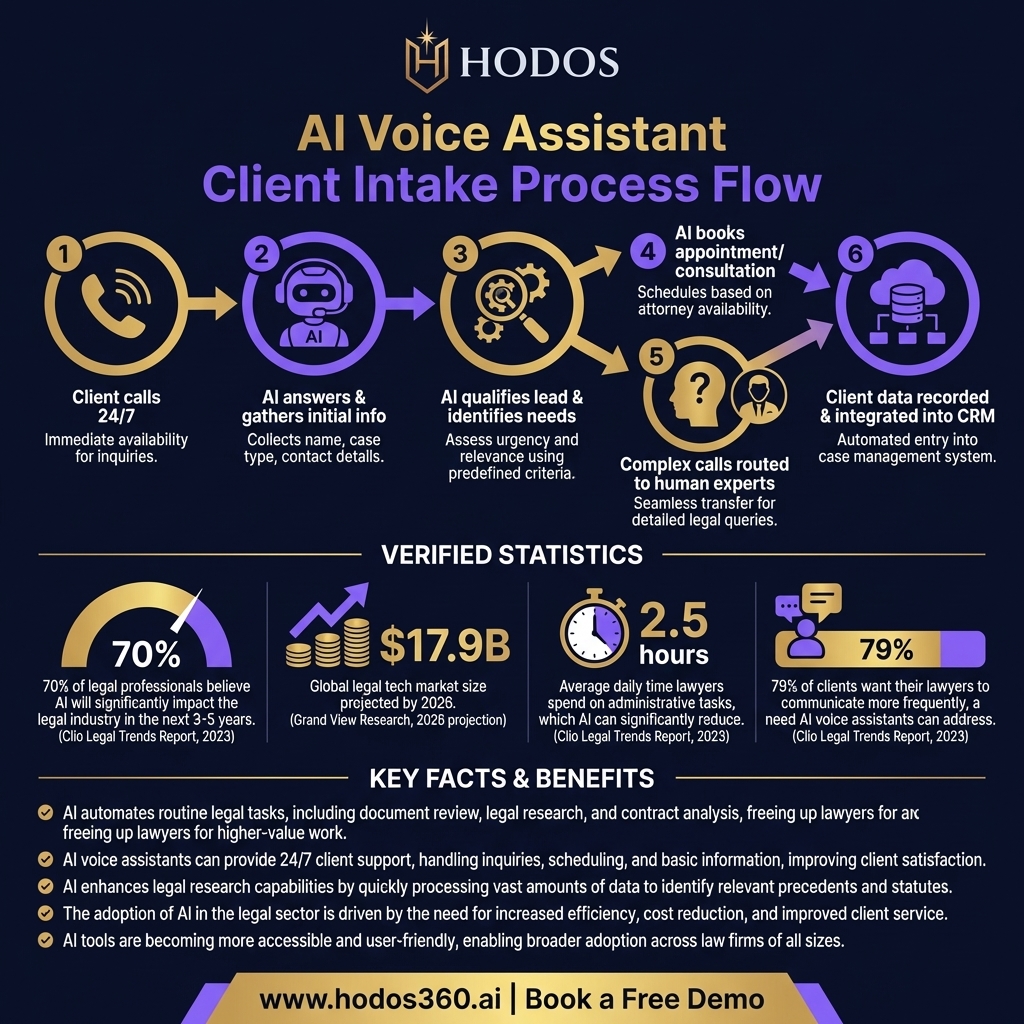
They provide 24/7 phone answering, ensuring no potential client call goes unanswered, regardless of time zones or public holidays. Beyond just answering, these AI solutions are adept at lead qualification, discerning the nature of an inquiry, and gathering essential preliminary information. This immediate, professional response not only enhances the client's perception of the firm but also ensures that valuable data is captured from the outset, laying the groundwork for more effective follow-up by human attorneys or paralegals.
The ability of AI Voice Assistants to create a seamless first impression is invaluable in a competitive market.
### Seamless Client Intake and Lead Qualification The process begins the moment a prospective client calls. Instead of a busy signal or voicemail, an AI Voice Assistant engages them in a natural, conversational manner Legal AI Gap Widens: Strategic Imperative for Law Firms 2026.
It can ask structured questions to identify the type of legal issue, gather contact information, and even assess the urgency of the matter. This intelligent pre-screening allows the firm to prioritize leads and allocate resources more effectively. For instance, a complex personal injury case might be routed directly to a senior attorney, while a routine will preparation inquiry is scheduled for a consultation with a junior associate.
This level of granular control over lead management significantly improves conversion rates, as qualified leads are quickly moved through the pipeline, reducing the time from initial contact to engagement. It’s a proactive approach to client acquisition, ensuring that no wildest opportunity is missed.
Furthermore, the multilingual support offered by advanced AI Voice Assistants is transformative.
In a globalized society, law firms often serve diverse populations, and the ability to communicate fluently in multiple languages removes a significant barrier for potential clients. An AI Voice Assistant can interact with callers in their native tongue, fostering trust and ensuring that critical information is accurately conveyed and understood.
This not only expands a firm's market reach but also reinforces its commitment to accessibility and client-centric service. By automating the initial stages of client intake and lead qualification, AI Voice Assistants empower law firms to scale their operations without compromising on the quality or responsiveness of their client interactions, thereby developing a stronger foundation for growth and client satisfaction.
Imagine the impact of consistently personalized interactions right from the first phone call.
Operational Efficiency: The Silent Revolution in Law Firms
Beyond their client-facing capabilities, AI Voice Assistants are catalyzing a silent but profound revolution in the internal operations of law firms. The daily grind of administrative tasks—scheduling appointments, managing calendars, sending reminders, and answering repetitive queries—consumes a significant portion of legal professionals' time. A study by Thomson Reuters found that attorneys spend an average of 30-40% of their time on non-billable administrative duties.
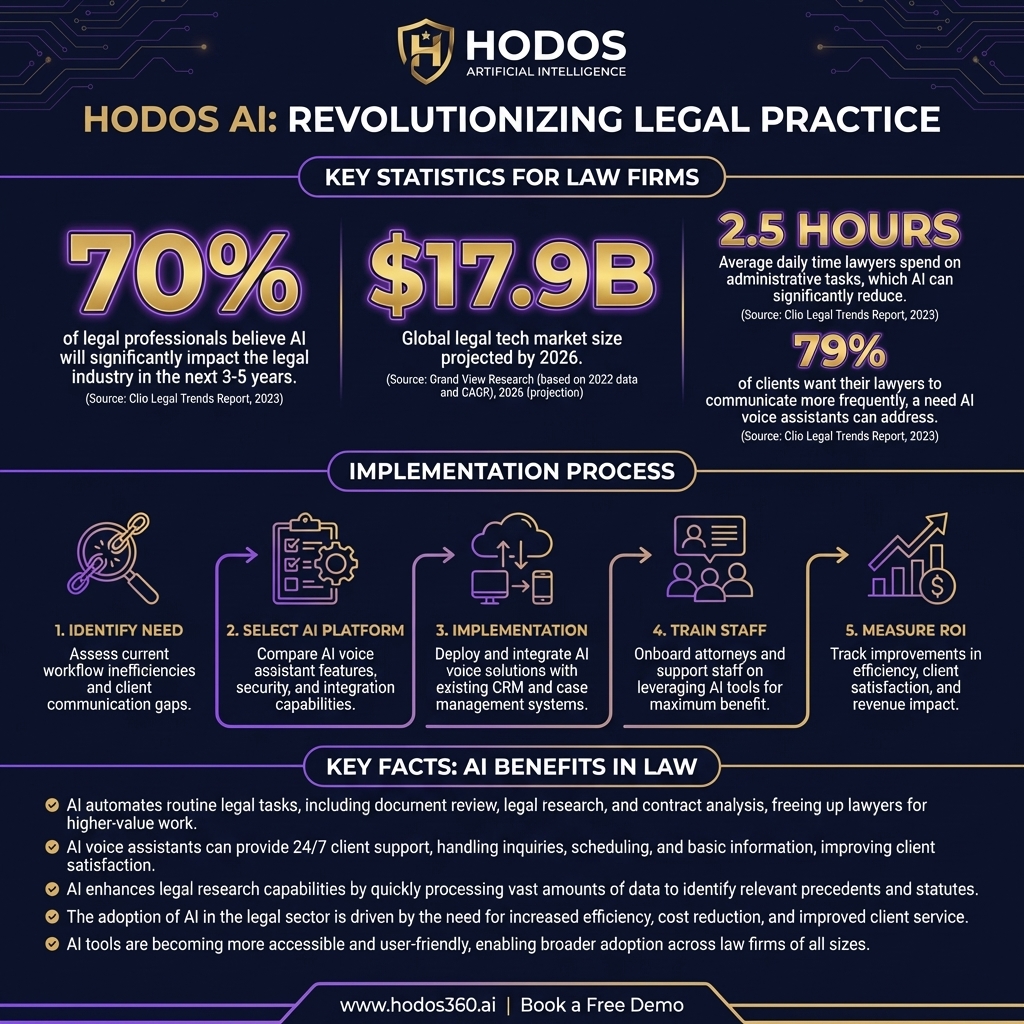
This inefficiency not only impacts profitability but also contributes to attorney burnout and reduces the capacity for high-value legal work. The integration of AI Voice Assistants into a firm's operational framework offers a powerful antidote to these pervasive challenges, freeing up human capital to focus on strategic legal analysis, courtroom advocacy, and complex client problem-solving.
It's about optimizing every minute of every day.
The impact on attorney productivity is particularly noteworthy. By offloading routine communications and administrative burdens, AI Voice Assistants allow legal teams to dedicate more time to their core competencies. Imagine a world where a paralegal isn't spending hours confirming appointments or answering basic questions about office hours, but instead dedicating that time to legal research or drafting documents.
This shift is not merely about automation; it's about intelligent delegation, where the AI Voice Assistant acts as a highly efficient, tireless administrative support. This enhances overall firm output, reduces the need for extensive manual oversight on routine tasks, and creates an environment where legal professionals can thrive, focusing on the nuanced legal workflows that define their expertise.
### Automating Routine Tasks for Peak Productivity Specific examples illustrate the transformative potential. An AI Voice Assistant can manage the entire appointment booking process, from initial scheduling to sending automated reminders to clients about upcoming consultations or court dates AI Marketing Revolution 2026: Autonomous Agents for Law F....
It can also handle frequently asked questions (FAQs) about the firm's services, fees, or general legal procedures, providing instant, accurate information without requiring human intervention. This capability is particularly valuable for developing a consistent client experience and ensuring that information is always accurate and up-to-date.
The data collected by these assistants—such as call volumes, peak inquiry times, and common client questions—provides invaluable insights for firm management, enabling them to make data-driven decisions about staffing, marketing strategies, and service improvements. This level of operational intelligence was previously difficult and costly to obtain.
Seamless integration with existing systems, such as case management software and CRM platforms, is a hallmark of advanced AI Voice Assistants like those offered by HODOS 360. This interoperability ensures that all client interactions and data captured by the AI are immediately logged and accessible within the firm's central database.
This eliminates manual data entry, reduces errors, and ensures that every member of the legal team has access to the most current client information. By automating these critical, yet often time-consuming, tasks, AI Voice Assistants not only enhance efficiency but also contribute to a more organized, responsive, and ultimately more profitable law firm.
The strategic deployment of AI Voice Assistants is less about replacing human roles and more about augmenting human capabilities, thereby fostering a more dynamic and efficient legal practice. This strategic use of AI ensures that every aspect of the legal process is optimized, from initial client contact to final case resolution.
Navigating the Ethical and Practical Landscape of Voice AI in Legal 2026
As AI Voice Assistants become increasingly integral to law firm operations, navigating the ethical and practical landscape of their deployment is paramount. The legal profession is bound by stringent ethical rules, such as the ABA Model Rules of Professional Conduct, which dictate duties of confidentiality (Rule 1.6) and competence (Rule 1.1).
The use of any technology, especially AI that handles sensitive client information, must align with these obligations. Concerns around data privacy, cybersecurity, and the potential for AI biases are legitimate and require proactive measures. Firms must ensure that the AI Voice Assistant technology they adopt is robustly secure, compliant with relevant data protection laws (like GDPR or CCPA), and transparent in its interactions with clients.
The wildest advancements in AI must be tempered with rigorous ethical oversight.
Transparency is a cornerstone of ethical AI deployment. Clients interacting with an AI Voice Assistant should be clearly informed that they are communicating with an artificial intelligence. This disclosure maintains trust and manages expectations.
Furthermore, firms must implement comprehensive data security protocols to protect client confidentiality. This includes end-to-end encryption for all communications, secure data storage, and regular audits of the AI system's performance and data handling. While AI can significantly enhance efficiency, it must always operate under human supervision, particularly for complex or sensitive legal matters that require nuanced judgment and empathy Voice AI Revolution 2026: Agentic Platforms Transform Law....
The human element remains indispensable, with AI serving as a powerful assistant rather than a replacement.
### Ensuring Compliance and Client Trust To ensure compliance, law firms should establish clear internal policies for the use of AI Voice Assistants. This includes training staff on the AI's capabilities and limitations, defining escalation protocols for complex inquiries that require human intervention, and regularly reviewing the AI's performance to identify and rectify any potential issues.
The developing legal framework around AI also necessitates vigilance; while specific statutes governing AI Voice Assistants in legal practice are still evolving, firms must adhere to existing data privacy laws and ethical guidelines from legal bodies. For instance, the ABA has issued guidance on the ethical implications of using AI in legal practice, emphasizing the need for attorneys to understand the technology they employ.
The practical implementation of AI Voice Assistants also involves customization and continuous learning. Each law firm has unique needs, client demographics, and operational nuances. The AI Voice Assistant must be tailored to the firm's specific practice areas, terminology, and brand voice. This initial setup is crucial for maximizing effectiveness.
Moreover, sophisticated AI systems learn and improve over time, requiring ongoing monitoring and refinement to ensure optimal performance. This iterative process, coupled with robust ethical safeguards, ensures that AI Voice Assistants serve as powerful, reliable assets that enhance client trust and streamline operations, rather than posing unforeseen risks.
As we move further into 2026, the responsible integration of such AI tools will differentiate leading law firms.

How HODOS 360 Empowers Law Firms with Cutting-Edge AI Voice Assistants
The narrative of an entrepreneur using AI to tackle a seemingly insurmountable challenge—creating a personalized cancer vaccine for his dog, Rosie—serves as a compelling metaphor for the transformative power of AI across all sectors, including legal. At HODOS 360, we understand that law firms, much like researchers, are constantly seeking innovative solutions to complex problems, whether it's optimizing legal workflows, enhancing client acquisition, or improving operational efficiency.
Our suite of AI-powered services is meticulously designed to meet these evolving needs, with AI Voice Assistants standing out as a cornerstone for modernizing client interaction and administrative processes. We provide the tools to not just compete, but to lead in the 2026 legal landscape.
HODOS 360’s AI Voice Assistants are engineered to address the specific pain points of law firms. Imagine the relief of knowing every prospective client call is answered promptly, 24/7, by an intelligent system capable of lead qualification and appointment booking. This ensures that valuable leads are captured and nurtured, not lost to voicemail or missed calls.
Our multilingual support breaks down communication barriers, allowing firms to serve a broader, more diverse clientele with ease and professionalism. Furthermore, intelligent call routing ensures that urgent or complex inquiries are seamlessly directed to the appropriate human expert, while routine questions are handled efficiently by the AI, optimizing attorney productivity and ensuring that no wildest or critical detail is overlooked.
Our AI Voice Assistants don't operate in a vacuum; they are an integral part of the comprehensive HODOS 360 ecosystem. They integrate seamlessly with our AI Law Firm Management System, feeding crucial client intake data directly into your case management, billing, and document automation processes Legal AI ROI: Maximizing Law Firm Value in 2026.
This synergy creates truly AI-powered legal workflows, minimizing manual data entry and maximizing efficiency from the very first client interaction. Furthermore, the insights gathered by our AI Voice Assistants can inform your AI Marketing Platform, providing valuable data for content generation and ROI tracking, helping you develop more targeted and effective campaigns.
The unified platform approach ensures that every aspect of your firm benefits from intelligent automation.
In an era where AI Voice Assistants are developing from novelties into necessities, HODOS 360 offers law firms a robust, ethical, and highly effective solution. We empower legal professionals to transcend administrative burdens, elevate client service, and unlock unprecedented growth opportunities.
Don't let your firm be left behind by the digital revolution. Just as AI helped create a vaccine for Rosie, let HODOS 360 help you create a future where your firm operates at peak efficiency and client satisfaction. It's time to transform your practice into a future-ready powerhouse.
Discover the HODOS 360 difference today and book a free demo!
- ✓24/7 Phone Answering: Ensure every client call, regardless of time, is professionally answered, capturing crucial information and preventing lost leads.
- ✓Intelligent Lead Qualification: AI accurately identifies the nature of inquiries and assesses lead potential, prioritizing valuable prospects for your team.
- ✓Automated Appointment Booking: Streamline scheduling for consultations and meetings directly through AI, reducing administrative overhead and client friction.
- ✓Multilingual Support: Communicate effortlessly with diverse clients in their preferred language, expanding your firm's reach and enhancing accessibility.
- ✓Smart Call Routing: Direct complex or urgent calls to the right human expert, while routine queries are handled efficiently by the AI, optimizing staff time.
- ✓Seamless Integration: AI Voice Assistants integrate with HODOS 360's Law Firm Management System, ensuring all client data flows directly into your case files and workflows.
- ✓Data-Driven Insights: Gain valuable analytics on call volumes, common inquiries, and client demographics to inform strategic decisions and improve service.
Frequently Asked Questions
What exactly is an AI Voice Assistant for law firms?+
An AI Voice Assistant for law firms is an intelligent, automated system designed to handle phone calls and client interactions. It uses advanced natural language processing to understand and respond to queries, qualify leads, book appointments, and route calls, operating 24/7 to ensure constant availability and efficiency for your practice.
How does an AI Voice Assistant improve client intake?+
It revolutionizes client intake by providing instant, 24/7 responses to callers, capturing essential preliminary information, and pre-qualifying leads. This ensures no potential client is missed, streamlines the initial data collection process, and allows your legal team to focus on already qualified prospects, significantly boosting conversion rates.
Can HODOS 360's AI Voice Assistant handle multiple languages?+
Yes, HODOS 360's AI Voice Assistant offers robust multilingual support. This feature enables your firm to communicate effectively with a diverse client base in their native language, breaking down barriers and expanding your market reach without the need for dedicated human translators for initial interactions.
Is client data secure with an AI Voice Assistant?+
HODOS 360 prioritizes data security and compliance. Our AI Voice Assistants are built with robust encryption and adhere to strict data protection protocols, aligning with legal industry standards. We ensure client confidentiality is maintained, with clear ethical guidelines for AI interaction and data handling.
How does an AI Voice Assistant integrate with my existing systems?+
HODOS 360's AI Voice Assistants are designed for seamless integration, particularly with our comprehensive AI Law Firm Management System. This means client data gathered by the AI flows directly into your case management, billing, and other operational tools, creating cohesive and automated legal workflows across your firm.
What's the ROI of implementing an AI Voice Assistant?+
The ROI is significant. Firms experience reduced operational costs (less need for 24/7 reception staff), increased lead conversion rates due to constant availability and efficient qualification, improved attorney productivity by offloading administrative tasks, and enhanced client satisfaction, all contributing to substantial growth and profitability.