

Ultimate AI Legal Platform: Law Firms' Strategic Advantage
The legal landscape is undergoing a monumental transformation, with artificial intelligence at its epicenter. On June 26, 2026, the legal world buzzed with the news that Herbert Smith Freehills Kramer (HSF Kramer), a global legal powerhouse, announced its collaboration with Acora and Microsoft to develop a proprietary AI platform.
This isn't just another tech adoption; it's a strategic declaration, signaling a profound shift from integrating off-the-shelf solutions to building bespoke, firm-specific AI capabilities that promise a significant competitive advantage. This move underscores a growing tension in the industry: firms that merely utilize AI tools versus those that own and customize their core AI infrastructure to drive unparalleled efficiency and innovation.
This landmark decision by HSF Kramer, a firm renowned for its forward-thinking approach, reflects a broader trend among elite legal practices. No longer content with generic AI applications, these firms are now investing heavily in tailor-made systems that integrate deeply with their unique operational frameworks, vast data repositories, and specialized expertise.
This 'build vs. buy' dilemma has reached a critical inflection point, where the benefits of a proprietary system—enhanced data control, bespoke workflow optimization, and a distinct intellectual property edge—are increasingly outweighing the substantial investment required. The collaboration with technology giants like Microsoft and expert integrators such as Acora highlights the complexity and strategic importance of such undertakings, pushing the boundaries of what a modern law firm can achieve.
For law firm owners and legal professionals navigating this rapidly evolving environment, HSF Kramer's initiative serves as a powerful case study. It demonstrates that the future of legal service delivery lies not just in adopting AI, but in strategically embedding it into the very fabric of the firm's operations.
This commitment to a proprietary AI platform is about more than just efficiency; it's about redefining the very nature of legal work, enhancing client value, and securing a leadership position in an increasingly competitive global market. As the industry watches closely, the lessons learned from such pioneering efforts will shape the trajectory for countless other firms grappling with their own digital transformation journeys.
Explore how your firm can leverage advanced AI solutions to stay ahead.
The Strategic Imperative of Proprietary AI in Legal Practice
In an era where every major law firm boasts some level of AI integration, the development of a proprietary AI platform becomes a crucial differentiator. This strategic imperative is driven by several factors, including the desire for greater control over intellectual property, enhanced data security, and the ability to create truly unique, competitive services.
While third-party solutions like Harvey AI, which has seen significant partnerships with firms like Allen & Overy, offer powerful general-purpose legal AI capabilities, they inherently provide a standardized experience. Firms like HSF Kramer, under the strategic guidance of leaders such as Jason Romer, Global Head of Digital Law, recognize that true competitive advantage emerges from systems designed from the ground up to reflect a firm's specific expertise, client base, and operational nuances.
This allows for a deeper integration into specialized workflows, offering insights and efficiencies that generic tools cannot match.
The push for proprietary systems also stems from the increasing complexity of legal challenges and the demand for bespoke client solutions. According to a 2024 report by McKinsey & Company, early adopters of AI in professional services have reported productivity gains of 20-30% in specific tasks, but the true value lies in transforming entire service delivery models.
Firms are no longer just automating tasks; they are rethinking how legal advice is generated, delivered, and consumed. A proprietary platform allows for the embedding of a firm's collective knowledge—its precedents, its unique analytical frameworks, and its institutional memory—into the AI itself. This creates a powerful feedback loop, where the AI continuously learns and refines its capabilities based on the firm's specific successes and challenges, making it an invaluable asset that cannot be easily replicated by competitors.
Furthermore, the ethical obligations surrounding client data and confidentiality, as outlined in ABA Model Rule 1.1 (Competence), which mandates that lawyers stay abreast of technology, increasingly favor systems where data governance is under direct firm control. Learn more about AI Voice Assistant: Essential Growth for Law Firms.
With a proprietary platform, firms can implement stringent security protocols, tailor data anonymization techniques, and ensure compliance with evolving global data privacy regulations like the EU AI Act. This level of control is often more challenging to achieve with external vendors, where data processing and storage practices may be less transparent.
The ability to guarantee data integrity and client confidentiality is not just a regulatory necessity but a cornerstone of client trust, making the investment in a self-owned proprietary AI platform a strategic imperative for long-term growth and reputation management.
This shift represents a significant investment, both financially and in terms of human capital.
It requires not only technological expertise but also a deep understanding of legal processes and client needs. The decision by HSF Kramer to partner with Acora, a seasoned IT solutions provider, and Microsoft, a leader in cloud and AI infrastructure, highlights the multi-faceted approach required.
It’s about leveraging external expertise to build internal strength, creating a system that is not only cutting-edge but also resilient, scalable, and fully aligned with the firm’s strategic vision. This complex undertaking marks a new frontier in legal innovation, where the lines between law firm and technology developer are increasingly blurred, paving the way for a more sophisticated and custom-driven legal future.
Navigating the Complexities of AI Legal Platform Development
Developing a proprietary AI platform is an undertaking fraught with technical and operational complexities, demanding significant investment in both capital and specialized talent. It's not merely about purchasing licenses; it's about architecting an entire ecosystem. Firms must grapple with integrating disparate legacy systems, ensuring data cleanliness and accessibility for AI training, and building robust, scalable infrastructure.
This often requires assembling a multidisciplinary team comprising AI engineers, data scientists, legal domain experts, and cybersecurity specialists—a talent pool that is both expensive and highly competitive. The challenge intensifies when considering the need for continuous model retraining and maintenance, ensuring the AI remains accurate, unbiased, and up-to-date with legal precedents and evolving legislation.
The HSF Kramer initiative, leveraging Microsoft's foundational AI capabilities and Acora's integration expertise, exemplifies a strategic approach to mitigating these challenges. Microsoft's Azure AI provides the robust, scalable cloud infrastructure and advanced machine learning services necessary for complex AI model deployment. However, the 'proprietary' aspect comes from how HSF Kramer customizes these foundational tools with its unique legal datasets, workflow logic, and specialized algorithms.
This deep customization ensures the platform addresses the firm's specific needs, from complex litigation analytics to highly specialized transactional document automation. The role of integrators like Acora becomes critical in bridging the gap between cutting-edge AI technology and the practical realities of a large law firm's operational environment, ensuring seamless integration with existing systems like case management, billing, and document management.
The journey from concept to fully operational proprietary AI platform is iterative, involving extensive pilot programs, user feedback loops, and continuous refinement. Learn more about AI Regulatory Monitoring: Essential for Law Firm Compliance. Firms must prepare for a long-term commitment, understanding that the initial build is just the beginning.
The biggest hurdle often isn't the technology itself, but the organizational change management required to foster widespread adoption among attorneys and staff. As Stuart Barr, a prominent figure in legal tech integration, has often emphasized, the success of any new legal technology hinges on its ability to seamlessly integrate into existing workflows and prove tangible value to end-users.
Without this user-centric approach, even the most sophisticated proprietary system risks becoming an underutilized asset, highlighting the importance of robust training and ongoing support.
Furthermore, the financial outlay for such ventures is substantial. Gartner projects global enterprise AI software spending to reach nearly $200 billion by 2026, with a significant portion allocated to custom development and integration.
This level of investment means firms must have a clear return on investment (ROI) strategy, demonstrating how the proprietary platform will enhance client service, improve operational efficiency, and ultimately boost profitability. The decision to build a proprietary AI platform is therefore not just a technological one, but a critical business strategy that requires meticulous planning, substantial resources, and a visionary leadership committed to long-term innovation.
Data Integrity and Ethical Considerations in AI Development
At the heart of any effective proprietary AI platform lies data—its quality, security, and ethical handling. The principle of 'garbage in, garbage out' is acutely relevant in legal AI; biased or incomplete training data can lead to skewed outcomes, potentially undermining the very trust legal professionals aim to uphold.
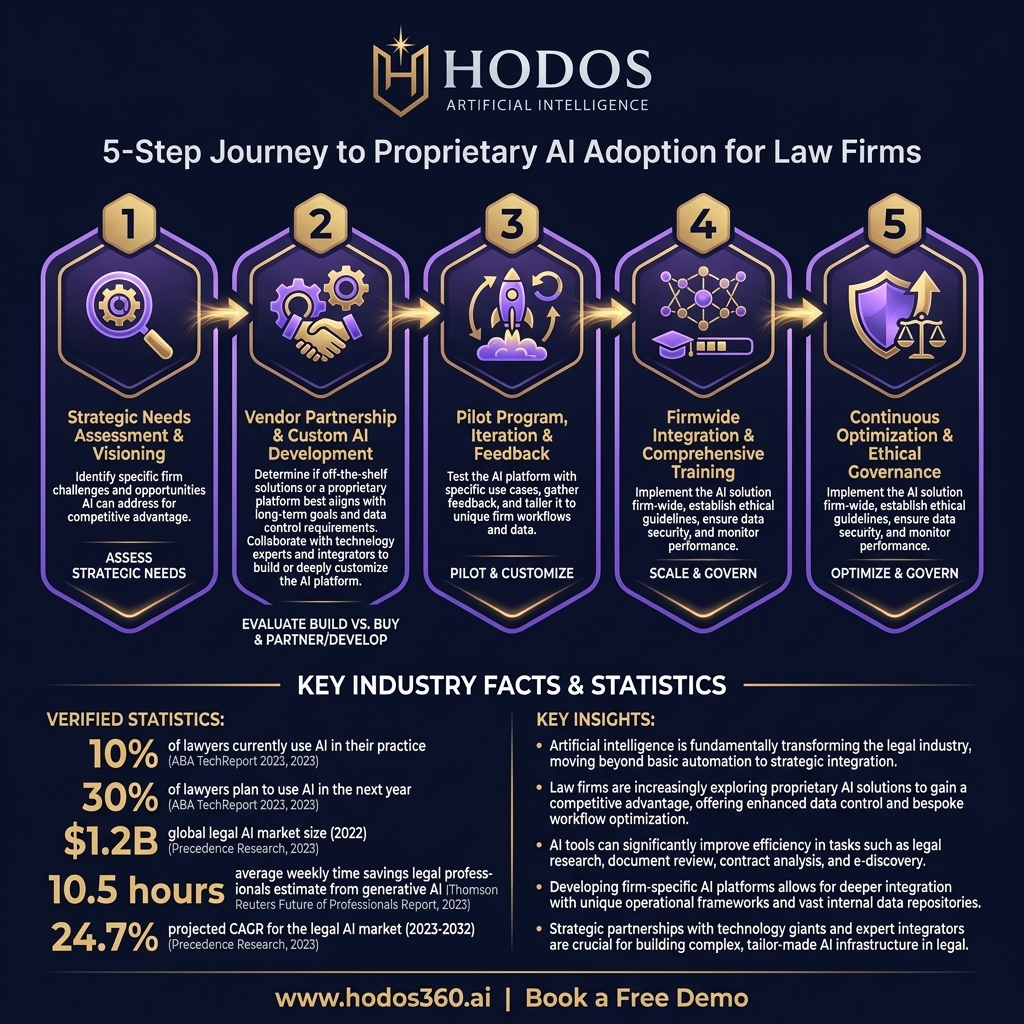
Firms developing their own AI must establish rigorous data governance frameworks, ensuring that client information is anonymized, secured, and used in compliance with all relevant regulations. This extends beyond technical measures to include clear policies on data access, usage, and retention, reflecting the highest standards of professional responsibility.
The EU AI Act, for instance, sets a precedent for stringent oversight, mandating transparency and human supervision for high-risk AI systems, a category into which many legal AI applications fall.
Moreover, the ethical considerations extend to the design and deployment of the AI itself. Learn more about Essential AI Legal Adoption: Akin's Firmwide Success Blueprint.
Firms must proactively address potential biases in algorithms, particularly those used in predictive analytics or case assessment, to ensure fairness and equity in legal outcomes. This involves diverse teams in development, regular audits of AI outputs, and mechanisms for human review and override. The investment in a proprietary AI platform offers a unique opportunity to embed these ethical safeguards directly into the system's architecture, rather than relying on third-party assurances.
This commitment to responsible AI development not only mitigates risks but also enhances the firm's reputation as a leader in ethical legal innovation, fostering greater trust among clients and the broader legal community.
The Competitive Landscape: Beyond Off-the-Shelf Solutions
In an increasingly crowded legal tech market, the development of a proprietary AI platform like HSF Kramer's creates a formidable competitive moat. While a plethora of excellent AI tools exist for specific legal tasks, a customized, firm-owned system offers strategic advantages that off-the-shelf solutions simply cannot replicate.
This includes the ability to integrate deeply with a firm's unique internal processes, leverage its specific historical data for predictive insights, and develop bespoke functionalities that directly address client needs in niche practice areas. This differentiation is crucial in a global legal market where firms are constantly vying for top talent and high-value clients.
A proprietary platform enhances efficiency and also allows firms to offer novel services, such as highly accurate risk assessments tailored to specific industry sectors or hyper-personalized legal advice based on proprietary data models.
Leading AI figures like Dario Amodei, CEO of Anthropic, and Sam Altman, CEO of OpenAI, have consistently highlighted the future of enterprise AI lies in specialized, domain-specific models built upon robust foundational architectures.
This is precisely the path HSF Kramer is forging. Instead of merely adapting to generic AI outputs, they are shaping the AI to their specific legal universe, drawing on decades of their own case law, client interactions, and strategic insights. This allows for the creation of unique intellectual property within the platform itself, making the firm's legal services more efficient, insightful, and difficult for competitors to replicate.
For instance, while LexisNexis's Lexis+ AI offers powerful predictive analytics, a proprietary system can fine-tune these capabilities using a firm's own litigation history, yielding more precise and actionable forecasts for their specific client portfolio.
The competitive edge extends to client acquisition and retention. Firms equipped with advanced proprietary AI platform capabilities can offer more transparent, value-based billing models, moving away from traditional hourly rates.
Learn more about Essential AI for Vibe Coding: Elevating Legal Web Development. This appeals to modern clients who demand predictability and demonstrable value. According to Thomson Reuters' latest 'Future of Legal' report, firms that have aggressively invested in advanced legal technology report higher client satisfaction rates and demonstrate stronger year-over-year revenue growth.
This isn't just about speed; it's about delivering superior outcomes and a more responsive, innovative client experience. The firm becomes not just a legal advisor but a technological leader, attracting clients seeking cutting-edge solutions to complex legal problems. Ready to transform your practice? Discover how HODOS 360’s AI Law Firm Management System can streamline your operations.
Moreover, a proprietary system allows for greater agility in responding to market changes and emerging legal trends. As new regulations are introduced or new legal challenges arise, the firm can rapidly update and adapt its AI models, ensuring its services remain at the forefront. This iterative development cycle, driven by internal expertise and specific firm needs, is a significant advantage over relying on vendor-dictated update cycles.
It empowers the firm to be proactive rather than reactive, positioning itself as an innovator capable of anticipating and shaping the future of legal service delivery rather than simply following existing trends. This strategic autonomy is invaluable in a fast-paced, competitive global market.
Elevating Client Service and Value Proposition
Beyond internal efficiencies, a proprietary AI platform profoundly elevates a law firm's client service and value proposition. By automating routine tasks and accelerating research, lawyers can dedicate more time to strategic thinking, complex problem-solving, and direct client engagement, thereby increasing the quality and depth of their advice.
This shift allows firms to move towards more value-based billing structures, offering clients predictable costs and outcome-focused engagements, a stark contrast to the often-criticized hourly billing model. Clients benefit from faster turnaround times, more comprehensive legal analysis, and a transparent understanding of the value they receive, fostering stronger, more trusting relationships.
Learn more about AI Call Assistant: The Ultimate Legal Firm Transformation. This isn't just about doing things faster; it's about doing them better, with a focus on delivering superior client outcomes.
Furthermore, the integration of AI can lead to the development of innovative client-facing tools, such as AI-powered client portals for 24/7 access to case updates, self-service document generation, or even multilingual AI voice assistants that can qualify leads and book appointments around the clock.
These capabilities, often seen in platforms like HODOS 360's AI Voice Assistants, demonstrate how technology can extend a firm's reach and responsiveness, providing unparalleled convenience and accessibility. By leveraging a proprietary AI platform, firms can customize these client touchpoints to reflect their brand and specific service offerings, creating a seamless and highly personalized client experience that sets them apart in a competitive market.
Ethical AI and Data Governance in Legal Practice
The deployment of a proprietary AI platform in legal practice necessitates an unwavering commitment to ethical AI and robust data governance. The legal profession, by its very nature, is built on trust, confidentiality, and the pursuit of justice. Introducing AI, especially when handling sensitive client data, brings forth a complex web of ethical considerations.
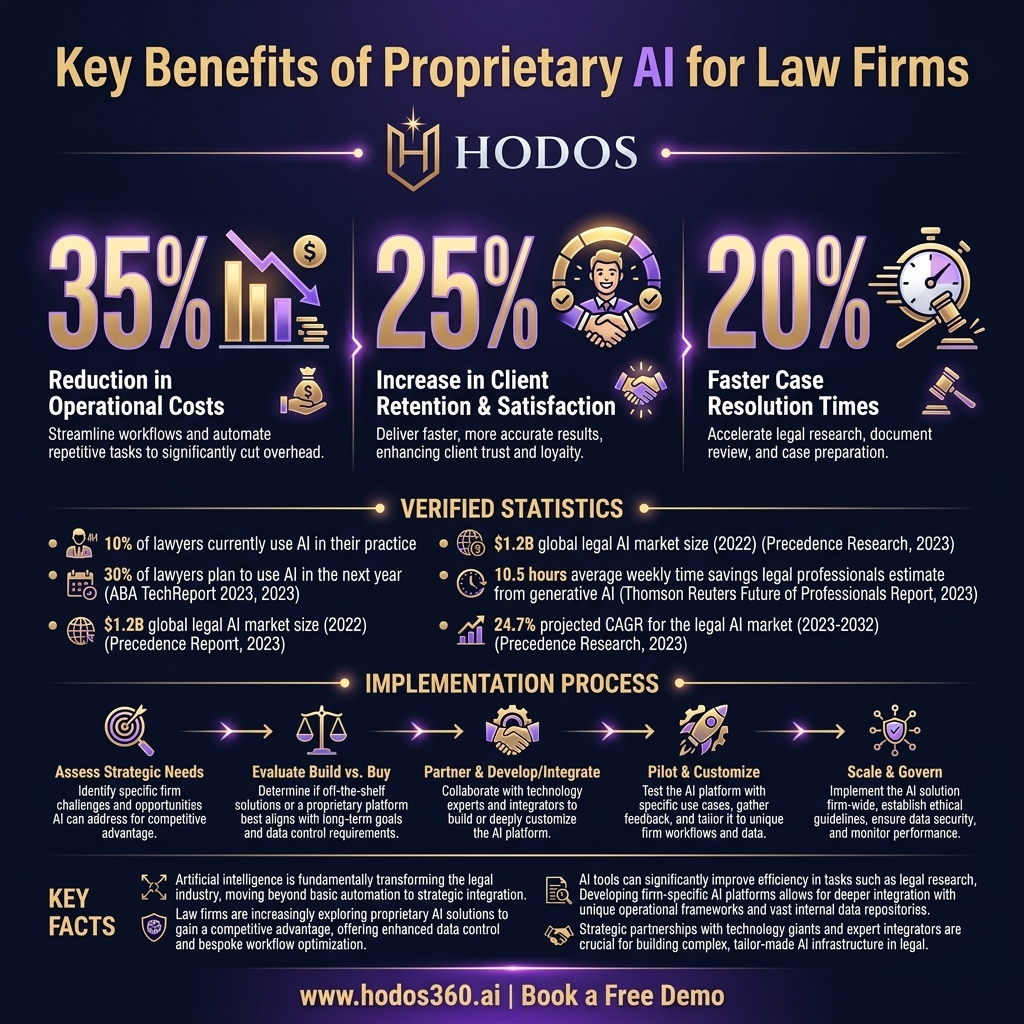
Foremost among these is the principle of confidentiality, enshrined in ABA Model Rule 1.6 (Confidentiality of Information). Firms must ensure that their AI systems are designed with the highest levels of data security and privacy, preventing unauthorized access, breaches, or inadvertent disclosure of privileged information.
This requires not only robust technical safeguards but also clear internal policies and continuous training for all personnel involved in AI development and deployment.
Another critical ethical challenge is the potential for bias in AI algorithms. If the data used to train a proprietary AI platform reflects historical biases present in legal records, the AI could perpetuate or even amplify these biases in its recommendations or predictions.
This poses a significant threat to fairness and equity, directly conflicting with the legal profession's commitment to justice. Firms must proactively implement strategies to identify and mitigate bias, including employing diverse datasets, conducting regular fairness audits, and ensuring human oversight in critical decision-making processes. The ABA's Standing Committee on Ethics and Professional Responsibility has increasingly issued guidance on these matters, urging lawyers to understand the limitations and ethical implications of AI tools they employ.
Furthermore, the ethical duty of supervision, as outlined in ABA Model Rule 5.3 (Responsibilities Regarding Nonlawyer Assistance), extends to the oversight of AI systems. Learn more about Legal AI Training: Essential Skills for Modern Law Firms. Lawyers remain ultimately responsible for the work product generated by AI, just as they are for the work of paralegals or junior associates.
This means understanding how the AI arrives at its conclusions, verifying its outputs, and knowing when to override its recommendations. A proprietary AI platform offers the advantage of greater transparency into the AI's inner workings compared to black-box third-party solutions, allowing firms to better fulfill this supervisory duty.
This internal control facilitates the development of explainable AI, where the reasoning behind an AI's output can be clearly articulated, a crucial requirement for maintaining professional accountability.
Finally, the transparency surrounding AI usage with clients is paramount. Clients have a right to know when AI is being used in their legal matters and how their data is being handled.
Firms must engage in clear and open communication, explaining the benefits and limitations of AI, and ensuring informed consent where appropriate. This commitment to ethical transparency not only builds client trust but also aligns with the evolving regulatory landscape, such as the EU AI Act, which emphasizes user rights and clear disclosure requirements.
By prioritizing ethical AI development and robust data governance, firms building a proprietary AI platform can uphold the core values of the legal profession while embracing technological advancement responsibly.
Ensuring Responsible AI Deployment
Responsible AI deployment within a proprietary AI platform requires a multi-faceted approach, starting with the establishment of internal AI ethics committees or review boards. These bodies, composed of legal experts, technologists, and ethicists, can guide the development process, review new AI applications for potential risks, and ensure alignment with the firm's values and professional obligations.
Firms are also investing heavily in comprehensive AI literacy programs for their attorneys and staff, moving beyond basic software training to educate on the nuances of AI capabilities, limitations, and ethical pitfalls. This empowers legal professionals to be intelligent users and supervisors of AI, fostering a culture of informed and responsible innovation.
Debates at forums like LegalTech NYC 2026 consistently highlight the need for such proactive measures.
Furthermore, implementing robust data anonymization and pseudonymization techniques is crucial for protecting client confidentiality while still allowing AI models to learn from vast datasets. This involves developing sophisticated data pipelines that strip identifying information before data is used for AI training or analysis.
Regular security audits and penetration testing of the proprietary AI platform are also essential to identify and address vulnerabilities before they can be exploited. By combining technical safeguards with strong ethical governance and continuous education, law firms can ensure that their advanced AI capabilities are deployed responsibly, building a foundation of trust and integrity in their technologically enhanced legal services.
The Future of Law: A Synergistic Human-AI Model
The development of a proprietary AI platform by firms like HSF Kramer paints a vivid picture of the future of law: a synergistic model where AI augments human intelligence, rather than replacing it. This vision aligns with Satya Nadella's concept of AI as a 'copilot,' empowering legal professionals to achieve more, faster, and with greater precision.
The future lawyer will not be an AI expert, but an expert in leveraging AI to enhance their legal acumen, focusing on the higher-value strategic, empathetic, and interpretive aspects of law that remain uniquely human. AI will handle the data crunching, document review, and predictive analysis, freeing up attorneys to engage in complex negotiations, client counseling, and novel legal argumentation.
This transformation promises to elevate the legal profession, making it more intellectually stimulating and impactful.
This shift will undoubtedly reshape legal education and career paths. Law schools are already adapting curricula to include legal tech and data science, preparing the next generation of attorneys for an AI-integrated practice.
For current practitioners, continuous learning and adaptation will be key. Firms that invest in proprietary AI platform development are not just investing in technology; they are investing in their human capital, empowering their teams with cutting-edge tools that amplify their capabilities. This creates a more attractive work environment, fostering innovation and retaining top talent who are eager to work at the forefront of legal technology.
The HSF Kramer initiative, in particular, is a leading indicator of this future. By taking ownership of their AI destiny, they are setting a precedent for how global law firms will operate in the coming decade. Their proprietary AI platform will likely become a blueprint for deep integration, demonstrating how customized AI can lead to unparalleled operational efficiency, superior client outcomes, and a robust competitive position.
This move suggests that the most successful firms will be those that not only embrace AI but actively shape it to their unique strategic advantage, creating bespoke solutions that reflect their institutional knowledge and future ambitions.
Ultimately, the future of law is not just about technology; it's about the strategic intersection of human expertise and advanced AI.
Platforms like HODOS 360, offering comprehensive AI-powered solutions from law firm management to marketing and voice assistants, exemplify how integrated technology can empower firms to build their own AI-driven future. The choice to develop a proprietary AI platform is a testament to the belief that the unique insights and competitive edge gained from tailored AI are indispensable for navigating the complexities and seizing the opportunities of the 21st-century legal landscape.

Key Takeaways and Next Steps
The HSF Kramer announcement of their proprietary AI platform marks a significant inflection point, signaling that the future of legal services lies in strategic, custom-built AI solutions. This move highlights the imperative for law firms to move beyond mere adoption of off-the-shelf tools towards deeper integration and ownership of their AI infrastructure.
The benefits are clear: enhanced competitive differentiation, superior client service, improved data governance, and the ability to tailor AI to a firm's unique operational DNA. While the complexities of development are substantial, the long-term strategic advantages in efficiency, insight, and value creation are undeniable. Firms that embrace this proactive approach will be best positioned to thrive in an increasingly AI-driven legal landscape.
For law firm owners and legal professionals contemplating their next steps, the message is clear: assess your firm's unique needs, evaluate the 'build vs. buy' proposition with a long-term strategic outlook, and prioritize ethical AI development and robust data governance. Whether through developing a custom solution or strategically integrating advanced platforms, the goal is to leverage AI to augment human capabilities, elevate client value, and secure a resilient future.
Discover how HODOS 360 can empower your firm's AI journey. Book a free demo today.
- ✓Strategic Customization: Proprietary AI allows firms to tailor solutions precisely to their unique workflows and specialized practice areas, offering a competitive edge unmatched by generic tools.
- ✓Enhanced Data Control: Firms gain full control over their sensitive client data, ensuring higher security, privacy compliance (e.g., EU AI Act), and ethical usage.
- ✓Intellectual Property Advantage: Custom-built AI embeds a firm's unique knowledge, precedents, and analytical frameworks, creating a proprietary asset that is difficult for competitors to replicate.
- ✓Superior Client Value: AI-driven efficiencies enable firms to offer more transparent, value-based billing, faster turnaround times, and innovative client-facing tools, improving overall client satisfaction.
- ✓Risk Mitigation: Direct ownership facilitates proactive identification and mitigation of AI biases, ensuring fairness and ethical outcomes in legal processes.
- ✓Long-term Agility: Firms can rapidly adapt their AI models to evolving legal landscapes and market demands, maintaining a cutting-edge position without reliance on third-party vendor cycles.
Frequently Asked Questions
What is a proprietary AI platform in the legal context?+
A proprietary AI platform refers to an artificial intelligence system developed, owned, and customized internally by a law firm, often with the help of technology partners. Unlike off-the-shelf software, it is specifically designed to integrate with the firm's unique operational workflows, data, and strategic objectives, offering tailored functionalities that provide a distinct competitive advantage and greater control over data and intellectual property.
Why are top law firms investing in proprietary AI platforms?+
Leading law firms are investing in proprietary AI platforms to gain a unique competitive edge beyond what generic AI tools can offer. This allows for deeper integration into specialized legal workflows, enhanced data security and governance, the ability to embed proprietary knowledge, and the creation of bespoke client services. It's a strategic move to optimize efficiency, elevate client value, and differentiate in a competitive market.
What are the main challenges in developing a proprietary AI platform?+
Developing a proprietary AI platform involves significant challenges, including substantial financial investment, the need for specialized AI and data science talent, complex integration with existing legacy systems, ensuring data quality and security, and managing organizational change. Continuous maintenance, model retraining, and adherence to evolving ethical and regulatory standards also pose ongoing complexities that require dedicated resources and expertise.
How does proprietary AI enhance client service and value?+
Proprietary AI enhances client service by automating routine tasks, allowing lawyers to focus on strategic, high-value work and direct client engagement. It facilitates more transparent, value-based billing models, faster turnaround times, and more insightful legal analysis. Custom client-facing tools, such as AI-powered portals or voice assistants, can also be developed to offer unparalleled convenience, accessibility, and personalized service, strengthening client relationships.
What ethical considerations are crucial for proprietary legal AI?+
Ethical considerations for proprietary legal AI are paramount and include ensuring client confidentiality (ABA Model Rule 1.6), mitigating algorithmic bias to ensure fairness, maintaining lawyer supervision over AI-generated work (ABA Model Rule 5.3), and ensuring transparency with clients about AI usage. Robust data governance frameworks, internal ethics committees, and continuous training are vital to navigate these complexities and uphold professional responsibilities.