


AI Legal Tech: The Essential Guide to Funding and Growth
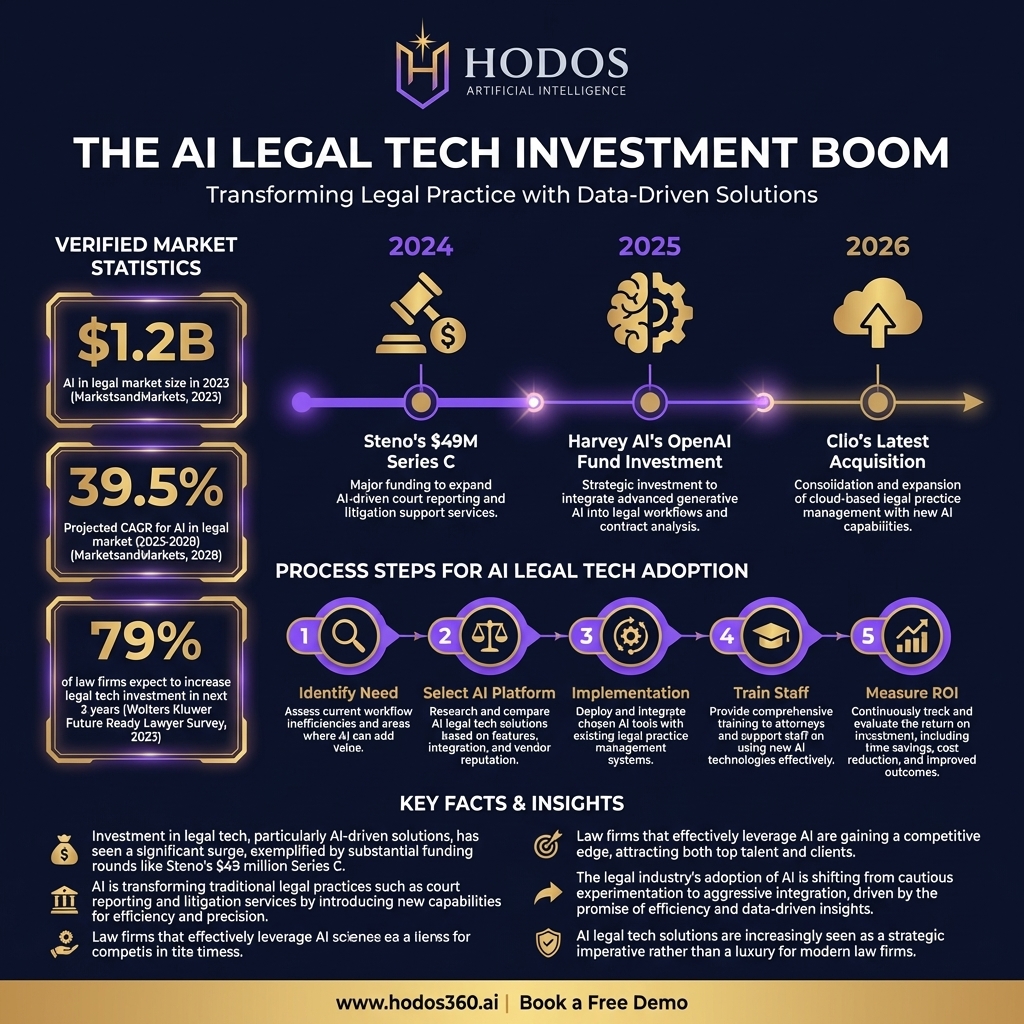
The legal industry stands at a pivotal juncture, where technological innovation, particularly in artificial intelligence, is no longer a luxury but a strategic imperative. The recent announcement from TipRanks, detailing Steno's impressive $49 million Series C funding round, serves as a powerful testament to this reality.
This substantial capital injection, aimed at accelerating Steno's AI-driven legal tech expansion and deepening its reach into the AmLaw 200, is more than just a win for one company; it's a resounding vote of confidence from investors in the transformative power of AI legal tech.
This investment reflects a broader market trend where firms that can effectively leverage AI to streamline operations, enhance client services, and drive efficiency are commanding significant attention and resources. The narrative is shifting from cautious experimentation to aggressive adoption, with real dollars backing the promise of a more efficient, accessible, and data-driven legal future.
This isn't merely about automating mundane tasks; it's about fundamentally reshaping how legal services are delivered and managed. From the meticulous precision required in court reporting to the complex strategies of litigation services, AI is introducing capabilities that were once the realm of science fiction.
The legal landscape is now defined by the tension between traditional practices and the disruptive force of innovation. Firms that embrace this wave of AI innovation are poised to gain a significant competitive advantage, attracting top talent and clients alike. As we unpack the implications of Steno's funding and the broader trends in legal tech funding, it becomes clear that understanding and integrating these advanced solutions is essential for any law firm aiming for sustained growth and relevance in the modern legal ecosystem.
The question is no longer *if* AI will impact your practice, but *how* quickly and effectively you will adapt to its undeniable influence. Ready to explore how these advancements can empower your firm? Discover how AI legal tech can redefine your practice.
The AI Legal Tech Investment Boom: Steno's $49M Series C and Beyond
Steno's $49 million Series C funding round is a significant marker in the ongoing AI legal tech revolution. Led by Savano Capital Partners, this investment brings Steno's total funding to nearly $100 million, following a $46 million raise in 2024. Steno, founded by CEO Greg Steno and CTO Daniel Simon, has rapidly built a reputation for its AI-powered court reporting and litigation support platform, which promises greater efficiency and accuracy than traditional methods.
Their expansion strategy, fueled by this capital, targets deeper penetration into large law firms and broader geographical coverage across the US. This move highlights a crucial shift in investor sentiment: capital is now flowing aggressively into legal tech companies that demonstrate tangible solutions to long-standing industry inefficiencies, particularly in high-volume, data-intensive areas like discovery and depositions.
The market is rewarding innovation that directly addresses the pain points of legal professionals.
This funding trend extends far beyond Steno. Learn more about AI Legal Revolution: Corporate Use Jumps 87% by 2026. Consider Harvey AI, an AI-powered legal assistant startup that secured a significant investment from OpenAI's startup fund, spearheaded by Sam Altman himself.
Harvey, co-founded by Winston Weinberg and Gabriel Pereyra, has already forged a strategic partnership with global law firm Allen & Overy, demonstrating how cutting-edge AI is being adopted by the legal elite. Similarly, Clio, under the leadership of CEO Jack Newton, has consistently attracted substantial investment rounds, enabling it to acquire companies like Lawyaw and further solidify its position as a leading provider of cloud-based law firm management solutions.
These examples illustrate a clear pattern: investors, from venture capitalists to strategic partners, are recognizing the immense potential for return on investment in companies that provide scalable, AI-driven tools that enhance legal practice. The competition is fierce, and firms that hesitate to engage with these platforms risk being outmaneuvered by more agile, tech-forward competitors.
Revolutionizing Court Reporting and Litigation Services with AI
The infusion of capital into companies like Steno directly translates into advancements in critical areas like court reporting and litigation services. Traditionally, these fields have been labor-intensive, reliant on human transcriptionists and manual processes. AI is fundamentally changing this paradigm. Steno's platform, for instance, leverages proprietary AI models to enhance the accuracy and speed of transcript generation, often integrating real-time speech-to-text conversion and speaker identification.
This technology not only reduces the turnaround time for depositions and court proceedings but also minimizes the potential for human error, ensuring a more reliable record. The impact extends to exhibit management, where AI can automatically categorize, tag, and cross-reference documents, making the discovery process significantly more efficient.
As noted by legal tech analyst Bob Ambrogi, the shift from reactive, manual processes to proactive, AI-assisted workflows is one of the most significant transformations in legal operations in decades.
Furthermore, the application of AI in litigation services is evolving rapidly. Learn more about Essential AI Website Builder Guide for Law Firms.
Beyond transcription, AI tools are now capable of sophisticated document review, identifying relevant clauses, anomalies, and potential risks in vast datasets far quicker than human attorneys. Predictive analytics, powered by machine learning, can analyze past case outcomes, judicial tendencies, and opposing counsel strategies to provide data-driven insights for case strategy.
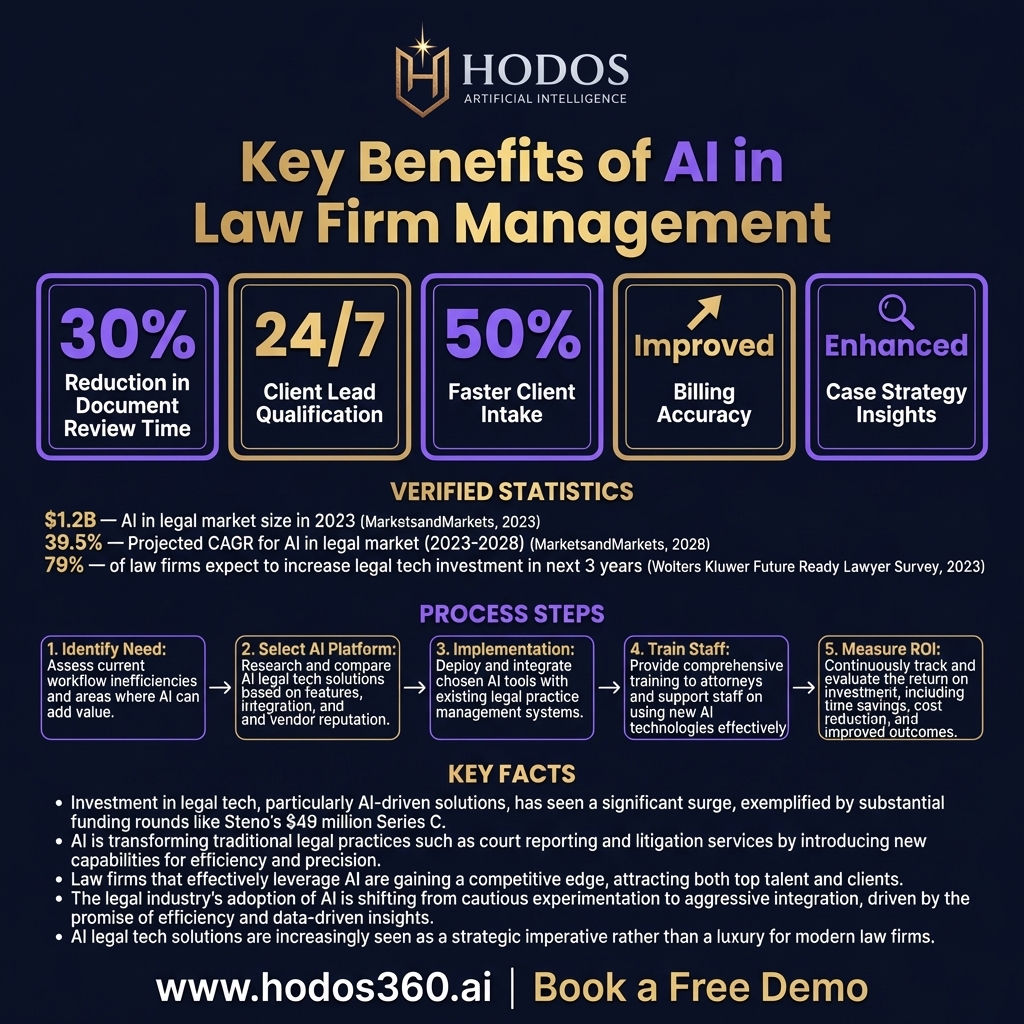
This empowers litigators to make more informed decisions, allocate resources more effectively, and even anticipate potential challenges. For example, a report by Thomson Reuters Legal showed that firms adopting AI for e-discovery saw a 30% reduction in review time and costs. This represents a tangible competitive advantage for firms, enabling them to offer more cost-effective services to clients while maintaining or even improving the quality of their legal work.
The legal profession is witnessing a redefinition of competence, where proficiency with advanced AI-driven solutions is becoming as critical as traditional legal acumen.
Transforming Law Firm Management with AI-Powered Platforms
The impact of AI legal tech extends deeply into the operational core of law firms, fundamentally transforming law firm management. Comprehensive platforms are emerging that integrate various administrative and practice-oriented functions, leveraging AI to enhance efficiency and decision-making. These systems go beyond basic case management; they offer AI-powered legal workflows that can automate client intake processes, from initial inquiry to conflict checks and retainer agreements.
This reduces administrative overhead, accelerates client onboarding, and ensures compliance with firm policies and regulatory requirements. Billing, a traditionally time-consuming and often contentious aspect of legal practice, is also being revolutionized. AI can analyze time entries, suggest appropriate billing codes, and even predict potential billing disputes, allowing firms to optimize revenue cycles and improve financial transparency.
According to the 2024 ABA Legal Technology Survey Report, nearly 60% of surveyed firms reported exploring or implementing AI tools for practice management, a significant jump from previous years.
Document automation is another area where AI is proving invaluable. Learn more about AI Marketing: Essential Strategies for Law Firm Growth.
Instead of manually drafting standard agreements, pleadings, or contracts, attorneys can use AI-powered tools to generate highly customized documents from templates, significantly reducing drafting time and ensuring consistency and accuracy. This frees up valuable attorney time to focus on complex legal analysis and client strategy, rather than repetitive administrative tasks.
Calendar and deadline management also benefit immensely from AI, with systems capable of proactively identifying potential conflicts, sending smart reminders, and integrating with court calendars to prevent missed deadlines—a critical aspect of risk management. For example, a firm using an integrated AI law firm management system can automatically generate a series of tasks and deadlines upon opening a new case, assign them to relevant team members, and track progress, all while flagging potential bottlenecks.
This holistic approach to practice management empowers firms to operate with unprecedented agility and precision, ensuring that legal teams are always informed and organized, ultimately leading to better client outcomes and a more profitable practice. Unlock the full potential of your firm with HODOS 360's AI Law Firm Management System.
Expanding Horizons: AI's Impact on Legal Marketing and Client Engagement
The influence of AI legal tech is not confined to internal operations; it is dramatically reshaping how law firms attract, engage, and retain clients. The rise of sophisticated AI marketing platforms is enabling firms to craft highly targeted campaigns, generate compelling content, and optimize their digital presence with unprecedented effectiveness.
AI-powered video creation tools allow firms to produce professional marketing videos without extensive resources, while social media automation ensures a consistent and engaging online presence. Content generation AI assists in drafting blog posts, articles, and website copy, ensuring SEO optimization and relevance. Crucially, these platforms offer advanced analytics and ROI tracking, allowing firms to measure the effectiveness of their marketing spend and refine strategies in real-time.
This data-driven approach marks a significant departure from traditional, often speculative, legal marketing efforts, making client acquisition more predictable and efficient. Firms that leverage these tools are seeing measurable increases in lead generation and client conversion, as demonstrated by early adopters at events like LegalTech NYC 2026, where discussions around AI-driven client acquisition dominated the agenda.
Beyond marketing, AI Voice Assistants are transforming the initial points of client contact. These 24/7 virtual receptionists can answer calls, qualify leads based on predefined criteria, and even book appointments directly into attorneys' calendars, all with multilingual support. Learn more about Legal AI Divide: Bridge the Gap, Thrive in 2026's Digital Era.
This ensures that potential clients receive immediate attention, regardless of time zone or language, providing a superior client experience from the very first interaction. For a busy law firm, this means fewer missed opportunities and a more efficient allocation of administrative staff. Furthermore, AI-powered Web & Mobile Development platforms are enabling firms to build highly responsive, SEO-optimized websites with high-converting templates, ensuring a strong digital storefront that captures client interest.
These tools analyze user behavior to continuously improve site performance and user experience. The integrated nature of these services, from initial lead generation to seamless client intake, represents a holistic approach to growth that was unimaginable just a few years ago. This comprehensive approach to client engagement, driven by AI-driven solutions, is rapidly becoming the benchmark for competitive law firms.
Here's how integrated AI platforms are redefining growth for law firms:
* Automated Client Intake: Streamlines the onboarding process, reducing administrative burden and improving client experience. * Targeted Marketing Campaigns: AI analyzes data to identify ideal client segments, increasing lead quality and conversion rates. * 24/7 Client Support: AI Voice Assistants ensure no potential client call is missed, providing immediate, multilingual assistance.
* Enhanced Document Generation: Drastically cuts down drafting time for standard legal documents, improving accuracy and consistency. * Optimized Billing & Case Management: AI predicts billing disputes and automates task assignment, boosting financial health and operational efficiency. * Superior Digital Presence: AI-powered web development creates high-converting, SEO-optimized websites and mobile experiences.
* Data-Driven Insights: Analytics tools provide actionable intelligence on marketing ROI and firm performance.
Ethical Considerations and the Future of AI in Legal Practice
While the benefits of AI legal tech are undeniable, the rapid pace of innovation necessitates a careful consideration of ethical implications. The legal profession, bound by stringent ethical codes, must navigate issues such as client confidentiality, data privacy, algorithmic bias, and the duty of competence.
The ABA Model Rules of Professional Conduct, specifically Model Rule 1.1 (Competence), obligates lawyers to keep abreast of changes in the law and its practice, including the benefits and risks associated with relevant technology. This means attorneys have an ethical duty to understand how AI tools work, their limitations, and how to use them responsibly to avoid potential malpractice or ethical breaches.
For instance, relying solely on an AI for legal research without human oversight could lead to inaccurate advice, as highlighted in recent court cases where generative AI produced fabricated citations.
Furthermore, concerns about data privacy and security are paramount, particularly when client sensitive information is processed by AI systems.
Firms must ensure that any AI-driven solutions they adopt comply with regulations like the GDPR or CCPA, and that vendors have robust security protocols. Learn more about AI Marketing Platform Elevates Law Firms in 2026. The potential for algorithmic bias, where AI systems perpetuate or amplify existing societal biases present in their training data, also poses a significant ethical challenge, especially in areas like predictive policing or sentencing.
The forthcoming enforcement of the EU AI Act, with its tiered risk-based approach, underscores the global push for responsible AI development and deployment. Legal professionals are uniquely positioned to not only adopt these technologies but also to help shape the regulatory frameworks that govern their use, ensuring that AI innovation serves justice rather than undermining it.
This requires a proactive, informed approach to technology integration and a commitment to continuous ethical scrutiny.
Strategic Adoption: Implementing AI Solutions for Sustainable Growth
For law firms looking to capitalize on the opportunities presented by AI legal tech, strategic adoption is paramount. It’s not enough to simply purchase an AI tool; successful integration requires a thoughtful, phased approach. Firms should begin with pilot programs focused on specific, high-impact areas where AI can demonstrate immediate value, such as document review for a particular practice group or automating initial client intake.
This allows for testing, refinement, and building internal champions before a broader rollout. Training is also critical; attorneys and staff need to understand not only *how* to use the tools but *why* they are beneficial and how they fit into the firm's overall strategy. This addresses potential resistance to change and fosters a culture of innovation.
As Sarah Chen, Managing Partner at Apex Legal Group, recently stated at a legal tech summit, "Our firm's successful AI integration wasn't just about the software; it was about empowering our people to embrace a new way of working, understanding that AI is a co-pilot, not a replacement."
Moreover, firms should prioritize integrated solutions over disparate tools. Learn more about AI Legal Research: The Ultimate Guide to legalgain & Beyond. A comprehensive platform that seamlessly connects case management, billing, document automation, and marketing functions offers far greater efficiencies than a collection of standalone applications.
This reduces data silos, improves workflow continuity, and provides a unified view of firm operations. For example, an integrated system can automatically update a client's billing record when a task is completed in the case management module, or trigger a follow-up marketing campaign based on client interaction data.
This holistic approach to AI-driven solutions ensures that the firm's technological infrastructure supports its strategic goals, rather than creating new complexities. The initial investment in a robust AI law firm management system may seem significant, but the long-term returns in efficiency, client satisfaction, and competitive advantage far outweigh the costs, especially as the legal market continues to evolve at an accelerated pace.
Cultivating a Culture of Innovation and Continuous Learning
The dynamic nature of AI legal tech means that successful adoption is an ongoing journey, not a one-time implementation. Firms must cultivate a culture of continuous learning and adaptation to stay ahead of the curve. This involves encouraging legal professionals to engage with emerging technologies, participate in legal tech communities, and attend industry conferences like those hosted by the American Bar Association's TECHSHOW.
Investing in ongoing professional development related to AI tools and their ethical use is crucial. Firms can establish internal innovation committees or designate 'AI champions' to explore new applications and disseminate best practices. This proactive engagement ensures that the firm not only keeps pace with technological advancements but also identifies new opportunities for service delivery and operational improvement.
The future of legal practice will be defined by those who are not just users of technology, but active participants in its evolution, constantly seeking ways to leverage AI-driven solutions to better serve their clients and enhance their practice. The legal profession's commitment to justice and client advocacy is now intertwined with its capacity for technological agility.

Key Takeaways: Charting a Course in the AI-Driven Legal Landscape
The significant funding flowing into companies like Steno underscores a fundamental truth: AI legal tech is no longer a peripheral trend but the central current shaping the future of legal practice. From revolutionizing court reporting and litigation services to transforming law firm management and client engagement, AI offers unprecedented opportunities for efficiency, growth, and competitive advantage.
However, realizing these benefits demands a strategic, informed, and ethically grounded approach to adoption. Firms must move beyond passive observation to active implementation, understanding that the integration of AI-driven solutions is a continuous journey requiring investment in technology, training, and a culture of innovation.
The firms that will thrive in this evolving landscape are those that embrace comprehensive, integrated AI platforms, carefully navigate the ethical complexities, and commit to continuous learning.
By doing so, they can not only streamline operations and enhance profitability but also elevate the quality of legal services they provide. The opportunity to redefine legal practice is here, powered by intelligent technology. **Ready to transform your law firm with leading AI legal tech solutions?
Schedule a consultation with HODOS 360 today to explore our comprehensive suite of services.**
Frequently Asked Questions
What is AI legal tech?+
AI legal tech refers to artificial intelligence applications designed to assist legal professionals and enhance law firm operations. This includes tools for document automation, legal research, case management, predictive analytics, and virtual assistants. The goal is to improve efficiency, accuracy, and accessibility of legal services, allowing attorneys to focus on complex, high-value tasks.
How does recent AI funding impact law firms?+
Significant AI funding, like Steno's $49 million Series C, validates the market demand for advanced legal technology. This capital fuels further innovation, leading to more sophisticated and accessible AI tools for law firms. It drives competition among tech providers, ultimately benefiting firms by offering better solutions for efficiency, growth, and client service in areas like litigation support and practice management.
What are the key benefits of AI in law firm management?+
AI in law firm management offers numerous benefits, including automated client intake, streamlined billing processes, enhanced document automation, and intelligent calendar management. These tools significantly reduce administrative burdens, improve operational efficiency, minimize human error, and free up attorneys' time for high-value legal work. This leads to better resource allocation and improved profitability.
Are there ethical concerns with AI in law?+
Yes, ethical concerns are crucial. Lawyers must adhere to ABA Model Rule 1.1 (Competence), understanding AI's capabilities and limitations. Key issues include client confidentiality, data privacy, algorithmic bias in decision-making, and the potential for AI to generate inaccurate information. Firms must implement AI responsibly, ensuring human oversight and compliance with ethical guidelines and emerging regulations like the EU AI Act.
How can my law firm effectively adopt AI technology?+
Effective AI adoption involves a strategic approach: start with pilot programs in high-impact areas, provide comprehensive training for staff, and prioritize integrated solutions over disparate tools. Foster a culture of continuous learning and innovation. Engage with legal tech communities and stay updated on advancements. This ensures seamless integration, maximizes benefits, and minimizes disruption, positioning your firm for sustainable growth.