


AI Operational Intelligence: The Essential Shift for Law Firms
In an increasingly competitive legal landscape, the recent announcement of Billables AI securing a $10 million Series A funding round, as reported by LawSites, isn't just another headline about a legal tech startup; it's a profound signal of a paradigm shift. This substantial investment, led by prominent venture capital firms, underscores a critical realization across the legal industry: AI operational intelligence is no longer a luxury but an essential competitive differentiator.
For years, law firms, from boutique practices to global giants like Latham & Watkins, have grappled with the inefficiencies embedded in traditional case management, client intake, and billing processes. The promise of AI has always loomed, but now, with significant capital flowing into companies like Billables AI, that promise is rapidly materializing into tangible solutions that redefine how legal services are delivered and managed.
This latest funding milestone for Billables AI, a company focused on accelerating AI-powered operational intelligence for law firms, reflects a broader market trend. Investors are keenly aware of the massive potential for efficiency gains and cost reductions that advanced AI platforms can offer. As legal professionals navigate the complexities of modern practice, from managing vast document repositories to ensuring compliance with evolving regulations, the demand for sophisticated tools that can automate routine tasks, provide actionable insights, and optimize resource allocation has never been higher.
The journey towards a truly intelligent law firm operation is accelerating, driven by both technological advancements and the strategic investments that empower innovators to bring these solutions to market. This pivotal moment compels every firm to consider its future readiness in an AI-driven world.
The legal industry's embrace of AI has evolved significantly beyond basic e-discovery or predictive coding. Today, the focus is on integrating AI across the entire operational spectrum, creating a seamless, intelligent ecosystem that optimizes every touchpoint of a law firm's workflow. The Billables AI funding round, for instance, highlights the increasing importance of AI-powered tracking and analytics to provide granular insights into firm performance, resource utilization, and profitability.
This isn't merely about automating time entries; it’s about leveraging machine learning to identify bottlenecks, forecast future demands, and even predict case outcomes based on historical data. Firms that adopt these advanced systems, such as the AI Law Firm Management System offered by HODOS 360, gain a distinct advantage by transforming raw data into strategic intelligence.
This shift is echoed by industry leaders like Benjamin Alarie, CEO of Blue J Legal, who frequently emphasizes the necessity of data-driven insights for modern legal practice, moving beyond intuition to empirically validated strategies. The goal is to build a resilient, agile firm capable of adapting to market changes and client expectations with unprecedented speed and precision.
The investment in companies like Billables AI is a clear signal that the market values platforms that offer this depth of operational insight, pushing the legal sector further into an era of data-centric decision-making.
The human element, however, remains paramount in this technological evolution. Learn more about AI Legal Plugins: The Ultimate Guide to Anthropic's Impact.
While AI can process vast amounts of information and automate repetitive tasks, the strategic judgment, ethical considerations, and client empathy of experienced attorneys are irreplaceable. The aim of AI operational intelligence is not to replace lawyers but to augment their capabilities, freeing them from administrative burdens to focus on high-value legal work.
This symbiotic relationship is crucial for successful AI integration. According to the 2023 ABA Legal Technology Report, firms reporting higher satisfaction with their tech investments often cited effective training and a clear strategy for human-AI collaboration. This means that while a startup like Billables AI raises millions to enhance its platform, the real-world impact depends on how law firms integrate these tools into their existing culture and workflows.
Firms that champion a culture of continuous learning and adaptability, like those highlighted in reports by Thomson Reuters on the 'Future of Legal,' are better positioned to leverage these advancements. The tension between tradition and disruption creates a compelling narrative within the legal tech space, with firms that embrace change often seeing significant gains in both efficiency and client satisfaction, while those hesitant risk falling behind in a rapidly evolving market.
Beyond Billables: Comprehensive AI Management for Modern Firms
The narrative around Billables AI's funding round underscores a broader truth: the legal tech market is maturing, moving beyond single-point solutions to integrated platforms that offer comprehensive AI management. This evolution means that law firms are no longer looking for just an AI tool for document review or legal research; they seek holistic systems that can streamline operations from end-to-end.
Think of the transition from fragmented software to integrated enterprise resource planning (ERP) systems in other industries. In legal, this translates to AI-powered platforms handling everything from streamlined client intake and conflict checks to robust case management, automated billing, and sophisticated document generation. The aim is to create a unified operational backbone that minimizes manual intervention, reduces errors, and provides a single source of truth for all firm data.
Firms like Allen & Overy, in their partnership with Harvey AI, have demonstrated the immense potential of such integration, not just in legal research but in automating complex legal tasks that traditionally consumed significant billable hours. This integrated approach is essential for firms looking to scale efficiently and maintain competitiveness in a market where clients demand greater transparency and value.
This comprehensive vision is what platforms like HODOS 360’s AI Law Firm Management System are designed to deliver, offering a suite of services that include AI-powered legal workflows, calendar management, and robust reporting, all designed to optimize every facet of a firm's operations.
The current wave of innovation, exemplified by the $10 million Billables AI raise, is not just about automating existing processes; it's about reimagining them entirely.
Learn more about AI Legal Tech Boom 2026: Unlocking Billions in Valuation. For example, traditional client intake, often a time-consuming and error-prone process, can be transformed by AI that gathers information, performs preliminary conflict checks, and even drafts initial engagement letters. Billing, historically a source of contention and administrative overhead, can be made more transparent and accurate through AI that automatically logs activities and generates detailed invoices, often with predictive analytics to optimize pricing strategies.
Furthermore, AI-powered legal workflows can guide attorneys through complex procedures, ensuring compliance and consistency across cases. This level of operational intelligence allows firms to not only save time and money but also to enhance the quality of their legal services, ultimately improving client satisfaction and retention.
The insights derived from such integrated systems can inform strategic decisions, from staffing and resource allocation to identifying new market opportunities. This comprehensive approach differentiates leading legal tech companies in a crowded market, moving them beyond niche applications to becoming indispensable partners in a firm’s growth trajectory.
- ✓Automated Case Management: AI organizes documents, tracks deadlines, and provides proactive alerts, ensuring no detail is overlooked.
- ✓Intelligent Billing & Time Tracking: AI accurately captures billable hours, automates invoice generation, and offers predictive insights into financial performance.
- ✓Enhanced Client Intake: AI streamlines data collection, conducts conflict checks, and personalizes client onboarding experiences.
- ✓Document Automation & Generation: AI drafts standard legal documents and contracts, significantly reducing manual effort and potential errors.
- ✓AI-Powered Legal Workflows: AI guides legal teams through complex processes, enforcing best practices and ensuring consistent execution.
- ✓Predictive Analytics for Operations: AI analyzes historical data to forecast workload, optimize resource allocation, and identify areas for efficiency improvement.
The Data-Driven Advantage: Unlocking Deeper Insights
The true power of AI operational intelligence lies in its ability to transform raw operational data into actionable insights. This isn't merely about presenting metrics; it's about using machine learning algorithms to identify patterns, predict future trends, and recommend optimal courses of action. For instance, an AI platform can analyze historical billing data to identify which types of cases are most profitable, which clients require the most administrative overhead, or where inefficiencies in legal workflows frequently occur.

Firms can then use these insights to refine their business strategy, optimize pricing models, and reallocate resources more effectively. Companies like Billables AI, with their focus on operational intelligence, are at the forefront of this data revolution, enabling firms to make decisions based on empirical evidence rather than anecdotal experience.
This data-driven approach is increasingly critical in a competitive market, as highlighted by reports from Gartner, which consistently emphasize the importance of data analytics for business growth across all sectors. Law firms that effectively harness their operational data gain an unparalleled understanding of their own performance, allowing for continuous improvement and strategic positioning in the legal market.
This level of granular insight was once the exclusive domain of large corporations with dedicated analytics teams, but AI is democratizing it for law firms of all sizes.
Beyond internal optimization, data-driven insights from AI operational intelligence also enhance client service. Learn more about Proven Strategy: AI-Built Websites Can Convert for Law Firms.
By understanding past project timelines, costs, and outcomes, firms can provide more accurate estimates and greater transparency to clients, building trust and strengthening relationships. For example, if an AI system identifies that a particular type of litigation consistently exceeds initial time estimates due to specific discovery challenges, the firm can proactively communicate this to new clients, manage expectations, and even devise alternative strategies.
This proactive, informed approach transforms the client experience from reactive to predictive. Furthermore, AI can help identify emerging legal trends or changes in regulatory landscapes by analyzing vast datasets, allowing firms to anticipate client needs and develop new service offerings. This forward-looking capability is a significant competitive advantage, enabling firms to stay ahead of the curve and provide truly strategic counsel.
The infusion of million-dollar funding into legal tech startups like Billables AI signifies a collective belief that these data-driven capabilities are not just desirable but indispensable for the future success of law firms, promising a future where legal operations are as sophisticated and insightful as the legal advice itself.
The Investment Landscape: Fueling Legal Tech Innovation
The $10 million Series A round for Billables AI is part of a larger, vibrant investment trend in legal technology. Venture capital firms are increasingly recognizing the untapped potential within the legal sector, which, despite its traditional nature, is ripe for technological disruption. This isn't an isolated incident; we've seen significant funding announcements across the board, from Clio's remarkable valuation after multiple rounds of investment to the substantial capital raised by companies like Harvey AI, which secured a significant investment led by Sequoia Capital to expand its AI platform for legal professionals.
These investments signal a strong market confidence in the ability of AI to fundamentally reshape legal practice, moving beyond incremental improvements to transformative change. The competition in this space is fierce, with numerous startups vying to offer the most compelling solutions for law firms. This competitive environment, driven by substantial capital, pushes innovators to develop more sophisticated, user-friendly, and impactful platforms.
The narrative often unfolds with a degree of human conflict, as legacy providers, entrenched in traditional models, face mounting pressure from agile, AI-native companies that promise superior efficiency and insights at a fraction of the cost. The drama of disruption versus tradition is playing out in real-time, with law firms often caught in the middle, evaluating which solutions offer the most tangible return on investment and long-term strategic advantage.
This influx of capital is not just about financial backing; it's about accelerating the pace of innovation. The funds raised by companies like Billables AI enable them to expand their research and development, attract top talent, and scale their operations to meet growing demand. Learn more about Voice Assist: Essential AI Scheduling for Law Firms.
This means more sophisticated algorithms, more intuitive user interfaces, and broader integration capabilities for law firms. For example, the development of advanced natural language processing (NLP) models, crucial for understanding complex legal texts, requires substantial resources. The investment community’s belief in these legal tech startups is a testament to the transformative power of AI.
Firms that were early adopters, such as those that partnered with ROSS Intelligence in its nascent stages, often gained a milestone advantage in terms of efficiency and market positioning. While ROSS ultimately faced its own challenges, its early impact highlighted the hunger for AI. Now, the market is more mature, and the solutions are more robust.
This wave of funding ensures that the legal tech sector will continue to push the boundaries of what’s possible, introducing innovations that were once considered futuristic into the everyday operations of law firms. The ongoing competition among these well-funded companies ultimately benefits the end-user – the law firm – by driving the development of increasingly powerful and accessible AI tools.
Mitigating Implementation Challenges: A Strategic Approach
Despite the undeniable potential, integrating AI operational intelligence into a law firm is not without its challenges. The primary hurdles often revolve around data migration, system interoperability, and user adoption. Law firms typically possess vast amounts of legacy data stored in disparate systems, making the consolidation and cleaning of this data a significant undertaking.
Moreover, ensuring that new AI platforms can seamlessly integrate with existing practice management software, accounting systems, and document management solutions is crucial. Firms must carefully plan their implementation strategy, often beginning with pilot programs in specific departments or for particular case types to demonstrate value and build internal champions.
A key lesson from early AI adopters, as documented by the ABA's annual tech surveys, is the importance of a phased rollout and robust training programs. Without adequate training, even the most sophisticated AI tools, like those developed by companies that have raised millions in funding, risk underutilization or even rejection by busy legal professionals.
The human conflict arises when traditionalists resist new technologies, viewing them as threats rather than aids. Overcoming this requires strong leadership, clear communication about the benefits, and active involvement from attorneys in the selection and customization of AI tools. Learn more about WordPress AI Unlocked: Legal Websites Mastered 2026.
Firms like Kirkland & Ellis, known for their innovative approaches, often invest heavily in change management alongside technological upgrades to ensure smooth transitions and high adoption rates.
Another significant challenge lies in the ethical considerations surrounding AI, particularly regarding data privacy, confidentiality, and potential biases in algorithms.
As AI operational intelligence systems process sensitive client information, firms must ensure compliance with regulations like GDPR and CCPA, as well as professional obligations under rules such as ABA Model Rule 1.6 (Confidentiality of Information). The potential for algorithmic bias, while less directly impactful in operational intelligence than in client-facing legal advice, still requires careful monitoring to ensure fair and equitable outcomes in resource allocation, staffing decisions, or performance reviews.
This necessitates transparent AI design and continuous oversight by human experts. Firms must also establish clear policies for AI use, outlining responsibilities and ensuring accountability. The successful integration of AI is not just a technological feat but a governance challenge, requiring a well-thought-out legal and ethical framework.
This proactive approach ensures that the benefits of AI are realized without compromising a firm's integrity or client trust. The funding flowing into the legal tech startup ecosystem often includes provisions for addressing these complex ethical and compliance issues, demonstrating that investors are aware of these critical considerations.
Strategic Adoption: Integrating AI for Sustainable Firm Growth
For law firms looking to leverage the power of AI operational intelligence for sustainable growth, a strategic and phased adoption approach is crucial. It begins with identifying specific pain points within current operations where AI can deliver the most immediate and measurable impact. This might be in areas like AI-powered video creation for marketing, automating routine document drafting, or optimizing billing and collections processes.
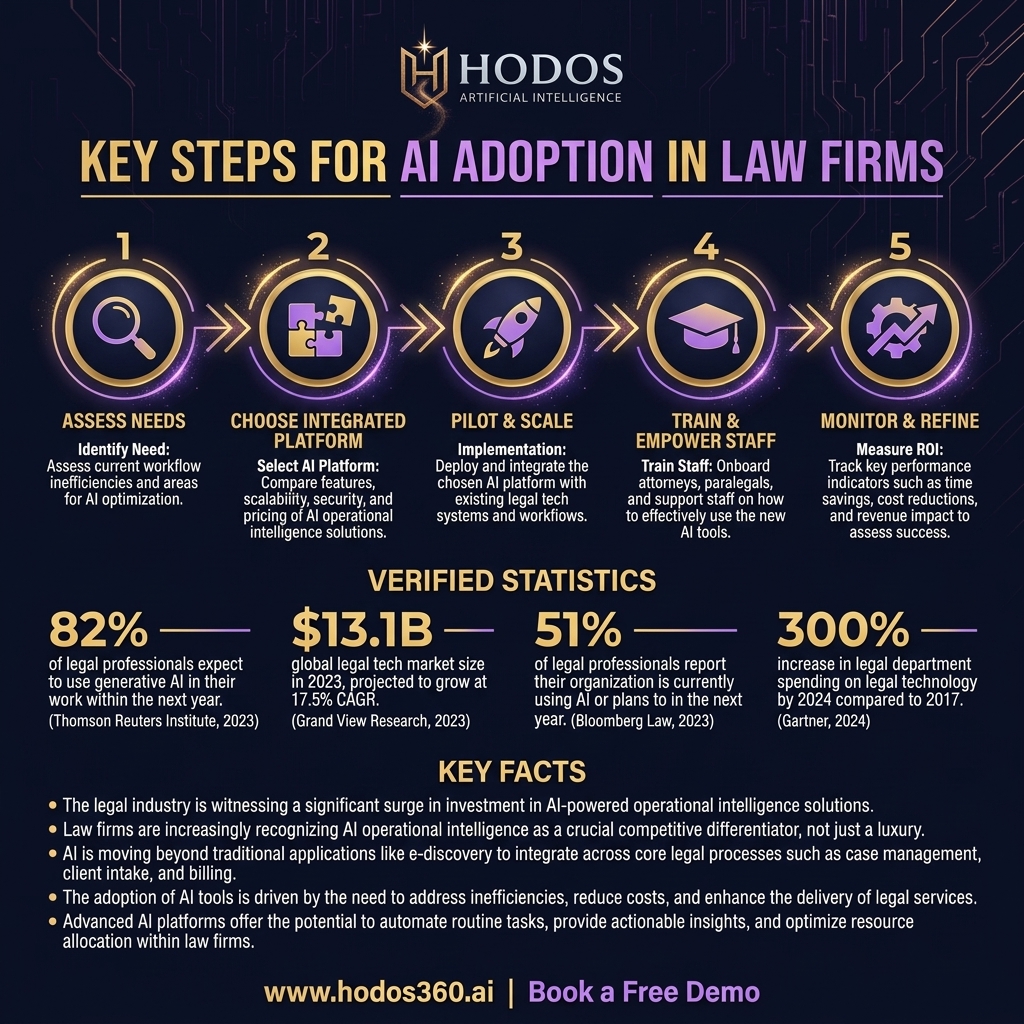
Instead of attempting a firm-wide overhaul at once, starting with a pilot project allows firms to test the technology, gather feedback, and demonstrate tangible ROI. For example, a firm might initially implement AI for document review in a specific practice group, measure the time and cost savings, and then use these results to build a business case for broader adoption.
This incremental approach mitigates risk and builds internal confidence in the technology. Furthermore, selecting the right AI partner is paramount. Firms should look for providers that offer not only robust technology but also strong implementation support, comprehensive training, and continuous updates. The market is filled with companies that have raised significant funding, but not all are created equal in terms of support and long-term vision.
Learn more about AI Software Development's **Revolutionary** 2026 Shift. Engaging with a partner like HODOS 360, which offers a full suite of AI-powered services from law firm management to AI marketing platforms and AI voice assistants, provides a comprehensive solution that can evolve with the firm's needs.
Beyond internal processes, AI also offers immense opportunities for enhancing a firm's external presence and client acquisition. AI marketing platforms, for instance, can analyze market trends, generate targeted content, and automate social media campaigns, significantly boosting a firm's reach and lead generation capabilities. Imagine an AI generating personalized video content for potential clients or automating the scheduling of initial consultations via a 24/7 AI voice assistant.
This level of sophistication in marketing and client engagement, once reserved for large corporations, is now accessible to law firms of all sizes thanks to these innovative platforms. The data generated from these marketing efforts can then feed back into the AI operational intelligence system, providing a holistic view of the firm's performance from lead generation to case completion.
This integrated strategy ensures that growth is not just about increasing caseloads but about optimizing every stage of the client journey. The competition among law firms is intensifying, and those that strategically adopt AI across their operations and client-facing activities will be best positioned to attract and retain top talent and clients, securing a competitive edge in the legal market for years to come.
This proactive embrace of technology is no longer an option but a strategic imperative, echoing the sentiments of legal tech visionaries who advocate for a future where technology is woven into the very fabric of legal service delivery.
The Human Element in AI Integration: Training and Culture
The success of AI operational intelligence hinges not just on the technology itself, but critically on the human element: the attorneys and staff who will use these tools daily. Resistance to change is a natural human tendency, and in a profession often steeped in tradition, overcoming this can be a significant hurdle.
Therefore, a robust training program is non-negotiable. This goes beyond basic software tutorials; it involves demonstrating *how* AI enhances their work, saves them time, and allows them to focus on more intellectually stimulating legal challenges. Firms should invest in continuous education, perhaps even establishing an internal 'AI champion' program where early adopters can guide and mentor their colleagues.
This fosters a culture of innovation and collaboration, turning potential skeptics into advocates. Furthermore, firms must ensure that their legal professionals understand the ethical boundaries and best practices for using AI, especially concerning client confidentiality and data integrity, aligning with principles found in Federal Rules of Civil Procedure Rule 26(b)(1) regarding the scope of discovery and the handling of electronically stored information.
The goal is to empower, not overwhelm, the workforce.
Ultimately, the most successful firms in the age of AI operational intelligence will be those that cultivate a forward-thinking culture that embraces technology as an enabler, not a replacement. This means leadership must actively champion AI initiatives, communicate the strategic vision clearly, and allocate adequate resources for both technology and training.
The narrative of firms that adopted AI early versus those that didn't often highlights a stark contrast in growth trajectories and market share. Those embracing innovation, like those featured at LegalTech NYC, are seeing significant gains, while hesitant firms grapple with outdated processes and declining efficiency.
This isn't just about implementing new software; it's about a fundamental shift in mindset. By fostering an environment where experimentation is encouraged, and continuous learning is valued, law firms can fully harness the power of AI to not only optimize their operations but also to attract and retain top talent, who increasingly expect modern, tech-enabled workplaces.
The $10 million funding received by companies like Billables AI is an investment in this future, but the ultimate ROI depends on the firms' commitment to integrating these tools intelligently and humanely.

Key Takeaways and Next Steps for Forward-Thinking Firms
The substantial funding round for Billables AI is a potent reminder that AI operational intelligence is rapidly becoming the bedrock of competitive legal practice. Firms can no longer afford to view AI as a futuristic concept; it is a present-day imperative for optimizing efficiency, enhancing client service, and ensuring sustainable growth.
The legal landscape is being reshaped by companies that are investing millions into sophisticated platforms designed to automate, analyze, and inform every aspect of law firm operations, from tracking billables to managing complex litigation. For law firm leaders, the immediate next step is not just to observe these trends but to actively engage with them.
This involves a thorough assessment of current operational inefficiencies, a careful evaluation of available AI solutions, and a commitment to strategic implementation.
Embracing AI operational intelligence means moving beyond piecemeal tech solutions to adopt integrated platforms that offer a holistic view of firm performance. It means leveraging tools that can automate routine tasks, provide predictive insights, and free up attorneys to focus on high-value legal work.
For firms ready to make this transformative leap, exploring comprehensive solutions like the AI-powered platform from HODOS 360 can provide a significant advantage. Offering a suite of services from AI Law Firm Management to AI Marketing and AI Voice Assistants, HODOS 360 is designed to empower firms to thrive in this new era.
The future of legal practice is intelligent, data-driven, and client-centric, and the firms that recognize and act on this reality today will be the leaders of tomorrow.
Frequently Asked Questions
What is AI Operational Intelligence in the legal context?+
AI Operational Intelligence in legal refers to the use of artificial intelligence to optimize and streamline various aspects of a law firm's daily operations. This includes automating tasks like case management, billing, client intake, and document processing, while also providing data-driven insights to improve efficiency, resource allocation, and overall firm performance. It moves beyond simple automation to intelligent, predictive management.
How does AI operational intelligence benefit law firms?+
AI operational intelligence offers numerous benefits: increased efficiency through automation of routine tasks, reduced administrative overhead, improved accuracy in billing and document generation, enhanced client satisfaction via faster service and greater transparency, and strategic insights for better decision-making. It enables firms to allocate resources more effectively and focus attorneys on high-value legal work, fostering sustainable growth.
What kind of AI systems are included in comprehensive AI management platforms?+
Comprehensive AI management platforms typically include systems for case management, client intake and onboarding, automated billing and time tracking, document automation and generation, legal research, and AI-powered workflow orchestration. Some also integrate AI marketing tools and AI voice assistants for client communication and lead qualification, creating a truly holistic operational ecosystem for law firms.
Is AI operational intelligence only for large law firms?+
No, AI operational intelligence is increasingly accessible and beneficial for law firms of all sizes. While large firms may have more complex data, boutique and mid-sized firms can achieve significant efficiency gains and competitive advantages by adopting these technologies. Many AI platforms are scalable and offer flexible pricing models, making them viable for smaller practices seeking to optimize their operations.
What are the key considerations for implementing AI in a law firm?+
Key considerations include a clear strategy for identifying pain points, selecting a reputable AI provider, ensuring data security and privacy compliance, and investing in robust training and change management programs for staff. It's crucial to foster a culture that embraces technology, addresses ethical implications, and views AI as an augmentation to human expertise rather than a replacement, ensuring successful adoption.