


AI Pressure for Legal CIOs: Ultimate Guide to Digital Transformation
The year 2026 marks a profound turning point for legal Chief Information Officers. For years, the legal industry, known for its measured pace, largely observed the nascent stages of artificial intelligence with a mix of cautious optimism and outright AI denial. Many CIOs, grappling with legacy systems and tight budgets, often relegated AI to the realm of futuristic speculation rather than immediate strategic imperative. This sentiment was perhaps best encapsulated by a partner at a prominent AmLaw 100 firm, who, at LegalTech NYC just a few years ago, famously quipped, "AI is for Silicon Valley, not the courtroom." Yet, the ground has shifted dramatically. Today, that same partner, along with countless legal leaders, finds themselves confronting an undeniable and escalating AI pressure for legal CIOs, a fundamental reality that demands immediate and strategic action. The conversation has moved from "if" to "how," and the stakes have never been higher.
This transformative period is not merely a technological upgrade; it represents a fundamental re-evaluation of how legal services are delivered, managed, and monetized. The external forces driving this change are relentless: client demands for efficiency and cost-effectiveness, aggressive competition from tech-forward firms, and the sheer pace of innovation from companies like OpenAI, Anthropic, and Microsoft, whose latest generative AI models are rewriting the rules of knowledge work. Legal CIOs are now on the front lines of this revolution, tasked with steering their firms through complex digital waters, ensuring competitive advantage, and safeguarding client data in an increasingly interconnected world. The challenge is immense, but so too is the opportunity for those who choose to lead rather than follow. It's a problem that requires a proactive, informed, and strategic response, moving beyond past denial to embrace the new reality of AI-driven legal practice.
Ready to transform your law firm's operations and strategy with AI? Discover how advanced legal tech can address the growing AI pressure for legal CIOs and drive unparalleled efficiency. [Explore HODOS 360's AI Solutions Today!]
The Shifting Sands: From AI Denial to Strategic Imperative
For a considerable period, the legal sector exhibited a collective AI denial, rooted in its inherent conservatism and the perceived novelty of artificial intelligence. Many legal CIOs, burdened by the technical debt of aging infrastructure and the complexities of legal compliance, viewed AI as a distant horizon rather than an immediate concern. This cautious stance was often justified by the nascent state of early AI tools, which, while promising, lacked the robust, industry-specific applications required by law firms. The prevailing sentiment echoed the concerns of a climate skeptic twenty years ago, where the problem was acknowledged but its urgency downplayed, creating a significant lag in technological adoption compared to other industries.
However, this period of inertia has abruptly ended. The turning point arrived swiftly, propelled by breakthroughs in generative AI and the mainstream adoption of these technologies. Learn more about Essential AI Marketing Tools: Supercharge Your Law Firm's Growth. Companies like OpenAI, with its GPT series, and Anthropic, with Claude, demonstrated capabilities that transcended simple automation, offering sophisticated reasoning, content generation, and summarization. This seismic shift was underscored by significant industry events, such as Allen & Overy's public partnership with Harvey AI in early 2023, signaling a clear endorsement of generative AI by a global legal powerhouse. This move, along with Microsoft President Brad Smith's repeated emphasis on AI's transformative power at various tech conferences, served as a potent wake-up call, transforming passive observation into urgent strategic planning for legal CIOs globally.
Navigating the New Reality of Legal Tech Adoption
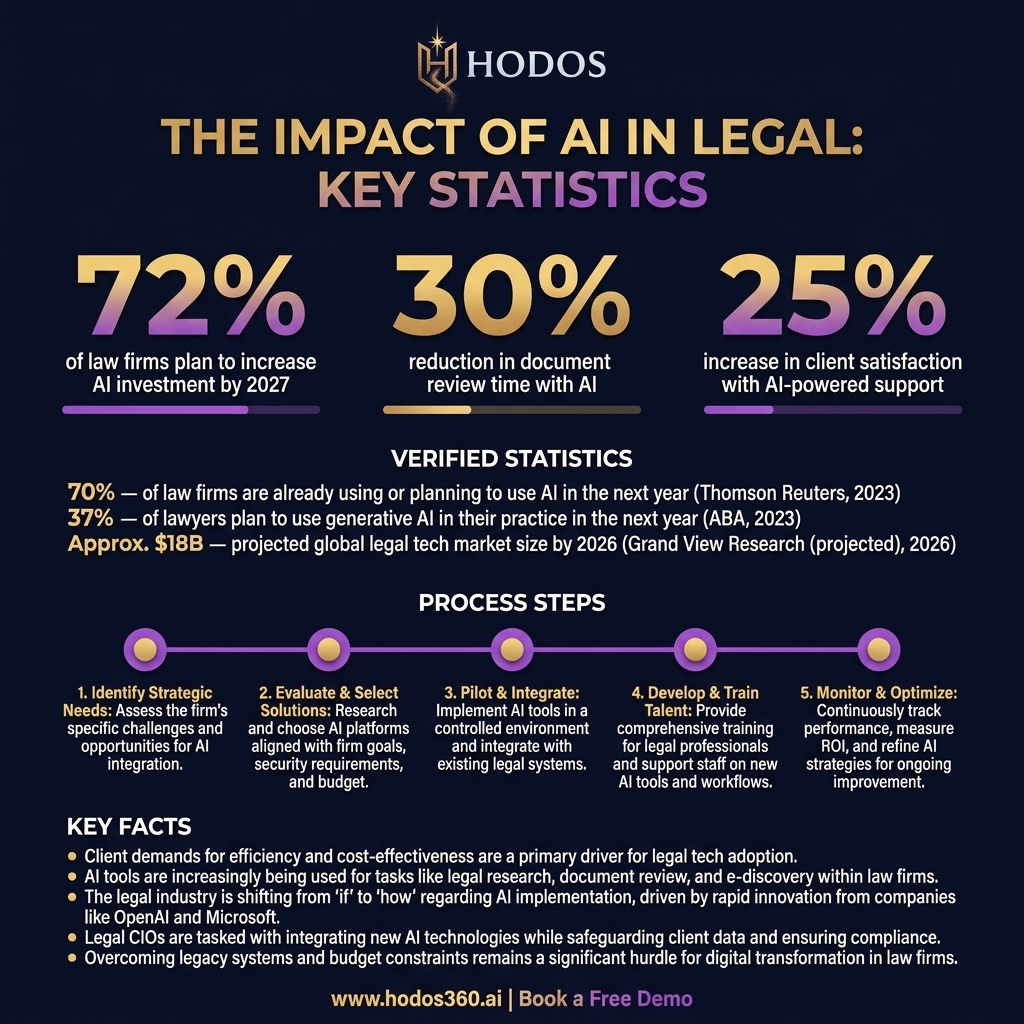
The transition from AI denial to widespread AI pressure for legal CIOs has thrust firms into a new reality where technological adaptation is no longer optional. The internal pressure is mounting from multiple fronts: junior associates, who grew up with advanced technology, expect modern tools; partners recognize the need for competitive edge; and clients demand greater efficiency, transparency, and value for money. According to the ABA TechReport 2025, 72% of surveyed law firms indicated plans to increase their investment in AI technologies over the next two years, a stark contrast to the single-digit figures reported just five years prior. This data highlights a fundamental shift in mindset, driven by the clear benefits AI offers in areas like discovery, contract analysis, and legal research.
Moreover, the threat of inaction is palpable. Firms that hesitate risk falling behind competitors who are already leveraging AI to reduce costs, enhance service delivery, and attract top talent. Learn more about AI Website Design: Essential Prompts for Law Firms. This competitive landscape creates a compelling case for immediate action, transforming the problem of AI adoption into a strategic imperative. Legal CIOs are now tasked with not just implementing technology, but with driving cultural change, managing data governance, and ensuring ethical AI deployment, all while maintaining the firm's operational integrity. The daily advancements in AI capabilities mean that what was considered cutting-edge yesterday is merely standard practice today, making continuous learning and adaptation crucial for sustained success.
Architecting the Future: AI-Powered Law Firm Management
Addressing the intense AI pressure for legal CIOs necessitates a fundamental rethinking of law firm management. AI-powered platforms are revolutionizing core operations, from client intake to case resolution. Consider the traditional pain points: manual data entry, inconsistent workflows, and time-consuming billing processes. AI Law Firm Management Systems, such as the one offered by HODOS 360, directly tackle these challenges. They integrate case management, automate billing, streamline client intake with intelligent forms, and generate documents with unprecedented speed and accuracy. This holistic approach ensures that administrative burdens are significantly reduced, freeing up legal professionals to focus on high-value, strategic work, a critical shift in the reality of legal practice.
The efficiency gains are not merely theoretical; they are quantifiable. Learn more about Law Firm Return on Investment: Maximize AI in 2026. A recent Thomson Reuters Future of Legal Report indicated that firms leveraging AI for document review and contract analysis reported an average reduction of 30-40% in time spent on these tasks. This directly translates to cost savings for clients and increased profitability for firms. AI-powered legal workflows, for instance, can automatically assign tasks, track deadlines, and flag potential issues, minimizing human error and ensuring compliance. This transforms the often-cumbersome process of managing a legal practice into a lean, agile, and highly efficient operation, providing a clear competitive advantage in a market increasingly defined by speed and precision.

Streamlining Workflows with Intelligent Automation
Intelligent automation is at the heart of modern legal operations, offering solutions that go far beyond simple task automation. For CIOs, the opportunity lies in deploying AI to create truly smart legal workflows that adapt and learn. Imagine an AI system that, upon receiving a new client inquiry, not only initiates the intake process but also automatically checks for conflicts, drafts initial engagement letters based on client data, and schedules the first consultation. This level of automation significantly reduces the administrative overhead and accelerates the client onboarding process, improving client satisfaction from the outset.
Furthermore, document automation, powered by generative AI, is transforming how legal documents are drafted and managed. Instead of starting from scratch, attorneys can leverage AI to generate first drafts of contracts, briefs, and motions, which they then review and refine. Learn more about AI Assistant: Essential Tool for Law Firm Staffing Shortages. This drastically cuts down drafting time, allowing more time for strategic analysis and client interaction. However, with this power comes the responsibility of ensuring data security and ethical use. Legal CIOs must implement robust security protocols and adhere to principles of responsible AI, recognizing the importance of human oversight and compliance with regulations like the EU AI Act and professional obligations such as ABA Model Rule 1.6 (Confidentiality of Information).
- ✓Case Management: AI automatically categorizes cases, tracks progress, and identifies critical deadlines.
- ✓Billing & Invoicing: Automated time tracking, expense categorization, and invoice generation reduce errors and improve cash flow.
- ✓Client Intake: AI-powered forms and chatbots streamline initial client interactions, capturing necessary data efficiently.
- ✓Document Automation: Generative AI assists in drafting, reviewing, and organizing legal documents, significantly cutting down manual effort.
- ✓Calendar & Scheduling: AI optimizes meeting schedules, sends reminders, and manages court dates, minimizing conflicts.
- ✓AI-Powered Legal Workflows: Custom intelligent workflows automate repetitive tasks, ensuring consistency and compliance across the firm.
Beyond Operations: Leveraging AI for Growth and Client Engagement
The AI pressure for legal CIOs extends beyond internal operations to encompass external growth and client engagement strategies. In today's competitive market, attracting and retaining clients requires innovative approaches, and AI is proving to be a game-changer. An AI Marketing Platform, for example, can automate social media posting, generate engaging content, and even create AI-powered videos, allowing law firms to maintain a robust online presence without extensive manual effort. This platform also provides sophisticated analytics, enabling firms to track marketing ROI and refine their strategies in real-time. This level of digital sophistication is no longer a luxury but a necessity for firms aiming to stand out.
Client communication and accessibility are also being revolutionized by AI. Imagine a client calling your firm at 2 AM with an urgent query. Traditional firms would rely on voicemail, but AI Voice Assistants offer 24/7 phone answering, lead qualification, and appointment booking. These intelligent assistants can handle routine inquiries, route complex calls to the appropriate human expert, and even provide multilingual support, significantly enhancing client experience. Learn more about Agentic AI Unleashed: 2026's Power in Legal Work. Dario Amodei, CEO of Anthropic, often speaks about the importance of making AI helpful and accessible, a principle that resonates deeply with the need for better client service in legal. This technology not only improves client satisfaction but also frees up valuable staff time, allowing them to focus on substantive legal work.
Finally, a strong digital presence is paramount. AI-powered Web & Mobile Development tools enable firms to build responsive, SEO-optimized websites with high-converting templates quickly and efficiently. These platforms leverage AI to analyze user behavior, suggest content improvements, and ensure the site ranks well on search engines. For legal CIOs, this means ensuring the firm's digital storefront is as professional and effective as its physical one, attracting new clients and reinforcing brand authority. The synergy of these AI-driven services creates a comprehensive ecosystem for growth.
The Human Element: Enhancing, Not Replacing, Legal Expertise
While AI's capabilities are profound, the core of legal practice remains inherently human. The goal of integrating AI is not to replace lawyers but to augment their capabilities, allowing them to perform at an even higher level. Lawyers and legal professionals are amazed daily by the latest AI models that can process vast amounts of data, identify patterns, and generate insights in seconds. This allows them to dedicate more time to critical thinking, strategic planning, client counseling, and courtroom advocacy – tasks that require nuanced judgment, empathy, and creativity. The ethical responsibility of lawyers, as outlined in ABA Model Rule 1.1 (Competence), includes staying abreast of changes in technology. Learn more about Agentic Marketing: The Ultimate Guide for Law Firms. This means understanding AI's potential and limitations, and ensuring its use aligns with professional duties.
For example, while AI can draft a contract, a human lawyer provides the critical judgment to tailor it to specific client needs, negotiate terms, and anticipate unforeseen legal implications. AI's role is to handle the heavy lifting of information processing and preliminary drafting, acting as a highly efficient research assistant and paralegal. This collaboration between human expertise and artificial intelligence defines the future of legal work, creating a more productive, fulfilling, and ultimately, more valuable service for clients. The CIO's role is to facilitate this synergy, providing the tools and infrastructure that empower lawyers to excel in this new era.
Overcoming Implementation Hurdles: A CIO's Blueprint
Navigating the implementation of AI solutions presents its own set of problems for legal CIOs. Common hurdles include significant upfront investment, the challenge of integrating new systems with legacy infrastructure, and resistance to change from within the firm. Budgetary constraints are a frequent concern, but CIOs must frame AI investments not as costs, but as strategic imperatives that deliver substantial long-term ROI through increased efficiency and competitive advantage. This requires a clear business case, demonstrating how AI addresses the AI pressure for legal CIOs by solving real-world challenges and enhancing profitability.
Effective implementation requires a phased approach. Pilot programs, focused on specific departments or practice areas, allow firms to test AI solutions, gather feedback, and demonstrate value before a broader rollout. Training and change management are equally crucial. Lawyers and staff must understand not only how to use the new tools but also *why* they are being implemented and how they will enhance their daily work. This proactive communication helps overcome internal resistance and fosters a culture of innovation. Firms like Clio, with its history of integrating various legal tech solutions, offer valuable lessons in successful adoption strategies, emphasizing user-friendliness and seamless integration.
Selecting the right vendor is paramount. CIOs should seek partners who understand the unique needs of the legal industry, offer robust security features, and provide scalable solutions that can grow with the firm. A strong vendor relationship includes ongoing support, regular updates, and a clear roadmap for future development. By carefully planning, communicating, and partnering with the right technology providers, legal CIOs can transform potential hurdles into stepping stones towards a more innovative and efficient future.
- ✓Strategic Planning: Develop a clear AI strategy aligned with firm goals and client needs.
- ✓Pilot Programs: Start with small, manageable projects to demonstrate value and gather feedback.
- ✓Change Management: Invest in training and communication to ensure firm-wide adoption and address resistance.
- ✓Data Governance: Establish robust policies for data privacy, security, and ethical AI use.
- ✓Vendor Selection: Choose partners with legal industry expertise, proven technology, and strong support.
- ✓Scalability: Ensure chosen solutions can grow and adapt with the firm's evolving needs.
- ✓Continuous Learning: Foster a culture of ongoing education about AI advancements and best practices.

The Path Forward: Embracing AI for Sustainable Legal Success
The transition from AI denial to embracing the AI pressure for legal CIOs is not merely a trend; it is a fundamental shift in the operational and strategic reality of the legal profession. Law firm CIOs are at the vanguard of this transformation, tasked with navigating complex technological landscapes, mitigating risks, and harnessing the immense power of artificial intelligence to drive efficiency, innovation, and client satisfaction. The firms that embrace this challenge proactively, investing in intelligent systems and fostering a culture of technological adoption, will be the ones that thrive in the coming decades. They will not only enhance their competitive position but also redefine the value they bring to their clients.
For CIOs, the path forward involves strategic vision, meticulous planning, and a commitment to continuous innovation. It means moving beyond the problem of legacy systems and embracing the future with tools that empower legal professionals, streamline operations, and enhance client engagement. Platforms that offer comprehensive AI Law Firm Management, AI Marketing, AI Voice Assistants, and Web & Mobile Development capabilities provide a holistic solution to these evolving demands. The opportunity to lead this change is immense, promising not just survival, but unprecedented growth and sustainable success in a rapidly evolving legal market. Don't let the threat of inaction define your firm's future. [Request a Free Demo of HODOS 360 Today!]
Frequently Asked Questions
What is driving the increased AI pressure for legal CIOs?+
The pressure stems from client demands for efficiency and cost-effectiveness, heightened competition from tech-forward firms, and rapid advancements in generative AI from companies like OpenAI. Legal CIOs must now strategically implement AI to maintain competitive advantage and meet evolving industry standards, moving beyond earlier AI denial to embrace this new reality.
How can AI Law Firm Management Systems benefit a firm?+
AI Law Firm Management Systems streamline operations such as case management, billing, client intake, and document automation. They reduce administrative burden, improve workflow consistency, and free up legal professionals for high-value tasks, leading to significant efficiency gains and improved profitability for the firm. This addresses a major problem for many firms.
What are the ethical considerations for AI in legal tech?+
Ethical considerations include data privacy, security, and ensuring AI tools are used responsibly and with human oversight. Compliance with regulations like the EU AI Act and professional obligations, such as ABA Model Rule 1.6 (Confidentiality), is paramount to maintain client trust and uphold the integrity of the legal profession. This is a critical human element.
How can AI enhance client engagement and marketing for law firms?+
AI Marketing Platforms automate content creation, social media management, and provide ROI tracking, helping firms attract new clients. AI Voice Assistants offer 24/7 support, lead qualification, and appointment booking, significantly improving client accessibility and satisfaction. AI-powered web development ensures a strong, optimized digital presence, transforming the reality of client acquisition.
What steps should a legal CIO take to implement AI successfully?+
Successful AI implementation requires strategic planning, starting with pilot programs to demonstrate value, and investing in change management and training. Establishing robust data governance and selecting vendors with legal industry expertise are crucial. Continuous learning and fostering a culture of innovation will ensure long-term success, mitigating the threat of being left behind.