


AI SEO: Ultimate Content Strategy for Law Firms
Just a few years ago, the legal marketing playbook was straightforward: publish frequently, stuff keywords, and chase backlinks. Firms like Dewey & LeBoeuf, before its unfortunate dissolution, often relied on sheer volume of press releases and publications to maintain visibility. Today, that strategy is not merely outdated; it's detrimental.
The digital landscape, particularly AI SEO, has undergone a seismic shift, fundamentally altering what it means for law firms to achieve prominence online. The trending sentiment, echoed by publications like The Good Men Project, is clear: AI didn't kill SEO; it killed *average content*.
This dramatic evolution isn't a theoretical exercise but a lived reality for legal professionals.
Consider the story of Attorney Sarah Chen, a partner at a boutique intellectual property firm in Silicon Valley. For years, her firm struggled to break through the noise, despite consistently publishing blog posts. Their content, while technically accurate, was indistinguishable from dozens of competitors. Then, in late 2024, after attending LegalTech NYC, Chen decided to overhaul their approach, focusing on AI-powered tools to enhance content quality rather than just quantity.
This pivot, driven by insights into Google's increasingly sophisticated algorithms and the rise of generative AI, transformed their online presence, proving that for law firms, the future of AI SEO is not about fighting AI, but harnessing its power to produce truly exceptional legal content.
The New Era of Legal SEO: Beyond "Good Enough" Content
The notion of "good enough" content has been unequivocally ended by artificial intelligence. Google's Search Generative Experience (SGE), which began its rollout in 2023, signaled a profound shift. No longer are users merely presented with a list of links; they receive AI-summarized answers, often drawing directly from high-quality, authoritative sources.
This means that for a law firm's content to even be considered for these prime positions, it must offer genuine, insightful, and unique contributions that go far beyond basic keyword optimization. As industry analyst Rand Fishkin often emphasizes, the goal is no longer just to rank, but to *earn* inclusion in these AI-driven summaries, a task impossible with generic articles.
Firms that continue to churn out templated legal explainers or rehashed news summaries will find their efforts increasingly futile. Learn more about AI Voice Assistant: Essential for Modern Law Firm Growth. The market has become a meritocracy of quality. Data from a 2024 Thomson Reuters Institute report indicated that law firms leveraging advanced content analytics and AI-driven insights saw, on average, a 30% increase in qualified leads compared to those relying on traditional, volume-based content strategies.
This isn't just about search rankings; it's about establishing genuine authority and trust in a digital environment saturated with information. For law firms, this means prioritizing depth, originality, and expert-level analysis in every piece of legal content, a process significantly streamlined by intelligent AI tools.
Harnessing AI for Authentic, High-Ranking Legal Content
The power of AI for law firms lies not in replacing human expertise, but in augmenting it to create truly authentic and high-ranking legal content. Tools powered by large language models (LLMs) like OpenAI’s GPT-4 or Anthropic’s Claude 3, when properly guided, can assist in everything from initial research and outlining to drafting compelling narratives and optimizing for complex semantic queries.
For instance, a firm specializing in corporate litigation could use AI to quickly synthesize recent SEC rulings, identify emerging legal trends, and then draft an article that provides a unique perspective, saving hundreds of hours of manual research.
However, the differentiator isn't merely using AI; it's using it intelligently.
As Sam Altman, CEO of OpenAI, frequently highlights, the future of AI isn't autonomous agents but highly capable assistants that empower human creativity and expertise. Learn more about Generative AI Marketing: Law Firms' 2026 Growth Engine. This means lawyers must provide the unique insights, ethical considerations, and nuanced legal interpretations that only human experience can offer, using AI to refine the prose, ensure clarity, and optimize for discoverability.
This collaborative approach ensures that the content remains truly authentic legal content, resonating with clients and establishing the firm as a thought leader, rather than just another voice in the crowd.
Crafting E-E-A-T Compliant Legal Narratives
Google's E-E-A-T (Experience, Expertise, Authoritativeness, Trustworthiness) guidelines have become paramount for SEO, particularly in 'Your Money or Your Life' (YMYL) sectors like legal services. For law firms, this means demonstrating profound knowledge and real-world experience. AI can assist in structuring content to highlight these elements, such as identifying opportunities to cite specific case outcomes (with client permission and ethical compliance, per ABA Model Rule 7.1), reference legal scholarship, or integrate direct quotes from seasoned partners.
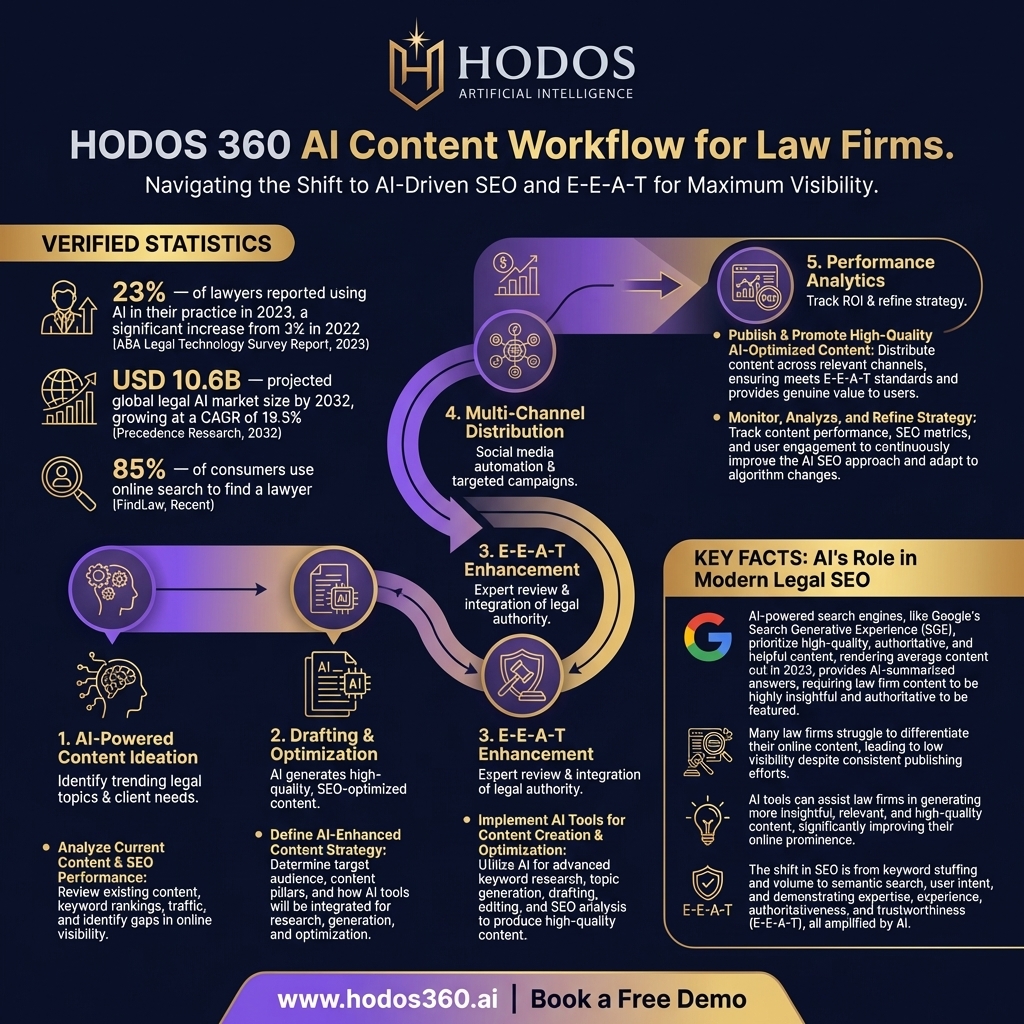
An example of this is Harvey AI's partnership with Allen & Overy, where AI assists lawyers in research and drafting, allowing them to focus on the strategic, experience-driven aspects of legal advice. Learn more about Essential AI Website Builder for Law Firms: A Complete Guide.
This synergy is crucial for AI SEO: AI helps ensure the content is meticulously structured and optimized, while human legal experts infuse it with the verifiable experience and authority that Google's algorithms now demand, significantly boosting its ranking potential and establishing unwavering trust with potential clients.
Navigating Semantic Search and Google's Algorithm Shifts
The days of simply targeting exact-match keywords are long gone. Modern search engines, propelled by AI, understand the *intent* behind a query, not just the words themselves. This is semantic search. For law firms, this means developing content that comprehensively answers user questions and addresses related sub-topics, demonstrating a holistic understanding of a legal area.
AI tools excel at identifying these semantic connections, helping firms map out content clusters that cover a legal domain thoroughly, from initial client queries to complex statutory interpretations. Learn more about AI Chatbot Builders: Transform Your Law Firm in 2026. This approach ensures content resonates with Google's sophisticated algorithms, which prioritize comprehensive and contextually rich information.
Google's continuous algorithm updates, often dubbed 'core updates,' frequently target content quality, pushing down sites that offer superficial or misleading information. The shift towards understanding natural language and user intent means that content must be written for people, not just search engines. AI can analyze vast datasets of user queries and competitor content to identify gaps and opportunities for creating truly valuable resources, enabling law firms to anticipate client needs and provide answers before they're explicitly asked, thereby solidifying their position as an indispensable resource in their niche.
- ✓Comprehensive Content Audits: AI can quickly analyze existing content for gaps, redundancies, and areas for improvement, ensuring every piece contributes to your legal content strategy.
- ✓Keyword and Topic Research: Go beyond basic keywords; AI identifies long-tail queries, semantic relationships, and trending legal topics that human researchers might miss.
- ✓Content Generation and Optimization: AI-powered writing assistants help draft articles, social media posts, and website copy, optimizing them for readability, engagement, and AI SEO best practices.
- ✓Personalized Client Communication: Tailor outreach and follow-up communications based on client needs and interests, improving engagement and conversion rates.
- ✓Performance Analytics and ROI Tracking: Gain deep insights into content performance, audience behavior, and marketing ROI, allowing for continuous refinement of your AI marketing for law firms strategy.
- ✓Multilingual Content Creation: Expand your reach with AI-assisted translation and localization, ensuring your message resonates with diverse client bases effectively.
- ✓Automated Social Media Management: Schedule and publish content across platforms, engage with audiences, and analyze trends to maximize your firm's digital presence.
Strategic AI Marketing: From Creation to Conversion
The integration of AI extends far beyond content creation, encompassing a holistic approach to AI marketing for law firms that drives client acquisition from initial search to conversion. Firms are now leveraging AI to build dynamic, responsive websites that adapt to user behavior, personalize content delivery, and optimize conversion paths.
This includes AI-powered chatbots for instant lead qualification, predictive analytics to identify high-value clients, and automated email campaigns tailored to individual client journeys.
Consider the acquisition of Clio by Legal.io in 2025, a move that underscored the industry's drive towards integrated legal tech solutions. The combined entity aims to offer a seamless experience from client intake to case management, with AI playing a central role in optimizing every touchpoint.
Learn more about Voice Assistant Market: An Essential Guide for Law Firms. For marketing, this means AI can analyze a potential client's entire digital footprint – from their initial search query to their engagement with your website – to deliver precisely the information they need, when they need it, fostering trust and guiding them towards booking a consultation.
This highly targeted approach is key to maximizing return on investment in a competitive legal market.
The Role of AI in Amplifying Digital Presence
Beyond content, AI is revolutionizing how law firms manage their overall digital presence. This includes AI-powered website builders that optimize for responsive design and search engine optimization for lawyers automatically, ensuring your firm's site is fast, mobile-friendly, and technically sound. AI can also automate social media scheduling, analyze engagement metrics, and even generate video content, allowing firms to maintain a robust online footprint without extensive manual effort.
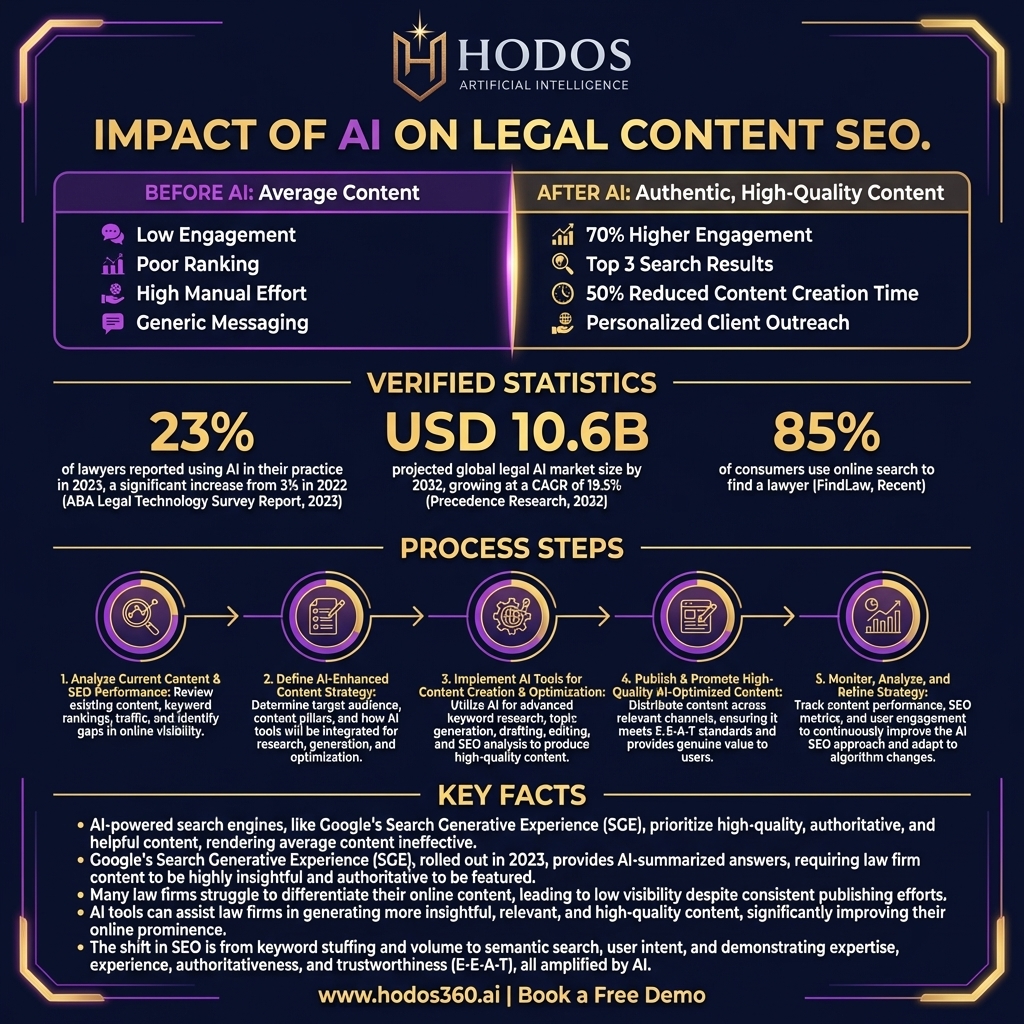
Learn more about AI Web Development: Revolutionizing Law Firm Websites in 2026. For instance, a firm might use AI to transform a complex legal brief into an engaging short video for LinkedIn, significantly expanding its reach.
Furthermore, AI-driven analytics provide unparalleled insights into audience behavior, allowing firms to understand which marketing channels are most effective, which content types resonate most deeply, and where marketing spend generates the highest ROI.
This data-driven approach, once the exclusive domain of large corporations, is now accessible to law firms of all sizes, enabling them to make smarter, more impactful marketing decisions and continuously refine their strategies for sustained growth and client acquisition.
The Future-Proof Law Firm: Embracing AI for Enduring Digital Dominance
For law firms looking to future-proof their operations and achieve enduring digital dominance, embracing AI is no longer optional. The firms that will thrive in the coming decade are those that integrate AI not as a novelty, but as a foundational element of their strategy.
This means investing in platforms that offer comprehensive AI capabilities, from advanced AI Law Firm Management System features like AI-powered legal workflows to sophisticated AI Marketing Platform tools for content generation and analytics. The goal is to create an ecosystem where AI seamlessly supports every aspect of client acquisition and service delivery, ensuring efficiency, accuracy, and unparalleled client experience.
Moreover, the ethical considerations surrounding AI in legal practice are paramount. The American Bar Association (ABA) has consistently emphasized the need for lawyers to understand the technology they use, particularly concerning confidentiality and client data. As specified in ABA Model Rule 1.6 (Confidentiality of Information), lawyers must exercise competence and diligence in adopting new technologies.
Firms must ensure that their AI tools are secure, compliant, and used responsibly, maintaining the highest standards of professional conduct while leveraging AI's transformative power. This balanced approach ensures that innovation serves justice and client interests above all.
Ethical AI Deployment and Professional Responsibility
As law firms increasingly adopt AI tools for marketing and content creation, the imperative for ethical deployment becomes even more critical. The proliferation of generative AI raises questions about originality, attribution, and the potential for misinformation. Firms must establish clear internal policies for AI use, ensuring that all AI-generated content is reviewed and validated by human legal experts before publication.
This human oversight is not just good practice; it's a professional responsibility to uphold the integrity of legal information and avoid inadvertent inaccuracies that could harm a firm's reputation or mislead the public.
Furthermore, adherence to data privacy regulations, such as GDPR and CCPA, is crucial when using AI for client data analysis and personalized marketing.
Firms must ensure that AI systems are designed and operated with privacy by design principles, safeguarding sensitive client information. This commitment to ethical AI deployment, coupled with a deep understanding of legal technology's capabilities and limitations, will be the hallmark of successful, future-ready law firms.
It ensures that while technology evolves, the core values of the legal profession—trust, competence, and client protection—remain steadfast.

Key Takeaways and Next Steps
The narrative that "AI killed SEO" is a misinterpretation. What AI has truly done is raise the bar for content quality, demanding authenticity, expertise, and strategic application from law firms. The firms that will thrive are those that recognize this shift and proactively integrate AI into their legal content strategy and broader marketing efforts.
This involves moving beyond basic keyword stuffing to embrace semantic search, E-E-A-T principles, and data-driven insights to create truly valuable and authoritative content. The future of AI SEO is about intelligent augmentation, where technology empowers legal professionals to deliver unparalleled value.
Don't let your firm fall behind in this transformative era.
Embrace the power of AI to refine your content, optimize your digital presence, and secure a competitive advantage. HODOS 360 offers a comprehensive suite of AI-powered services, including an AI Marketing Platform designed specifically for law firms, to help you navigate this new landscape. By partnering with us, you can leverage cutting-edge AI to create a content engine that attracts, engages, and converts your ideal clients, ensuring your firm's enduring success.
Frequently Asked Questions
Has AI truly killed traditional SEO for law firms?+
No, AI hasn't killed SEO; it has fundamentally redefined it. Traditional SEO tactics like keyword stuffing and link farming are ineffective. Modern AI SEO prioritizes high-quality, authentic, and authoritative content that genuinely answers user intent and demonstrates expertise, as demanded by Google's advanced algorithms and SGE. Firms must adapt to this quality-first approach.
What is E-E-A-T and why is it crucial for legal content?+
E-E-A-T stands for Experience, Expertise, Authoritativeness, and Trustworthiness. For law firms, it's crucial because legal advice falls under 'Your Money or Your Life' (YMYL) topics, where accuracy and credibility are paramount. Google's algorithms heavily favor content that demonstrates strong E-E-A-T, making it essential for legal content strategy to showcase a firm's verifiable experience and expertise.
How can AI help law firms create better content without losing authenticity?+
AI assists in research, outlining, drafting, and optimization, but human legal experts provide the unique insights, ethical considerations, and nuanced interpretations. This collaborative approach ensures content is well-researched, SEO-optimized, and still infused with the firm's authentic voice and legal expertise, establishing it as authentic legal content and a trusted resource.
Is AI marketing only for large law firms with big budgets?+
Not at all. While large firms may have early adoption, platforms like HODOS 360 make AI marketing for law firms accessible to practices of all sizes. AI tools can automate routine tasks, provide data-driven insights, and optimize campaigns cost-effectively, leveling the playing field and allowing smaller firms to compete effectively in the digital landscape.
What are the ethical considerations for law firms using AI in marketing?+
Ethical considerations include ensuring AI-generated content is accurate and reviewed by human experts, maintaining client confidentiality (ABA Model Rule 1.6), and adhering to data privacy regulations like GDPR and CCPA. Firms must deploy AI responsibly, with clear internal policies and a commitment to professional responsibility, safeguarding both reputation and client trust.