

Voice Agents: Essential AI for Law Firm Client Engagement
In late 2025, Sarah Chen, managing partner at Chen & Associates, a bustling mid-sized firm in San Francisco, faced a persistent challenge: their client intake process was bottlenecked. Potential clients calling outside business hours or during peak litigation periods frequently encountered voicemail or long hold times. "We were literally letting revenue walk out the door," Chen recounted at a recent Legaltech conference. "Our front office simply couldn't scale with demand, causing us to miss countless opportunities from urgent inquiries that needed an immediate, human-like response." This scenario highlights a critical pain point across the legal sector: the struggle to deliver consistent, immediate, and high-quality client engagement without overwhelming existing staff.
This very challenge is precisely where advanced AI voice agents are emerging as a game-changer, transforming the foundational elements of law firm client interaction. Just last month, Stevendev Marketing launched custom AI voice agents specifically designed to answer calls, book appointments, and qualify leads with unprecedented efficiency. This development underscores a broader trend: the legal profession is now embracing sophisticated AI to enhance operational efficacy and client satisfaction. Firms like Chen & Associates are discovering that these intelligent assistants are not merely automated answering machines but sophisticated virtual team members capable of conducting nuanced conversations, understanding intent, and performing complex tasks, thereby freeing up valuable human capital for high-value legal work.
The imperative for law firms to adapt to this new paradigm is clear. As clients increasingly expect instant gratification and seamless digital experiences, firms that leverage AI voice agents gain a distinct competitive edge. This isn't just about answering calls; it's about building a robust, always-on client engagement strategy that nurtures leads, streamlines intake, and ultimately drives sustainable growth. The maturity of conversational AI, exemplified by systems capable of understanding diverse accents and complex legal queries, offers a clear path forward. Firms proactively adopting these solutions are not just improving their bottom line; they are redefining what it means to offer world-class legal service in the digital age.
Table of Contents
- ✓The Dawn of Intelligent Legal Communication: Custom Voice Agents Redefine Engagement
- ✓Beyond the Hype: Quantifiable Impact of AI Voice Assistants in Law Firms
- ✓Building Secure and Personalized AI Voice Agents for Legal Practice
- ✓Strategic Implementation: Integrating AI Voice into Your Law Firm Ecosystem
- ✓The Future is Conversational: Preparing Your Firm for AI-Driven Legal Services
- ✓Key Takeaways and Next Steps for AI-Powered Law Firms
The Dawn of Intelligent Legal Communication: Custom Voice Agents Redefine Engagement
The legal sector is rapidly writing new chapters in client communication, largely driven by sophisticated custom AI voice agents. Gone are the days of rudimentary interactive voice response (IVR) systems that frustrated callers with endless menus and impersonal prompts. Today’s AI voice agents, powered by breakthroughs in natural language processing (NLP) and generative AI, offer a conversational experience that is virtually indistinguishable from interacting with a human. Learn more about Essential AI Web Development: Harvard's Free Courses for Law Firms. These intelligent assistants are trained on vast datasets of legal terminology and client interaction patterns, enabling them to understand complex queries, extract critical information, and respond contextually. For instance, a potential client calling about a personal injury claim can be guided through an initial information-gathering process, from incident details to parties involved, all handled by an AI that adapts its dialogue, significantly reducing the initial intake burden for human staff.
The recent launch by Stevendev Marketing of their custom AI voice agents, capable of 24/7 call answering, lead qualification, and appointment booking, serves as a powerful testament to this technological leap. This reflects a broader industry push, with companies like OpenAI and Anthropic continually refining their large language models (LLMs) to enhance conversational AI capabilities. For law firms, this means access to virtual assistants that can manage high call volumes without fatigue, answer frequently asked questions about firm services, and even handle initial conflict checks. Consider a scenario where a firm partner, like Amelia Davies from Davies & Partners, is in court all day. Learn more about AI Implementation: Essential Guide for Law Firms. Traditionally, incoming calls might go to voicemail. With an AI voice agent, those calls are actively managed, leads qualified, and appointments seamlessly booked, ensuring no potential client feels ignored, especially in urgent legal fields like criminal defense or family law.
Moreover, the "custom" aspect of these voice agents is vital for the legal domain. Unlike generic chatbots, these systems are meticulously trained on a firm's specific practice areas, internal processes, and brand voice. This customization allows the AI to speak with the authority and nuance required for legal interactions, ensuring compliance with professional standards and client expectations. Learn more about Voice AI: The Essential Shift for Modern Law Firms. For example, an intellectual property firm can train its AI voice agent to understand and discuss specific patent or trademark terminology, providing preliminary information that is both accurate and relevant. This deep level of personalization, extending to multilingual support, allows firms to cater to a diverse client base, breaking down language barriers and broadening their market reach.
The market competition in this space is heating up, with startups like "Clara" (a hypothetical name for an emerging legal AI voice assistant) pushing innovation alongside established players. Sam Altman, CEO of OpenAI, has often emphasized the importance of customizable AI for specific industry applications, a sentiment echoed by Dario Amodei of Anthropic. Their foundational models are increasingly being leveraged by legal tech developers to create bespoke solutions. Learn more about AI Website Design: Essential Strategies for Law Firms. This fierce competition ultimately benefits law firms, driving down costs and improving the sophistication of available tools. The focus is no longer just on automating tasks but on creating intelligent interfaces that enhance the human element of legal service, ensuring attorneys dedicate their expertise to complex legal strategy rather than routine administrative tasks.
Beyond the Hype: Quantifiable Impact of AI Voice Assistants in Law Firms
While the concept of AI voice agents might sound futuristic, their impact on a law firm's bottom line and operational efficiency is already being rigorously measured and documented. The narrative of "AI transforming legal" is no longer a speculative prediction but a tangible reality, backed by compelling data. According to the American Bar Association's 2023 TechReport, firms leveraging AI tools reported significant improvements in efficiency, with a notable percentage specifically citing enhanced client intake and communication. Learn more about AI Voice Assistants: Essential Practical Features for Law Firms. A McKinsey & Company report from early 2026 projected that generative AI could unlock trillions of dollars in value across industries, with service-based sectors like legal seeing substantial gains in productivity from automation. For law firms, this translates into direct financial benefits: reduced overhead costs, a dramatic increase in qualified leads converted, and improved client retention due to superior responsiveness.
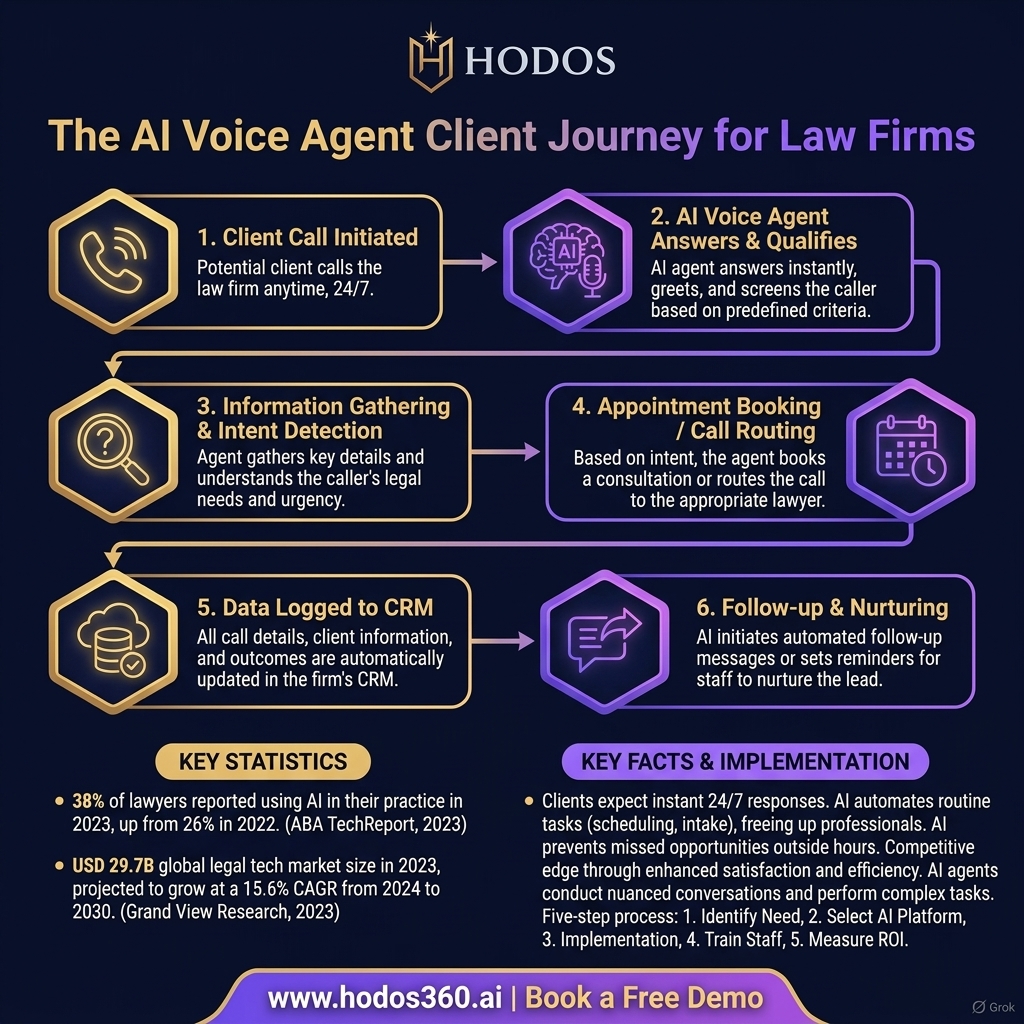
The core of this quantifiable impact lies in the AI's ability to consistently perform tasks that are often inconsistent or resource-intensive for human staff. Consider lead qualification: a human receptionist might spend valuable time on calls that don't fit the firm's practice areas. An AI voice agent, however, can be programmed with precise qualification criteria, efficiently screening callers and only routing truly viable leads to attorneys. This not only saves attorney time but also optimizes the entire sales funnel. Learn more about AI Marketing Agents: The Ultimate Guide for Law Firms. For example, a firm like Sterling & Partners, specializing in corporate law, found that after implementing custom voice agents, their attorneys spent 25% less time on initial screening calls, allowing them to focus on complex legal strategy. This reallocation of resources from administrative to substantive work is where the true ROI of AI lies.
The "human conflict" in this adoption often revolves around concerns about job displacement. However, the experience of firms successfully integrating AI voice assistants tells a different story. Instead of replacing human staff, AI augments their capabilities, allowing them to elevate their roles. Receptionists can transition to client success managers, focusing on deeper client relationships, while paralegals can dedicate more time to legal research. This shift was underscored by Jack Newton, CEO of Clio, at the 2026 Clio Cloud Conference, where he emphasized that legal technology should empower legal professionals. Firms that embraced AI early, such as the digital-first firm "Lex Innova," reported not only increased profitability but also higher employee satisfaction, as staff were freed from repetitive tasks and could engage in more meaningful work.
Moreover, the analytics and ROI tracking capabilities embedded within advanced AI platforms provide firms with unprecedented insights into their client engagement strategies. Firms can track call volumes, lead conversion rates, appointment booking efficacy, and even client satisfaction scores derived from post-call surveys, all in real-time. This data-driven approach, often a feature of robust AI Marketing Platforms, allows firms to continually refine their scripts, qualification criteria, and overall client communication strategy. For a managing partner like David Lee of Lee & Associates, this means moving beyond anecdotal evidence to making informed, strategic decisions based on hard data. This granular visibility empowers law firms to operate with a level of precision and strategic foresight that was previously unattainable, solidifying the quantifiable and undeniable benefits of integrating AI voice assistants into their core operations.
Building Secure and Personalized AI Voice Agents for Legal Practice
The unique demands of the legal profession—paramount among them, client confidentiality and ethical obligations—mean that building custom AI voice agents for law firms requires a fundamentally different approach than for other industries. It's not enough for an AI to simply answer calls; it must do so with an unwavering commitment to data security and ethical compliance. This starts with the underlying architecture of the AI system itself. Leading legal AI platforms prioritize enterprise-grade security protocols, including end-to-end encryption for all conversations, secure data storage compliant with industry standards like HIPAA (for healthcare-related legal matters) and SOC 2, and strict access controls. Furthermore, data residency options, allowing firms to choose where their data is stored geographically, are becoming crucial, particularly for international firms or those operating in jurisdictions with stringent data protection laws like the EU AI Act, which came into full enforcement in early 2026.
The personalization aspect goes beyond merely customizing a script; it involves training the AI voice agent on a firm's specific knowledge base, case types, and even its unique tone of voice. This deep learning process ensures that the AI can accurately represent the firm, providing information that is consistent with its legal expertise and client service philosophy. For example, a family law firm might train its AI to respond with empathy and sensitivity, while a corporate litigation firm might prefer a more direct, authoritative tone. This level of granular control is achieved through advanced training modules where firms can upload their FAQs, anonymized case summaries, internal procedures, and even recordings of exemplary client interactions. This bespoke training is what elevates a generic AI to a truly "personalized AI agent" for a specific legal practice, making it an authentic extension of the firm's brand and expertise.
Ethical AI Deployment: Navigating Client Confidentiality and Compliance
The ethical implications of deploying AI voice agents in a legal context are profound and non-negotiable. ABA Model Rule 1.6 on Confidentiality of Information is the cornerstone of legal practice, and any AI system must operate within its strictures. This means ensuring that client information discussed with an AI agent remains privileged and is not used for any purpose beyond its intended function within the firm, nor is it accessible to unauthorized third parties. Firms must engage with vendors that offer robust data anonymization and encryption features, preventing the AI model itself from retaining sensitive PII in a way that could compromise confidentiality. Furthermore, the duty of competence (ABA Model Rule 1.1) extends to a lawyer's understanding of technology, requiring attorneys to be proficient in the risks and benefits of AI tools they employ. This implies a continuous due diligence process, not just at the point of adoption but throughout the lifecycle of the AI agent.
Moreover, the concept of "informed consent" becomes critical. While an AI voice agent can provide initial information, it is imperative that clients understand they are interacting with an artificial intelligence, not a human attorney, especially when discussing sensitive matters. Transparent disclosure, often embedded in the AI's initial greeting, helps manage client expectations and maintains ethical boundaries. The potential for misinterpretation or miscommunication, however slight, must be mitigated through clear programming and continuous monitoring. The legal community, through bodies like the ABA Standing Committee on Ethics and Professional Responsibility, is actively developing guidance on AI use, such as recent formal opinions addressing the use of generative AI in legal practice. Firms must stay abreast of these evolving standards, ensuring their AI voice agents are not just technologically advanced but also ethically sound.
Strategic Implementation: Integrating AI Voice into Your Law Firm Ecosystem
Successfully integrating AI voice agents into a law firm's operations is less about plugging in a new tool and more about strategically weaving it into the existing technological and procedural fabric. The most effective deployments don't just automate a single function; they create a seamless, interconnected ecosystem that enhances every stage of the client journey. This begins with robust integration capabilities. An AI voice assistant must be able to communicate effortlessly with the firm's existing case management system, billing software, and client relationship management (CRM) platforms. For instance, when an AI voice agent qualifies a lead and books an appointment, that information should automatically populate a new client record in the case management system (like HODOS 360's AI Law Firm Management System), create an event on the firm's shared calendar, and trigger a follow-up email or SMS confirmation to the prospective client. This eliminates manual data entry and reduces the risk of errors.
The strategic implementation also involves designing AI-powered legal workflows that leverage the voice agent's capabilities to their fullest. This could mean a workflow where the AI handles initial intake forms over the phone, then automatically generates a draft retainer agreement using document automation tools, and finally assigns the new lead to the appropriate attorney based on practice area and availability. This kind of end-to-end automation, often facilitated by platforms offering comprehensive solutions, dramatically reduces the administrative burden on attorneys and support staff, allowing them to focus on substantive legal work. Firms like "LegalPath Solutions," a growing mid-sized firm, have reported cutting their client intake time by nearly 40% after implementing such integrated AI workflows. Their managing partner, Elena Rodriguez, noted that "the synergy between our AI voice assistants and our case management system means clients feel heard immediately, and our team receives pre-qualified, structured leads, ready for legal action."
Optimizing Lead Qualification and Client Intake with AI
One of the most immediate and impactful applications of AI voice agents for law firms is the optimization of lead qualification and client intake. In the competitive legal market, the speed and efficiency with which a firm can capture and process new leads can be the difference between growth and stagnation. Traditional intake processes are often slow, prone to human error, and inconsistent. An AI voice agent, however, can be programmed to ask a series of precise, qualifying questions—ranging from the nature of the legal issue and the jurisdiction to the urgency and the client's financial capacity. Based on the responses, the AI can immediately determine if the lead is a good fit for the firm, routing high-priority cases directly to an attorney, scheduling a consultation, or politely referring unsuitable inquiries elsewhere. This ensures that attorneys only spend their valuable time engaging with genuinely promising prospects.
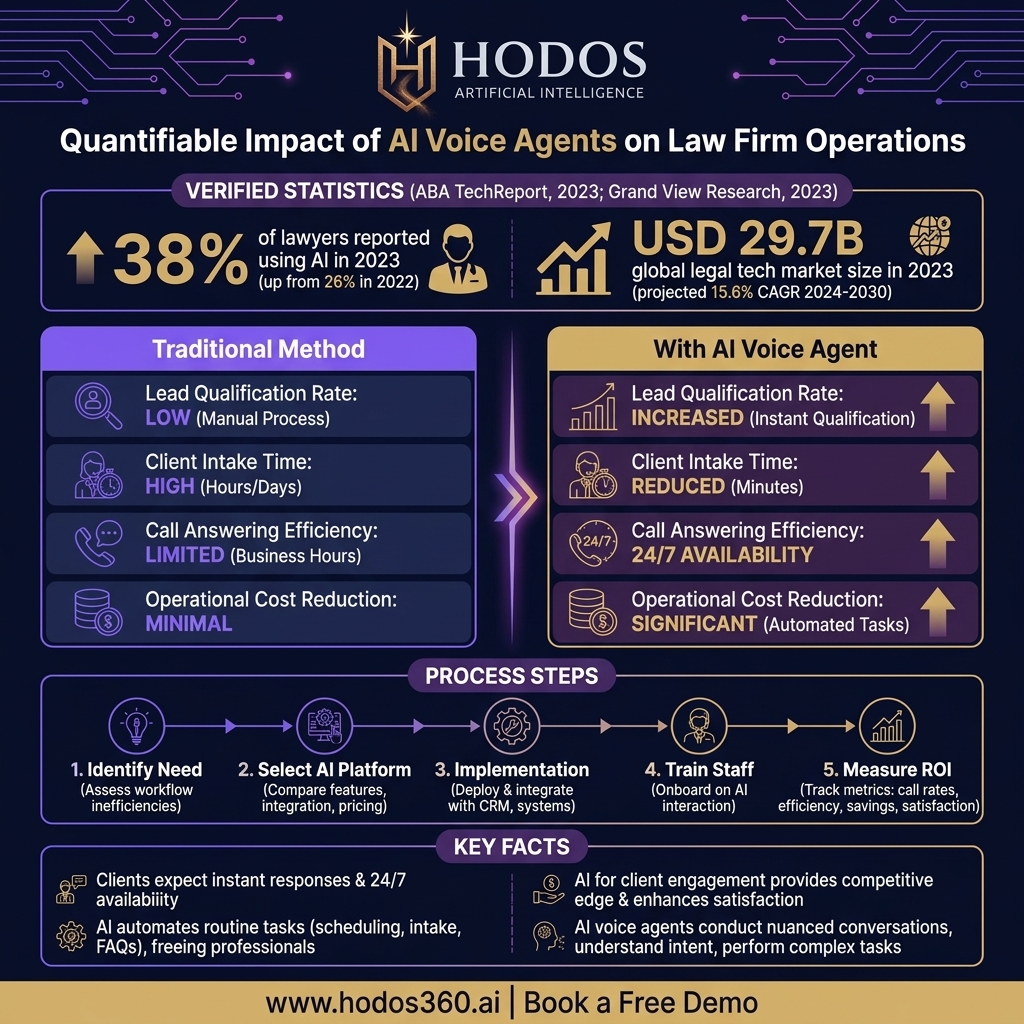
Furthermore, the AI can gather all necessary preliminary information during the initial call, such as contact details, a brief summary of the legal issue, and any relevant deadlines. This data is then automatically transcribed, categorized, and entered into the firm's CRM or case management system, forming the foundation of the new client file. This proactive data collection streamlines the subsequent human interaction, allowing the attorney to begin the consultation with a clear understanding of the client's needs. For example, a solo practitioner, Michael Vance, specializing in estate planning, found that his AI voice agent dramatically improved his conversion rate by ensuring that every caller who reached him was already pre-qualified and had provided essential details, making the initial consultation far more productive. This strategic use of AI in the intake funnel not only boosts efficiency but also significantly enhances the client experience.
The Future is Conversational: Preparing Your Firm for AI-Driven Legal Services
As we look beyond the immediate benefits, the trajectory of AI voice agents points towards an even more integrated and sophisticated future for legal services. The advancements in generative AI and large language models are continually expanding the capabilities of these conversational interfaces, moving them from sophisticated assistants to proactive problem-solvers. We can anticipate AI voice agents becoming adept at handling increasingly complex legal queries, providing preliminary legal information based on jurisdiction-specific statutes (with clear disclaimers, of course), and even assisting in document discovery by intelligently guiding clients through information gathering processes. The goal is to offload more routine, information-gathering, and initial assessment tasks to AI, thereby allowing legal professionals to focus exclusively on strategic thinking, complex problem-solving, and the nuanced human aspects of client advocacy.
Emerging trends suggest that multilingual support will become standard, allowing firms to effortlessly serve a global client base without the need for human interpreters for initial contacts. Imagine an AI voice agent seamlessly switching between English, Spanish, Mandarin, and French, providing consistent, high-quality service regardless of the caller's native language. This is already within reach, with platforms actively developing advanced multilingual NLP capabilities. Furthermore, the integration of AI voice agents with other AI-powered tools will create a truly holistic legal tech ecosystem. For example, a voice agent could automatically trigger a deep-learning document review system to analyze intake documents, identifying key clauses or potential red flags before a human attorney even sees the file. This kind of interconnected intelligence represents the next frontier, promising unprecedented levels of efficiency and accuracy in legal operations.
The HODOS 360 Advantage: Unifying AI for Comprehensive Law Firm Growth
In this rapidly evolving landscape, the strategic choice of an AI platform is paramount. HODOS 360 stands at the forefront of this transformation, offering a unified suite of AI-powered services designed specifically for the unique needs of law firms. Our AI Voice Assistants are not standalone tools; they are seamlessly integrated components of a broader ecosystem that includes an AI Law Firm Management System, an AI Marketing Platform, and Web & Mobile Development services. This holistic approach means that when a HODOS 360 AI Voice Assistant qualifies a lead and books an appointment, that data flows directly into your case management system, triggers targeted marketing campaigns, and even informs updates to your AI-powered website. This eliminates data silos and creates a cohesive, intelligent workflow that maximizes efficiency and client engagement across all touchpoints.
The real power of HODOS 360 lies in this synergy. Imagine an AI Voice Assistant identifying a lead for a specific practice area; this information can immediately be used by the AI Marketing Platform to send targeted follow-up content, while the AI Law Firm Management System prepares the necessary intake documents. This integrated strategy ensures that law firms are not just adopting individual AI tools but are building a future-proof, AI-driven operational backbone. By choosing a comprehensive platform like HODOS 360, firms can streamline their entire operation, from client acquisition and intake to case management and billing, all powered by intelligent automation. This unified approach empowers legal professionals to focus on their core mission: delivering exceptional legal services, confident that their administrative and client engagement processes are optimized, secure, and always-on.

Key Takeaways and Next Steps for AI-Powered Law Firms
The narrative surrounding AI voice agents in the legal industry has evolved from cautious curiosity to strategic imperative. As we've explored, these sophisticated conversational AI tools are no longer merely a novelty but an essential component for any law firm aiming to thrive in an increasingly competitive and client-centric market. From revolutionizing initial client contact and dramatically improving lead qualification to ensuring 24/7 responsiveness and significantly reducing operational overhead, the benefits are clear and quantifiable. Firms like Chen & Associates, once grappling with missed opportunities, are now experiencing streamlined intake and enhanced client satisfaction, underscoring a fundamental shift in how legal services are delivered. The tension between preserving the human touch in legal practice and embracing technological efficiency is being resolved through AI that augments, rather than replaces, human expertise, freeing attorneys and staff for higher-value work.
For law firm owners and legal professionals looking to harness this transformative technology, the next steps involve a strategic assessment and a commitment to ethical, integrated deployment. Begin by evaluating your current client intake and communication pain points. Then, explore solutions that offer robust customization, stringent data security, and seamless integration with your existing legal tech stack. Platforms offering a holistic approach, where AI voice agents work in concert with case management, marketing, and web development tools, provide the most comprehensive advantage. The legal landscape is undeniably shifting towards an AI-driven future, as evidenced by continuous innovation from companies like Stevendev Marketing and the evolving guidance from bodies such as the ABA. Embracing intelligent automation is not just about staying competitive; it's about redefining excellence in client service and operational efficiency. The future of legal practice is conversational, integrated, and intelligent, and your firm's journey towards it begins now.
Frequently Asked Questions
What are AI voice agents for law firms?+
AI voice agents are advanced conversational AI systems designed to handle client interactions for law firms. They can answer calls 24/7, qualify leads, book appointments, and provide information, all while mimicking human conversation. These agents are custom-trained on a firm's specific legal knowledge and processes, ensuring accurate and compliant communication.
How do AI voice agents improve lead qualification?+
AI voice agents improve lead qualification by consistently asking precise, pre-programmed questions to callers, assessing their needs against the firm's criteria. They efficiently filter out unsuitable inquiries and route only highly qualified leads to attorneys, saving valuable time and increasing the conversion rate of prospective clients into paying clients.
Are AI voice agents secure for sensitive legal information?+
Yes, leading AI voice agents for law firms prioritize enterprise-grade security, including end-to-end encryption, secure data storage, and compliance with privacy regulations like HIPAA and SOC 2. Firms must ensure their chosen AI solution adheres to strict data protection protocols and ethical guidelines, such as ABA Model Rule 1.6 on confidentiality.
Can AI voice agents integrate with existing law firm software?+
Effective AI voice agents are designed for seamless integration with a law firm's existing technology ecosystem. This includes case management systems, CRM platforms, billing software, and shared calendars. This integration ensures automatic data flow, eliminates manual entry, and creates cohesive, automated workflows from initial client contact to case initiation.
What is the ROI of implementing AI voice agents?+
The ROI of AI voice agents for law firms is significant and quantifiable. Benefits include reduced operational costs (e.g., staffing for 24/7 reception), increased lead conversion rates (due to efficient qualification and 24/7 availability), improved client satisfaction and retention, and the ability for legal professionals to focus on higher-value legal work rather than administrative tasks. Firms often see a substantial increase in booked consultations and efficiency gains.