


AI Voice Assistant: Essential for Law Firm Client Experience
The legal landscape, traditionally rooted in centuries of precedent and personal interaction, is now at the precipice of a significant technological shift. News of Tanner Health introducing its new AI Voice Chat Assistant, Clara, to significantly reduce call center hold times for its patients is more than just an industry-specific innovation; it signals a broader, inevitable wave of AI adoption across professional services, including law firms.
For legal practices grappling with increasing client demands, the imperative to provide seamless, immediate, and accessible communication has never been stronger. This development highlights a crucial trend: the integration of sophisticated AI Voice Assistant technology is no longer a futuristic concept but a present-day necessity for maintaining competitive advantage and delivering superior client service.
In an era where clients expect instant access and personalized support, the traditional model of relying solely on human receptionists and paralegals for every inbound query can lead to bottlenecks, missed opportunities, and ultimately, client dissatisfaction. The promise of voice AI extends beyond mere automation; it offers a strategic advantage, enabling law firms to scale their client interactions without compromising quality.
From initial contact and lead qualification to appointment scheduling and answering common questions, an advanced AI Voice Assistant can revolutionize a firm’s front office, ensuring that every potential and existing client receives prompt, professional attention, regardless of the hour or language preference. This article delves into how law firms can harness this transformative technology to elevate their client experience, streamline operations, and drive growth in an increasingly competitive market.
Learn how integrating cutting-edge AI Voice Assistant solutions can empower your firm to thrive in the digital age.
The Evolving Landscape of Legal Client Communication
Today's legal clients, conditioned by instant gratification in every other aspect of their lives, expect the same responsiveness from their legal counsel. A 2023 report by Thomson Reuters found that 80% of legal clients consider responsiveness a critical factor when choosing a law firm. Yet, many firms struggle with managing the sheer volume of inbound calls, emails, and web inquiries, leading to frustrating hold times and delayed responses.
This disconnect creates a significant gap between client expectations and firm capabilities, often resulting in lost leads and a tarnished reputation. Legal thought leaders like Mark Cohen, CEO of Legal Mosaic, have consistently emphasized that the future of legal services hinges on efficiency and client-centricity, asserting that firms failing to adapt will simply be left behind.
The competition isn't just other law firms; it's the standard set by tech-forward companies in every sector.
The challenge is particularly acute for mid-sized and growing firms that lack the extensive administrative staff of larger enterprises but face similar pressures to provide comprehensive support. Learn more about Voice AI Landscape: Essential Strategies for Law Firms.
Take, for instance, the experience of Sarah Chen, a managing partner at a personal injury firm in Atlanta. Chen often recounts how her firm, despite its excellent legal outcomes, frequently received feedback about initial call delays, especially during peak hours. "We were losing potential clients simply because we couldn't answer every call immediately," Chen stated at a recent LegalTech conference.
"Our paralegals were overwhelmed, splitting their time between critical case work and basic intake questions." This scenario is not unique; it's a common pain point across the industry, exacerbated by the increasing complexity of legal inquiries and the need for bilingual support in diverse communities.
The solution must address both efficiency and accessibility, offering a scalable model that traditional staffing alone cannot provide.
Beyond Basic Answering: Core Capabilities of AI Voice Assistants in Law Firms
An advanced AI Voice Assistant for law firms is far more sophisticated than a simple answering machine or an automated phone tree. These intelligent systems leverage natural language processing (NLP) and machine learning to understand complex queries, engage in meaningful conversations, and perform a range of crucial tasks autonomously.
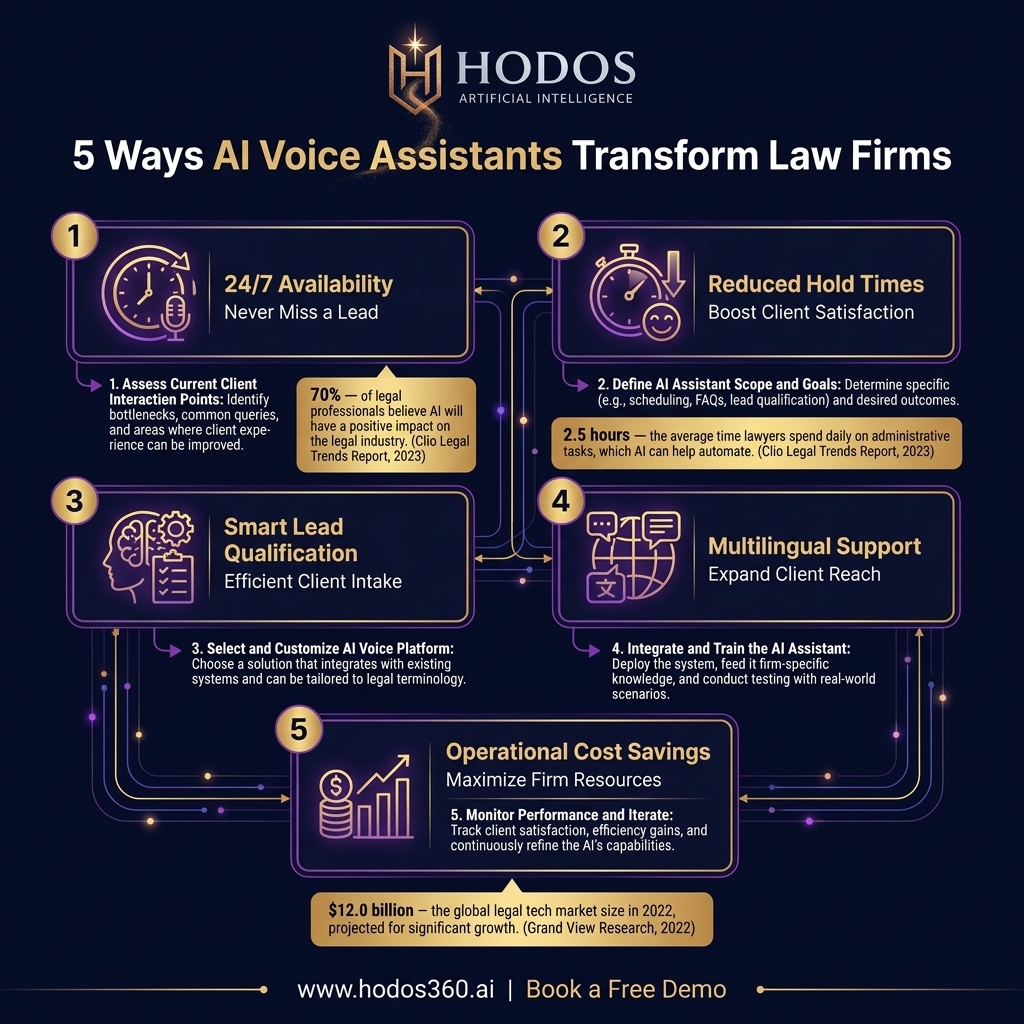
For example, HODOS 360's AI Voice Assistants provide 24/7 phone answering, ensuring no call goes unanswered, whether it's midnight or a national holiday. This constant availability is a game-changer for client satisfaction, as it caters to diverse schedules and urgent needs. The system can act as the firm's virtual front desk, fielding initial inquiries, explaining basic legal processes, and even providing directions or office hours, all without human intervention.
Beyond basic information, these AI systems excel at lead qualification and appointment booking. Imagine a potential client calling after hours, seeking representation for a complex legal matter. Learn more about AI Marketing: The Ultimate Guide for Law Firms. Instead of reaching voicemail, they interact with an AI Voice Assistant like Clara, the system recently introduced by Tanner Health, which can intelligently ask a series of predefined questions to assess the caller's needs, determine if they fit the firm's practice areas, and even screen for conflicts of interest.
This streamlined process not only enhances the client's initial experience but also ensures that when a human attorney or paralegal follows up, they are engaging with a pre-qualified lead, saving valuable time and resources. Furthermore, the assistant can directly integrate with the firm's calendar, allowing callers to book consultations or appointments in real-time, drastically reducing the friction in the client intake process.
This capability ensures that qualified leads are captured and scheduled efficiently, transforming casual inquiries into actionable opportunities.
Enhancing Client Intake and Qualification
One of the most significant benefits of deploying an AI Voice Assistant is its ability to revolutionize client intake. Historically, this process has been resource-intensive, requiring staff to dedicate significant time to initial screenings. With AI, a potential client can call and be guided through an interactive, conversational intake process, providing essential details about their case, contact information, and specific needs.
This data is then automatically transcribed, categorized, and funneled into the firm's AI Law Firm Management System, creating a new client profile instantly. Learn more about AI Marketing: The Ultimate Guide to Law Firm Growth & Automation. This automation ensures consistency, reduces manual data entry errors, and provides a comprehensive initial brief for the legal team.
It also allows for multilingual support, enabling firms to serve a broader demographic without hiring additional bilingual staff, a critical advantage in today's diverse society, as exemplified by the capabilities of advanced voice AI platforms. This comprehensive approach to intake not only improves efficiency but also elevates the professional image of the firm, demonstrating a commitment to modern, client-centric service.
The Tangible Benefits: Reducing Hold Times and Boosting Efficiency
The immediate and most palpable benefit of implementing an AI Voice Assistant is the dramatic reduction in client hold times. A 2024 Gartner report on customer service automation highlighted that companies deploying AI-powered virtual assistants saw an average reduction of 60% in call handling times for routine inquiries.
For law firms, this translates directly into higher client satisfaction and retention. Clients who feel heard and attended to promptly are more likely to trust their legal counsel and recommend the firm to others. Moreover, by automating routine tasks, legal staff are freed from repetitive administrative duties, allowing them to focus on complex legal work, client advocacy, and strategic case management.
This re-allocation of resources optimizes professional expertise and enhances overall firm productivity. For instance, a paralegal who previously spent hours on the phone answering questions about court dates or document requirements can now dedicate that time to drafting motions or conducting legal research, significantly improving the firm's output and quality of service.
Beyond just time savings, the financial implications are substantial. Learn more about AI Marketing Transforms Legal Web: Webflow's Vidoso Acquisition 2026. AI Voice Assistants operate at a fraction of the cost of human staff, offering 24/7 support without overtime expenses or benefits packages. McKinsey & Company's analysis of AI in professional services projected that firms adopting intelligent automation could see a 30-40% reduction in operational costs related to client communication over five years.
This cost-efficiency allows firms to invest more in their legal talent, technology infrastructure, or even pass savings on to clients, making legal services more accessible. Furthermore, the ability to streamline inbound inquiries means that fewer potential clients abandon calls due to long waits, directly impacting lead conversion rates.
Every call answered, every lead qualified, and every appointment booked by an AI Voice Assistant represents a tangible return on investment, showcasing how this technology doesn't just cut costs but actively contributes to revenue growth and market expansion.
Operationalizing AI for Seamless Legal Support
Successfully operationalizing an AI Voice Assistant requires careful planning and integration into existing legal workflows. It's not merely about plugging in a new tool; it's about strategically embedding AI into the firm's entire operational fabric. This involves connecting the AI Voice Assistant with the firm's AI Law Firm Management System for seamless data flow, ensuring that information gathered during client interactions is immediately accessible and actionable.
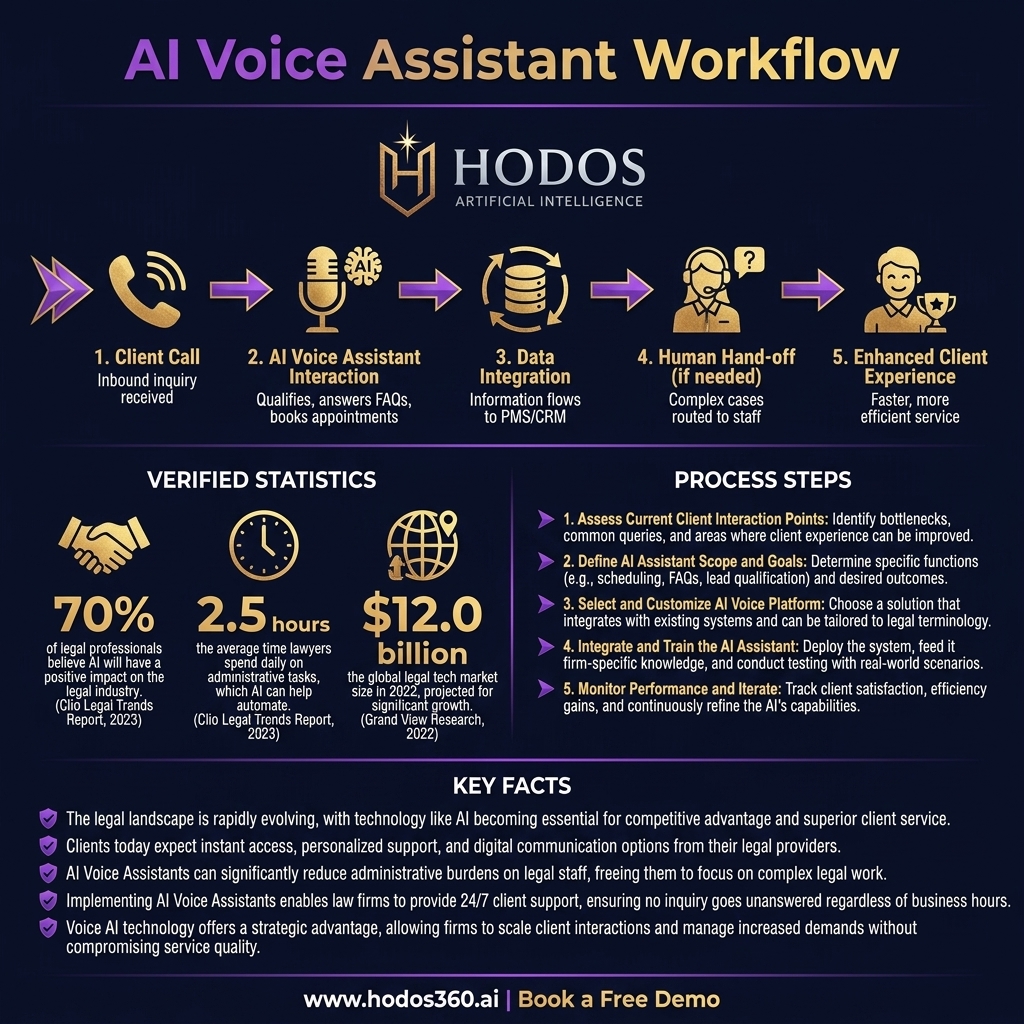
Firms must also consider how the AI will hand off complex cases to human staff, establishing clear protocols for escalation. Learn more about AI Voice Assistants Transform Law: HODOS 360's 2026 Impact. This hybrid approach, combining AI efficiency with human empathy and judgment, is key to maximizing the benefits of voice AI without sacrificing the personal touch that clients value in legal services.
The goal is to create a unified, intelligent system that enhances every stage of the client journey, from initial contact to case resolution, making legal support more robust and reliable.
Navigating Ethical and Practical Considerations in Voice AI Adoption
While the benefits of AI Voice Assistants are compelling, their adoption in the legal field necessitates careful consideration of ethical and practical challenges. Paramount among these is client confidentiality. ABA Model Rule 1.6: Confidentiality of Information dictates that lawyers must protect client information. Firms deploying voice AI must ensure that their chosen platforms are robustly secure, encrypted, and compliant with all relevant data privacy regulations like GDPR or CCPA.
This means vetting vendors thoroughly, understanding their data handling protocols, and ensuring that any recorded conversations or collected data are stored and processed in a manner that upholds the highest standards of privacy and professional ethics. As Dario Amodei, CEO of Anthropic, a leading AI safety company, often emphasizes, responsible AI development and deployment must prioritize security and ethical safeguards above all else.
Firms must be transparent with clients about the use of AI, ensuring they are aware when interacting with a virtual assistant rather than a human.
Another critical aspect revolves around the ABA Model Rule 5.3: Responsibilities Regarding Nonlawyer Assistants. While an AI Voice Assistant is not a human nonlawyer, the principle of supervision applies.
Learn more about Agentic Marketing: The Ultimate Guide for Law Firms. Lawyers remain ultimately responsible for the actions and outcomes facilitated by the AI. This means attorneys must understand the AI's capabilities and limitations, regularly review its performance, and establish clear guidelines for its operation.
For instance, the AI should be programmed to recognize when a query moves beyond its scope and requires human intervention. Furthermore, integrating AI into existing systems presents technical hurdles. Firms need to ensure compatibility with their current AI Law Firm Management System and other software.
Training the AI to understand legal jargon, nuances, and specific firm protocols requires significant effort and ongoing refinement. The initial investment in setup, customization, and staff training to effectively manage and oversee the voice AI system is a practical consideration that firms must budget for and plan strategically.
The Future: AI Voice Assistants as Strategic Assets
Looking ahead, AI Voice Assistants are poised to become indispensable strategic assets for law firms. They will evolve beyond merely handling inbound calls to proactively identifying client needs, offering personalized insights, and even assisting with preliminary legal research by querying internal knowledge bases. Imagine an AI that not only books an appointment but also provides the client with a curated list of documents to prepare, based on their specific case type, before their first meeting.
This level of proactive, intelligent support will redefine client engagement and operational efficiency. Firms that embrace this technology early will gain a significant competitive edge, attracting tech-savvy clients and top legal talent alike. The future of legal practice is not about replacing human lawyers with AI, but about augmenting human capabilities with intelligent automation to deliver unparalleled service and achieve superior outcomes.
This symbiotic relationship between human expertise and voice AI will be the hallmark of successful law firms in the coming decade, creating a more accessible, efficient, and client-centric legal ecosystem.

Key Takeaways and Next Steps for Law Firms
The emergence of advanced AI Voice Assistants, as highlighted by innovations like Tanner Health's Clara, underscores a fundamental shift in how professional services, including law firms, must approach client communication and operational efficiency. For law firms, the key takeaway is clear: embracing voice AI is no longer optional but a strategic imperative for long-term success.
Firms that prioritize the integration of these intelligent systems will not only significantly reduce client hold times and enhance client experience but also unlock substantial operational efficiencies, allowing their legal professionals to focus on higher-value work. The journey involves careful planning, selecting the right technology partner, and a commitment to continuous adaptation and ethical deployment.
Platforms like HODOS 360 offer comprehensive AI Voice Assistants designed specifically for the legal sector, providing 24/7 phone answering, lead qualification, appointment booking, and multilingual support to help firms navigate this transformation successfully.
To effectively leverage this technology, law firms should begin by assessing their current client communication bottlenecks and identifying areas where an AI Voice Assistant can provide immediate value.
Pilot programs focusing on specific functions, such as initial client intake or frequently asked questions, can offer valuable insights before a broader rollout. Investing in staff training to work alongside AI, rather than in fear of it, is also crucial for a smooth transition. The goal is to create a synergistic environment where AI handles the routine, allowing human expertise to shine in complex legal matters and client relationship building.
By taking these proactive steps, law firms can not only keep pace with the evolving demands of the market but also set new benchmarks for client service and operational excellence, ensuring a prosperous future in the age of intelligent automation.
Frequently Asked Questions
What is an AI Voice Assistant for law firms?+
An AI Voice Assistant for law firms is an intelligent, automated system that uses artificial intelligence to handle inbound and outbound calls. It can understand natural language, answer client questions, qualify leads, book appointments, route calls, and provide 24/7 support, significantly reducing hold times and streamlining administrative tasks for legal professionals. It's designed to enhance client experience and operational efficiency.
How can AI Voice Assistants reduce client hold times?+
AI Voice Assistants can instantly answer multiple inbound calls simultaneously, eliminating queues. They handle common inquiries, direct callers to relevant information, or efficiently route complex cases to the appropriate human staff. This parallel processing and intelligent pre-screening drastically cut down on the time clients spend waiting, ensuring faster service and improved satisfaction, thereby enhancing the overall client experience.
Are AI Voice Assistants secure for handling sensitive legal information?+
Security is paramount. Reputable AI Voice Assistant providers for the legal sector employ advanced encryption, data privacy protocols, and compliance measures (e.g., GDPR, CCPA). Firms must vet vendors carefully, ensuring their solutions meet ABA Model Rule 1.6 confidentiality standards. Transparency with clients about AI interaction is also crucial to maintain trust and ethical obligations. Data is secured and processed responsibly.
Can AI Voice Assistants provide multilingual support?+
Yes, a significant advantage of modern AI Voice Assistants is their ability to offer multilingual support. They can communicate with clients in various languages, providing bilingual support and ensuring that language barriers do not hinder access to legal services. This capability expands a firm's reach, improves inclusivity, and caters to a diverse client base without requiring additional human language specialists on staff, offering seamless support.
How do AI Voice Assistants integrate with existing law firm systems?+
AI Voice Assistants are designed to integrate seamlessly with a firm's existing AI Law Firm Management System, CRM, and calendaring software. This integration allows for automated data capture, lead qualification information transfer, and real-time appointment scheduling. The goal is to create a unified ecosystem where client data flows effortlessly, enhancing overall legal operations and ensuring that all systems work in concert to boost efficiency.