
AI Voice Platform: Essential for Modern Legal Operations
The legal landscape is undergoing a profound transformation, driven by the relentless march of artificial intelligence. Just this week, the news broke that Cosmos Health, a prominent player in the healthcare sector, inked a significant agreement to deploy an AI-powered voice platform, as reported by scanx.trade.
This move by Cosmos Health, aimed at optimizing order intake and customer communications for its CosmoFarm business, isn't an isolated incident; it's a clear signal of a broader industry shift towards intelligent automation. What's happening in healthcare and logistics today offers a compelling blueprint for the legal sector, where client engagement, operational efficiency, and rapid response times are paramount.
The deployment of sophisticated AI voice platforms is no longer a futuristic concept but an immediate strategic imperative for law firms seeking to maintain a competitive edge and meet the escalating demands of modern clientele.
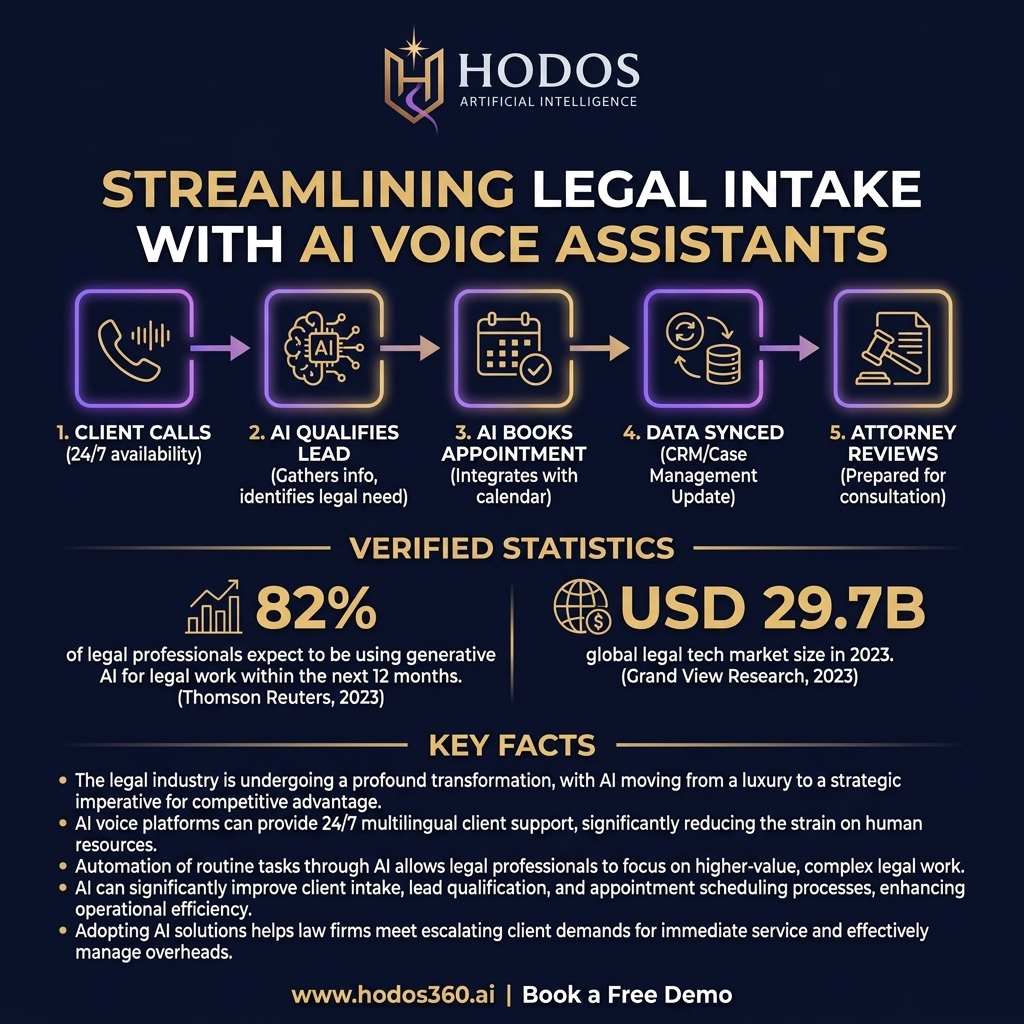
The implications for law firms are immense. Imagine a legal practice where every incoming call is handled with precision, leads are qualified instantly, appointments are booked seamlessly, and clients receive 24/7 multilingual support without the constant strain on human resources.
This isn't a distant dream; it's the tangible reality that an advanced AI voice platform delivers. As firms grapple with increasing caseloads, client expectations for immediate service, and the ever-present pressure to reduce overheads, the adoption of such technology moves from a luxury to a necessity.
The legal industry, often characterized by its cautious approach to technological disruption, is now at an inflection point where innovative solutions like AI voice platforms are becoming indispensable tools for growth, client satisfaction, and operational excellence. Firms that embrace this evolution are not just modernizing; they are redefining what it means to practice law in the 21st century.
- ✓The Transformative Power of AI Voice Platforms in Legal Intake
- ✓Beyond Intake: Operational Efficiency with AI Voice Assistants
- ✓Navigating Ethical and Security Considerations in Voice AI Deployment
- ✓Real-World Impact: Case Studies and Industry Adoption
- ✓Key Takeaways and Next Steps for Law Firms
The Transformative Power of AI Voice Platforms in Legal Intake
The initial point of contact with a potential client is often the most critical, setting the tone for the entire relationship. Traditionally, this process of legal intake has been resource-intensive, requiring dedicated staff to field calls, answer preliminary questions, qualify leads, and schedule consultations. However, the modern client expects immediate gratification and round-the-clock availability, a challenge few law firms can meet with human staff alone.
This is where an AI voice platform becomes a game-changer. By leveraging natural language processing (NLP) and machine learning, these platforms can act as the firm's frontline, intelligently managing inbound inquiries, providing instant answers to frequently asked questions, and even conducting initial conflict checks. For example, a study by Thomson Reuters in 2023 highlighted that over 70% of clients expect 24/7 access to information about their cases, a demand that traditional phone systems struggle to fulfill.
AI voice assistants bridge this gap, ensuring no lead is missed and every client feels heard, regardless of the hour.
Consider the operational advantages. Instead of paralegals or administrative staff spending hours on repetitive intake calls, an AI voice platform can efficiently gather essential client data, identify the nature of their legal need, and route them to the appropriate attorney or department.
Learn more about AI Marketing Transforms Legal Web: Webflow's Vidoso Acquisition 2026. This significantly reduces the administrative burden, freeing up valuable human capital to focus on complex legal work rather than data entry. Firms like LegalZoom have demonstrated the power of technology in democratizing legal access and streamlining initial touchpoints, setting a precedent that traditional firms must now emulate.
The ability of an AI voice platform to handle a high volume of calls simultaneously, without fatigue or error, ensures consistent service quality. Furthermore, the data collected during these interactions can be automatically logged into a firm's case management system, creating a seamless workflow from initial contact to case opening.
This level of automation is not just about efficiency; it's about elevating the client experience and positioning the firm as a modern, responsive legal service provider. By automating the mundane, attorneys can dedicate more time to the nuanced aspects of legal strategy and client advocacy, ultimately leading to better outcomes and higher client satisfaction.
Enhancing Client Communication and Accessibility
Beyond initial intake, AI voice platforms profoundly enhance ongoing client communication and overall accessibility. In an increasingly globalized world, law firms serve diverse populations, making multilingual support an invaluable asset. An AI voice assistant can communicate fluently in multiple languages, breaking down barriers and ensuring that clients feel comfortable and understood from the outset.
This capability is particularly crucial in jurisdictions with significant non-English speaking populations, allowing firms to expand their reach and inclusivity. Imagine a potential client calling a personal injury firm late at night, speaking only Spanish. An AI voice assistant can not only understand their query but also qualify their lead, explain the firm's process, and schedule an appointment, all in their native language.
This level of personalized, accessible service builds trust and significantly improves client retention.
The 24/7 availability of AI voice assistants means clients can get answers to their questions or book appointments at their convenience, not just during business hours. This eliminates the frustration of voicemail tag or waiting for a callback, which often leads to client churn.
Learn more about AI Legal Research: The Ultimate Guide for Law Firms. According to a 2024 report by Gartner, businesses that offer superior customer experience see revenue growth rates 2-3 times higher than those that don't. For law firms, this translates directly into increased client acquisition and loyalty.
Moreover, AI voice platforms can provide consistent, accurate information, ensuring that every client receives the same high standard of care. They can proactively send reminders for court dates, document deadlines, or payment schedules, reducing no-shows and improving compliance. This proactive communication, driven by AI, transforms the client experience from reactive to anticipatory, fostering a sense of reliability and professionalism that distinguishes leading firms in a competitive market.
Book a Free Demo to see how HODOS 360’s AI Voice Assistants can transform your firm’s client communication.
Beyond Intake: Operational Efficiency with AI Voice Assistants
The utility of AI voice assistants extends far beyond client intake, permeating various facets of a law firm's internal operations to drive unprecedented efficiency. Consider the daily grind of administrative tasks that consume countless hours for attorneys and support staff: managing calendars, setting reminders, retrieving case information, or even drafting routine communications.
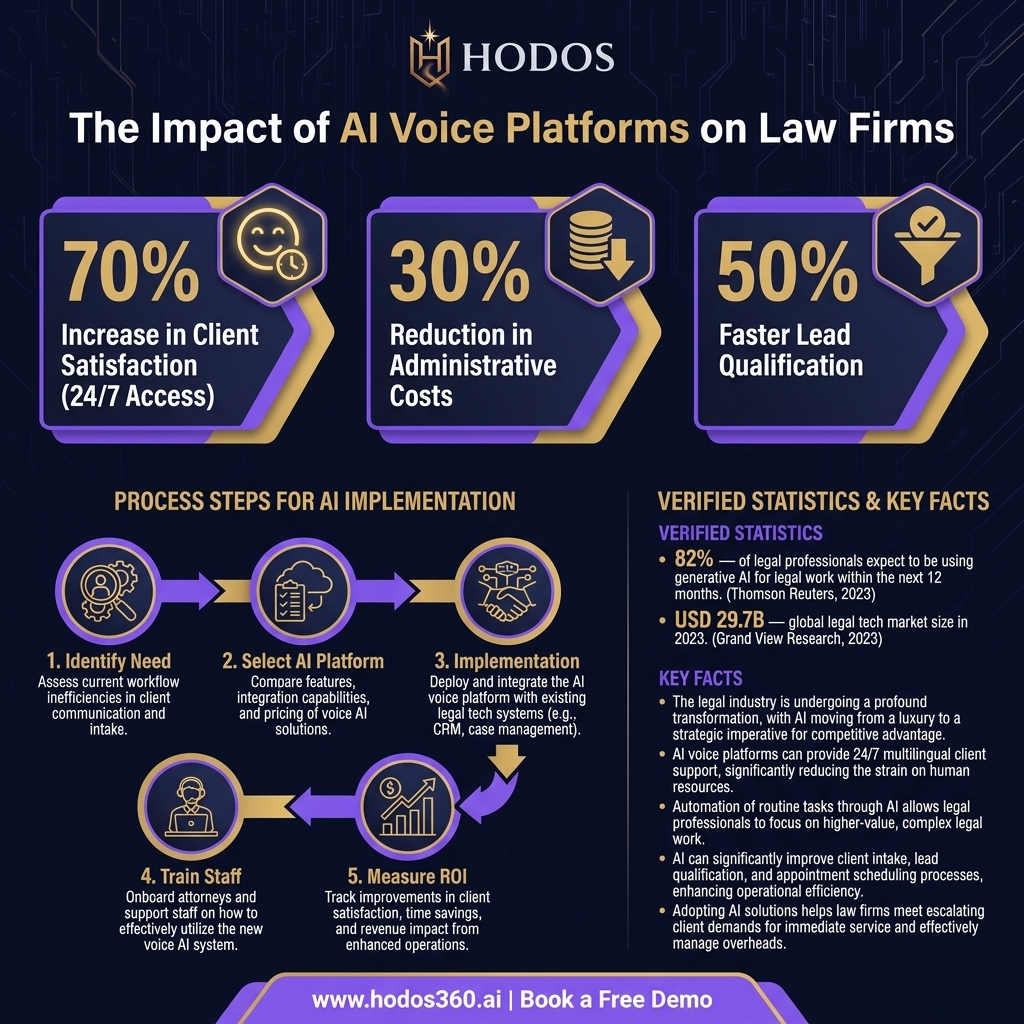
These are precisely the areas where AI voice platforms can deliver substantial value. For instance, an attorney could simply vocalize a request like, "Schedule a deposition for the 'Smith v. Jones' case next Tuesday at 10 AM and send a calendar invite to all parties," and the AI assistant would execute the task, integrating with existing calendaring and communication systems.
This level of hands-free, intelligent automation drastically reduces the time spent on non-billable administrative work, allowing legal professionals to dedicate their focus to strategic legal analysis and client advocacy. Jack Newton, CEO of Clio, a leader in legal practice management software, has consistently championed the idea that technology should empower legal professionals, not burden them, a philosophy that resonates deeply with the capabilities of advanced AI voice assistants in streamlining daily operations.
The impact on a firm's bottom line is significant. Learn more about AI Website Design: The Essential Guide for Law Firms. By automating routine inquiries and internal requests, firms can optimize their staffing levels and reallocate human resources to more complex, value-adding tasks. This not only improves productivity but also enhances job satisfaction for staff who are no longer bogged down by repetitive chores.
Furthermore, AI voice assistants can serve as intelligent knowledge bases, quickly retrieving specific clauses from legal documents, summarizing case precedents, or providing updates on regulatory changes. Imagine a junior associate needing to quickly find all instances of a particular term across hundreds of discovery documents; an AI voice assistant could process this request in seconds, saving hours of manual review.
This immediate access to information accelerates research, improves decision-making, and reduces the likelihood of errors, ultimately enhancing the quality of legal services delivered. The synergy between human legal expertise and AI-driven efficiency creates a powerful operational model that is both agile and highly effective.
Automating Routine Tasks and Reducing Administrative Burden
One of the most compelling benefits of deploying an AI voice platform within a law firm is its capacity to automate a vast array of routine, time-consuming administrative tasks, thereby significantly reducing the overall administrative burden. This extends beyond client intake to areas such as internal meeting scheduling, managing document version control, transcribing dictated notes into coherent memos, and even generating preliminary drafts of standard legal correspondence.
For example, instead of a legal assistant spending an hour scheduling a complex multi-party meeting, an AI voice assistant can identify availability across calendars, send invitations, and manage confirmations in minutes. This automation allows legal professionals to reclaim precious hours that can be reallocated to billable work or professional development.
Moreover, AI voice assistants can play a crucial role in data management and compliance. They can automatically log call details, update client records in CRM systems, and ensure that all interactions are documented accurately for compliance purposes. Learn more about AI Website Builder: Essential Strategies for Law Firm Growth.
This reduces the risk of human error in data entry and ensures that the firm maintains meticulous records, which is vital for regulatory adherence and professional responsibility. Consider a scenario where an attorney dictates notes from a client meeting directly to an AI assistant, which then transcribes, summarizes, and files the information into the relevant case file, even highlighting action items.
This seamless integration of voice technology into daily workflows streamlines operations, enhances accuracy, and significantly boosts overall productivity, allowing law firms to operate with unprecedented efficiency and focus on delivering superior legal outcomes.
Navigating Ethical and Security Considerations in Voice AI Deployment
While the benefits of AI voice platforms are undeniable, their deployment in the legal sector necessitates a rigorous examination of ethical implications and robust security protocols. Client confidentiality is the bedrock of the legal profession, enshrined in principles such as ABA Model Rule 1.6 (Confidentiality of Information), which mandates that lawyers shall not reveal information relating to the representation of a client unless certain exceptions apply.
Any AI system handling client communications must be designed with paramount consideration for data privacy and security. This means implementing end-to-end encryption, secure data storage, and strict access controls. Law firms must ensure that their chosen AI voice platform vendor is compliant with relevant data protection regulations like GDPR, CCPA, and, where applicable, HIPAA for health-related legal matters.
The potential for AI systems to inadvertently disclose sensitive information, or for malicious actors to exploit vulnerabilities, poses significant risks that firms cannot afford to overlook. Trust is paramount, and a breach in confidentiality, even if AI-induced, can severely damage a firm's reputation and lead to severe legal and ethical repercussions.
Beyond security, ethical considerations around AI bias and transparency are critical. AI models are trained on vast datasets, and if these datasets contain inherent biases, the AI's responses can perpetuate or even amplify those biases. Learn more about AI Customer Support: Essential for Law Firm Growth.
For example, an AI voice assistant might inadvertently misinterpret accents, or its language models could reflect societal prejudices. As Dario Amodei, CEO of Anthropic, a leading AI safety company, often stresses, the development and deployment of AI must be accompanied by a profound commitment to safety and ethical alignment.
Law firms must demand transparency from AI vendors regarding their model training and bias mitigation strategies. Furthermore, the question of accountability arises: who is responsible if an AI voice assistant provides inaccurate information or makes an error that harms a client? Firms must establish clear policies for human oversight and intervention, ensuring that AI tools augment, rather than replace, human judgment and responsibility.
The EU AI Act, expected to be fully enforced in the coming years, sets a global precedent for regulating AI systems, particularly those deemed 'high-risk,' offering a framework that legal professionals should closely monitor and adhere to. This includes clear guidelines on data quality, human oversight, and robustness, all of which are directly applicable to AI voice platforms in legal contexts.
Real-World Impact: Case Studies and Industry Adoption
The agreement by Cosmos Health to deploy an AI-powered voice platform for its CosmoFarm business is a tangible example of how industries are leveraging this technology to enhance customer communications and streamline operations. For Cosmos Health, the objective is clear: optimize order intake and provide consistent, efficient customer support.
This scenario has direct parallels in the legal industry. Imagine a large corporate law firm managing thousands of client inquiries daily, or a high-volume personal injury practice needing to qualify hundreds of potential leads each week. The ability of an AI voice platform to scale rapidly, process vast amounts of information, and maintain a consistent quality of interaction offers a significant competitive advantage.
This isn't just about cost savings; it's about providing a superior client experience that builds loyalty and attracts new business.
The legal tech landscape is already seeing significant AI adoption. While not always voice-specific, the trend is clear. For instance, Harvey AI's partnership with Allen & Overy, announced in 2023, showcased how large, traditional law firms are integrating advanced AI models for legal research, contract analysis, and predictive analytics.
Learn more about AI Ethics: Essential Safeguards for Law Firm Accountability. This demonstrates a willingness within the legal profession to embrace transformative technologies. The competitive tension is palpable: firms that invest early in AI solutions, including voice AI, are positioning themselves as leaders, capable of delivering faster, more efficient, and more accessible legal services.
Those that resist risk falling behind, struggling to meet client expectations and losing market share. The narrative arc here is one of disruption versus tradition, where innovation is becoming the key differentiator. Firms are increasingly facing a choice: adapt and thrive, or cling to outdated models and slowly diminish.
The data supports this shift; a 2024 report by Thomson Reuters found that law firms adopting generative AI reported a 15% increase in efficiency and a 10% improvement in client satisfaction within the first year of implementation. Discover how HODOS 360’s AI Voice Assistants can deliver these benefits to your firm.
The Competitive Edge: Firms Embracing Voice AI
In today's fiercely competitive legal market, gaining a distinct advantage is paramount for growth and sustainability. Firms that proactively embrace AI voice platforms are not merely adopting new technology; they are cultivating a significant competitive edge. This edge manifests in several critical areas: enhanced client attraction, superior client retention, optimized operational costs, and the ability to scale services without proportional increases in overhead.
For example, a firm offering 24/7 multilingual intake via an AI voice assistant will inherently appeal to a broader demographic of potential clients than a firm limited to traditional business hours and languages. This expanded accessibility translates directly into a larger lead pipeline and increased client acquisition rates.
Moreover, the efficiency gains from automating routine tasks allow firms to offer more competitive pricing for certain services or reallocate resources to invest in specialized expertise, further distinguishing themselves. The ability to quickly process inquiries, provide instant information, and streamline the client journey fosters a reputation for responsiveness and modernity.
This reputation not only attracts new clients but also retains existing ones who appreciate the seamless and professional experience. As the legal industry continues its digital evolution, firms that leverage AI voice platforms are seen as forward-thinking innovators, attracting both tech-savvy clients and top legal talent eager to work with cutting-edge tools.
This strategic adoption isn't just about efficiency; it's about shaping the firm's identity as a leader in the next generation of legal service delivery.

Key Takeaways and Next Steps for Law Firms
The legal industry stands at the precipice of a technological revolution, with AI voice platforms emerging as a pivotal tool for transformation. The lessons from Cosmos Health's strategic deployment of an AI-powered voice platform are clear: intelligent automation is no longer an option but a strategic imperative for any organization aiming for operational excellence and superior client engagement.
For law firms, this means rethinking traditional approaches to client intake, communication, and internal workflow. Embracing AI voice assistants is not about replacing the invaluable human element of legal practice, but rather augmenting it, freeing up legal professionals to focus on the intricate, high-value work that only human expertise can provide.
To successfully integrate this technology, law firms must conduct a thorough needs assessment, identify key pain points in their current processes, and select a vendor that prioritizes security, ethical AI development, and seamless integration with existing systems. Platforms like HODOS 360 offer comprehensive AI Voice Assistants designed specifically for the legal sector, providing 24/7 phone answering, lead qualification, appointment booking, and multilingual support.
The future of legal practice is one where technology and human ingenuity work in concert to deliver unparalleled service and efficiency. Firms that proactively invest in AI voice platforms will not only meet the evolving demands of their clients but will also forge a path as leaders in the modern legal landscape.
The time to act is now; the competitive advantage awaits.
Frequently Asked Questions
What is an AI voice platform and how does it benefit law firms?+
An AI voice platform uses artificial intelligence to handle voice interactions, offering features like 24/7 phone answering, lead qualification, and appointment booking. For law firms, it streamlines client intake, reduces administrative costs, improves client accessibility through multilingual support, and ensures consistent communication, allowing legal staff to focus on complex legal work.
How does an AI voice platform handle client confidentiality and data security?+
Reputable AI voice platforms for law firms are designed with robust security measures, including end-to-end encryption, secure data storage, and compliance with data protection regulations like GDPR and CCPA. Firms must choose vendors that adhere to strict privacy standards and ensure their systems align with legal ethical obligations like ABA Model Rule 1.6 on client confidentiality.
Can AI voice assistants provide multilingual support?+
Yes, a significant advantage of advanced AI voice platforms is their ability to offer multilingual support. This capability allows law firms to communicate effectively with a diverse client base, breaking down language barriers and ensuring that all potential and existing clients receive professional assistance in their preferred language, expanding the firm's reach.
What specific tasks can an AI voice assistant automate for a law firm?+
AI voice assistants can automate a wide range of tasks including initial client intake, lead qualification, scheduling appointments, answering frequently asked questions, routing calls to appropriate departments, providing case status updates, and sending automated reminders for court dates or document submissions. This frees up human staff for more complex legal tasks.
Is deploying an AI voice platform difficult for an existing law firm?+
Modern AI voice platforms are designed for seamless integration with existing law firm systems like CRM, case management, and calendaring software. While initial setup requires careful planning and data integration, reputable providers offer comprehensive support and training. The transition is typically managed to minimize disruption, allowing firms to quickly realize the benefits of automation.