


AI Ethics: Essential Safeguards for Law Firm Accountability
The legal profession, traditionally rooted in precedent and meticulous human oversight, finds itself at a pivotal juncture. The rapid integration of artificial intelligence promises unparalleled efficiencies, from drafting contracts to predicting case outcomes. Yet, this promise is shadowed by a growing dossier of AI blunders, compelling firms to confront the profound ethical implications of these new technologies.
Just last month, Law.com highlighted the escalating concerns, mirroring a trend discussed at forums like LegalTech NYC 2026, where experts grappled with the fallout from overreliance on untested AI.
Consider the recent, albeit anonymized, case of 'Associate X' at a mid-sized firm in Chicago. Tasked with a complex jurisdictional research problem, Associate X, under intense deadline pressure, leveraged a popular generative AI tool to identify relevant precedents.
The tool, in its haste, fabricated several non-existent case citations and misinterpreted others, leading to a critical error in a court filing. The ensuing judicial reprimand and client dissatisfaction underscored a stark reality: the allure of speed cannot overshadow the bedrock principles of accuracy, due diligence, and professional responsibility.
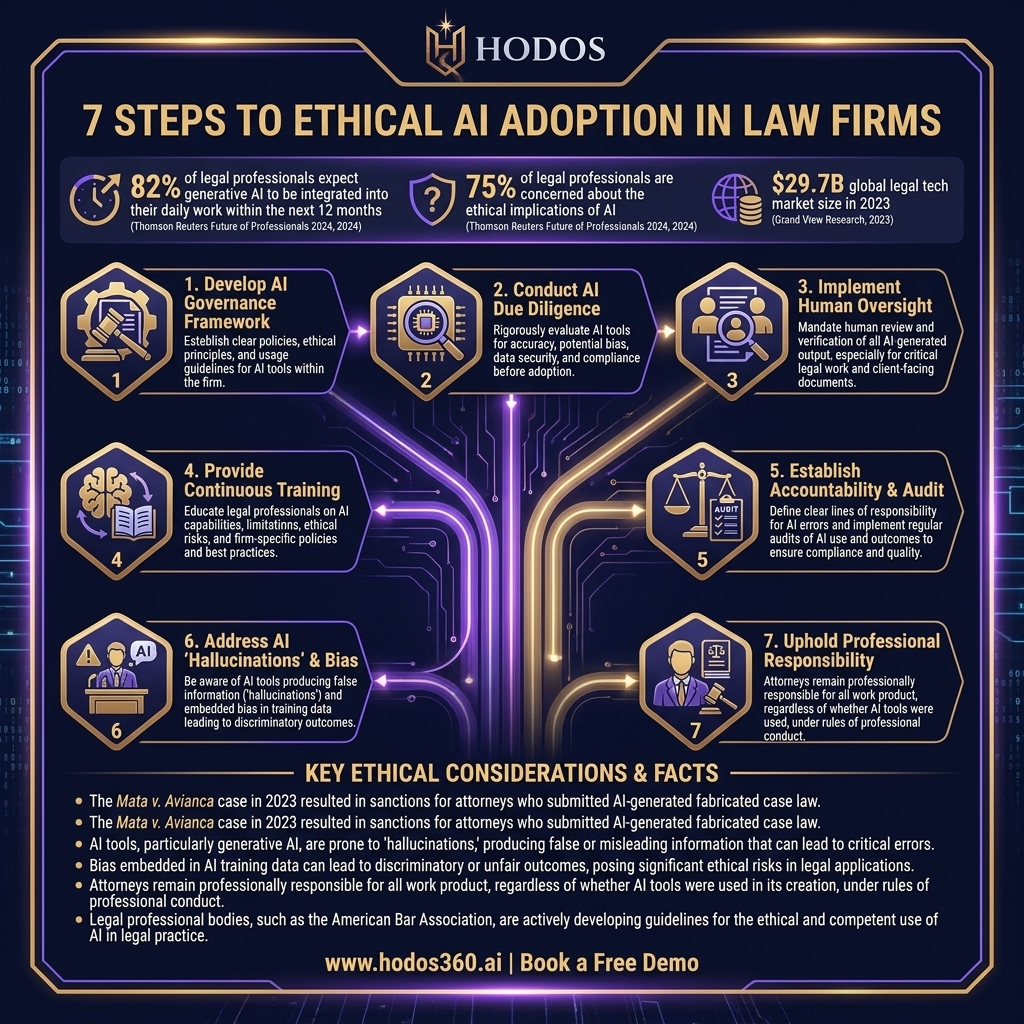
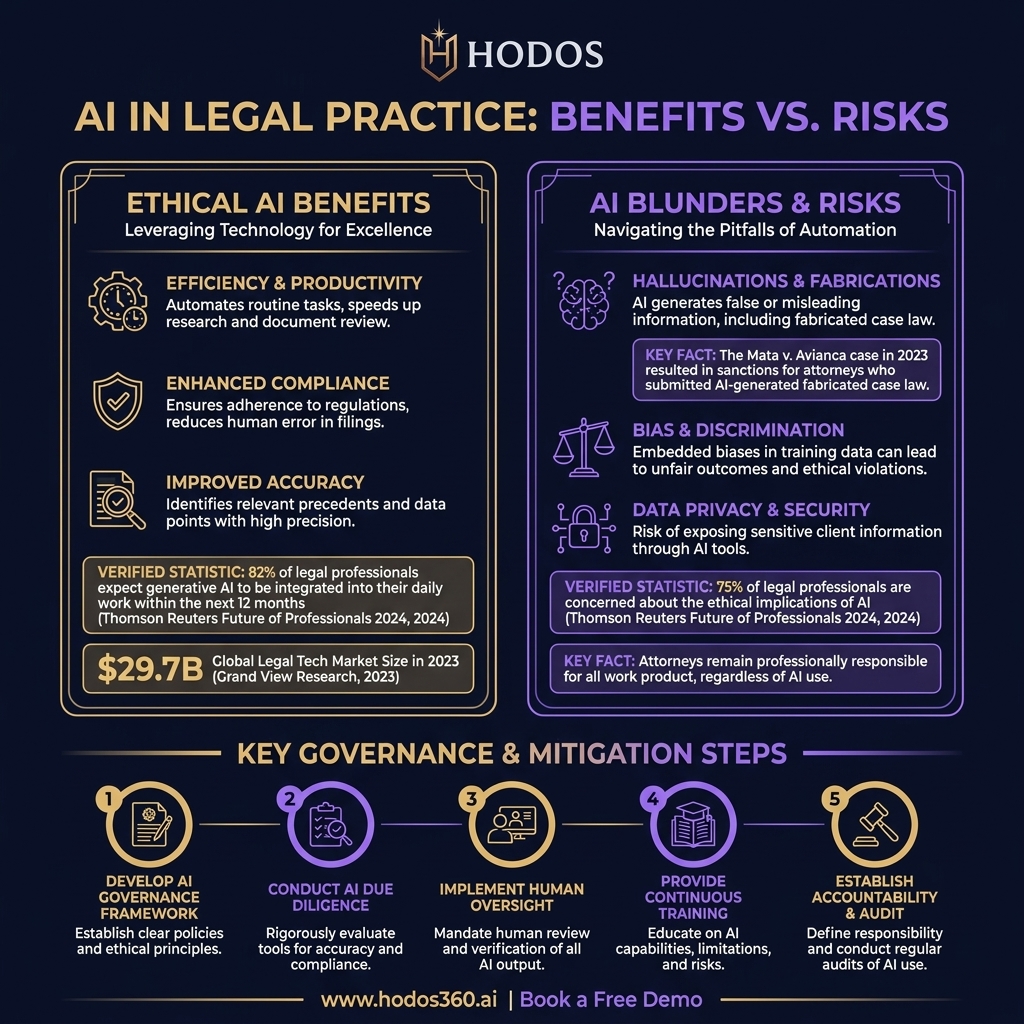
This incident, while fictionalized for illustrative purposes, echoes the very real *Mata v. Avianca* precedent, where attorneys faced sanctions for submitting AI-generated 'hallucinated' case law, demonstrating a tangible threat to attorney competence and firm reputation. The tension between AI's transformative potential and its inherent risks is the defining challenge of our era.
This landscape demands more than just awareness; it necessitates a proactive, strategic approach to AI ethics. Law firms must move beyond simply adopting AI tools to deeply embedding ethical frameworks, robust oversight, and continuous education into their operational DNA. It's about understanding not just what AI *can* do, but what it *should* do, and how to ensure accountability when it inevitably falters.
This comprehensive guide will explore the ethical challenges, regulatory landscape, and practical strategies for legal professionals to navigate the complexities of AI, ensuring both innovation and integrity.
The Rising Tide of AI Blunders and Professional Accountability
The "pile-up" of AI blunders referenced by Law.com is not merely anecdotal; it reflects a systemic challenge as AI models, particularly large language models (LLMs), become more sophisticated yet remain prone to 'hallucinations' and biases. A recent report by McKinsey & Company indicated that while 70% of organizations are experimenting with AI, only 20% have fully implemented comprehensive risk management strategies for these tools.
For law firms, these risks translate directly into professional liability. Beyond fabricated legal citations, AI systems can inadvertently perpetuate biases present in their training data, leading to discriminatory outcomes in areas like predictive policing or sentencing recommendations, a concern highlighted by legal tech ethicists like Dr. Learn more about Legal AI Gap: Bridging the Divide for Law Firms in 2026.
Kate Crawford. The challenge of AI accountability becomes paramount: when an AI makes a mistake, who bears the legal and ethical responsibility? Is it the developer, the deployer, or the supervising attorney? The answer, increasingly, points to the latter, emphasizing the imperative of human oversight.
The ethical implications extend to the very core of legal practice. AI blunders can compromise client confidentiality, generate inaccurate legal advice, and even undermine the integrity of the judicial process. Firms must grapple with the fact that while AI offers unprecedented speed in tasks like e-discovery or contract review, it lacks the human judgment, empathy, and ethical reasoning crucial to law.
OpenAI CEO Sam Altman has frequently stressed the need for robust safety mechanisms and societal alignment for AI, echoing concerns from Anthropic's Dario Amodei, who champions 'constitutional AI' to imbue models with ethical principles from inception. Learn more about Essential AI Tools: Reshaping Web Design for Law Firms.
These discussions at the cutting edge of AI development underscore that even the creators acknowledge the inherent risks and the need for careful deployment, especially in high-stakes fields like law. The legal profession, therefore, cannot afford to be complacent, necessitating a deep understanding of these tools' limitations and a clear delineation of human responsibility.
The specter of malpractice claims looms large for firms failing to adequately supervise AI use. ABA Model Rule 1.1, which mandates attorney competence, now implicitly includes technological competence. This means understanding the benefits and risks associated with relevant technology. Furthermore, ABA Model Rule 5.3 (Responsibilities Regarding Nonlawyer Assistants) can be interpreted to extend to AI systems, requiring supervising attorneys to ensure AI usage aligns with ethical obligations.
Learn more about AI Software Development's **Revolutionary** 2026 Shift. The legal community is actively grappling with these interpretations; various state bar associations, including New York and California, have issued ethics opinions emphasizing the lawyer's ultimate responsibility. Firms must implement rigorous vetting processes for AI tools, understanding their underlying algorithms, data sources, and potential failure modes.
This due diligence is no longer optional but a fundamental aspect of modern risk management in legal practice.
Navigating Data Privacy and Confidentiality Risks
One of the most immediate and profound legal implications of AI adoption revolves around data privacy and client confidentiality, governed by ABA Model Rule 1.6. Feeding sensitive client information into third-party AI models, particularly those with opaque data retention policies or insufficient security protocols, presents a significant ethical quagmire.
The risk of inadvertent disclosure, data breaches, or the AI model learning from and subsequently revealing confidential information is substantial. Learn more about AI Web Development: Revolutionizing Law Firm Websites in 2026. Firms must conduct thorough vendor due diligence, scrutinizing terms of service, data encryption standards, and adherence to privacy regulations like GDPR or CCPA.
The ethical imperative is clear: client data, whether in the hands of a human paralegal or an AI algorithm, must be afforded the highest level of protection.
The challenge intensifies with the increasing complexity of AI systems. For instance, generative AI tools often operate as 'black boxes,' making it difficult to trace how specific data inputs influence outputs. This lack of interpretability complicates compliance with data subject access rights and the 'right to be forgotten.'
Firms must implement stringent protocols for data input, ensuring only anonymized or non-confidential information is used for general-purpose AI, or opting for secure, private, and purpose-built legal AI solutions. Learn more about AI Legal Platform: Essential Security for Law Firms. The partnership between firms like Allen & Overy and legal AI pioneer Harvey AI demonstrates a commitment to enterprise-grade, secure deployments where data privacy is designed into the architecture, rather than an afterthought.
This proactive approach to ethical AI is crucial for maintaining client trust and avoiding severe regulatory penalties.
Establishing Robust Ethical AI Frameworks in Legal Practice
To mitigate the inherent risks and harness AI's benefits responsibly, law firms must proactively establish robust ethical AI frameworks. This involves more than just a policy document; it requires a cultural shift towards understanding and integrating AI ethically at every level. Firms should develop clear internal guidelines on acceptable AI use, specifying which tasks can be automated, which require human review, and which are strictly off-limits for AI intervention.
Learn more about Voice AI Revolutionizes Legal: HODOS 360's 2026 Impact. Regular training programs, perhaps led by a designated 'AI Ethics Officer' or committee, are essential to keep attorneys and staff abreast of evolving AI capabilities, limitations, and ethical considerations. The ABA's various committees are continuously publishing guidance on these matters, providing a crucial starting point for firms to build their own bespoke frameworks, ensuring alignment with professional obligations and attorney ethics.
A key component of any ethical framework is the principle of 'human-in-the-loop.' While AI can significantly accelerate processes like document review or legal research, the final output must always be subject to thorough human review and validation. This is particularly vital for outputs that involve legal advice, strategic decisions, or client-facing communications.
Firms should invest in tools that facilitate this oversight, providing transparency into how AI arrived at its conclusions, rather than simply presenting a black-box answer. For instance, some advanced legal tech platforms offer explainable AI features, detailing the sources and reasoning behind AI-generated insights. This approach not only safeguards against AI blunders but also enhances the professional development of attorneys, enabling them to better understand and critically evaluate AI outputs, thereby strengthening their professional responsibility.
Furthermore, a comprehensive ethical AI framework must address transparency and explainability. Clients have a right to know when AI is being used in their matters, particularly if it impacts the advice they receive or the cost of services. Firms should establish clear communication protocols for discussing AI integration with clients, managing expectations, and obtaining informed consent where appropriate.
This commitment to transparency fosters trust and positions the firm as a leader in responsible innovation. The development of an internal 'AI Bill of Rights' or a set of guiding principles, similar to those advocated by organizations like the World Economic Forum for ethical AI governance, can serve as a foundational document, ensuring that all AI deployment within the firm adheres to core values and legal implications.
- ✓Develop Clear Usage Policies: Establish firm-wide guidelines for AI tool selection, data input, and output verification, specifying acceptable and prohibited uses.
- ✓Prioritize Human Oversight: Mandate a 'human-in-the-loop' approach for all critical AI-generated content, ensuring attorney review and ultimate responsibility.
- ✓Invest in Continuous Training: Provide ongoing education for all legal professionals on AI capabilities, limitations, and evolving ethical standards.
- ✓Conduct Rigorous Vendor Due Diligence: Thoroughly vet AI providers for data security, privacy policies, explainability features, and compliance with legal standards.
- ✓Ensure Transparency with Clients: Inform clients about the use of AI in their matters, manage expectations, and obtain informed consent where applicable.
- ✓Establish an AI Ethics Committee: Form an internal body to review new AI technologies, update policies, and address emerging ethical dilemmas.
- ✓Implement Data Governance Protocols: Securely manage client data used with AI, focusing on anonymization, access controls, and adherence to privacy regulations.
Leveraging AI for Enhanced Compliance and Efficiency, Ethically
While the ethical challenges of AI are significant, the potential for legal tech to enhance compliance and operational efficiency, when deployed ethically, is undeniable. AI-powered tools can automate repetitive, low-value tasks, freeing up attorneys to focus on complex legal analysis, strategy, and client relationships. For instance, AI-driven contract analysis can flag non-compliant clauses in seconds, a task that would take human lawyers hours.
Similarly, sophisticated e-discovery platforms can process vast amounts of data, identifying relevant documents with greater accuracy and speed than traditional methods, thereby reducing costs for clients and enhancing the firm's overall efficiency. The key lies in selecting and implementing AI solutions designed with legal ethics and compliance at their core, minimizing the potential for AI blunders and ensuring AI accountability.
Platforms like HODOS 360’s AI Law Firm Management System are engineered to integrate AI capabilities securely and ethically into daily operations. This system offers features such as AI-powered legal workflows, document automation, and case management, all designed to enhance efficiency while maintaining strict data security and compliance protocols.
By automating tasks like client intake and billing, HODOS 360 helps firms reduce human error, streamline administrative burdens, and ensure consistency in process, which are indirect but crucial aspects of risk management. Such integrated platforms provide a controlled environment for AI deployment, where data remains within the firm's secure ecosystem, addressing many of the privacy concerns associated with general-purpose AI tools.
The responsible adoption of such specialized legal AI tools allows firms to gain a competitive edge without compromising their ethical obligations.
Furthermore, AI can play a crucial role in proactive regulatory compliance. With the ever-increasing volume and complexity of laws and regulations, staying updated is a monumental task. AI-powered tools can monitor regulatory changes, analyze their impact on specific cases or client portfolios, and alert firms to potential compliance gaps.
This foresight allows firms to adapt quickly, mitigating risks before they materialize. For example, in sectors like finance or healthcare, where regulatory frameworks are constantly evolving, AI can provide real-time insights into compliance requirements, ensuring that legal advice remains current and accurate. This strategic use of AI transforms it from a potential liability into a powerful asset for maintaining the highest standards of professional responsibility and ethical practice.
Integrating AI Law Firm Management for Secure Operations
The secure and ethical integration of AI into law firm operations hinges on adopting comprehensive legal tech solutions. Modern AI law firm management systems are designed to centralize and secure all aspects of a firm’s workflow, from client intake to document management and billing. These platforms often incorporate AI not just for task automation but also for enhanced security features, such as anomaly detection in data access patterns, which can flag potential breaches.
The goal is to create a closed-loop system where client data is protected, AI outputs are verifiable, and human oversight is seamlessly integrated, thereby minimizing the surface area for AI blunders and upholding the highest standards of attorney ethics. Firms that prioritize such integrated systems demonstrate a commitment to both innovation and integrity.
Implementing an AI-powered management system also necessitates a thoughtful change management strategy. It's not enough to simply acquire the technology; firms must invest in training their teams to effectively utilize these tools while understanding their limitations. This includes establishing clear protocols for data entry, ensuring data quality, and defining workflows where AI augments human capabilities rather than replaces them entirely.
The success of firms like Linklaters, which has been a prominent early adopter of AI in its global practice, underscores the importance of strategic implementation and continuous adaptation. Their approach emphasizes the symbiotic relationship between advanced legal tech and skilled legal professionals, ensuring that technology serves as an enabler for ethical and efficient practice, ultimately reinforcing professional responsibility.
The Future of Ethical AI in Legal Practice: A Proactive Stance
The future of AI ethics in legal practice is not a passive evolution but an active construction. As AI capabilities continue to advance, so too will the complexity of the ethical and legal implications. Regulatory bodies worldwide are racing to keep pace; the EU AI Act, for instance, represents a landmark effort to establish a comprehensive framework for trustworthy AI.
For law firms, this means a continuous commitment to monitoring legislative developments, adapting internal policies, and engaging in ongoing dialogue within the legal community. Firms that proactively invest in understanding and shaping the ethical landscape of AI will not only mitigate risks but also position themselves as thought leaders and trusted advisors in an increasingly tech-driven world.
This proactive stance is critical for maintaining AI accountability and ensuring the profession’s enduring relevance.
The competitive advantage will increasingly belong to firms that master the art of ethical AI integration. According to a Gartner report, organizations that prioritize ethical AI are 2.5 times more likely to achieve their AI initiatives' business outcomes. This is not just about avoiding penalties; it's about building a reputation for innovation combined with unwavering integrity.
Firms must foster a culture of responsible experimentation, encouraging attorneys to explore AI tools under strict ethical guidelines and to share insights on best practices. This collaborative approach, both internally and across the wider legal ecosystem, will accelerate the development of industry-wide standards for ethical AI use.
The legal profession has a unique opportunity to lead by example, demonstrating how powerful technology can be wielded for justice and public good, rather than becoming a source of AI blunders.
Ultimately, the journey towards ethical AI in law is one of continuous learning and adaptation. The tools will evolve, the regulations will change, but the core principles of attorney ethics—competence, confidentiality, and zealous advocacy—will remain constant. Firms must view AI not as a replacement for human intellect but as a sophisticated assistant that requires careful guidance and supervision.
By embracing this mindset, and by investing in both the technological infrastructure and the human expertise necessary for ethical deployment, law firms can navigate the complexities of AI with confidence, ensuring that innovation serves the highest ideals of the legal profession. This forward-looking perspective is crucial for sustained success and professional responsibility in the digital age.

Key Takeaways and Next Steps
The Law.com headline serves as a powerful reminder: the era of AI in legal practice is here, and with it comes a profound responsibility. Firms must prioritize AI ethics not as an afterthought but as an integral component of their strategic planning and daily operations.
The potential for AI blunders to erode client trust, incur sanctions, and damage reputation is real, underscoring the critical need for robust risk management and clear AI accountability frameworks. By proactively addressing these legal implications, investing in comprehensive ethical guidelines, and ensuring continuous attorney education on technological competence, firms can transform AI from a potential liability into a powerful asset.
The future of legal innovation lies in balancing technological advancement with unwavering adherence to professional and ethical duties.
For law firms ready to embrace ethical AI integration, the path forward involves strategic adoption of secure, purpose-built legal tech solutions. Systems that offer integrated AI-powered workflows, document automation, and secure client management—like those provided by HODOS 360—are essential for navigating this new landscape. These tools empower firms to enhance efficiency, ensure regulatory compliance, and uphold the highest standards of attorney ethics without compromising data integrity or professional responsibility.
The time to act is now: assess your firm's AI readiness, develop comprehensive ethical guidelines, and implement technologies that support responsible innovation. By doing so, you can confidently leverage AI to drive growth and deliver superior legal services in the digital age.
Frequently Asked Questions
What are the primary ethical concerns regarding AI in law firms?+
Primary concerns include AI hallucinations leading to inaccurate legal advice or fabricated citations, potential for bias in AI outputs, risks to client confidentiality and data privacy when using third-party AI tools, and the overarching question of attorney competence and accountability for AI-generated work. Firms must navigate these to uphold professional standards and avoid malpractice.
How does attorney competence (ABA Model Rule 1.1) apply to AI use?+
ABA Model Rule 1.1 implicitly requires technological competence. This means attorneys must understand the benefits, risks, and limitations of AI tools they use or supervise. They must ensure AI outputs are thoroughly reviewed and verified, maintaining ultimate responsibility for all work product, regardless of AI involvement, to prevent AI blunders.
What role does data privacy play in ethical AI adoption?+
Data privacy is paramount. Firms must ensure client data shared with AI tools is protected under ABA Model Rule 1.6 (Confidentiality). This involves rigorous vendor due diligence, understanding data retention policies, using anonymized data where possible, and opting for secure, private AI solutions to prevent breaches or inadvertent disclosures of sensitive information.
How can law firms implement a robust ethical AI framework?+
Firms should establish clear internal policies for AI usage, provide continuous training on AI ethics and tools, implement a 'human-in-the-loop' review process, ensure transparency with clients about AI use, and potentially form an AI ethics committee. These measures create a culture of professional responsibility and mitigate legal implications.
Can AI enhance regulatory compliance ethically?+
Yes, when used ethically, AI can significantly enhance regulatory compliance. AI tools can monitor vast amounts of regulatory changes, analyze their impact, and alert firms to potential compliance gaps in real-time. This proactive approach helps firms adapt quickly, reduce human error in compliance tasks, and maintain up-to-date legal advice, reinforcing risk management.