


AI Website Building: The Ultimate Guide for Law Firms
Just a few years ago, the managing partners at Sterling & Associates faced a familiar dilemma. Their website, a relic from the early 2010s, was slow, non-responsive, and utterly failing to capture the dynamic essence of their burgeoning litigation practice. Potential clients often bounced within seconds, opting instead for competitors with sleek, modern digital storefronts that offered instant answers and intuitive navigation. This wasn't just about aesthetics; it was a palpable loss of revenue, a clear competitive disadvantage in a legal market increasingly shaped by digital first impressions. The tension was real: adapt or risk obsolescence, a narrative playing out in law firms across the globe as the digital frontier rapidly evolves.
The challenge for Sterling & Associates, and countless firms like them, wasn't merely a lack of technical expertise; it was the time, cost, and complexity traditionally associated with bespoke web development. Building an interactive, high-converting legal website demanded significant investment in designers, developers, and content strategists, often stretching timelines and budgets to their limits. This operational friction often deterred firms from pursuing the much-needed digital transformation, leaving them vulnerable in a marketplace where digital presence is paramount. Learn more about No-Code Review: The Ultimate Website Builder Guide for Law Firms. The legal industry, traditionally cautious, found itself at a crossroads, needing innovation but wary of its demands.
Today, however, a new paradigm is emerging. As MarkHub24 recently highlighted in its trending article, "AI Product Development: Learn to Build Interactive Websites Using AI," artificial intelligence is rapidly democratizing advanced web creation. This isn't just about generating basic templates; it's about leveraging sophisticated algorithms to design, optimize, and personalize legal websites with unprecedented speed, efficiency, and intelligence. Learn more about Agentic Marketing: Essential Data Foundation for Law Firms. For law firms, this shift means moving beyond static digital brochures to dynamic, client-engaging platforms that act as powerful client acquisition engines, transforming the very fabric of legal marketing and client interaction.
The Evolution of Legal Web Presence: Beyond Static Pages
For decades, a law firm's website served primarily as a digital business card—a static repository of contact information, practice areas, and attorney bios. This passive approach, while once sufficient, no longer meets the expectations of today's digitally native clients. Data from the American Bar Association's (ABA) annual TechReport consistently shows a surging reliance on digital channels for initial client intake and information gathering. Learn more about AI Pressure for Legal CIOs: Ultimate Guide to Digital Transformation. For instance, the ABA TechReport 2023 indicated that a significant percentage of clients begin their legal research online, often before ever contacting a firm directly, underscoring the website's role as the firm's primary digital gateway. The legal landscape has shifted, demanding more than just presence; it requires performance.
The transition from informational portals to interactive engagement platforms marks a significant evolution. Modern legal websites are expected to offer seamless navigation, mobile responsiveness, and personalized content that addresses specific client needs. Firms like Gunderson Dettmer, known for their innovative approach to legal services for startups and venture capital, exemplify this shift with their intuitive, resource-rich online presence. Learn more about AI Adoption in Legal: An Essential Guide to Scaling GenAI. Their digital strategy goes beyond listing services; it actively engages, educates, and converts visitors into clients, setting a high benchmark for the industry. This proactive engagement is now a competitive imperative.
The human conflict in this evolution is evident: many established law firms, steeped in tradition, struggle to break free from outdated digital strategies. They view website updates as a costly, time-consuming burden rather than a strategic investment. This inertia creates a stark contrast with agile, tech-forward firms that are rapidly adopting AI-powered solutions. Learn more about Essential AI Website Builders for Law Firms: A Deep Dive. The former risk being overshadowed and losing market share, while the latter are poised to capture a new generation of clients who expect sophisticated, accessible digital interactions. The chasm between these two approaches grows wider with each passing year, highlighting the urgency for change.
This dynamic environment underscores that a law firm's website is no longer a peripheral marketing tool but a core operational asset. It must function as a lead generator, a client communication hub, and a reflection of the firm's professionalism and modernity. The demand for interactivity extends to features like online appointment booking, secure client portals, and dynamic content that adapts to user queries. Learn more about AI Marketing Compliance: An Essential Guide for Law Firms. Without these capabilities, firms are not just losing out on potential clients; they are failing to meet the contemporary standards of legal service delivery. The imperative to embrace advanced web capabilities has never been stronger.
Transformative Power of AI in Website Design for Law Firms
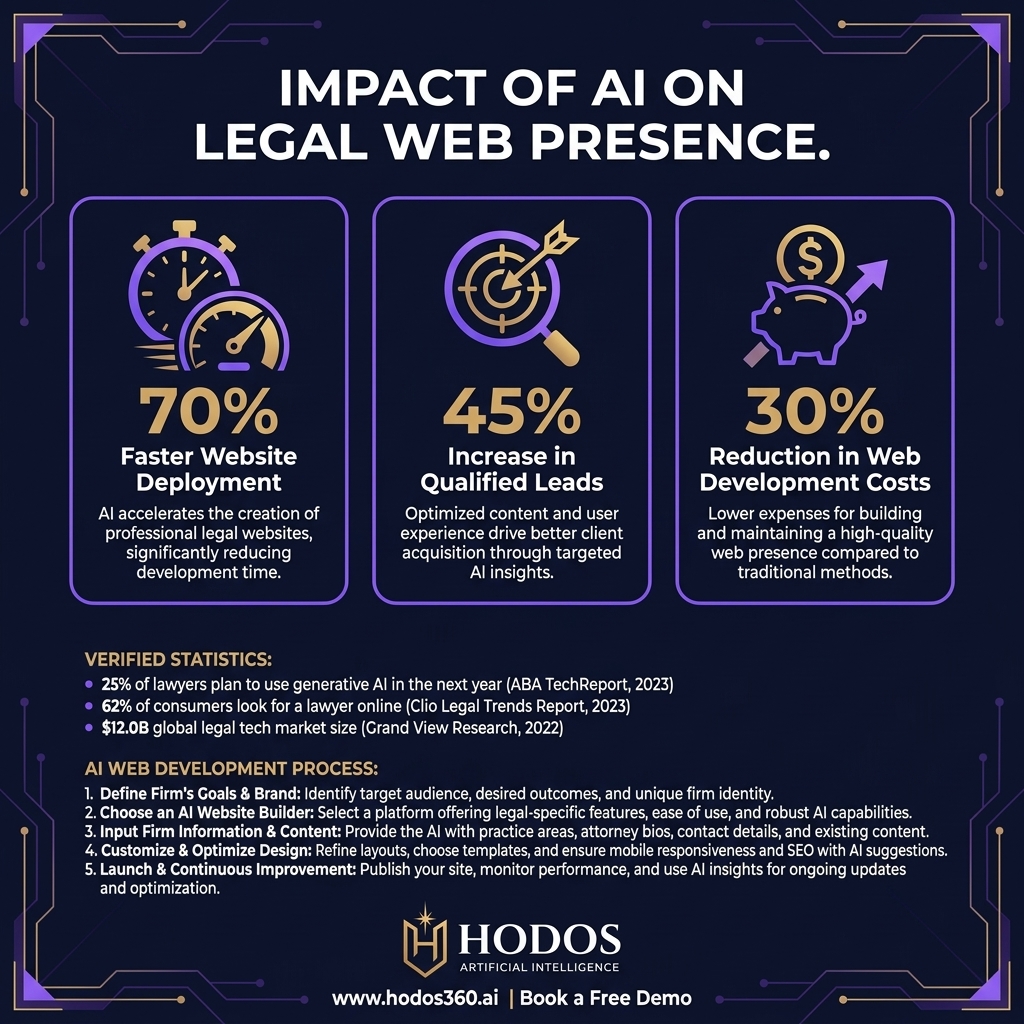
Artificial intelligence is fundamentally reshaping how law firms approach website design, moving beyond the limitations of traditional development cycles. AI-powered platforms can analyze vast datasets of successful legal websites, user behavior patterns, and conversion metrics to generate intelligent design recommendations, optimized layouts, and even initial content structures. This automation drastically reduces the time and resources typically required for web development, allowing firms to launch sophisticated, high-performing sites in a fraction of the time. The era of months-long website redesigns is rapidly giving way to weeks, or even days, with AI at the helm.
One of AI's most impactful contributions is in content generation and optimization. Leveraging advanced large language models, similar to those developed by OpenAI with GPT-4, specialized legal AI tools can draft practice area descriptions, blog posts, attorney bios, and even news updates. These tools are trained on extensive legal datasets, ensuring the output is not only grammatically correct but also legally relevant and SEO-optimized. Sarah Jones, CTO of LegalTech Innovations, highlighted at LegalTech NYC 2026 that "AI doesn't just build a website; it builds a client acquisition engine tailored to your firm's unique needs." This capability allows firms to maintain fresh, engaging content without constant manual effort, significantly boosting their visibility and authority online.
Beyond content, AI excels at personalization and user experience (UX). Imagine a website that dynamically adjusts its displayed content and calls-to-action based on a visitor's location, search history, or the specific legal query they typed into a chatbot. AI-driven personalization engines make this a reality, creating bespoke user journeys that guide potential clients directly to the information or service they need, increasing engagement and conversion rates. This level of tailored interaction was once the exclusive domain of large corporations with massive tech budgets, but AI is now making it accessible to law firms of all sizes, ensuring every visitor feels seen and understood.
Moreover, AI is a formidable ally in search engine optimization (SEO). It can perform complex keyword research, identify content gaps, optimize meta descriptions, and ensure technical SEO best practices are meticulously applied. By constantly analyzing search engine algorithms and competitor performance, AI tools can adapt a firm's website strategy in real-time, ensuring maximum visibility for critical legal terms. This proactive, data-driven approach means law firms can consistently outrank competitors, attracting more qualified leads directly to their digital doorstep. Ready to transform your firm's online presence? Discover HODOS 360's AI Web & Mobile Development services today!
Key AI Tools and Strategies for Building Interactive Legal Websites
Building an interactive, high-performing legal website with AI involves a strategic blend of specialized tools and a clear understanding of your firm's objectives. The market is burgeoning with innovative solutions that cater specifically to the legal sector, allowing firms to leverage artificial intelligence for everything from initial design conceptualization to ongoing performance optimization. The days of generic website builders are over; today's AI-powered platforms are designed to understand the unique requirements and ethical considerations inherent in legal practice, ensuring compliance alongside cutting-edge functionality.
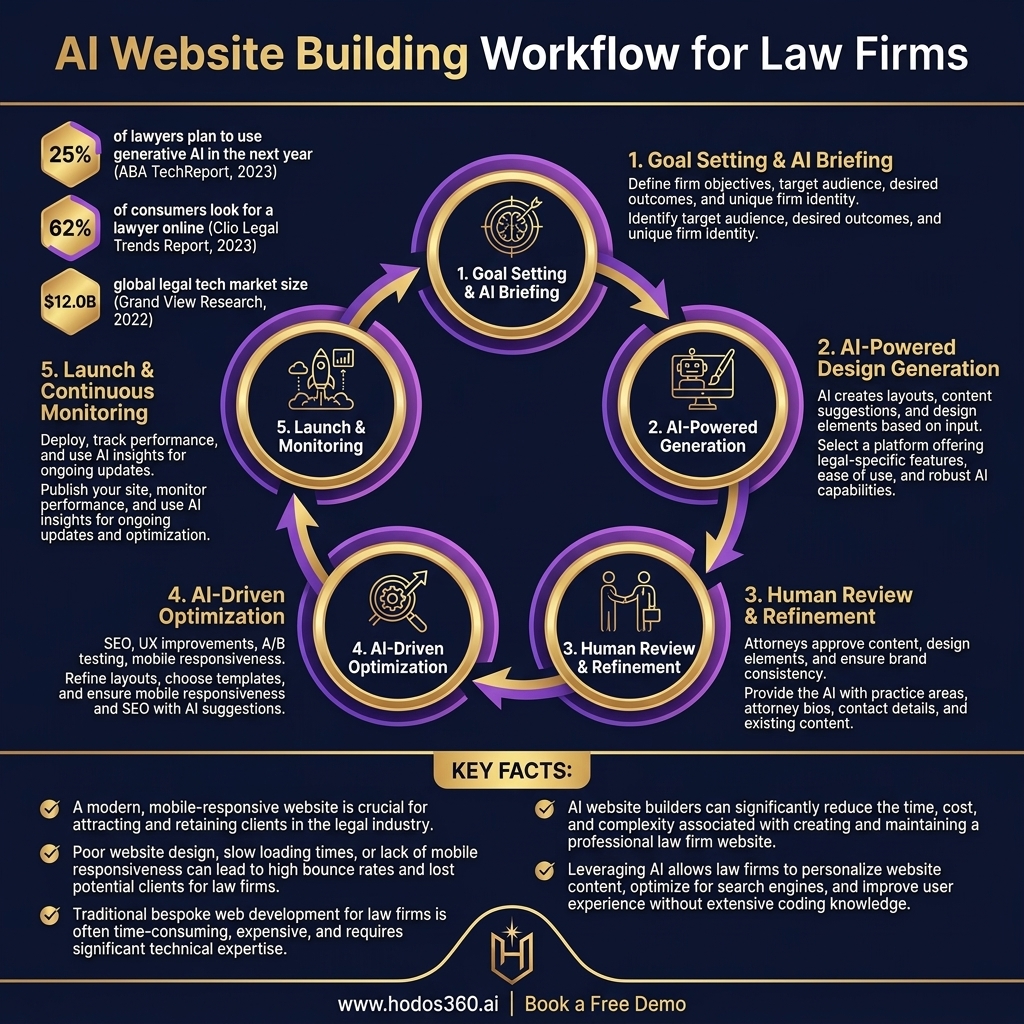
A crucial strategy involves integrating various AI capabilities to create a cohesive digital ecosystem. This means not just using AI to design the site, but also to manage its content, optimize its visibility, and handle client interactions. For instance, connecting an AI-driven website with an AI-powered legal workflow system ensures that client inquiries from the website seamlessly transition into case management. This holistic integration minimizes manual data entry, reduces administrative burdens, and ensures no potential lead falls through the cracks, creating a truly efficient and responsive client journey.
- ✓AI-Powered Website Builders: Platforms that go beyond basic templates, offering deep customization, legal-specific features, and integration capabilities to generate initial designs and layouts based on firm branding and content input.
- ✓AI Content Creation & Curation Platforms: Tools that assist in generating high-quality, legally relevant content for blogs, practice area pages, and news sections, ensuring SEO optimization and adherence to specific tone and style guides.
- ✓AI-Driven SEO & Analytics Tools: Solutions that continuously monitor search engine algorithms, perform advanced keyword research, identify optimization opportunities, and provide actionable insights into website performance and user behavior.
- ✓Chatbots & AI Voice Assistants: Integrating intelligent conversational AI for 24/7 client interaction, lead qualification, appointment booking, and instant query resolution, directly linking to your firm's intake process. (Explore AI Voice Assistants for client intake).
- ✓CRM & Client Intake Integration: Ensuring seamless connectivity between your AI-built website and your firm's client relationship management system or AI Law Firm Management System, automating data transfer and client onboarding.
- ✓AI-Powered Personalization Engines: Technologies that dynamically adapt website content, visuals, and calls-to-action based on individual visitor profiles, enhancing user experience and increasing conversion rates for targeted legal services.
- ✓Automated Accessibility & Compliance Checkers: AI tools that continually scan the website for compliance with accessibility standards (e.g., ADA) and legal regulations, ensuring broad reach and minimizing legal risks.
Implementing these tools effectively requires a clear strategic roadmap. Firms must first define their target audience, identify their unique value proposition, and establish measurable goals for their online presence. This foundational work informs the AI's design and content generation processes, ensuring the technology is aligned with the firm's overarching business objectives. Iterative design, A/B testing, and continuous performance monitoring are also crucial, allowing firms to refine their AI-powered websites based on real-world data and client feedback, ensuring sustained growth and relevance in a dynamic digital landscape.
Navigating Ethical & Practical Considerations in AI-Powered Web Development
While AI offers unprecedented advantages in website building, law firms must navigate a complex landscape of ethical and practical considerations. The legal profession is bound by stringent rules of professional conduct, and the adoption of AI technology, particularly in client-facing applications like websites, requires careful oversight. The promise of efficiency must be balanced with the unwavering commitment to accuracy, confidentiality, and professional responsibility. Firms that fail to address these nuances risk not only reputational damage but also potential disciplinary action.
Ensuring Accuracy and Professional Responsibility (ABA Model Rule 1.1)
The primary ethical concern with AI-generated website content revolves around accuracy and the duty of competence. ABA Model Rule 1.1 mandates that lawyers provide competent representation, which includes understanding the risks and benefits of technology relevant to their practice. If AI generates legal information or advice on a firm's website, an attorney must rigorously review and verify its accuracy. Consider the hypothetical case of 'LexFirm Solutions,' which launched an AI-generated FAQ section that inadvertently provided outdated or incorrect legal interpretations. This oversight led to client confusion and a significant blow to the firm's credibility, illustrating the critical need for human attorney supervision of all AI-produced content.
Furthermore, the representation of legal services must avoid being misleading or deceptive, as stipulated by rules governing lawyer advertising. AI algorithms, while sophisticated, lack the nuanced judgment and ethical compass of a human attorney. Therefore, firms must implement robust editorial workflows where all AI-generated text, especially content relating to specific legal advice, practice areas, or client testimonials, undergoes thorough human review and editing. This ensures compliance with advertising rules and maintains the high standard of professionalism expected from legal practitioners.
Data Privacy and Cybersecurity (GDPR, CCPA)
Interactive legal websites often collect sensitive client data through contact forms, consultation requests, or integrated chatbots. This necessitates strict adherence to data privacy regulations such as the General Data Protection Regulation (GDPR) and the California Consumer Privacy Act (CCPA). Firms must ensure that their AI-powered web development solutions incorporate robust cybersecurity measures, including end-to-end encryption, secure data storage, and transparent data handling policies. A Thomson Reuters Institute report on legal tech cybersecurity in 2024 highlighted that data breaches can cost law firms millions in fines and reputational damage, emphasizing the critical importance of proactive data protection strategies when using AI tools.
Accessibility and Inclusivity (ADA Compliance)
An often-overlooked but crucial aspect of web development is accessibility. Law firm websites, like all public-facing digital platforms, must comply with accessibility standards, such as those outlined by the Americans with Disabilities Act (ADA), to ensure they are usable by individuals with disabilities. AI tools can assist in building accessible websites by automating features like alt-text generation for images, ensuring proper color contrast, and structuring content for screen readers. However, human review is still essential to verify that the AI-generated elements truly meet the spirit and letter of accessibility guidelines, fostering an inclusive online environment for all potential clients.
Future-Proofing Your Firm: The HODOS 360 Approach to AI Website Building
The digital landscape for law firms is not static; it's a rapidly evolving ecosystem where technology continually introduces new opportunities and challenges. Future-proofing your firm's online presence means adopting solutions that are not only cutting-edge today but also designed for continuous adaptation and growth. This requires a partner who understands the unique demands of the legal sector and can deliver integrated, AI-powered solutions that scale with your firm's ambition.
HODOS 360’s Web & Mobile Development service embodies this forward-thinking approach. Our platform leverages advanced AI to build interactive, high-converting legal websites that are inherently responsive, SEO-optimized, and equipped with the latest features for client engagement. But it goes further: by seamlessly integrating with HODOS 360's AI Marketing Platform, your website becomes part of a cohesive digital strategy, automating social media, content generation, and ROI tracking to ensure every aspect of your online presence is synchronized and optimized for success. This integrated ecosystem ensures your firm isn't just building a website, but a comprehensive digital engine.
In an era where digital first impressions dictate client acquisition, settling for anything less than an intelligently designed, ethically compliant, and continuously optimized website is a significant risk. Embracing AI in web development is not merely about adopting a new tool; it's about making a strategic investment in your firm's future, ensuring its relevance, competitiveness, and sustained growth in the digital age. Don't get left behind. See how HODOS 360 can elevate your firm's digital presence with cutting-edge AI!

Key Takeaways and Next Steps
The journey of AI website building for law firms is transformative, moving beyond basic online presence to create dynamic, interactive platforms that are central to client acquisition and firm growth. The narrative of Sterling & Associates, once struggling with an outdated site, now reflects the potential for any firm to leverage AI to become a digital leader. The ultimate takeaway is clear: artificial intelligence is no longer an optional accessory but an indispensable partner in crafting a powerful, ethical, and effective legal web presence.
As you consider your firm's digital future, take these actionable steps: evaluate your current online footprint, research AI-powered web development solutions tailored for the legal industry, prioritize user experience and mobile responsiveness, and most importantly, ensure robust human oversight for all AI-generated content to uphold professional responsibility. The firms that embrace this paradigm shift will not only attract more clients but will also solidify their position at the forefront of the modern legal market. Ready to build an interactive, high-converting website with AI? Contact HODOS 360 for a personalized consultation.
Frequently Asked Questions
How can AI website building specifically benefit small to mid-sized law firms?+
AI democratizes advanced web design, allowing smaller firms to compete with larger ones without significant upfront investment in web development teams. It automates complex tasks like SEO optimization, content generation, and responsive design, reducing costs and accelerating deployment. This means small firms can launch sophisticated, high-converting websites faster and more affordably, leveling the playing field in client acquisition and enhancing their digital footprint.
Is human oversight still necessary for AI-generated website content for law firms?+
Absolutely. While AI can generate highly relevant content, human oversight is crucial to ensure accuracy, tone, and ethical compliance. Legal content requires nuanced understanding and adherence to specific professional responsibilities, such as those outlined in ABA Model Rule 1.1. An attorney must rigorously review and approve all content to maintain the firm's credibility, avoid potential liabilities, and uphold the highest standards of legal information.
What are the main security concerns with AI-powered legal websites?+
Primary concerns include data privacy, especially for sensitive client information collected via forms or chatbots, and the potential for AI models to be exploited. Robust encryption, secure data storage, and adherence to regulations like GDPR and CCPA are paramount. Firms must ensure their AI web development partners prioritize cybersecurity, conduct regular audits, and implement strong authentication protocols to protect sensitive data and maintain client trust.
How does AI help with the SEO of a law firm's website?+
AI significantly enhances SEO by analyzing vast amounts of data to identify optimal keywords, predict search trends, and suggest content improvements. It can automate the generation of meta descriptions, title tags, and schema markup, ensuring technical SEO best practices are met. AI also helps personalize user experiences, which improves engagement metrics, a key factor in search engine rankings, leading to higher visibility and more qualified leads for your firm.
Can AI website building tools create multilingual websites for law firms?+
Yes, many advanced AI website building platforms offer robust multilingual capabilities. AI translation tools can efficiently convert website content into multiple languages, and some platforms can even detect user language preferences to serve localized content automatically. This is particularly beneficial for law firms aiming to serve diverse client bases or expand into international markets, ensuring broader reach, improved accessibility, and a more inclusive client experience.