

Claude AI for Legal: The Ultimate Guide to Contract Review
The flickering fluorescent lights of a downtown law firm often illuminate stacks of contracts, each page a potential minefield of clauses, obligations, and risks. For decades, the meticulous, often monotonous, task of contract review has been a cornerstone of legal practice, consuming countless billable hours and testing the endurance of even the most dedicated associates.
This scenario, a familiar one to partners like Sarah Jenkins, head of corporate law at Sterling & Finch LLP, represents a significant bottleneck in legal operations, a challenge ripe for disruption. But what if the very documents attorneys spend their lives scrutinizing could be understood, analyzed, and even redrafted by an intelligent assistant working seamlessly within their most familiar tools?
The answer arrived with a quiet but seismic shift in April 2026, as Anthropic officially launched its Claude AI native add-in for Microsoft Word, specifically highlighting legal contract review as a primary use case. This isn't just another AI tool; it's a strategic move to embed advanced generative AI directly into the fabric of daily legal work, promising to transform efficiency and accuracy across the board.
This pivotal development stems from a broader, intense competition within the AI industry, where giants like OpenAI and Anthropic are vying for dominance in specialized enterprise applications. While OpenAI's partnerships, such as with Allen & Overy for its Harvey AI platform, have made headlines, Anthropic’s approach with Claude AI for Word signifies a deliberate strategy to democratize sophisticated AI capabilities, making them accessible where lawyers already spend most of their time.
Dario Amodei, CEO of Anthropic, has consistently articulated a vision for AI that is helpful, harmless, and honest, principles that are particularly critical in the high-stakes legal domain. This move isn't merely about technological advancement; it's about addressing a critical pain point for law firms: the immense pressure to deliver faster, more cost-effective services without compromising quality.
The integration of Claude AI directly into the Microsoft Word environment—a ubiquitous tool in legal offices worldwide—is poised to set a new standard for AI-powered legal workflows, compelling firms to re-evaluate their operational strategies and embrace the potential of intelligent automation.
The Emergence of AI in Legal Contract Review: A New Era
For generations, the process of legal contract review has been characterized by its labor-intensive nature, a meticulous dance of human eyes poring over dense legal text. From identifying critical clauses to ensuring compliance with regulatory frameworks and flagging potential risks, the sheer volume and complexity of modern contracts often lead to burnout, inconsistencies, and, inevitably, human error.
This traditional model, while foundational, has increasingly struggled to keep pace with the demands of a globalized, fast-moving economy. Firms face immense pressure to accelerate deal closures, conduct due diligence under tight deadlines, and manage ever-growing caseloads, all while maintaining competitive fee structures. The inherent inefficiencies of manual review, estimated by McKinsey to consume up to 30-40% of an attorney's time on certain matters, have long been a significant drain on resources and profitability.
The legal tech industry has, for years, sought to alleviate this burden through various tools, but the advent of sophisticated generative AI, particularly large language models (LLMs) like Claude AI, marks a qualitative leap forward.
The competitive landscape in legal AI is vibrant and rapidly evolving.
Companies like Thomson Reuters, with its CoCounsel AI, and Clio, with its recent AI enhancements, have been pushing boundaries, while specialized startups like Harvey AI have secured significant partnerships, notably with global firms like Allen & Overy. Learn more about AI Legal Revolution: Corporate Use Jumps 87% by 2026.
However, Anthropic’s decision to bring Claude AI directly into Microsoft Word represents a strategic masterstroke, targeting the point of maximum friction for legal professionals. By embedding Claude AI as a native add-in, Anthropic aims to reduce the friction of adopting new tools, allowing lawyers to leverage advanced AI capabilities without leaving their familiar document environment.
This move is not just about a new feature; it’s about fundamentally rethinking the lawyer-document interaction. Imagine a world where a lawyer, working on a complex M&A agreement, can instantly query Claude AI within Word to identify all indemnification clauses, cross-reference them against internal playbooks, or even draft counter-proposals based on specific parameters.
This level of seamless integration and contextual understanding is what sets the current generation of AI apart and promises to usher in a new era for legal contract review, where efficiency gains are measured not in percentages but in paradigm shifts.
From Manual Labor to Intelligent Automation: The Shift
The shift from manual legal contract review to intelligent automation is not merely an incremental improvement; it represents a fundamental re-architecture of legal workflows. Historically, a junior associate might spend days sifting through hundreds of pages of contracts, a task prone to fatigue and oversight.
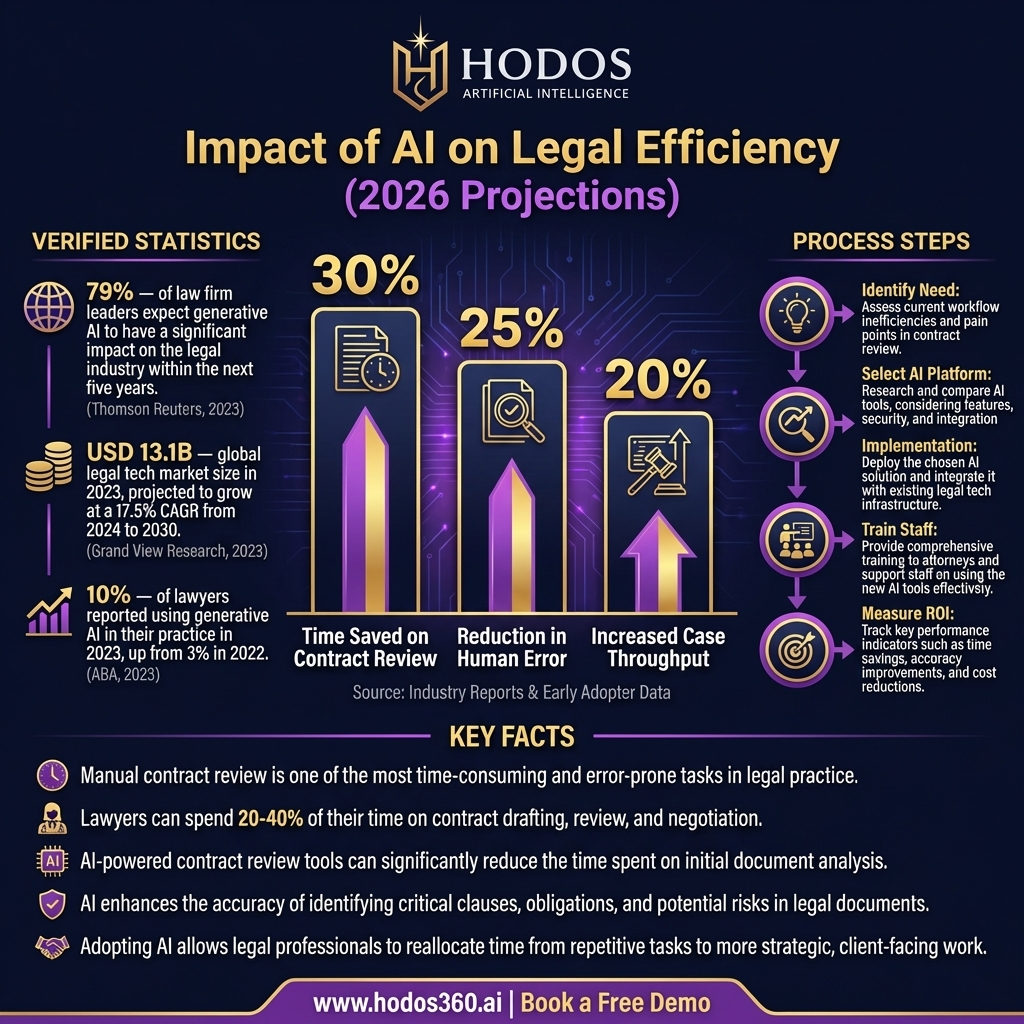
Now, with tools like Claude AI, the initial heavy lifting can be performed in minutes. For instance, a recent report from the Thomson Reuters Institute highlighted that early adopters of generative AI in legal departments have seen a 25-30% reduction in time spent on first-pass contract review.
This allows legal professionals to pivot from being mere document processors to strategic advisors, focusing their valuable expertise on high-level analysis, negotiation, and client counseling rather than repetitive data extraction. The economic implications are profound: firms can take on more cases, deliver services faster, and potentially reduce operational costs, making legal services more accessible and competitive.
This transition also minimizes the risk of human error, a critical factor in legal practice where a single missed clause can have significant financial or reputational repercussions. AI's ability to consistently apply predefined rules and identify anomalies with precision far surpasses human capacity over extended periods, providing a crucial layer of quality assurance that was previously unattainable.
Moreover, the integration of advanced AI goes beyond simple keyword searching or template matching. Learn more about AI Legal Research: The Ultimate Guide for Law Firms. Claude AI, with its sophisticated natural language understanding, can comprehend context, identify nuances in legal language, and even infer intent, capabilities that were once exclusive to seasoned legal minds.
For example, during due diligence for a major acquisition, a firm could deploy Claude AI to review thousands of vendor contracts, identifying specific change-of-control clauses or intellectual property assignments that might otherwise take a large team weeks to uncover. This not only accelerates the M&A process but also provides a more comprehensive risk assessment.
The American Bar Association (ABA) has increasingly emphasized the duty of technological competence, and adopting such tools is becoming less of an option and more of a professional imperative. As firms navigate the complexities of modern legal practice, leveraging intelligent automation powered by Claude AI is no longer a futuristic concept but a present-day reality, enabling a more strategic, efficient, and ultimately, more human-centric approach to law.
Discover how HODOS 360's AI Law Firm Management system streamlines these and other legal workflows. [Learn more about AI-powered legal workflows]
How Claude AI Integrates Directly into Microsoft Word for Legal Professionals
The brilliance of Anthropic’s Claude AI integration lies in its seamless, native presence within Microsoft Word, transforming the ubiquitous document editor into an intelligent legal co-pilot. Unlike standalone applications that require constant switching between interfaces, Claude AI appears as a persistent sidebar, accessible directly within the Word document.
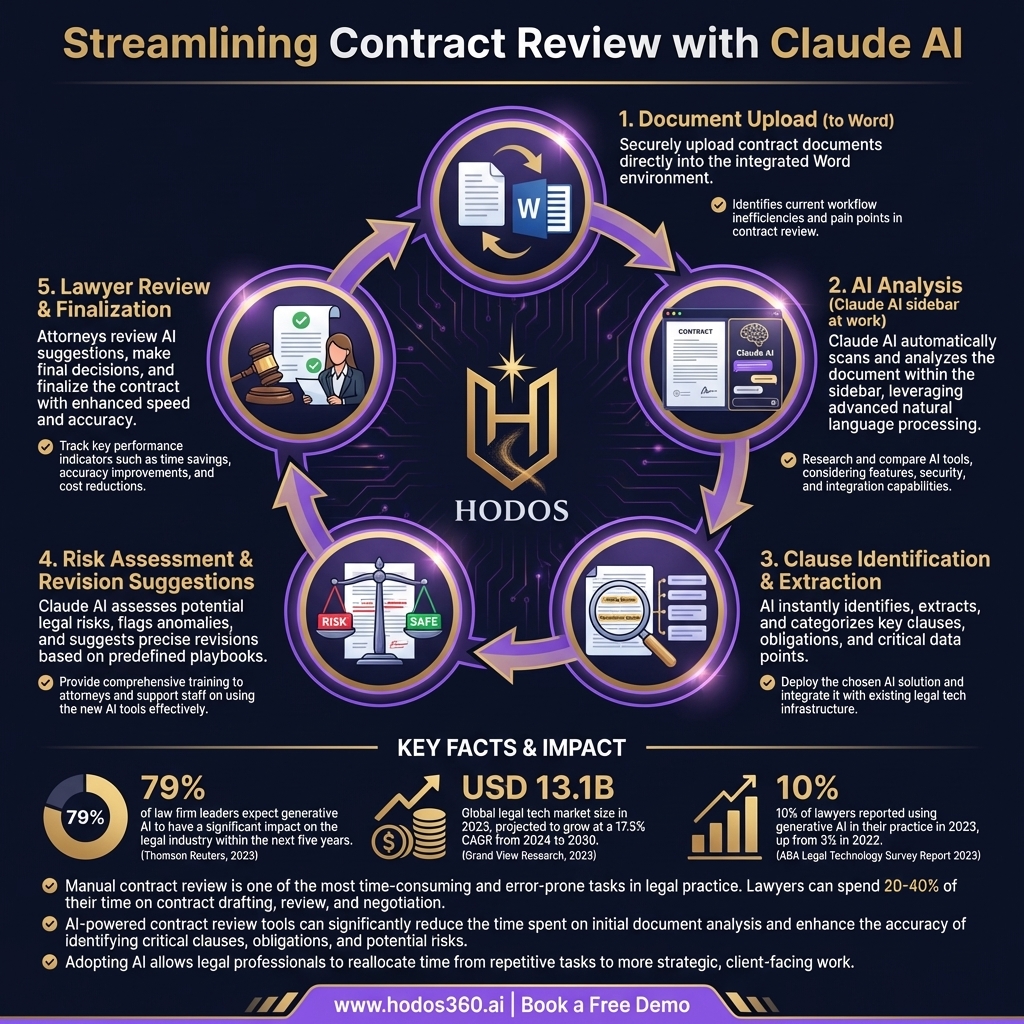
This 'inside your document' approach minimizes context switching, a known productivity killer, and allows lawyers to interact with the AI in real-time as they draft, review, or redline. The add-in, available through Microsoft AppSource, provides a suite of functionalities specifically tailored for legal professionals. For instance, a lawyer can highlight a clause and prompt Claude AI to explain its implications, suggest alternative phrasing, or identify similar clauses across a document or even a repository of precedents.
This direct interaction facilitates a dynamic and iterative review process, where the AI acts as an extension of the lawyer’s analytical capabilities, offering immediate insights and drafting assistance.
Specific use cases for legal contract review are numerous and immediately impactful. Learn more about Legal AI Revolution: Unlocking 2026 Firm Growth with HODOS.
Imagine a lawyer working on a complex service agreement. They can use Claude AI to: 1) Automatically identify and extract key provisions such as indemnification, limitation of liability, or force majeure clauses; 2) Cross-reference contractual terms against a firm's internal playbooks or industry standards to ensure compliance and consistency; 3) Summarize lengthy sections or entire contracts, providing a high-level overview for quick decision-making; 4) Redline and suggest revisions based on predefined parameters, such as client-specific preferences or risk tolerance; 5) Conduct compliance checks against relevant regulations, flagging any non-conforming language; and 6) Generate alternative clauses or entirely new sections based on a textual prompt, significantly accelerating the drafting process.
This functionality moves beyond simple search-and-replace, leveraging Claude’s deep understanding of natural language and legal concepts to provide truly intelligent assistance. Dario Amodei, speaking at a recent tech summit, emphasized that Anthropic’s goal is to build AI that augments human intelligence, not replaces it, ensuring that the lawyer remains firmly in control while benefiting from unprecedented analytical support.
Enhancing Accuracy and Efficiency: Practical Applications
The practical applications of Claude AI for enhancing accuracy and efficiency in legal contract review are vast and immediately tangible. Consider a scenario where a corporate legal department needs to review hundreds of vendor contracts following a new data privacy regulation, such as the upcoming Federal Data Protection Act of 2027. Manually identifying and amending non-compliant clauses would be a monumental, error-prone task.
With Claude AI, the legal team can upload these documents into Word, use the sidebar to prompt the AI to find all data processing clauses, compare them against the new statutory requirements, and even draft suggested amendments for non-compliance. This not only drastically reduces the time involved—from weeks to potentially days—but also ensures a higher degree of accuracy and consistency across all reviewed documents, minimizing the risk of regulatory penalties or litigation.
The AI's ability to maintain vigilance over repetitive tasks far exceeds human capacity, virtually eliminating the 'fatigue factor' that often leads to critical oversights.
Furthermore, Claude AI facilitates a more proactive approach to risk management. By rapidly identifying unusual or high-risk clauses, attorneys can prioritize their review efforts, focusing their specialized expertise where it's most needed.
Learn more about AI App Development: Essential for Law Firms' Digital Future. For instance, in real estate transactions, a partner could use Claude AI to quickly flag all environmental indemnities or complex financing conditions across multiple property agreements, allowing them to assess cumulative risk more effectively.
This immediate access to granular detail, combined with the AI’s ability to synthesize information, empowers lawyers to make more informed decisions and provide more comprehensive advice to clients. The reduction in human error is perhaps one of the most significant benefits; a single misplaced comma or an overlooked exclusion clause can have multi-million dollar consequences.
By leveraging Claude AI's meticulous review capabilities, law firms can significantly enhance the reliability and integrity of their contractual work, bolstering client confidence and firm reputation. This also frees up junior lawyers from tedious tasks, allowing them to engage in more complex, intellectually stimulating work, contributing to better talent retention and professional development within the firm.
[Explore AI-powered client intake solutions]
Navigating the Ethical and Practical Implications of AI in Law Firms
While the promise of Claude AI in legal practice is immense, its adoption necessitates a careful navigation of ethical and practical implications. The core principle guiding AI integration must always be the lawyer's unwavering duty to competence and client confidentiality. ABA Model Rule 1.1 on Competence mandates that lawyers 'keep abreast of changes in the law and its practice, including the benefits and risks associated with relevant technology.'
This clearly extends to understanding how AI tools function, their limitations, and how to effectively supervise their output. A critical concern revolves around data privacy and client confidentiality. When lawyers use Claude AI, they must be acutely aware of how client data is processed, stored, and secured by Anthropic and Microsoft.
Firms must ensure that any data shared with AI tools complies with internal privacy policies, client agreements, and professional obligations. This includes understanding whether data used for analysis by Claude AI remains confidential and is not inadvertently used to train public models or shared with third parties.
Transparency with clients about the use of AI in their matters is also paramount, fostering trust and managing expectations regarding the technology's role.
The practical implications extend to the crucial aspect of human oversight. While Claude AI can significantly accelerate review, it does not diminish the lawyer's ultimate responsibility for the accuracy and quality of legal work.
Learn more about Essential AI Web Development: Build Legal Apps with Ease. AI is a tool, not a substitute for legal judgment. Attorneys must meticulously review the AI's output, verify its suggestions, and exercise their professional discretion, especially in complex or novel legal situations where nuances might elude even advanced AI.
This necessitates training for legal professionals on how to effectively prompt AI, interpret its results, and identify potential biases or errors. Furthermore, firms must develop clear internal protocols for AI usage, outlining permissible applications, required levels of human review, and data handling procedures. The ethical landscape of AI in law is still evolving, with discussions ongoing at various bar associations and legal tech conferences, such as LegalTech NYC 2026, regarding best practices and potential regulatory frameworks.
Firms that proactively establish robust ethical guidelines and implement comprehensive training programs will be best positioned to harness the benefits of Claude AI while mitigating its risks. [Discover tools for advanced document automation]
The Competitive Landscape and Future of AI-Powered Legal Workflows
The legal tech market is a fiercely competitive arena, with every major player vying for a piece of the burgeoning AI pie. Anthropic’s move to embed Claude AI directly into Microsoft Word places it in direct competition with established legal tech giants and innovative startups alike.
OpenAI, with its ubiquitous ChatGPT, has forged partnerships with firms like Allen & Overy through its investment in Harvey AI, offering bespoke legal AI solutions. Thomson Reuters continues to innovate with CoCounsel AI, integrating generative capabilities into its extensive legal research platforms. Clio, a leader in cloud-based practice management, is also heavily investing in AI, enhancing features for client intake and case management.
The distinction often lies in the deployment model: some offer standalone platforms requiring data migration, while others, like Claude for Word, opt for deep integration into existing software ecosystems. This competition drives rapid innovation, benefiting law firms with an ever-expanding suite of powerful tools, but also demanding careful evaluation of which solutions best fit their specific operational needs and existing tech stack.
The future of AI-powered legal workflows extends far beyond just contract review. The success of Claude AI's integration into Word will likely set a precedent for other critical legal tasks. We can anticipate AI becoming more deeply embedded in legal research, predictive analytics for litigation outcomes, automated compliance monitoring, and even sophisticated legal writing assistance for briefs and motions.
Learn more about Voice AI: An Essential Leap for Law Firms' Client Engagement. The market is also seeing significant M&A activity, with larger players acquiring specialized AI startups to consolidate market share and intellectual property. For instance, the legal tech sector saw over $1.5 billion in venture capital funding in 2025, a clear indicator of investor confidence in AI's transformative potential for law.
Law firms that embrace these technologies early are not just gaining an edge in efficiency; they are fundamentally redefining their service offerings, attracting top talent, and positioning themselves as leaders in a rapidly evolving industry. Firms that resist, however, risk being left behind, unable to compete on speed, cost, or innovation.
HODOS 360, with its comprehensive AI Law Firm Management System, offers an integrated approach to legal technology, combining AI-powered workflows, document automation, and case management to help firms navigate this new landscape effectively. Our platform complements specialized tools like Claude AI by providing the overarching digital infrastructure necessary for a truly modern, AI-augmented practice.
[Learn about HODOS 360's AI Marketing Platform]
Beyond Contract Review: The Broader Impact on Law Firm Operations
The successful integration of Claude AI into Microsoft Word for contract review is merely a harbinger of its broader impact on law firm operations. This development establishes a powerful precedent for how AI can be embedded directly into other core legal functions, fundamentally reshaping the day-to-day life of legal professionals.
Consider the implications for client intake, where AI could automatically analyze new client inquiries, identify relevant legal issues, and even draft initial engagement letters. Or imagine AI assisting in case management, summarizing deposition transcripts, flagging key evidence, or predicting litigation outcomes based on vast datasets of past cases.
The same underlying AI technology that excels at understanding and manipulating contractual language can be adapted to analyze court filings, regulatory documents, and even client communications, creating a more interconnected and intelligent legal ecosystem. This shift liberates lawyers from mundane, repetitive tasks, allowing them to dedicate more time to complex problem-solving, strategic thinking, and direct client engagement—the aspects of law that truly require human ingenuity and empathy.
It also enables smaller firms to compete more effectively with larger ones by democratizing access to powerful analytical tools, leveling the playing field in terms of efficiency and capacity.
Furthermore, the integration of AI tools like Claude AI fosters a culture of innovation within law firms.
As lawyers become accustomed to working alongside AI, they will naturally identify new applications and efficiencies, driving further technological adoption and development. This iterative process of human-AI collaboration will lead to the creation of bespoke AI solutions tailored to specific practice areas or firm needs.
The impact extends to legal education and professional development, as law schools and bar associations adapt their curricula to prepare future lawyers for an AI-augmented practice. Firms that invest in training their staff not just in legal principles but also in AI literacy will cultivate a more agile and future-proof workforce.
Ultimately, the broader impact of AI goes beyond mere automation; it’s about redefining the very nature of legal work, making it more strategic, more efficient, and more focused on the unique value that human legal expertise brings. As AI continues to evolve, its symbiotic relationship with legal professionals will only deepen, charting a course for a more innovative and effective legal industry.

Strategic Adoption: Key Takeaways for Forward-Thinking Law Firms
The integration of Claude AI into Microsoft Word for legal contract review is not just a technological upgrade; it's a strategic imperative for law firms aiming to thrive in the 21st century. The key takeaway for forward-thinking firms is that AI is no longer an optional luxury but a foundational element of modern legal practice.
Firms must move beyond contemplation and towards deliberate, strategic adoption. This begins with a thorough assessment of existing workflows to identify areas where AI can deliver the most significant impact, such as high-volume contract reviews, initial due diligence, or compliance checks. Investing in comprehensive training for legal professionals on how to effectively utilize Claude AI and other generative AI tools is crucial.
This includes understanding prompting techniques, validating AI output, and integrating AI-generated insights into overall legal strategy. The goal is to cultivate a workforce that is not only legally proficient but also technologically adept, capable of leveraging AI as a powerful co-pilot.
Moreover, firms must establish robust internal governance frameworks for AI usage, addressing critical issues like data privacy, client confidentiality, and ethical oversight.
This proactive approach ensures compliance with professional obligations and builds client trust, positioning the firm as a responsible innovator. Collaborating with legal tech providers and engaging with the broader legal tech community will also be vital for staying abreast of new developments and best practices.
The firms that will lead the industry in the coming years are those that view AI not as a threat but as an opportunity to enhance efficiency, elevate accuracy, and provide superior client service. By strategically integrating tools like Claude AI, law firms can free up valuable human capital, allowing attorneys to focus on the nuanced, high-value aspects of legal work that truly differentiate their practice.
The future of law is here, and it is intelligently augmented.
Frequently Asked Questions
What is Claude AI for Microsoft Word and how does it benefit law firms?+
Claude AI for Microsoft Word is a native add-in by Anthropic that embeds advanced generative AI directly into Word. For law firms, it revolutionizes contract review by automating tasks like clause identification, compliance checks, and drafting suggestions. This significantly enhances efficiency, reduces human error, and allows legal professionals to focus on higher-value analytical and strategic work, ultimately saving time and resources.
How does Claude AI handle data privacy and client confidentiality in legal documents?+
When using Claude AI with legal documents, law firms must ensure compliance with strict data privacy and confidentiality protocols. It's crucial to understand Anthropic's data handling policies and Microsoft's security measures. Firms should only use tools that guarantee client data remains confidential, is not used for public model training, and adheres to all ethical obligations and regulatory requirements, potentially requiring client consent.
Is human oversight still necessary when using Claude AI for contract review?+
Absolutely. While Claude AI provides powerful assistance, human oversight remains indispensable. Attorneys retain ultimate responsibility for the accuracy and quality of all legal work. AI is a tool to augment, not replace, human judgment. Legal professionals must carefully review AI-generated outputs, verify suggestions, and apply their expertise to ensure accuracy, context, and ethical compliance, especially in complex legal matters.
What are the ethical considerations for lawyers using AI like Claude AI?+
Ethical considerations include the duty of technological competence (ABA Model Rule 1.1), maintaining client confidentiality, ensuring data security, avoiding unauthorized practice of law, and supervising non-lawyer assistants (including AI). Lawyers must understand AI's limitations, disclose its use to clients where appropriate, and ensure that AI tools are used responsibly and ethically, always upholding professional standards.
How does Claude AI compare to other AI tools in the legal tech market?+
Claude AI distinguishes itself by its native integration directly into Microsoft Word, offering seamless, in-document assistance. While competitors like OpenAI's Harvey AI and Thomson Reuters' CoCounsel offer robust legal AI solutions, Claude's approach minimizes context switching, making it highly user-friendly for lawyers. Its focus on helpful, harmless, and honest AI also sets it apart, catering specifically to the high-stakes legal domain.