
Client Pressure: The Ultimate Driver of Law Firm AI Investment
In early 2026, a pivotal moment unfolded for a prominent AmLaw 100 firm, illustrating the profound shift sweeping the legal landscape. During a high-stakes negotiation for a Fortune 500 client, the general counsel, Sarah Chen, explicitly questioned the firm's technological capabilities. "We need real-time data insights, predictive analytics on litigation outcomes, and transparent, cost-efficient processes," she stated, comparing their current experience to the tech-driven efficiencies she saw in other sectors.
This wasn't just a request; it was a clear articulation of evolving client expectations that are now directly dictating law firm AI investment choices, as highlighted in a recent IT Brief UK article. The traditional model, once sacrosanct, is being stress-tested by a new generation of clients who demand more than just legal acumen—they demand technological prowess and demonstrable value.
This burgeoning client pressure isn't merely a trend; it's a fundamental market force compelling law firms to re-evaluate their operational frameworks and embrace artificial intelligence. From streamlining complex e-discovery to automating routine contract analysis, the strategic integration of AI is no longer a luxury but a strategic imperative for survival and growth.
Firms that proactively adapt are not just gaining a competitive edge; they are redefining what it means to deliver modern legal services. This post delves into the multifaceted aspects of this client-driven AI revolution, exploring how law firms can strategically navigate the AI landscape to meet these demands, ensure ethical compliance, and secure their future in an increasingly tech-centric world.
Client Pressure: The New Mandate for Legal AI Strategy
The intensifying client pressure AI investment is reshaping the very DNA of legal practice. Today's clients, particularly sophisticated corporate legal departments, are no longer content with opaque billing practices or lengthy, manual processes. They operate in a data-rich, efficiency-driven world and expect their legal counsel to do the same.
A 2025 survey by the American Bar Association (ABA) revealed that over 70% of corporate clients prioritize law firms that can demonstrate technological sophistication, including the use of AI for efficiency and predictive insights. This demand is echoed by influential figures like JPMorgan Chase CEO Jamie Dimon, who consistently champions technological innovation across all sectors, including the legal services his company consumes.
Firms that fail to meet these expectations risk not only losing business but becoming irrelevant in a rapidly evolving market, highlighting the urgent need for a robust law firms AI strategy.
This shift is partly driven by the success of 'New Law' firms and alternative legal service providers (ALSPs) that have, from their inception, leveraged technology to offer more agile, cost-effective solutions.
Traditional firms are now playing catch-up, recognizing that their long-standing client relationships are not immune to disruption. Learn more about Voice AI Adoption: Essential for Law Firms' Future Growth. For instance, the general counsel of a major tech conglomerate might ask a firm how they are using AI to reduce discovery costs, or how predictive analytics are informing their litigation strategy, not just their legal arguments.
This necessitates a fundamental re-evaluation of how legal services are priced and delivered, moving towards value-based billing and demonstrable ROI, a direct consequence of escalating client pressure.
Moreover, the globalized nature of commerce means clients often operate across multiple jurisdictions, demanding consistency and speed. AI tools, from automated contract review to AI-powered legal research, offer the promise of standardizing processes and accelerating workflows, providing a competitive advantage to early adopters.
Firms that can articulate a clear AI investment roadmap and demonstrate tangible benefits to their clients are winning pitches and retaining key accounts. This isn't just about adopting a new tool; it's about fundamentally transforming service delivery to align with modern business imperatives, establishing a strategic framework that prioritizes legal tech innovation.
Understanding Client Expectations in the Digital Age
Modern clients expect proactive, data-driven legal advice, transparent billing, and faster resolution times. They want their legal partners to anticipate challenges, leverage data to forecast outcomes, and integrate seamlessly with their own technological ecosystems. A 2024 Thomson Reuters report, "The Future of Legal," underscored this, noting that 85% of corporate legal departments expect their law firms to provide data analytics to support legal strategy.
This includes everything from predicting litigation success rates to identifying contractual risks with greater precision. Firms that can deliver on these expectations are seen as strategic partners rather than mere service providers, building stronger, more enduring relationships based on trust and demonstrable value. Learn more about Legal AI Gap: Bridging the Divide for Law Firms in 2026.
This focus on client satisfaction legal is paramount for sustained growth.
Furthermore, the demand for greater cost predictability and efficiency is a constant refrain. Clients are increasingly sophisticated buyers of legal services, armed with their own internal data and benchmarking tools. They are less tolerant of billable hours that don't clearly translate into value, and they are actively seeking firms that can leverage artificial intelligence legal solutions to streamline tasks, reduce human error, and ultimately, lower overall legal spend.
This economic imperative, coupled with the desire for cutting-edge insights, forms the bedrock of current client pressure on law firms to invest in AI.
Navigating the AI Landscape: Strategic Choices for Law Firms
The burgeoning AI landscape presents both immense opportunities and complex strategic choices for law firms. The market is flooded with specialized tools, from AI-powered legal research platforms like LexisNexis AI and Casetext's CoCounsel to advanced document review systems. The challenge for firms lies not just in selecting individual tools, but in developing a cohesive law firms AI strategy that integrates these technologies into a seamless operational framework.
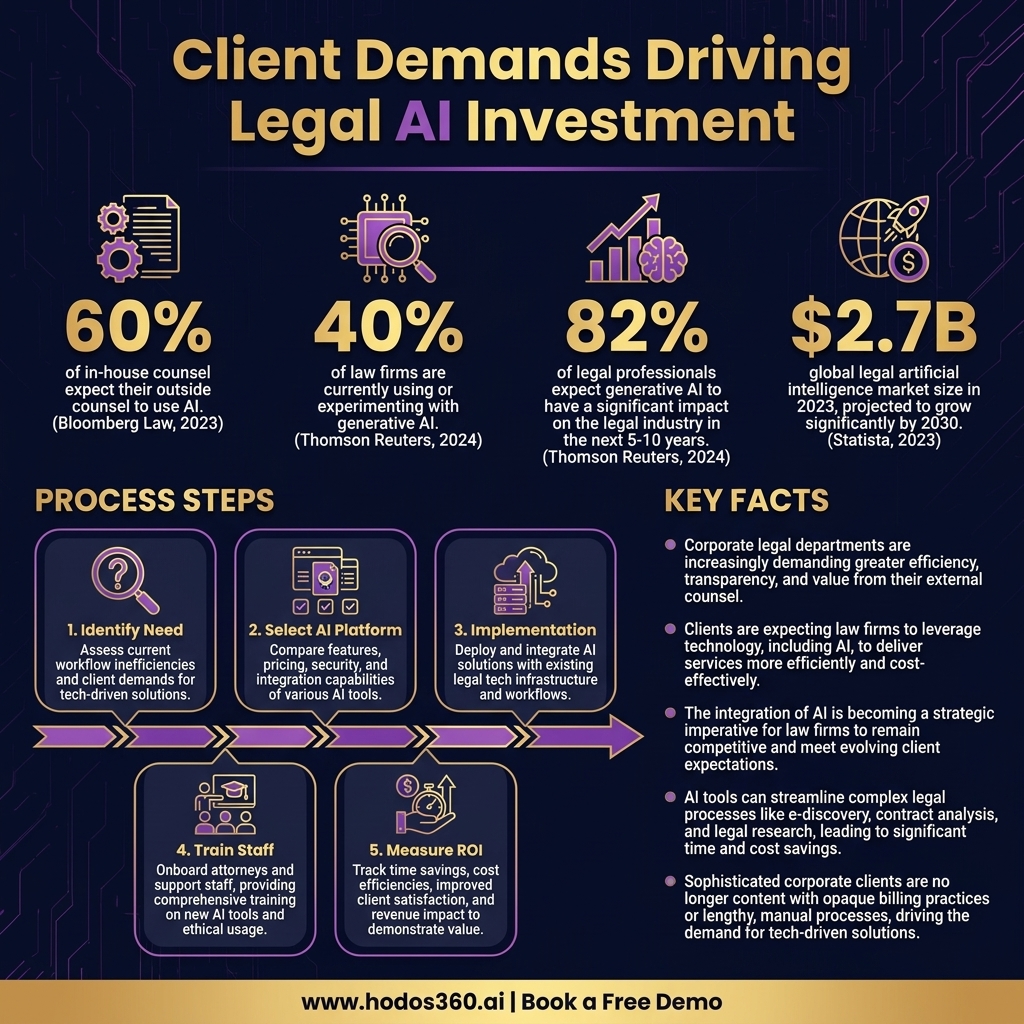
Firms must decide whether to invest in off-the-shelf solutions, partner with legal tech startups, or even develop proprietary AI capabilities. For instance, the much-publicized partnership between Allen & Overy and Harvey AI in late 2022 showcased a leading firm's commitment to leveraging generative AI for complex legal tasks, demonstrating a clear strategic direction in response to market demands and client pressure AI investment.
Strategic deployment of AI means looking beyond mere automation to truly transformative applications. For example, AI-powered legal workflows can revolutionize everything from client intake to compliance monitoring. Platforms like Clio, which has consistently evolved its practice management suite, continue to integrate more sophisticated AI features, helping small to mid-sized firms compete on efficiency.
Similarly, larger players like Thomson Reuters are embedding advanced AI into their Westlaw Precision platform, offering enhanced litigation analytics and predictive insights. Learn more about AI Legal Tech Boom 2026: Unlocking Billions in Valuation. These developments underscore that effective AI investment requires a holistic view, considering how each tool contributes to overall operational efficiency law and client service.
Crucially, firms must foster a culture of innovation and continuous learning. Adopting AI isn't a one-time purchase; it's an ongoing commitment to adaptation and integration. This involves training legal professionals to work alongside AI, understanding its capabilities and limitations, and ensuring data governance protocols are robust.
The firms that succeed will be those that view AI not as a replacement for human expertise, but as a powerful augmentation that frees up lawyers to focus on higher-value, strategic work, ultimately enhancing client satisfaction legal. This strategic approach to legal innovation is vital for long-term success.
Ready to transform your firm with cutting-edge AI? Discover how HODOS 360's integrated solutions can streamline your operations and elevate client service. Learn More About HODOS 360’s AI Law Firm Management System or Book a Free Demo Today.
Leveraging AI for Enhanced Client Experience and Operational Efficiency
AI's most direct impact on client experience comes through improved efficiency and responsiveness. By automating routine, time-consuming tasks such as document review, legal research, and contract drafting, AI frees up lawyers to dedicate more time to strategic thinking, client communication, and complex problem-solving. This leads to faster turnaround times, more accurate results, and ultimately, a more satisfying client experience.
For instance, an AI-powered system can process thousands of documents for relevance in minutes, a task that would take human lawyers days or weeks, significantly reducing discovery costs and accelerating case timelines, directly addressing client pressure for speed and cost-effectiveness. This allows for more precise and predictable project timelines, fostering greater trust and transparency.
Beyond direct client interactions, AI significantly boosts operational efficiency law within firms. Learn more about Voice AI: Essential Revenue Protection for Law Firms. AI Law Firm Management Systems, such as HODOS 360, integrate various functions like case management, billing, client intake, and document automation into a single, intelligent platform.
This holistic approach ensures seamless workflows, reduces administrative overhead, and provides partners with real-time insights into firm performance. The ability to quickly generate accurate bills, automate client communication, and manage complex calendars through AI-powered legal workflows not only saves time and resources but also allows firms to scale their operations more effectively, driving profitability and enhancing their overall market position.
This integrated approach is crucial for maintaining a competitive edge in a demanding market.
Beyond Hype: Real-World AI Implementation and Impact
The AI investment narrative is often dominated by grand pronouncements, but the real impact is found in practical, measured implementations. Firms like Linklaters have been pioneers, investing in their own internal AI solutions and fostering an innovation lab to develop tools tailored to their specific needs.

Their experience, shared at LegalTech NYC 2026, highlighted that successful adoption hinges on clear use cases and robust change management. While initial skepticism among some legal professionals is common, demonstrating tangible benefits—such as reducing the time spent on due diligence by 50% or accurately predicting case outcomes with 80% accuracy—is key to securing buy-in and driving widespread adoption.
This pragmatic approach counters the hype and focuses on delivering real value, addressing core client pressure points.
However, implementation is not without its challenges. Data quality remains a significant hurdle; AI models are only as good as the data they are trained on, and legacy legal systems often house disparate, unstructured data.
Integrating new AI tools with existing IT infrastructure can be complex and costly. A 2024 Gartner report noted that only 15% of legal departments reported fully integrating their AI tools, with many citing interoperability issues. Learn more about Voice AI: Essential for Law Firms, Touting Twilio's Success.
This reflects a broader industry tension between rapid technological advancement and the inherently conservative nature of legal practice. Firms that have successfully navigated this include those who partner with dedicated legal tech providers, ensuring smooth integration and ongoing support.
Despite these hurdles, the firms that embrace AI strategically are seeing measurable returns.
For example, a mid-sized litigation boutique, 'Lex Analytics LLC,' publicly reported a 30% reduction in e-discovery costs and a 15% increase in client retention after deploying an AI-driven document review platform. This wasn't achieved overnight but through a phased approach, careful pilot programs, and continuous feedback loops with their legal teams.
As Brad Blickstein, founder of the Blickstein Group, often emphasizes, "The real revolution isn't just in the AI, but in how legal professionals adapt their processes to leverage it effectively." This adaptation is critical for firms seeking to optimize legal workflows automation and solidify their AI investment.
These real-world examples underscore that while the initial AI investment might seem daunting, the long-term benefits in terms of efficiency, accuracy, and client satisfaction are undeniable. The competitive landscape is increasingly divided between firms that are actively integrating AI into their core operations and those that are hesitating, risking being left behind.
The firms that are winning are those actively building an AI strategy that not only responds to current client pressure but anticipates future demands, ensuring their business remains relevant and profitable.
- ✓Increased Efficiency: AI automates repetitive tasks, freeing lawyers for complex work, leading to faster case resolution.
- ✓Cost Reduction: Automated processes lower operational overhead, allowing for more competitive pricing and transparent billing.
- ✓Enhanced Accuracy: AI minimizes human error in document review and data analysis, improving the quality of legal work.
- ✓Predictive Insights: Advanced analytics offer better forecasting for litigation outcomes, informing strategic decisions.
- ✓Improved Client Satisfaction: Faster service, greater transparency, and data-driven advice directly address client demands.
- ✓Competitive Advantage: Early and strategic AI adopters gain a significant lead over less technologically advanced firms.
- ✓Scalability: AI tools enable firms to handle larger volumes of work without proportionally increasing headcount, supporting growth.
The Ethical Imperative and Regulatory Framework for Legal AI
As law firms deepen their AI investment, the ethical and regulatory dimensions become paramount. The legal profession, bound by strict ethical codes, must navigate potential pitfalls such as bias in AI algorithms, the preservation of client confidentiality, and the imperative of attorney supervision. ABA Model Rule 1.1 (Competence) explicitly states that lawyers must maintain the requisite knowledge and skill, which increasingly includes understanding the benefits and risks associated with relevant technology.
Failure to adequately supervise AI tools or understand their limitations could lead to breaches of professional responsibility. This ethical consideration is a critical component of any comprehensive law firms AI strategy, especially as client pressure for rapid adoption grows.
Concerns about algorithmic bias are particularly pressing.
If AI systems are trained on historical data that reflects societal biases, they could perpetuate or even amplify those biases in legal outcomes, raising serious questions of fairness and justice. For instance, an AI tool used for predictive policing or sentencing could inadvertently discriminate if its training data is skewed.
Legal ethicists, such as Professor Frank Pasquale of Brooklyn Law School, have consistently warned about the need for transparency and explainability in AI, advocating for 'black box' solutions to be avoided where critical decisions are made. Firms must conduct thorough due diligence on AI tools, understanding their data sources and algorithms to mitigate these risks, ensuring that artificial intelligence legal applications uphold justice and equity.
Moreover, the regulatory landscape for AI is rapidly evolving. The European Union's AI Act, set to be fully enforced in the coming years, introduces a tiered risk-based approach to AI governance, with strict requirements for high-risk applications. Learn more about Voice AI: An Essential Leap for Law Firms' Client Engagement.
While primarily impacting EU-based entities, its extraterritorial reach will influence global legal tech providers and firms operating internationally. In the United States, various states are exploring their own AI regulations, and federal agencies are issuing guidance. Law firms must remain vigilant, ensuring their AI investment and deployment strategies comply with these nascent and complex legal frameworks, especially concerning data privacy and consumer protection.
Federal Rules of Civil Procedure regarding e-discovery also gain new layers of complexity with AI-generated content and AI-assisted review, requiring careful consideration of data provenance and integrity.
Ultimately, responsible AI strategy in law firms is not just about avoiding legal and ethical pitfalls; it's about building trust.
Clients expect their legal counsel to be not only technologically adept but also ethically sound. Firms that proactively address these ethical and regulatory considerations, demonstrating a commitment to responsible AI, will differentiate themselves in the market. This includes transparent policies on AI usage, rigorous data security protocols, and continuous education for their legal teams on the evolving implications of legal tech innovation.
By prioritizing these aspects, firms can leverage AI's power while safeguarding their professional integrity and client relationships.
The Role of AI in Risk Mitigation and Compliance
AI offers powerful capabilities for risk mitigation and compliance, transforming how law firms identify, assess, and manage legal risks for themselves and their clients. AI-powered compliance platforms can monitor vast amounts of regulatory data, flagging potential violations in real-time and providing actionable insights. This is particularly valuable in highly regulated sectors like finance or healthcare, where the volume and complexity of regulations are overwhelming for manual review.
For instance, AI can analyze financial transactions for signs of money laundering or review contractual clauses for adherence to new data privacy laws like GDPR or CCPA, significantly reducing exposure to fines and legal challenges. This proactive approach to legal compliance is a direct benefit of strategic AI investment.
Furthermore, AI's ability to analyze litigation data can help firms better assess case risks, identify settlement patterns, and even predict judicial rulings with a higher degree of accuracy. This predictive power allows firms to advise clients more effectively on litigation strategy, potentially avoiding costly disputes or securing more favorable outcomes.
By leveraging AI to scrutinize contracts for hidden liabilities or non-compliance issues before they escalate, firms can provide an invaluable layer of protection, demonstrating their commitment to comprehensive client advocacy. This demonstrates how artificial intelligence legal applications extend beyond efficiency, becoming integral to safeguarding client interests and enhancing a firm's reputation for foresight and diligence.

Key Takeaways and Next Steps
The message is unequivocal: client pressure is the primary accelerant for law firms AI investment. Modern legal clients demand efficiency, transparency, and data-driven insights, compelling firms to strategically integrate AI into their operations. This isn't merely about adopting new tools; it's about a fundamental transformation in service delivery, risk management, and ethical practice.
Firms that embrace this shift with a clear AI strategy, focusing on real-world implementation and ethical governance, will not only survive but thrive in the competitive legal landscape, securing their relevance for decades to come. The future of legal practice is inextricably linked to the intelligent adoption of AI.
For law firms looking to embark on this transformative journey, the next steps involve a comprehensive assessment of current needs, a clear articulation of an AI investment roadmap, and a commitment to continuous learning and adaptation. Leveraging integrated platforms that offer AI-powered legal workflows, from client intake to document automation, can provide a significant head start.
Embrace AI not as a threat, but as an opportunity to enhance client value, streamline operations, and redefine legal excellence. Don't let client pressure become a liability—turn it into your firm's greatest asset.
Transform your legal practice today. Explore HODOS 360’s full suite of AI-powered solutions, designed to meet the demands of modern legal clients and optimize your firm’s operations.
Frequently Asked Questions
Why are clients pushing law firms to adopt AI?+
Clients, especially corporate legal departments, are increasingly sophisticated and demand greater efficiency, cost transparency, and data-driven insights from their legal counsel. They expect faster turnaround times, more predictable costs, and proactive advice, all of which AI can help facilitate. This pressure stems from their own experiences in tech-driven industries and a desire for demonstrable value.
What types of AI are most relevant for law firms today?+
Currently, AI is highly relevant for tasks like document review (e.g., e-discovery), legal research (e.g., Lexis+ AI, Casetext), contract analysis and generation, litigation prediction, and automating administrative tasks such as client intake and billing. Generative AI is also emerging for drafting and content creation, significantly boosting operational efficiency law.
What are the ethical considerations for law firms using AI?+
Ethical considerations include ensuring AI tools are used competently (ABA Model Rule 1.1), maintaining client confidentiality and data security, mitigating algorithmic bias, and ensuring proper lawyer supervision of AI-generated work. Firms must also be transparent with clients about AI usage and comply with evolving data privacy and AI regulations like the EU AI Act.
How can AI improve client satisfaction in a law firm?+
AI improves client satisfaction by enabling faster, more accurate, and cost-effective legal services. It streamlines processes, reduces delays, and offers data-backed insights, leading to more predictable outcomes and transparent billing. By freeing lawyers from mundane tasks, AI allows them to focus on strategic client advice and communication, enhancing overall service quality and responsiveness.
What steps should law firms take to strategically invest in AI?+
Law firms should start by assessing their specific needs and pain points, then research and pilot AI solutions that address those areas. Developing a clear AI strategy, investing in attorney training, ensuring robust data governance, and fostering a culture of innovation are crucial. Prioritizing integrated platforms that offer comprehensive AI-powered legal workflows can provide a significant competitive advantage and streamline adoption.