


Voice AI: Essential Revenue Protection for Law Firms
The legal landscape is fiercely competitive, and the adage 'time is money' has never rung truer. For law firms, every missed call, every delayed response, represents not just a potential client lost, but a direct hit to the bottom line. This challenge recently gained fresh urgency with the announcement that Insurvoice.ai is launching an early adopter program, specifically targeting insurance agencies to help them staunch the flow of revenue lost to after-hours missed calls.
While this news focuses on the insurance sector, its implications for law firms are undeniable and profound: the same vulnerabilities that plague insurance agencies—the inability to provide 24/7, immediate, and intelligent client engagement—are endemic in many legal practices, leading to substantial, often unquantified, revenue leakage.
The question for legal professionals isn't *if* this problem exists, but *how* to effectively address it before competitors gain an insurmountable edge.
In an era where client expectations are shaped by instant gratification and seamless digital interactions, traditional law firm communication models are increasingly obsolete.
A prospective client searching for legal counsel doesn't wait for business hours; they call when they have a need, often in moments of crisis, and if their call goes unanswered or is met with an impersonal voicemail, they simply move on to the next firm.
Data from Clio's 2023 Legal Trends Report consistently highlights the importance of responsiveness, indicating that firms with faster response times secure more clients. This isn't merely about convenience; it's about building immediate trust and demonstrating reliability from the very first touchpoint. The competitive tension is palpable: firms that embrace cutting-edge solutions like AI Voice Assistants are rapidly pulling ahead, leaving those clinging to outdated methods struggling to convert leads and maintain client loyalty in a market that demands constant availability and intelligent interaction.
This burgeoning demand for always-on, intelligent client engagement is precisely where advanced legal technology steps in. The early success stories emerging from industries like insurance, as exemplified by Insurvoice.ai's initiative, serve as a compelling blueprint for how law firms can leverage similar AI-powered solutions. By integrating AI Voice Assistants, law firms can transform their client intake processes, ensuring that every inquiry is met with professionalism, efficiency, and intelligence, regardless of the time of day.
This isn't just about answering phones; it's about qualifying leads, scheduling appointments, providing basic information, and routing complex inquiries to the right human attorney, all while maintaining a consistent and professional brand image. The opportunity to stem revenue loss and accelerate client acquisition through this innovative approach is not just a strategic advantage—it's fast becoming an operational imperative for any firm aiming for sustainable growth and a superior client experience.
The Silent Drain: How Missed Calls Cost Law Firms Millions
The narrative of lost revenue in professional services often focuses on billable hours or inefficient workflows, but a more insidious problem lies hidden in plain sight: missed client calls. For law firms, the stakes are incredibly high. A study by the American Bar Association (ABA) in its 2023 TechReport indicated that client expectations for immediate communication have never been higher, yet many firms still operate with limited reception hours or rely on generic answering services that fail to capture critical lead information.
This creates a significant gap between client need and firm availability, a gap that competitors are increasingly eager to fill. The financial impact is not trivial; if a potential client calls after 5 PM on a Friday and reaches a voicemail, their urgency often compels them to call the next firm on their list.
This isn't merely anecdotal; industry analysis suggests that as many as 70-80% of callers will not leave a voicemail if they can immediately reach another business, particularly in urgent legal matters like personal injury, criminal defense, or immediate business disputes.
Consider the case of a mid-sized personal injury firm, 'Justice & Associates.'
For years, they relied on a traditional receptionist during business hours and an automated voicemail system after hours. Managing Partner Sarah Chen, reflecting on their past practices, noted, "We always assumed clients would leave a message if it was important. What we didn't realize was how many simply hung up and called someone else.
We were literally leaving money on the table, especially with emergency cases." Chen's experience is not unique. A report by Thomson Reuters on legal practice management revealed that firms with a structured, 24/7 client intake process reported significantly higher lead conversion rates—sometimes by as much as 30%—compared to those without.
Learn more about AI Voice Clone: The Ultimate Guide for Law Firms. This substantial difference underscores the direct correlation between responsiveness and revenue. The tension here is clear: firms must choose between the traditional, limited-availability model and a proactive, always-on approach that aligns with modern client expectations and competitive pressures.
This issue extends beyond initial lead capture. Existing clients often require urgent updates or have time-sensitive questions that cannot wait until morning. A lack of immediate access can erode client trust and satisfaction, potentially leading to negative reviews or even client attrition. For example, a client needing clarification on an upcoming court date or a critical document might become frustrated if they can't get an answer promptly, regardless of the hour.
This constant pressure to be available, without the resources to support it, leads to attorney burnout and operational inefficiencies. The conflict between providing exceptional client service and maintaining a sustainable work-life balance for legal teams is a perennial challenge. However, the emergence of sophisticated AI Voice Assistants offers a compelling resolution, promising to bridge this gap without overburdening human staff, thus safeguarding both client relationships and firm resources.
The Cost of Inefficiency: Beyond Just Missed Calls
The financial drain from missed calls is only one facet of the broader inefficiency problem. Law firms also grapple with the significant overhead of manual client intake, lead qualification, and appointment scheduling. A human receptionist, while invaluable, has limitations: they can only handle one call at a time, require breaks, and are unavailable after hours or on holidays.
This means firms often miss peak inquiry times, as many potential clients initiate contact outside of standard 9-to-5 working hours. Furthermore, the process of manually qualifying leads—determining if a caller's needs align with the firm's expertise and capacity—is time-consuming and prone to human error. Learn more about AI to Create a Website: The Ultimate Guide for Law Firms.
Junior staff often spend valuable hours on calls that ultimately don't convert, diverting their focus from more productive, billable tasks. This operational friction directly impacts attorney productivity and firm profitability, creating a bottleneck in the client acquisition funnel. The competitive environment demands agility and scalability, yet traditional methods often hinder both, leaving firms vulnerable to more tech-savvy rivals.
AI Voice Assistants: The Strategic Imperative for Modern Law Firms
Against this backdrop of competitive pressure and operational inefficiency, AI Voice Assistants are emerging not just as a convenience, but as a strategic imperative for modern law firms. These sophisticated systems go far beyond simple call routing; they are designed to intelligently engage with callers, understand their needs, and perform a range of tasks that traditionally required human intervention.
Consider the advancements made by companies like OpenAI, whose large language models power many of these voice AI solutions. Sam Altman, CEO of OpenAI, has often emphasized the transformative potential of conversational AI across industries, and the legal sector is no exception. Firms can now deploy AI that answers common questions, explains basic legal processes, pre-screens potential clients based on specific criteria, and even schedules consultations directly into an attorney's calendar, all with a professional and consistent tone.
This capability ensures that every inbound inquiry is handled promptly and effectively, drastically reducing the chances of a lead slipping away due to unresponsiveness.
Moreover, the integration of AI Voice Assistants significantly enhances the client experience. In a world where immediate service is expected, an AI assistant provides instant gratification, making clients feel valued and heard from the very first interaction.
This is crucial for building trust, especially in sensitive legal matters. For instance, a client seeking a divorce attorney might be calling during a stressful personal moment. An empathetic, yet efficient, AI assistant can guide them through initial questions, provide reassurance, and set up a meeting with a human attorney, all while capturing critical details.
This level of service, available 24/7, positions the firm as forward-thinking and client-centric. Dario Amodei, CEO of Anthropic, another leading AI research company, has spoken about the importance of 'helpful, harmless, and honest' AI, principles that are particularly pertinent when applying voice AI in the legally sensitive context of client interactions.
Firms leveraging these tools are not just improving efficiency; they are fundamentally redefining their client engagement model, setting a new standard for accessibility and responsiveness in the legal industry.
Beyond initial intake, AI Voice Assistants play a critical role in lead qualification and nurturing. Learn more about AI Marketing Automation: Essential Lead Flow for Law Firms.
They can ask targeted questions to determine the nature of the legal issue, the urgency, and the caller's financial capacity, instantly filtering out unqualified leads and prioritizing high-value opportunities. This frees up human staff to focus on substantive legal work and complex client interactions. For a firm like 'LexCorp Legal,' known for its corporate litigation, implementing an AI Voice Assistant meant that paralegals no longer spent hours on initial calls that didn't fit their niche.
Instead, the AI efficiently directed relevant inquiries to the appropriate department, streamlining operations and boosting overall productivity. This strategic deployment of AI allows law firms to scale their client acquisition efforts without a proportional increase in administrative overhead, providing a clear competitive advantage in a crowded market.
The investment in such technology is quickly recouped through increased client conversions and enhanced operational efficiency, making it a compelling proposition for growth-oriented legal practices.
Furthermore, the multilingual capabilities of many advanced AI Voice Assistants address a critical need in diverse legal markets. Firms serving communities with multiple languages often face barriers in initial client communication.
An AI assistant capable of fluent, real-time communication in various languages ensures that potential clients are never turned away due to language differences. This expands a firm's potential client base significantly and demonstrates a commitment to inclusivity, aligning with modern business ethics and market demands.
This capability is not just a convenience; it's a powerful tool for market penetration and community engagement, allowing firms to reach broader demographics and build stronger relationships within underserved populations. The strategic implementation of such an AI solution, like those offered by HODOS 360, can transform a firm's ability to connect with and serve a truly global clientele, proving that advanced technology can also foster deeper human connections.
Navigating Ethical & Practical Implementation of Voice AI in Legal
The adoption of AI Voice Assistants in law firms, while promising, also necessitates careful consideration of ethical guidelines and practical implementation strategies. The ABA Model Rules of Professional Conduct, particularly Rule 1.1 (Competence) and Rule 1.6 (Confidentiality of Information), are paramount. Firms must ensure that the AI system is competently designed and deployed, safeguarding client data and maintaining confidentiality.
This means choosing vendors with robust security protocols and clear data privacy policies. Moreover, Rule 5.3 (Responsibilities Regarding Nonlawyer Assistants) dictates that attorneys must supervise nonlawyer assistants, which now extends to AI tools. Firms must therefore have clear policies on what information the AI can disclose, how it handles sensitive data, and when it must escalate to a human.
The tension here lies in balancing the efficiency gains of AI with the unwavering ethical obligations of the legal profession. Firms that fail to address these considerations risk not only regulatory scrutiny but also a significant erosion of client trust.
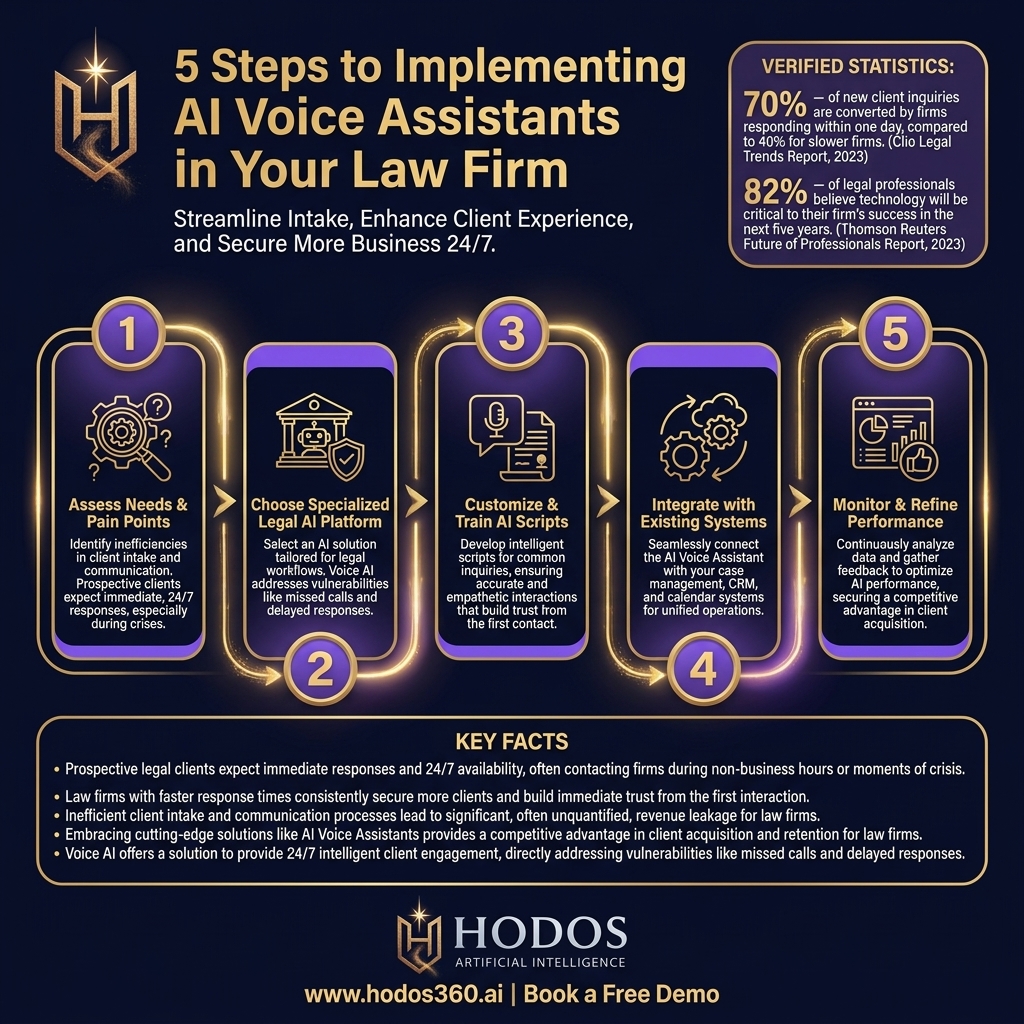
Practical implementation also involves integrating the AI Voice Assistant seamlessly into existing firm workflows.
This isn't a 'set it and forget it' solution. It requires careful configuration to align with the firm's specific practice areas, client intake forms, and scheduling systems. For instance, a family law firm might need the AI to ask different qualifying questions than a corporate law firm.
Learn more about AI Marketing: The Ultimate Guide to Law Firm Growth & Automation. Training the AI with firm-specific scripts, FAQs, and decision-making logic is crucial for maximizing its effectiveness and ensuring a consistent brand voice. Firms should also plan for ongoing monitoring and refinement of the AI's performance, using analytics to identify areas for improvement.
This iterative approach, championed by many successful tech implementations, ensures that the AI continuously adapts and optimizes its interactions, becoming an increasingly valuable asset over time. The initial investment in setup and customization pays dividends through improved accuracy and efficiency, reinforcing the firm's commitment to cutting-edge service.
Furthermore, managing client expectations regarding AI interaction is vital. While AI is highly capable, transparency is key. Firms should consider informing callers, perhaps through a brief introductory message, that they are interacting with an AI assistant, with options to speak to a human at any point.
This maintains honesty and builds trust, preventing potential misunderstandings. Brad Smith, Vice Chair and President of Microsoft, has frequently spoken about the need for 'responsible AI,' emphasizing transparency and accountability as foundational principles. For law firms, this translates to ensuring that the AI is a helpful tool, not a deceptive substitute for human interaction when it's truly needed.
By thoughtfully integrating AI Voice Assistants with a clear ethical framework and practical operational strategy, law firms can harness their full potential to enhance client service, streamline operations, and ultimately protect and grow their revenue streams, all while upholding the highest standards of the legal profession.
Measuring ROI: From Lead Capture to Client Retention
Quantifying the return on investment (ROI) for AI Voice Assistants is crucial for demonstrating their value to firm partners and stakeholders. The metrics extend beyond simply counting answered calls. Firms can track enhanced lead capture rates, noting how many inquiries outside of business hours are now successfully qualified and converted into appointments.
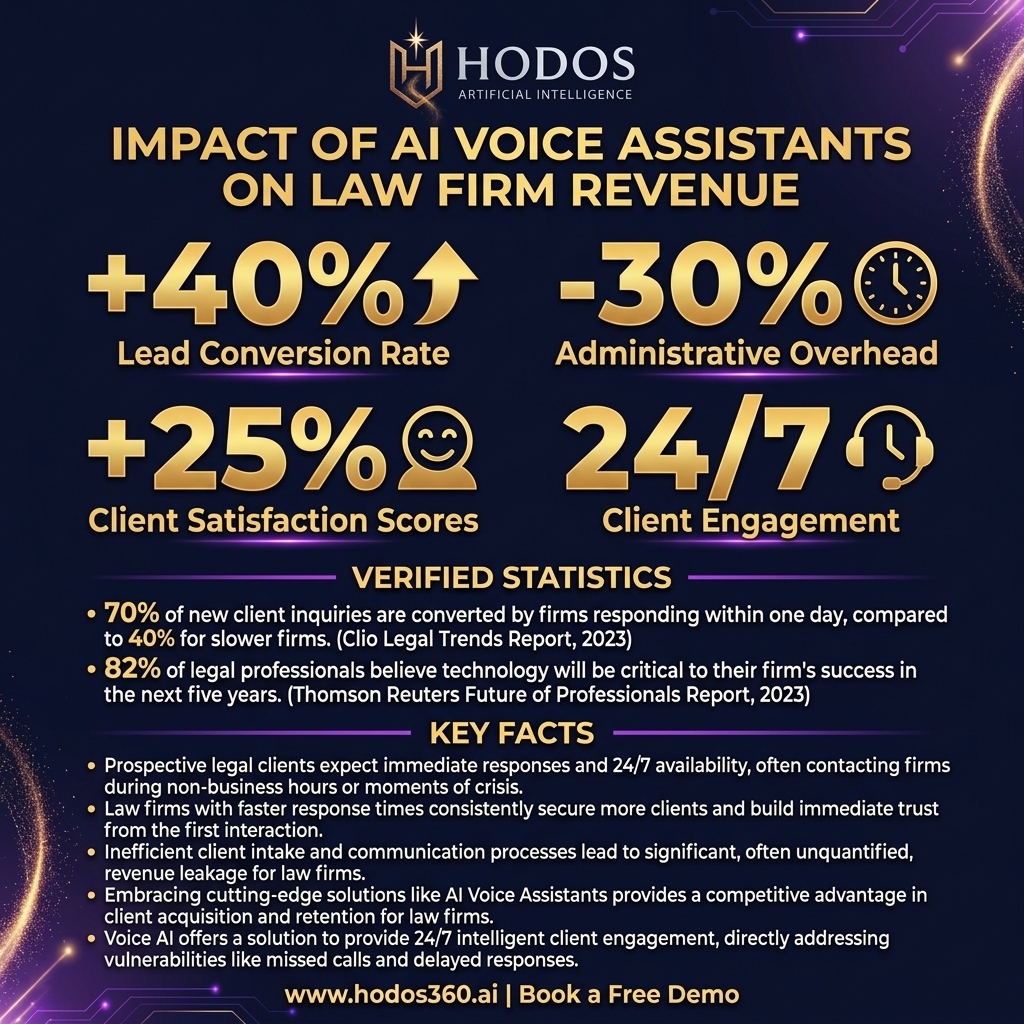
Reduced administrative overhead, measured by the time saved by paralegals and receptionists no longer performing initial screening, also contributes significantly to ROI. Learn more about Legal AI Divide: Bridge the Gap, Thrive in 2026's Digital Era. Furthermore, improved client satisfaction scores, often gleaned from post-interaction surveys, can indicate stronger client retention and positive referrals—a critical, albeit sometimes indirect, driver of long-term revenue.
By carefully analyzing these data points, law firms can build a compelling case for continued investment in AI technology, showcasing its tangible impact on both efficiency and profitability. This data-driven approach moves the conversation beyond mere technological adoption to strategic business growth, solidifying the AI's role as a core asset.
- ✓24/7 Availability: Ensure no potential client call is ever missed, regardless of time zones or after-hours inquiries.
- ✓Instant Lead Qualification: AI accurately screens callers, gathering essential information and determining case viability before human intervention.
- ✓Automated Appointment Booking: Seamlessly integrate with firm calendars to schedule consultations, reducing administrative burden.
- ✓Multilingual Support: Broaden client reach by communicating effectively in multiple languages, fostering inclusivity.
- ✓Consistent Client Experience: Deliver uniform, professional responses, enhancing brand image and client satisfaction.
- ✓Reduced Operational Costs: Minimize the need for extensive human receptionist staff and free up paralegals for billable work.
- ✓Data-Driven Insights: Generate analytics on call patterns, lead sources, and conversion rates to optimize marketing and intake strategies.
The Future is Conversational: AI's Role in Legal Client Engagement
The trajectory of legal technology points unmistakably towards a future where conversational AI plays an increasingly central role in client engagement. The early adopter programs, like Insurvoice.ai's, are just the beginning, demonstrating the immense potential for specialized voice AI across professional services. For law firms, this means not just catching up, but actively shaping the future of client interaction.
Imagine a scenario where an AI Voice Assistant not only handles initial intake but also provides clients with real-time case updates, answers frequently asked questions about court procedures, or even assists in gathering pre-discovery information, all under the careful supervision of an attorney. This isn't science fiction; it's the near future, driven by rapid advancements in natural language processing and machine learning.
Firms that embrace this evolution will be better positioned to attract and retain clients, offering a level of service that differentiates them from traditional competitors. The shift towards AI-powered client engagement is not just about efficiency; it's about redefining the very nature of legal service delivery to be more responsive, accessible, and client-centric than ever before.
This evolution is also influencing how legal professionals view their own roles. As AI handles more routine and administrative tasks, attorneys and paralegals are freed to focus on the complex, strategic, and empathetic aspects of legal practice that truly require human intellect and judgment. This can lead to greater job satisfaction, reduced burnout, and a more fulfilling professional experience.
Jensen Huang, CEO of NVIDIA, has often highlighted how AI empowers human ingenuity by automating mundane tasks, allowing professionals to dedicate their energy to higher-value activities. Learn more about WordPress AI Unlocked: Legal Websites Mastered 2026. In the legal context, this means attorneys can spend more time on legal strategy, courtroom advocacy, and deep client counseling, rather than being bogged down by repetitive phone calls or intake forms.
This human-AI collaboration is not about replacing lawyers, but augmenting their capabilities, making them more effective and efficient, ultimately leading to better outcomes for clients and more profitable practices for firms. The competitive advantage of a firm that strategically leverages AI for these tasks becomes undeniable, attracting both top legal talent and discerning clients.
Furthermore, the data generated by AI Voice Assistants will provide law firms with unprecedented insights into client needs, market trends, and operational bottlenecks. Firms can analyze call volumes, common queries, lead conversion rates, and even sentiment analysis from client interactions to refine their marketing strategies, identify new practice areas, and optimize their service offerings.
This data-driven approach to practice management, once the exclusive domain of large corporations, is now accessible to law firms of all sizes. It allows for proactive decision-making, moving firms from reactive problem-solving to strategic foresight. The firms that will thrive in the coming decade are those that not only adopt AI but also harness its analytical power to continually innovate and adapt to the evolving demands of the legal market.
This commitment to data-informed growth is a hallmark of truly modern and successful legal enterprises, demonstrating how technology can drive continuous improvement across all facets of a firm's operations.
Preparing for the AI-Powered Legal Practice
Preparing for this AI-powered future requires a proactive and strategic approach. Law firms should begin by assessing their current client intake processes, identifying pain points and areas where responsiveness is lacking. Researching and piloting AI Voice Assistant solutions, perhaps starting with a specific practice area or during off-hours, can provide valuable insights and allow for iterative adjustments.
Investing in training for staff to understand how to best collaborate with AI tools is also crucial, ensuring a smooth transition and maximizing the technology's benefits. The goal is not to replace human interaction but to enhance it, creating a hybrid model where AI handles the routine and repetitive, while human attorneys focus on the complex and empathetic.
By taking these deliberate steps, law firms can not only mitigate revenue loss from missed opportunities but also position themselves as leaders in a rapidly evolving legal landscape, ready to meet the demands of the modern client and secure a prosperous future.

Key Takeaways and Next Steps
The legal industry stands at a critical juncture, with the lessons from sectors like insurance—highlighted by Insurvoice.ai's proactive steps—serving as a stark reminder of the financial consequences of unaddressed client communication gaps. For law firms, embracing AI Voice Assistants is no longer a luxury but a strategic necessity for safeguarding revenue, optimizing operations, and delivering a superior client experience.
These intelligent systems ensure 24/7 responsiveness, streamline lead qualification, and free up valuable human resources, directly contributing to a firm's growth and profitability. The ethical considerations, particularly around confidentiality and competence, are paramount, requiring careful vendor selection and robust internal policies to ensure compliance with professional conduct rules like ABA Model Rule 1.6 on client confidentiality.
Firms that proactively integrate and responsibly manage these AI tools will not only attract and retain more clients but also cultivate a more efficient and future-ready practice. This is about more than just technology; it's about competitive survival and thriving in the digital age.
To begin your journey towards an AI-powered legal practice, consider a comprehensive platform that integrates these advanced capabilities.
Evaluate solutions that offer not just voice AI, but also broader AI-powered legal workflows, client management, and marketing tools. Understanding the nuances of how these systems can be tailored to your firm's specific needs is crucial. The investment in such technology, while significant, is a foundational step towards building a resilient, responsive, and highly profitable law firm.
Discover how HODOS 360’s AI Voice Assistants can transform your firm's client intake and revenue protection strategies today. Explore our solutions and book a free demo to see the impact firsthand.
Frequently Asked Questions
What specifically is an AI Voice Assistant for law firms?+
An AI Voice Assistant for law firms is an intelligent, conversational system designed to handle inbound and outbound client communications. It uses natural language processing to understand caller intent, answer questions, qualify leads, schedule appointments, and route complex inquiries to human attorneys, operating 24/7 to ensure no client opportunity is missed. It's a specialized tool tailored to legal needs.
How do AI Voice Assistants prevent revenue loss for law firms?+
AI Voice Assistants prevent revenue loss by ensuring 24/7 availability, meaning no after-hours or weekend calls from potential clients are missed. They efficiently qualify leads, capturing critical information and scheduling consultations, converting inquiries that might otherwise go to competitors. This direct lead capture and efficient processing significantly boost client acquisition and protect the firm's bottom line.
Are AI Voice Assistants ethical and compliant with legal professional conduct rules?+
Yes, when implemented responsibly. Firms must ensure competence (ABA Model Rule 1.1) and confidentiality (Rule 1.6) by selecting secure, ethical AI vendors and establishing clear internal policies for data handling and attorney supervision (Rule 5.3). Transparency with callers about interacting with AI also builds trust and maintains ethical standards.
What are the key benefits of using AI Voice Assistants beyond just answering calls?+
Beyond answering calls, AI Voice Assistants offer automated lead qualification, appointment booking, multilingual support, and consistent client experience. They reduce administrative overhead, free up human staff for complex legal work, and provide valuable data analytics on client interactions, enabling firms to optimize operations and marketing strategies for growth.
How can a law firm get started with implementing an AI Voice Assistant?+
Law firms should start by assessing current communication pain points, researching specialized legal AI Voice Assistant providers, and planning for phased implementation. Begin with pilot programs for specific practice areas or off-hours, train staff on AI collaboration, and establish clear ethical guidelines. Choose a platform that integrates seamlessly with existing case management systems for maximum efficiency.