
AI Marketing Automation: Essential Lead Flow for Law Firms
In the fiercely competitive legal landscape of 2026, the traditional methods of client acquisition are increasingly yielding to a new paradigm driven by artificial intelligence. Consider two hypothetical law firms: Sterling & Associates, which still relies on word-of-mouth referrals and sporadic outreach, and Veritas Legal, which has fully embraced an AI marketing automation platform.
While Sterling & Associates grapples with inconsistent client intake and unpredictable revenue, Veritas Legal consistently attracts and converts high-value clients through a finely tuned AI marketing automation and lead flow system. This stark contrast highlights a critical shift, recently underscored by announcements like Thryv’s launch of its AI Lead Flow, which unifies marketing and sales automation for small businesses.
While Thryv targets the broader SMB market, its innovation signals a broader trend that legal professionals cannot afford to ignore: the future of law firm growth is inextricably linked to intelligent, automated client engagement.
For too long, many law firms have viewed marketing as a necessary but often inefficient expense, a disjointed effort separate from the core legal work.
The manual processes involved in identifying prospects, nurturing leads, and converting them into paying clients are not only time-consuming but also prone to human error and inconsistency. This inefficiency directly impacts a firm's bottom line and its capacity for strategic expansion. However, the advent of sophisticated AI marketing automation tools offers a transformative solution, moving beyond simple email campaigns to create dynamic, personalized client journeys.
These platforms are designed to streamline every touchpoint, from initial inquiry to case onboarding, ensuring no potential client falls through the cracks. They represent a fundamental shift in how law firms can approach business development, promising not just efficiency but a strategic advantage in a crowded market.
This evolution is not merely about adopting new software; it's about fundamentally rethinking how law firms engage with their market and manage their pipeline. The ability to leverage AI-powered insights to predict client needs, personalize communications, and automate repetitive tasks frees up valuable attorney time, allowing legal professionals to focus on delivering exceptional legal services.
By understanding the nuances of how AI marketing automation and intelligent lead flow systems can be tailored for the unique demands of the legal industry, law firms can unlock unprecedented opportunities for growth and establish a more resilient, client-centric practice. This is not a futuristic fantasy but a present-day reality, defining the next generation of successful legal practices.
The Shifting Sands of Legal Client Acquisition: Beyond Traditional Methods
The legal client acquisition landscape has undergone a seismic shift, moving away from the reliance on static websites and word-of-mouth referrals that once characterized the industry. Today's clients, whether individuals or corporations, expect a digital-first experience, akin to what they encounter in every other service sector.
Data from the American Bar Association (ABA) TechReport consistently shows a slow but steady increase in law firms investing in digital marketing, yet many struggle to connect these efforts to tangible law firm growth. The challenge lies not just in being present online, but in creating a seamless, engaging, and personalized journey from the moment a potential client expresses interest.
Traditional methods, while still holding some value, often lack the scalability and analytical depth required to compete effectively in a market where information is abundant and client expectations are high. Firms that fail to adapt risk being left behind by more agile, tech-forward competitors.
Leading the charge in this transformation are firms and innovators who recognize the power of strategic technology.
For instance, Joe Walsh, the CEO of Thryv, emphasized the goal of their new AI Lead Flow to "help small businesses save time and win more customers by automating their marketing and sales efforts." While Thryv caters to a broad audience, the underlying principle of unifying disparate marketing and sales functions through AI is directly applicable to legal practices.
Similarly, in the realm of sophisticated legal services, firms like Wilson Sonsini Goodrich & Rosati have long been recognized for their innovative approach to technology, leveraging data to understand market dynamics and client needs. Their proactive stance contrasts sharply with firms still hesitant to move beyond antiquated systems, illustrating a growing divide in the industry.
Learn more about AI Legal Startup Sandstone: Unlocking 2026's Legal Tech Future. The human element, while always crucial in legal services, is now augmented by intelligent systems that can identify patterns and opportunities that human analysis alone might miss, thereby enhancing, not replacing, the attorney-client relationship.
The evolution of client expectations is further fueled by their experiences with consumer-grade technology. Clients are accustomed to instant responses, personalized recommendations, and intuitive online interfaces. When they seek legal services, they bring these same expectations. A recent report by Thomson Reuters Institute highlighted that firms embracing digital transformation reported significantly higher revenue growth compared to their less tech-savvy counterparts.
This isn't just about having a website; it's about the entire digital ecosystem that supports client acquisition AI. From the first search query to the initial consultation, every interaction must be efficient, informative, and tailored. This demands a robust marketing management system that can intelligently capture, categorize, and act upon client data, ensuring that every touchpoint moves a prospect closer to becoming a loyal client.
Data-Driven Insights for Legal Marketing
At the heart of modern legal tech marketing lies the ability to harness data for actionable insights. AI-powered platforms can sift through vast quantities of information – from website traffic and social media engagement to competitor analysis and demographic trends – to identify patterns and predict future behaviors.
This predictive power allows law firms to move beyond guesswork, enabling them to make truly data-driven decisions about their marketing spend and strategies. For example, AI can analyze which content pieces resonate most with specific client segments, or which advertising channels yield the highest return on investment.
This granular understanding is critical for optimizing campaigns and ensuring that marketing efforts are not just visible, but effective.
Industry leaders like Jack Newton, CEO of Clio, have consistently championed the role of data in transforming legal practice management, including marketing. Newton's vision emphasizes a holistic approach where data informs every aspect of a firm's operation, leading to better client outcomes and stronger business performance.
Learn more about Essential Risk Management for Law Firms in the AI Era. Gartner predicts that by 2027, generative AI will be used in 75% of marketing organizations to assist with content creation and demand generation, a trend that legal firms cannot afford to ignore.
This isn't just about automating tasks; it's about enabling a level of strategic foresight that was previously unattainable. By understanding which services are in demand in specific regions, or which demographic groups are most likely to require certain legal expertise, firms can proactively tailor their outreach, ensuring their message reaches the right audience at the right time.
This precise targeting is the cornerstone of effective lead flow and maximized client acquisition AI, fundamentally changing how law firms approach their market.
Unifying Marketing and Sales: The Power of AI Lead Flow for Law Firms
The true innovation of AI in client acquisition lies in its ability to seamlessly unify marketing and sales functions, creating an integrated lead flow system that guides prospects from initial awareness to successful client conversion. For law firms, this means moving beyond siloed departments where marketing generates leads and then 'hands them off' to attorneys or intake specialists with little ongoing coordination.
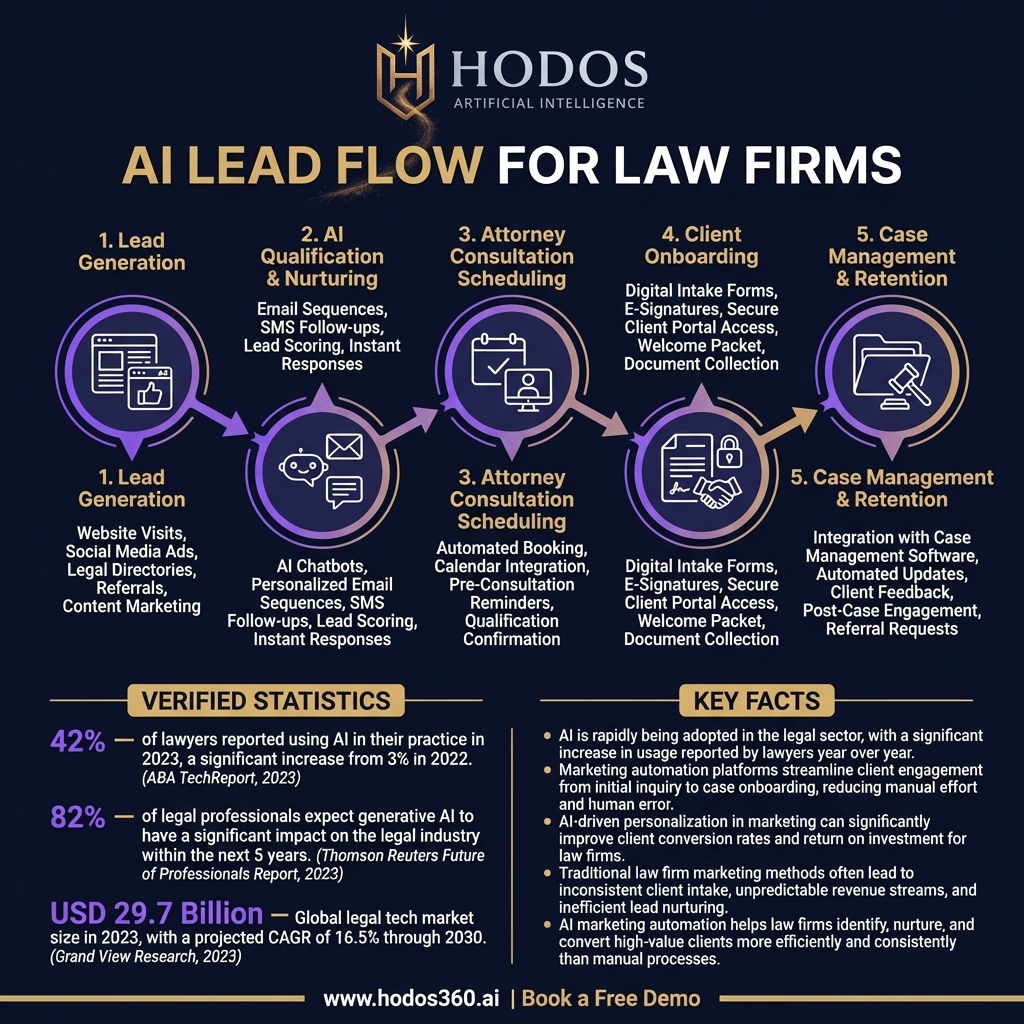
An AI marketing automation platform acts as the central nervous system, ensuring that every interaction is tracked, analyzed, and optimized. From the moment a potential client interacts with a firm’s website or social media, AI begins to build a comprehensive profile, assessing their needs, intent, and potential value.
This real-time intelligence empowers firms to deliver highly personalized follow-ups and service offerings, significantly increasing the likelihood of conversion. This integrated approach, as seen in the broader businesses sector with platforms like Thryv's, is now being specifically designed and built for the unique ethical and operational requirements of the legal industry.
This holistic integration is precisely where platforms like HODOS 360's AI Marketing Platform offer a distinct advantage for law firms. By bringing together content generation, social media automation, lead qualification, and appointment booking, HODOS 360 ensures a cohesive and efficient client journey. The platform doesn't just manage leads; it actively nurtures them through intelligent, automated workflows that mimic the expertise of a seasoned marketing and intake team.
Learn more about AI Document Workflows: Unleash Firm Efficiency in 2026. For example, if a prospect downloads an e-book on estate planning, the AI can automatically trigger a series of personalized emails providing further relevant information, suggest booking a consultation, and even qualify their specific needs before an attorney ever engages.
This proactive engagement is crucial in a legal market where responsiveness and perceived expertise are paramount. This AI-powered approach ensures that no lead is overlooked and every opportunity for engagement is maximized, reducing the manual burden on staff and significantly improving conversion rates.
Moreover, the integration extends to predicting which leads are most likely to convert based on historical data and behavioral patterns.
This predictive capability allows law firms to prioritize their efforts, focusing on high-potential prospects and allocating resources more efficiently. Instead of spending valuable time chasing every inquiry, attorneys and intake teams can dedicate their attention to qualified leads who are genuinely ready to engage. This level of sophistication transforms business development from a reactive process into a proactive, strategic function.
The unified marketing and sales management approach, powered by AI, ensures that the firm’s brand message is consistent across all channels and that the transition from marketing engagement to direct client interaction is smooth and professional, ultimately enhancing the client experience and firm reputation.
- ✓Automated Client Intake & Qualification: AI-driven forms and chatbots capture essential client information, assess case viability, and prioritize leads, ensuring only qualified prospects reach attorneys.
- ✓Personalized Content Generation: AI crafts targeted blog posts, articles, and social media updates based on client demographics and expressed interests, enhancing engagement and establishing thought leadership.
- ✓Multi-channel Social Media Automation: Schedule and publish content across various platforms, monitor engagement, and respond to inquiries, maintaining a consistent and active online presence.
- ✓AI-Powered Lead Nurturing Campaigns: Develop automated email sequences and communication flows that provide value to prospects over time, guiding them through the sales funnel with relevant information.
- ✓Predictive Analytics for Conversion: Utilize AI to analyze lead behavior and firm data to forecast conversion likelihood, allowing firms to allocate resources more effectively to high-potential leads.
- ✓Seamless CRM Integration: Connect marketing automation with existing client relationship management systems to ensure a unified view of client interactions and a smooth transition from prospect to client.
- ✓24/7 AI Voice Assistants: Integrate voice AI for immediate phone answering, initial lead qualification, and appointment booking, ensuring no prospective client call goes unanswered.
From Prospect to Client: AI-Powered Nurturing and Conversion Strategies
Once a prospect enters the lead flow, the journey to becoming a client is paved with strategic, AI-powered nurturing. This involves a series of personalized interactions designed to build trust, demonstrate expertise, and address specific client needs. AI can analyze a prospect's digital footprint – their website visits, content downloads, and email engagement – to tailor communications that are highly relevant to their expressed interests.
For instance, if a potential client repeatedly views pages related to intellectual property law, the AI can automatically send them case studies, articles, or webinar invitations on that specific topic. This level of personalization is far beyond what manual efforts can achieve, ensuring that every touchpoint adds value and moves the prospect closer to a decision.
Firms leveraging these sophisticated AI-powered strategies are reporting significant improvements in conversion rates, transforming passive interest into active engagement.
The ethical considerations around AI marketing automation in the legal field are paramount. The ABA Model Rule 7.1 concerning Communications Concerning a Lawyer's Services mandates that "A lawyer shall not make a false or misleading communication about the lawyer or the lawyer's services."
This principle extends to AI-generated content and automated communications. While AI can draft persuasive messages, human oversight remains crucial to ensure accuracy, compliance, and appropriate tone. Firms must implement robust review processes to ensure that all automated outreach adheres to professional standards and accurately represents the firm's capabilities.
Learn more about Website Design Cost 2026: Strategic Investment for Law Firms. Pioneers in legal tech, like Noah Waisberg, co-founder of Kira Systems (now part of Litera), have consistently emphasized the importance of ethical AI deployment, advocating for transparency and accountability. The goal is to augment human capabilities, not replace the lawyer's professional judgment or ethical obligations.
Beyond personalized content, AI facilitates critical conversion actions such as appointment booking and initial consultations. Imagine a prospective client visiting a law firm's website after hours. Instead of an unanswered phone or a generic contact form, an AI voice assistant can immediately engage, qualify their need, and even schedule an appointment directly into an attorney's calendar.
This instant gratification and seamless experience are powerful differentiators. Firms that have adopted advanced marketing management solutions often report a substantial reduction in missed opportunities and a higher rate of successful initial consultations. According to a 2023 report by the Thomson Reuters Institute, firms that have integrated AI into their client intake and marketing processes saw, on average, a 15-20% increase in qualified leads converted into new matters.
This demonstrates the tangible ROI of investing in intelligent lead nurturing, moving beyond simple lead generation to true conversion optimization.
Ethical AI in Client Engagement
The deployment of AI marketing automation in the legal sector necessitates a rigorous adherence to ethical guidelines and best practices. While AI offers unparalleled efficiency, firms must ensure transparency with clients about the use of automated systems, particularly in initial interactions. Data privacy and security are also critical, with regulations like GDPR and the California Consumer Privacy Act (CCPA) setting stringent standards for how client information is collected, stored, and used.
Firms must implement robust safeguards to protect sensitive legal data processed by AI systems. The human element cannot be entirely removed; instead, AI should function as a powerful assistant, augmenting the capabilities of attorneys and support staff. Maintaining human oversight ensures that client communications are always empathetic, accurate, and aligned with the firm's professional values, preventing any misrepresentation or ethical breach.
Furthermore, the legal profession's duty of confidentiality and zealous advocacy means that any AI system interacting with potential or existing customers (clients) must be designed with these principles in mind. Learn more about AI Chatbot Builders: Transform Your Law Firm in 2026. This includes ensuring that AI-generated content is accurate and does not create unrealistic expectations or make misleading claims, directly addressing concerns raised by ABA Model Rule 7.1.
Law firms must also consider potential biases in AI algorithms, working to mitigate them to ensure equitable and fair treatment for all prospects. The development of ethical AI frameworks within legal tech, championed by organizations like the European Legal Technology Association (ELTA) and various state bar associations, is a crucial step in ensuring that innovation aligns with professional responsibility.
By prioritizing ethical deployment, law firms can build trust and maintain the integrity of the attorney-client relationship while still leveraging the transformative power of AI.
Measuring Success: ROI Tracking and Continuous Optimization with AI
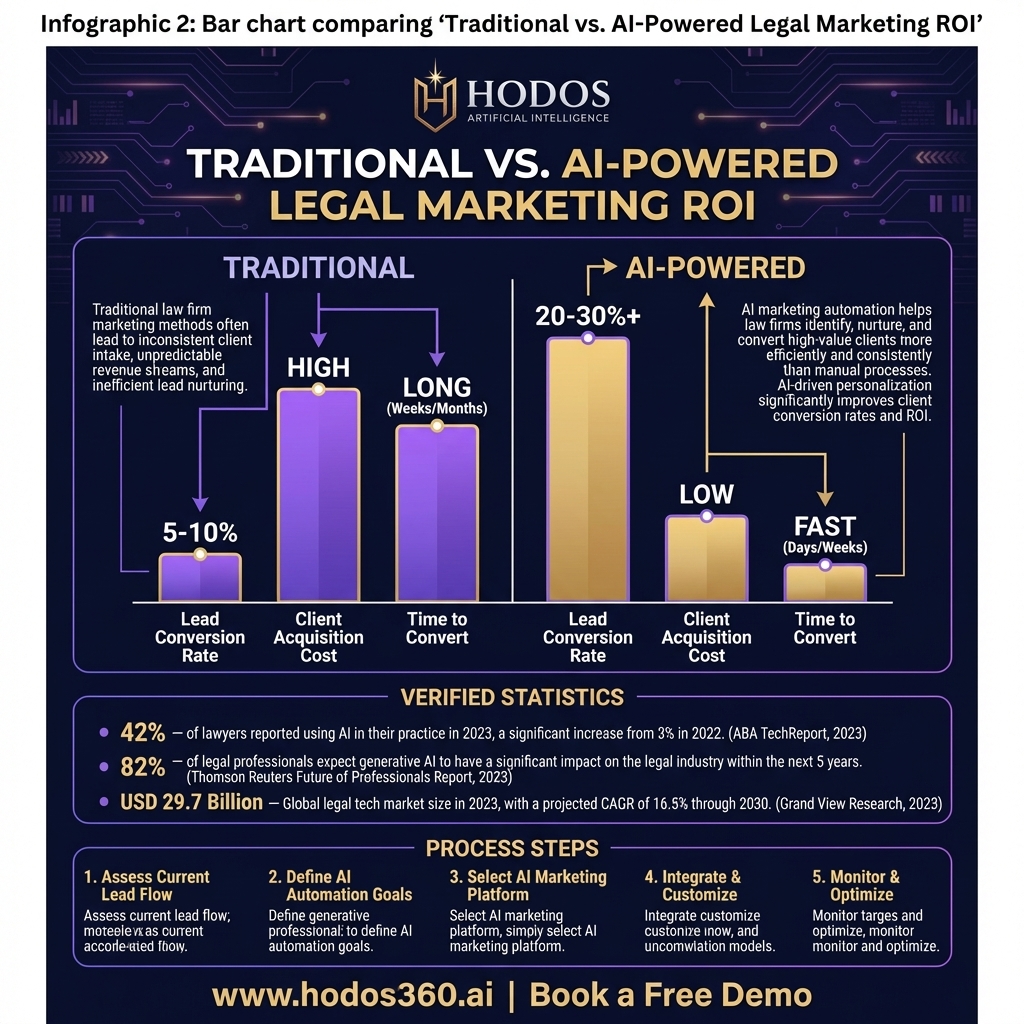
In the realm of legal marketing, the ability to accurately measure return on investment (ROI) has historically been a significant challenge. However, AI marketing automation platforms fundamentally change this, providing granular insights into campaign performance and client acquisition AI costs. These systems track every touchpoint, from initial ad impression to final client conversion, allowing firms to see precisely which strategies are generating the most qualified leads and ultimately, the most revenue.
This data-driven approach moves beyond anecdotal evidence, enabling law firms to make informed decisions about where to allocate their marketing budget for maximum impact. By continuously analyzing performance metrics, AI can identify underperforming campaigns and suggest optimizations in real-time, ensuring that marketing spend is always efficient and effective.
This continuous feedback loop is critical for sustained law firm growth.
Real-world data underscores the importance of this analytical capability. A recent McKinsey & Company report on AI adoption across industries indicated that companies leveraging AI for marketing and sales optimization reported a 10-15% increase in lead-to-revenue conversion rates.
Applied to the legal sector, this translates to tangible financial benefits. For example, a firm can track the cost per qualified lead flow from different channels, measure the average client lifetime value generated by specific campaigns, and attribute revenue directly back to marketing efforts. Learn more about Essential AI Website Builder for Law Firms: A Complete Guide.
This transparency allows managing partners to confidently invest in marketing initiatives, knowing they have clear metrics to demonstrate success. Without AI, such detailed analysis would require extensive manual data collection and interpretation, often resulting in delayed or incomplete insights. AI automates this complex process, providing immediate, actionable intelligence that drives strategic marketing management decisions.
Furthermore, AI marketing automation platforms facilitate A/B testing and multivariate analysis on a scale previously unimaginable. Firms can test different ad creatives, email subject lines, landing page designs, and call-to-action buttons to identify the most effective combinations. The AI can then automatically implement the winning variations, continuously optimizing campaigns for peak performance.
This iterative process ensures that a firm's marketing efforts are always evolving and improving, adapting to market changes and client preferences. This agility is a significant competitive advantage, allowing firms to respond rapidly to new opportunities and challenges. By embracing these AI-powered strategies, law firms can transform their marketing from a cost center into a powerful, measurable engine for growth, ensuring every dollar spent contributes directly to generating new customers (clients) and strengthening the firm's position in the market.
Predictive Analytics for Future Growth
Beyond optimizing current campaigns, AI marketing automation excels at predictive analytics, offering law firms a glimpse into future trends and opportunities. By analyzing vast historical data – including past client demographics, case types, economic indicators, and market shifts – AI can forecast demand for specific legal services, identify emerging client segments, and even predict potential market disruptions.
This foresight allows firms to proactively adjust their marketing management strategies, developing new service offerings or targeting untapped markets before competitors. For instance, if AI predicts an uptick in regulatory compliance needs due to impending legislation, a firm can preemptively launch targeted marketing campaigns and prepare relevant content, positioning itself as a leader in that area.
This strategic advantage is invaluable for sustained law firm growth and market leadership.
This capability extends to optimizing future marketing spend. AI can recommend the most effective channels and content types for upcoming campaigns based on predicted client behavior and market conditions. This ensures that every marketing dollar is invested wisely, yielding the highest possible ROI.
For example, if AI identifies a growing trend of small businesses seeking remote legal services, the firm can allocate more resources to online advertising and virtual consultation promotions. This forward-looking approach, integral to advanced AI-powered strategies, shifts marketing from a reactive expense to a proactive investment in the firm's future.
It empowers law firm leaders to make strategic decisions built on robust data and intelligent forecasts, ensuring their firm remains competitive and relevant in an ever-evolving legal landscape.

Key Takeaways and Next Steps for Forward-Thinking Law Firms
The legal profession stands at a pivotal juncture, where the integration of AI marketing automation and advanced lead flow strategies is no longer a luxury but a strategic imperative. The era of disjointed marketing efforts and manual client intake is rapidly drawing to a close, replaced by intelligent, AI-powered systems that streamline every aspect of client acquisition.
Firms that embrace this evolution, like Veritas Legal in our opening scenario, are not just surviving but thriving, establishing a competitive edge through efficiency, personalization, and data-driven decision-making. The comprehensive unifying of marketing and sales automation, as demonstrated by market trends and platforms designed for various businesses, offers law firms a clear path to sustainable law firm growth and enhanced client relationships.
The choice is clear: adapt and lead, or risk falling behind in a rapidly accelerating digital legal market.
For forward-thinking law firms, the next steps involve a thoughtful assessment of current marketing and management processes and a proactive exploration of integrated AI solutions. This isn't about wholesale disruption but strategic augmentation, focusing on areas where AI can deliver the most immediate and impactful benefits, such as automated lead flow qualification, personalized outreach, and robust ROI tracking.
Consider how a platform like HODOS 360’s comprehensive suite of services, including its specialized AI Marketing Platform, can provide a holistic solution for your firm. By leveraging AI for everything from content creation and social media automation to 24/7 AI Voice Assistants for lead qualification and appointment booking, firms can create a seamless, efficient, and highly effective client acquisition engine.
This investment is not merely in technology but in the future resilience and prosperity of your legal practice.
Ultimately, the goal is to cultivate a practice that is not only exceptional in its legal service delivery but also equally adept at attracting and retaining clients in the digital age.
Firms like "Smith & Jones LLP," who have proactively integrated these AI-powered strategies, are demonstrating that a future-proof legal practice is built on innovation, efficiency, and a deep understanding of the modern client journey. By embracing AI marketing automation and optimizing your lead flow, your firm can unlock its full potential, ensuring a steady stream of qualified clients and a strong, sustainable trajectory for years to come.
The time to act is now, transforming your firm into a leader in the next generation of legal service providers.
Frequently Asked Questions
What is AI marketing automation for law firms?+
AI marketing automation for law firms involves using artificial intelligence to streamline and optimize client acquisition processes. This includes automating tasks like lead generation, content creation, social media management, personalized email campaigns, and client intake. It leverages AI to analyze data, predict client behavior, and personalize interactions, ensuring a more efficient and effective marketing and sales lead flow tailored to the legal industry.
How does AI improve lead flow in a law firm?+
AI improves lead flow by automating lead qualification, nurturing, and follow-up. It can instantly respond to inquiries, assess a prospect's needs, score their potential value, and guide them through a personalized journey. This ensures that valuable leads are identified quickly, receive relevant information, and are promptly directed to the right attorney or intake specialist, significantly increasing conversion rates and overall law firm growth.
Are there ethical concerns with using AI in legal marketing?+
Yes, ethical concerns exist, primarily around transparency, data privacy, and accuracy. Law firms must ensure AI-generated content and communications are truthful and compliant with rules like ABA Model Rule 7.1. Maintaining human oversight is crucial to prevent misleading information and uphold professional standards. Robust data security measures are also essential to protect client information and adhere to privacy regulations like GDPR or CCPA.
What specific AI tools are beneficial for legal marketing?+
Beneficial AI tools for legal tech marketing include AI-powered content generators for blogs and social media, intelligent chatbots for website engagement and lead qualification, predictive analytics for campaign optimization, and AI Voice Assistants for 24/7 client intake and appointment booking. Platforms that unify marketing and sales automation, like HODOS 360's AI Marketing Platform, offer comprehensive solutions tailored for law firms.
How can a small law firm implement AI marketing automation?+
Small law firms can start by identifying key pain points in their current client acquisition process. Begin with a single AI-powered solution, such as an AI chatbot for lead qualification or an automated email nurturing system. Look for integrated platforms that offer scalable solutions and comprehensive support. Gradual implementation, focusing on areas with immediate ROI, allows firms to adapt to the technology without overwhelming their existing operations and ensures efficient marketing management.