

Fine-Tuning LLMs: Ultimate Guide for Legal Innovation
The legal world watched closely as Artificial Lawyer reported a significant development: Kirkland & Ellis, a titan in the global legal landscape, hinted at its intentions to fine-tune Large Language Models (LLMs) for its own proprietary legal AI model. This isn't just another tech headline; it's a profound signal.
When one of the world's highest-grossing law firms, known for its strategic prowess and forward-thinking approach, publicly contemplates such a move, it underscores a critical inflection point for the entire industry. It signifies a shift from merely experimenting with off-the-shelf generative AI to a determined pursuit of bespoke, enterprise-grade AI solutions that are deeply embedded within a firm's unique operational DNA.
This ambition reflects a growing understanding that generic AI, while impressive, often falls short of the stringent demands of legal practice, necessitating a more tailored and secure approach.
The implications of Kirkland's potential foray into custom LLM fine-tuning are vast, signaling a new era where competitive advantage will increasingly hinge on a firm's ability to develop and deploy highly specialized AI.
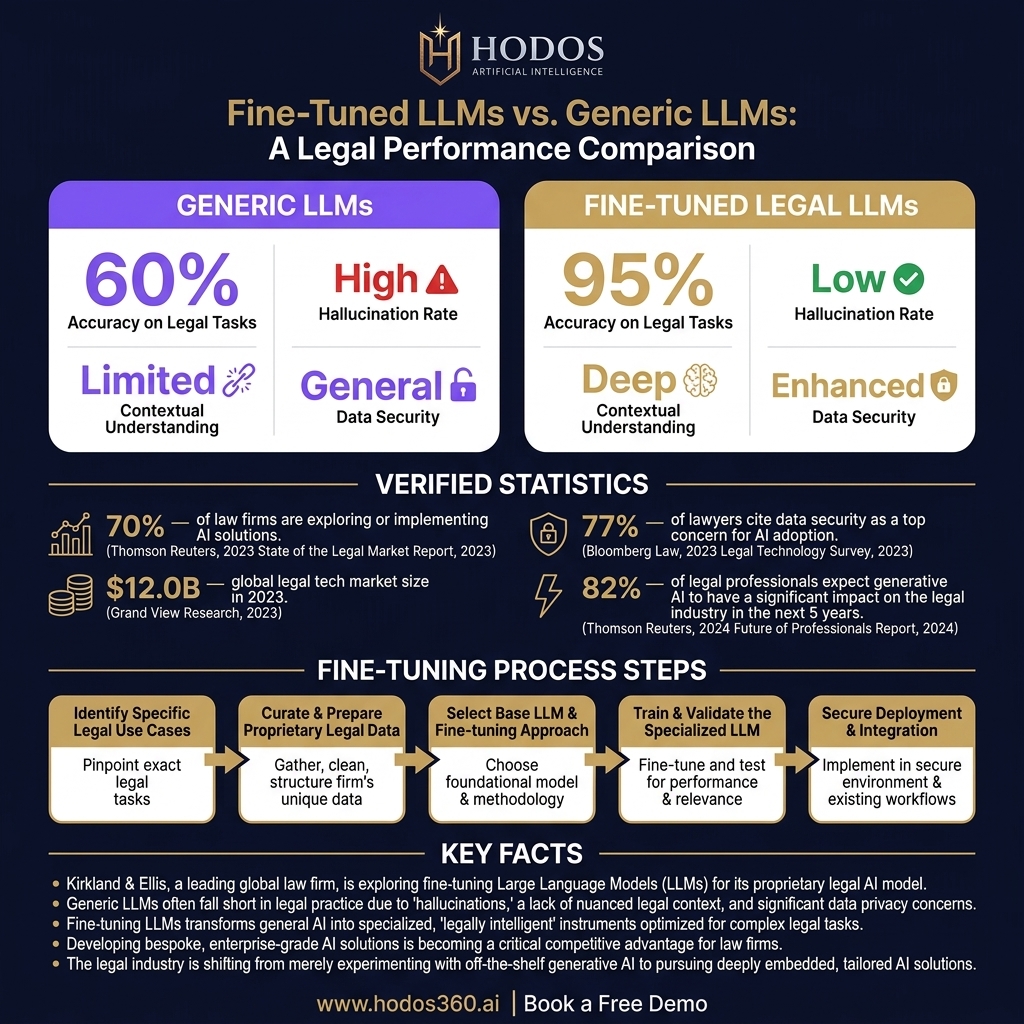
While initial excitement around general-purpose LLMs like OpenAI's GPT-4 or Google's Gemini was palpable, legal professionals quickly encountered their limitations: a propensity for 'hallucinations,' a lack of nuanced legal context, and significant data privacy concerns when handling sensitive client information. These shortcomings highlighted an urgent need for models that are not just intelligent, but *legally intelligent*—trained on vast, validated legal datasets and optimized for specific, complex legal tasks.
This drive for precision and reliability is propelling leading firms to invest in fine-tuning LLMs, transforming generic AI into powerful, specialized legal instruments.
This strategic pivot towards customized AI is not a fleeting trend but a fundamental re-evaluation of how law firms can leverage technology to enhance efficiency, accuracy, and client service.
By fine-tuning LLMs, firms can develop AI tools that understand the subtleties of specific practice areas, adhere to internal precedents, and operate within the strictest confidentiality protocols. This article delves into the strategic imperative behind this movement, demystifies the technical aspects of fine-tuning, explores the critical role of proprietary data, and outlines how these advanced AI models can be seamlessly integrated into modern legal workflows.
It’s a roadmap for law firms aiming to stay ahead in an increasingly AI-driven legal landscape, moving beyond general capabilities to unlock truly transformative legal innovation. Ready to explore the future of legal AI? Discover HODOS 360's AI Law Firm Management System and see how specialized AI can redefine your practice.
The Strategic Imperative: Why Law Firms Must Customize AI
The legal profession operates under a unique set of constraints and demands that generic AI models, trained on broad internet data, simply cannot meet. Legal work is characterized by extreme precision, absolute confidentiality, and an intricate web of precedents, statutes, and ethical obligations. Relying on an LLM that might 'hallucinate' a case citation or misinterpret a complex contractual clause poses unacceptable risks.
As firms like Kirkland & Ellis recognize, the "human conflict" here is stark: firms that proactively invest in customizing their AI will gain a decisive edge over those content with off-the-shelf tools. This isn't merely about efficiency; it's about maintaining professional standards and mitigating the significant liabilities associated with inaccurate or uncontextualized AI outputs.
The ethical mandate, often encapsulated in rules like ABA Model Rule 1.6 (Confidentiality of Information), dictates that attorneys must safeguard client data, a principle that generic cloud-based LLMs, without robust private fine-tuning, struggle to uphold fully.
The competitive landscape is rapidly bifurcating. On one side are the early adopters, like Allen & Overy with its partnership with Harvey AI, who are aggressively pursuing tailored AI solutions.
On the other are firms grappling with the inertia of tradition, often underestimating the transformative power of specialized legal AI. A recent Thomson Reuters Institute report from late 2025 indicated that law firms leveraging highly customized AI for tasks like initial contract review and legal research reported an average 20% increase in efficiency and a 15% reduction in error rates compared to those relying solely on generalist models.
This data underscores the tangible benefits of a focused approach to AI development. Learn more about AI Web Development: Essential Collaboration for Law Firms. Moreover, the ability to build proprietary models, trained exclusively on a firm's vast internal knowledge base—client files, past litigation, corporate documents—creates an invaluable intellectual property asset that is difficult for competitors to replicate.
Andrew Perlman, Dean of Suffolk University Law School and a renowned pioneer in legal technology, has often emphasized the critical need for legal-specific AI. He argues that "the nuances of legal language and reasoning are so profound that only deeply specialized models, informed by expert legal input, can truly serve the profession."
This sentiment resonates strongly with the challenges faced by law firms today. For instance, the interpretation of a single word in a contract can have multi-million dollar implications. A generic LLM, lacking the specific legal training, might interpret 'reasonable efforts' differently from how a seasoned attorney, informed by years of case law and industry practice, would.
This gap in contextual understanding is precisely what fine-tuning LLMs aims to bridge, transforming a powerful but unspecialized tool into a highly reliable legal assistant.
Furthermore, the concern over data privacy and security is paramount. Sending sensitive client data to public LLMs for processing, even with enterprise-level safeguards, raises red flags for many firms and their clients.
By fine-tuning models on private, secure infrastructure, law firms can maintain complete control over their data, ensuring compliance with strict regulatory frameworks like GDPR, CCPA, and most importantly, their ethical obligations to clients. This control is not just a 'nice-to-have' feature; it is a fundamental requirement for the responsible adoption of AI in legal practice.
The strategic imperative is clear: to remain competitive, ethical, and efficient, law firms must move beyond superficial AI adoption and embrace the deep customization offered by optimizing large language models for their unique operational needs.
Beyond Generic: The Limitations of Off-the-Shelf LLMs
While general-purpose LLMs are impressive in their breadth of knowledge and conversational abilities, their inherent design makes them ill-suited for the specific demands of legal practice without significant adaptation. These models are trained on a vast corpus of internet data, which, while diverse, lacks the depth, precision, and contextual understanding required for legal analysis.
They often struggle with domain-specific jargon, the subtle distinctions in legal precedents, and the strict logical reasoning necessary to interpret statutes or advise clients. This can lead to what is commonly termed 'hallucination,' where the AI generates plausible but factually incorrect or legally unsound information, posing severe risks in a profession where accuracy is paramount.
For example, a generic LLM might confidently cite a non-existent case or misinterpret a jurisdictional nuance, leading to potentially disastrous outcomes if unchecked.
The notion that a firm can simply adapt generic models without proper fine-tuning is a significant misconception, often leading to a 'waste' of resources and missed opportunities.
Learn more about AI Marketing: The Essential Legal Firm Growth Blueprint. The time and effort spent trying to coax generalist AI into performing specific legal tasks effectively could be far better invested in a targeted fine-tuning strategy. Companies like Harvey AI, even with their strategic partnership with Allen & Overy, continuously refine their models not just through general updates but through specific training on vast, curated legal datasets to ensure deeper legal integration and reliability.
This ongoing refinement is what allows their AI to move beyond basic information retrieval to more sophisticated legal reasoning, illustrating that even leading legal AI providers understand the necessity of specialized tuning.
Demystifying Fine-Tuning: Methods and Applications for Legal Tasks
At its core, fine-tuning is the process of taking a pre-trained large language model (LLM) – one that has already learned general language patterns from massive datasets – and further training it on a smaller, highly specific dataset relevant to a particular domain or task.
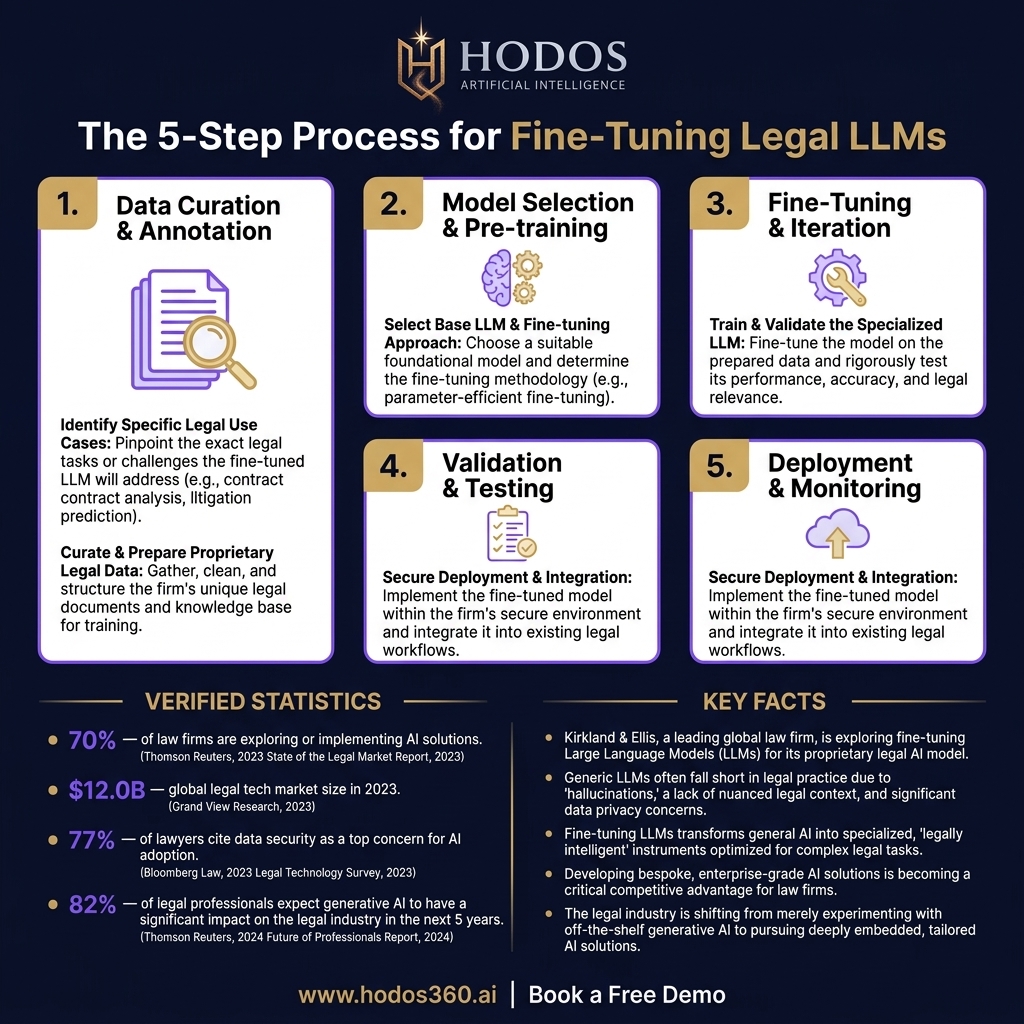
For law firms, this means taking a foundational LLM and exposing it to a curated collection of legal documents, case law, internal memos, and firm precedents. This process effectively teaches the model the nuances of legal language, reasoning, and specific firm practices, making it significantly more accurate and reliable for legal applications.
Think of it as teaching a brilliant generalist student to become a specialist in constitutional law; they already have a strong foundation, but they need focused instruction and exposure to specialized materials to excel in that particular field. This targeted training dramatically improves the model's ability to generate relevant, legally sound outputs, moving it from a general conversationalist to a highly competent legal assistant.
Several methods for fine-tuning large language models exist, each with its own advantages. Supervised fine-tuning involves providing the model with input-output pairs (e.g., a contract clause and its legal interpretation, or a client query and a legally accurate response). Reinforcement Learning from Human Feedback (RLHF), famously used by OpenAI, involves human evaluators ranking AI outputs, which helps the model learn to generate more desirable responses.
More recently, Parameter-Efficient Fine-Tuning (PEFT) methods, such as LoRA (Low-Rank Adaptation), have gained prominence. These techniques allow for efficient fine-tuning by only adjusting a small fraction of the model's parameters, making the process faster, less computationally intensive, and requiring smaller datasets. This is crucial for law firms with limited IT resources or smaller, highly specialized datasets, enabling them to create powerful custom models without needing to retrain a colossal LLM from scratch.
These methods are critical for optimizing models for the unique demands of legal work.
The applications of fine-tuned LLMs in legal tasks are transformative. For contract review, a fine-tuned model can accurately identify specific clauses, flag deviations from standard agreements, and even suggest amendments based on firm precedents, far exceeding the capabilities of a generic model.
Learn more about AI Web Design: Essential Agentic Workflows for Law Firms. In legal research, these models can synthesize vast amounts of case law and statutes, providing highly relevant summaries and identifying key arguments much faster than traditional methods. For due diligence, they can sift through thousands of documents to extract critical information, identify risks, and highlight discrepancies.
Compliance tasks, predictive analytics for litigation outcomes, and even generating initial drafts of legal documents are all areas where a precisely fine-tuned LLM can deliver unparalleled efficiency and accuracy. Firms like Google's internal legal team and Microsoft's legal AI initiatives are already leveraging such tuning techniques to streamline their operations, demonstrating the real-world impact of these technologies.
Consider the meticulous requirements of legal documentation and disclosure. Federal Rule of Civil Procedure 26(g) requires attorneys to certify that disclosures and discovery responses are complete and accurate. A fine-tuned legal AI can be instrumental in ensuring such accuracy, by meticulously reviewing documents for completeness and consistency before attorney certification.
This is a far cry from a generic LLM, which might offer creative but legally unsubstantiated responses. The ability to customize the model's output to conform to specific jurisdictional rules, firm-specific style guides, and even individual partner preferences is invaluable. This precision, directly attributable to the fine-tuning LLMs process, helps legal professionals meet their ethical obligations while dramatically enhancing productivity and quality of work.
It’s about making the AI an indispensable, trustworthy part of the legal process, not just a novelty.
- ✓Enhanced Accuracy in Legal Drafting: Fine-tuned models learn the precise language, terminology, and structure required for legal documents, reducing errors and ensuring compliance with specific legal standards.
- ✓Reduced Hallucination Rates for Legal Advice: By training on validated legal datasets, fine-tuned LLMs are less prone to generating incorrect or fabricated information, making their outputs more reliable for legal analysis.
- ✓Accelerated Document Review and Analysis: These models can quickly and accurately identify relevant clauses, flag issues, and extract key data from large volumes of legal documents, significantly speeding up due diligence and discovery.
- ✓Improved Client Intake and Query Handling: Custom-trained AI can better understand legal-specific client queries, providing more accurate initial responses and streamlining the intake process.
- ✓Customized Legal Research Capabilities: Fine-tuned LLMs can synthesize vast amounts of case law, statutes, and academic articles, delivering highly relevant summaries and precedents tailored to specific legal questions.
- ✓Greater Adherence to Firm-Specific Precedents and Style Guides: By incorporating a firm's internal documents and style manuals into training, the AI can generate content that aligns perfectly with the firm's established practices and branding.
- ✓Stronger Data Security and Confidentiality: Fine-tuning on secure, private datasets ensures that sensitive client information remains within the firm's control, addressing critical ethical and compliance concerns.
The Data Imperative: Building a Proprietary Legal Dataset
The success of any fine-tuning LLMs endeavor hinges critically on the quality and quantity of the data used for training. For law firms, this translates into the challenging but ultimately rewarding task of curating a proprietary legal dataset. This isn't just about dumping all available documents into a model; it requires a strategic, meticulous approach to data collection, cleaning, and annotation.
The dataset must be representative of the tasks the AI is expected to perform, free from bias, and rigorously validated by human legal experts. Imagine the vast repository of knowledge within a law firm: client files, past court filings, transactional documents, internal research memos, and expert opinions.
This treasure trove, when properly structured and annotated, becomes the 'secret sauce' that transforms a generic LLM into a highly specialized legal intelligence. Firms that successfully build and leverage these proprietary datasets are creating an enduring competitive advantage, akin to having an exclusive, constantly learning legal brain trust.
Curating such a high-quality dataset is a significant undertaking, requiring both technological infrastructure and deep legal expertise. It involves identifying relevant documents, anonymizing sensitive client information to comply with privacy regulations, and meticulously annotating data points—for example, marking specific clauses in contracts, identifying legal entities, or tagging positive/negative precedents in case law.
This often necessitates collaboration between legal professionals and data scientists, with the former providing the domain knowledge and the latter the technical skills for data processing and model training. Companies like Kira Systems (acquired by Litera) built their early success on developing sophisticated AI trained on vast, carefully curated legal datasets, proving the power of this data-centric approach.
Their journey underscores that the true value of legal AI is unlocked not just by the algorithms, but by the specialized data they learn from.
Data governance is paramount throughout this process. Learn more about Voice AI: The Essential Shift to Personal Legal Assistants. Firms must establish clear protocols for data collection, storage, access, and retention, ensuring compliance with ethical guidelines and legal requirements.
Anonymization techniques are crucial to protect client confidentiality, transforming sensitive personally identifiable information (PII) into non-identifiable data while preserving the legal context. This meticulous approach to data management is not just a technicality; it's an ethical imperative, directly linked to ABA Model Rule 1.6 on client confidentiality.
Without robust data governance, the benefits of fine-tuning LLMs could be overshadowed by privacy breaches or ethical missteps. The investment in building a secure, well-governed proprietary dataset is an investment in the firm's future, ensuring its AI capabilities are both powerful and compliant.
The competitive advantage derived from a proprietary legal dataset cannot be overstated.
While general LLMs are accessible to all, a firm’s unique collection of internal documents, precedents, and expert annotations represents an exclusive knowledge base. This allows the firm to train models that reflect its specific legal strategies, client base, and operational nuances. This deep customization means the AI can perform tasks not just generally well, but *exceptionally well* within the firm's specific context, offering insights and automation that generic tools cannot.
This is how firms can truly differentiate themselves in a crowded market, moving beyond basic efficiency gains to establish themselves as leaders in AI-driven legal practice, leveraging trained models that are truly their own.
Ethical AI and Data Security in Fine-Tuning
As law firms delve deeper into fine-tuning LLMs, the ethical implications and data security challenges become even more pronounced. The 'black box' problem, where the reasoning behind an AI's output is opaque, raises significant concerns about accountability and transparency in legal advice. Firms must prioritize interpretability and explainability, ensuring that attorneys can understand and validate the AI's conclusions rather than blindly accepting them.
Bias mitigation is another critical ethical consideration; if the training data reflects historical biases (e.g., racial, gender, socio-economic), the fine-tuned model will perpetuate and even amplify those biases in its legal analysis or recommendations. This could lead to inequitable outcomes, directly conflicting with the legal profession's commitment to justice and fairness.
Leaders in AI, such as Dario Amodei (co-founder of Anthropic), consistently emphasize the paramount importance of aligning AI with human values and rigorous safety testing to prevent unintended harms.
Beyond ethical considerations, robust data security is non-negotiable when fine-tuning legal AI. Learn more about Essential AI Legal Solutions: Freshfields' Gemini Integration.
Sensitive client information, case details, and proprietary firm strategies are invaluable assets that require the highest level of protection. This means implementing stringent encryption protocols for data at rest and in transit, establishing granular access controls, and regular security audits to identify and mitigate vulnerabilities.
Compliance with global data protection regulations, such as GDPR and CCPA, is not merely a checkbox but a fundamental aspect of responsible AI deployment. By conducting fine-tuning within secure, private cloud environments or on-premise infrastructure, law firms can significantly reduce the risk of data breaches and maintain client trust.
This commitment to security is a cornerstone of professional responsibility, ensuring that the power of optimizing large language models does not come at the cost of confidentiality.
Integrating Fine-Tuned LLMs into Law Firm Workflows
The true value of fine-tuning LLMs is realized when these specialized models are seamlessly integrated into existing law firm workflows, transforming daily operations rather than disrupting them. This isn't about replacing human lawyers but augmenting their capabilities, automating mundane tasks, and providing powerful analytical support.
Successful integration typically involves API connections to core legal tech systems such as case management platforms, document management systems, and client intake portals. For instance, a fine-tuned LLM could automatically draft initial responses to client inquiries within the client intake system, or rapidly summarize relevant precedents directly within a case file, saving attorneys countless hours.
The aim is to create intelligent, AI-powered legal workflows that enhance efficiency and accuracy at every touchpoint, allowing legal professionals to focus on strategic thinking and client interaction, which truly require human expertise.
However, integration is not without its challenges. Change management is a critical factor; introducing new AI tools requires careful planning, comprehensive training for staff, and strong leadership buy-in.
Attorneys and support staff must understand how the AI works, its capabilities, and its limitations to use it effectively and trust its outputs. Firms must invest in user adoption strategies, demonstrating the tangible benefits and addressing any anxieties about job displacement. A compelling success story comes from LexCorp LLP, a mid-sized corporate law firm that implemented a fine-tuned LLM for initial contract review.
Following its deployment, which was showcased at LegalTech NYC 2026, LexCorp reported a remarkable 30% reduction in first-pass review time and a 15% increase in error detection over generic tools, leading to significant cost savings and improved client satisfaction. Learn more about Essential AI Web Design Tools for Law Firm Growth.
This success was largely attributed to their meticulous integration process and robust user training, proving the power of well-deployed trained models.
Platforms that offer comprehensive AI Law Firm Management Systems, like HODOS 360, play a pivotal role in this integration. These platforms are designed to be the central nervous system of a modern law firm, encompassing case management, billing, client intake, and document automation.
A fine-tuned LLM, whether developed internally or through a specialized vendor, can be integrated directly into such a system, acting as an intelligent layer that enhances every module. For example, a custom LLM could power the document automation feature, generating highly accurate and firm-specific legal documents, or enhance the client intake process by intelligently extracting key information and suggesting next steps.
This holistic approach ensures that the benefits of specialized AI are distributed across the entire firm, maximizing ROI and streamlining operations.
The future of legal practice will be defined by how effectively firms can harness these advanced AI capabilities. The goal is not just to automate tasks, but to create a more intelligent, proactive, and responsive legal practice.
By strategically integrating fine-tuning LLMs into their operational framework, law firms can unlock unprecedented levels of efficiency, accuracy, and innovation. This integration allows firms to deliver higher quality legal services, manage larger caseloads with greater ease, and ultimately, provide superior value to their clients, solidifying their position in a competitive market.
It’s about creating a symbiotic relationship between human expertise and machine intelligence, where each enhances the other.
The Role of AI Law Firm Management Systems
In this new era of customized legal AI, comprehensive AI Law Firm Management Systems become indispensable. These systems serve as the operational backbone, providing the infrastructure necessary to host, integrate, and leverage fine-tuned LLMs across all facets of a firm's operations. Imagine a single platform where your fine-tuned model assists with client intake by analyzing initial inquiries, powers document automation to draft custom contracts, and enhances case management by summarizing court filings and identifying relevant precedents.
This integrated approach ensures that the specialized intelligence derived from fine-tuning LLMs is not isolated but permeates every workflow, creating a truly intelligent and efficient legal ecosystem. HODOS 360's AI Law Firm Management System is specifically designed for this purpose, offering a suite of AI-powered tools that naturally accommodate and amplify the capabilities of custom LLMs, turning advanced AI into actionable insights and automated processes for your firm.

Key Takeaways and Next Steps for Legal Professionals
The legal industry stands at a pivotal juncture, where the strategic adoption of AI, particularly through the fine-tuning LLMs, will define the leaders of tomorrow. The move by firms like Kirkland & Ellis to explore proprietary legal AI models is a clear indicator that generic, off-the-shelf solutions are no longer sufficient for achieving true competitive differentiation.
Law firm owners and legal professionals must recognize that investing in custom AI is not merely an IT expense but a strategic imperative that promises enhanced accuracy, unprecedented efficiency, and superior client service. The future demands a proactive approach: firms that commit to building and leveraging their own specialized AI capabilities will be best positioned to navigate the complexities of modern legal practice, mitigate risks, and unlock new avenues for growth and innovation.
For legal professionals contemplating this journey, the next steps are clear and actionable. First, conduct a thorough assessment of your firm's current workflows to identify pain points and areas where AI can deliver the most significant impact—be it in contract review, legal research, or client intake.
Second, begin to evaluate your existing data infrastructure and develop a strategy for curating and annotating a high-quality, proprietary legal dataset, ensuring strict adherence to data governance and privacy protocols. This foundational work is crucial for effective fine-tuning LLMs. Third, explore partnerships with legal tech providers that offer comprehensive AI Law Firm Management Systems designed to integrate and maximize the value of custom AI models.
This will provide the necessary platform for deployment and ongoing optimization.
Finally, foster a culture of innovation and continuous learning within your firm. AI is not a one-time implementation but an evolving capability that requires ongoing refinement and adaptation. Encourage your team to engage with new technologies, participate in training programs, and provide feedback that can further enhance your AI models.
The firms that embrace this iterative process, combining human legal expertise with advanced machine learning, will be the ones that truly thrive. By taking these decisive steps, legal professionals can transform their practices, moving beyond traditional constraints to harness the full power of specialized AI, ultimately delivering greater value to clients and securing a leading position in the ever-evolving legal landscape.
Empower your firm with cutting-edge AI. Schedule a Free Demo with HODOS 360 Today!
Frequently Asked Questions
What is fine-tuning LLMs in legal tech?+
Fine-tuning LLMs in legal tech involves taking a pre-trained large language model (LLM) and further training it on a smaller, highly specific dataset of legal documents, case law, and firm precedents. This process adapts the general LLM to understand legal nuances, terminology, and reasoning, making it significantly more accurate and reliable for legal tasks like contract review, research, and document generation, reducing errors and hallucinations specific to the legal domain.
Why can't law firms just use ChatGPT or other general LLMs?+
General LLMs like ChatGPT, while powerful, are trained on broad internet data, lacking the specific legal context and precision required for law firms. They are prone to 'hallucinations,' can misinterpret legal nuances, and raise significant data privacy concerns when handling sensitive client information. Law firms need highly specialized, secure, and accurate AI that adheres to ethical guidelines and legal precedents, which only fine-tuned or proprietary models can reliably provide.
What kind of data is needed to fine-tune a legal LLM?+
To fine-tune a legal LLM effectively, firms need a high-quality, curated proprietary dataset. This typically includes internal client files (anonymized), past court filings, transactional documents, legal research memos, firm precedents, and expert-annotated legal texts. The data must be clean, representative, and free from bias, and its collection and use must comply with strict data governance, privacy regulations (e.g., GDPR, CCPA), and ethical obligations like ABA Model Rule 1.6.
How long does it take to fine-tune an LLM for legal use?+
The time it takes to fine-tune an LLM for legal use varies significantly based on the size and quality of the training dataset, the complexity of the desired tasks, and the computational resources available. It can range from a few weeks for initial, narrowly focused tasks with a well-prepared dataset to several months for more comprehensive, robust models requiring extensive data curation and iterative refinement. This process is ongoing, with continuous improvements and updates.
What are the ethical considerations when fine-tuning legal AI?+
Ethical considerations include mitigating bias in training data to prevent discriminatory outcomes, ensuring transparency and explainability of AI outputs (avoiding the 'black box' problem), and rigorously protecting client confidentiality and data security. Firms must also address accountability for AI-generated content, ensuring human oversight, and complying with professional responsibility rules like ABA Model Rule 1.1 (Competence) and 1.6 (Confidentiality) when deploying and utilizing fine-tuned legal AI models.