

Voice AI: The Essential Shift to Personal Legal Assistants
Remember the early days of in-car voice assistants? They were often clunky, misunderstood commands, and primarily focused on basic functions. Fast forward to April 2026, and as *Automotive News* recently highlighted, "In-car voice AI shifts from basic commands to personal assistants," capable of complex interactions, proactive suggestions, and even learning user preferences.
This dramatic evolution isn't confined to the automotive industry; it's a powerful harbinger for the legal sector. For years, legal professionals have grappled with administrative tasks, the challenge of 24/7 client availability, and the constant pressure to optimize efficiency. The traditional law firm, with its reliance on manual processes, is increasingly finding itself at a crossroads, needing to innovate to remain competitive.
The question is no longer if voice AI will integrate into legal practice, but how deeply and effectively firms can harness its burgeoning capabilities to create a truly transformative experience for both their teams and their clients. This shift is not merely about automation; it's about augmentation, empowering legal professionals with tools that understand, anticipate, and act with unprecedented sophistication.
The implications for law firms are profound, extending far beyond simple dictation software. As companies like OpenAI, led by CEO Sam Altman, continue to push the boundaries of large language models (LLMs) and conversational AI, the sophistication available to enterprise applications has skyrocketed. This technological leap allows for AI assistants that can handle nuanced legal inquiries, qualify leads with precision, and even manage complex scheduling, freeing up valuable human capital for high-value legal work.
The legal industry, historically cautious about adopting new technologies, is now recognizing the imperative to embrace these advancements. Firms that once viewed AI with skepticism are actively seeking solutions that can address pain points like client intake bottlenecks, missed after-hours calls, and labor-intensive document generation.
The competitive landscape is intensifying, with firms like Allen & Overy partnering with legal AI trailblazers like Harvey AI, demonstrating a clear commitment to integrating advanced AI into their core operations. This adoption signals a broader trend: legal professionals are ready to move beyond basic automation and embrace intelligent systems that can truly act as an extension of their team, fostering efficiency and enhancing client satisfaction.
The evolution of voice AI is not just an upgrade; it's a paradigm shift in legal service delivery.
Discover the future of legal operations with HODOS 360's AI Voice Assistants. Learn how sophisticated conversational AI can transform your firm's client engagement and efficiency – Book a Free Demo Today!
- ✓The Evolution of Voice AI in Legal Practice
- ✓Beyond Basic Commands: Conversational AI for Law Firms
- ✓HODOS 360's AI Voice Assistants: A Strategic Advantage
- ✓Navigating Ethical & Practical Considerations of Voice AI
- ✓Future-Proofing Your Firm with Advanced Voice AI
- ✓Key Takeaways and Next Steps
The Evolution of Voice AI in Legal Practice
The journey of voice AI from rudimentary speech-to-text to intelligent conversational partners has been exponential, driven by breakthroughs in machine learning and neural networks. Early legal applications of voice technology were largely confined to dictation software, a significant improvement over manual transcription but still a far cry from true AI assistance.
Lawyers like Sarah Jones, a partner at a mid-sized litigation firm in Chicago, recall the frustrations of early systems that struggled with legal jargon and accents, often leading to more time spent correcting than dictating. However, the landscape began to change dramatically with the advent of more powerful large language models (LLMs) and improved natural language processing (NLP).
Companies like Nuance Communications, long a leader in speech recognition, have seen their technology evolve to power more sophisticated virtual assistants, demonstrating the potential for deeper integration. This evolution mirrors the broader tech industry's push towards more intuitive human-computer interaction, as evidenced by Google's advancements in Duplex or Amazon's Alexa, which have accustomed consumers to seamless voice interactions in their daily lives.
The legal sector, always a few steps behind consumer tech, is now catching up, recognizing that the same underlying technologies can resolve critical operational challenges.
The shift from basic command recognition to contextual understanding is pivotal. Learn more about AI Officer: The Essential Role for Modern Law Firms.
Where older systems required precise phrasing, modern AI assistants can interpret intent, understand follow-up questions, and even detect emotional cues. This capability is crucial in a client-facing environment where interactions are rarely linear or predictable. Research from the Thomson Reuters Institute in 2025 indicated that law firms adopting AI tools reported an average 15% increase in administrative efficiency and a 10% improvement in client satisfaction scores.
This data underscores a growing realization among legal leaders, including figures like Brad Smith, Vice Chair and President of Microsoft, who has consistently championed the transformative power of AI across industries. The legal profession, often characterized by its demanding workload and high-stakes interactions, stands to gain immensely from intelligent systems that can offload routine tasks, manage initial client queries, and streamline communication, allowing attorneys to focus on strategic legal counsel rather than administrative overhead.
This profound shift is redefining what's possible in legal service delivery, moving beyond simple automation to genuine intelligent assistance.
Streamlining Client Intake and Engagement
One of the most immediate and impactful applications of advanced voice AI in law firms is in streamlining client intake and enhancing engagement. Traditionally, the client intake process is resource-intensive, often involving multiple phone calls, form filling, and manual data entry. Missed calls, especially outside of business hours, can mean lost leads.
With AI voice assistants, law firms can provide 24/7 responsiveness, ensuring every potential client receives immediate, professional attention. Imagine a scenario where a prospective client calls at 10 PM after an accident. Instead of reaching an answering machine, they are greeted by an AI assistant that can empathetically gather initial details, explain the firm's relevant practice areas, qualify the lead based on predefined criteria, and even schedule an initial consultation directly into the attorney's calendar.
This level of service not only captures leads that might otherwise be lost but also sets a professional, responsive tone from the very first interaction. Firms leveraging these capabilities, such as the early adopters seen at LegalTech NYC 2026, report significant reductions in lead qualification time and an increase in conversion rates.
Learn more about AI in MarTech: The Ultimate Guide to Predictive Power. This proactive engagement is not just about convenience; it's about building trust and demonstrating a firm's commitment to modern, client-centric service from the outset.
The true power lies in the assistant's ability to engage in natural, context-aware conversations.
Unlike static chatbots or IVR systems, advanced voice AI can adapt to the caller's language (offering multilingual support), understand nuanced questions about their legal issue, and provide relevant information without human intervention. This capability is particularly vital for firms serving diverse communities, where language barriers can often be a significant impediment to accessing legal services.
Furthermore, these AI assistants can seamlessly integrate with existing case management systems, populating client information directly into the firm's database, thereby reducing manual errors and saving countless hours for administrative staff. This integration transforms the client journey from a series of disjointed steps into a smooth, efficient, and highly personalized experience, reflecting the sophistication seen in the broader AI assistant market, where personalization is key.
The legal sector is finally embracing the potential of truly intelligent and responsive client engagement, moving beyond mere automation to a proactive, AI-driven approach.
Beyond Basic Commands: Conversational AI for Law Firms
The distinction between basic voice commands and true conversational AI is critical for understanding its transformative potential in legal practice. Basic commands are transactional; they execute a specific, pre-programmed function. Conversational AI, on the other hand, is relational; it engages in dialogue, understands context, maintains memory of previous interactions, and can even infer intent.
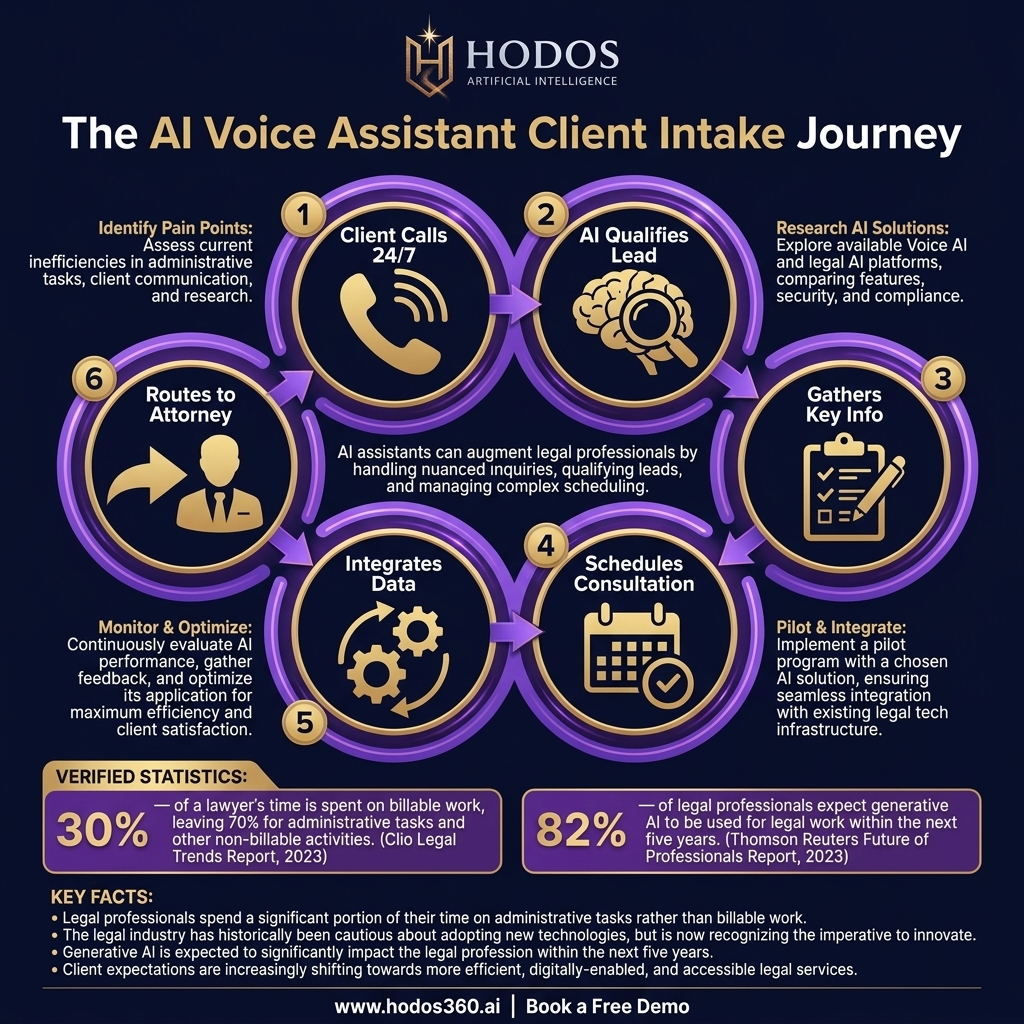
This paradigm shift, from simple "call John Doe" to "Can you tell me about the legal implications of this contract clause, and then schedule a follow-up with the client?" represents a leap in functionality. Pioneers in this space, such as Dario Amodei, CEO of Anthropic, have emphasized the importance of AI models that can reason and engage in complex, multi-turn conversations, a capability that is invaluable in the nuanced world of legal work.
This advanced capability means that AI assistants can do more than just answer FAQs; they can assist in preliminary legal research by summarizing key statutes, help draft initial client communications by pulling relevant case details, or even provide real-time updates on case statuses to clients without interrupting an attorney's workflow.
The ability to handle these complex, multi-faceted tasks is what elevates voice AI from a utility to a genuine strategic asset.
Consider the daily operational challenges faced by busy law firms. Attorneys are constantly juggling client calls, internal meetings, court appearances, and document reviews. Learn more about AI Voice Clone: The Ultimate Guide for Law Firms.
Interruptions for routine inquiries or scheduling conflicts can severely impact productivity. Conversational AI assistants act as a critical buffer, filtering and managing these interactions intelligently. They can route urgent calls directly to the appropriate attorney, provide basic information to clients, and even proactively remind clients of upcoming appointments or document deadlines.
This level of proactive support is akin to having an exceptionally efficient, always-on junior paralegal or administrative assistant. Furthermore, the data gathered from these interactions provides invaluable insights into client needs, common inquiries, and operational bottlenecks, allowing firms to refine their services and improve efficiency continuously.
This data-driven approach, similar to how leading technology companies analyze user interaction with their AI assistants, offers a powerful competitive edge, enabling firms to anticipate client needs and optimize their resource allocation effectively.
Enhancing Operational Efficiency
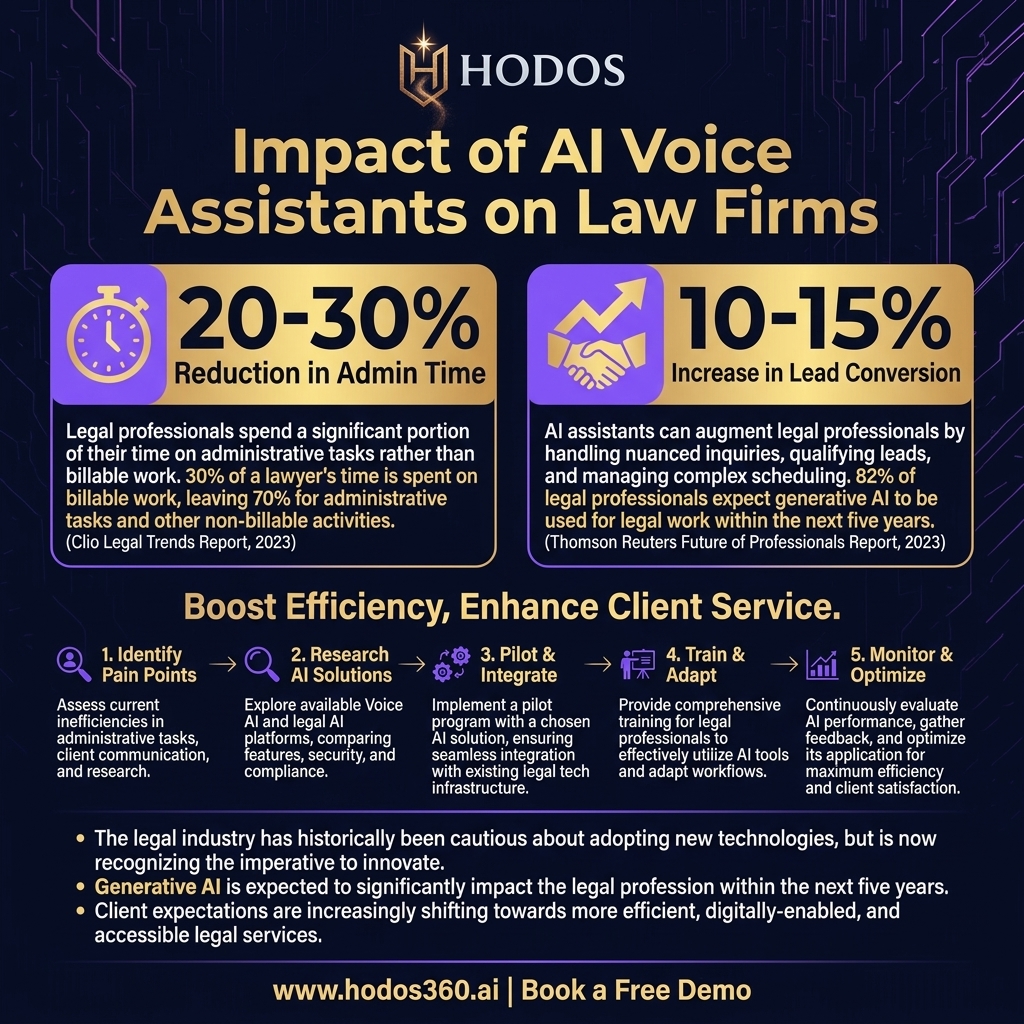
Beyond client-facing applications, the operational efficiency gains from advanced voice AI within a law firm are substantial. Legal professionals spend a significant portion of their day on administrative tasks that, while necessary, detract from billable hours and strategic work. From managing calendars and scheduling depositions to initiating document automation workflows and updating case management systems, these tasks can be significantly streamlined by intelligent AI assistants.
For instance, an attorney could simply voice a command like, "Schedule a deposition with opposing counsel for the Miller case next Tuesday at 10 AM, and send out calendar invites," and the AI assistant would interface with the firm's calendar system, check availability, send invitations, and log the event in the case management software.
This hands-free, intuitive control dramatically reduces the time spent on logistics, allowing attorneys to maintain focus on legal strategy. This mirrors the advancements in automotive technology, where voice control frees drivers from manipulating physical controls, enhancing safety and focus on the road.
The integration of voice AI with other legal tech solutions, such as document automation platforms or AI-powered legal research tools, further amplifies its impact.
Learn more about Essential Legal AI Access: NELLCO's Broad Impact. An AI assistant can be instructed to "generate a standard NDA for the new client onboarding in the Smith matter," triggering a workflow that pulls relevant templates, populates client data, and drafts the document, ready for attorney review.
This seamless interaction across different systems transforms complex, multi-step processes into simple voice commands. According to a 2025 report by Gartner, firms that effectively integrate AI into their operational workflows can expect to see a 20-30% reduction in time spent on routine administrative tasks. This translates directly into increased billable hours, improved attorney well-being, and a more responsive, efficient firm overall.
The shift to voice AI is not just about convenience; it's about fundamentally rethinking and optimizing the operational backbone of a modern legal practice.
Ready to revolutionize your firm's efficiency and client service? Explore how HODOS 360's AI Voice Assistants seamlessly integrate with your existing legal workflows. Transform challenges into opportunities – Request a Personalized Demo!
HODOS 360's AI Voice Assistants: A Strategic Advantage
The legal industry's embrace of sophisticated voice AI is a testament to its potential, and platforms like HODOS 360 are at the forefront of this transformation. HODOS 360's AI Voice Assistants are designed specifically to address the unique pain points of law firms, moving beyond generic virtual assistants to provide specialized, legal-centric solutions.
Our platform offers 24/7 phone answering, ensuring no lead is ever missed, regardless of when a potential client calls. This always-on availability is critical in competitive markets where timely response can be the difference between securing a new client and losing them to a competitor.
Furthermore, our AI assistants are equipped with advanced lead qualification capabilities, allowing them to intelligently assess a caller's needs against the firm's practice areas and ideal client profile. This precision in qualification ensures that attorneys spend their valuable time on high-potential leads, significantly improving conversion rates and optimizing marketing spend.
The ability to automatically book appointments directly into attorney calendars, even across complex schedules, further streamlines the initial client engagement, reducing administrative burden and accelerating the client onboarding process.
What truly sets HODOS 360 apart is its deep integration with the broader legal tech ecosystem and its commitment to multilingual support.
Learn more about AI Voice Calls: The Essential Guide for Modern Law Firms. Recognizing the diverse client base of many modern law firms, our AI voice assistants offer support in multiple languages, breaking down communication barriers and expanding a firm's reach. This is not just a feature; it’s a strategic imperative for firms looking to serve a globalized and multicultural clientele effectively.
Additionally, the seamless call routing capabilities ensure that calls are directed to the most appropriate department or individual within the firm, minimizing internal friction and maximizing efficiency. This holistic approach to voice AI is more than just an answering service; it's a comprehensive client engagement and operational optimization tool.
By leveraging HODOS 360's AI Voice Assistants, law firms are not just adopting technology; they are investing in a strategic advantage that enhances client experience, boosts operational efficiency, and positions them as leaders in a rapidly evolving legal landscape. This comprehensive suite of services aligns perfectly with the current market demand for integrated, intelligent legal solutions, pushing the boundaries of what voice AI can achieve in the legal sector.
Navigating Ethical & Practical Considerations of Voice AI
While the benefits of voice AI are compelling, law firms must also navigate the ethical and practical considerations inherent in deploying such advanced technology. Foremost among these is the imperative of client confidentiality, a cornerstone of legal ethics as enshrined in ABA Model Rule 1.6. When AI assistants handle client communications, firms must ensure that all data is encrypted, securely stored, and processed in compliance with privacy regulations like GDPR or CCPA.
The potential for data breaches or unauthorized access to sensitive client information is a significant concern that requires robust cybersecurity measures and clear vendor agreements. Law firms must conduct thorough due diligence on any AI assistant provider, verifying their security protocols, data handling policies, and compliance certifications.
Furthermore, transparency with clients about the use of AI in communications is crucial. While clients may interact with an AI assistant, they should be aware that their initial contact might not be with a human, fostering trust and avoiding potential misunderstandings. Firms like Cooley LLP have publicly discussed their internal guidelines for AI use, emphasizing the need for human oversight and ethical deployment, signaling a growing industry-wide recognition of these critical issues.
Another critical consideration is the need for human oversight and the maintenance of professional judgment. Learn more about AI-Powered Web Development: The Essential Guide for Law Firms. While AI assistants excel at routine tasks and information gathering, they cannot replace the nuanced legal advice, empathy, and strategic thinking of a human attorney.
ABA Model Rule 1.1 on Competence mandates that lawyers provide competent representation, which includes understanding the risks and benefits of technology. Therefore, firms must implement clear protocols for when an AI assistant hands off a client interaction to a human, ensuring that complex legal issues are always handled by a qualified professional.
The goal of voice AI is to augment, not replace, human expertise. The "human in the loop" principle is paramount, ensuring that AI-generated responses are reviewed, and client interactions that require deep legal analysis or emotional intelligence are escalated appropriately. The legal profession, through bodies like the ABA Standing Committee on Ethics and Professional Responsibility, continues to issue guidance on the ethical use of AI, underscoring the dynamic interplay between technological advancement and professional obligations.
This ensures that the integration of voice AI upholds the highest standards of legal practice.
Data Security and Client Confidentiality
The bedrock of the attorney-client relationship is trust, underpinned by strict confidentiality. The use of voice AI in a law firm introduces new vectors for potential data exposure if not managed meticulously. Firms must prioritize vendors who offer enterprise-grade security, including end-to-end encryption for all voice data, secure cloud storage compliant with legal industry standards, and strict access controls.
Furthermore, understanding the AI model's training data and how it handles new client information is crucial. Does the AI learn from client conversations in a way that could inadvertently compromise confidentiality across clients or firms? Reputable AI assistant providers will offer clear policies on data anonymization and isolation.
The EU AI Act, expected to be fully enforced in the coming years, provides a robust framework for regulating AI systems, particularly those deemed "high-risk," which could certainly include AI interacting with sensitive legal data. Law firms must stay abreast of such legislative developments and ensure their voice AI solutions are compliant.
Beyond technical safeguards, firms must establish internal policies and training for their staff on the responsible use of AI assistants. This includes guidance on what information can be shared with the AI, how to verify AI-generated responses, and procedures for reporting any potential security incidents.
The principle of "reasonable care," as often invoked in legal malpractice cases, extends to the selection and management of technology. Firms that fail to adequately secure client data, regardless of the technology used, face significant reputational damage and potential legal liability. Therefore, while the allure of efficiency and enhanced client service provided by voice AI is strong, it must always be balanced against the paramount duty to protect client information.
Proactive measures in data security and robust internal governance are not optional; they are essential for any firm integrating advanced AI assistants into its operations.
Future-Proofing Your Firm with Advanced Voice AI
The trajectory of voice AI suggests an increasingly sophisticated role in the legal ecosystem. Industry leaders like Jensen Huang, CEO of Nvidia, frequently articulate a future where AI is deeply embedded in every aspect of business, acting as an intelligent co-pilot. For law firms, this means moving beyond current capabilities to anticipate future advancements.
We can foresee AI assistants not only managing initial client contact but also assisting in complex litigation support, summarizing deposition transcripts, identifying key arguments in legal briefs, or even drafting initial responses to discovery requests based on context and precedent. The integration will deepen, with voice AI becoming an omnipresent interface for all aspects of a firm's operations, seamlessly interacting with document management systems, research databases, and even predictive analytics tools.
This level of integration will allow firms to operate with unprecedented agility and insight, delivering legal services more efficiently and effectively than ever before.
Firms that proactively embrace and integrate advanced voice AI are not just adopting a new tool; they are strategically future-proofing their practice.
The competitive advantage will increasingly belong to those who can leverage technology to enhance both client experience and internal productivity. As the cost of AI assistants continues to decrease and their capabilities expand, the divide between tech-forward firms and traditional practices will widen. Early adopters will gain valuable experience, refine their workflows, and build an institutional knowledge base around AI best practices, making them more resilient and adaptable to future market shifts.
This proactive stance is critical in an era where technological disruption is a constant. By investing in scalable, intelligent voice AI solutions now, law firms are not merely keeping pace; they are positioning themselves to lead the charge in defining the next generation of legal service delivery, ensuring their relevance and profitability in the decades to come.

Key Takeaways and Next Steps
The shift in voice AI from basic commands to intelligent personal assistants, mirroring the automotive industry and now transforming legal practice, represents a pivotal moment for law firms. The ability to offer 24/7 client engagement, streamline intake, qualify leads with precision, and automate routine administrative tasks is no longer a luxury but a strategic imperative.
Firms that embrace these advanced AI assistants can significantly enhance operational efficiency, improve client satisfaction, and free up their legal professionals to focus on high-value, complex legal work. While ethical considerations, particularly around data security and human oversight, demand careful attention, the benefits of judiciously deployed voice AI are undeniable.
To truly thrive in this evolving landscape, law firms must move beyond passive observation and actively explore how intelligent voice AI can be integrated into their specific workflows. Platforms like HODOS 360 offer comprehensive AI Voice Assistants designed specifically for the legal sector, providing a robust solution for firms ready to embrace this transformation.
By leveraging these sophisticated tools, firms can not only optimize their current operations but also strategically position themselves for future growth and competitive advantage. The future of legal practice is conversational, efficient, and intelligently augmented – are you ready to engage?
Ready to transform your law firm with cutting-edge AI Voice Assistants? Visit HODOS 360 today to learn more and schedule a personalized consultation to see how we can empower your practice!
Frequently Asked Questions
What is the primary difference between basic voice commands and AI Voice Assistants for law firms?+
Basic voice commands are typically pre-programmed, executing simple, singular actions like "call client." AI Voice Assistants, however, leverage advanced conversational AI to understand context, engage in multi-turn dialogues, qualify leads, book appointments, and integrate with firm systems, acting as a true intelligent assistant rather than just a command executor.
How do AI Voice Assistants enhance client intake for law firms?+
AI Voice Assistants provide 24/7 availability, ensuring no prospective client call is missed. They can empathetically gather initial case details, qualify leads based on firm criteria, answer common FAQs, and even schedule consultations directly into attorney calendars, significantly streamlining the intake process and improving lead conversion rates.
What are the key ethical considerations when implementing voice AI in a law firm?+
The primary ethical considerations include client confidentiality (ABA Model Rule 1.6), data security, and maintaining professional competence (ABA Model Rule 1.1). Firms must ensure robust data encryption, transparent communication with clients about AI use, and establish clear human oversight protocols for complex legal advice, ensuring AI augments, not replaces, human judgment.
Can AI Voice Assistants integrate with existing law firm management systems?+
Yes, advanced AI Voice Assistants, like those offered by HODOS 360, are designed for seamless integration with popular case management, billing, and document automation systems. This allows for automated data entry, calendar management, and workflow triggering, ensuring a cohesive and efficient operational environment.
How does AI Voice Assistant technology help improve a law firm's operational efficiency?+
By automating routine administrative tasks such as managing calendars, scheduling meetings, routing calls, and initiating document generation, AI Voice Assistants free up attorneys and staff from non-billable work. This leads to increased billable hours, reduced administrative overhead, and improved focus on strategic legal work, enhancing overall firm productivity.