

AI in MarTech: The Ultimate Guide to Predictive Power
Just last month, Sarah Chen, a managing partner at a mid-sized corporate law firm in Chicago, found herself staring at another quarterly marketing report. The numbers were decent, but the narrative felt stale: increased website traffic, higher social media engagement – all performative metrics that didn't directly translate into new client matters.
She knew her firm was spending heavily on marketing technology, yet the 'why' behind client acquisition remained a mystery, shrouded in guesswork rather than data-driven insight. This scenario is increasingly common in the legal sector, where the promise of artificial intelligence in marketing technology (AI in MarTech) often clashes with the reality of its implementation, leaving many firms wondering if they're truly leveraging AI's transformative power or merely performing for an audience.
The challenge for law firms today isn't just adopting AI; it's understanding the distinct capabilities of predictive, prescriptive, and performative AI within their marketing strategies. The legal industry, traditionally cautious, is now grappling with the rapid evolution of AI tools. Firms that merely automate social media posts or generate blog content without a deeper analytical framework risk falling into the 'performative' trap – using AI for surface-level tasks that don't yield strategic advantages.
The real differentiator lies in harnessing AI to forecast future client needs, optimize lead generation, and even dictate the most effective marketing actions. This shift from reactive to proactive marketing is not just an upgrade; it's a fundamental redefinition of how law firms identify, attract, and retain clients in a digital-first world, demanding a nuanced understanding of AI's true role.
Beyond Descriptive: The Evolution of AI in Legal MarTech
For years, law firms relied on descriptive analytics, painstakingly compiling historical data to understand past marketing performance. Metrics like website visits, email open rates, and conversion numbers were the bedrock of strategy, telling firms *what* happened. However, this rearview mirror approach provides limited foresight. As AI in MarTech matured, the industry witnessed a pivot towards more sophisticated capabilities.
Early innovators like Clio, through its acquisition strategies and platform enhancements, began integrating basic AI functionalities to automate routine tasks, moving firms away from purely manual data compilation. This marked the genesis of a more dynamic approach, laying the groundwork for what would become predictive and prescriptive analytics.
Today, the landscape is dramatically different. Learn more about Voice AI Revolutionizes Legal: HODOS 360's 2026 Impact. Firms are no longer content with simply knowing past performance; they demand actionable insights into future trends and optimal strategies. This demand is fueled by the success stories emerging from other sectors and the increasing sophistication of general AI models from entities like OpenAI and Google.
The legal industry’s adoption of these advanced tools, while slower than some tech-native sectors, is accelerating. The ABA Legal Technology Survey Report consistently shows an uptick in AI adoption, with the 2023 report indicating a growing percentage of firms exploring AI for client intake and marketing automation.
This evolution signifies a critical juncture: firms must now distinguish between AI that merely reports on the past and AI that actively shapes the future.
The Pitfalls of Performative AI in Law Firms
Performative AI, while seemingly productive, often offers a false sense of progress. It's the AI that generates generic blog posts or automates social media scheduling without underlying strategic intelligence or deep audience understanding. While such tools can save time, they rarely provide a competitive edge or drive significant ROI.
Many law firms, eager to embrace AI, inadvertently fall into this trap, investing in tools that mimic innovation without delivering substantive value. Learn more about Voice Assist: Essential AI Scheduling for Law Firms. This leads to a disconnect between effort and outcome, where marketing departments are busy but not necessarily effective.
The true value of AI in MarTech for law firms lies not in simply doing more, but in doing smarter – a distinction that separates leaders from laggards.
Predictive Analytics: Forecasting Legal Client Behavior
Predictive analytics represents a significant leap forward in AI in MarTech for law firms, moving beyond 'what happened' to 'what will happen.' By analyzing vast datasets of past client interactions, market trends, economic indicators, and even legislative changes, predictive AI algorithms can forecast future client needs and behaviors with remarkable accuracy.
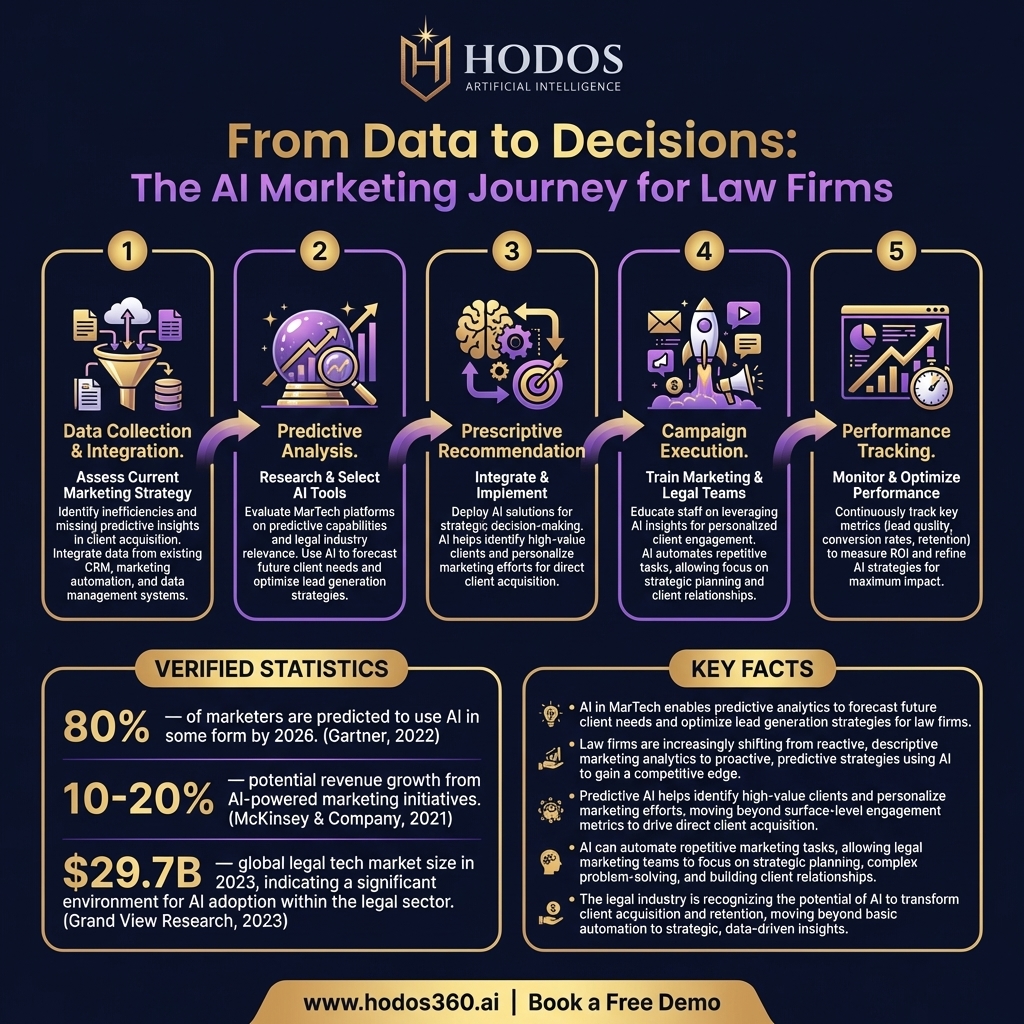
For instance, a firm specializing in real estate law could use predictive models to anticipate surges in commercial property transactions based on interest rate fluctuations and regional development plans. This allows for proactive marketing campaigns, targeting potential clients before their need becomes immediate, giving the firm a crucial first-mover advantage.
Thomson Reuters, a long-standing player in legal information, has been integrating predictive capabilities into its legal research platforms, indirectly influencing how firms approach market analysis.
Consider the work of data scientists like Daniel Katz at Illinois Tech, who has long championed the application of advanced analytics in law.
His research underscores how pattern recognition, a core component of predictive AI, can identify early indicators of legal demand. Learn more about Legal AI ROI: Maximizing Law Firm Value in 2026. For a law firm, this translates into being able to predict which industries are likely to face increased regulatory scrutiny, which demographics will require estate planning services in the next 12-18 months, or even which existing clients are at risk of attrition.
This foresight enables firms to allocate marketing budgets more efficiently, craft hyper-targeted content, and prepare their legal teams for anticipated caseloads. The ability of AI in MarTech to accurately forecast future demand transforms marketing from an expense into a strategic investment, directly impacting the firm's bottom line and competitive positioning.
Leveraging Data for Future-Proof Marketing Strategies
The power of predictive analytics lies in its ability to transform raw data into a crystal ball for legal marketing. Firms can use these insights to identify emerging practice areas, optimize their content strategy for anticipated search queries, and personalize outreach to an unprecedented degree.
For example, by analyzing client lifecycle data, predictive models can flag clients likely to require a new service based on past engagement patterns, allowing for timely and relevant cross-selling efforts. Learn more about AI Marketing Automation: Essential Lead Flow for Law Firms. This proactive engagement, driven by sophisticated AI in MarTech, not only improves client satisfaction but significantly enhances the lifetime value of each client relationship.
It's about building marketing strategies that are not just reactive but inherently future-proof.
Prescriptive AI: Guiding Your Firm's Growth Strategy
While predictive AI tells you *what will happen*, prescriptive AI takes it a crucial step further, telling you *what to do about it*. This is where the true strategic power of AI in MarTech for law firms comes into play. Prescriptive analytics not only forecasts outcomes but also recommends specific actions to achieve desired goals or mitigate potential risks.
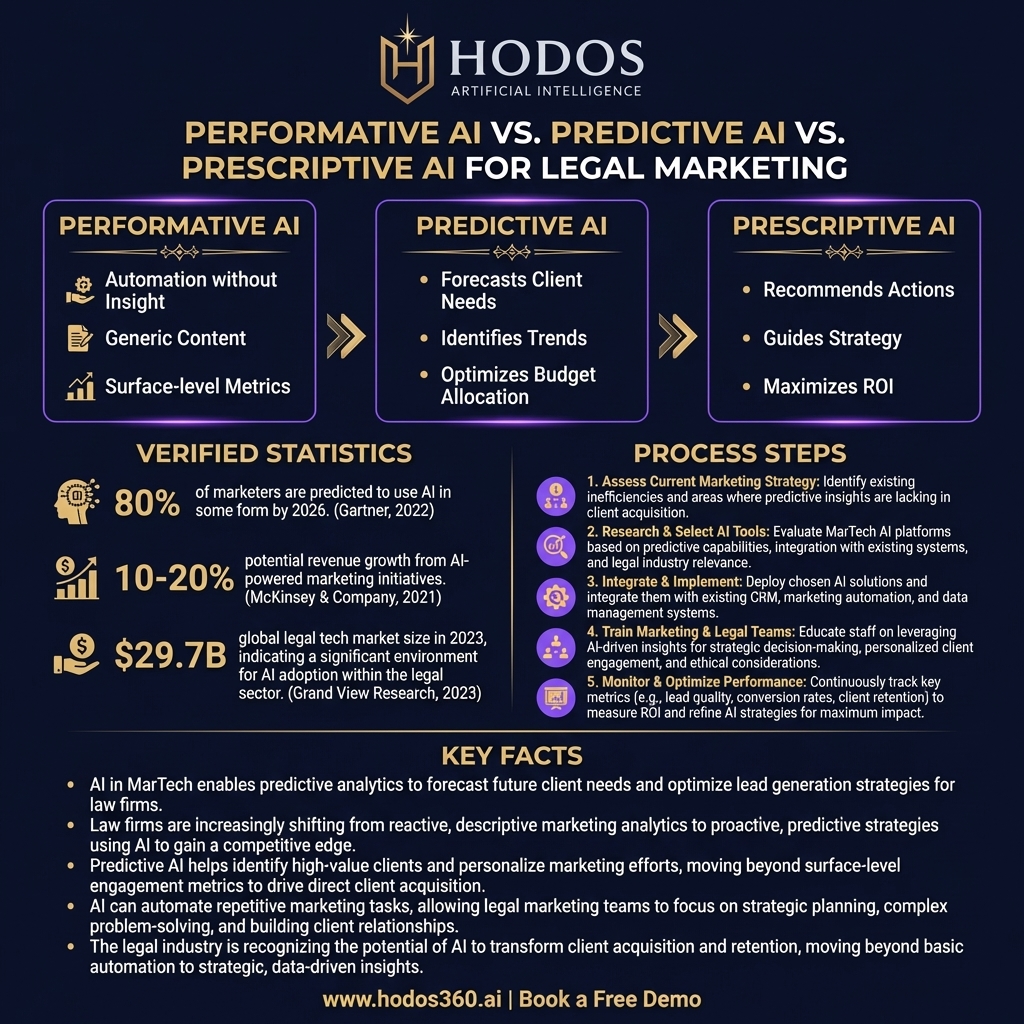
For example, if predictive AI identifies a growing demand for data privacy litigation among tech startups, prescriptive AI might recommend a multi-channel marketing campaign: specific content topics for blog posts, target keywords for SEO, optimal ad spend on LinkedIn for specific job titles, and even suggest creating a webinar series featuring a firm partner.
This level of guided decision-making is revolutionary for legal marketing, moving beyond guesswork to data-backed directives.
Leading firms are beginning to experiment with this advanced form of AI. Learn more about Law Firm Return on Investment: Maximize AI in 2026. Allen & Overy, for instance, through its partnership with Harvey AI, has demonstrated a clear commitment to leveraging advanced AI for legal operations, and this mindset is now extending to their marketing and business development efforts.
Imagine an AI system advising a firm like A&O on the most effective way to position its new legal service offerings in a competitive global market, recommending specific client segments and communication channels based on real-time market dynamics and internal firm capabilities. This isn't just about automation; it's about strategic augmentation.
Prescriptive AI in MarTech acts as a virtual marketing strategist, continuously analyzing vast amounts of data – from competitor activity and client feedback to internal resource availability – to provide optimized, actionable recommendations, ensuring that every marketing dollar spent is maximized for impact.
- ✓Targeted Client Acquisition: Prescriptive AI identifies ideal client profiles and recommends the most effective channels and messaging to reach them, optimizing conversion rates.
- ✓Optimized Content Strategy: It suggests specific legal topics, formats (e.g., video, whitepaper), and distribution platforms that resonate with predicted client needs.
- ✓Dynamic Budget Allocation: AI analyzes campaign performance in real-time and recommends adjustments to marketing spend across different channels for maximum ROI.
- ✓Personalized Client Journeys: It guides the creation of bespoke marketing experiences for individual clients, from initial outreach to post-engagement follow-up.
- ✓Risk Mitigation in Branding: Prescriptive AI can flag potential reputational risks based on public sentiment analysis, suggesting proactive communication strategies.
- ✓Strategic Service Development: By identifying unmet legal needs and market gaps, AI can inform the development of new, highly demanded legal services.
Implementing AI Marketing: A Strategic Imperative for Law Firms
For law firms, the journey towards sophisticated AI in MarTech is no longer optional; it's a strategic imperative. The competitive landscape demands efficiency, precision, and a deep understanding of the client journey. Firms that hesitate risk being outmaneuvered by agile competitors leveraging these advanced tools.
Brad Blickstein of the Blickstein Group, a prominent legal industry consultant, frequently emphasizes that data-driven decision-making is the future of legal business, extending far beyond legal practice into the realm of marketing and client development. This means moving beyond merely collecting data to actively interpreting and acting upon it through AI-powered insights.
The integration of AI marketing tools needs to be approached systematically, starting with clear objectives and a phased implementation. Firms should assess their current marketing infrastructure, data quality, and team capabilities. Learn more about Essential AI Website Builder Guide for Law Firms. Investing in platforms that offer robust data integration and analytical dashboards is crucial.
This is where comprehensive solutions like HODOS 360 come into play, offering an AI Marketing Platform that integrates AI video creation, social media automation, content generation, and critical analytics with ROI tracking. Such platforms provide the backbone for developing predictive and prescriptive marketing strategies, ensuring that every campaign is backed by intelligence and designed for optimal impact.
The goal is to create a symbiotic relationship between human marketers and AI, where AI handles the heavy lifting of data analysis and recommendation, freeing up legal marketing professionals to focus on creative strategy and client relationships.
Navigating Ethical Considerations and Data Privacy
As law firms delve deeper into AI in MarTech, ethical considerations and data privacy become paramount. The legal profession operates under stringent rules regarding client confidentiality and advertising. ABA Model Rule 7.1 (Communications Concerning a Lawyer's Services) dictates that lawyer communications must not be false or misleading, a principle that applies equally to AI-generated marketing content.
Furthermore, ABA Model Rule 1.6 (Confidentiality of Information) underscores the need to safeguard client data, which becomes critical when feeding proprietary client information into AI models for analysis. Firms must ensure that their chosen AI solutions comply with these ethical obligations, implementing robust data governance frameworks and privacy protocols.
This includes anonymizing data where appropriate, ensuring secure data storage, and transparently communicating data usage policies to clients. The responsible adoption of AI is not just about compliance, but about maintaining the trust that is fundamental to the attorney-client relationship.

Key Takeaways and Next Steps
The distinction between performative, predictive, and prescriptive AI in MarTech is not merely academic; it’s a critical framework for law firms aiming to thrive in a rapidly evolving digital landscape. While performative AI offers superficial efficiency, true competitive advantage stems from leveraging predictive capabilities to forecast client needs and prescriptive insights to guide strategic marketing actions.
Firms must move beyond simply automating tasks to genuinely intelligent marketing that anticipates market shifts and optimizes client engagement. This transition requires a commitment to data-driven strategies, investment in integrated AI platforms, and a clear understanding of the ethical responsibilities inherent in using advanced technology.
Embracing predictive and prescriptive AI in MarTech means transforming your law firm's marketing from a cost center into a powerful growth engine. It's about making informed decisions, anticipating client demands, and executing campaigns with unparalleled precision. By strategically adopting AI, law firms can not only streamline their operations but also build stronger client relationships and secure a dominant position in their respective markets.
The future of legal marketing is intelligent, proactive, and deeply integrated with AI, offering unprecedented opportunities for growth and innovation. Take the first step towards this future by exploring how integrated AI solutions can empower your firm.