


Law Firms' Ultimate AI Problem: It's Data, Not Tech
Just a few years ago, the legal industry buzzed with the promise of artificial intelligence, heralding a new era of efficiency. Yet, beneath the surface of optimistic press releases and ambitious pilot programs, a quieter, more complex narrative has unfolded. Many law firms today find themselves grappling with AI tools that fail to deliver on their grand promises, not due to a fundamental flaw in the algorithms, but because of a pervasive, often overlooked, challenge: the Law Firms AI Problem is fundamentally a data problem. This isn't just an abstract concept; it's a lived reality for managing partners like Sarah Chen, who, after investing heavily in a sophisticated AI contract review platform for her mid-sized corporate law firm, Chen & Associates, saw adoption rates stagnate. The platform, while powerful, choked on inconsistent, unstructured data scattered across legacy systems, rendering its insights unreliable and its efficiency gains minimal. The promise of AI was clear, but the path to realizing its value was paved with fragmented data.
This sentiment echoes across the industry, as highlighted by a recent *Artificial Lawyer* article, which provocatively declared: "Law Firms Don’t Have an AI Problem, They Have a Data Problem." The article articulates a growing consensus among legal tech veterans and innovators: the bottleneck to AI success isn't the availability of advanced AI models – from OpenAI's GPT series to Anthropic's Claude – but the quality, accessibility, and governance of the data these models are trained on and expected to process. Firms are discovering that without a robust data strategy, even the most cutting-edge AI tools become expensive ornaments, quietly abandoned or underutilized. The challenge isn't merely about acquiring the latest AI software; it's about transforming the entire data ecosystem within a legal practice, a task far more intricate than licensing a new application. The journey to unlocking AI's true potential begins not with an AI implementation roadmap, but with a comprehensive data readiness plan.
This paradigm shift demands a re-evaluation of how law firms perceive and manage their most valuable asset: information. The initial excitement around AI often overshadowed the foundational work required to make it effective. Now, the industry is confronting this reality head-on. As firms look to the future, the ability to harness AI for improved client communication, enhanced workflow efficiency, and superior legal outcomes hinges entirely on their capacity to solve their underlying data problem. This article will delve into the multifaceted nature of this challenge, explore actionable strategies for data transformation, and illustrate how leading firms are turning their data woes into competitive advantages. It's time to move beyond the superficial allure of AI and address the fundamental data infrastructure that truly enables its power.
The Core Challenge: Untangling the Law Firms' AI Data Problem
The prevailing narrative that law firms face an AI problem is often a misdiagnosis. The real ailment lies in the fragmented, siloed, and often unstructured nature of their data. Consider the typical journey of a legal document: it might start as an email attachment, get saved to a local drive, uploaded to a document management system, then shared via a client portal, with various versions floating across different platforms. This labyrinthine data landscape creates significant hurdles for AI systems, which thrive on clean, consistent, and logically organized information. When an AI tool, designed to automate processing of legal documents, encounters a myriad of formats, inconsistent naming conventions, and missing metadata, its accuracy plummets, leading to 'hallucinations' or, more commonly, simply failing to extract meaningful insights. This directly contributes to why many firms quietly abandon these promising tools after initial enthusiasm wanes, finding that the manual effort required to prepare data negates any perceived value.
This data fragmentation is exacerbated by the historical evolution of legal tech. For decades, law firms adopted point solutions for specific needs – one system for billing, another for document management, a third for client intake. While each served its purpose, they rarely integrated seamlessly, creating a patchwork of disparate data sources. According to a 2024 survey by Thomson Reuters, nearly 60% of law firms still struggle with integrating their various technology platforms, directly impacting their ability to leverage advanced analytics and AI. This lack of integration means that comprehensive client histories, litigation patterns, and contractual precedents remain locked away in isolated digital vaults, inaccessible to AI tools designed to learn from such rich datasets. Learn more about Event Marketing: Essential Strategies for Live Events in the AI Era. Legal professionals, including seasoned lawyers like David Lee, a partner at a litigation boutique, often express frustration: "We have terabytes of data, but it's like trying to drink from a firehose with a sieve. The AI can't make sense of it because *we* can't even make sense of it consistently." This highlights a critical insight: an AI problem in law firms is often a symptom of a deeper organizational data management issue.
The implications extend beyond mere inefficiency. Poor data quality can lead to significant ethical and professional risks. The ABA Model Rules of Professional Conduct, particularly Rule 1.1 (Competence) and Rule 1.6 (Confidentiality of Information), implicitly demand that lawyers employ technology competently and safeguard client data. Relying on AI tools fed by unreliable data could lead to erroneous legal advice, mismanaged cases, or even breaches of confidentiality if data governance is lax. This is not a hypothetical concern; instances of AI tools generating incorrect case citations or misinterpreting client instructions due to poor input data have already surfaced, eroding trust and proving that the lawyer's problem can quickly become a client's problem. The imperative for robust data management is therefore not just about technological advancement, but about maintaining the core tenets of legal practice: accuracy, integrity, and client protection. Without addressing the foundational data challenges, the promise of AI for legal value remains largely unfulfilled, leaving firms vulnerable to both operational inefficiencies and reputational damage.
Legacy Systems and Data Fragmentation Hindering AI Value
The root of much of this data fragmentation lies in legacy systems, some dating back decades, which were never designed for the interoperability and data fluidity required by modern AI. These systems, often custom-built or acquired through mergers, create deep silos where critical information resides in proprietary formats, making it exceedingly difficult for new AI applications to ingest and process. For example, a firm might have its client intake records in an older CRM, billing data in a separate accounting system, and case files stored across multiple network drives and cloud platforms. This patchwork makes it nearly impossible for an AI-powered case management system to gain a holistic view of a matter, hindering its ability to automate tasks, predict outcomes, or even accurately track time. Learn more about AI Alliances Reshuffle: Essential Legal Tech Strategy for Firms. The result is a perpetual cycle of manual data entry, reconciliation, and verification, which directly undermines the efficiency gains that AI promises. This struggle with integrating disparate data sources is often why firms, even after investing in cutting-edge AI, find themselves still relying on manual workflows for critical processing tasks, leading to the impression that AI is failing them, when in fact, their data infrastructure is the true culprit.
Building the Foundation: Essential Data Strategies for AI Success
Overcoming the data problem requires a strategic, multi-faceted approach that prioritizes data governance, standardization, and integration. Forward-thinking firms are beginning to understand that AI adoption isn't just an IT project; it's a firm-wide transformation requiring leadership buy-in and a cultural shift. The first step is a comprehensive data audit to identify all data sources, their formats, quality, and accessibility. This often reveals surprising redundancies and critical gaps. Following the audit, establishing clear data governance policies is paramount. This includes defining data ownership, establishing protocols for data entry and maintenance, and implementing security measures to comply with regulations like GDPR or CCPA, which are increasingly relevant for client data. Firms like Paul Hastings, under the guidance of their CIO, often invest in dedicated data teams or consultants to oversee this complex process, recognizing that a proactive stance on data hygiene is an investment in future AI capabilities. This commitment ensures that data is not merely collected but curated, making it truly valuable for AI applications.
Data standardization is another critical pillar. This involves creating uniform templates for documents, consistent naming conventions for files, and structured fields for client information across all systems. For instance, instead of free-text fields for 'case type,' firms can implement dropdown menus with predefined categories. This seemingly mundane work is transformative for AI, allowing algorithms to accurately categorize, extract, and analyze information at scale. Learn more about AI Regulatory Monitoring: Essential for Law Firm Compliance. Integrating disparate systems is the next logical step, often achieved through APIs (Application Programming Interfaces) or middleware solutions that create a unified data layer. Companies like Clio have demonstrated the value of integrated practice management platforms that serve as central hubs for various legal workflows, consolidating client, billing, and case processing data. This integration not only prepares data for AI but also provides a single source of truth for all firm operations, drastically reducing manual reconciliation and improving overall data reliability. It's a foundational shift that moves firms away from a reactive, siloed approach to a proactive, integrated data ecosystem.
The benefits of a robust data strategy extend far beyond enabling AI; they fundamentally enhance a firm's operational efficiency, risk management, and strategic decision-making. Firms with clean, integrated data can generate more accurate reports, identify trends in client demands, and even predict litigation outcomes with greater precision. This proactive use of data allows lawyers to deliver more informed advice, optimize resource allocation, and ultimately provide superior value to their clients. The investment in data infrastructure, while substantial, yields exponential returns by transforming raw information into actionable intelligence. As Jensen Huang, CEO of NVIDIA, often emphasizes in the broader tech landscape, "The more data you feed it, the smarter it gets." This holds true for legal AI: the better the data, the more intelligent and valuable the AI tools become. Law firms that embrace this data-first mindset are not just adopting new tools; they are redefining their operational backbone for the AI era.
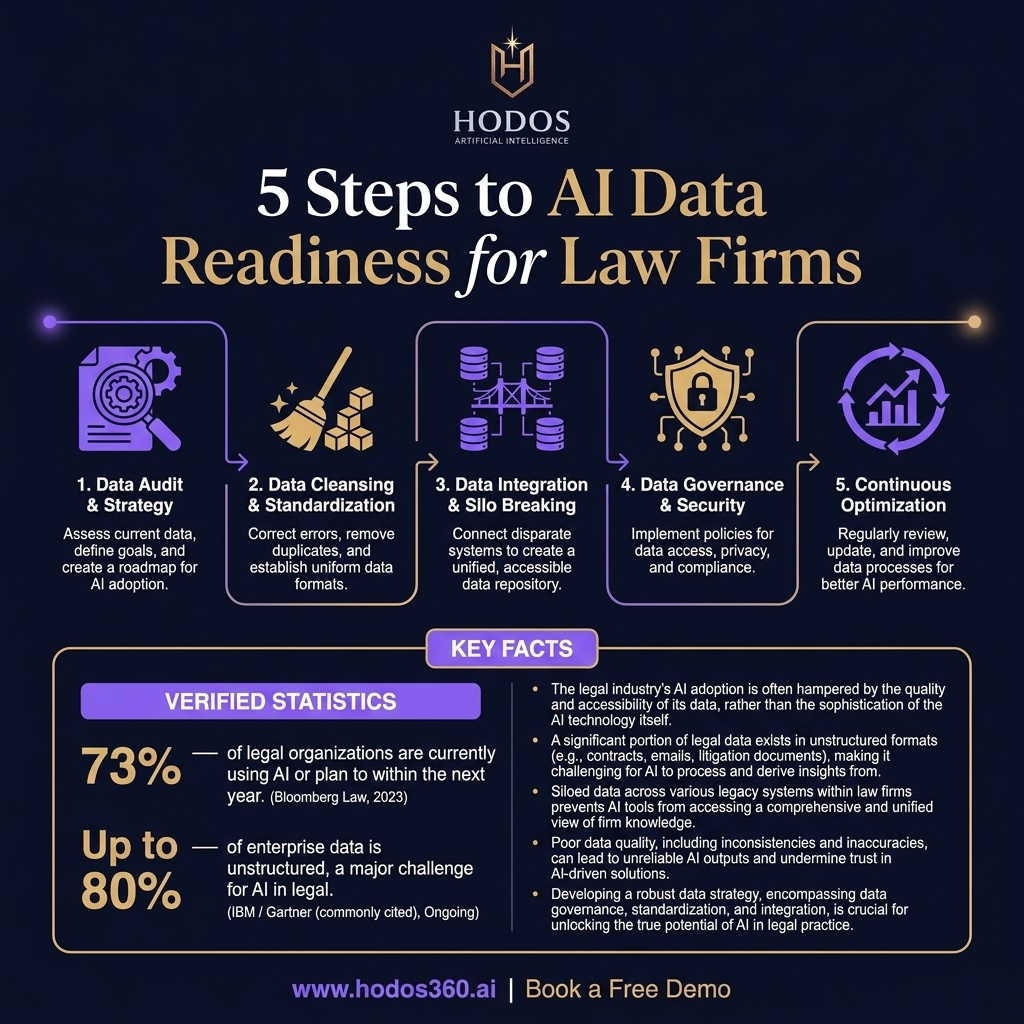
- ✓Conduct a Comprehensive Data Audit: Map all data sources, formats, and quality levels across your firm.
- ✓Establish Clear Data Governance Policies: Define data ownership, entry standards, and security protocols.
- ✓Standardize Data Formats and Naming Conventions: Implement uniform templates and structured fields for consistent information.
- ✓Integrate Disparate Systems: Utilize APIs or unified platforms to break down data silos and create a single source of truth.
- ✓Invest in Data Cleansing Tools: Employ AI-powered solutions to identify and correct inconsistencies and errors in existing data.
- ✓Prioritize Data Security and Compliance: Ensure all data practices align with relevant privacy regulations (e.g., CCPA, GDPR).
- ✓Foster a Data-Driven Culture: Train staff on best practices for data management and emphasize its importance for AI success.
From Data to Insight: Leveraging AI for Enhanced Client Value and Communication
Once a firm has addressed its fundamental data problem, the true transformative power of AI begins to unfold, directly impacting client value and communication. With clean, structured, and accessible data, AI tools can move beyond basic automation to deliver profound insights and efficiencies. Imagine an AI-powered system that, fed with years of litigation data, can accurately predict the likely outcome of a specific case based on jurisdiction, judge, and opposing counsel – a capability that significantly enhances strategic advice. This is no longer futuristic speculation; firms like Allen & Overy, through their partnership with Harvey AI, are demonstrating how sophisticated AI, when underpinned by robust data, can revolutionize legal research, contract drafting, and even due diligence, reducing hours of manual work to mere minutes. This shift allows lawyers to dedicate more time to complex problem-solving, client strategy, and relationship building, elevating the perceived value of legal services.
Moreover, a well-managed data infrastructure empowers AI to revolutionize client communication. AI voice assistants, for example, can provide 24/7 client support, answer FAQs, qualify leads, and even schedule appointments, all while accessing real-time client information from a centralized database. This personalized, immediate responsiveness significantly improves the client experience, differentiating firms in a competitive market. Furthermore, AI-driven content generation and social media automation, fueled by insights from client data, enable targeted marketing campaigns that resonate deeply with potential clients, improving lead generation and retention. Learn more about Colorado AI Act: Essential Guide for Law Firms on Automated Decisions. This seamless flow of information, from internal systems to client-facing interactions, transforms how legal services are delivered and perceived, making the client journey more efficient and satisfying. The value proposition becomes undeniable when AI is integrated into a firm's workflow with a solid data foundation.
The regulatory landscape, particularly with the enforcement of the EU AI Act, further underscores the importance of data quality. This landmark legislation mandates transparency, accuracy, and human oversight for AI systems, especially those deemed 'high-risk.' For law firms deploying AI, this translates into an absolute necessity for auditable data trails, clear data processing protocols, and robust data governance. Firms cannot afford to use AI with opaque or unreliable data, as this could lead to non-compliance, fines, and severe reputational damage. Therefore, investing in data readiness is not just about gaining a competitive edge; it's about ensuring compliance and ethical practice in an increasingly regulated AI ecosystem. The problem of data quality becomes a legal imperative, demanding attention from every lawyer and managing partner. Firms that proactively manage their data are not only poised for AI success but are also better equipped to navigate the evolving regulatory challenges of the AI era.
AI-Powered Legal Workflows: Beyond Basic Automation
The true potential of AI in legal workflows extends far beyond simple task automation. With clean, integrated data, AI can power intelligent automation that anticipates needs, makes recommendations, and even completes complex multi-step processes autonomously. Consider an AI-driven system that, upon a new client intake, automatically populates forms, cross-references conflicts, drafts an engagement letter based on pre-approved templates, and initiates a case management file – all by intelligently drawing from a unified data repository. This level of sophisticated processing moves beyond mere 'doing' to 'thinking,' allowing lawyers to focus on strategic legal analysis rather than administrative overhead. Learn more about AI Settlement Rates: An Essential Guide to Maximizing Outcomes. Firms that have successfully implemented these advanced tools report significant reductions in administrative time (up to 40% in some areas, according to a recent ABA TechReport), freeing up lawyers to concentrate on high-value legal work. This shift not only improves efficiency but also enhances job satisfaction for legal professionals, making their roles more intellectually stimulating and less repetitive.
The Competitive Edge: Firms That Master Data Win with AI
The divergence between firms that embrace robust data strategies and those that don't is creating a widening competitive chasm in the legal industry. This isn't just about early adopters vs. laggards; it's about firms fundamentally transforming their operational DNA to leverage AI effectively. Companies like LegalZoom, a pioneer in accessible legal services, continue to invest heavily in data infrastructure to refine their AI-driven platforms, enabling them to serve a massive client base with unprecedented efficiency and scale. Their success puts pressure on traditional law firms to innovate or risk losing market share, particularly in routine legal matters. The problem for many traditional firms is not a lack of desire to adopt AI, but a lack of foundational data readiness, which prevents them from competing effectively. As Jack Newton, CEO of Clio, often states, "The future of law is client-centered, and that means leveraging technology and data to deliver better experiences and outcomes." This imperative drives a fierce market competition, where data-savvy firms are clearly gaining an advantage.
This competitive tension is palpable, with managing partners openly discussing the 'AI divide' at conferences like LegalTech NYC 2026. Firms that are mastering their data are not just enhancing internal efficiencies; they are also attracting top talent and high-value clients who seek technologically advanced and transparent legal services. A 2025 report by Gartner indicated that firms demonstrating superior data analytics and AI capabilities are perceived as more innovative and trustworthy by prospective clients, influencing their hiring decisions. Learn more about Legal AI Workflows: Essential Shifts Beyond Microsoft Word for Firms. Conversely, firms still struggling with data silos and manual processing are finding it harder to justify their fees and attract digitally native talent. The narrative becomes one of survival and thriving: those who invest in data infrastructure as a prerequisite for AI are positioning themselves as leaders, while those who overlook this foundational problem risk becoming footnotes in the history of legal innovation. The value of AI is directly proportional to the quality of the data it consumes, making data mastery the ultimate differentiator.
Consider the significant funding rounds and acquisitions in the legal tech space, often targeting companies specializing in data integration and intelligent automation. For example, the reported $6.6 billion raise by OpenAI in early 2026, or the continuous investment by major players like Thomson Reuters in AI-driven legal solutions, signals a clear market direction. These investments are not just in AI *algorithms* but in the entire ecosystem that makes AI viable, with data management being a cornerstone. Law firms that fail to recognize this holistic approach—that AI success is inextricably linked to data quality—are effectively leaving significant value on the table. They might acquire sophisticated AI tools, but without the clean, accessible data to feed them, they will inevitably quietly abandon them, perpetuating the cycle of failed tech adoption. The lawyer's role is evolving to include not just legal expertise, but also a strategic understanding of how data powers modern legal services, ensuring that the firm's data strategy becomes as critical as its legal strategy.
Future-Proofing Your Practice: Avoiding the AI Adoption Pitfalls
To future-proof their practices, law firms must shift their mindset from viewing AI as a standalone solution to seeing it as an accelerant for well-managed data. This means prioritizing investments in robust data infrastructure, data governance, and data literacy across the firm. Avoiding the AI problem pitfalls requires a proactive, continuous approach to data quality. Firms should establish cross-functional teams, including lawyers, IT professionals, and legal operations specialists, to champion data initiatives. Regular data audits, cleansing routines, and ongoing training for staff on data entry best practices are essential. Furthermore, firms should seek out legal tech partners that offer integrated solutions designed to consolidate and standardize data, rather than adding another siloed tool. This strategic approach ensures that AI adoption is not a reactive experiment but a well-planned evolution of the firm's capabilities, building a resilient foundation for sustained innovation and competitive advantage in the years to come.

Key Takeaways and Next Steps
The prevailing wisdom is clear: the Law Firms AI Problem is not a deficiency in artificial intelligence itself, but a fundamental challenge in data management. Law firms can no longer afford to view data as a byproduct of their operations; it must be recognized as the fuel that powers every advanced legal technology. Firms that neglect their data infrastructure will find even the most sophisticated AI tools delivering subpar results, leading to quietly abandoned projects and missed opportunities for value creation. The path to successful AI adoption begins with a clear, actionable data strategy focused on governance, standardization, and integration. This foundational work transforms raw information into a strategic asset, enabling AI to truly enhance client communication, streamline workflows, and provide a significant competitive edge. Ignoring this data imperative is to risk falling behind in an increasingly AI-driven legal landscape.
For law firms ready to tackle their data problem head-on and unlock the full potential of AI, the time to act is now. Start with a comprehensive data audit, establish rigorous data governance, and invest in integrated solutions that consolidate your information. Platforms like HODOS 360, with its AI Law Firm Management System, are designed to help firms consolidate and leverage their data for seamless case management, document automation, and AI-powered legal workflows, ensuring that your AI investments yield tangible value. By prioritizing data readiness, firms can transform their operations, deliver superior client services, and truly future-proof their practice against the challenges and opportunities of the AI era.
Frequently Asked Questions
Why are law firms struggling with AI adoption despite its potential?+
Many law firms struggle not because AI is flawed, but due to poor data quality and fragmented data infrastructure. AI tools require clean, structured, and accessible data to function effectively. Without proper data governance and integration, AI systems deliver unreliable results, leading to underutilization and eventual abandonment, creating an AI problem that is, in fact, a data problem.
What does 'data problem' mean for a law firm in the context of AI?+
A data problem refers to issues like scattered data across disparate legacy systems, inconsistent data formats, lack of standardization, and poor data hygiene. This makes it challenging for AI to ingest, process, and derive meaningful insights from the firm's information, thereby hindering AI's ability to automate tasks or provide accurate analytics.
How can law firms improve their data quality for better AI integration?+
Firms can improve data quality by conducting a comprehensive data audit, establishing robust data governance policies, standardizing data formats and naming conventions, and integrating disparate systems. Investing in data cleansing tools and fostering a data-driven culture among staff are also crucial steps for successful AI integration.
What are the ethical implications of using AI with poor data in legal practice?+
Using AI with poor data carries significant ethical risks, including the potential for erroneous legal advice, mismanaged cases, and breaches of client confidentiality. ABA Model Rules emphasize competence and safeguarding client information, meaning firms must ensure AI tools are fed reliable data to maintain professional standards and avoid sanctions.
What tangible benefits can a law firm expect from addressing its data problem before adopting AI?+
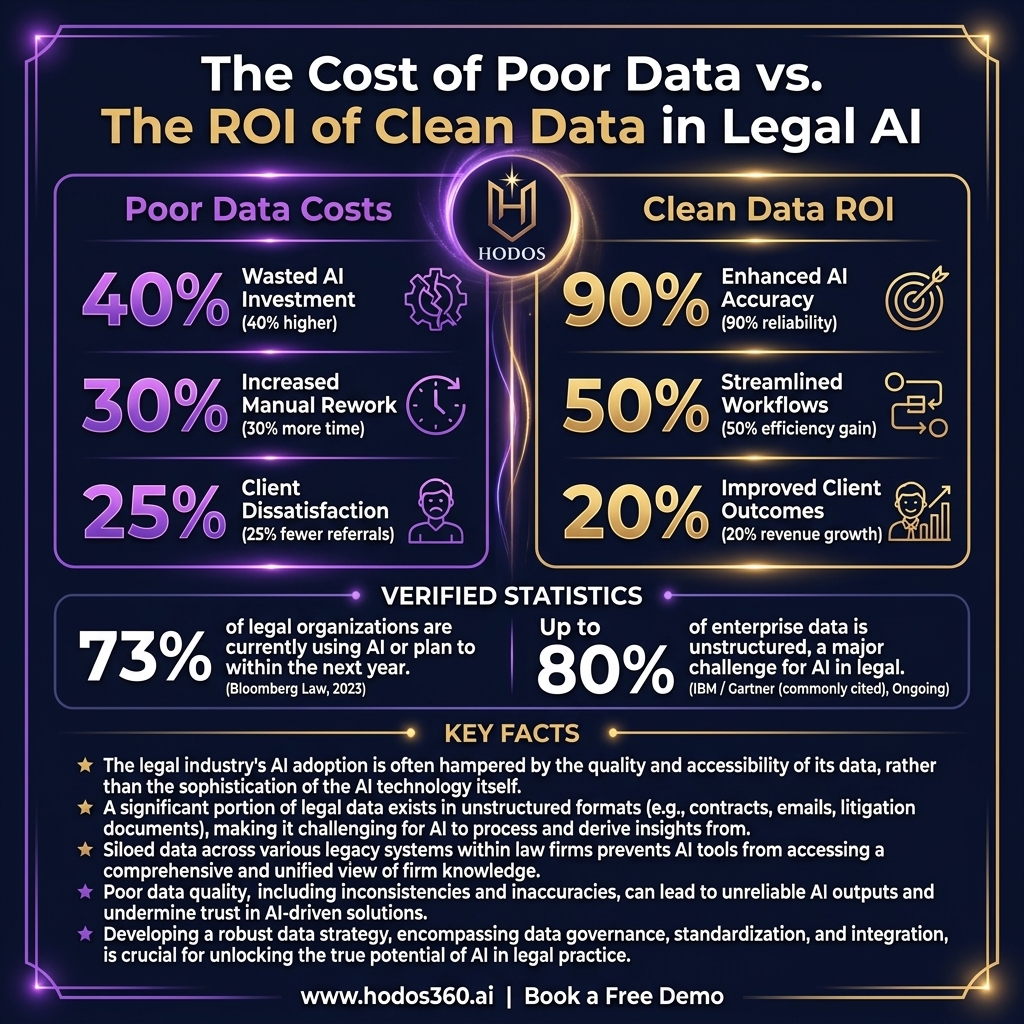
By addressing the data problem, firms can expect enhanced AI accuracy, streamlined workflows, improved client communication, and better strategic decision-making. Clean data empowers AI to deliver higher value by automating complex tasks, predicting outcomes, and allowing lawyers to focus on high-value legal work, ultimately leading to increased efficiency and competitive advantage.