

AI Regulatory Monitoring: Essential for Law Firm Compliance
In a legal world grappling with an unprecedented deluge of regulations, a significant development from leading international law firm Osborne Clarke has sent ripples across the industry. On May 22, 2026, the firm announced the launch of Justima, an independent company specifically designed for AI regulatory monitoring.
This strategic move, spearheaded by CEO Gianluigi Marino, signals a profound recognition of AI's indispensable role in navigating the labyrinthine complexities of modern compliance. Osborne Clarke's decision to spin off a dedicated AI venture is not merely an internal restructuring; it's a powerful statement about the future of legal practice, emphasizing that proactive, AI-powered compliance is no longer a luxury but a fundamental necessity for firms aiming to mitigate risk and sustain growth in a rapidly evolving global market.
The sheer volume of new legislation, from data privacy acts like GDPR to emerging frameworks such as the EU AI Act, has made traditional, manual monitoring methods untenable, pushing firms towards innovative technological solutions.
The creation of Justima reflects a growing trend among forward-thinking legal institutions to not just adopt, but to actively develop specialized AI capabilities.
This isn't just about efficiency; it's about accuracy, speed, and the ability to identify subtle shifts in regulatory landscapes that human teams might miss. As legal departments and law firms face increasing pressure to ensure adherence to ever-changing rules across multiple jurisdictions, the competitive advantage will undeniably belong to those who can leverage AI to transform vast amounts of data into actionable intelligence.
This article delves into the significance of Osborne Clarke’s pioneering step, explores the broader imperative for AI in regulatory compliance, and offers a roadmap for how law firms can integrate these powerful tools to future-proof their operations and deliver superior client service. The legal industry is at a pivotal juncture, and the firms that embrace AI will be the ones that thrive.
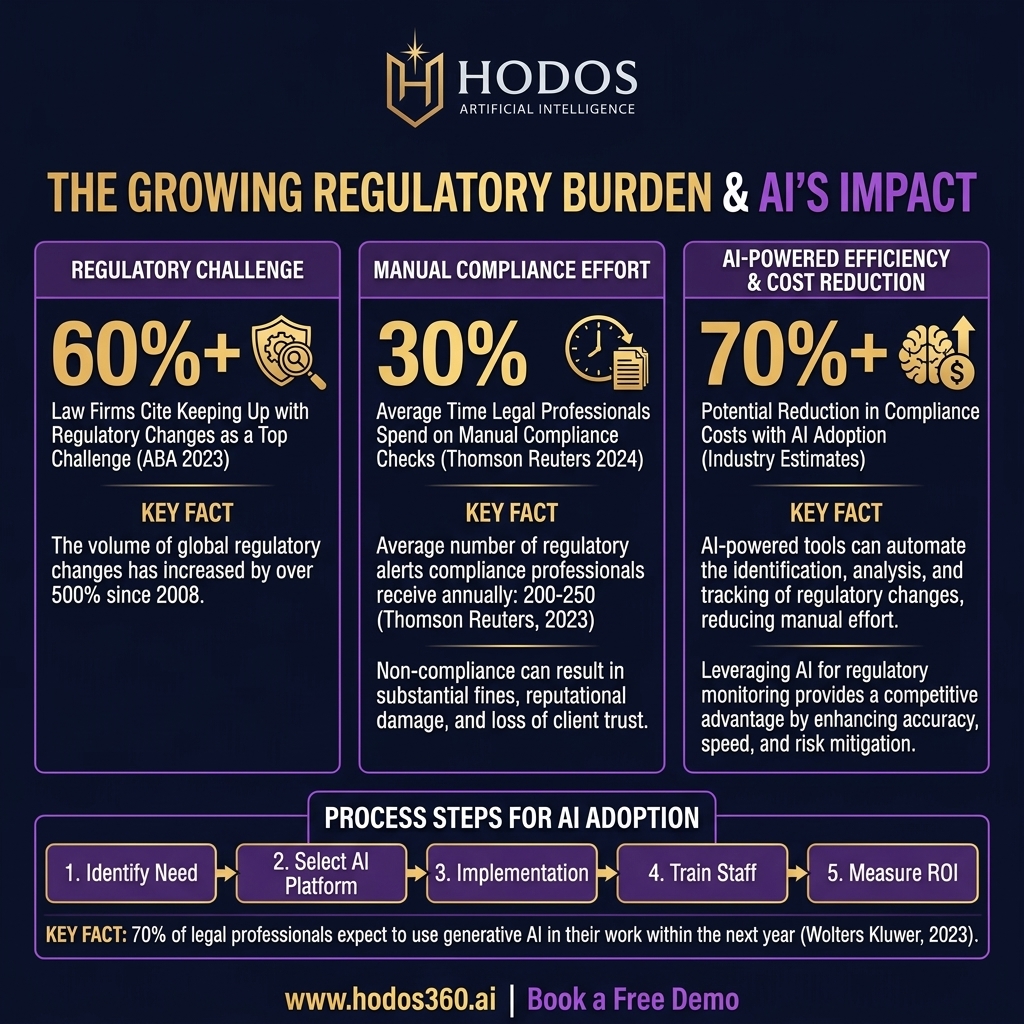
The legal industry is undergoing a profound transformation, driven by an exponential increase in data and regulatory complexity. According to a 2024 report by Thomson Reuters, legal professionals spend an average of 30% of their time on administrative tasks, including manual compliance checks, a figure that is unsustainable in today's fast-paced environment.
The emergence of specialized AI ventures like Justima, an independent company spun off from Osborne Clarke, represents a critical evolution. This move is a direct response to the escalating demands placed on legal departments and law firms to maintain continuous vigilance over an ever-expanding universe of legal and regulatory sources.
Justima, under the leadership of Gianluigi Marino, is designed to automate the continuous monitoring of over 200 legal and regulatory sources, providing real-time insights that would be impossible to achieve through conventional methods. This proactive approach allows firms to anticipate changes, identify potential risks, and advise clients with unprecedented speed and precision.
The strategic decision by Osborne Clarke to launch Justima as an independent entity, rather than keeping it solely as an internal department, highlights a shrewd understanding of market dynamics. Learn more about Essential AI for Client Relationships: Future-Proofing Law Firms. It allows Justima to scale its services beyond Osborne Clarke, potentially serving a wider array of legal and compliance departments facing similar challenges.
This model fosters innovation by creating a dedicated focus on AI-powered solutions, attracting specialized talent, and enabling agility in product development. It also positions Osborne Clarke not just as a consumer of legal tech, but as a significant contributor to its evolution, demonstrating thought leadership in an increasingly competitive landscape.
The firm's partners, recognizing the inherent value in this specialized venture, understood that an independent structure would best facilitate the growth and impact of such a sophisticated AI regulatory monitoring service. This separation enables Justima to operate with the entrepreneurial spirit of a startup while benefiting from the deep legal expertise and credibility of its parent firm, addressing a critical market need for reliable, scalable compliance solutions.
Navigating Regulatory Complexity: The Imperative for AI Compliance
The sheer volume and velocity of regulatory changes globally pose an existential challenge for law firms. From the EU AI Act, which is set to enforce stringent rules on AI development and deployment, to evolving data privacy laws across continents, the regulatory landscape is in constant flux.
A 2023 survey by the American Bar Association (ABA) revealed that over 60% of law firms cited keeping up with regulatory changes as a top challenge. This isn't merely about knowing the law; it's about understanding its nuances, anticipating its impact, and ensuring clients remain compliant across diverse operations.
Manual processes, typically involving teams of lawyers sifting through legislative updates, court rulings, and administrative guidance, are not only time-consuming and expensive but also prone to human error. Even the most diligent teams can miss critical updates, leading to potential non-compliance, hefty fines, and significant reputational damage.
The competitive pressures also mean that firms must offer proactive, value-added services, moving beyond reactive problem-solving to strategic foresight.
This escalating complexity underscores why AI-powered solutions are no longer optional but a strategic imperative for comprehensive compliance. Learn more about AI Legal Practice Management: The Ultimate Firm Advantage.
AI systems, particularly those utilizing Natural Language Processing (NLP) and machine learning, can ingest and analyze vast quantities of legal text at speeds unimaginable for humans. They can identify patterns, flag relevant changes, and even predict potential future regulatory directions based on historical data and legislative trends.
Firms that do not adopt these tools risk falling behind, unable to offer the speed and accuracy that modern clients demand. The investment in AI regulatory monitoring is not just an expense; it's an investment in a firm's future viability and its ability to deliver superior client outcomes.
The strategic importance of this shift is clear: firms must evolve from simply interpreting the law to actively monitoring and forecasting its trajectory, a task uniquely suited for advanced AI. This shift is particularly vital for firms with international practices, where the intersection of multiple jurisdictions amplifies the compliance challenge exponentially.
The Cost of Non-Compliance: Mitigating Risks with Proactive Monitoring
The repercussions of non-compliance extend far beyond monetary penalties. While fines can be substantial – for instance, a single GDPR violation can incur penalties up to €20 million or 4% of global annual turnover – the damage to a firm's reputation and client trust can be even more devastating.
In 2025, a prominent financial institution faced a multi-million-dollar settlement and a significant stock price drop due to an overlooked regulatory update concerning data residency requirements, a blunder that could have been avoided with robust AI regulatory monitoring. Law firms advising such clients bear a heavy responsibility, and a lapse in their own compliance guidance can lead to professional liability claims and a loss of market standing.
Proactive monitoring, empowered by AI, transforms a firm's approach from reactive damage control to strategic risk management. It allows legal teams to identify potential compliance gaps before they escalate into crises, providing clients with timely advice and enabling them to adjust their operations accordingly. This foresight builds deeper client relationships, positioning the firm as a trusted strategic partner rather than just a legal service provider.
The ability to demonstrate a cutting-edge approach to compliance becomes a powerful differentiator in a crowded legal market.
Furthermore, the increasing scrutiny from regulatory bodies means that firms must not only comply but also be able to demonstrate their compliance efforts effectively. Learn more about Gemini 3.1 Flash TTS: Ultimate Voice AI for Law Firms.
AI systems can generate comprehensive audit trails, documenting every identified regulatory change, the firm's analysis, and the actions taken. This transparency is invaluable during regulatory inspections or due diligence processes. Consider the case of a mid-sized law firm that, after implementing an AI-powered compliance system, successfully navigated a complex audit by the Department of Justice regarding anti-money laundering regulations.
The firm's ability to quickly produce detailed reports on its ongoing monitoring and internal policy adjustments, directly attributable to the AI system's alerts, significantly expedited the audit and prevented potential sanctions. This real-world example underscores the tangible benefits of moving beyond manual, fragmented compliance efforts towards an integrated, AI-driven framework.
The legal industry, historically slow to adopt technological shifts, is now recognizing that the cost of inaction far outweighs the investment in advanced legal tech.
The Mechanics of AI-Powered Monitoring: Beyond Basic Keyword Searches
Modern AI regulatory monitoring systems are far more sophisticated than simple keyword searches or rule-based alerts. They leverage advanced machine learning algorithms, particularly deep learning models for Natural Language Processing (NLP), to understand the context, intent, and implications of legal texts. When Justima monitors over 200 sources, it's not just looking for specific terms; it's analyzing the semantic relationships between concepts, identifying legislative amendments, judicial interpretations, and regulatory guidance across diverse formats – from parliamentary bills to agency pronouncements and case law.
This capability allows the system to discern subtle changes in legal language that could have significant implications for a client's operations. For example, a minor alteration in a definition within a financial regulation might seem innocuous at first glance but could trigger new reporting requirements or change the risk profile of certain transactions.
AI can pinpoint these critical shifts with remarkable accuracy and speed, ensuring that no stone is left unturned in the pursuit of comprehensive compliance.
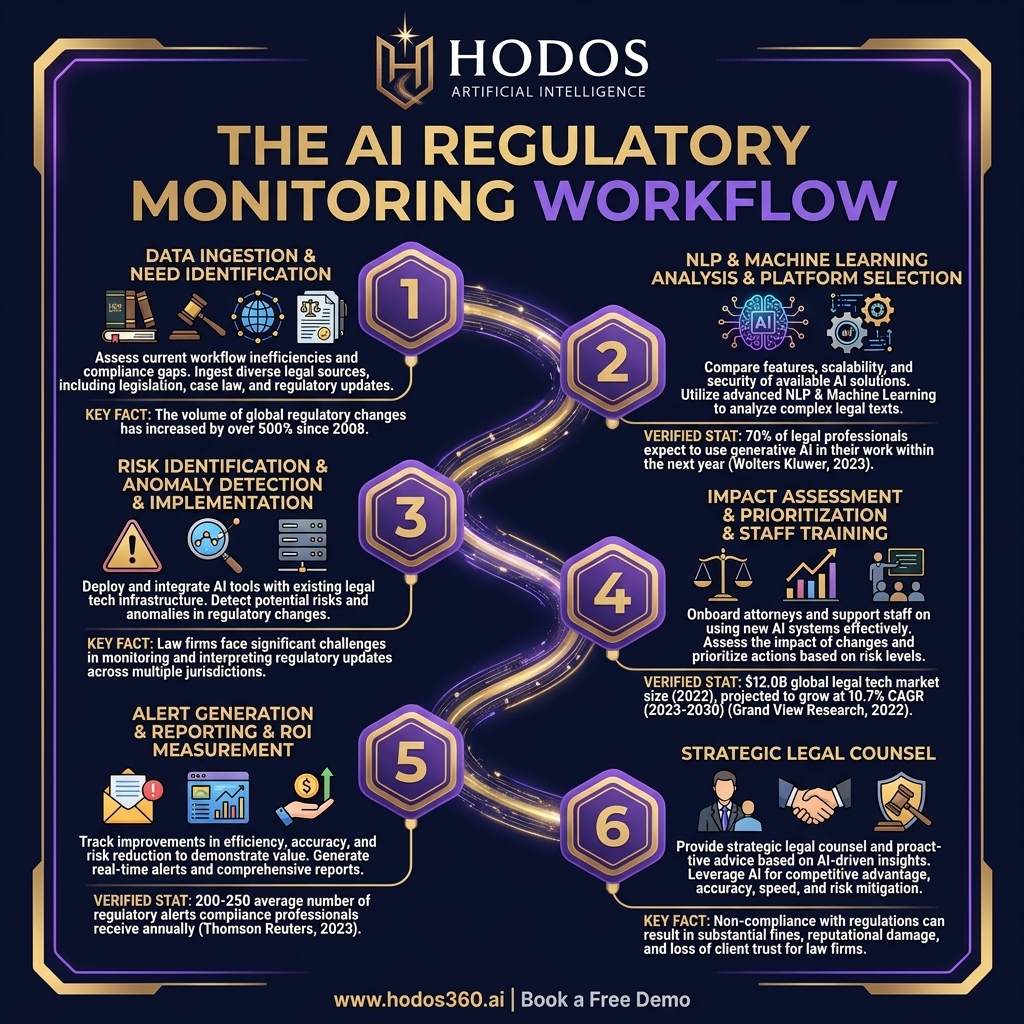
The operational workflow of such an AI system typically involves several stages. First, data ingestion: the system continuously scrapes and processes vast amounts of unstructured and semi-structured data from official government portals, legislative databases, court archives, and news feeds.
Learn more about AI SaaS Builders: The Ultimate Blueprint for Law Firms. Second, data enrichment and normalization: raw data is cleaned, categorized, and tagged using ontologies specific to legal domains. Third, advanced NLP and machine learning models analyze the content for relevant regulatory changes, identifying new laws, amendments, and interpretations.
These models are trained on massive datasets of legal documents, enabling them to understand legal jargon, identify authoritative sources, and even detect the tone and urgency of new directives. Finally, the system generates targeted alerts and reports, often customized for specific industries or client profiles, delivering actionable intelligence directly to legal professionals.
This holistic approach ensures that law firms are not just informed, but *intelligently* informed, allowing them to focus their expertise on strategic advice rather than data collation.
From Data Overload to Actionable Intelligence: AI's Transformative Power
The true power of AI regulatory monitoring lies in its ability to transform an overwhelming volume of raw data into concise, actionable intelligence. Legal professionals are no longer burdened with sifting through thousands of pages of legislative updates; instead, they receive curated summaries and impact analyses tailored to their specific needs.
This shift fundamentally redefines the role of the lawyer, moving them from information gatherers to strategic advisors. For instance, a general counsel at a multinational corporation, working with a law firm that uses an AI compliance platform, might receive an alert detailing a new environmental regulation in Germany, immediately followed by an analysis of its potential impact on their company's European manufacturing operations, complete with recommended policy adjustments.
This level of insight, delivered in real-time, empowers businesses to make informed decisions and adapt swiftly to new legal requirements, maintaining their license to operate and mitigating financial exposure. It's a prime example of how AI enhances human capabilities, rather than replacing them, allowing legal experts to focus on complex problem-solving and client-centric strategy.
Furthermore, these AI systems can identify cross-jurisdictional conflicts or synergies that might be challenging for human teams to spot. For a global corporation, a new regulation in one country might inadvertently conflict with existing compliance requirements in another, or it might present an opportunity for harmonizing internal policies across regions.
Learn more about AI Voice Calls: The Essential Guide for Modern Law Firms. AI can highlight these interdependencies, providing a holistic view of the regulatory landscape. This capability is particularly valuable for large law firms with diverse client portfolios, enabling them to offer more integrated and sophisticated advice.
The data generated by these monitoring systems also feeds back into the AI’s learning models, continuously improving its accuracy and predictive capabilities. This iterative learning process ensures that the system becomes more intelligent and effective over time, making it an increasingly indispensable tool for any legal department or law firm committed to excellence in regulatory adherence.
The competitive legal market demands such dynamism, and AI provides the means to achieve it.
Integrating AI into Law Firm Operations: Building a Competitive Edge
For law firms looking to emulate the forward-thinking approach of Osborne Clarke and its Justima venture, integrating AI into their core operations is paramount. This isn't just about subscribing to an external service; it involves a holistic embrace of AI across various facets of practice.
Firms can start by identifying areas of high regulatory burden and repetitive compliance tasks, where AI can deliver immediate value. Beyond AI regulatory monitoring, solutions like AI Law Firm Management Systems can streamline case management, automate document generation, and enhance client intake, freeing up lawyers to focus on high-value work.
For example, a firm handling a high volume of M&A deals can leverage AI for due diligence, rapidly reviewing contracts and identifying red flags related to regulatory adherence, thereby significantly reducing transaction times and costs. The integration of AI tools needs to be strategic, aligning with the firm's overall business objectives and client service model, ensuring that technology serves as an enabler for superior legal outcomes.
The shift towards AI-powered operations requires a cultural change within law firms. Attorneys and legal professionals must be trained not only on how to use these tools but also on how to interpret their outputs and integrate them into their legal analysis. Learn more about Scaling Legal AI: Essential Strategies to Prevent Tool Sprawl.
This continuous learning is crucial for maximizing the benefits of AI. Firms that invest in comprehensive training and foster a culture of technological adoption will see higher engagement and better results. Platforms like HODOS 360 offer an integrated suite of AI services, from AI-powered legal workflows within their management system to AI Voice Assistants for client communication and AI Marketing Platforms for business development.
This comprehensive approach allows firms to build an AI ecosystem that supports all aspects of their practice, from proactive compliance to efficient client acquisition and management. The goal is to create a seamless operational environment where AI augments human expertise, leading to increased efficiency, improved accuracy, and a significant competitive advantage in the legal market.
This strategic adoption positions firms at the forefront of legal innovation, attracting top talent and discerning clients.
Future-Proofing Legal Practice: Proactive vs. Reactive Compliance
The distinction between proactive and reactive compliance is fundamental to future-proofing a legal practice in the age of AI. Reactive compliance involves responding to regulatory changes *after* they have occurred, often leading to costly remediation efforts and potential penalties. Proactive compliance, enabled by AI regulatory monitoring, involves anticipating changes, understanding their implications, and adjusting operations *before* they take effect.
This foresight allows firms to guide clients through complex transitions smoothly, minimizing disruption and maintaining operational continuity. For instance, as new environmental, social, and governance (ESG) regulations emerge globally, an AI system can identify these nascent trends, allowing a firm to develop specialized ESG compliance services, advising clients on sustainable practices and reporting requirements long before they become mandatory.
This strategic positioning not only protects clients but also opens up new revenue streams and strengthens the firm's market leadership in emerging legal fields. The ability to offer anticipatory advice is a hallmark of truly sophisticated legal counsel.
The long-term benefits of a proactive, AI-driven approach are manifold.
Firms can optimize their resource allocation, deploying legal talent to complex, high-value tasks that require human judgment and creativity, rather than routine monitoring. They can also enhance their risk management framework, building more robust internal controls and reducing exposure to legal and financial liabilities. Moreover, a reputation for cutting-edge AI compliance attracts clients who are themselves seeking innovative solutions to their business challenges.
As the legal industry continues its rapid evolution, catalyzed by technological advancements and global interconnectedness, firms that embrace this proactive mindset will be the ones that not only survive but thrive. The example set by Osborne Clarke and Justima serves as a powerful testament to the transformative potential of AI, urging all law firms to consider their own AI journey and strategically integrate these tools to secure their future success.
The regulatory landscape will only grow more intricate, making AI an indispensable ally for sustained excellence.

Key Takeaways and Charting Your Firm's AI Journey
The launch of Justima by Osborne Clarke is a clear signal: AI regulatory monitoring is no longer a niche technology but a core component of modern legal practice. Firms that fail to adopt these advanced tools risk falling behind in a rapidly evolving, highly regulated world.
The imperative for compliance is intensifying, driven by a constant flow of new legislation and the escalating costs of non-adherence. AI offers a powerful solution, transforming the arduous task of regulatory oversight into an efficient, accurate, and proactive process. By leveraging machine learning and natural language processing, AI systems can process vast amounts of legal data, identify critical changes, and provide actionable intelligence, empowering legal professionals to deliver superior client service and mitigate risks effectively.
This shift enables lawyers to move beyond data collection to focus on strategic advice and complex problem-solving.
For law firms looking to embark on or accelerate their AI journey, the path forward involves strategic planning and thoughtful integration. Start by assessing your firm's current compliance challenges and identifying areas where AI can make the most significant impact.
Explore comprehensive AI platforms that offer integrated solutions, from case management and document automation to advanced analytics and marketing tools. Investing in training your team on these new technologies is crucial to foster adoption and maximize their benefits. The future of legal practice is undeniably intertwined with AI, and firms that embrace this transformation will not only enhance their operational efficiency but also solidify their position as leaders in the legal industry.
The journey towards an AI-powered firm is an investment in long-term success, ensuring your firm remains agile, compliant, and highly competitive in the decades to come. Don't just monitor the changes; lead the way in adapting to them.
- ✓Embrace Proactive Compliance: Shift from reactive responses to anticipatory strategies using AI for continuous regulatory scanning and analysis.
- ✓Invest in Integrated AI Solutions: Look for platforms that offer comprehensive legal tech services, from AI Law Firm Management System to AI Voice Assistants, to create a cohesive operational ecosystem.
- ✓Prioritize Training and Culture: Ensure your legal professionals are proficient in using AI tools and understand how to interpret their insights for strategic advice.
- ✓Leverage AI for Competitive Advantage: Utilize AI not just for efficiency but to offer differentiated, value-added services that attract and retain clients.
- ✓Mitigate Risk Effectively: Employ AI to identify compliance gaps and potential legal liabilities before they escalate, protecting both your firm and your clients.
- ✓Stay Ahead of Regulatory Trends: Use AI to forecast emerging legal and regulatory changes, allowing your firm to develop new practice areas and specialized expertise.
Frequently Asked Questions
What is AI regulatory monitoring?+
AI regulatory monitoring involves using artificial intelligence, particularly machine learning and natural language processing, to continuously scan, analyze, and interpret vast amounts of legal and regulatory data. This includes legislative updates, court rulings, and administrative guidance, transforming them into actionable intelligence to help law firms and legal departments ensure compliance and mitigate risks proactively.
Why did Osborne Clarke launch Justima as an independent company?+
Osborne Clarke launched Justima as an independent company to allow it to scale its AI regulatory monitoring services beyond the firm's internal needs, serving a wider market of legal and compliance departments. This structure fosters focused innovation, attracts specialized AI talent, and enables agile product development, positioning Justima as a significant player in the legal tech ecosystem while benefiting from Osborne Clarke's deep legal expertise.
How does AI regulatory monitoring differ from traditional methods?+
Traditional regulatory monitoring relies heavily on manual processes, often involving human lawyers sifting through documents, which is time-consuming, expensive, and prone to error. AI regulatory monitoring, conversely, automates this process, using algorithms to analyze data at scale, identify subtle changes, and provide real-time, contextualized alerts, making it significantly faster, more accurate, and more comprehensive.
What are the benefits of AI compliance for law firms?+
Benefits include enhanced efficiency by automating repetitive tasks, improved accuracy in identifying regulatory changes, proactive risk mitigation to avoid costly penalties and reputational damage, and the ability to offer clients more strategic, forward-looking advice. It also frees up legal professionals to focus on higher-value, complex legal work, thereby increasing overall firm productivity and client satisfaction.
How can law firms integrate AI into their existing operations?+
Law firms can integrate AI by adopting comprehensive legal tech platforms that offer AI-powered solutions for case management, document automation, client intake, and regulatory monitoring. It's crucial to identify specific pain points where AI can add immediate value, invest in training staff, and foster a culture of technological adoption to ensure seamless integration and maximize the benefits across the firm's operations.