


Scaling Legal AI: Essential Strategies to Prevent Tool Sprawl
The promise of Artificial Intelligence in the legal sector has never been more tangible. From automating mundane tasks to providing predictive insights, AI stands poised to redefine legal practice. Yet, as the Raconteur article "Scaling legal AI without tool sprawl" aptly highlights, this transformative potential often collides with a significant operational challenge: the uncontrolled proliferation of disparate AI tools.
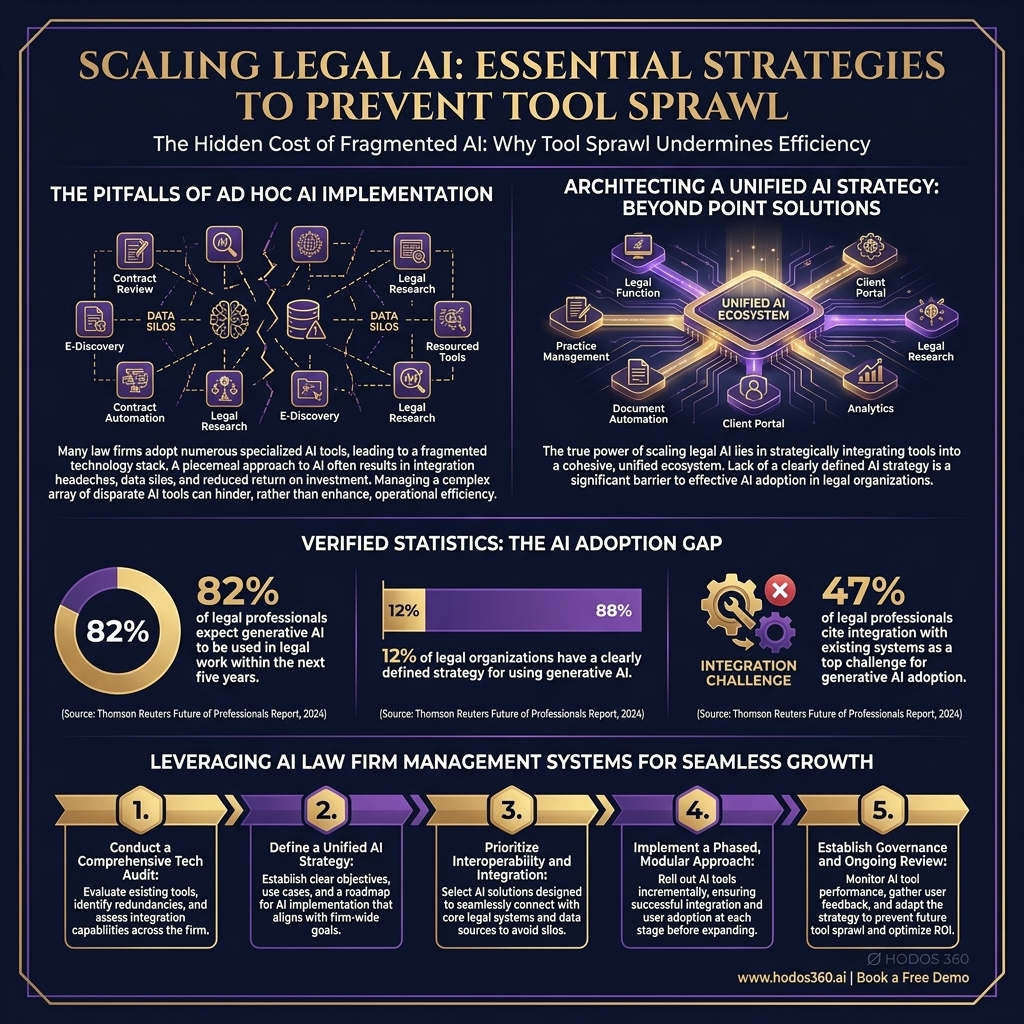
Many law firms, eager to leverage cutting-edge capabilities, adopt numerous point solutions—one for contract review, another for e-discovery, a third for legal research—only to find themselves managing a complex, fragmented tech stack that hinders, rather than enhances, efficiency. This piecemeal approach, while seemingly proactive, often leads to integration headaches, data silos, and a diminished return on investment, leaving attorneys frustrated and IT departments overwhelmed.
The true power of scaling legal AI lies not in accumulating more tools, but in strategically integrating them into a cohesive, unified ecosystem.
Consider the experience of Sterling & Associates, a mid-sized corporate law firm that, in 2024, invested heavily in over half a dozen specialized AI applications.
Their initial enthusiasm quickly waned as attorneys struggled with multiple login credentials, inconsistent user interfaces, and the constant need to export and re-import data between systems. The vision of seamless automation gave way to a reality of increased administrative burden, as their legal operations team spent more time troubleshooting integration issues than optimizing workflows.
This scenario, far from unique, underscores a critical tension in today's legal tech landscape: the drive for specialized AI capabilities versus the imperative for operational simplicity and strategic coherence. The path to truly scaling legal AI requires a deliberate shift from an ad hoc adoption model to a meticulously planned, integrated strategy that prioritizes interoperability and user experience above all else.
This strategic pivot is not merely about technology; it's about fundamentally rethinking how legal services are delivered in an AI-powered future.
The Hidden Cost of Fragmented AI: Why Tool Sprawl Undermines Efficiency
The allure of specialized AI tools is undeniable. A solution promising to reduce contract review time by 70%, or an AI-powered legal research platform that uncovers obscure precedents, can seem like a silver bullet for specific pain points. However, as firms accumulate these sophisticated tools without an overarching strategy, they often fall victim to what industry experts like Brad Blickstein of the Blickstein Group refer to as "tool sprawl."
According to the Blickstein Group's 2025 Legal Operations Survey, legal departments reported a staggering 30% increase in unique software vendors over the past three years, a trend that directly correlates with rising integration challenges. Learn more about AI Marketing: The Ultimate Platform Disrupting Agencies. This fragmented landscape creates significant inefficiencies, transforming potential gains into actual losses through redundant data entry, training fatigue, and the constant need for manual reconciliation across systems.
Data silos become an inevitable byproduct, preventing a holistic view of cases, clients, and firm performance, thereby sabotaging the very insights AI is meant to provide.
The Pitfalls of Ad Hoc AI Implementation
The ad hoc adoption of AI often leads to a complex web of disconnected applications, each with its own data storage, security protocols, and user interface. This lack of standardization not only complicates IT management but also introduces significant security vulnerabilities, as data flows through multiple unverified channels.
Quantum Legal, a firm specializing in intellectual property, learned this lesson the hard way. Their initial investment in a suite of specialized AI tools for patent analysis, trademark search, and litigation prediction led to an estimated 15% increase in their IT budget solely for managing integrations and data transfers.
Learn more about AI Settlement Rates: An Essential Guide to Maximizing Outcomes. Instead of achieving the promised operational efficiencies, attorneys found themselves spending valuable time navigating disparate platforms, undermining their productivity and increasing the risk of errors. This real-world conflict between the promise of individual AI tools and the reality of managing a fragmented tech ecosystem highlights the urgent need for a more integrated and strategic approach to legal AI adoption.
Architecting a Unified AI Strategy: Beyond Point Solutions
The antidote to tool sprawl is not less AI, but smarter AI integration. A unified AI strategy transcends the adoption of individual point solutions, instead focusing on building a cohesive technological ecosystem where all tools communicate seamlessly. This approach aligns with the concept of "governed AI orchestration," as emphasized by industry thought leaders, which advocates for a strategic framework to manage and integrate AI technologies effectively.

Learn more about Voice AI: Essential for Law Firms, Touting Twilio's Success. Even proponents of specialized AI, such as Gabe Pereyra, co-founder of Harvey AI, implicitly underscore this need; while Harvey offers powerful, specialized capabilities, its true value is unlocked when it integrates smoothly into a firm's broader legal workflows and data infrastructure.
The goal is to create a synergy where the whole is greater than the sum of its parts, allowing AI to augment human intelligence without creating new operational bottlenecks.
Building such a unified strategy begins with clearly defining the firm's overarching objectives and identifying how AI can genuinely solve specific problems, rather than simply adopting technology for its own sake. As legal tech consultant Casey Flaherty of Procertas frequently advises, firms should always start with the problem, not the tool.
This means conducting a thorough audit of existing workflows, identifying bottlenecks, and then selecting AI solutions that can integrate into a comprehensive platform. Learn more about AI Voice Assistants Transform Law: HODOS 360's 2026 Impact. This ecosystem approach, similar to how leading legal tech providers like Clio have built expansive, interconnected marketplaces, ensures that data flows freely, insights are centralized, and attorneys can work within a familiar, consistent environment.
A strategic, integrated approach minimizes the friction of technology adoption, ensuring that the firm's digital transformation efforts yield measurable improvements in efficiency, accuracy, and client service.
Leveraging AI Law Firm Management Systems for Seamless Growth
The most effective way to combat tool sprawl and achieve true AI scalability is through comprehensive AI Law Firm Management systems. These platforms consolidate critical operations—from case management and billing to client intake and document automation—into a single, intelligent ecosystem. Imagine a system where a new client's information, captured by an AI Voice Assistant, automatically populates into the case management system, triggers an AI-powered legal workflow for document generation, and initiates billing protocols, all without manual intervention.
This is the reality offered by integrated solutions like HODOS 360, which provides a suite of AI-powered services designed to create a unified operational backbone for law firms. Learn more about AI-Native Law Firms: The Ultimate Guide to Thriving in a New Era. By centralizing these functions, firms eliminate the need for multiple, disconnected applications, ensuring data consistency and streamlined processes.
The ABA TechReport 2025 indicated a growing preference for integrated practice management suites, with firms reporting a 20% higher satisfaction rate compared to those relying on disparate tools, underscoring the tangible benefits of a unified approach.
These advanced platforms go beyond mere consolidation; they embed AI directly into daily legal workflows, transforming routine tasks into intelligent, automated processes. For instance, AI-powered document automation within a unified system can generate complex legal documents by pulling relevant data directly from case files, ensuring accuracy and saving hundreds of hours.
Similarly, intelligent client intake systems leverage AI to qualify leads, gather essential information, and even schedule appointments, drastically reducing the administrative burden on front-office staff. Learn more about AI Legal Tech: The Essential Guide to Funding and Growth. This integrated approach ensures that every piece of client and case data contributes to a richer, more accurate understanding, fostering data-driven decision-making and enhancing overall firm performance.
Firms that embrace such comprehensive systems are not just adopting AI; they are building truly next-generation law firms capable of unprecedented efficiency and growth.
- ✓Consolidated Case Management: Centralize all case data, documents, and communications for a 360-degree view.
- ✓Automated Billing & Financials: Streamline invoicing, expense tracking, and financial reporting with AI-driven insights.
- ✓Intelligent Client Intake: Automate lead qualification, data capture, and onboarding processes.
- ✓AI-Powered Document Automation: Generate accurate legal documents instantly from centralized data.
- ✓Streamlined Legal Workflows: Design and automate complex legal processes across departments.
- ✓Enhanced Collaboration: Foster seamless team collaboration on cases and projects within a single platform.
Ready to centralize your operations and boost efficiency? Discover how HODOS 360 can streamline your operations and empower your team with intelligent, integrated AI. [Learn More about HODOS 360's AI Law Firm Management System]
Navigating Ethical and Practical Hurdles of AI Adoption
While the benefits of integrated AI are compelling, law firms must also navigate the inherent ethical and practical challenges of AI adoption. The ethical use of AI is paramount, touching upon fundamental professional responsibilities. Lawyers must uphold their duty of competence (ABA Model Rule 1.1), meaning they must understand the capabilities and limitations of the AI tools they employ.
This extends to ensuring that AI outputs are reviewed, validated, and do not inadvertently introduce bias or inaccuracies into legal advice. Furthermore, the duty of confidentiality (ABA Model Rule 1.6) requires robust data security measures to protect sensitive client information processed by AI systems. The enforcement of regulations like the EU AI Act, impacting data governance globally, underscores the critical need for firms to implement stringent data privacy protocols and conduct thorough due diligence on AI vendors.
Ensuring Data Integrity and Security
Beyond ethics, practical hurdles include ensuring data integrity and robust security. Integrated AI platforms, while solving tool sprawl, must be chosen for their enterprise-grade security features, including advanced encryption, access controls, and compliance certifications. The risk of "AI quietly hijacking legal judgment" arises when attorneys over-rely on AI outputs without critical human oversight.
As a report from the Thomson Reuters Institute on the evolving regulatory landscape for legal AI highlights, firms must develop clear internal policies for AI use, emphasizing human review at every critical juncture. This ensures that AI acts as an augmentation tool, empowering lawyers with insights and automation, rather than replacing their indispensable professional judgment.
Prioritizing ethical guidelines and data security builds trust in AI, both within the firm and with clients.
Don't let complexity hinder your firm's growth. Explore HODOS 360's unified platform designed for secure and ethical AI integration.
The Future-Proof Law Firm: Embracing Integrated AI for Competitive Advantage
The firms that will thrive in the coming decade are those that move beyond piecemeal AI adoption to embrace a fully integrated, strategic approach. They are not just efficient; they are building truly "next-generation law firms" that are more agile, scalable, and client-centric. Consider the trajectory of Innovate Legal, a firm specializing in emerging technologies, led by managing partner Sarah Chen.
By strategically adopting an integrated AI platform in early 2025, they reported a 30% increase in case load capacity and a 15% reduction in administrative overhead within two years. This allowed them to allocate more resources to high-value client work and outcompete rivals still grappling with fragmented systems.
This success story isn't about simply using AI, but about integrating it intelligently to create a seamless operational flow that enhances every aspect of their practice.
The competitive landscape demands sophisticated, digital-first legal services. Integrated AI is no longer a luxury but a foundational element for maintaining relevance and achieving sustained growth. It empowers lawyers to shed repetitive tasks, focus on complex legal strategy, and deliver superior client outcomes. The narrative arc of legal tech is shifting from individual tools to comprehensive platforms that orchestrate an entire firm's operations.
By choosing an integrated solution, law firms can future-proof their practice, attract top talent, and deliver unparalleled value in an increasingly complex legal market. The time to transition from tool sprawl to strategic, unified AI is now, ensuring your firm is not just participating in the future of law, but actively shaping it.

Key Takeaways and Next Steps
The era of piecemeal AI adoption in legal practice is quickly drawing to a close. While specialized AI tools offer compelling individual benefits, the true competitive advantage lies in their strategic integration within a unified platform. Law firms must recognize that "scaling legal AI" is not merely about acquiring more technology, but about architecting a cohesive ecosystem that eliminates tool sprawl, streamlines workflows, and centralizes data.
Integrated AI Law Firm Management systems offer a powerful solution, transforming client intake, case management, document automation, and billing into seamless, intelligent processes. By embracing such a holistic approach, firms can overcome operational inefficiencies, mitigate ethical risks, and position themselves as leaders in the evolving legal landscape.
The future belongs to firms that prioritize smart integration, enabling their legal professionals to deliver superior service and drive sustainable growth. Ready to future-proof your firm and achieve unparalleled growth? Book a free demo with HODOS 360 and transform your legal practice today.
Frequently Asked Questions
What is 'tool sprawl' in legal tech and why is it a problem?+
Tool sprawl refers to the uncontrolled proliferation of numerous, disconnected software applications within a law firm. It's a problem because it leads to data silos, integration challenges, redundant data entry, increased IT costs, and diminished overall efficiency, preventing a holistic view of operations and hindering true AI scalability.
How can an integrated AI platform prevent tool sprawl?+
An integrated AI platform prevents tool sprawl by consolidating core legal operations—like case management, billing, client intake, and document automation—into a single, unified system. This ensures that all data and workflows are interconnected, eliminating the need for multiple disparate tools and fostering seamless communication across the firm.
What ethical considerations should law firms address when scaling legal AI?+
Law firms must address ethical duties of competence (understanding AI's capabilities/limitations), confidentiality (securing client data), and supervision (ensuring human oversight). They must also mitigate bias, maintain transparency, and comply with evolving data privacy regulations like the EU AI Act to ensure responsible AI use.
What are the key benefits of AI Law Firm Management systems?+
AI Law Firm Management systems offer benefits like enhanced operational efficiency through automated workflows, improved data accuracy and centralized insights, faster client intake and onboarding, reduced administrative overhead, and better resource allocation. They provide a unified platform for all core legal processes, driving productivity and profitability.
How does AI improve client intake and marketing for law firms?+
AI improves client intake by automating lead qualification, capturing essential client information, and streamlining appointment booking, freeing up staff time. For marketing, AI platforms can automate social media, generate content, provide analytics, and track ROI, enabling firms to reach and convert prospects more effectively and efficiently.