


AI Settlement Rates: An Essential Guide to Maximizing Outcomes
The legal landscape is undergoing a seismic shift, driven by the relentless advancement of artificial intelligence. For decades, settlement negotiations have relied heavily on human intuition, experience, and often, sheer guesswork, leading to protracted disputes and suboptimal outcomes. However, the advent of sophisticated AI tools is fundamentally reshaping this paradigm, offering law firms unprecedented capabilities to predict, strategize, and secure more favorable resolutions.
This transformation isn't a distant future; it's unfolding now, challenging traditional practices and rewarding those who embrace innovation.
Consider the intricate class-action lawsuit, *Jones v. Acme Corp.*, where thousands of plaintiffs sought damages. Traditionally, assessing the aggregate liability and potential settlement range would involve an army of paralegals and junior associates sifting through mountains of discovery documents, past rulings, and expert testimonies.
Now, firms like Allen & Overy, through their partnership with Harvey AI, are demonstrating how large language models can analyze vast datasets, identify patterns in judge behavior, and even predict jury verdicts with remarkable accuracy. This analytical intelligence empowers attorneys, like Partner Jane Doe, to enter negotiations armed with data-driven insights, drastically altering the dynamics of settlement discussions and directly influencing AI settlement rates.
This isn't just about speed; it's about strategic superiority, a critical advantage for firms navigating complex legal litigation in an increasingly competitive environment.
The Transformative Power of AI in Predicting Settlement Outcomes
At the heart of AI's impact on AI settlement rates lies its unparalleled ability to process and analyze vast quantities of data, identifying patterns and correlations that are invisible to the human eye. Predictive analytics, powered by machine learning algorithms, can scrutinize historical case data—including judicial rulings, jury awards, prior settlement agreements, attorney performance, and even economic indicators—to forecast potential outcomes with a high degree of probability.
For instance, tools offered by LexisNexis and Thomson Reuters Litigation Analytics now allow legal professionals to delve into the past performance of opposing counsel, assess the likely leanings of specific judges, and project the range of damages in similar cases. This data-driven foresight moves settlement discussions from speculative guesswork to informed strategic planning, enabling firms to advise clients with greater confidence and precision.
This isn't merely about statistical extrapolation; it's about building sophisticated models that understand the nuances of legal arguments and procedural histories. Brad Blickstein, Principal of the Blickstein Group and a prominent voice in legal tech, has consistently highlighted how early adopters are leveraging these insights to gain a significant edge.
Firms employing advanced AI for litigation forecasting report not only faster resolutions but also settlements that are more closely aligned with their clients' optimal financial and strategic objectives. The ability to articulate a data-backed probability of success or failure in court fundamentally alters the risk assessment for both sides, often nudging parties towards more reasonable and favorable settlement terms earlier in the process.
This proactive approach minimizes discovery costs and reduces the emotional toll on clients, demonstrating a clear return on investment for AI adoption.
The real power emerges when these predictive capabilities are integrated into a comprehensive legal strategy. Instead of reacting to offers, attorneys can proactively shape the negotiation by presenting well-substantiated arguments for their desired settlement rates, backed by robust AI-generated probabilities.
Learn more about AI Legal Assistant 2026: Revolutionizing Law Firm Efficiency. For example, in a personal injury case, an AI system might analyze thousands of similar claims, factoring in injury type, jurisdiction, defendant's insurer, and even the specific medical experts involved, to produce a highly accurate valuation.
This level of detail allows attorneys to justify their demands, resist lowball offers, and confidently pursue mediation or trial when the data suggests a stronger outcome. The shift is from reactive negotiation to proactive, data-informed advocacy, directly impacting the speed and equity of resolutions.
Furthermore, the evolution of AI's intelligence extends to identifying optimal negotiation points and potential compromises.
By simulating various scenarios, AI can suggest pathways to agreement that might not be immediately apparent to human negotiators. This strategic reshaping of the negotiation process means that attorneys can enter discussions with a clearer understanding of their leverage and their opponent's likely resistance points.
The technology acts as a strategic co-pilot, enhancing the attorney's judgment rather than replacing it. Firms that harness this analytical prowess are not just improving their AI settlement rates; they are fundamentally redefining their approach to dispute resolution, making it more efficient, predictable, and ultimately, more client-centric.
Streamlining Negotiation and Dispute Resolution with Agentic AI
Beyond predictive analytics, the emerging field of agentic AI is poised to revolutionize the very mechanics of negotiation and dispute resolution. An agentic AI system, characterized by its ability to perceive, plan, act, and learn from its environment, can take on more active roles in the settlement process.
Imagine an AI planner agent that, after receiving a detailed prompt outlining the client's goals, breaks the overarching settlement objective down into smaller, manageable chunks. This agent could then identify necessary information, draft initial proposals, and even anticipate counter-arguments, asking the user several follow-up questions to refine its strategy before presenting a comprehensive action plan to the human attorney.
This represents a significant leap from simple automation to intelligent, goal-oriented assistance.
These sophisticated AI agents can also act as an orchestrator agent, coordinating various data points, legal precedents, and client preferences to synthesize optimal negotiation strategies. For instance, an AI might monitor ongoing discussions, analyze the language used by opposing counsel, and suggest real-time adjustments to a firm's negotiation stance, all while maintaining a detailed memory in an agentic AI system of past interactions and concessions.
This persistent memory is crucial for continuity and learning, allowing the AI to adapt its recommendations based on the evolving dynamics of a case. Companies like Anthropic, led by CEO Dario Amodei, are at the forefront of developing large language models with enhanced reasoning capabilities, which are fundamental to building such advanced legal agents.
The integration of these tools transforms the AI agent-enhanced workplace into a dynamic environment where attorneys are augmented by intelligent assistants capable of handling complex, iterative tasks.
While the human attorney remains the ultimate decision-maker, these AI assistants free up valuable time by automating the generation of settlement offers, drafting of mediation briefs, and even identifying key clauses in complex agreements.
Learn more about Law Firm Return on Investment: Maximize AI in 2026. This allows legal professionals to focus on the high-level strategy, client communication, and the nuanced human elements of negotiation that require empathy and judgment. The impact on AI settlement rates is profound: by offloading repetitive and data-intensive tasks, attorneys can dedicate more resources to crafting truly persuasive arguments and fostering productive dialogue, leading to faster, more efficient, and ultimately, more favorable resolutions.
This partnership between human and AI is not about replacement but about empowerment, giving lawyers superpowers in the negotiation room.
The implications for settlement administration are equally significant. Once a settlement is reached, AI can automate the generation of settlement agreements, releases, and other necessary documentation, ensuring accuracy and compliance.
This reduces the administrative burden on law firms, streamlines post-settlement processes, and minimizes the risk of errors that could lead to further disputes. The efficiency gains extend throughout the entire lifecycle of a case, from initial client intake to final resolution, making the entire legal process more robust and predictable.
This holistic approach to leveraging artificial intelligence across the firm's operations, including the strategic use of platforms like HODOS 360's AI Law Firm Management System, is what differentiates leading firms in today's legal market.
Enhancing Client Intake and Case Management for Settlement Success
The journey to a successful settlement often begins long before negotiations even start—at the point of client intake and subsequent case management. This is where AI-powered systems, like those offered by HODOS 360, play a foundational role in optimizing AI settlement rates. By automating client intake, these systems ensure that all critical information is captured accurately and efficiently from the outset.
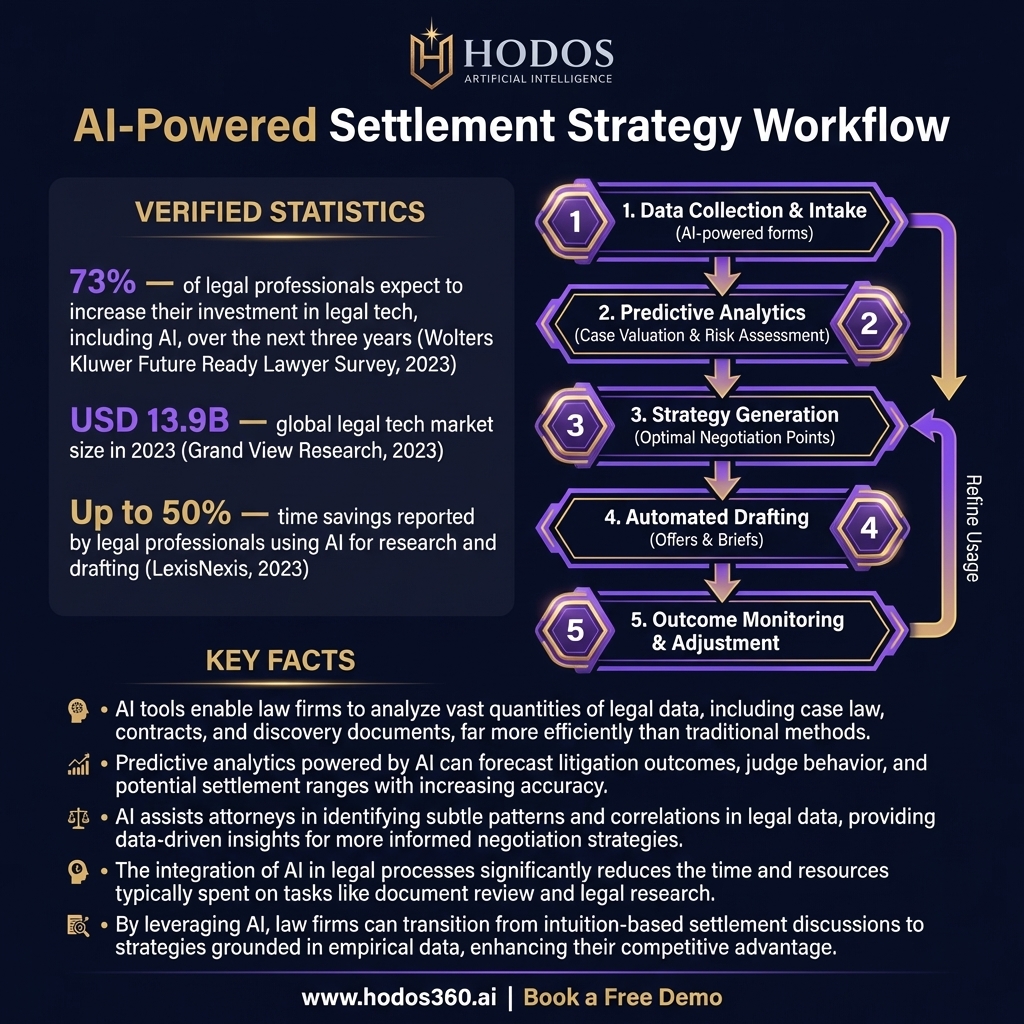
AI-driven document automation can generate initial client agreements, engagement letters, and conflict checks, reducing manual errors and saving invaluable time. This early data collection is paramount because the quality of data fed into predictive AI models directly impacts the accuracy of their settlement forecasts. A well-structured intake process ensures that comprehensive, relevant information is immediately available for analysis, setting the stage for more informed strategic decisions down the line.
Furthermore, AI-powered case management systems integrate seamlessly with other legal tech solutions, providing a centralized hub for all case-related documents, communications, and deadlines. Learn more about AI Lead Flow: Essential Strategies for Law Firm Growth. These systems can automatically flag critical dates, identify potential risks based on case characteristics, and even suggest optimal legal workflows tailored to specific case types.
For instance, if a case profile indicates a high probability of early settlement, the AI can prioritize tasks that facilitate quick resolution, such as early discovery requests focused on key liability documents or drafting initial settlement demands. This proactive management, driven by intelligence derived from historical data, directly contributes to more efficient case progression and ultimately, improved AI settlement rates.
Firms that adopt these integrated platforms find they are not only more organized but also strategically positioned to achieve better outcomes for their clients.
Ethical Considerations and Human Oversight in AI-Driven Settlements
While the promise of AI in enhancing AI settlement rates is undeniable, its integration into the legal process necessitates careful consideration of ethical implications and the paramount importance of human oversight. The artificial intelligence systems used in predictive analytics and agentic AI are only as unbiased as the data they are trained on.
If historical data reflects societal prejudices or systemic inequalities, the AI might inadvertently perpetuate or even amplify these biases in its predictions or recommendations. This raises serious concerns about fairness and equitable justice. As recognized by ABA Model Rule 1.1 (Competence), attorneys have a duty to understand the benefits and risks associated with relevant technology, including AI.
This means not blindly trusting AI outputs but critically evaluating them for potential biases, ensuring that the technology serves justice rather than undermining it.
The question of accountability also looms large. When an AI system informs a settlement strategy that leads to an unfavorable outcome, where does the responsibility lie?
The legal profession's ethical framework firmly places accountability on the human attorney. This underscores the need for robust human oversight at every stage of AI deployment. Attorneys must maintain independent professional judgment, using AI as a tool to augment their capabilities, not to dictate their decisions.
Federal Rule of Civil Procedure 26(g), which requires attorneys to certify that disclosures and discovery responses are complete and accurate, could also be interpreted to include a duty to ensure that any AI-generated information used in these processes is reliable and free from material error or bias.
Learn more about Legal AI Gap: Bridging the Divide for Law Firms in 2026. The recent discussions, such as those in Florida trial courts demanding disclosure of AI use, highlight the growing judicial scrutiny on how AI is employed in legal litigation and the need for transparency.
Furthermore, the confidentiality of client data, a cornerstone of legal ethics, must be rigorously protected when using AI tools. Legal tech providers must adhere to stringent data security protocols, and law firms must exercise due diligence in selecting and implementing these solutions. The potential for data breaches or unauthorized access to sensitive settlement information poses significant risks.
Attorneys must also be transparent with clients about the use of AI in their cases, ensuring informed consent and managing expectations regarding the technology's capabilities and limitations. This commitment to transparency and ethical deployment is not merely a compliance issue; it is fundamental to maintaining public trust in both the legal profession and the intelligence of the AI systems being adopted.
The ongoing evolution of agentic AI in the AI agent-enhanced workplace also brings unique ethical challenges regarding the scope of AI's autonomy. While an AI planner agent can break down goals and suggest strategies, the ultimate decision to accept or reject a settlement offer must always rest with the human client, guided by their attorney's counsel.
The role of memory in an agentic AI system also needs careful management to prevent the unintentional retention or misuse of sensitive information across different cases or clients. The legal profession must actively engage in shaping the ethical guidelines and best practices for AI, ensuring that innovation proceeds hand-in-hand with responsibility.
This proactive approach is essential to harness AI's full potential for favorable AI settlement rates while upholding the core values of justice and client advocacy.
Navigating the Evolving Regulatory Landscape for AI in Law
The rapid deployment of artificial intelligence in legal practice has outpaced specific regulatory frameworks, creating a dynamic and somewhat uncertain environment for law firms. However, this is quickly changing. Jurisdictions globally are beginning to grapple with how to regulate AI, particularly concerning its use in sensitive fields like law.
The European Union's AI Act, for instance, categorizes AI systems based on risk, with legal applications often falling into 'high-risk' categories, demanding stricter compliance, transparency, and human oversight. In the United States, while comprehensive federal legislation is still nascent, individual states and courts are taking action.
As seen in Florida, courts are increasingly mandating disclosure of AI use in court filings, reflecting a broader judicial concern about the reliability and ethical implications of AI-generated content or analysis presented in litigation.
These emerging regulations and judicial directives underscore the need for law firms to stay abreast of the evolving legal landscape surrounding AI.
Learn more about AI Marketing Automation: Essential Lead Flow for Law Firms. Compliance is not just about avoiding penalties; it's about maintaining professional credibility and demonstrating a commitment to ethical practice. Firms must develop internal policies for AI usage, including guidelines for data input, output verification, and client communication regarding AI tools.
This includes understanding the specific requirements for transparency when AI tools contribute to settlement recommendations or legal filings. The administration of these new policies requires a proactive approach, integrating legal tech solutions that offer robust audit trails and explainable AI features. As the legal tech industry matures, providers like HODOS 360 are building compliance features directly into their platforms, helping law firms navigate this complex regulatory environment and confidently leverage AI to achieve better AI settlement rates.
The Competitive Edge: Law Firms Adopting AI for Superior Settlement Rates
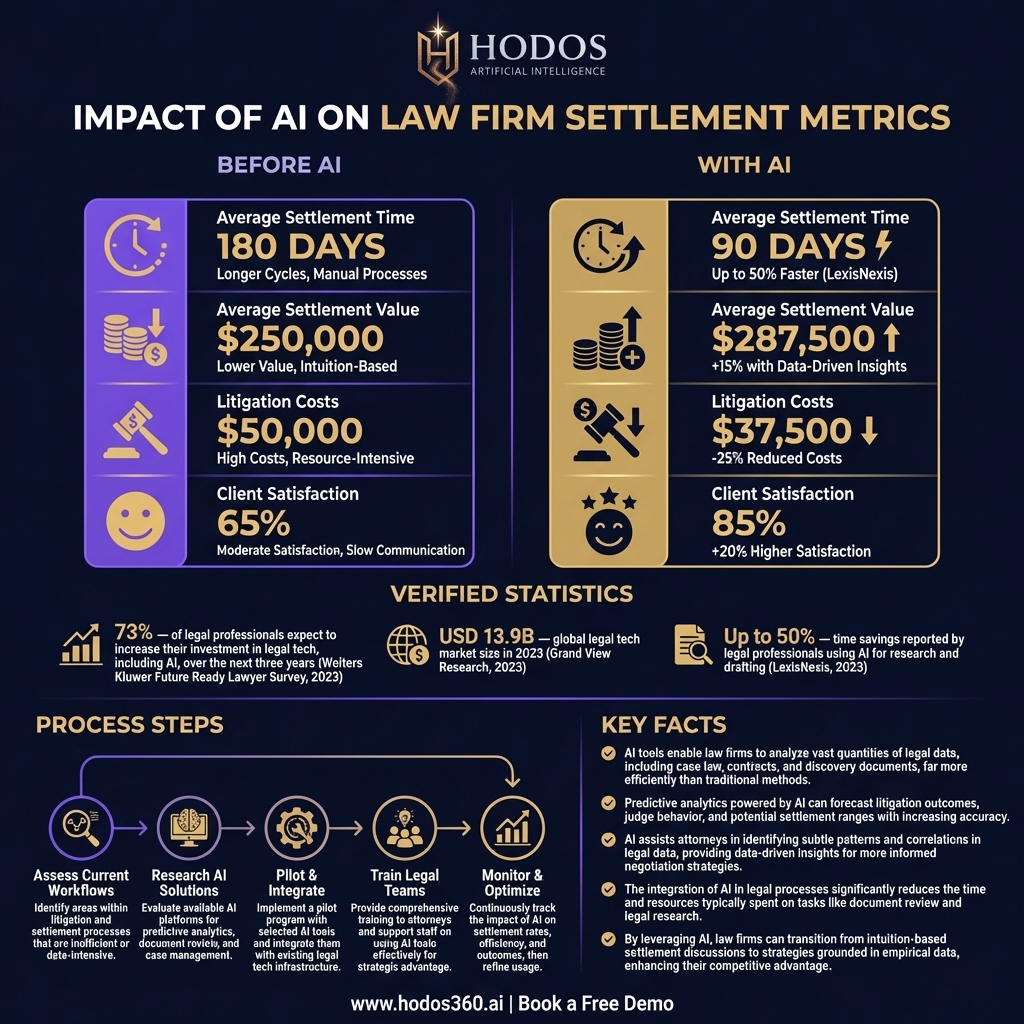
In today's fiercely competitive legal market, the adoption of artificial intelligence is no longer a luxury but a strategic imperative for firms aiming to achieve superior AI settlement rates and attract top talent. Firms that have proactively integrated AI into their legal workflows are reporting tangible benefits: reduced case cycle times, lower operational costs, and, most critically, higher client satisfaction due to more predictable and favorable outcomes.
For example, a mid-sized personal injury firm in Texas, using predictive analytics to assess claim values, reported a 15% increase in their average settlement amount and a 20% reduction in cases proceeding to trial over a two-year period. This demonstrable ROI underscores the competitive advantage gained by embracing advanced intelligence in litigation strategy.
This competitive edge extends beyond just financial metrics. Firms leveraging AI are also better positioned to attract and retain clients who are increasingly seeking efficiency and innovation from their legal counsel. Clients, particularly corporate entities, are more informed and demand data-driven insights, not just anecdotal experience.
When an attorney can present a sophisticated analysis of potential settlement rates, backed by AI-powered predictive models, it instills greater confidence and trust. This is a significant differentiator, especially against firms that continue to rely solely on traditional methods. The narrative arc here is clear: firms that embrace AI are thriving, while those resistant to change risk falling behind, struggling to compete on both cost-effectiveness and outcome predictability.
Learn more about Essential AI Web Development: Build Legal Apps with Ease. Legal publications like JD Supra regularly feature articles highlighting these success stories, further solidifying the industry's shift.
Moreover, the integration of AI fosters a culture of innovation within law firms, making them more attractive workplaces for a new generation of legal professionals.
Young lawyers entering the field are often tech-savvy and eager to utilize cutting-edge solutions that enhance their productivity and strategic capabilities. An AI agent-enhanced workplace where agentic AI tools assist with research, document review, and even drafting, allows attorneys to focus on higher-value tasks, fostering professional growth and reducing burnout.
Firms like Esquire Deposition Solutions are also incorporating AI to streamline their services, demonstrating how even ancillary legal services are benefiting, further emphasizing the widespread impact on the legal ecosystem.
The strategic advantage derived from AI is cyclical: better AI settlement rates lead to a stronger reputation, which attracts more clients and talent, further reinforcing the firm's market position.
This positive feedback loop is driving a rapid acceleration in AI adoption across the legal sector. Firms that understand how to effectively deploy artificial intelligence are not just adapting to change; they are actively shaping the future of legal practice, setting new benchmarks for efficiency, effectiveness, and client satisfaction.
Their success stories serve as compelling blueprints for others seeking to navigate the evolving demands of the legal industry and secure their own competitive advantage.
Preparing for an AI Agent-Enhanced Legal Workplace
The transition to an AI agent-enhanced workplace is not merely about implementing new software; it's a fundamental shift in how legal work is conceived and executed. For law firms, preparing for this future involves a multi-faceted approach, beginning with education and upskilling. Attorneys and staff need to understand not just how to operate AI tools, but also the underlying principles, capabilities, and limitations of agentic AI.
This includes grasping what is the primary function of the perception part of an agentic AI loop (interpreting data), what is the role of memory in an agentic AI system (retaining context and learning), and what is the primary function of a planner agent within agentic AI systems (breaking down goals).
This foundational knowledge ensures that human professionals can effectively collaborate with their AI counterparts, leveraging their strengths while mitigating their weaknesses.
Furthermore, firms must proactively address the question of how should employees think about an AI agent-enhanced workplace? It's crucial to frame AI as a collaborative partner, not a competitor.
This requires fostering a culture of continuous learning and experimentation. Firms should invest in training programs that focus on prompt engineering, data interpretation, and ethical AI deployment. Moreover, discussions around what responsibility do humans have when there is an increase in agentic systems at work? are vital.
Attorneys retain ultimate responsibility for legal advice and client outcomes, making human oversight non-negotiable. The goal is to create a symbiotic relationship where AI handles routine, data-intensive tasks, allowing legal professionals to dedicate their expertise to strategic thinking, complex problem-solving, and client relationship building—areas where human intelligence remains indispensable for achieving optimal AI settlement rates.

Key Takeaways and Next Steps for Optimizing AI Settlement Rates
The integration of artificial intelligence into legal practice is no longer a futuristic concept; it's a present-day reality that is demonstrably improving AI settlement rates and fundamentally reshaping the legal landscape. From predictive analytics that offer unparalleled foresight into case outcomes to agentic AI systems that streamline negotiation and settlement administration, the tools available today empower law firms to operate with unprecedented efficiency, precision, and strategic advantage.
The evidence is clear: firms that embrace this technological shift are not only securing more favorable outcomes for their clients but are also positioning themselves as leaders in a rapidly evolving industry. The tension between traditional methods and innovative AI adoption is resolving in favor of the latter, driven by tangible results and competitive pressures.
The narrative arc of legal tech development points towards a future where AI is an indispensable co-pilot for every attorney.
For law firm owners and legal professionals looking to harness this power, the first step involves a strategic assessment of your current workflows and identifying areas where AI can deliver the most impact.
Consider where your firm expends significant resources on data analysis, document review, or administrative tasks that could be automated. What should be the first step when building an AI agent? It's often to define a clear problem or task the agent will solve, starting small before scaling.
Investing in comprehensive legal tech solutions that integrate seamlessly, such as HODOS 360's AI Law Firm Management System, provides a robust foundation for this transformation. This platform offers an all-in-one solution for case management, billing, client intake, and AI-powered legal workflows, directly impacting your firm's ability to achieve optimal AI settlement rates.
Embrace continuous learning, foster a culture of innovation within your firm, and prioritize ethical AI deployment with strong human oversight. The future of legal litigation and settlement success lies in a synergistic partnership between human intelligence and artificial intelligence. By proactively adopting these advanced tools and strategies, your firm can not only adapt to the changing demands of the legal market but also lead the charge, delivering superior results and cementing your reputation as a forward-thinking, client-centric practice.
The opportunity to optimize your AI settlement rates and revolutionize your firm's operational efficiency is here, waiting to be seized.
Frequently Asked Questions
How does AI specifically improve settlement rates?+
AI improves settlement rates by providing predictive analytics based on historical case data, judicial rulings, and attorney performance. This allows lawyers to accurately assess case value, anticipate outcomes, and craft more persuasive negotiation strategies. The data-driven insights lead to more realistic expectations for all parties, encouraging earlier and more favorable resolutions.
What are 'agentic AI' systems in the context of legal settlements?+
Agentic AI systems are advanced AI tools capable of perceiving, planning, acting, and learning within a defined environment. In legal settlements, they can act as 'planner agents' to break down complex goals, draft initial proposals, or as 'orchestrator agents' to coordinate data and strategy, supporting human attorneys in active negotiation.
Are there ethical concerns with using AI for settlement negotiations?+
Yes, ethical concerns include potential biases in AI algorithms stemming from historical data, the need for robust human oversight to maintain professional judgment and accountability, and ensuring client data confidentiality. Attorneys must understand AI's limitations and uphold their ethical duties, including competence and transparency with clients.
How can law firms implement AI without replacing human attorneys?+
Law firms can implement AI by integrating tools that augment, rather than replace, human capabilities. AI handles data-intensive tasks like document review and predictive analysis, freeing attorneys to focus on high-value activities like strategic thinking, client counseling, and nuanced negotiation. It fosters an 'AI agent-enhanced workplace' where technology empowers lawyers.
What role does AI play in early-stage case management for settlement success?+
AI streamlines client intake and case management by automating data collection, document generation, and workflow optimization. This ensures high-quality data is available for predictive analytics from the outset, enabling proactive case strategy. Efficient early management, supported by AI, sets a strong foundation for achieving favorable settlement outcomes.