


AI SaaS Builders: The Ultimate Blueprint for Law Firms
Just three years ago, Sarah Jenkins, a founding partner at the boutique intellectual property firm 'Innovate Legal,' faced a familiar dilemma. Her firm’s outdated website was a relic, failing to reflect their cutting-edge work or attract the tech-savvy clients they desired. "We were spending a fortune on web development agencies," Jenkins recounted at LegalTech NYC 2024, "only to receive generic templates that didn't understand the nuances of patent law or the urgency of our clients' needs.
Our online presence was actively hindering our growth, making us look less innovative than we actually were." This scenario, a common narrative across the legal sector, highlighted a significant gap: the need for sophisticated, yet accessible, web development solutions tailored for law firms. The traditional model was slow, expensive, and often disconnected from the specific requirements of legal practice.
Many firms found themselves caught in a cycle of endless revisions and budget overruns, with their digital storefronts lagging far behind their competitors in other industries.
The landscape, however, has dramatically shifted. Today, the burgeoning field of AI SaaS builders is revolutionizing how law firms approach their digital infrastructure.
These powerful platforms, highlighted recently by Trend Hunter as a significant trend, enable legal practices to design, build, and deploy high-converting, AI-powered websites with unprecedented speed and efficiency. The promise is not just quicker website creation but a fundamentally smarter approach to development, one that integrates AI to understand legal-specific content, optimize for search engines, and streamline client interactions from the ground up.
This shift represents a pivotal moment for law firms, moving them from reactive, costly web maintenance to proactive, intelligent digital strategy. The era of generic, off-the-shelf websites is ending, replaced by an ecosystem where AI acts as the chief architect, allowing firms like Innovate Legal to finally build an online presence that truly reflects their expertise and ambition.
The Dawn of AI-Powered Web Development for Legal Practices
Historically, creating a robust, functional website for a law firm was an arduous and resource-intensive undertaking. Firms grappled with exorbitant agency fees, protracted development cycles stretching into many months, and the constant challenge of ensuring their digital assets adhered to stringent legal and ethical guidelines, such as those outlined in ABA Model Rule 7.1 (Communications Concerning a Lawyer’s Services).
The resulting websites, more often than not, were static brochures rather than dynamic client engagement tools. This created a significant bottleneck for growth, as potential clients increasingly relied on online searches to find legal representation. The frustration was palpable across the industry, with many partners feeling that their digital investments yielded diminishing returns.
A 2023 Thomson Reuters report indicated that over 60% of small to mid-sized law firms felt their current website was either 'adequate but not outstanding' or 'in need of significant overhaul,' pointing to widespread dissatisfaction with traditional web development paradigms.
The advent of AI SaaS builders has ushered in a new paradigm, fundamentally transforming this landscape.
These sophisticated platforms leverage advanced artificial intelligence, including generative AI and machine learning, to automate and optimize every stage of website development. Unlike conventional low-code or no-code solutions, AI builders don't just provide drag-and-drop interfaces; they intelligently design layouts, suggest content, optimize images, and even integrate complex functionalities based on natural language inputs.
For instance, platforms like the hypothetical 'LexiSite AI' (inspired by the capabilities of tools like Pablo.Design mentioned in SERP analysis) analyze a law firm's practice areas, target demographics, and competitive landscape to generate tailored website structures and content modules. This capability significantly accelerates the time-to-market for a professional online presence, allowing firms to launch a fully functional site in weeks rather than months, a critical advantage in a fast-paced market.
The core innovation lies in AI's capacity to learn and adapt, continuously refining the website design and functionality based on user data and evolving legal trends.
This shift is not merely about speed; it's about intelligent creation. Learn more about AI Legal Platform: Essential Security for Law Firms.
AI builders are equipped to understand the semantic nuances of legal content, ensuring that practice area descriptions are not only compelling but also accurately reflect legal concepts and terminology. Jensen Huang, CEO of NVIDIA, has often emphasized the importance of domain-specific AI, stating that general-purpose AI needs to be 'infused with domain knowledge' to truly create value.
This principle is vividly applied in AI SaaS builders for legal, where the AI is trained on vast datasets of legal documents, successful law firm websites, and client interaction patterns. This deep understanding allows the AI to proactively suggest features like secure client portals, integrated booking systems, and compliance-focused disclaimers, all critical for legal operations.
Furthermore, the AI can assist in the building of a robust digital presence by identifying optimal keyword strategies and content gaps, ensuring the website is not just aesthetically pleasing but also highly discoverable by prospective clients, effectively serving as an intelligent starter kit for a firm's digital venture.
The impact on efficiency and cost-effectiveness is profound. McKinsey's 2023 report on AI's economic impact projected that generative AI could add trillions to the global economy, primarily through productivity gains. For law firms, this translates into dramatically reduced development costs and significantly lower ongoing maintenance expenses.
Instead of hiring a team of developers, designers, and SEO specialists, firms can now leverage a single, integrated AI-powered platform. This democratization of high-quality web development empowers even small and mid-sized firms to compete with larger players, equipping them with a sophisticated digital tool that was once the exclusive domain of firms with substantial marketing budgets.
The ability to iterate quickly, test different designs, and implement changes without extensive technical intervention positions AI SaaS builders as an indispensable asset for any law firm aiming to modernize its client acquisition and service delivery.
Beyond Templates: Customization Driven by AI
One of the most significant criticisms of early website builders was their reliance on generic templates, leading to a sea of undifferentiated online presences. AI SaaS builders transcend this limitation by offering true customization, not just cosmetic changes. The AI engine analyzes a law firm's unique brand identity, specific practice areas (e.g., corporate law, family law, immigration), and target client demographics to generate bespoke design elements and content structures.
For example, a firm specializing in M&A might receive design suggestions emphasizing professionalism and deal-making prowess, while a personal injury firm might get layouts that prioritize empathy and clear calls to action for consultations. This intelligent design process ensures that each website is a genuine reflection of the firm's unique value proposition.
Learn more about Essential AI for Client Relationships: Future-Proofing Law Firms. Andrew Arruda, co-founder of ROSS Intelligence, has often spoken about the need for AI to augment human creativity, not replace it. In the context of web development, this means AI provides the framework and intelligent suggestions, but the firm retains ultimate control over the final aesthetic and messaging, ensuring authenticity and brand alignment.
This blend of AI efficiency and human oversight is what makes these builders so powerful, allowing for a truly unique digital presence that stands out in a crowded legal market, enhancing the firm's digital presence and client perception.
Strategic Advantages of AI Website Development for Law Firms
The strategic advantages of adopting AI website development are multi-faceted, directly addressing many of the pain points traditionally associated with online presence for legal practices. Firstly, the sheer speed of deployment is a game-changer. While a conventional agency might take 6-12 months to launch a complex legal website, AI SaaS builders can achieve similar or superior results in a fraction of that time, often within weeks.
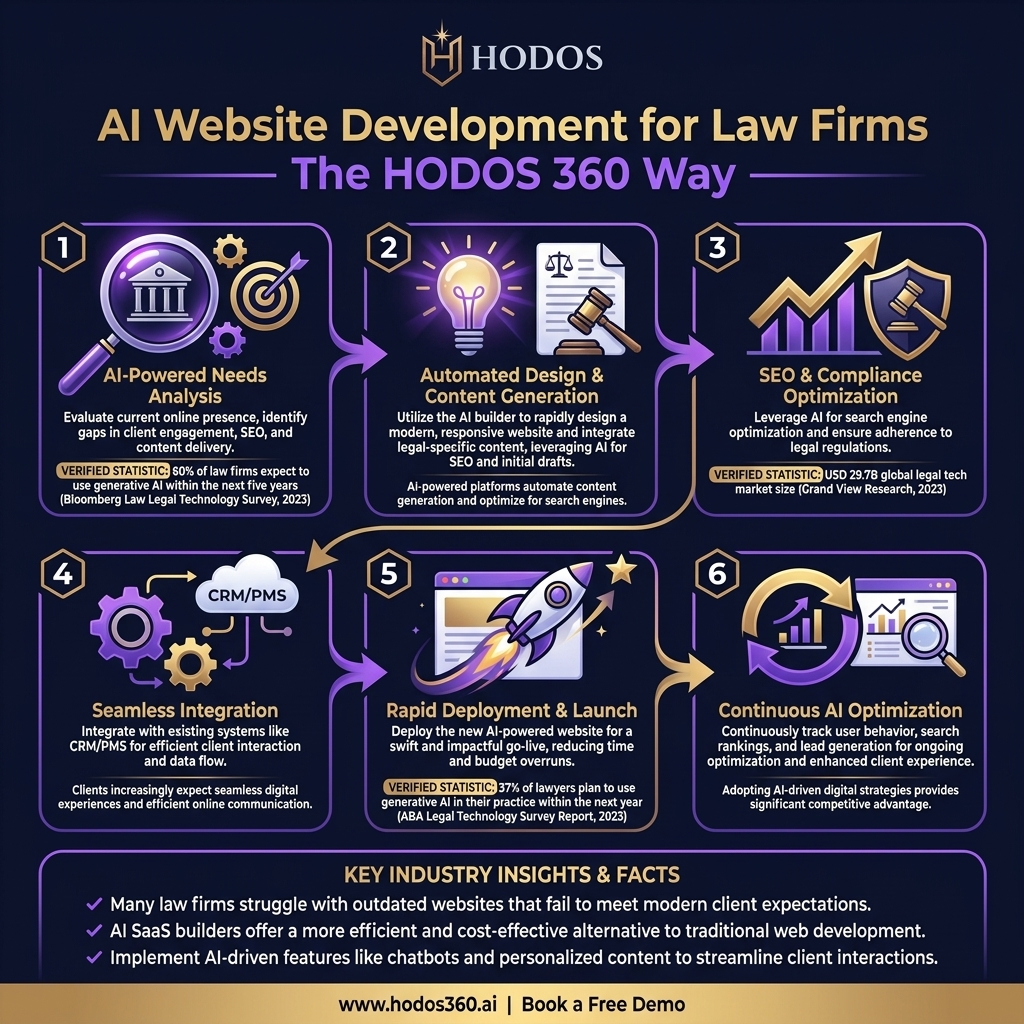
This rapid iteration capability means firms can quickly respond to market shifts, launch new practice areas, or update their messaging without significant delays. For example, when 'LexCorp Legal' needed a dedicated microsite for their emerging AI regulation practice following the EU AI Act enforcement in early 2026, their AI builder allowed them to go from concept to live site in just three weeks, capturing early-mover advantage in a niche market.
This agility is invaluable in today's rapidly evolving legal landscape, allowing firms to stay ahead of the trend and capitalize on new opportunities.
Secondly, the cost reduction is substantial. Traditional web development involves multiple highly-paid specialists: project managers, UX/UI designers, front-end developers, back-end developers, and SEO experts.
AI SaaS platforms consolidate many of these functions into an automated system, drastically cutting labor costs. A 2024 report by the ABA Legal Technology Resource Center found that law firms typically spend between $10,000 and $50,000 on initial website development, with ongoing maintenance adding thousands annually.
AI builders can reduce these upfront costs by 50-70% and ongoing expenses even further, democratizing access to professional-grade websites for firms of all sizes. This allows firms to reallocate valuable resources towards other growth initiatives, such as talent acquisition or expanding their service offerings, rather than being bogged down by web development overhead.
The financial efficiency makes advanced digital creation accessible, even for starter firms.
Thirdly, AI's inherent capabilities significantly boost SEO optimization. Modern AI SaaS platforms don't just build a site; they optimize it from the ground up for search engine visibility. Learn more about Voice AI: Ultimate Competitive Landscape for Law Firms.
This includes automated keyword research tailored to legal queries, intelligent content structuring that aligns with Google's E-E-A-T (Experience, Expertise, Authoritativeness, Trustworthiness) guidelines, and technical SEO best practices (like schema markup, mobile responsiveness, and site speed optimization) baked into the design process. For instance, an AI builder can analyze top-ranking legal content for specific practice areas and suggest improvements to a firm's own content, ensuring it's not only informative but also highly discoverable.
This proactive approach to SEO is crucial for client acquisition, as studies consistently show that over 80% of potential clients use search engines to find legal services. A well-optimized AI-built website can dramatically increase organic traffic, converting passive searchers into active leads. This is a powerful form of venture building in the digital realm.
Finally, the enhanced client experience and scalability are paramount. AI builders often come with integrated functionalities like secure client portals, online appointment scheduling, and AI-powered chatbots for initial lead qualification – features that significantly improve client engagement and streamline client intake. These capabilities are essential for meeting the expectations of today's digitally native clients.
Furthermore, these platforms are inherently scalable. As a law firm grows, adds new attorneys, or expands into new jurisdictions, the website can be easily updated and expanded without needing a complete overhaul. The modular nature of AI-generated sites means new pages, services, or features can be added with minimal effort, ensuring the website remains a dynamic and evolving asset rather than a static burden.
This agility supports a firm's growth trajectory and ensures its digital presence always aligns with its strategic objectives, reinforcing the value of AI-powered website building.
The Integration Imperative: Connecting Your Digital Ecosystem
For law firms, a website is not an isolated entity; it's a critical component of a broader digital ecosystem. The true power of AI SaaS builders lies in their ability to seamlessly integrate with a firm's existing legal tech stack. This means connecting with case management systems, billing software, client relationship management (CRM) platforms, and document automation tools.
Imagine a potential client visiting a firm's AI-built website, booking a consultation through an integrated calendar, and having their details automatically populate the firm's client intake system, triggering an AI-powered legal workflow for initial conflict checks and document generation. Learn more about Voice AI Revolution 2026: Agentic Platforms Transform Law Firms.
Such seamless data flow eliminates manual data entry, reduces errors, and significantly enhances efficiency across the firm. This integration also extends to communication channels, allowing 24/7 AI Voice Assistants to handle initial inquiries and route qualified leads directly to the relevant attorney, further streamlining the client journey.
The comprehensive nature of HODOS 360's offerings, which include an AI Law Firm Management System and AI Voice Assistants alongside Web & Mobile Development, exemplifies this integrated approach, providing a holistic solution for firms seeking to optimize their entire digital footprint and ensure compliance with stringent rules like ABA Model Rule 1.15 (Safeguarding Property) regarding client data.
Navigating the Landscape: Choosing the Right AI Website Builder
Selecting the optimal AI website builder for a law firm requires careful consideration, as the market is rapidly expanding with diverse platforms. Firms must prioritize solutions that not only offer cutting-edge AI-powered design and creation capabilities but also deeply understand the unique regulatory and ethical environment of legal practice.
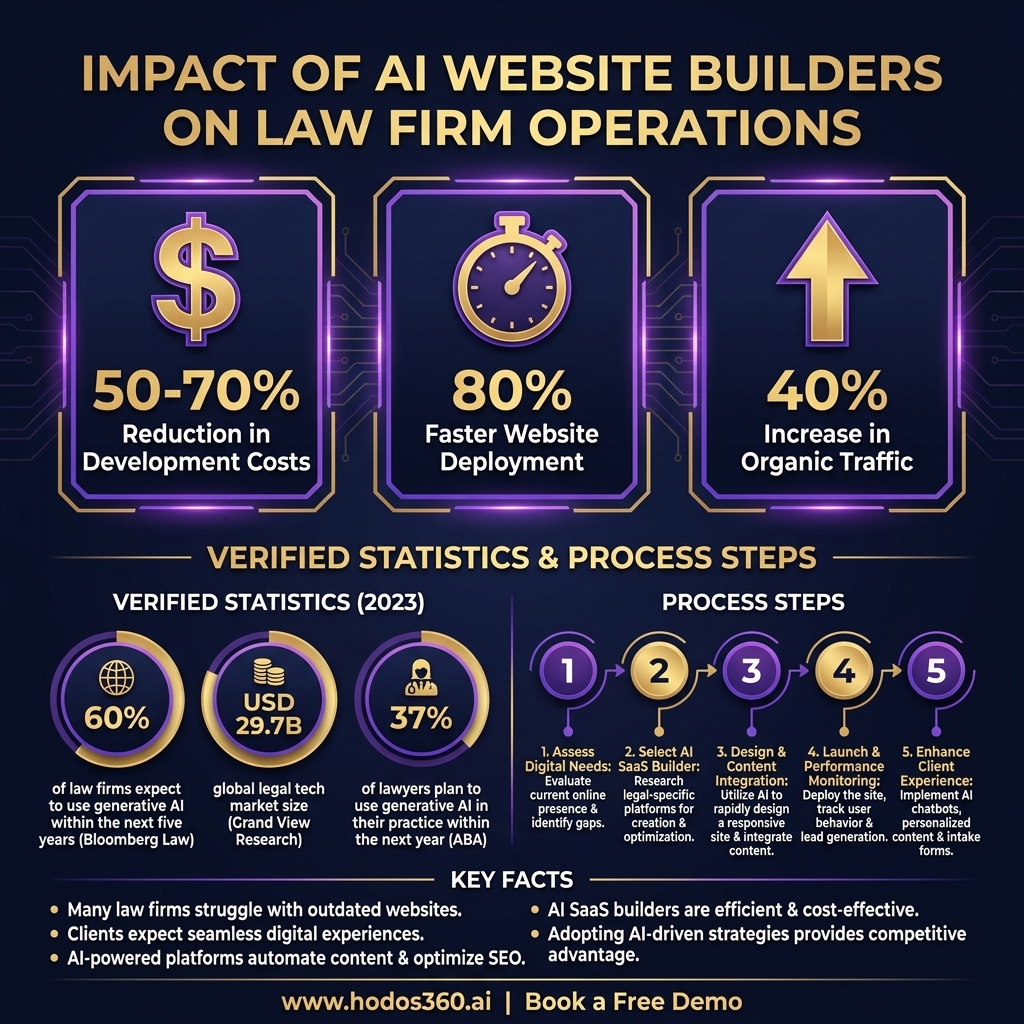
Key features to look for include robust security protocols to protect sensitive client data, compliance with accessibility standards (e.g., ADA), and the ability to integrate disclaimers and privacy policies easily. Furthermore, the platform should offer a high degree of customization to ensure the website accurately reflects the firm's brand and specialized legal services, moving beyond generic templates to truly bespoke design.
Evaluating the underlying AI models is also crucial; firms should seek builders powered by large language models (LLMs) that have demonstrated proficiency in legal terminology and content generation, ensuring accuracy and authority in online communications, a vital aspect for maintaining professional credibility and adhering to ethical advertising standards.
Another critical factor is the platform's capacity for seamless integration with existing legal technology. A website should not operate in a silo but rather as a central hub connecting to a firm's practice management software, CRM, and client intake systems. This interconnectedness streamlines operations, reduces manual data entry, and ensures a consistent client experience across all touchpoints.
For instance, an AI builder that can automatically push new client inquiries from the website directly into a firm's case management system, triggering AI-powered legal workflows for lead qualification and follow-up, offers immense value. Firms should also assess the platform's scalability and ease of maintenance, ensuring that as their practice evolves, the website can be updated and expanded without requiring extensive technical expertise or incurring prohibitive costs.
The best AI platforms act as a venture building partner, growing with the firm.
Considering the competitive landscape, firms should look beyond basic AI website builders and seek comprehensive platforms that offer a full suite of digital tools. Some builders focus solely on site creation, while others, like HODOS 360, provide an integrated ecosystem.
Learn more about AI Web Development: Revolutionizing Law Firm Websites in 2026. This could include features for AI video creation for marketing, social media automation to amplify content, and advanced analytics for tracking website performance and ROI. A holistic approach ensures that the website is not just a standalone presence but a powerful engine driving the firm's entire digital strategy.
The ability to generate targeted legal content and optimize it for search engines automatically is a significant differentiator, transforming the website into a potent client acquisition tool by leveraging SEO optimization and content generation capabilities. This strategic alignment ensures that every aspect of the firm's online presence works synergistically to achieve its business objectives, positioning the firm as a leader in its respective legal trend.
Finally, firms must consider the level of support and community offered by the AI builder provider. While these platforms are designed for ease of use, legal professionals may still require assistance with specific integrations, advanced customizations, or troubleshooting. A provider with robust customer support, comprehensive documentation, and an active user community can be invaluable.
Training resources, tutorials, and dedicated account managers can help firms maximize their investment and leverage all the features of their AI-powered website building solution effectively. The long-term success of an AI-built website depends not only on the technology itself but also on the support infrastructure that enables firms to continually adapt and optimize their digital presence in response to evolving market demands and technological trends.
This ongoing partnership is essential for sustainable digital growth and ensures that the firm remains at the forefront of the legal tech trend.
The Future of Legal Digital Presence: Trends and Predictions
The evolution of the legal digital presence, propelled by AI SaaS builders, is far from complete. Looking ahead, we can anticipate several transformative trends that will further reshape how law firms interact with clients online. Hyper-personalization, driven by increasingly sophisticated AI, will be a cornerstone.
Websites will not just adapt to device types but will dynamically tailor content, calls-to-action, and even visual elements based on individual user behavior, location, and expressed legal needs. Imagine a website that, after a few clicks, recognizes a user is searching for 'estate planning in California' and immediately presents relevant articles, attorney profiles, and a booking option for a California-licensed estate planning lawyer, all in real-time.
This level of personalized engagement will significantly enhance user experience and conversion rates, making the website a truly intelligent starter for legal consultations. The data analytics capabilities of these platforms will become even more predictive, allowing firms to anticipate client needs and proactively offer relevant services, essentially transforming their websites into highly responsive digital consultants.
Another significant trend will be the deeper integration of voice search optimization and multimodal AI interfaces. With the proliferation of smart speakers and voice assistants, optimizing legal websites for spoken queries will become paramount. AI builders will incorporate advanced natural language processing (NLP) to ensure websites respond accurately and effectively to voice commands, providing concise, legally sound answers.
Furthermore, multimodal AI will enable websites to process and generate information across various formats – text, image, video, and audio – creating more immersive and accessible user experiences. This means a client could upload a document to a website and have an AI summarize it or answer questions about its content, or engage with an AI voice assistant directly on the site.
Learn more about Generative AI Marketing: Law Firms' 2026 Growth Engine. This push towards intuitive, multi-sensory interaction will make legal services more accessible and user-friendly, expanding the reach of law firms to a broader demographic, and aligning with the broader trend of conversational AI.
The regulatory landscape surrounding AI will also play a crucial role in shaping the future of AI website development for law firms.
The enforcement of regulations like the EU AI Act, which came into full effect in early 2026, will necessitate that AI builders adhere to strict guidelines concerning transparency, data privacy, and algorithmic bias. Law firms utilizing these platforms will need assurances that their websites are built in an ethically compliant manner, particularly when processing sensitive client information or engaging in automated decision-making processes (e.g., lead qualification).
This will drive innovation in 'explainable AI' (XAI) within website creation tools, allowing firms to understand how AI makes design and content recommendations. The focus will shift not just to what the AI can do, but how it does it, ensuring accountability and trust in the digital interactions between firms and their clients, reinforcing the need for custom legal software that is both powerful and ethical.
Finally, the concept of the website as a static entity will completely dissipate. Future AI SaaS builders will enable websites to function as dynamic, self-optimizing platforms that continuously learn and adapt. Leveraging real-time data on user engagement, conversion rates, and market trends, the AI will automatically A/B test different layouts, content variations, and calls-to-action, making autonomous adjustments to maximize performance.
This continuous optimization cycle will ensure that a law firm's digital presence is always at the cutting edge, delivering the best possible user experience and conversion outcomes without constant manual intervention. This represents the ultimate venture building capability, where the website itself becomes an intelligent, evolving entity, a powerful digital presence that actively contributes to the firm's success.
The competition among builders will intensify, pushing the boundaries of what AI-powered website building can achieve, making the selection of the right development partner more critical than ever.
Ethical Considerations and Best Practices in AI-Powered Design
While AI offers unprecedented power in web development, law firms must navigate its use with a keen awareness of ethical considerations. Algorithmic bias, for instance, could inadvertently lead to discriminatory outcomes in how legal services are presented or accessed, an issue that could contravene ethical obligations of fairness and access to justice.
Firms must ensure that their chosen AI SaaS builders employ diverse datasets and transparent algorithms to mitigate such risks. Moreover, the paramount importance of client confidentiality, enshrined in ABA Model Rule 1.6, demands that any AI-driven website feature robust data security and privacy measures. Firms should scrutinize how client data is collected, stored, and processed by the AI platform, ensuring compliance with all relevant privacy regulations.
Best practices include maintaining human oversight over all AI-generated content and design decisions, regularly auditing the website's performance for unintended biases, and providing clear disclosures about the use of AI to clients. This proactive approach ensures that the benefits of AI-powered design are realized responsibly and ethically, building trust rather than eroding it, and upholding the legal profession's core values.

Key Takeaways and Next Steps for Law Firms
The emergence of AI SaaS builders marks a pivotal moment for law firms. No longer is a sophisticated, high-performing website an exclusive luxury for large enterprises; it is now an accessible, strategic imperative for every legal practice aiming to thrive in the digital age. These platforms offer a compelling blend of speed, cost-efficiency, and intelligent design, enabling firms to build a powerful digital presence that truly reflects their expertise and attracts their ideal clientele.
The ability to rapidly deploy, cost-effectively maintain, and continuously optimize a website through AI is not merely a technological advancement but a fundamental shift in how law firms can approach client acquisition and service delivery. Firms that embrace this trend will gain a significant competitive edge, positioning themselves as modern, forward-thinking legal providers capable of meeting the evolving demands of today's clients.
The future of legal web development is intelligent, integrated, and accessible.
For law firms ready to harness this transformative technology, the next step is clear: explore the capabilities of comprehensive AI-powered website building solutions. Evaluate platforms that offer not just site creation but also seamless integration with your existing legal tech stack, robust security features, and intelligent SEO optimization.
Consider how an integrated solution can streamline your client intake processes, enhance client engagement, and free up valuable resources. This strategic investment in modern digital infrastructure is crucial for sustained growth and relevance. Discover how HODOS 360's Web & Mobile Development service, alongside its full suite of AI-powered legal solutions, can provide your firm with the ultimate blueprint for a future-ready digital presence.
Book a free demo today to see how we can transform your firm's online capabilities.
Frequently Asked Questions
What are AI SaaS builders for law firms?+
AI SaaS builders are cloud-based software platforms that leverage artificial intelligence to automate and streamline the process of designing, building, and deploying websites. For law firms, these builders offer specialized features and content generation capabilities tailored to legal practices, enabling rapid creation of professional, SEO-optimized sites with integrated legal functionalities like client portals and secure communication.
How do AI website builders reduce costs for law firms?+
AI website builders significantly cut costs by automating tasks traditionally performed by multiple specialists, such as designers, developers, and SEO experts. This reduces upfront development fees and ongoing maintenance expenses by minimizing the need for extensive human intervention. Firms can allocate these savings to other growth areas, making high-quality web presence more affordable.
Can AI-built websites be customized to specific practice areas?+
Absolutely. Modern AI website builders go far beyond generic templates. They use AI to analyze a law firm's specific practice areas, brand identity, and target audience to generate bespoke designs, content structures, and features. This ensures the website accurately reflects the firm's specialized services, such as corporate law or personal injury, and resonates with its ideal clients.
What are the SEO benefits of using an AI website builder?+
AI website builders offer substantial SEO advantages by integrating optimization from the ground up. They perform automated keyword research, structure content for search engine visibility, implement technical SEO best practices (like mobile responsiveness and schema markup), and suggest content improvements. This proactive approach dramatically increases a law firm's organic search rankings and client acquisition potential.
How do AI builders ensure data security and client confidentiality?+
Reputable AI SaaS builders for law firms prioritize robust data security and privacy protocols. They typically employ advanced encryption, secure hosting, and compliance measures to protect sensitive client information, adhering to legal and ethical standards like ABA Model Rule 1.6. Firms should verify the platform's security certifications and ensure it supports secure client portals and communication channels.
Is technical expertise required to use AI website builders?+
No, a key advantage of AI website builders is their user-friendliness. They are designed for legal professionals with minimal to no coding or design experience. The AI automates complex technical tasks, allowing users to focus on content and strategy through intuitive interfaces. This empowers firms to manage their digital presence effectively without needing dedicated IT staff.