


Colorado AI Act: Essential Guide for Law Firms on Automated Decisions
The legal landscape is in constant flux, but few shifts have been as profound as the rapid integration of artificial intelligence. For law firms, this promises unprecedented efficiencies, yet also introduces complex ethical and regulatory challenges. Today, May 27, 2026, the spotlight shines brightly on Colorado, which has enacted a pioneering AI Act, setting a new benchmark for how automated decision-making technology must be governed, particularly when it comes to 'consequential decisions.'
This legislation, as highlighted by Ogletree, represents a critical juncture for legal professionals, demanding a deep dive into its implications for practice management, client service, and risk mitigation.
This isn't merely another piece of tech policy; it’s a foundational re-evaluation of how AI tools are deployed in sensitive contexts.
Consider the scenario of a partner at a Denver-based firm, like Sarah Chen of "Rocky Mountain Legal," who championed the adoption of AI-powered case prediction and client intake systems. For years, these tools offered a competitive edge, streamlining operations and informing strategic decisions. Now, with the Colorado AI Act in force, Ms. Chen, along with countless other legal leaders across the state, faces the immediate challenge of ensuring these systems meet stringent new requirements for transparency, fairness, and accountability.
The Act isn't designed to stifle innovation but to ensure it proceeds responsibly, protecting individuals from potential biases and errors inherent in complex algorithms. It underscores a growing global tension between the accelerating pace of technological advancement and the inherently slower, yet crucial, process of legislative oversight.
The Colorado AI Act stands as a testament to this evolving regulatory environment, pushing law firms to confront not just the capabilities of their AI tools, but also their inherent risks. It moves beyond generic discussions of 'AI ethics' into concrete, actionable mandates for legal entities.
This comprehensive guide will dissect the Act's core tenets, explore its practical implications for law firms, and outline strategies for compliance and responsible AI adoption. As AI continues to embed itself deeper into legal workflows, understanding and proactively addressing these regulatory shifts is not just about avoiding penalties; it's about safeguarding client trust, maintaining professional integrity, and future-proofing your practice in an increasingly automated world.
The implications extend far beyond Colorado's borders, signaling a potential blueprint for national and international AI governance, making this an essential read for any legal professional leveraging artificial intelligence.
Understanding Colorado's AI Act: Scope and Definitions
The Colorado AI Act, signed into law by Governor Jared Polis, represents a significant legislative effort to address the complexities of artificial intelligence. Unlike earlier drafts that faced criticism for their broad scope, the revised Act, as noted by various legal analyses, focuses specifically on 'automated decision-making technology' (ADMT) when applied to 'consequential decisions.'
This targeted approach aims to balance innovation with consumer protection, acknowledging the transformative power of AI while mitigating its potential for harm. For law firms, this means a meticulous review of all AI tools used in processes that could significantly impact clients, employees, or third parties.
The Act signals a clear move towards proactive governance rather than reactive litigation, placing the onus of responsible deployment firmly on the shoulders of developers and deployers of AI systems.
Central to the Act's framework is the emphasis on accountability. It mandates that developers and deployers of ADMT take reasonable care to protect consumers from algorithmic discrimination.
This isn't a vague suggestion; it's a legal obligation. For law firms utilizing AI for tasks such as client intake assessments, predictive analytics for case outcomes, or even automated billing adjustments, this translates into a requirement to understand the underlying logic of these systems. As Brad Smith, Vice Chair and President of Microsoft, often emphasizes regarding responsible AI development, 'When we create technology, we need to ensure that it serves humanity.'
Colorado’s Act operationalizes this sentiment into law, pushing firms to move beyond mere adoption to deep understanding and ethical stewardship of their AI tools. The legislation, effective August 1, 2026, gives firms a tight window to ensure compliance.
The Act defines 'consequential decisions' broadly to include areas such as employment, housing, insurance, healthcare services, and credit.
Learn more about AI Voice Assistants: The Ultimate Guide for Law Firms. While direct legal advice is not explicitly listed, many ancillary processes within a law firm, such as hiring decisions for staff, assessing client financial risk for fee structures, or even certain aspects of legal aid eligibility determination, could fall under this umbrella.
Firms must critically evaluate whether their AI systems are 'materially influencing' these decisions. This requires a nuanced interpretation, moving beyond the obvious to consider indirect impacts and potential downstream effects of AI outputs. The spirit of the law is to prevent situations where an automated system, without human oversight or transparency, could lead to unjust or discriminatory outcomes.
The implications extend to the design and deployment of AI systems. The Act requires developers to make reasonable efforts to design ADMT to mitigate algorithmic discrimination and make available a 'risk management framework' to deployers. For law firms, this means engaging with their AI vendors to ensure these frameworks exist and are robust.
It also necessitates internal protocols for assessing vendor compliance and integrating these external frameworks into their own operational policies. The shift in legal responsibility means that simply purchasing an AI solution is no longer enough; firms must now actively participate in its responsible deployment, understanding its limitations and ensuring its ethical application within their specific legal context.
Defining Automated Decision-Making Technology (ADMT)
The Colorado AI Act defines Automated Decision-Making Technology (ADMT) as any system that processes personal data and uses computation, including machine learning, statistics, or other data processing techniques, to materially influence a consequential decision. This broad definition encompasses a wide array of AI tools currently in use or under development within law firms.
It specifically targets systems that move beyond mere data aggregation to actively inform or make decisions that have significant impacts on individuals. For instance, an AI tool that merely summarizes documents would likely not qualify, but one that uses those summaries to predict the likelihood of a lawsuit's success and then recommends a settlement amount, thereby influencing a client's financial decision, would almost certainly fall within the scope.
Learn more about AI Lead Generation: The Ultimate Guide to Smarter Law Firm Growth. The key is the 'material influence' on a 'consequential decision,' requiring firms to scrutinize the actual use-case and impact of their AI systems rather than just their technical specifications. This necessitates a functional understanding of AI's role in the firm's operational and client-facing processes.
The Mandate of Accountability: Risk Management for Legal AI
The Colorado AI Act places a significant emphasis on accountability, fundamentally altering the risk management paradigm for law firms employing AI. No longer can firms merely adopt AI tools and delegate responsibility solely to the vendor. The Act explicitly states that deployers of ADMT must exercise reasonable care to avoid algorithmic discrimination and implement a comprehensive risk management framework.
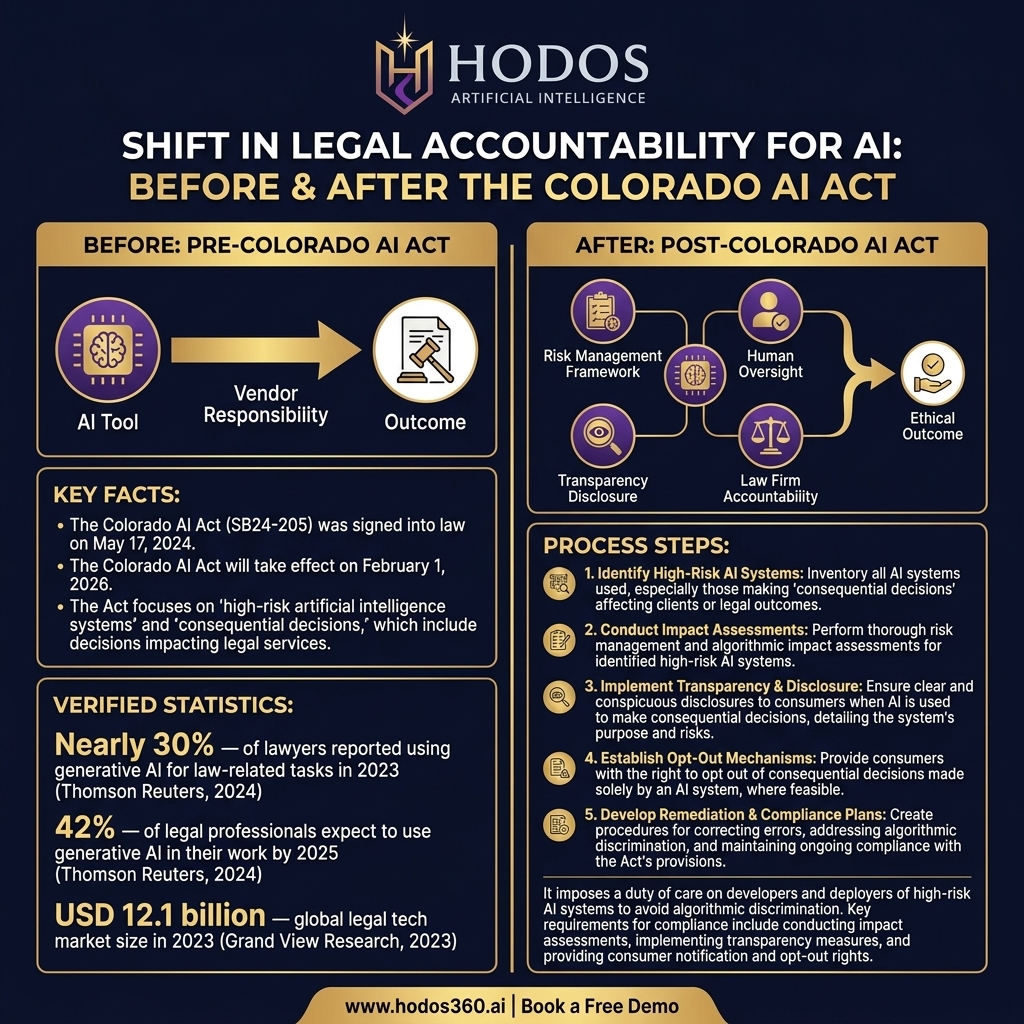
This means that if an AI system used by a law firm leads to a discriminatory outcome in a consequential decision, the firm itself could be held liable. This shift necessitates a cultural change within legal practices, moving towards a proactive and continuous assessment of AI risks, rather than a reactive approach only after issues arise.
The legal and ethical implications are profound, demanding a new level of diligence from firm leadership.
This mandate extends to understanding the potential for 'algorithmic discrimination,' defined as any condition that results in an unlawful differential treatment or impact on the basis of protected characteristics.
For law firms, this is particularly salient in areas like hiring, client selection, or even in advising clients on matters that involve sensitive demographic data. For example, if an AI-powered lead qualification system inadvertently prioritizes certain demographics over others, leading to a disparate impact on protected groups, the firm could face severe penalties.
The Act compels firms to conduct regular impact assessments, identifying and mitigating these biases before they manifest. As research from entities like the National Institute of Standards and Technology (NIST) on AI risk management frameworks suggests, a robust framework is crucial for identifying, measuring, and managing these inherent risks, moving beyond theoretical discussions to practical implementation.
Implementing an effective risk management framework involves several key components. Firms must establish clear policies for AI procurement, deployment, and oversight. Learn more about Legal AI: Microsoft's Essential Tool Reshapes Law Practice. This includes due diligence on AI vendors, ensuring they provide transparent documentation on their models, data sources, and mitigation strategies for bias.
Internally, firms need to designate responsible parties for AI governance, potentially forming an AI Ethics Committee or integrating these responsibilities into existing compliance structures. This mirrors the growing trend seen in larger corporations, where Chief AI Officers or dedicated AI ethics teams are becoming common.
The American Bar Association (ABA), through its various committees, has long advocated for ethical considerations in legal technology, and Colorado's Act provides a statutory framework for these principles.
Furthermore, the Act requires deployers to provide notice to consumers when ADMT is used to make a consequential decision, offering an opportunity to opt out or request human review.
This transparency requirement is crucial for maintaining client trust and upholding professional obligations. Imagine a client being denied a specific legal service or a particular fee arrangement based solely on an AI assessment; the Act ensures they have recourse and understanding. This also impacts how firms communicate about their use of AI, requiring clear, understandable explanations rather than technical jargon.
The onus is on the firm to demystify AI for its clients and ensure that human oversight remains paramount in critical decision-making processes. This human-in-the-loop approach is not just a best practice; it is becoming a legal necessity.
Implementing Robust AI Governance Frameworks
To comply with the Colorado AI Act, law firms must implement robust AI governance frameworks that extend across their entire operational footprint. This involves establishing clear policies for data management, algorithmic transparency, and continuous monitoring of AI system performance. A comprehensive framework should include regular audits of AI models for bias, ensuring data inputs are fair and representative, and instituting mechanisms for human intervention and override in consequential decisions.
Firms should look to standards set by organizations like the International Organization for Standardization (ISO) for AI management systems or the European Union’s proposed AI Act for guidance on best practices, even if not directly applicable. Learn more about AI Litigation Workflows: Essential for Modern Law Firms.
The goal is to create a structured approach that integrates ethical considerations and legal compliance into every stage of the AI lifecycle, from initial procurement to ongoing maintenance and review. This proactive governance minimizes legal exposure and reinforces client trust.
Navigating Compliance: Practical Steps for Law Firms
For law firms operating in Colorado, navigating the new AI Act requires immediate and systematic action. The first practical step is to conduct a comprehensive audit of all existing AI and automated systems within the firm. This includes identifying every instance where AI is used to process personal data and materially influence a consequential decision, from client intake and case management to HR processes and financial operations.
Firms must categorize these uses, assess their potential for algorithmic discrimination, and identify specific points where human oversight or intervention is currently, or could be, implemented. This inventory forms the bedrock of a robust compliance strategy, allowing firms to prioritize areas of highest risk and ensure no critical application is overlooked.
Without a clear understanding of where and how AI is deployed, compliance becomes an insurmountable challenge.
Following the audit, firms must develop and implement a clear, written AI policy that aligns with the Act's requirements. This policy should outline the firm's commitment to responsible AI, detailing procedures for risk assessments, bias detection, and mitigation strategies.
It should also cover data governance, ensuring that data used to train and operate AI systems is fair, accurate, and lawfully obtained. Training for all personnel involved in AI deployment and decision-making is crucial. This includes attorneys, paralegals, and administrative staff, ensuring they understand the Act's provisions, the firm's internal policies, and their individual responsibilities.
Firms like Allen & Overy, known for their early adoption of AI tools like Harvey, demonstrate the importance of firm-wide education and policy integration when introducing advanced technologies.
Another critical step is to establish transparent communication protocols with clients and affected individuals. Learn more about AI Regulatory Monitoring: Essential for Law Firm Compliance.
The Act's requirement for notice and the option for human review means firms must clearly articulate when and how AI is being used in consequential decisions. This could involve updating engagement letters, privacy policies, or creating dedicated informational materials. For instance, if an AI tool assists in determining eligibility for pro bono services, applicants must be informed and given the option to have their application reviewed by a human.
This level of transparency not only meets legal obligations but also reinforces the firm's commitment to ethical practice and client advocacy, fostering a deeper sense of trust. The challenge lies in communicating complex technical processes in an accessible and reassuring manner.
Finally, firms must engage in continuous monitoring and adaptation.
The field of AI is evolving rapidly, and regulatory frameworks will likely follow suit. Compliance with the Colorado AI Act is not a one-time event but an ongoing process. Firms should regularly review their AI systems, policies, and training programs to ensure they remain effective and compliant with any future amendments or interpretations of the law.
This proactive stance includes staying informed about broader trends in AI governance, such as the EU AI Act's enforcement or new guidelines from federal agencies. By embracing a culture of continuous improvement and vigilance, law firms can transform regulatory challenges into opportunities for leadership in responsible legal innovation, demonstrating their commitment to both technological advancement and ethical practice.
Ethical AI Deployment in Client Services and Beyond
Beyond mere compliance, the Colorado AI Act compels law firms to consider the broader ethical implications of AI deployment, especially in client services. The core of legal practice is trust and advocacy, and AI tools, while powerful, must enhance, not detract from, these foundational principles.

Ethical deployment means ensuring that AI systems are not only compliant with the letter of the law but also align with the spirit of justice and fairness. This includes carefully evaluating AI's role in sensitive areas like predicting litigation outcomes, assessing client credibility, or even generating legal documents.
The potential for AI to introduce or amplify existing biases, even unintentionally, demands a heightened level of ethical scrutiny from legal professionals, who are bound by strict codes of conduct such as the ABA Model Rules of Professional Conduct, particularly Rule 1.1 (Competence) and Rule 1.6 (Confidentiality of Information).
One significant ethical consideration is the 'black box' problem, where the internal workings of complex AI algorithms are opaque, making it difficult to understand how a decision was reached. The Colorado AI Act's emphasis on transparency and explainability directly addresses this. Law firms must push their AI vendors for more transparent models or develop internal expertise to interpret AI outputs responsibly.
This is particularly crucial when AI assists in making consequential decisions that could significantly impact a client's life or legal standing. Without clear explanations, the firm risks undermining client confidence and its own professional integrity. The ethical imperative here is to ensure that AI serves as an augmentative tool, providing insights and efficiencies, but never replacing the human judgment, empathy, and ethical reasoning that are hallmarks of legal practice.
The Act also indirectly encourages firms to rethink their data privacy and security practices. AI systems often require vast amounts of data, much of which can be sensitive client information. Learn more about Voice AI Assistants: The Ultimate Law Firm Advantage. Ensuring the ethical sourcing, secure storage, and appropriate use of this data is paramount.
Firms must implement robust cybersecurity measures and adhere to stringent data protection regulations, going beyond the minimum requirements to safeguard client confidentiality. The ethical deployment of AI is inextricably linked to superior data governance, protecting clients not only from algorithmic bias but also from data breaches and misuse.
This holistic approach to ethical AI ensures that technology enhances, rather than compromises, the attorney-client relationship.
As law firms integrate more sophisticated AI, the balance between efficiency and ethical considerations becomes a central challenge. The Colorado AI Act provides a legal framework, but firms must also cultivate an internal culture of ethical AI.
This involves ongoing dialogue, case studies, and a commitment from leadership to prioritize responsible innovation. It's about empowering attorneys to question AI outputs, understand its limitations, and always apply human judgment in critical moments. The goal is to leverage AI's power to elevate legal services while steadfastly upholding the profession's core values.
This proactive ethical stance can differentiate a firm in a competitive market and build enduring client trust, moving beyond mere compliance to true leadership in responsible legal tech.
Leveraging AI Responsibly with Integrated Platforms
For law firms seeking to navigate the complexities of AI regulation while maximizing technological benefits, integrated platforms offer a strategic advantage. Systems like HODOS 360's AI Law Firm Management System are designed to embed compliance and ethical considerations directly into legal workflows. By offering features such as AI-powered legal workflows, robust document automation, and comprehensive case management, these platforms can help firms track AI usage, document decision-making processes, and ensure transparency.
The integration of client intake and billing systems further ensures that all client-facing interactions are managed with an eye towards regulatory adherence. Such platforms provide the infrastructure to implement the risk management frameworks required by the Colorado AI Act, enabling firms to confidently deploy AI while maintaining accountability and safeguarding against algorithmic discrimination.
They transform the challenge of compliance into an opportunity for streamlined, ethically sound operations.
- ✓Conduct a comprehensive AI audit: Identify all AI tools, their data sources, and their role in 'consequential decisions.' Document potential biases and mitigation strategies.
- ✓Develop a robust AI governance policy: Create clear internal guidelines for AI procurement, deployment, oversight, and ethical use, aligning with the Colorado AI Act.
- ✓Implement continuous monitoring and review: Regularly assess AI system performance, audit for algorithmic discrimination, and update policies as technology evolves and regulations change.
- ✓Ensure transparency and human oversight: Provide clear notice to consumers about AI use in consequential decisions, offer opt-out options, and guarantee human review for critical outcomes.
- ✓Invest in staff training and education: Equip all personnel with the knowledge to understand AI's capabilities, limitations, and the firm's compliance obligations.
- ✓Collaborate with AI vendors: Demand transparency regarding their models, data, and risk management frameworks to ensure their tools support your firm's compliance efforts.
The Future of Legal AI Regulation: A National Perspective
Colorado's proactive stance on AI regulation is not an isolated event but rather a bellwether for a national and even global trend. As AI continues its rapid advancement, with major players like OpenAI and Google investing billions into new capabilities, other states and federal agencies are closely watching Colorado's implementation and its impact.
The EU AI Act, expected to be fully enforced soon, provides another significant international precedent for comprehensive AI governance, influencing regulatory thinking worldwide. This fragmented regulatory landscape presents both challenges and opportunities for law firms. While navigating a patchwork of state-specific laws can be complex, early compliance with stringent regulations like Colorado's positions firms favorably for future federal mandates or harmonized interstate policies.
The trend is clear: AI regulation is here to stay, and it will only become more sophisticated and widespread.
Legal tech leaders and policy makers are actively engaged in shaping this future. At events like LegalTech NYC 2026, discussions frequently center on the need for a balanced approach to AI regulation—one that fosters innovation while protecting fundamental rights.
Figures like Jack Newton, CEO of Clio, have often spoken about the transformative power of AI for access to justice, but also caution about the ethical considerations. The Colorado Act demonstrates a pragmatic approach by focusing on 'consequential decisions' rather than a blanket regulation of all AI.
This targeted strategy is likely to be adopted by other jurisdictions, emphasizing risk-based regulation that scales with the potential impact of AI systems. Law firms that proactively embrace these principles will be better positioned to adapt to an evolving regulatory environment and leverage AI's full potential responsibly.
Ultimately, the Colorado AI Act serves as a powerful reminder that the legal profession must evolve alongside technology. It challenges law firms to move beyond simply adopting new tools to becoming architects of responsible AI deployment. This isn't just about avoiding penalties; it's about shaping the future of legal services in a way that upholds justice, fairness, and human dignity.
Firms that develop robust internal AI governance, prioritize transparency, and ensure human oversight will not only comply with emerging regulations but also build a stronger foundation of trust with their clients and the wider community. The journey towards ethical and compliant AI in law is complex, but it is an essential one for the profession's future relevance and integrity.

Key Takeaways and Next Steps
The Colorado AI Act marks a pivotal moment for law firms, establishing a clear framework for accountability and responsible deployment of automated decision-making technology. The immediate takeaway is the imperative for every firm utilizing AI in Colorado to conduct a thorough review of their systems and processes.
This isn't merely a compliance exercise; it's an opportunity to solidify ethical practices and enhance client trust in an increasingly automated world. Firms must prioritize transparency, ensure robust human oversight in consequential decisions, and proactively mitigate the risks of algorithmic discrimination. The Act underscores that while AI offers immense benefits, its power must be wielded with profound care and a deep understanding of its societal implications.
The legal profession, by its very nature, is tasked with upholding justice, and this mandate now extends to the digital frontier. Proactive engagement with these regulations will define the leaders in legal innovation.
Looking ahead, the strategies adopted in Colorado will likely influence AI regulation nationwide.
Law firms that develop comprehensive AI governance frameworks now will be better prepared for future legislative actions and industry best practices. This includes continuous education for legal professionals on AI ethics and compliance, fostering a culture where technological advancement is balanced with professional responsibility. Engaging with legal tech providers who prioritize ethical AI development and offer transparent, auditable solutions is also crucial.
Firms should view these regulations not as barriers, but as guideposts for building more resilient, trustworthy, and future-proof legal practices. The investment in responsible AI today will pay dividends in reputation, client loyalty, and sustained growth.
In conclusion, the Colorado AI Act is a call to action for law firms to embrace AI not just for its efficiency, but for its responsible and ethical application.
By understanding its requirements, implementing proactive compliance measures, and fostering a culture of accountability, legal professionals can confidently navigate this new regulatory landscape. This commitment ensures that as technology evolves, the core values of the legal profession – justice, fairness, and client advocacy – remain at the forefront.
The path forward involves strategic planning, diligent implementation, and a steadfast dedication to ethical innovation, securing a future where AI empowers legal professionals to serve their clients with even greater integrity and impact.
Frequently Asked Questions
What is the primary focus of Colorado's new AI Act?+
The Colorado AI Act primarily focuses on regulating 'automated decision-making technology' (ADMT) when it is used to make or materially influence 'consequential decisions.' It mandates that developers and deployers of such technology take reasonable care to protect consumers from algorithmic discrimination, emphasizing transparency, fairness, and accountability in AI systems, especially in sensitive areas like employment, housing, and financial services. It aims to balance technological innovation with consumer protection from potential biases.
How does the Act define 'consequential decisions' for law firms?+
While the Act explicitly lists areas like employment, housing, and credit, for law firms, 'consequential decisions' can encompass various internal and client-facing processes. This includes AI-assisted decisions related to hiring, client intake assessments, fee structure determinations, or even legal aid eligibility. Any AI use that materially influences an outcome significantly impacting an individual's rights, opportunities, or financial standing within the firm's operations likely falls under this definition, requiring careful consideration and compliance.
What is 'algorithmic discrimination' and how can law firms avoid it?+
'Algorithmic discrimination' refers to unlawful differential treatment or impact based on protected characteristics (e.g., race, gender) caused by an AI system. Law firms can avoid it by conducting regular impact assessments of their AI tools, ensuring diverse and unbiased training data, implementing robust human oversight, and having clear mechanisms for review and override of AI-generated consequential decisions. Proactive identification and mitigation of biases in AI models are crucial for compliance and ethical practice.
What are the key compliance steps for law firms under the new Act?+
Key compliance steps include conducting a comprehensive audit of all AI systems to identify their role in consequential decisions, developing a firm-wide AI governance policy, implementing a robust risk management framework, ensuring transparency with clients about AI use, providing options for human review, and offering continuous staff training on AI ethics and compliance. Firms must also collaborate with AI vendors to ensure their tools meet regulatory standards and provide necessary documentation for accountability.
How can legal tech platforms like HODOS 360 assist with compliance?+
Integrated legal tech platforms like HODOS 360's AI Law Firm Management System can significantly assist with compliance by providing structured AI-powered legal workflows, document automation, and case management tools that track AI usage and decision points. They help embed risk management frameworks, ensure data governance, and facilitate transparent client communication. By centralizing AI-driven processes, such platforms enable firms to maintain accountability, audit AI performance, and ensure ethical deployment in line with the Colorado AI Act's requirements, streamlining compliance efforts.