


AI Litigation Workflows: Essential for Modern Law Firms
In an era defined by rapid technological advancement, the legal industry stands at a critical juncture. The recent announcement of a strategic partnership between Everlaw, a leading e-discovery platform, and Legora, an innovative AI-powered legal drafting solution, signals a profound shift. This collaboration, unveiled by Business Wire on May 4, 2026, isn't merely another integration; it represents a significant leap towards truly end-to-end AI litigation workflows, promising to unify disparate stages of the litigation process from early case assessment through document review, analysis, and legal drafting.
For law firm leaders and legal professionals, this development underscores an undeniable truth: the future of legal practice is intrinsically linked to intelligent automation and seamless digital integration. Firms that embrace these advanced capabilities are poised to redefine efficiency, enhance client outcomes, and secure a formidable competitive edge in an increasingly demanding market.
This partnership is a testament to the accelerating trend of legal technology vendors moving beyond siloed, point solutions towards comprehensive, interconnected platforms. Figures like Carl Morrison, CEO of Everlaw, and Daniel Li, CEO of Legora, have articulated a vision where attorneys can access and leverage critical case data and insights directly within their drafting environments, eliminating tedious manual transfers and reducing the risk of errors.
This integration reflects a growing demand from legal teams for systems that not only automate tasks but also provide intelligent insights, allowing lawyers to focus on high-value strategic work rather than administrative burdens. As the volume of electronic data continues its exponential growth, traditional manual approaches to discovery and document analysis are becoming untenable, making the adoption of sophisticated AI litigation workflows not just an advantage, but a necessity for maintaining operational viability and delivering superior client service.
The implications for law firms are far-reaching. Historically, the transition between e-discovery and subsequent legal analysis or drafting phases has been a friction-filled process, often involving data exports, re-imports, and manual contextualization. The Everlaw-Legora integration directly addresses this chasm, offering a glimpse into a future where the entire litigation lifecycle is managed within a cohesive, AI-augmented ecosystem.
This strategic move by two prominent players in the legal tech arena is a wake-up call for firms still hesitant to invest deeply in artificial intelligence. It highlights the competitive imperative to not only adopt AI tools but to strategically integrate them into core operations, transforming everything from client intake and case management to billing and document automation.
The question is no longer *if* AI will reshape legal practice, but *how quickly* firms can adapt to leverage its full potential.
Ready to revolutionize your practice with advanced AI? Discover how HODOS 360’s comprehensive AI Law Firm Management System can streamline your operations and elevate your firm's capabilities.
The Everlaw-Legora Partnership: A Catalyst for Change
The recent collaboration between Everlaw and Legora marks a significant milestone in the evolution of legal technology, particularly within the realm of litigation. Everlaw, a powerhouse in cloud-native e-discovery, has long been a go-to platform for legal teams managing vast datasets, offering sophisticated tools for document review, analytics, and case preparation.
Its capabilities have been instrumental in helping firms navigate the complexities of discovery under stringent deadlines, as underscored by its consistent recognition in industry reports from Gartner and Forrester. On the other hand, Legora has emerged as a leader in AI-powered legal drafting, enabling attorneys to generate and refine legal documents with unprecedented speed and accuracy, leveraging machine learning to understand context and legal nuances.
The synergy between these two platforms, as articulated by Everlaw’s CEO Carl Morrison, aims to create a 'seamless bridge between the insights gleaned from discovery and the creation of compelling legal arguments,' a vision echoed by Legora’s CEO Daniel Li, who emphasized the goal of empowering legal professionals with tools that enhance both efficiency and strategic depth.
This partnership is more than just a technical integration; it represents a strategic response to the fragmentation that has historically plagued legal workflows. Law firms often rely on a patchwork of specialized tools for different stages of a case, leading to inefficiencies, data silos, and increased operational costs.
Learn more about AI Marketing Tools: The Ultimate Guide for Law Firms. The Everlaw-Legora alliance is a direct challenge to this status quo, offering a unified environment where insights from vast document repositories can flow directly into the drafting process. Imagine a scenario where, during a complex litigation, a legal team using Everlaw identifies a critical pattern in emails related to a specific Federal Rule of Civil Procedure, such as Rule 26 on discovery scope.
With Legora integration, those insights can immediately inform the drafting of motions, briefs, or even client communications, ensuring consistency and accuracy without manual data re-entry. This not only accelerates the pace of litigation but also significantly reduces the potential for human error, a critical factor in maintaining professional competence as outlined by ABA Model Rule 1.1.
Transforming Legal Practice with End-to-End AI
The promise of end-to-end AI litigation workflows extends far beyond mere convenience; it fundamentally transforms how legal professionals approach complex cases, from initial client intake to final settlement or verdict. Such integrated systems leverage artificial intelligence to automate repetitive, time-consuming tasks, thereby freeing up attorneys to focus on strategic analysis, client counseling, and courtroom advocacy.
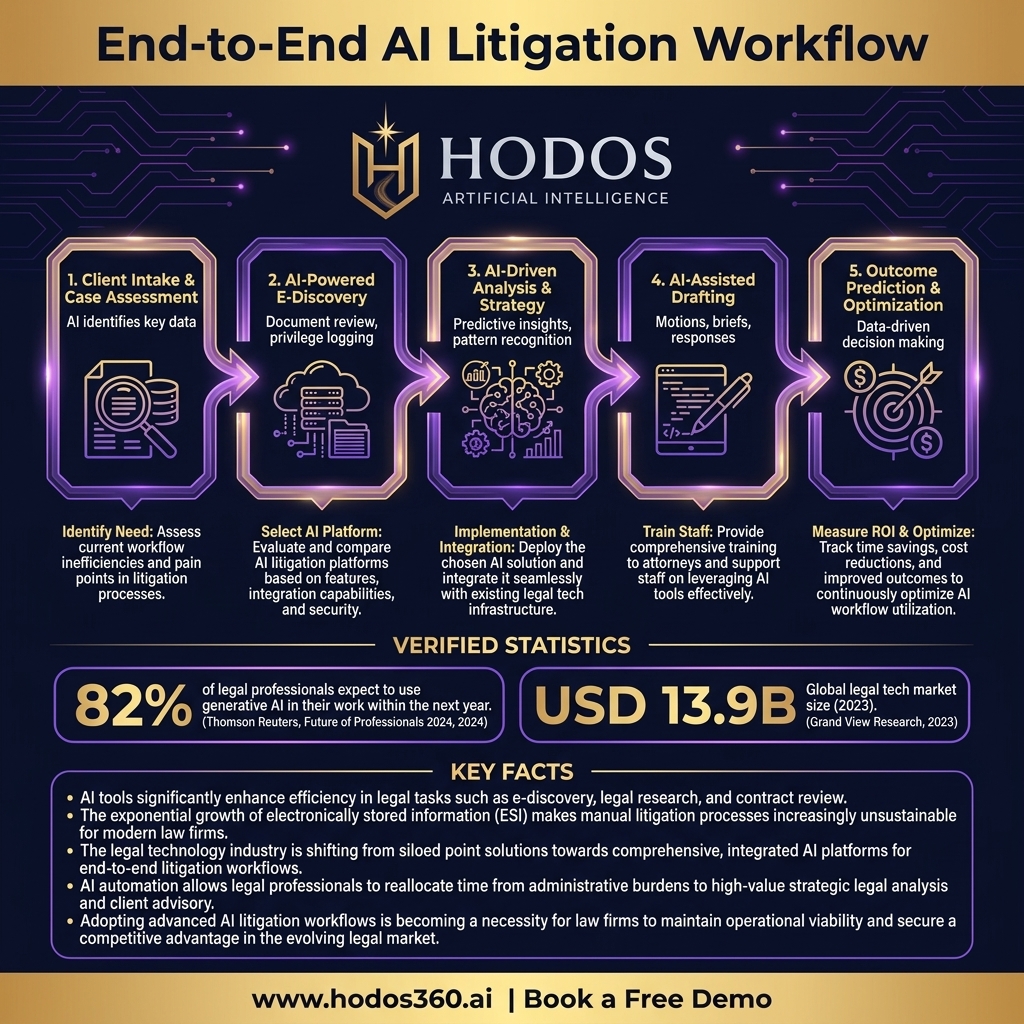
For instance, in the early stages of a product liability case, an AI-powered system can rapidly process millions of documents from diverse sources—emails, contracts, engineering specifications—identifying key players, timelines, and potential liabilities far more efficiently than human reviewers alone. Learn more about Essential AI Website Builder Guide for Law Firms.
This capability significantly reduces the time and cost associated with the discovery phase, which traditionally consumes a substantial portion of litigation budgets. According to a 2023 report by Thomson Reuters, firms leveraging AI for document review reported average cost savings of 30-50% compared to traditional methods, alongside a marked improvement in accuracy and recall rates.
From Document Review to Predictive Analytics
One of the most impactful transformations brought by end-to-end AI is the evolution from basic document review to sophisticated predictive analytics. AI algorithms can not only identify relevant documents but also analyze patterns, anomalies, and correlations that might escape human detection. For example, in a class-action lawsuit, AI can quickly identify common themes, recurring defendants, or similar factual patterns across thousands of individual claims, providing a powerful basis for aggregation and strategy.
Beyond mere identification, advanced AI platforms can analyze judicial opinions, juror behavior data, and historical case outcomes to offer probabilistic insights into potential litigation outcomes. This capability, often referred to as 'litigation intelligence,' empowers legal teams to make more informed strategic decisions, from settlement negotiations to trial strategy.
Moreover, the integration of AI extends to the creation and management of legal documents. Learn more about AI Marketing Revolution 2026: Autonomous Agents for Law Firms. Systems like Legora, when linked with e-discovery platforms, can leverage the insights from reviewed documents to auto-populate drafts of motions, interrogatories, and responses.
This ensures consistency in factual assertions and legal arguments across all case filings, while drastically cutting down on drafting time. This level of automation and intelligent support minimizes the risk of factual inconsistencies that could undermine a case, and allows lawyers to dedicate more time to refining the persuasive aspects of their arguments.
The overall impact is a more efficient, accurate, and strategically robust litigation process, where every piece of information discovered is seamlessly integrated into the legal strategy, ultimately leading to better client outcomes and a more competitive firm.
Curious about the practical applications of AI in your firm? Explore how HODOS 360’s AI-powered legal workflows can enhance your firm's efficiency across case management, document automation, and client intake.
Navigating the AI Litigation Landscape: Challenges and Opportunities
While the promise of end-to-end AI litigation workflows is compelling, their adoption is not without significant challenges that law firms must proactively address. One of the foremost concerns revolves around data security and privacy. Entrusting vast quantities of sensitive client data, including privileged communications and confidential business information, to cloud-based AI platforms requires robust security protocols and strict adherence to regulatory frameworks like HIPAA or GDPR, depending on jurisdiction and data type.
Firms must conduct thorough due diligence on vendor security practices and ensure compliance with their professional obligations regarding client confidentiality, as mandated by ABA Model Rule 1.6. Another critical challenge is the ethical implication of AI in legal decision-making. While AI can process information, it lacks human judgment and empathy.
Attorneys remain ultimately responsible for the advice given and the work produced, meaning they must understand the limitations of AI tools and supervise their outputs diligently. The 'black box' nature of some AI algorithms also raises questions about transparency and explainability, particularly when AI insights are used in court.
Beyond ethical and security considerations, law firms often encounter internal resistance to change. Learn more about Voice AI Revolution 2026: Agentic Platforms Transform Law Firms. Many seasoned legal professionals, accustomed to traditional methods, may view AI as a threat rather than an enhancement. Overcoming this 'digital divide' within firms requires comprehensive training programs, clear communication about the benefits of AI for both efficiency and professional development, and strong leadership from managing partners.
A 2024 ABA TechReport highlighted that while awareness of AI is high, actual adoption rates for advanced applications remain varied, with smaller firms often lagging due to perceived cost barriers and lack of expertise. However, this challenge also presents a significant opportunity. Firms that successfully integrate AI can attract and retain top talent—particularly younger lawyers who are digital natives and eager to leverage cutting-edge technology.
They can also differentiate themselves in the market, appealing to clients who value efficiency, innovation, and data-driven insights.
Strategic Implementation of AI Workflows in Your Firm
Implementing end-to-end AI litigation workflows is a strategic initiative that requires careful planning and a phased approach, rather than a mere technical upgrade. Law firms considering this transformation must first conduct a comprehensive audit of their existing workflows to identify pain points, bottlenecks, and areas where AI can deliver the most significant impact.
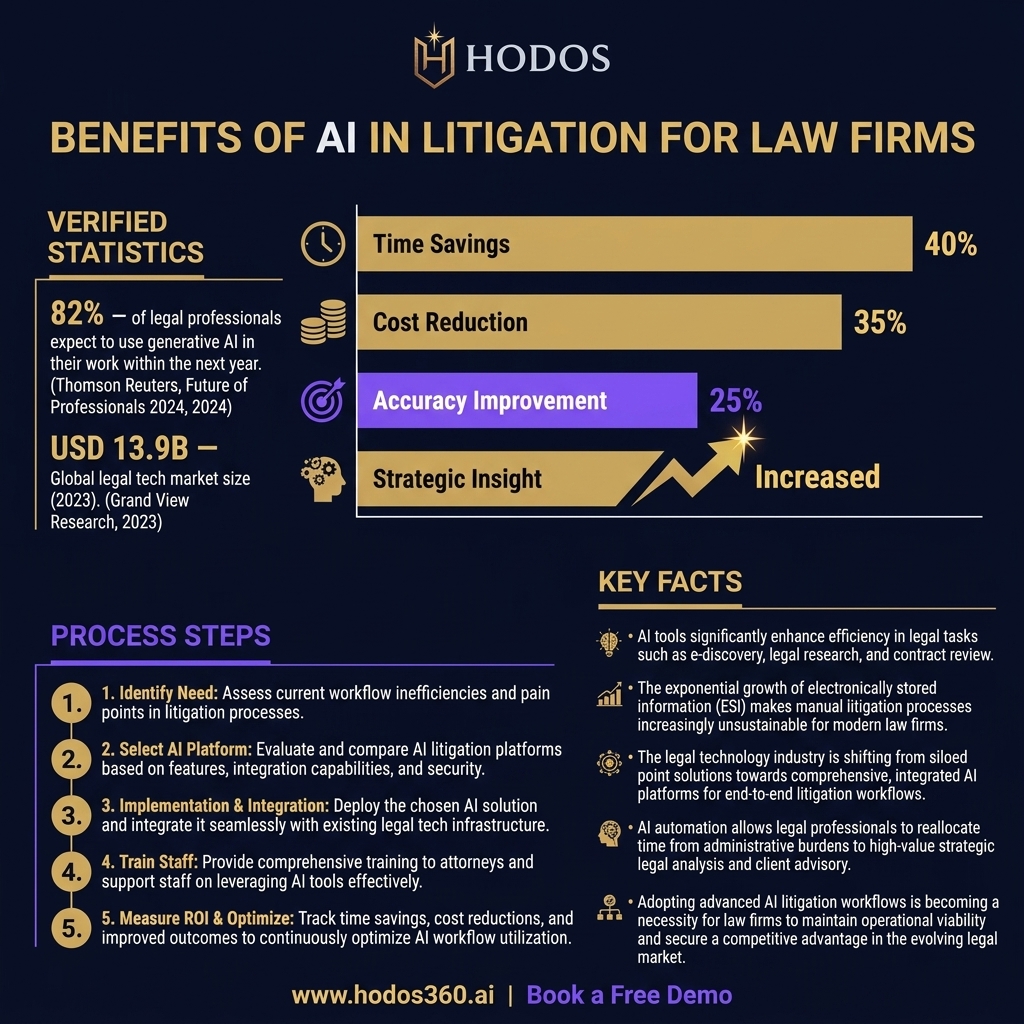
This might involve mapping out the entire lifecycle of a litigation matter, from initial client intake and conflict checks to e-discovery, document review, legal research, drafting, and even post-settlement compliance. Learn more about AI Voice Assistant: Essential for Modern Law Firm Success. Understanding these current processes is crucial for selecting the right AI solutions that integrate seamlessly and address specific firm needs.
The goal is not to replace human lawyers but to augment their capabilities, enabling them to perform their work more efficiently and effectively.
Choosing the Right AI Partner
Selecting the right AI partner is paramount to the success of any AI implementation. Firms must evaluate vendors not just on their technological capabilities but also on their understanding of legal practice, their security posture, and their commitment to client support. Key criteria for evaluation should include the platform's scalability to grow with your firm, its ease of integration with existing systems (like practice management software or billing platforms), and its track record of innovation.
A comprehensive platform like HODOS 360, which offers an AI Law Firm Management System encompassing case management, billing, client intake, and document automation, alongside an AI Marketing Platform, AI Voice Assistants, and Web & Mobile Development, provides a holistic solution. Such an integrated approach ensures that AI benefits are realized across all operational facets, creating a truly unified and intelligent ecosystem.
This strategic choice avoids the pitfalls of siloed solutions that fail to communicate, ultimately hindering rather than helping firm efficiency.
Once a partner and solution are selected, a phased implementation strategy is advisable. Learn more about Legal AI Problem: Mastering Ethical Tech in Law Firms 2026.
Starting with a pilot program on a specific type of case or department allows firms to test the waters, gather feedback from attorneys, and refine processes before a broader rollout. Continuous training and education are also vital to ensure user adoption and maximize the benefits of the technology.
This includes not just technical training on how to use the software but also educational sessions on the broader implications of AI in law, ethical considerations, and how it empowers legal professionals. By investing in their people and processes alongside the technology, law firms can successfully embed advanced AI litigation workflows into their daily operations, turning potential disruption into a powerful strategic advantage.

Key Takeaways and Next Steps
The legal industry is undergoing an irreversible transformation, driven by the accelerating pace of AI innovation. The Everlaw and Legora partnership serves as a powerful illustration of this shift, demonstrating the critical need for integrated, end-to-end AI litigation workflows. For law firms, this is no longer a futuristic concept but a present-day imperative for maintaining competitiveness, enhancing operational efficiency, and delivering superior client outcomes.
The era of piecemeal technology solutions is giving way to comprehensive, intelligent platforms that seamlessly connect every stage of a legal matter, from initial data ingestion to final legal drafting. Firms that embrace this evolution will not only streamline their internal processes but also empower their legal teams to focus on higher-value strategic work, ultimately fostering a more fulfilling and impactful practice.
Looking ahead, the successful adoption of AI in litigation hinges on strategic planning, careful vendor selection, and a commitment to continuous learning and adaptation. Firms must move beyond simply purchasing AI tools and instead focus on integrating these technologies into a cohesive, intelligent workflow that supports their unique practice areas and client needs.
This involves fostering a culture of innovation, investing in training, and prioritizing ethical considerations alongside technological advancement. The future belongs to firms that are agile, forward-thinking, and willing to leverage the power of artificial intelligence to redefine what's possible in legal practice. By taking these decisive steps, law firms can ensure they remain at the vanguard of the legal profession, ready to navigate the complexities of modern litigation with unparalleled efficiency and strategic insight.
It’s time to move from contemplation to action, securing your firm’s place in the AI-driven legal future.
Frequently Asked Questions
What are AI litigation workflows?+
AI litigation workflows are integrated processes leveraging artificial intelligence tools to automate, optimize, and enhance various stages of the litigation lifecycle. This includes AI-powered e-discovery for document review, predictive analytics for case assessment, automated legal research, and AI-assisted drafting of motions, briefs, and other legal documents, creating a seamless flow of information and insights from start to finish.
How do AI platforms like Everlaw and Legora integrate?+
Platforms like Everlaw (e-discovery) and Legora (AI drafting) integrate by creating direct data pipelines and shared environments. This allows legal teams to access documents reviewed and analyzed in Everlaw directly within Legora's drafting interface. The integration eliminates manual data transfers, ensures consistency, and allows AI insights from discovery to inform and accelerate the creation of legal arguments and documents.
What are the main benefits of using AI in litigation?+
The primary benefits include significant time and cost savings by automating repetitive tasks like document review, enhanced accuracy and consistency in legal analysis and drafting, improved strategic insights through predictive analytics, and better resource allocation. AI allows lawyers to focus on complex legal reasoning and client strategy, leading to more efficient processes and superior client outcomes.
Are there ethical concerns with AI in legal practice?+
Yes, ethical concerns exist, primarily around data security, client confidentiality (ABA Model Rule 1.6), and attorney competence (ABA Model Rule 1.1). Firms must ensure AI platforms meet robust security standards and that attorneys understand AI's limitations, supervising its output diligently. Transparency, explainability, and preventing bias in AI algorithms are also critical considerations for responsible AI adoption.
How can small and mid-sized firms adopt AI litigation tools?+
Small and mid-sized firms can adopt AI by starting with targeted solutions that address specific pain points, such as AI-powered document review or client intake automation. They should prioritize cloud-native, scalable platforms that offer intuitive interfaces and strong vendor support. Phased implementation, pilot programs, and continuous staff training are crucial to successful integration without overwhelming resources.