


Legal AI Pricing: The Ultimate Guide to Value, Not Fear
The legal industry stands at a pivotal juncture, where the transformative power of artificial intelligence beckons with promises of unprecedented efficiency and insight. Yet, beneath the gleaming veneer of innovation, a palpable tension simmers: the escalating "legal AI pricing" conundrum. For many law firm partners and legal operations leaders, the initial excitement around tools like generative AI for document review or legal research is increasingly tempered by the opaque and often unpredictable costs associated with their adoption. Sarah Chen, a managing partner at LexCorp Legal, recently shared her firm's initial apprehension after a pilot program for an AI-powered contract analysis tool. "The efficiency gains were undeniable," Chen recounted, "but the 'usage-based billing' model, particularly the 'token costs' for large language models, left us grappling with a significant unknown. We feared an open-ended financial commitment, a sentiment echoed across the industry, as highlighted by a recent Law.com article on 'pricing fears' amid AI's ubiquity." This concern is not unfounded; as legal teams feel "pressure from clients and leadership" to adopt AI, understanding its true economic impact becomes paramount.
This landscape demands more than just cautious optimism; it requires a strategic re-evaluation of how law firms perceive and integrate technology. The shift from traditional subscription models to more dynamic, consumption-based pricing for advanced "AI legaltech" solutions presents both challenges and opportunities. Firms that proactively develop a robust "AI strategy legal" will be better positioned to not only mitigate these "law firm AI costs" but also to harness AI's full potential for competitive advantage and enhanced client service. This guide aims to demystify the complex world of legal AI economics, offering actionable insights for firms to navigate "token costs," optimize "legal tech adoption," and ultimately, achieve a compelling "AI ROI legal" without succumbing to the pervasive "pricing fears." It's about shifting the focus from cost anxiety to value realization, ensuring that AI becomes a sustainable driver of growth and innovation for your practice.
The Shifting Sands of AI Pricing Models: Beyond the Sticker Shock
The evolution of "legal AI pricing" has been rapid, moving beyond simple seat licenses to intricate models that reflect the underlying technology's operational costs. Early legal AI tools often came with predictable annual subscriptions, but the rise of generative AI, powered by large language models (LLMs) from companies like OpenAI (with models like GPT-4) and Anthropic (with Claude 3), has introduced a new paradigm: "consumption-based billing." This model, akin to cloud computing services, charges based on actual usage, such as the number of queries, documents processed, or, most notably, the 'tokens' consumed. For instance, a legal AI platform leveraging OpenAI's API will incur costs based on the input and output tokens generated during tasks like summarizing depositions or drafting legal briefs. This fundamental change is a significant source of "pricing fears" for "legal teams" accustomed to fixed budgets, as it introduces an element of unpredictability that can quickly inflate "law firm AI costs" if not carefully managed. The pressure to adopt AI, fueled by client expectations and internal "legal leadership" mandates, means firms must now develop sophisticated forecasting and cost-tracking mechanisms to avoid budget overruns.
The implications of this shift are far-reaching. Companies like Harvey AI, which partners with firms such as Allen & Overy to provide generative AI capabilities, must build their own pricing structures atop these foundational LLM costs. Learn more about AI Voice Assistants Transform Law: HODOS 360's 2026 Impact. This often translates into tiered models or specialized "usage-based billing" packages designed to provide some predictability. However, the core challenge remains: how to accurately project the 'token' consumption for diverse legal workflows. A recent Gartner report predicted that by 2028, over 35% of new legaltech spending by corporate legal departments will be tied to AI consumption, underscoring the industry's irreversible move towards these dynamic pricing structures. This trend necessitates a proactive approach from law firms, demanding a deeper understanding of not just what an AI tool does, but precisely how its usage translates into financial expenditure. Firms that master this understanding will transform potential "pricing fears" into strategic advantages, optimizing their "legal tech adoption" for maximum "AI ROI legal" and ensuring sustainable growth in an increasingly AI-driven market.
Decoding Tokenomics and Usage-Based Billing
At the heart of modern AI pricing lies 'tokenomics.' In the context of large language models, a 'token' is a unit of text – it can be a single word, part of a word, or even punctuation. When you feed a document into an AI or ask it a question, that input is broken down into tokens. The AI's response also consumes tokens. Vendors then charge based on the total number of input and output tokens. This creates a direct correlation between the complexity and volume of tasks performed by the AI and the resulting cost. Learn more about Claude's Visual Coding: An Essential Guide for Law Firms. For law firms, this means a lengthy, complex legal brief requiring extensive summarization and follow-up questions will incur significantly higher 'token costs' than a simple contract review. The unpredictability arises because the exact number of tokens consumed can vary based on the prompt's quality, the model's response length, and the iterative nature of legal research and drafting. Mitigating this requires rigorous internal protocols for prompt engineering and careful monitoring of usage analytics to prevent unexpected spikes in "law firm AI costs."
Strategic Adoption: Maximizing ROI in Legal AI Investments
The narrative around "legal AI pricing" often focuses on costs, but the true story is about value. Maximizing "AI ROI legal" requires a strategic approach that transcends mere cost-cutting and embraces the transformative potential of these tools. Firms that integrate AI effectively are not just saving money; they are delivering better client outcomes, gaining competitive advantages, and unlocking new revenue streams. The Thomson Reuters Institute's annual State of the Legal Market Report consistently highlights that top-performing firms are those that strategically invest in technology, including AI, to enhance efficiency and client service. For instance, a firm using AI for automated document review can drastically reduce the time spent on due diligence, allowing attorneys to focus on high-value strategic advice. This doesn't just reduce billable hours on mundane tasks; it allows for faster deal closures, more thorough analysis, and ultimately, a stronger relationship with the client. Learn more about AI Voice Assistants: Essential for Modern Law Firms. The real return on investment comes from the ability to do more, better, and faster, without necessarily increasing headcount, thereby justifying the initial "law firm AI costs" and ongoing "usage-based billing."
Moreover, the competitive landscape demands proactive "legal tech adoption." Firms that hesitate due to "pricing fears" risk falling behind. Clio's Legal Trends Report has repeatedly demonstrated a clear correlation between technology adoption and firm success, showing that tech-savvy firms often report higher revenue growth and better client satisfaction. The "hidden costs of inaction" can be far greater than the actual "legal AI pricing." These include losing out on top talent who seek modern, efficient workplaces, failing to meet evolving client expectations for speed and innovation, and ceding market share to more agile competitors. "Legal leadership" must recognize that investment in AI is not merely an expense, but a strategic imperative that secures the firm's future relevance and profitability. A well-defined "AI strategy legal" involves identifying specific pain points that AI can solve, piloting solutions, and scaling successful implementations across the firm to maximize collective benefits and ensure a robust "AI ROI legal."

Overcoming Pricing Paralysis: A Firm's Guide to Value-Driven AI
Moving past "pricing fears" requires a systematic approach to evaluating and integrating "legal AI pricing" into a firm’s financial and operational strategy. The first step is a thorough needs assessment: what specific problems can AI solve for your firm, and what is the measurable value of solving them? For example, if a firm spends 200 hours per month on contract review at an average attorney rate, an AI tool that cuts that time by 50% offers significant potential savings, even with "usage-based billing." Next, firms should engage in rigorous vendor negotiations. Don't be afraid to ask about tiered pricing, predictable caps on "token costs," and discounts for long-term commitments. Many vendors are flexible and understand the need for budgetary certainty in the legal sector. The ABA's TechReport consistently shows that firms that actively engage with vendors often find more favorable terms. Furthermore, a phased implementation strategy, starting with pilot programs in specific practice areas, allows firms to test the waters, gather data on actual usage, and refine their "AI strategy legal" before a full-scale rollout. Learn more about AI Website Security: Essential Defenses for Law Firms. This data-driven approach is crucial for validating "AI ROI legal" and building internal confidence, assuaging "pricing fears" among "legal teams."
Effective internal training and change management are also critical components of a value-driven "legal tech adoption." Even the most sophisticated AI tool will fail to deliver ROI if attorneys don't understand how to use it efficiently or if it's not integrated seamlessly into their "legal workflows." Investing in comprehensive training ensures that legal professionals can leverage AI to its full potential, minimizing wasted usage and optimizing "token costs." For instance, teaching attorneys how to craft precise prompts for generative AI can dramatically reduce the number of iterations needed, directly impacting costs. Firms should also establish clear internal guidelines for AI usage, balancing efficiency with fiscal responsibility. Finally, transparent communication with "clients" about how AI is being used to enhance service delivery and potentially reduce overall costs (by making legal processes more efficient) can turn the perception of "law firm AI costs" from a burden into a competitive advantage. This openness builds trust and demonstrates a commitment to innovation, helping to justify the investment in advanced "AI legaltech."
The Importance of a Phased Implementation
A phased implementation is a cornerstone of smart "legal AI pricing" management. Instead of a 'big bang' adoption across the entire firm, start with a targeted pilot program within a single practice group or for a specific type of legal task. This allows the firm to collect real-world data on "usage-based billing" and "token costs" in a controlled environment. By understanding actual consumption patterns, firms can refine their budget projections, optimize workflows, and train users more effectively before scaling. Learn more about Siri AI Revolution: Essential Legal Voice Assistant Strategies. This iterative approach significantly reduces the risk of unexpected "law firm AI costs" and helps to build internal champions, making the broader "legal tech adoption" process smoother and more successful. It transforms vague "pricing fears" into concrete, manageable data points, enabling informed decisions.
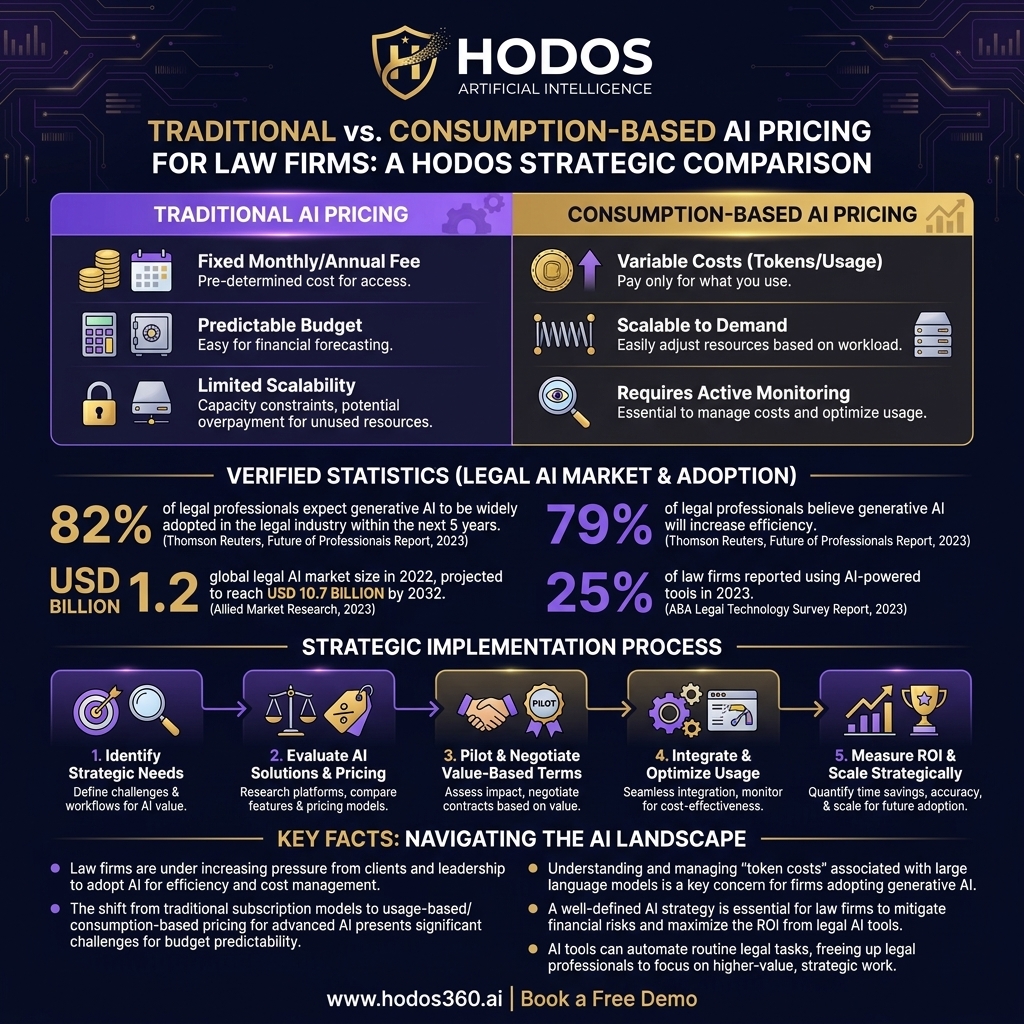
- ✓Conduct thorough cost-benefit analyses for each potential AI tool, projecting efficiency gains against "legal AI pricing" models.
- ✓Start with pilot projects in specific practice areas to test "AI ROI legal" and gather real-world data on "usage-based billing" before full rollout.
- ✓Negotiate pricing models with vendors, seeking predictable caps on "token costs," tiered pricing, or volume discounts to mitigate financial uncertainty.
- ✓Invest in robust internal training programs to maximize tool utilization and ensure efficient usage, directly impacting "usage-based billing."
- ✓Integrate AI tools strategically into existing "legal workflows" to streamline processes and avoid redundant efforts, optimizing "law firm AI costs."
- ✓Monitor usage analytics diligently to identify cost-saving opportunities and adjust "AI strategy legal" as needed.
- ✓Educate "clients" on the value AI brings to their matters, explaining how efficiency gains can lead to more predictable or even reduced overall legal fees, justifying "legal tech adoption."
The Legal Professional's Evolving Role in an AI-Powered Landscape
Beyond the financial considerations of "legal AI pricing," lies the profound impact on the legal professional's role itself. AI is not poised to replace lawyers, but rather to augment their capabilities, freeing them from mundane, repetitive tasks to focus on higher-value strategic work, complex problem-solving, and direct client engagement. As Brad Smith, Vice Chair and President of Microsoft, has often stated, AI is a tool designed to empower human ingenuity, not diminish it. For instance, an attorney equipped with an AI assistant for research or document drafting can dedicate more time to nuanced legal argumentation, client counseling, or business development. This shift elevates the practice of law, making it more intellectually stimulating and client-centric. The investment in "AI legaltech," even with its associated "law firm AI costs" and "usage-based billing," becomes an investment in the professional development of a firm's "legal teams" and their capacity to deliver superior legal services. It's about enabling lawyers to be better lawyers, a powerful argument against "pricing fears."
However, this evolution also places new responsibilities on legal professionals. Learn more about AI Marketing: The Ultimate Guide for Law Firm Growth. The ethical imperative for responsible AI adoption is paramount. Lawyers must remain competent in understanding the technology they use, as articulated in ABA Model Rule 1.1 (Competence), which includes staying abreast of changes in technology. This means understanding the limitations and potential biases of AI tools, ensuring data privacy, and maintaining human oversight over AI-generated outputs. The burgeoning regulatory landscape, exemplified by the EU AI Act, underscores the importance of ethical "AI strategy legal." Firms that prioritize ethical AI implementation will not only safeguard their clients' interests but also build a reputation for trustworthiness and innovation. This commitment to responsible "legal tech adoption" ultimately enhances the perceived "AI ROI legal" by fostering client confidence and mitigating potential legal and reputational risks. The future of "legal innovation" hinges not just on adopting AI, but on adopting it wisely and ethically.
The Ethical Imperative of Responsible AI Adoption
The widespread adoption of AI in legal practice brings with it a non-negotiable ethical imperative. Firms must consider issues of bias in AI algorithms, data privacy and security, and the potential for AI to produce inaccurate or misleading information. ABA Model Rule 1.6 (Confidentiality of Information), for example, becomes even more critical when client data is processed by third-party AI tools. "Legal leadership" must implement robust data governance policies, conduct thorough due diligence on AI vendors, and ensure continuous human review of AI-generated content. Ignoring these ethical considerations can lead to severe reputational damage, malpractice claims, and regulatory penalties, making any perceived savings from lower "legal AI pricing" utterly moot. Responsible "AI strategy legal" is not an add-on; it is foundational to sustainable and trustworthy "legal innovation."

Key Takeaways and Next Steps: Building a Sustainable AI Future
The "pricing fears" surrounding the increasing ubiquity of "legal AI pricing" are valid, but they are surmountable with a strategic, informed approach. The transition to "usage-based billing" and the complexities of "token costs" demand a new level of financial scrutiny and operational agility from law firms. However, by embracing a value-driven mindset, conducting thorough due diligence, implementing phased adoption, and prioritizing ethical considerations, firms can transform these challenges into unparalleled opportunities. The goal is not merely to adopt AI, but to integrate it intelligently to enhance efficiency, elevate client service, and secure a competitive edge in the evolving legal market. Firms that empower their "legal teams" with the right "AI legaltech" and a clear "AI strategy legal" will unlock substantial "AI ROI legal," turning potential liabilities into powerful assets.
Ultimately, the future belongs to firms that view AI as a strategic partner, not just another line item on a budget. Moving beyond the initial anxieties, firms should focus on the immense value AI brings in streamlining operations, improving legal outcomes, and fostering greater "legal innovation." HODOS 360’s AI-powered platform, with its comprehensive AI Law Firm Management System, is designed precisely to help firms navigate these complexities, offering solutions that provide predictable cost management, optimize workflows, and maximize the return on your AI investment. By leveraging integrated tools for case management, document automation, and AI-powered workflows, firms can achieve operational excellence and confidently embrace the AI revolution, ensuring that "law firm AI costs" are an investment in growth, not a source of fear.
Frequently Asked Questions
What are the primary types of legal AI pricing models law firms encounter?+
Law firms primarily encounter two main types: traditional subscription-based models, offering predictable monthly or annual fees, and modern consumption-based models. The latter charges based on actual usage, such as the number of documents processed, queries run, or 'tokens' consumed by large language models. This shift, particularly with 'token costs,' introduces variability and requires careful monitoring to manage 'legal AI pricing' effectively.
How can law firms mitigate the unpredictability of usage-based billing and token costs?+
Mitigating unpredictability involves several strategies. Firms should implement phased adoption with pilot programs to understand actual usage patterns, negotiate with vendors for predictable caps or tiered pricing, and invest in robust internal training for efficient AI tool utilization. Monitoring usage analytics, setting clear internal guidelines for AI use, and aligning 'AI strategy legal' with specific, measurable goals can also help manage 'law firm AI costs' and reduce 'pricing fears.'
What is the true ROI of investing in legal AI, beyond simple cost savings?+
Beyond direct cost savings from automating tasks, the true 'AI ROI legal' encompasses enhanced client outcomes, competitive advantage, and improved attorney satisfaction. AI enables faster, more thorough legal research and document review, allowing lawyers to focus on higher-value strategic work. This leads to better client service, quicker case resolution, and increased capacity for new business, positioning the firm as a leader in 'legal innovation' and attracting top talent.
How can a small or mid-sized firm compete with larger firms regarding AI adoption costs?+
Small and mid-sized firms can compete by focusing on strategic, targeted 'legal tech adoption.' Instead of large-scale investments, they should identify specific pain points where AI offers maximum impact (e.g., client intake, document automation). Leveraging SaaS-based AI solutions, negotiating flexible 'legal AI pricing,' and prioritizing tools that integrate seamlessly into existing 'legal workflows' can provide significant 'AI ROI legal' without prohibitive 'law firm AI costs.' Phased implementation is key.
What ethical considerations should firms bear in mind when adopting AI in legal practice?+
Firms must uphold ethical duties when adopting AI, including competence (ABA Model Rule 1.1) in understanding the technology's capabilities and limitations, and confidentiality (ABA Model Rule 1.6) regarding client data security. Addressing potential biases in AI algorithms, ensuring human oversight for AI-generated outputs, and complying with evolving regulations like the EU AI Act are crucial. A robust 'ethical AI strategy legal' builds client trust and safeguards the firm's reputation.