

AI Website Security: Essential Defenses for Law Firms
The digital frontier of legal practice, once a realm of burgeoning opportunity, now faces an increasingly sophisticated array of threats. The recent revelation by Sophos X-Ops researchers of a malvertising campaign distributing the previously undocumented 'Beagle' Windows backdoor via a fake Claude AI website serves as a stark reminder of this evolving menace.
This incident, detailed by security expert Gabor Szappanos, underscores a critical vulnerability: the ease with which advanced AI platforms can be mimicked to ensnare unsuspecting users. For law firms, whose very existence hinges on trust and the impenetrable security of sensitive client data, such an attack is not merely a technical glitch; it's an existential threat.
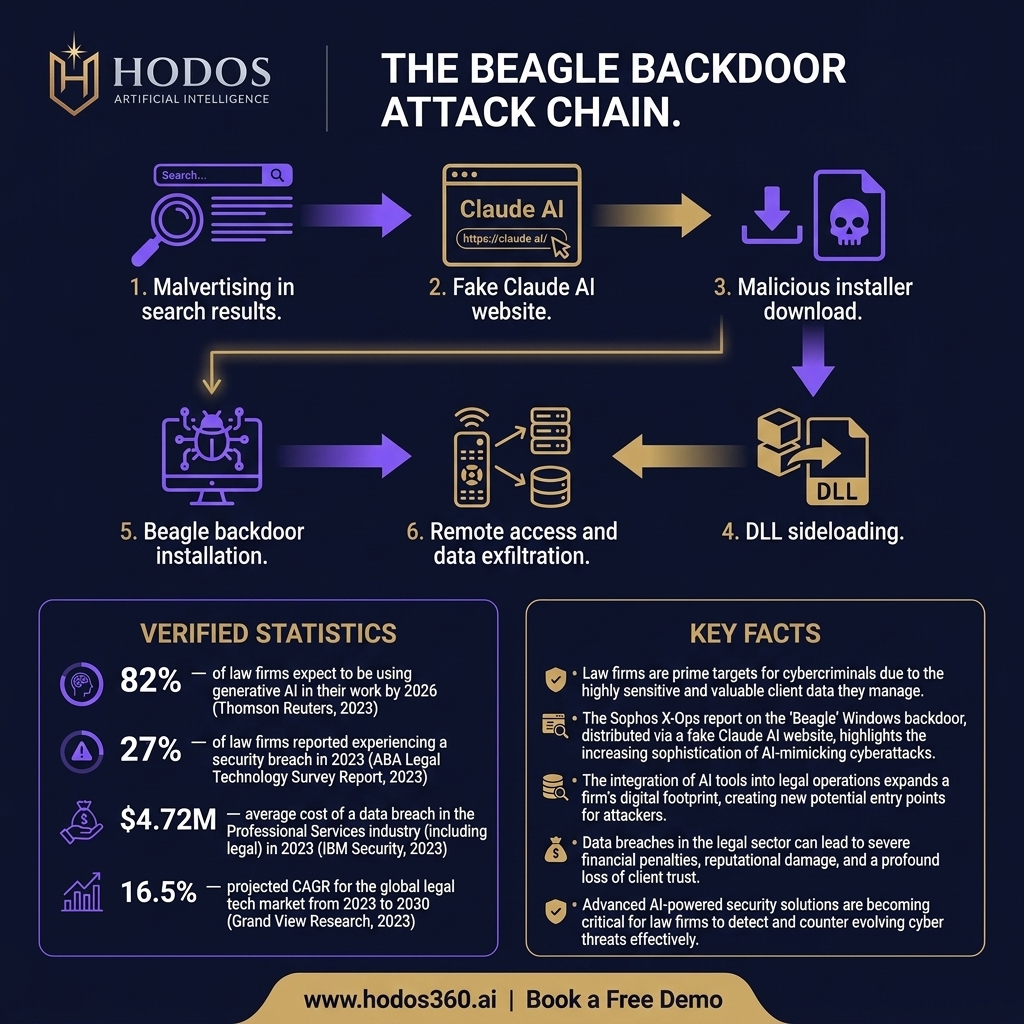
The fake Claude AI website, designed to appear legitimate, leveraged DLL sideloading to install the Beagle backdoor, granting attackers persistent remote access and data exfiltration capabilities. This level of deception, harnessing the credibility of a leading AI developer like Anthropic, signals a new era where digital defenses must be as agile and intelligent as the threats they aim to counter.
The implications for legal professionals are profound, demanding a reevaluation of their web and mobile development strategies and a heightened awareness of the sophisticated tactics employed by cyber adversaries.
The legal sector, a prime target due to the invaluable nature of the information it handles—ranging from corporate secrets and intellectual property to sensitive personal identifiable information (PII) of clients—cannot afford to be complacent.
The 'Beagle' backdoor incident is not an isolated event but a symptom of a broader trend where cybercriminals exploit public interest in rapidly advancing technologies like AI. As law firms increasingly integrate AI tools into their operations, from case management to client intake, their digital footprint expands, creating more potential entry points for attackers.
The proliferation of deepfake technology and sophisticated phishing tactics, often indistinguishable from legitimate communications, renders traditional security measures insufficient. The challenge lies in creating a robust digital ecosystem that not only leverages AI for efficiency but also inherently protects against its misuse. This requires a comprehensive approach to AI website security, extending beyond basic firewalls to include proactive threat intelligence, continuous vulnerability assessments, and secure, AI-powered web development practices.
The urgency for law firms to bolster their digital defenses has never been greater. The financial and reputational costs of a data breach can be catastrophic, potentially leading to regulatory fines, loss of client trust, and irreparable damage to a firm's standing. As noted by the American Bar Association (ABA) in its annual TechReport, cybersecurity incidents remain a persistent concern for legal professionals, with a significant percentage of firms reporting breaches or attempted breaches annually.
The 'Beagle' attack is a clear signal that attackers are adapting their methods, employing advanced social engineering and technical exploits that leverage the very technologies designed to empower us. Therefore, understanding the mechanics of such attacks, the vulnerabilities they exploit, and the advanced defense mechanisms available is paramount.
Law firms must transcend reactive security postures and embrace a proactive, intelligence-driven strategy to safeguard their digital assets and client confidentiality in this new era of AI-powered cyber warfare. Learn how to protect your firm and client data with cutting-edge AI website security solutions.
- ✓Understanding the Beagle Backdoor: How sophisticated malvertising campaigns exploit AI interest.
- ✓The Unique Vulnerabilities of Law Firms: Why legal data is a prime target for cybercriminals.
- ✓Proactive Defense Strategies: Implementing robust AI website security measures.
- ✓Leveraging AI for Enhanced Protection: Using intelligent systems to detect and prevent threats.
- ✓Building a Resilient Digital Future: A holistic approach to legal tech security and compliance.
- ✓The Imperative of Continuous Vigilance: Why cybersecurity is an ongoing commitment, not a one-time fix.
The Beagle Backdoor: A New Frontier in Cyber Espionage Against AI Users
The 'Beagle' backdoor, uncovered by Sophos X-Ops, represents a chilling evolution in cyberattack methodology, specifically targeting the burgeoning interest in advanced AI platforms. The attack vector was ingenious: cybercriminals created a highly convincing, fake Claude AI website. Users, eager to download Anthropic’s cutting-edge AI assistant, would inadvertently download a malicious installer.
This installer, instead of providing the legitimate Claude AI application, utilized a technique known as DLL sideloading to inject the Beagle backdoor onto Windows systems. Once installed, Beagle grants attackers extensive control over the compromised machine, enabling data exfiltration, remote command execution, and persistent access, often without the user's immediate knowledge.
This incident highlights the critical need for vigilance when interacting with new software and online platforms, especially those related to popular AI tools.
The sophistication of the 'Beagle' campaign lies not just in its technical execution but also in its social engineering prowess. Learn more about AI Legal Research: The Ultimate Evolution of Legal Analysis.
By mimicking a trusted brand like Anthropic and leveraging malvertising—malicious advertisements designed to appear legitimate in search results—attackers bypassed many traditional security filters. This strategy capitalizes on the human element, exploiting users' trust and eagerness to access new technology. The ability to create deepfake websites and use AI-generated content to enhance the legitimacy of phishing campaigns makes it increasingly difficult for even tech-savvy individuals to discern genuine from fraudulent.
As Dario Amodei, CEO of Anthropic, and other AI leaders push the boundaries of what AI can achieve, the shadow cast by those who seek to exploit these advancements grows longer. The 'Beagle' backdoor is a testament to the escalating arms race in cybersecurity, where attackers are constantly refining their techniques to exploit the weakest link in any security chain: human perception and trust.
Escalating Digital Threats to Law Firms: Beyond Traditional Phishing
Law firms are uniquely attractive targets for cybercriminals due to the highly sensitive and confidential nature of the data they manage. Client files, litigation strategies, intellectual property, financial records, and personally identifiable information (PII) are all high-value assets on the dark web. The ABA's 2023 TechReport revealed that over 25% of law firms experienced a security breach, with phishing remaining the most common attack vector.
However, incidents like the 'Beagle' backdoor demonstrate a shift towards more sophisticated, AI-enhanced attacks that go far beyond simple phishing emails. Attackers are now employing tactics like malvertising and deepfake websites, making it much harder for busy legal professionals to differentiate between legitimate and malicious digital interactions.
This creates a significant challenge for firms struggling to keep pace with the evolving threat landscape.
Beyond the direct financial and reputational damage, law firms face severe ethical and regulatory repercussions from data breaches. Learn more about AI-Native Law Firms: Essential Blueprint for Future Legal Success.
ABA Model Rule 1.6 on Confidentiality of Information requires lawyers to make reasonable efforts to prevent the inadvertent or unauthorized disclosure of, or unauthorized access to, information relating to the representation of a client. Furthermore, Model Rule 1.1 on Competence mandates that lawyers keep abreast of changes in the law and its practice, including the benefits and risks associated with relevant technology.
A breach resulting from inadequate AI website security or a lack of understanding of modern cyber threats can lead to disciplinary action, costly litigation, and a devastating loss of client trust. Firms like those led by prominent legal tech advocates, such as Richard Susskind, have long emphasized the ethical imperative to safeguard client data, a responsibility that now extends to understanding and mitigating risks posed by advanced AI-driven cyberattacks.
The stakes are higher than ever, demanding a proactive and robust approach to cybersecurity.
The Peril of Supply Chain Attacks in Legal Tech
The 'Beagle' incident also highlights the growing risk of supply chain attacks, where attackers compromise a trusted vendor or platform to then infiltrate downstream users. In the legal tech ecosystem, where firms rely on a multitude of software-as-a-service (SaaS) providers for case management, document automation, and communication, the potential for such attacks is considerable.
A compromise in a widely used legal AI platform, or even a convincing imitation, could have widespread ramifications across the entire legal industry. This vulnerability extends to the very infrastructure upon which law firm websites are built and maintained. Learn more about AI SEO: Ultimate Content Strategy for Law Firms.
If a firm’s web development partner or hosting provider has lax security, it creates a potential entry point for attackers to deploy malware or exploit vulnerabilities directly on the firm’s public-facing website. This emphasizes the need for due diligence not only in internal security practices but also in vetting every third-party vendor and service provider that interacts with a firm’s digital presence or data.
Fortifying Your Digital Perimeter: Proactive AI Website Security Strategies
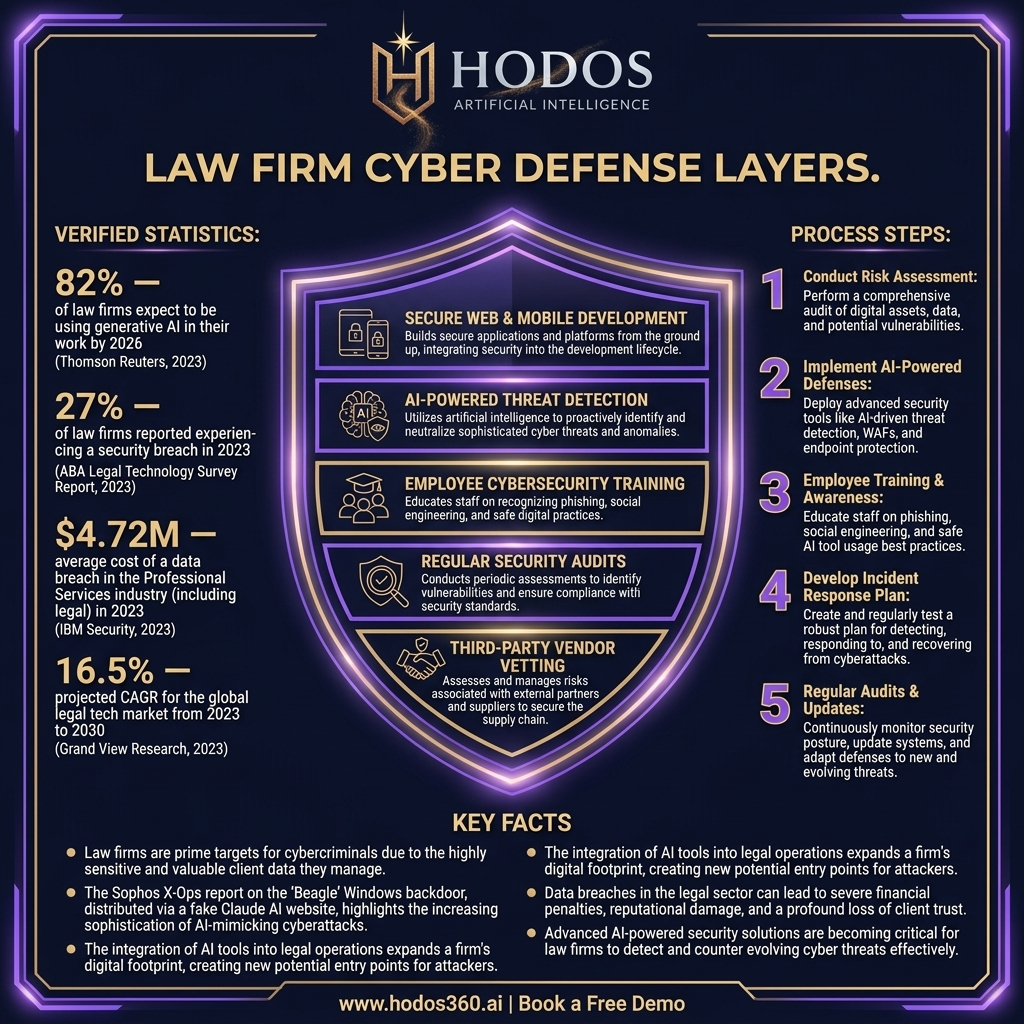
Building an impenetrable digital perimeter for law firms in the age of AI requires a multi-faceted and proactive approach, moving beyond reactive measures to anticipate and neutralize threats. At its core, this involves investing in robust web and mobile development practices that prioritize security from inception.
This means secure coding standards, regular security audits, penetration testing, and continuous monitoring for vulnerabilities. Firms must ensure their public-facing websites and internal portals are built with the latest security protocols, including strong SSL/TLS encryption, robust content security policies (CSP), and protection against common web exploits like SQL injection and cross-site scripting (XSS).
Furthermore, comprehensive employee training is non-negotiable. Even the most advanced technical defenses can be circumvented by human error, making cybersecurity awareness training—specifically on identifying sophisticated phishing, malvertising, and deepfake threats—a critical component of any firm's defense strategy. This training should be ongoing, reflecting the dynamic nature of cyber threats.
Beyond technical safeguards, firms must implement stringent internal policies regarding software downloads and third-party AI tool adoption. Before integrating any new AI platform or software, thorough vetting is essential, including reviewing vendor security certifications, data handling policies, and incident response plans. For instance, when considering a new AI legal research tool or a document automation platform, firms should inquire about its security architecture, data encryption methods, and compliance with privacy regulations like GDPR or CCPA.
Firms should also leverage advanced domain monitoring services to detect fraudulent domains impersonating their brand or those of their trusted partners, a direct countermeasure to malvertising campaigns like the 'Beagle' attack. Learn more about Essential Guide: Customer Support Voice AI for Law Firms. This proactive monitoring can help identify and take down malicious sites before they cause significant damage.
Industry leaders like Mary Shen O'Carroll, formerly of CLOC and now a prominent legal operations consultant, consistently advocate for rigorous vendor management and security diligence as foundational elements of modern legal practice.
This is where platforms like HODOS 360 become invaluable. Our Web & Mobile Development service is specifically designed to build and fortify AI-powered websites for law firms, integrating advanced security features from the ground up.
We utilize AI-powered website building tools that incorporate responsive design, SEO optimization, and high-converting templates, all underpinned by enterprise-grade security protocols. Our approach includes continuous vulnerability scanning, real-time threat detection, and adherence to best practices in secure coding and infrastructure management. By partnering with a platform that understands the unique security demands of the legal sector, law firms can establish a resilient digital presence that not only attracts clients but also safeguards their most valuable assets.
Don't wait for an attack; build your defense with HODOS 360's secure web development expertise. Discover how to transform your firm's digital presence into an unyielding fortress.
Leveraging AI for Advanced Threat Detection and Response
While AI can be exploited by attackers, it is also a powerful ally in the fight against cyber threats. Law firms can leverage AI-powered security solutions to enhance their threat detection and response capabilities significantly. AI and machine learning algorithms excel at identifying anomalies in network traffic, user behavior, and system logs that human analysts might miss.
For example, AI-driven security platforms can quickly detect the tell-tale signs of a 'Beagle' backdoor infection, such as unusual outbound network connections or unauthorized file modifications, by analyzing vast datasets in real-time. Companies like Darktrace and CrowdStrike have pioneered AI-driven cybersecurity, using autonomous response capabilities to neutralize threats before they can cause widespread damage.
Integrating such AI tools into a firm's security stack provides an intelligent layer of defense that continuously learns and adapts to new threats, offering a crucial advantage in the evolving cyber landscape. This proactive use of AI moves beyond traditional signature-based detection, which is often too slow to catch zero-day exploits or novel malware variants.
The application of AI extends beyond mere detection to predictive analytics, where AI models can forecast potential attack vectors and vulnerabilities based on global threat intelligence and historical data. Learn more about Voice Assistant Migration: An Essential Guide for Law Firms. This allows law firms to implement preventative measures before an attack even materializes.
For instance, AI can analyze trends in malvertising campaigns, identifying emerging patterns and informing web development teams on how to harden their online properties against similar future attacks. Furthermore, AI-powered security orchestration, automation, and response (SOAR) platforms can automate routine security tasks, freeing up IT personnel to focus on more complex threat analysis.
This automation significantly reduces response times during an incident, minimizing potential damage and ensuring a more efficient recovery. As Jensen Huang, CEO of NVIDIA, often emphasizes the transformative power of AI across industries, its application in cybersecurity for critical sectors like law is becoming indispensable for maintaining robust defenses in a hostile digital environment.
The Role of AI in Proactive Web Security
Specifically for web security, AI plays a pivotal role in identifying and neutralizing threats before they impact users. AI algorithms can be trained to recognize the subtle cues of deepfake websites, malicious redirects, and fraudulent content, often faster and more accurately than human inspection. This includes analyzing domain registration patterns, website content inconsistencies, and unusual traffic behaviors that might indicate a phishing or malvertising campaign.
AI-powered web application firewalls (WAFs) can intelligently filter malicious traffic, protecting websites from a wide array of attacks, including those that exploit application-layer vulnerabilities. Learn more about Legal AI Gap: Bridging the Divide for Law Firms in 2026. By continuously monitoring user interactions and server responses, AI systems can adapt to new attack methods, providing a dynamic shield against evolving threats.
This proactive AI-driven web security is crucial for law firms, ensuring their online presence remains a trusted and secure gateway for clients and information, rather than a potential entry point for sophisticated backdoors like Beagle.
Building a Resilient Future: A Holistic Approach to Legal Tech Security
Ultimately, safeguarding law firms against advanced cyber threats like the 'Beagle' backdoor demands a holistic, integrated approach to legal tech security. This means viewing cybersecurity not as an IT department's sole responsibility, but as a foundational element of firm-wide strategy, deeply embedded in every aspect of operations, from client intake to document management and web presence.
It requires fostering a culture of cybersecurity awareness where every employee understands their role in protecting sensitive data. This holistic view encompasses robust technical defenses, continuous employee education, strict policy enforcement, and regular, independent security audits and penetration testing. Firms should engage third-party experts to regularly test their systems for vulnerabilities, simulating real-world attacks to identify weaknesses before cybercriminals do.
The goal is to build a resilient ecosystem that can not only withstand attacks but also rapidly detect, respond to, and recover from them with minimal disruption.
The future of legal practice is undeniably intertwined with technology, particularly AI. Firms that embrace this technological evolution while prioritizing an unyielding commitment to security will be the ones that thrive.
This involves strategic investments in secure legal tech platforms and expert web development services that are designed with the unique compliance and confidentiality needs of the legal sector in mind. It means staying informed about emerging threats and continuously adapting security protocols. As the legal landscape becomes increasingly digital, the ability to protect client data and maintain trust will be the ultimate differentiator.
The lessons from the 'Beagle' backdoor incident are clear: complacency is not an option. Law firms must proactively build a future where innovation and security are not mutually exclusive but mutually reinforcing, ensuring their digital presence is a testament to their commitment to client protection and ethical practice.
The Imperative of Regular Security Audits and Penetration Testing
To truly fortify their digital perimeter, law firms must make regular security audits and penetration testing an indispensable part of their cybersecurity strategy. An audit provides a comprehensive review of a firm's security posture, identifying vulnerabilities in systems, networks, and applications, including their public-facing websites.
Penetration testing, often referred to as ethical hacking, takes this a step further by actively attempting to exploit identified weaknesses, mimicking the tactics of real-world attackers. This hands-on approach helps uncover hidden vulnerabilities, such as those that might allow for DLL sideloading or the deployment of backdoors like Beagle.
By engaging certified cybersecurity professionals for these assessments, law firms gain invaluable insights into their actual risk exposure and receive actionable recommendations for strengthening their defenses. This proactive validation is critical for maintaining compliance with regulatory requirements and, more importantly, for ensuring the ongoing integrity and confidentiality of client information.

Key Takeaways and Next Steps
The 'Beagle' backdoor attack via a fake Claude AI website is a potent reminder that the digital threats facing law firms are evolving rapidly, becoming more sophisticated and harder to detect. The era of simple phishing is over; we are now contending with AI-powered malvertising and deepfake techniques designed to exploit trust and technological fascination.
For law firms, the imperative is clear: invest in robust AI website security and comprehensive digital defense strategies that are as advanced as the threats themselves. This includes secure web and mobile development, continuous employee training, rigorous third-party vendor vetting, and leveraging AI for proactive threat detection.
Firms must adopt a culture of perpetual vigilance, understanding that cybersecurity is an ongoing commitment to protecting client confidentiality and maintaining the integrity of their practice. The future of legal excellence hinges on the ability to navigate this complex digital landscape securely.
To ensure your firm is not the next target, prioritize building a secure and resilient digital presence.
Evaluate your current web and mobile development practices, assess your team's cybersecurity awareness, and explore advanced AI-powered security solutions. Platforms like HODOS 360 offer specialized Web & Mobile Development services tailored for the legal industry, providing the secure infrastructure and expertise needed to safeguard your firm against the most advanced cyber threats.
Don't let your digital presence become a vulnerability; transform it into a fortress. Contact HODOS 360 today for a consultation on fortifying your firm's AI website security.
Frequently Asked Questions
What is the Beagle backdoor and how was it delivered?+
The Beagle backdoor is a new Windows malware discovered by Sophos X-Ops that grants attackers remote access and data exfiltration capabilities. It was delivered via a malvertising campaign using a fake Claude AI website, tricking users into downloading a malicious installer that employed DLL sideloading to infect systems. This highlights the dangers of sophisticated online impersonation.
Why are law firms prime targets for AI-powered cyberattacks?+
Law firms are prime targets due to the highly sensitive and valuable client data they handle, including PII, corporate secrets, and litigation strategies. AI-powered attacks, like deepfake websites and advanced phishing, exploit the trust and busy schedules of legal professionals, posing significant ethical and financial risks if client confidentiality is breached.
How can law firms detect and prevent fake AI websites and malvertising?+
Law firms can detect fake AI websites by scrutinizing URLs, looking for subtle inconsistencies, and using trusted sources for software downloads. Prevention involves robust web development with strong security protocols, employee training on cyber hygiene, and leveraging AI-powered domain monitoring services to identify and take down fraudulent sites impersonating their brand or trusted AI platforms.
What role does HODOS 360's Web & Mobile Development play in security?+
HODOS 360's Web & Mobile Development service builds AI-powered websites for law firms with security at its core. It integrates enterprise-grade security protocols, continuous vulnerability scanning, and real-time threat detection. This ensures law firms have a resilient digital presence that protects against advanced cyber threats like the Beagle backdoor, safeguarding client data and firm reputation.
What are the ethical obligations of attorneys regarding client data security?+
Attorneys have ethical obligations under ABA Model Rule 1.6 (Confidentiality) to protect client information and Rule 1.1 (Competence) to understand the benefits and risks of technology. This includes implementing reasonable security measures to prevent unauthorized access to client data, staying informed about evolving cyber threats, and ensuring third-party vendors also adhere to strict security standards.