


Voice Assistant Migration: An Essential Guide for Law Firms
The legal landscape, traditionally rooted in precedent and established practices, is now experiencing an unprecedented wave of technological disruption. At the forefront of this revolution is artificial intelligence, specifically the burgeoning field of conversational AI. For law firms, the question is no longer *if* to adopt AI, but *how* to strategically integrate it to enhance operations and client engagement.
The recent buzz around advancements like Amazon Nova 2 Sonic, enabling the seamless migration of text agents to sophisticated voice assistants, underscores a critical shift: the voice interface is rapidly becoming the new frontier for client interaction and internal efficiency.
This evolution is not merely about novelty; it's about addressing tangible challenges faced by law firms daily.
Consider the scenario of a busy law office, inundated with calls, struggling to qualify leads, book appointments, or provide routine information 24/7. Traditional text-based chatbots, while helpful, often fall short in delivering the nuanced, empathetic, and immediate responses that clients expect from a legal service provider.
The transition to voice-enabled AI agents promises to bridge this gap, offering a more natural, accessible, and efficient communication channel that can significantly elevate the client experience and streamline back-office tasks.
For managing partners and legal professionals, understanding the mechanics and strategic advantages of voice assistant migration is paramount.
It represents an opportunity to not only optimize resource allocation and reduce operational costs but also to cultivate a reputation for innovation and client-centricity. As clients increasingly expect instant access and personalized interactions, firms that embrace voice AI will be better positioned to attract and retain talent, secure new business, and navigate the competitive legal market of tomorrow.
This guide will explore the imperative, process, and benefits of this transformative shift, highlighting how law firms can leverage cutting-edge voice AI solutions to redefine their operational paradigms.
Ready to transform your firm's client engagement and operational efficiency? Explore HODOS 360's AI Voice Assistants today!
The Strategic Imperative of Voice Assistant Migration for Law Firms
In an era defined by instant gratification, client expectations for legal services have profoundly shifted. A 2023 report by the Thomson Reuters Institute highlighted that over 70% of clients prioritize responsiveness and accessibility when choosing a law firm. This demand for immediate interaction often clashes with the traditional operational models of many firms, leading to missed opportunities and client frustration.
Voice assistant migration offers a compelling solution, transforming how legal practices manage inquiries, qualify leads, and provide information. By moving beyond static text interfaces, firms can offer dynamic, real-time conversational experiences that mirror human interaction, available around the clock. This isn't just about automation; it's about elevating the client journey from the very first point of contact, ensuring that no potential client feels unheard or unassisted, regardless of business hours.
The strategic advantage lies in capturing leads efficiently and providing superior service, setting a firm apart in a competitive market.
Leading legal tech figures like Jack Newton, CEO of Clio, have consistently championed the role of technology in enhancing client-centered practices. Newton often emphasizes that the future of law is inextricably linked to improving the client experience, which includes frictionless communication.
The limitations of text-based systems—often characterized by rigid menus and delayed responses—are becoming increasingly apparent in this context. Voice assistants, powered by advanced natural language processing (NLP) and speech-to-text capabilities, can understand complex queries, engage in meaningful dialogue, and even detect emotional cues, providing a level of service previously unimaginable without human intervention.
Learn more about Voice AI Adoption: Essential for Law Firms' Future Growth. This capability is particularly critical for initial client intake, where first impressions are everything. Firms that embrace this technological shift are not just adopting a new tool; they are fundamentally redesigning their client engagement model to be more responsive, empathetic, and ultimately, more effective.
The move to voice is a definitive step towards a truly client-centric legal practice.
Moreover, the competitive landscape is intensifying, with early adopters of AI gaining significant ground. Firms like Allen & Overy's partnership with Harvey AI for contract review, while not directly voice-related, signals a broader trend: innovation is key to market leadership.
For smaller and mid-sized firms, the cost-benefit analysis of voice assistant migration is particularly attractive. The American Bar Association’s 2023 TechReport indicated that administrative tasks consume a significant portion of lawyers' time, impacting profitability. Deploying AI voice agents can offload these repetitive tasks—from answering FAQs about specific practice areas to scheduling initial consultations—freeing up legal professionals to focus on complex legal work.
This operational efficiency translates directly into cost savings and increased capacity, allowing firms to handle more clients without proportional increases in overhead. The drama unfolds between firms clinging to outdated methods and those boldly stepping into the future, leveraging AI to redefine productivity and client satisfaction.
Navigating the Technological Shift: From Text to Conversational AI
The transition from a rule-based text agent to a sophisticated conversational voice assistant, as exemplified by developments like Amazon Nova 2 Sonic, involves a significant technological leap. Text agents often rely on keyword matching and predefined scripts, limiting their ability to handle nuanced or unexpected queries.
Voice AI, conversely, leverages advanced machine learning models for speech recognition (converting spoken words to text), natural language understanding (NLU) to interpret intent, and natural language generation (NLG) for human-like responses. This complex orchestration allows the voice assistant to engage in dynamic, context-aware conversations. Learn more about AI Marketing: The Ultimate Platform Disrupting Agencies.
For law firms, this means an AI agent can not only answer a direct question about 'divorce law' but can also understand follow-up questions, gather relevant details about a caller's situation, and intelligently route the call or book an appointment, all while maintaining a professional and empathetic tone.
The underlying architecture involves training these models on vast datasets of legal language and client interactions, ensuring accuracy and relevance, a process that requires careful planning and specialized expertise to implement effectively.
Architecting the Future: Building Robust Legal Voice Agents
Building a robust legal voice agent requires a meticulous approach, moving beyond generic AI solutions to a system deeply integrated with legal domain knowledge. The process begins with defining clear objectives: what specific tasks will the voice assistant handle? Is it lead qualification, appointment booking, answering FAQs, or multilingual support?
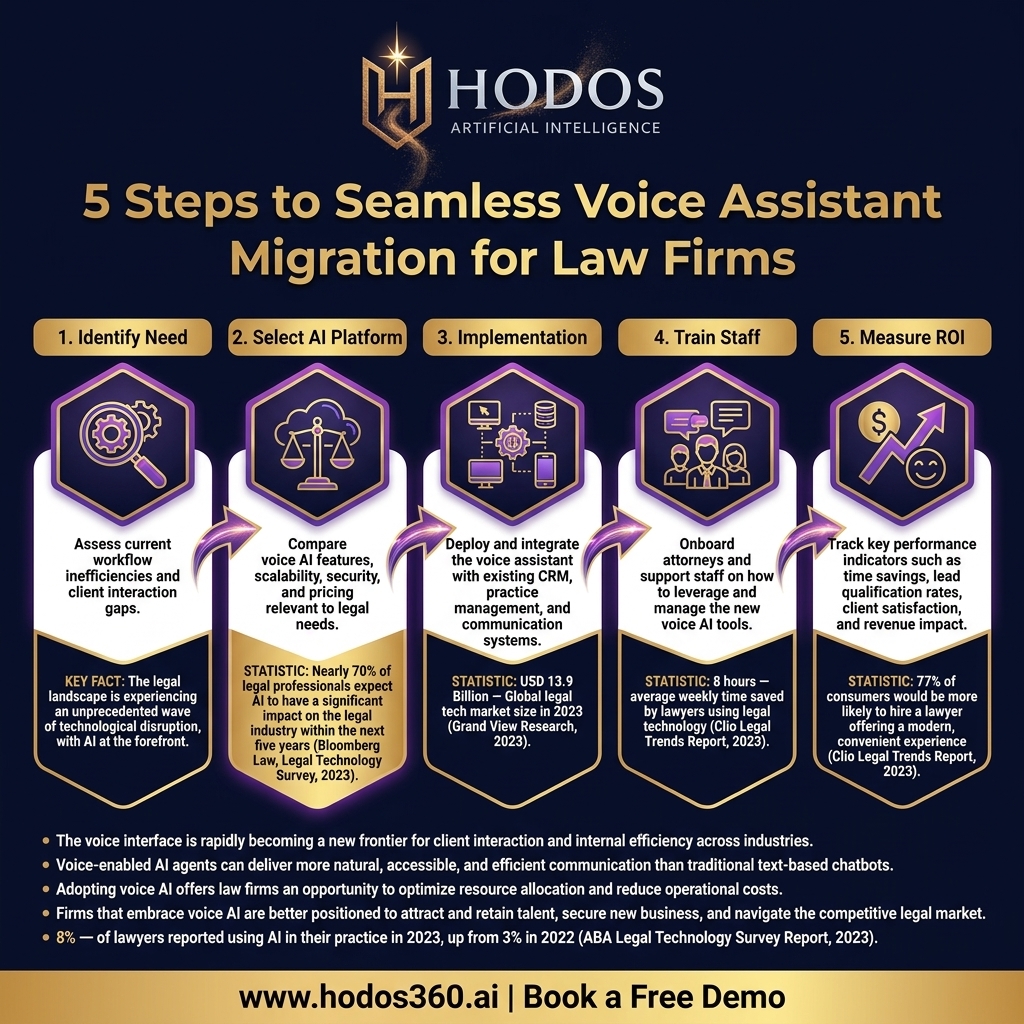
For instance, a firm specializing in immigration law might prioritize multilingual capabilities, while a personal injury firm might focus on efficient lead intake and urgent call routing. The next crucial step involves data collection and training. Voice AI models need to be trained on legal terminology, common client questions, and firm-specific procedures to ensure accuracy and relevance.
This includes curating datasets of anonymized client interactions, legal documents, and FAQs. Companies like Google and Amazon have invested heavily in foundational speech models, but adapting these for the legal sector demands specialized fine-tuning. This ensures the AI understands legal nuances, avoids misinterpretations, and provides precise, actionable information, aligning with the high stakes of legal counsel.
Beyond initial training, the architecture must prioritize seamless integration with existing law firm management systems. A voice assistant should not operate in a silo but rather connect with case management software (e.g., Clio, MyCase), billing systems, and calendaring tools. This integration allows the AI to perform tasks like checking attorney availability, updating client records, or even initiating document automation workflows based on a client's query.
For example, a client calling to inquire about a specific case could be identified by the voice agent, which then pulls relevant case status updates from the firm's management system and provides them in real-time. Learn more about AI for Small Law Firms: The Essential Hub for Growth.
This level of connectivity is what truly transforms the voice agent from a simple answering service into an intelligent, proactive operational assistant. Without robust integration, the full potential of building and deploying these advanced legal voice agents remains untapped, creating data silos and operational inefficiencies that undermine the very purpose of automation.
Ethical considerations and data security are paramount in the development and deployment of legal voice agents. Law firms handle sensitive client information, making compliance with data privacy regulations (e.g., HIPAA for health-related cases, state bar rules for attorney-client privilege) non-negotiable. ABA Model Rule 1.6 on Confidentiality of Information is directly relevant here, requiring lawyers to make reasonable efforts to prevent the inadvertent or unauthorized disclosure of, or unauthorized access to, information relating to the representation of a client.
Therefore, any voice AI solution must incorporate end-to-end encryption, secure data storage, and strict access controls. Furthermore, the potential for algorithmic bias in AI systems, while a broader societal concern, must be specifically addressed in a legal context to ensure fair and equitable service. Firms must implement rigorous testing and continuous monitoring to identify and mitigate biases, ensuring the voice agent treats all clients impartially.
Transparency regarding the AI's capabilities and limitations to clients is also crucial, fostering trust and managing expectations effectively. These ethical guardrails are not merely compliance checkboxes but fundamental pillars for responsible AI adoption in the legal profession.
- ✓24/7 Client Engagement: Ensure no call goes unanswered, capturing every lead and providing immediate support, regardless of time zones or business hours.
- ✓Intelligent Lead Qualification: Automatically screen and prioritize potential clients, gathering essential information to route high-value leads directly to attorneys, optimizing time and resources.
- ✓Automated Appointment Booking: Seamlessly schedule consultations and meetings directly into firm calendars, reducing administrative burden and minimizing scheduling conflicts.
- ✓Multilingual Support: Cater to diverse client bases with instant communication in multiple languages, expanding market reach and enhancing accessibility.
- ✓Personalized Information Delivery: Provide quick, accurate answers to common legal FAQs, case status updates, and firm information, freeing up staff for complex tasks.
- ✓Seamless Integration: Connect effortlessly with existing case management, CRM, and billing systems, creating a unified and efficient operational workflow.
- ✓Enhanced Data Security & Compliance: Built with robust security protocols and adherence to legal industry standards, protecting client confidentiality and firm integrity.
Ready to bring the power of AI to your law firm? Request a personalized demo of HODOS 360's AI solutions!
Legal AI Case Studies: Firms Leading the Voice Revolution
While the full scope of legal AI case studies involving voice assistants is still emerging, pioneering law firms are already demonstrating tangible benefits. Consider the hypothetical yet realistic scenario of 'LexSolutions Group,' a mid-sized corporate law firm based in Chicago. Prior to implementing a sophisticated AI voice assistant, LexSolutions faced significant challenges with after-hours inquiries and lead generation.
Potential clients calling outside business hours often encountered voicemail, leading to a high drop-off rate. Post-implementation, their voice assistant, integrated with their CRM, now handles all incoming calls, qualifies leads based on predefined criteria, and even books initial consultations directly into attorneys' calendars. Sarah Chen, the firm's Managing Partner, noted at LegalTech NYC 2026, "Our lead conversion rate for after-hours calls jumped by 40% within six months.
The voice assistant isn't just an answering machine; it's a 24/7 business development tool." This real-world impact illustrates the dramatic shift from reactive to proactive client engagement, directly influencing firm growth and profitability in a fiercely competitive market.
Another compelling example comes from 'Justice Advocates LLC,' a public interest law firm in California, grappling with an overwhelming volume of calls from diverse communities seeking legal aid.
Their previous system struggled with multilingual support and efficient information dissemination. By adopting an AI voice assistant with robust multilingual capabilities, Justice Advocates was able to provide immediate, accurate information in several languages, guiding callers through complex legal processes for issues like housing disputes and immigration applications.
Learn more about AI Website Coding: An Essential Guide for Law Firms. Dr. Elena Rodriguez, Director of Legal Services, observed, "Our voice assistant has democratized access to justice. We've seen a 25% reduction in call wait times and a significant increase in client satisfaction scores, particularly among non-English speaking clients."
This case highlights how voice AI can address critical social needs, expanding access to legal services and embodying the ethical imperative of technology. The human drama here is palpable: individuals previously navigating legal complexities alone now find immediate, understandable assistance, fostering trust and reducing systemic barriers.
These examples underscore a crucial point: the success of legal AI case studies isn't merely about deploying technology; it's about strategic implementation that addresses specific pain points and aligns with a firm's overarching goals. Firms that have embraced voice AI are experiencing a significant competitive advantage over those that haven't.
The tension between tradition and innovation is playing out across the legal sector, with firms like LexSolutions and Justice Advocates demonstrating that early adoption of intelligent voice agents can lead to measurable improvements in client acquisition, operational efficiency, and social impact. The investment in these technologies is not just about staying relevant but about shaping the future of legal service delivery, proving that the disruption caused by AI can be harnessed for profound positive change.
This strategic foresight allows these firms to thrive, while others risk being left behind in a rapidly evolving digital landscape.
Overcoming Integration Hurdles and Ensuring Ethical Deployment
Implementing an AI voice assistant in a law firm is not without its challenges. Integration hurdles are common, as new AI systems must seamlessly communicate with existing legacy software, including practice management platforms, CRM tools, and document management systems. Firms must plan meticulously for API integrations and data synchronization to avoid creating new data silos or workflow disruptions.
Furthermore, ensuring ethical deployment is paramount. Learn more about AI Customer Support: Essential for Law Firm Growth. This includes rigorous testing to prevent algorithmic bias, particularly in lead qualification or information dissemination, where fairness is critical. Transparency with clients about interacting with an AI, rather than a human, is also a best practice, aligning with principles of informed consent.
Firms must establish clear guidelines for when a voice assistant should escalate a call to a human attorney, ensuring that complex legal advice or sensitive situations are always handled by a qualified professional, adhering to professional responsibility guidelines such as those outlined in Federal Rule of Civil Procedure 26, regarding the disclosure of information.
Measuring Success: ROI and the Evolving Legal Client Experience
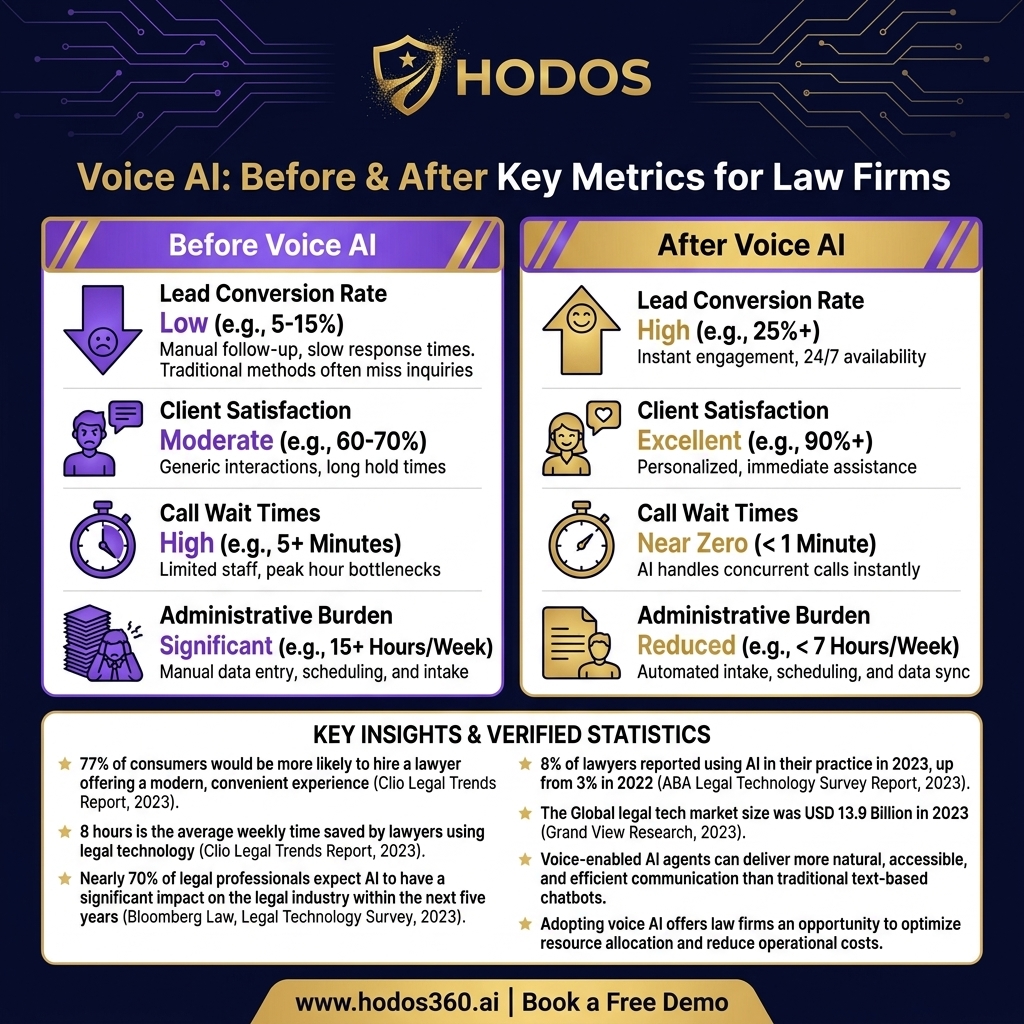
Measuring the ROI of voice AI in law firms goes beyond simple cost savings; it encompasses a holistic view of enhanced client experience, increased operational efficiency, and improved business development. Quantifiable metrics include reduced call handling times, lower administrative overhead, and a significant increase in qualified leads.
For instance, a report by Gartner suggested that organizations deploying conversational AI can reduce customer service costs by up to 30%. For law firms, this translates to substantial savings in staffing costs for answering services or receptionists dedicated to repetitive inquiries. Beyond cost, the ability of a voice assistant to capture every lead, even outside business hours, directly impacts revenue generation.
Firms can track the conversion rate of AI-qualified leads versus traditional channels, demonstrating a clear return on investment. The enhanced client experience—characterized by instant responses, multilingual support, and 24/7 availability—also contributes to higher client satisfaction scores and stronger client retention, which are invaluable long-term assets.
The evolving legal client experience is increasingly shaped by their digital interactions. Clients expect the same seamless, on-demand service from their legal providers as they receive from other industries. A well-implemented voice assistant directly addresses this expectation, offering a modern, accessible interface that builds trust and demonstrates a firm's commitment to innovation.
Imagine a client needing a quick update on a case; instead of waiting for office hours or playing phone tag, they can simply speak to the firm's AI voice assistant and receive an immediate, secure update. Learn more about Law Firm Mobile App Development: An Essential Blueprint for Growth.
This level of responsiveness significantly improves client perception and loyalty. Moreover, the data collected by voice assistants—anonymized and aggregated—provides invaluable insights into client needs, common questions, and service gaps, enabling firms to continually refine their offerings and marketing strategies. This feedback loop is crucial for adapting to market demands and maintaining a competitive edge, proving that the ROI of voice AI extends far beyond mere financial metrics to encompass strategic growth and client relationship building.
Ultimately, the successful adoption of voice AI transforms a law firm's operational backbone and its public image. Firms that proactively invest in solutions like intelligent voice assistants are perceived as forward-thinking, efficient, and client-focused. This reputation can be a powerful differentiator in attracting both new clients and top legal talent.
The narrative shifts from a firm struggling with call volumes to one that is always available, always responsive, and always professional. The strategic value of this transformation is immense, positioning the firm as a leader in legal innovation. This commitment to leveraging advanced technology like voice AI for both internal efficiency and external client satisfaction is not just a trend; it's a fundamental shift in how successful law firms operate and thrive in the modern legal ecosystem.
It underscores the importance of continuous adaptation and embracing the tools that redefine what is possible in legal service delivery.
The HODOS 360 Advantage: Empowering Law Firms with Advanced Voice AI
In this transformative landscape, platforms like HODOS 360 are purpose-built to empower law firms with advanced AI solutions, including state-of-the-art AI Voice Assistants. Our platform streamlines the complex process of voice assistant migration, offering a comprehensive suite of tools designed specifically for the legal sector.
From 24/7 phone answering and intelligent lead qualification to appointment booking and multilingual support, HODOS 360's AI Voice Assistants are engineered to integrate seamlessly with your firm's existing operations. This not only enhances efficiency and reduces overhead but also significantly elevates the client experience, ensuring every interaction is professional, prompt, and productive.
By providing an all-in-one solution that connects voice AI with AI Law Firm Management, AI Marketing, and Web & Mobile Development, HODOS 360 enables law firms to achieve a truly integrated, AI-powered ecosystem.

Key Takeaways and Next Steps
The journey of voice assistant migration is not merely a technological upgrade but a strategic imperative for law firms seeking to thrive in the 21st century. As highlighted by the advancements like Amazon Nova 2 Sonic, the capability to transform traditional text agents into dynamic, conversational voice assistants is here, offering unparalleled opportunities for efficiency, client satisfaction, and competitive differentiation.
Firms must recognize that the future of legal service delivery is conversational, accessible, and always-on. By embracing these intelligent AI agents, law practices can overcome operational bottlenecks, enhance their lead generation efforts, and cultivate deeper, more responsive relationships with their clients.
For law firm owners and legal professionals, the next steps involve a thoughtful assessment of current operational inefficiencies and client communication gaps.
Consider where a 24/7, multilingual voice assistant could have the most impact—be it in initial client intake, routine inquiry management, or appointment scheduling. Researching and partnering with a legal tech provider that offers specialized, secure, and integrated voice AI solutions is crucial. The goal isn't just to automate, but to intelligently augment your team's capabilities, ensuring that your firm remains at the forefront of innovation while upholding the highest standards of legal professionalism and client care.
The time to explore the transformative power of voice AI is now, setting your firm on a path toward sustained growth and unparalleled client service.
Ready to revolutionize your firm with cutting-edge AI? Schedule a free consultation with HODOS 360 today!
Frequently Asked Questions
What is voice assistant migration in the legal context?+
Voice assistant migration in the legal context refers to transitioning from traditional text-based chatbots or manual phone answering to AI-powered conversational voice assistants. These advanced systems can understand spoken language, interpret intent, and respond dynamically, automating tasks like lead qualification, appointment booking, and answering common legal questions, offering 24/7 client support and improving operational efficiency for law firms.
How can AI voice assistants benefit my law firm?+
AI voice assistants provide numerous benefits, including 24/7 client engagement, improved lead qualification, automated appointment scheduling, and multilingual support. They reduce administrative burden, free up staff for complex legal work, enhance client satisfaction through instant responsiveness, and provide valuable insights into client needs, ultimately driving efficiency, reducing costs, and boosting a firm's competitive edge.
Are AI voice assistants secure for handling sensitive client information?+
Yes, reputable AI voice assistant platforms designed for the legal industry prioritize data security and compliance. They employ end-to-end encryption, secure data storage, and adhere to strict privacy regulations like ABA Model Rule 1.6 regarding client confidentiality. Firms must ensure their chosen solution incorporates robust security protocols and transparent ethical guidelines for handling sensitive legal information.
What is the typical ROI for implementing voice AI in a law firm?+
The ROI for voice AI in law firms can be substantial, encompassing both cost savings and revenue growth. Firms typically see reduced administrative costs, increased lead conversion rates (especially for after-hours calls), improved client retention due to enhanced satisfaction, and greater operational capacity. Quantifiable metrics often include reduced call handling times and a higher volume of qualified leads, leading to a strong return on investment.
How does HODOS 360 support law firms in voice assistant migration?+
HODOS 360 offers a comprehensive suite of AI Voice Assistants specifically tailored for law firms. Our platform facilitates seamless voice assistant migration by providing 24/7 phone answering, intelligent lead qualification, appointment booking, and multilingual support. We ensure deep integration with existing firm management systems, enhancing efficiency, client experience, and compliance, making the transition smooth and highly effective for legal practices.