


AI-Native Law Firms: Essential Blueprint for Future Legal Success
The legal landscape is experiencing a profound transformation, marked by a surge of investment into AI-native law firms. This week's headline, "Manifest OS raises $60m Series A to build AI-native law firm model" from Legal IT Insider, isn't just news; it's a clarion call signaling a fundamental shift in how legal services will be delivered and managed.
This substantial funding round, valuing Manifest OS at an impressive $750 million, underscores a burgeoning market conviction that the future of law lies not merely in augmenting traditional practices with AI tools, but in building legal operations from the ground up, with artificial intelligence at their very core.
This isn't an incremental change; it's a foundational redesign, moving beyond simple automation to create truly intelligent legal enterprises that leverage advanced AI across every facet of their operation, from client intake to complex litigation strategy. This significant capital infusion into a platform aiming to scale the world's first AI-native law firm model highlights the growing chasm between firms that embrace deep AI integration and those that risk being left behind in an increasingly competitive and technologically advanced legal market.
It's a strategic move that reflects the broader trend of major venture capital firms recognizing the immense potential for disruption and efficiency gains that AI brings to a historically conservative industry.
This pivotal moment, exemplified by Manifest OS's successful Series A, forces every law firm owner and legal professional to confront a critical question: what does it truly mean to be an AI-native law firm, and how can existing practices evolve to compete in this new era?
The answer extends far beyond merely adopting a few AI-powered software solutions. It involves a holistic rethinking of operational models, talent acquisition, client engagement, and even the very definition of legal expertise. Firms that historically relied on manual processes and human-intensive tasks are now faced with the imperative to integrate AI not just as a tool, but as a strategic partner capable of driving unprecedented efficiency, accuracy, and scalability.
This narrative isn't about replacing lawyers; it's about empowering them to focus on higher-value, more complex legal work, while AI handles the repetitive, data-intensive tasks. The $60 million invested in Manifest OS is a testament to the belief that such a model is not only viable but represents the most profitable and client-centric path forward, attracting significant capital largely toward building these transformative capabilities.
This article will delve into the implications of this shift, exploring the core components of an AI-native legal practice and the strategic steps firms must take to thrive in this evolving landscape. The transformation is not just about technology; it's about a new philosophy of legal service delivery, one that prioritizes data, automation, and intelligent workflows to deliver superior outcomes.
The Rise of AI-Native Law Firms: A New Paradigm
The concept of an AI-native law firm represents a significant leap beyond traditional legal tech adoption. While many firms have embraced AI for specific tasks like e-discovery or contract review, an AI-native model embeds artificial intelligence into the very DNA of its operations. This means AI isn't just a tool; it's the foundational layer upon which all legal processes, from client acquisition to case resolution, are built.
Dan Mishin, co-founder and CEO of Manifest OS, articulated this vision, stating that their platform aims to "end the era of the 'AI-augmented' law firm and usher in the era of the AI-native law firm." This distinction is critical: an augmented firm uses AI to enhance existing, often manual, processes, whereas an AI-native firm designs its processes specifically for AI optimization, making efficiency and intelligence inherent.
This approach promises not just marginal gains, but exponential improvements in productivity, cost-effectiveness, and service quality, fundamentally reshaping the competitive landscape. The market has taken notice, with a reported $6 billion invested in legal technology last year alone, a significant portion of which is now funneled into these transformative AI-first models, demonstrating a clear shift in investment priorities within the legal tech sector towards more holistic, integrated solutions rather than piecemeal adoptions.
Manifest OS's successful Series A funding round is a potent indicator of investor confidence in this paradigm shift. The company's strategy is to provide a comprehensive operating system that integrates AI across case management, client intake, document generation, and even complex legal reasoning. Learn more about Voice AI Revolutionizes Legal: HODOS 360's 2026 Impact.
This holistic platform aims to empower lawyers by offloading repetitive administrative and research tasks, allowing them to focus on strategic thinking, client relationships, and complex legal analysis. This directly addresses one of the core tensions in the legal industry: the constant pressure to reduce costs while maintaining high-quality, personalized service.
By leveraging AI to automate and optimize, AI-native law firms can achieve both, offering more competitive rates without sacrificing expertise. This model is attracting not just investment but also top talent, as legal professionals increasingly seek environments where cutting-edge technology enhances, rather than hinders, their practice.
The ability to scale legal services efficiently and consistently is a key differentiator that AI-native firms are uniquely positioned to exploit, giving them an unprecedented advantage in a market that demands both speed and precision.
Manifest OS: A Bellwether for Change
The Manifest OS platform, now backed by $60 million in fresh capital, is designed to be the central nervous system for these next-generation legal practices. Their vision extends beyond merely offering a suite of tools; it's about creating an integrated ecosystem where AI seamlessly orchestrates workflows, from initial client contact to final case resolution.
Consider the traditional pain points in law firm management: cumbersome client intake forms, manual document drafting, and reactive case management. Manifest OS aims to transform these into intelligent, proactive processes. For instance, their AI-powered intake can qualify leads, gather preliminary information, and even draft initial engagement letters, significantly reducing the time from inquiry to retainer.
This level of integration allows for predictive analytics, identifying potential bottlenecks or risks in cases before they escalate, a capability far beyond what traditional systems can offer. The company's rapid ascent and substantial funding round are not isolated events but rather part of a larger trend where foundational AI platforms are attracting significant capital, signaling a shift from niche legal tech solutions to comprehensive operating systems that power entire legal practices.
Learn more about AI Legal Research: The Ultimate Guide to legalgain & Beyond. This strategic investment in building an AI-native law firm model is a clear signal to the industry that the future demands a fundamentally different approach to legal operations, one where AI is not an add-on but an intrinsic component of success.
This significant investment in Manifest OS is indicative of a broader market shift towards integrated, AI-driven legal solutions. Firms that have traditionally relied on disparate software for different functions are now looking for unified platforms that can streamline operations and provide a single source of truth.
The promise of an AI-native law firm is that it can achieve unprecedented levels of efficiency and accuracy, reducing human error and freeing up legal professionals to focus on higher-value, strategic work. This move is not without its challenges; integrating AI at such a deep level requires significant cultural change, retraining of staff, and a commitment to continuous technological evolution.
However, the potential rewards—increased profitability, enhanced client satisfaction, and a stronger competitive position—are compelling. As Manifest OS continues to scale its operations and platform, it will serve as a critical case study for how the legal industry can successfully transition into an AI-first future, demonstrating the tangible benefits that can be reaped when AI is truly integrated as a core component of legal service delivery.
Beyond Automation: Deep Integration of AI in Legal Workflows
The true power of AI-native law firms lies in their capacity for deep integration of AI into every legal workflow, far surpassing simple automation. This involves AI not just performing tasks, but actively learning, predicting, and optimizing processes. Take, for example, the realm of case management.
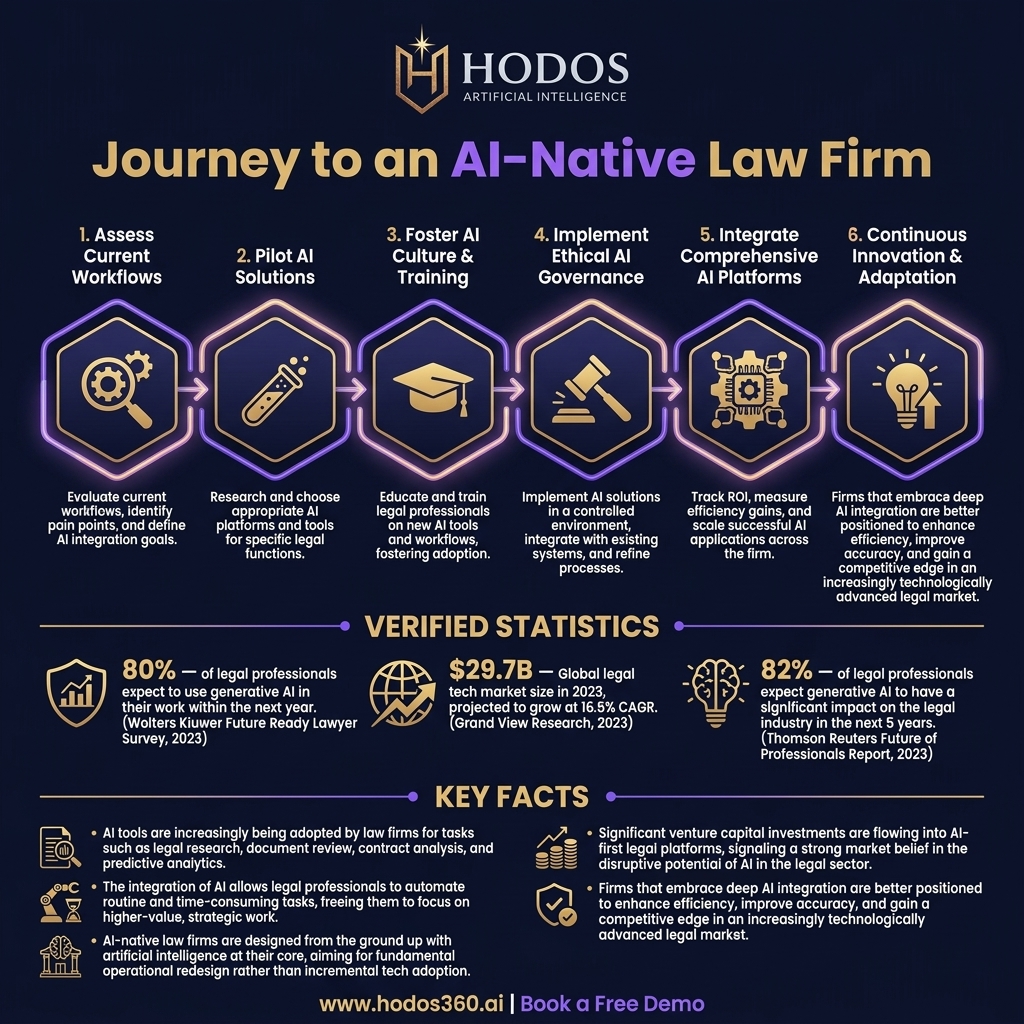
An AI-native system can analyze vast amounts of historical case data to predict litigation outcomes, identify optimal legal strategies, and even flag potential risks based on precedents and judicial tendencies. This goes beyond a simple document management system; it's an intelligent assistant that provides strategic insights.
Similarly, in contract lifecycle management, AI can not only draft agreements but also review them for compliance, identify anomalous clauses, and even suggest amendments based on prevailing market standards or specific client risk profiles. Leading firms like Allen & Overy have already demonstrated the power of such integration through their partnership with Harvey AI, an enterprise-grade AI platform.
This collaboration, announced at LegalTech NYC 2026, showcased how sophisticated AI models can assist lawyers in everything from due diligence to regulatory compliance, significantly reducing the time and resources traditionally required for these tasks. This partnership exemplifies how a truly AI-native legal approach leverages advanced algorithms to augment human intelligence, creating a symbiotic relationship that enhances decision-making and operational agility.
The deep integration of AI also fundamentally transforms client intake and experience. Instead of static forms and manual data entry, AI-native law firms utilize AI voice assistants and intelligent chatbots to engage prospective clients 24/7, qualify leads, and even schedule initial consultations. This not only improves responsiveness but also provides a more personalized and efficient onboarding journey.
Learn more about AI SEO: Ultimate Content Strategy for Law Firms. For instance, an AI-powered system can analyze client needs based on initial interactions, automatically route them to the most appropriate legal expert, and even generate a preliminary case brief, all before a human lawyer ever picks up the phone.
This level of proactive, intelligent engagement is a game-changer for client acquisition and retention, ensuring that firms can capture and serve a broader client base more effectively. According to a 2025 report by Thomson Reuters, firms that leverage AI for client intake reported a 30% increase in lead conversion rates and a 20% reduction in client onboarding time, highlighting the tangible benefits of this deep integration.
This data underscores the competitive edge gained by firms that move beyond basic automation to truly embed AI into their core client-facing processes, making the entire client journey more seamless and efficient.
Furthermore, the evolution of AI-native law firms extends to sophisticated document automation and legal research.
While early AI tools focused on basic template generation, today's AI can generate complex legal documents, such as pleadings, motions, and comprehensive legal opinions, tailored to specific jurisdictions and factual scenarios. This is achieved by drawing upon vast repositories of legal knowledge and leveraging advanced natural language generation (NLG) capabilities.
Beyond creation, AI also plays a crucial role in compliance and risk management, continuously monitoring regulatory changes (like the impending enforcement of the EU AI Act) and flagging potential non-compliance in real-time. This proactive approach minimizes legal exposure and ensures that firms remain agile in a rapidly changing regulatory environment.
The impact on legal research is equally transformative; AI-powered research platforms can sift through millions of legal documents, statutes, and case precedents in seconds, identifying highly relevant information that would take human researchers days or weeks. This capability significantly reduces research costs and enhances the accuracy and comprehensiveness of legal advice, providing lawyers with an unparalleled analytical advantage.
Transforming Client Intake and Case Management
One of the most immediate and impactful areas where AI-native law firms are seeing dramatic improvements is in client intake and case management. Traditional client intake processes are often bottlenecks, characterized by lengthy forms, repetitive data entry, and slow response times. An AI-native approach revolutionizes this by deploying intelligent virtual assistants that can engage prospective clients 24/7, collecting initial information, answering frequently asked questions, and even conducting preliminary conflict checks.
This not only streamlines the onboarding process but also significantly enhances the client experience, providing immediate gratification and demonstrating the firm's technological sophistication. For example, a client inquiring about a personal injury claim can interact with an AI chatbot that gathers incident details, explains preliminary legal options, and schedules a consultation with a human attorney, all within minutes.
This efficiency translates directly into higher lead conversion rates and improved client satisfaction, setting a new standard for accessibility and responsiveness in legal services.
In case management, AI moves beyond simple task tracking to become an active participant in strategy and execution. AI-powered legal workflows can automatically assign tasks, monitor deadlines, and even predict potential case delays based on historical data and external factors.
Learn more about Legal AI Adoption: An Essential Guide for Discerning Firms. For instance, in a complex corporate litigation, an AI system can analyze discovery documents, identify key evidentiary patterns, and suggest lines of questioning for depositions, vastly enhancing a legal team's strategic capabilities. The system can also monitor court dockets and external news feeds for relevant developments, alerting attorneys to critical information in real-time.
This proactive, data-driven approach allows firms to manage larger caseloads with greater precision and efficiency, reducing administrative burden and allowing lawyers to dedicate more time to substantive legal work. The integration of AI into these core operational areas is not just about doing things faster; it's about doing them smarter, leading to better client outcomes and a more profitable practice model for AI-native law firms.
Law firms seeking to truly integrate these advanced AI capabilities into their operations for streamlined case management and enhanced client intake should explore comprehensive platforms that offer such robust features.
The Strategic Imperative: Investing in AI for Competitive Advantage
The substantial $60 million raises by Manifest OS is a clear signal that investing in AI-native law firm models is no longer an option but a strategic imperative for competitive advantage. Firms that fail to embrace this shift risk falling behind in efficiency, client acquisition, and overall profitability.
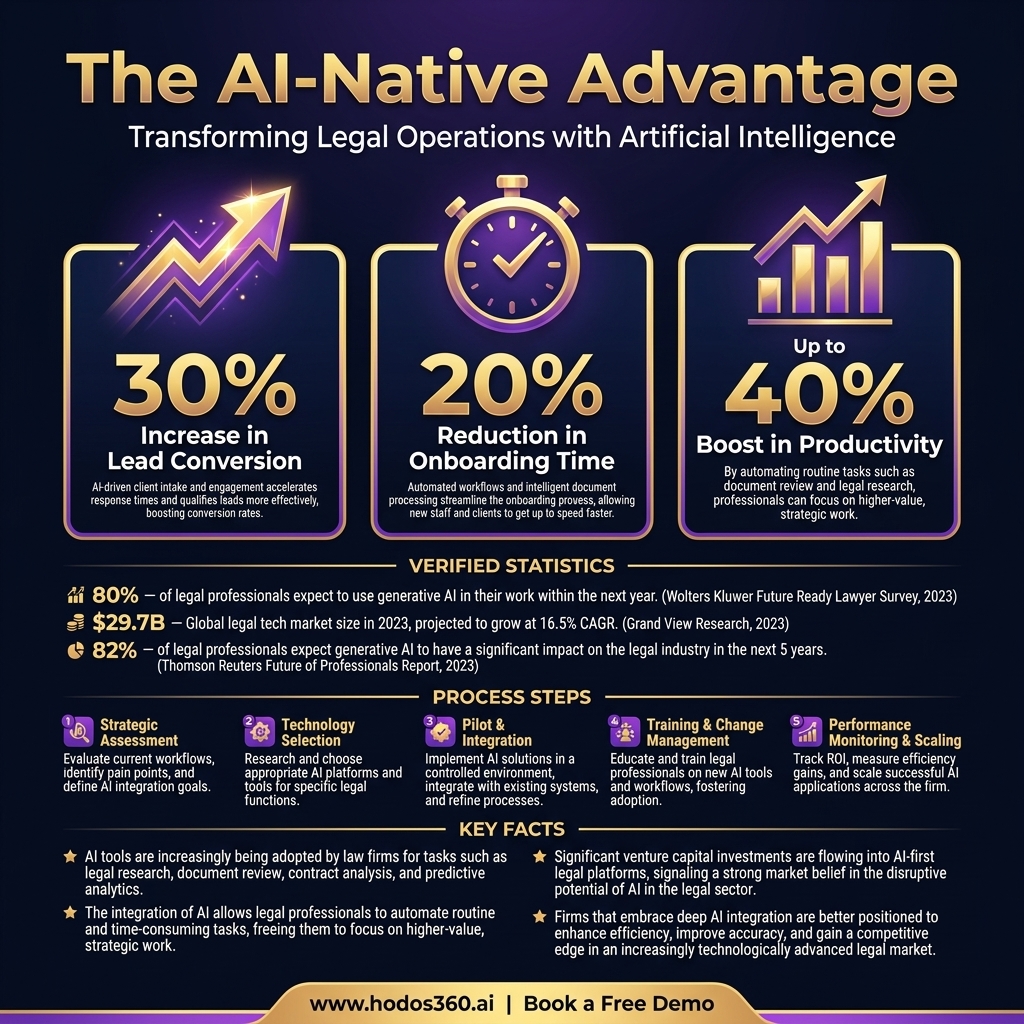
A 2024 report by Gartner predicted that by 2027, over 50% of legal departments will use AI to automate legal tasks, highlighting the rapid pace of adoption. For law firms, this means a significant portion of their client base will expect AI-driven efficiency and innovation.
The return on investment (ROI) for AI integration is becoming increasingly evident. Studies by McKinsey & Company have shown that AI can boost productivity across various industries by up to 40%, and the legal sector is no exception. This productivity gain translates into reduced operational costs, the ability to take on more cases without proportional increases in headcount, and ultimately, higher profit margins.
Firms that integrate AI effectively can reallocate human capital to more complex, client-facing tasks, enhancing the value proposition they offer.
Moreover, the competitive landscape is intensifying. Major global firms are already making significant moves in AI. Linklaters, for instance, has been an early adopter of AI for due diligence and contract analysis, leveraging tools that significantly reduce the time and cost associated with large-scale transactions.
Similarly, firms like Kirkland & Ellis are investing heavily in data science teams to develop proprietary AI solutions for litigation strategy and risk assessment. This creates a two-tiered market: firms that can deliver faster, more accurate, and cost-effective services through AI, and those that cannot.
Learn more about AI Marketing: The Ultimate Guide to Law Firm Growth & Automation. Clients, particularly sophisticated corporate clients, are increasingly demanding greater efficiency and transparency, and AI-native law firms are uniquely positioned to meet these demands. The ability to demonstrate a commitment to technological innovation also serves as a powerful marketing tool, attracting both new clients and top legal talent who are eager to work at the forefront of legal technology.
This investment is not just about technology; it's about future-proofing the business model of the firm, ensuring its relevance and profitability in the decades to come.
This is where platforms like HODOS 360 become invaluable. For law firms looking to strategically integrate AI for a competitive edge, HODOS 360 offers a comprehensive suite of AI-powered services designed to transform existing practices into modern, efficient, and client-centric operations.
From AI Law Firm Management Systems that streamline every aspect of firm administration to AI Marketing Platforms that drive client acquisition, HODOS 360 provides the tools necessary to compete and thrive in this evolving landscape. Firms can leverage HODOS 360's AI Voice Assistants for 24/7 lead qualification and appointment booking, ensuring no prospective client is ever missed, while their Web & Mobile Development services build AI-powered, high-converting digital presences.
These integrated solutions allow firms to not only adopt AI but to build a truly AI-native legal infrastructure, ensuring they are well-equipped to navigate the future of legal service delivery and capitalize on the opportunities presented by advanced technology. Embracing these solutions is not just about keeping pace; it's about setting the pace for innovation in the legal industry.
For law firms ready to embrace this new era and leverage AI for unparalleled competitive advantage, it's time to act. Discover how HODOS 360 can empower your firm to become an AI-native leader. Book a Free Demo today!
Building an AI-Powered Legal Practice: Practical Steps
Transitioning to an AI-native law firm model requires a structured, multi-faceted approach, not a haphazard adoption of tools. The first practical step involves a thorough assessment of current workflows and identifying areas ripe for AI integration. This isn't about replacing every human task, but strategically identifying bottlenecks, repetitive processes, and data-intensive activities where AI can deliver the most significant impact.
Firms should conduct a comprehensive audit of their client intake, document management, billing, and case management systems to pinpoint inefficiencies. Following this assessment, piloting AI solutions in a controlled environment is crucial. For instance, a firm might start with an AI-powered document review for a specific practice area or implement an AI voice assistant for after-hours client inquiries.
This allows for testing, refinement, and demonstrating the tangible benefits of AI to internal stakeholders, building confidence and buy-in across the firm. This iterative approach minimizes disruption and allows the firm to learn and adapt, gradually scaling AI integration across more departments and workflows, moving towards a truly AI-native legal operational model.
This phase is critical for demonstrating early successes and building momentum for broader technological adoption within the firm, addressing any initial skepticism or resistance to change by showcasing clear, measurable improvements.
The cultural shift within the firm is as important as the technological implementation. Attorneys and support staff must be educated on the benefits of AI and trained on how to effectively collaborate with AI tools.
This involves demystifying AI, addressing concerns about job displacement, and highlighting how AI can enhance their roles, allowing them to focus on more stimulating and complex legal work. Firms should invest in continuous learning programs, perhaps partnering with legal tech education providers or leveraging internal experts to lead training sessions.
Furthermore, establishing clear data governance policies and ethical guidelines for AI use is paramount. The ABA Model Rule 1.1 on Competence, for instance, implies a duty for lawyers to stay abreast of changes in technology, including the benefits and risks associated with relevant technology. This means understanding how AI processes data, ensuring client confidentiality, and mitigating potential biases in AI outputs.
Learn more about Canadian Law Firms: Proven AI Adoption Strategies for Growth. Firms must develop robust protocols for data privacy, security, and the responsible use of AI, aligning with emerging regulations like the EU AI Act, which sets stringent requirements for AI systems in sensitive sectors, ensuring that their AI-powered practice remains compliant and ethically sound.
Integrating new AI platforms requires careful planning and execution. Firms should prioritize platforms that offer seamless integration with existing systems (where applicable) and provide comprehensive support and training. The goal is to create a unified technological ecosystem where various AI tools communicate and collaborate effectively, rather than operating in isolated silos.
This might involve working with providers who offer end-to-end solutions or building internal teams capable of customizing and managing AI deployments. Moreover, a successful transition to an AI-native law firm model demands a commitment to continuous innovation. The field of AI is evolving at an unprecedented pace, with new advancements emerging regularly.
Firms must foster a culture of adaptability, regularly evaluating new AI technologies and refining their existing implementations to maintain a competitive edge. This proactive approach ensures that the firm remains at the forefront of legal innovation, continuously optimizing its operations and service delivery through the intelligent application of AI.
This continuous evolution is crucial for long-term success, as the legal tech landscape is dynamic and requires ongoing attention to new developments and best practices, ensuring that the firm's AI strategy remains cutting-edge and effective.
Finally, firms must consider the long-term implications of AI adoption on their business model, particularly regarding pricing and service offerings.
With AI driving down costs and increasing efficiency, firms can explore new billing models, such as fixed-fee arrangements for services that were previously billed hourly, or offer entirely new AI-powered legal products. This strategic rethinking allows AI-native law firms to capture new market segments and differentiate themselves from traditional competitors.
For instance, a firm might offer an AI-driven contract review service at a significantly lower cost than a human-intensive review, attracting clients who prioritize speed and affordability. This proactive adaptation of the business model is essential for maximizing the commercial benefits of AI and ensuring sustained growth and profitability in the evolving legal market.
It's about leveraging AI to innovate not just operations, but the very nature of legal service delivery itself.
Navigating Ethical AI in Legal Practice
As AI-native law firms increasingly integrate advanced algorithms into core operations, navigating the ethical landscape of AI becomes paramount. The American Bar Association (ABA) has consistently emphasized the ethical obligations of lawyers concerning technology, particularly regarding competence and confidentiality. ABA Formal Opinion 483, for instance, addresses lawyers' obligations after an e-discovery breach, underscoring the need for robust data security measures, which are even more critical when AI systems handle sensitive client data.
Firms must ensure that their AI tools are designed and deployed with privacy by design principles, adhering to regulations like the General Data Protection Regulation (GDPR) and the California Consumer Privacy Act (CCPA). This includes stringent protocols for data anonymization, encryption, and access controls to prevent unauthorized data exposure.
The ethical imperative extends to transparency: lawyers must be able to explain how AI tools arrive at their conclusions, especially when those conclusions inform critical legal advice or strategy. This avoids the "black box" problem, ensuring accountability and maintaining client trust, which is foundational to the attorney-client relationship.
Another critical ethical consideration for AI-native law firms is the potential for algorithmic bias. AI systems are trained on vast datasets, and if those datasets reflect historical biases present in legal records or societal data, the AI can perpetuate or even amplify those biases. For example, an AI tool used for sentencing recommendations could inadvertently discriminate against certain demographics if trained on biased historical criminal justice data.
Firms must implement rigorous testing and auditing mechanisms to identify and mitigate such biases, ensuring that AI-powered decisions are fair, objective, and non-discriminatory. This proactive approach requires a multidisciplinary effort, involving legal ethicists, data scientists, and domain experts to continuously monitor and refine AI models.
Furthermore, the question of attorney supervision over AI-generated work is crucial. While AI can draft documents or conduct research, the ultimate responsibility for the accuracy and appropriateness of legal advice always rests with the human attorney. This requires lawyers to critically review AI outputs, exercising independent professional judgment rather than blindly accepting algorithmic recommendations.
The ethical integration of AI is not merely about compliance; it's about upholding the fundamental principles of justice, fairness, and client advocacy in an increasingly technological world, ensuring that AI-native law firms leverage technology responsibly and ethically.

Key Takeaways and Next Steps
The $60 million Series A raise by Manifest OS is a definitive marker: the era of the AI-native law firm has arrived, and it demands attention from every legal professional. This fundamental shift moves beyond simply augmenting existing processes with AI; it advocates for building legal operations with AI at their core, promising unprecedented levels of efficiency, accuracy, and scalability.
Firms that embrace this paradigm will not only survive but thrive, leveraging AI to streamline client intake, revolutionize case management, automate document creation, and gain a significant competitive edge through data-driven insights. The strategic imperative is clear: proactive investment in integrated AI solutions is essential for future relevance and profitability.
This requires a commitment to technological adoption, a willingness to foster a culture of innovation, and a robust framework for ethical AI use.
For law firms looking to navigate this transformative period and position themselves as leaders in the AI-native legal landscape, the time for strategic action is now.
Evaluating and integrating comprehensive AI platforms is crucial. Solutions that offer integrated AI Law Firm Management Systems, AI Marketing Platforms, AI Voice Assistants, and Web & Mobile Development capabilities provide the foundational tools necessary to build a truly intelligent and efficient legal practice. By adopting these advanced technologies, firms can unlock new levels of productivity, enhance client satisfaction, and ensure their continued growth in an increasingly AI-driven legal market.
The future of legal success belongs to those who are willing to reimagine their practice through the lens of artificial intelligence, embracing the opportunity to innovate and lead. The journey to becoming an AI-native law firm is an investment in the future, promising not just survival, but unparalleled growth and leadership in the evolving legal industry.
Your firm can be part of this revolution, transforming challenges into opportunities for unprecedented success.
Frequently Asked Questions
What defines an AI-native law firm?+
An AI-native law firm integrates artificial intelligence into the foundational layers of its operations, rather than merely augmenting existing manual processes. This means AI orchestrates workflows from client intake and case management to document generation and legal research. It's a holistic approach where AI is central to efficiency, decision-making, and service delivery, enabling predictive analytics and proactive problem-solving across all legal functions, fundamentally reshaping the practice model.
How does AI-native differ from AI-augmented legal practices?+
An AI-augmented practice uses AI tools to enhance traditional, often manual, workflows, like using AI for e-discovery. An AI-native law firm, however, designs its entire operational model around AI, embedding it into every core process from the ground up. This distinction results in exponential gains in efficiency and intelligence, as processes are optimized for AI rather than retrofitted, creating a more seamless, data-driven, and scalable legal service delivery model.
What are the key benefits of becoming an AI-native law firm?+
Becoming an AI-native law firm offers numerous benefits, including significantly increased operational efficiency, reduced costs through automation, enhanced accuracy in legal tasks, and improved client satisfaction through faster, more personalized services. Firms can manage larger caseloads, gain deeper strategic insights through predictive analytics, and attract top talent. Ultimately, it leads to a stronger competitive position and higher profitability in the evolving legal market.
What practical steps can a law firm take to become AI-native?+
Practical steps to become an AI-native law firm include assessing current workflows for AI integration opportunities, piloting AI solutions in specific areas, fostering a firm-wide culture of AI adoption through education and training, and establishing robust ethical AI guidelines. Firms should also seek integrated AI platforms that offer comprehensive solutions for management, marketing, and client engagement, ensuring seamless technological integration and continuous innovation.
How does ethical AI play a role in AI-native law firms?+
Ethical AI is crucial for AI-native law firms. It involves ensuring data privacy, mitigating algorithmic bias, maintaining transparency in AI decision-making, and upholding attorney supervision over AI-generated work. Firms must comply with regulations like GDPR and ABA ethical rules, implementing rigorous testing to ensure AI systems are fair, objective, and do not perpetuate discrimination. The ultimate responsibility for legal advice remains with the human attorney, demanding critical review of AI outputs.
- ✓AI Law Firm Management System: Streamline case management, billing, client intake, and document automation with AI-powered legal workflows.
- ✓AI Marketing Platform: Drive client acquisition through AI video creation, social media automation, content generation, and ROI tracking.
- ✓AI Voice Assistants: Enhance client engagement with 24/7 phone answering, lead qualification, appointment booking, and multilingual support.
- ✓Web & Mobile Development: Build a high-converting online presence with AI-powered website building, responsive design, and SEO optimization.
- ✓Ethical AI Integration: Develop robust internal policies for data privacy, bias mitigation, and responsible AI use in legal practice.
- ✓Continuous Learning & Adaptation: Foster a culture of ongoing education and evaluation of new AI technologies to stay competitive.