

Legal AI Training: Essential Skills for Modern Law Firms
Just weeks ago, Sarah Chen, a managing partner at a respected mid-sized firm in Chicago, found herself at a crossroads. Fresh off LegalTech NYC 2026, where the buzz around generative AI was deafening, she felt a palpable tension: her firm needed to embrace these tools, but her team, from seasoned partners to junior associates, lacked a unified understanding of their practical application and ethical implications.
The recent Litera webinar, “Education + Training in the Age of Legal AI,” underscored her dilemma, highlighting that while law students are experimenting with sophisticated legal technology, many practicing attorneys are still grappling with the basics. This isn't merely about adopting new software; it's about fundamentally reshaping legal competence and workflow, a shift that demands a strategic, firm-wide commitment to continuous legal AI training.
The narrative of AI in law is no longer theoretical; it's being written in real-time by pioneers like Allen & Overy, which famously partnered with Harvey AI, and by innovators at companies like Thomson Reuters, who are embedding generative AI into their core legal research platforms.
The stakes are high: firms that invest in robust legal AI training programs are poised to gain a significant competitive advantage, while those that hesitate risk falling behind. This isn't just about understanding the technology's capabilities but also its limitations, biases, and the critical human oversight required.
The legal profession, historically rooted in tradition, is now at an inflection point, where education and adaptation are not just beneficial, but absolutely essential for survival and growth in an increasingly AI-driven legal landscape.
The legal industry is undergoing a seismic shift, propelled by advancements in artificial intelligence. What was once futuristic speculation is now daily reality, with AI tools permeating every aspect of law firm operations, from client intake and case management to document review and legal research.
This accelerating pace, as highlighted by a recent ABA TechReport, indicates that over 50% of law firms are now experimenting with or actively using some form of AI, a significant jump from just a few years ago. The imperative for legal AI training is no longer a luxury but a fundamental requirement for maintaining competence and competitiveness.
Firms that fail to equip their attorneys and staff with the necessary skills risk not only inefficiency but also ethical missteps and client dissatisfaction. The tension between the rapid evolution of technology and the traditional slow pace of legal education creates a critical skills gap that must be urgently addressed.
Consider the statements of figures like Dario Amodei, CEO of Anthropic, or Sam Altman of OpenAI, whose work continues to push the boundaries of what AI can achieve. Their innovations, while not directly legal, set the stage for the capabilities we now see in specialized legal AI.
Learn more about AI Marketing Automation: Law Firms' 2026 Growth Catalyst. This rapid development means that yesterday's expertise is quickly becoming obsolete. For instance, the ability to craft effective prompts for generative AI tools is now as crucial as traditional legal research methods. A 2024 report by McKinsey & Company predicted that AI could automate up to 23% of lawyers' current tasks, freeing up valuable time for higher-value work – *if* attorneys are trained to leverage these tools effectively.
Without targeted legal AI training, firms will struggle to realize these efficiencies, leaving billable hours on the table and falling behind more agile competitors. The market competition is fierce, and clients are increasingly expecting tech-savvy solutions that deliver faster, more cost-effective results.
The Urgent Imperative for Comprehensive Legal AI Training
The urgency surrounding legal AI training is underscored by the evolving ethical landscape. The ABA Model Rules of Professional Conduct, particularly Rule 1.1 (Competence), implicitly require lawyers to stay abreast of changes in technology. As AI tools become integral to legal practice, a lawyer's duty of competence extends to understanding these tools, their benefits, and their inherent risks.
This isn't abstract; we've seen instances where lawyers faced sanctions for submitting AI-generated content without proper verification, leading to fabricated case citations. Such incidents highlight the critical need for not just technical proficiency, but also a deep ethical understanding of AI's application in law. Firms must foster a culture where continuous learning about AI is as fundamental as staying current with case law or statutory changes.
Without this foundational knowledge, attorneys risk not only their professional reputation but also their clients' interests.
The competitive landscape also dictates this imperative. Learn more about Ultimate AI Decision Automation: Transforming Legal Marketing. Firms like Dentons, which has been an early adopter of AI tools for various functions, are setting a new standard for efficiency and client service.
According to a recent Thomson Reuters Institute report, firms that have successfully integrated AI into their workflows report significant improvements in client satisfaction and profitability. This success isn't accidental; it's a direct result of strategic investment in technology and, crucially, in the legal AI training that enables their teams to maximize its potential.
The conflict between firms that embrace this technological wave and those that resist it is creating a clear divide in the market. Those lagging are finding it harder to attract top talent, retain existing clients, and compete for new business, demonstrating that education in AI is now a core business strategy.
Bridging the Generational Knowledge Divide in Legal Tech
One significant challenge in the current legal landscape is the generational knowledge divide. Law students entering the profession today are often digital natives, having grown up experimenting with legal technology and generative AI in their academic pursuits. They arrive with an intuitive understanding of these tools, having used them for research, drafting, and even moot court preparations.
However, seasoned partners and mid-level associates, while possessing invaluable legal acumen, may not have had the same exposure or formal legal AI training. This disparity can create friction and inefficiencies within a firm, as different generations approach tasks with varying toolsets and expectations. A comprehensive training strategy must therefore be designed to bridge this gap, ensuring that knowledge transfer flows effectively in both directions, allowing experienced lawyers to guide ethical application while newer generations introduce innovative approaches.
Learn more about Launch Your Law Firm Website: Essential AI Tools Guide. The goal is not to replace experience but to augment it, fostering a collaborative environment where AI is a shared asset.
Firms must recognize that a one-size-fits-all approach to training will not suffice.
Programs need to be tailored to different experience levels and practice areas, acknowledging that a litigator's AI needs might differ significantly from those of a transactional attorney. For example, a Litera webinar might focus on document automation for corporate lawyers, while a separate session could address AI-powered legal research for litigators.
The key is to provide relevant, practical legal AI training that resonates with each group, demonstrating immediate value and applicability to their daily tasks. This targeted approach not only enhances engagement but also accelerates the adoption of new technologies, ensuring that the entire firm moves forward cohesively into the AI era, maximizing the benefits of their technological investments.
Crafting a Comprehensive Legal AI Education Strategy
Developing an effective legal AI training strategy requires a thoughtful, multi-faceted approach that extends beyond basic software tutorials. It must encompass a deep dive into the underlying principles of AI, its ethical implications, and its practical application within specific legal workflows. Firms should consider establishing dedicated AI education initiatives, perhaps akin to Litera University's e-learning and live training models, but tailored to their unique needs.
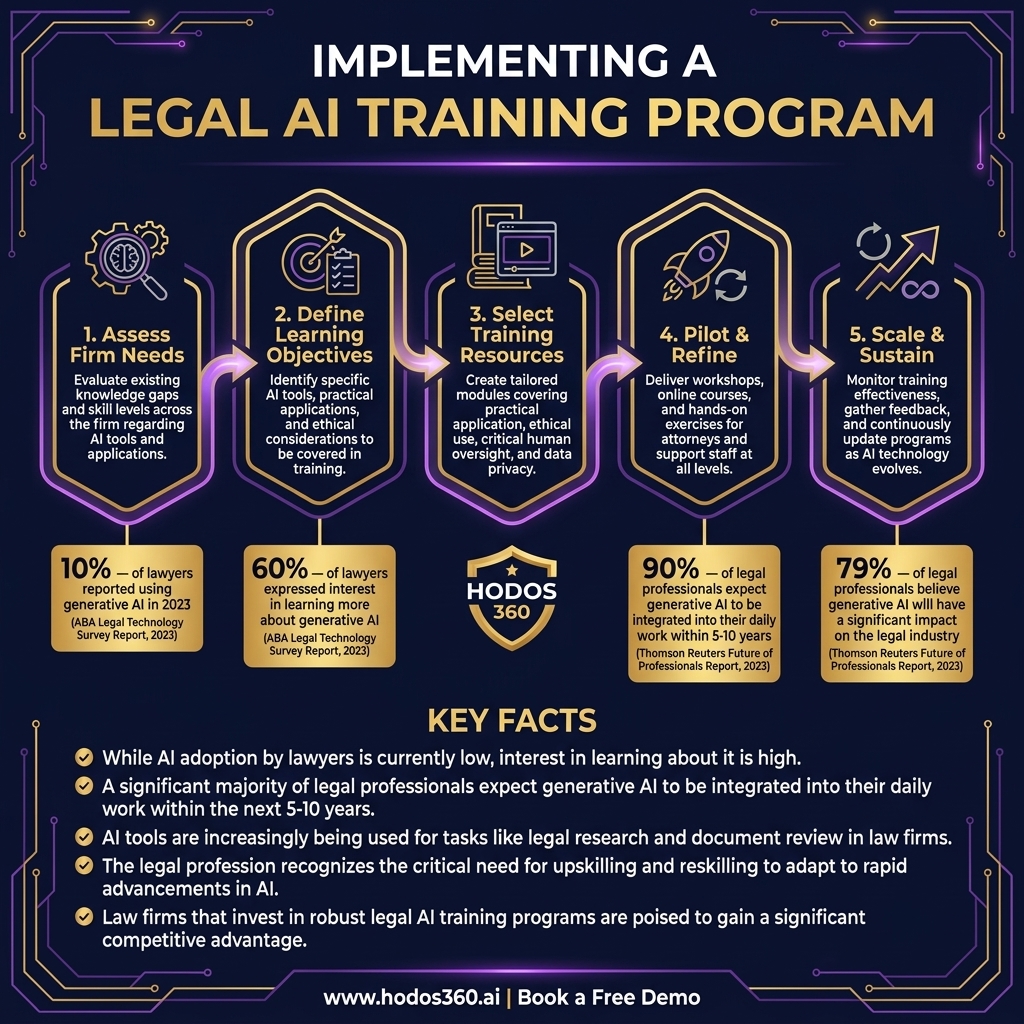
This involves not only formal workshops and online courses but also informal learning opportunities, such as internal webinars, peer-to-peer mentoring, and a centralized repository of best practices. The goal is to cultivate a learning culture where attorneys feel empowered, not intimidated, by technology. This proactive stance ensures that the firm remains at the forefront of legal innovation, leveraging tools like HODOS 360's AI Law Firm Management System to streamline operations and enhance client service.
For instance, leading firms like Latham & Watkins have invested heavily in internal technology academies, recognizing that continuous education is paramount. Learn more about AI Marketing Transforms Legal Web: Webflow's Vidoso Acquisition 2026. Their approach often involves a blend of external experts and internal champions who can translate complex AI concepts into actionable legal strategies.
These programs don't just teach *how* to use a tool; they teach *when* and *why* to use it, emphasizing critical thinking and human oversight. A key component of any comprehensive legal AI training is understanding prompt engineering – the art and science of crafting effective queries for generative AI.
This skill is vital for maximizing the utility of tools for legal research, drafting, and analysis, ensuring accurate and relevant outputs while mitigating risks of 'hallucinations' or biased information. Without this nuanced understanding, even the most advanced AI tools can become liabilities rather than assets, underscoring the necessity of structured and ongoing education.
- ✓Ethical AI Use & Bias Mitigation: Training on the responsible deployment of AI, addressing potential biases, and adhering to professional conduct rules like ABA Model Rule 1.1 (Competence) and 1.6 (Confidentiality).
- ✓Prompt Engineering for Legal Research & Drafting: Mastering the art of crafting precise and effective prompts to maximize the utility of generative AI for legal tasks.
- ✓Data Security & Confidentiality Protocols: Understanding how AI tools handle sensitive client data and implementing robust safeguards to maintain confidentiality.
- ✓AI Tool Proficiency (e.g., case management, document automation, legal research): Hands-on training with specific AI-powered platforms relevant to the firm’s practice areas.
- ✓Critical Evaluation of AI Outputs: Developing the ability to critically assess AI-generated content for accuracy, relevance, and potential errors or 'hallucinations'.
- ✓Strategic Integration into Legal Workflows: Learning how to seamlessly incorporate AI tools into existing legal processes to enhance efficiency without disrupting core operations.
- ✓Continuous Learning & Adaptation: Fostering a mindset of ongoing education to keep pace with rapid advancements in AI technology and regulatory changes.
Navigating the Ethical and Practical Landscape of AI
The ethical considerations surrounding AI in legal practice are paramount and form a cornerstone of any effective legal AI training program. The potential for AI to aid in tasks like document review or predictive analytics is immense, but so are the risks of over-reliance, bias, and breaches of confidentiality.
The American Bar Association (ABA) has been proactive in issuing guidance, emphasizing that lawyers retain the ultimate responsibility for work performed with AI assistance. ABA Model Rule 1.1 (Competence) requires lawyers to understand the benefits and risks associated with relevant technology, including AI. Similarly, Model Rule 1.6 (Confidentiality of Information) mandates that lawyers take reasonable steps to protect client information, a critical concern when using cloud-based AI tools that process sensitive data.
Training must delve into these specific rules, using real-world scenarios to illustrate potential pitfalls and best practices. The infamous case of a lawyer submitting fictional cases generated by AI serves as a stark reminder of the non-negotiable need for human oversight and verification.
Beyond professional rules, the broader regulatory landscape, such as the enforcement of the EU AI Act, signals a global trend towards stricter governance of AI.
Learn more about Voice AI: Essential Transformation for Modern Legal Workflows. While primarily focused on high-risk AI systems, these regulations will inevitably influence the development and deployment of legal AI tools, impacting how law firms interact with them. Firms must understand these external frameworks as part of their legal AI training, ensuring compliance and future-proofing their operations.
This includes understanding vendor contracts, data governance policies, and the implications of using AI across different jurisdictions. The drama surrounding early AI adoption often stems from a lack of clear guidelines and adequate training, leading to public skepticism and professional embarrassment. By proactively addressing these ethical and regulatory challenges through comprehensive education, law firms can build trust, mitigate risks, and confidently leverage AI's transformative potential.
The Critical Role of Human Oversight and Validation
It is crucial to emphasize that AI is a powerful tool, not a substitute for human legal judgment. Effective legal AI training must instill in attorneys the understanding that AI outputs require rigorous human oversight and validation. AI models, particularly generative ones, can 'hallucinate' or produce plausible but incorrect information, or they may reflect biases present in their training data.
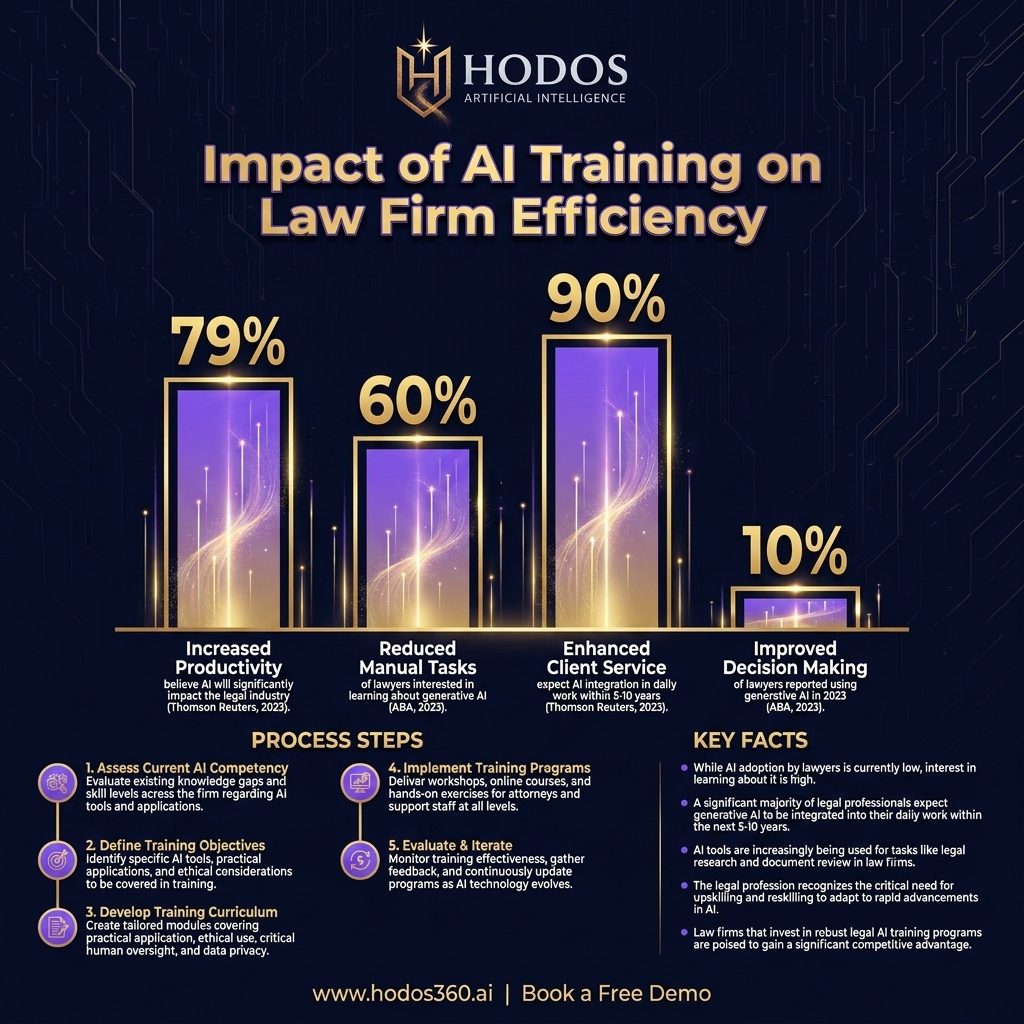
Therefore, lawyers must be trained to critically evaluate AI-generated content, cross-reference facts, and apply their nuanced legal reasoning. This means understanding the limitations of AI, recognizing when its recommendations might be flawed, and knowing when to escalate complex issues beyond automated solutions. As Jensen Huang, CEO of NVIDIA, often states, AI is an augmentative technology, designed to enhance human capabilities, not replace them.
Learn more about AI Settlement Rates: An Essential Guide to Maximizing Outcomes. The human element—the lawyer’s expertise, ethical compass, and critical thinking—remains indispensable in ensuring justice and client protection.
Furthermore, the integration of AI tools, even those designed for efficiency like document automation or AI-powered website building, requires a human touch to customize and refine.
No AI can fully grasp the intricate nuances of a client relationship or the strategic subtleties of litigation without human guidance. Legal AI training should empower lawyers to be expert users of these tools, capable of directing AI to achieve specific outcomes, rather than passively accepting its suggestions.
This active engagement transforms AI from a potential liability into a strategic advantage, allowing firms to deliver superior legal services with unprecedented efficiency. The ability to effectively supervise and validate AI's contributions will distinguish leading law firms in the coming years, turning technological potential into tangible value for clients.
The HODOS 360 Advantage: Empowering Firms with AI Skills
For law firms looking to not only adopt AI but truly master its potential, platforms like HODOS 360 offer a comprehensive ecosystem that inherently demands and facilitates advanced AI skills. HODOS 360's suite of services—including its AI Law Firm Management System, AI Marketing Platform, AI Voice Assistants, and Web & Mobile Development—are designed to work synergistically, but their full power is unlocked only when a firm's team is adequately trained.
The AI Law Firm Management System, for instance, offers AI-powered legal workflows, document automation, and intelligent case management. Without proper legal AI training, attorneys might only scratch the surface of these capabilities, missing out on significant efficiency gains and strategic advantages. HODOS 360 provides the tools; firms must invest in the education to wield them effectively, transforming their operations from reactive to proactive, and from manual to intelligent.
Imagine Maria Rodriguez, a partner at a boutique firm specializing in intellectual property, who adopted HODOS 360 last year. Initially, her team used the platform for basic case management. However, after engaging in a structured legal AI training program focused on prompt engineering for document automation and leveraging the AI Marketing Platform for content generation, her firm saw a remarkable shift.
They reduced document drafting time by 40% and increased lead generation by 25% through targeted AI-driven campaigns. This wasn't magic; it was the direct result of her team understanding how to strategically interact with and direct the AI within HODOS 360. This tangible ROI underscores that technology alone is insufficient; it's the combination of cutting-edge tools and a highly skilled workforce that truly drives success.
HODOS 360 is built to empower, but that empowerment is realized through knowledge and continuous learning.
From Basic Understanding to Strategic Implementation
The true value of platforms like HODOS 360 lies in their ability to integrate AI across the entire firm's operations. This demands a holistic approach to legal AI training, moving beyond a basic understanding of individual tools to a strategic comprehension of how AI can transform every touchpoint.
From the initial client intake, where AI Voice Assistants can qualify leads and book appointments 24/7, to the final stages of a case, where AI-powered legal workflows streamline complex processes, every service benefits from a team well-versed in AI best practices. This integrated approach means that training isn't just for legal professionals; it extends to administrative staff, marketing teams, and even IT personnel, ensuring everyone understands their role in the AI ecosystem.
The goal is to cultivate a firm-wide intelligence that can adapt to new AI advancements, making the firm resilient and innovative.
Moreover, the strategic implementation of AI, facilitated by platforms like HODOS 360, requires continuous feedback loops. As attorneys and staff engage with the AI Law Firm Management System or utilize the AI Marketing Platform's analytics, their insights can inform further training needs and platform optimizations.
This iterative process of learning, applying, and refining ensures that the firm's AI capabilities evolve in tandem with the technology itself. It fosters an environment where attorneys are not just users but active participants in shaping the future of their practice, leveraging tools like AI-powered website building for a stronger online presence or social media automation to reach a wider audience.
This commitment to ongoing education and strategic implementation is what truly distinguishes leading firms in the age of legal AI.

Key Takeaways and Next Steps for Your Firm
The age of legal AI is not a distant future; it is the present. For law firms, investing in comprehensive legal AI training is no longer optional but a strategic imperative that underpins competence, efficiency, and ethical practice. The insights from industry events like the Litera webinar and the experiences of pioneering firms underscore a clear message: continuous education in AI is the bedrock upon which modern legal success is built.
By prioritizing robust training programs, firms can bridge generational knowledge gaps, mitigate ethical risks, and unlock unprecedented levels of productivity and innovation. Embrace this shift not as a challenge, but as an opportunity to redefine legal excellence.
To effectively navigate this transformative era, firms must commit to a proactive approach.
Start by assessing your team's current AI literacy, define clear learning objectives, and invest in a combination of formal and informal training resources. Platforms like HODOS 360 provide the advanced AI tools necessary for modern practice, but the true power lies in a well-trained workforce capable of leveraging these technologies strategically and ethically.
The future of law belongs to those who are prepared to learn, adapt, and lead with intelligence.
Frequently Asked Questions
What is legal AI training?+
Legal AI training is a structured educational process designed to equip legal professionals with the knowledge and skills to understand, utilize, and ethically manage artificial intelligence tools in their practice. It covers everything from basic AI concepts and prompt engineering to specific legal tech applications, data security, and ethical considerations like competence and confidentiality.
Why is legal AI training important now?+
Legal AI training is crucial due to the rapid integration of AI into legal workflows, client expectations for tech-enabled services, and competitive pressures. It helps firms boost efficiency, reduce costs, enhance accuracy, mitigate ethical risks (e.g., AI 'hallucinations'), and maintain professional competence as required by rules like ABA Model Rule 1.1.
What topics should legal AI training cover?+
Comprehensive legal AI training should cover ethical AI use, bias mitigation, prompt engineering for legal tasks, data security protocols, proficiency with specific AI legal tools (e.g., document automation, legal research platforms), critical evaluation of AI outputs, and strategic integration into existing legal workflows. It should also address relevant regulations like the EU AI Act.
How can law firms implement effective AI training?+
Firms can implement effective AI training by assessing current AI literacy, defining clear learning objectives, and utilizing a blend of internal and external resources. This might include workshops, online courses, peer mentoring, and integrating training with platforms like HODOS 360. Tailoring content to different roles and ensuring continuous learning are key for success.
What are the ethical considerations in legal AI?+
Ethical considerations in legal AI include maintaining attorney competence (ABA Model Rule 1.1), protecting client confidentiality (ABA Model Rule 1.6) when using AI tools, avoiding the unauthorized practice of law, mitigating algorithmic bias, and ensuring proper human oversight and validation of AI-generated content to prevent errors or 'hallucinations.'