


Web Application Development: Essential AI Workflows Emerge
Sarah Chen, Managing Partner at LexCorp LLP, vividly recalls the firm's persistent struggles with its client portal – a clunky, static interface that was a perpetual source of frustration for both clients and staff. The firm once poured nearly half a million dollars and countless billable hours into a custom-built case management system that, despite its immense cost, rapidly became obsolete, a stark illustration of technology's relentless pace.
This narrative of significant investment yielding quickly outdated solutions is far from unique in the legal sector, where the imperative for tailored digital solutions frequently collides with the prohibitive costs and extended timelines of traditional web application development. Law firms often find themselves caught between the need for cutting-edge digital infrastructure and the practical realities of development cycles that struggle to keep pace with evolving client expectations and regulatory demands.
It is against this backdrop that the recent "AppWizzy Launches 2026 Web Application Development Research Survey Focused on AI-Driven Workflows," prominently featured by The National Law Review, holds profound significance. This survey, a collaborative initiative with Flatlogic, transcends the typical industry report; it functions as a crucial barometer, measuring how artificial intelligence is fundamentally reweaving the fabric of how digital platforms are conceptualized, constructed, and maintained.
For law firms, this evolution extends far beyond merely possessing a modern website; it is about strategically harnessing sophisticated web application development to forge dynamic client experiences, drastically streamline internal operations, and, ultimately, secure a decisive competitive advantage in an increasingly digital legal landscape. The findings from such research provide a roadmap for firms aiming to navigate this complex terrain.
The legal industry, historically characterized by a cautious approach to technological adoption, now stands at a critical juncture. Firms that proactively integrate AI-driven workflows into their web application development strategies are not merely enhancing their online presence; they are strategically recalibrating their entire operational model for the future.
As visionary leaders like OpenAI’s Sam Altman and Anthropic’s Dario Amodei champion the next generation of generative AI, the tools becoming available to developers are more potent and accessible than ever before. This transformative shift presents both a considerable challenge to entrenched development methodologies and an unprecedented opportunity for legal professionals to engineer bespoke, intelligent applications that were once the exclusive domain of technology giants, all while meticulously addressing the intricate complexities of data privacy, ethical AI deployment, and regulatory compliance.
The pressing question for managing partners like Sarah Chen is no longer 'if' AI will impact their digital infrastructure, but 'how' to strategically integrate it to foster unparalleled innovation and efficiency.
The Shifting Landscape of Legal Web Application Development
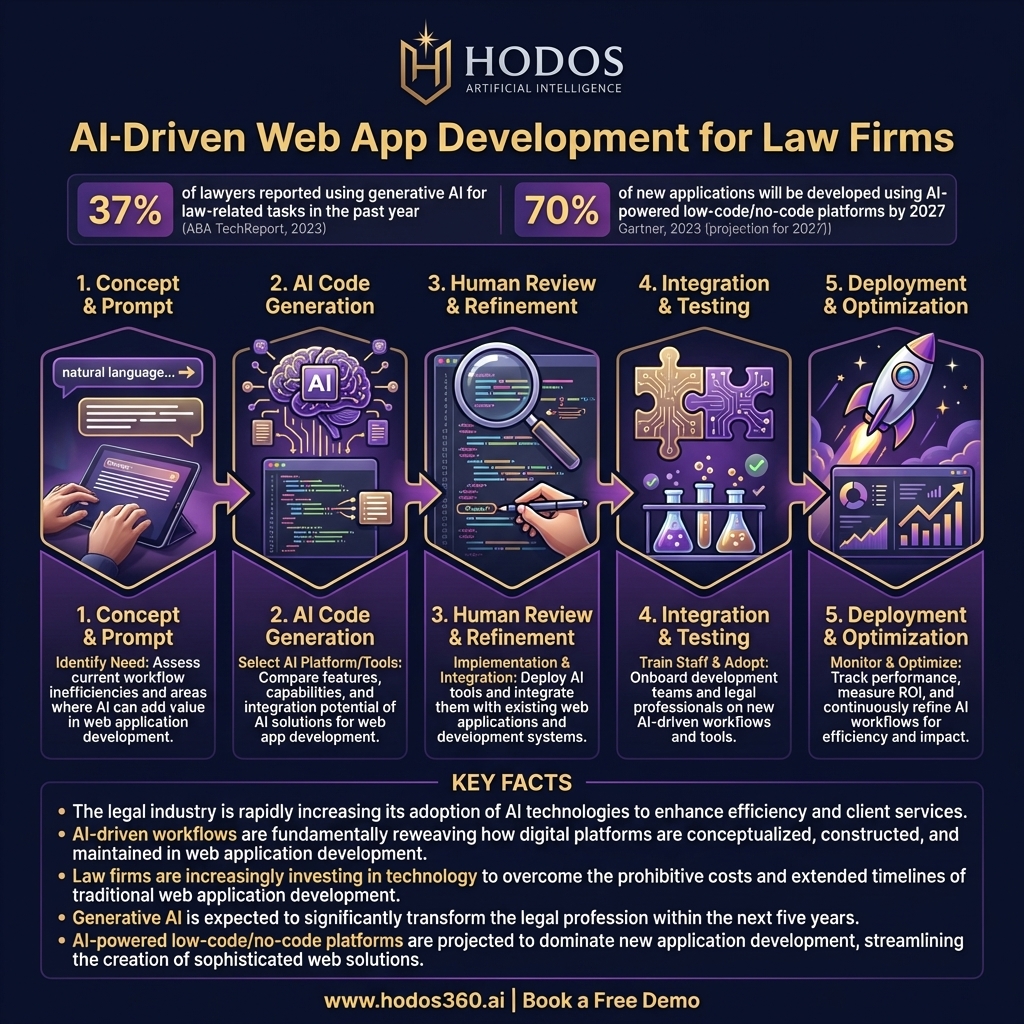
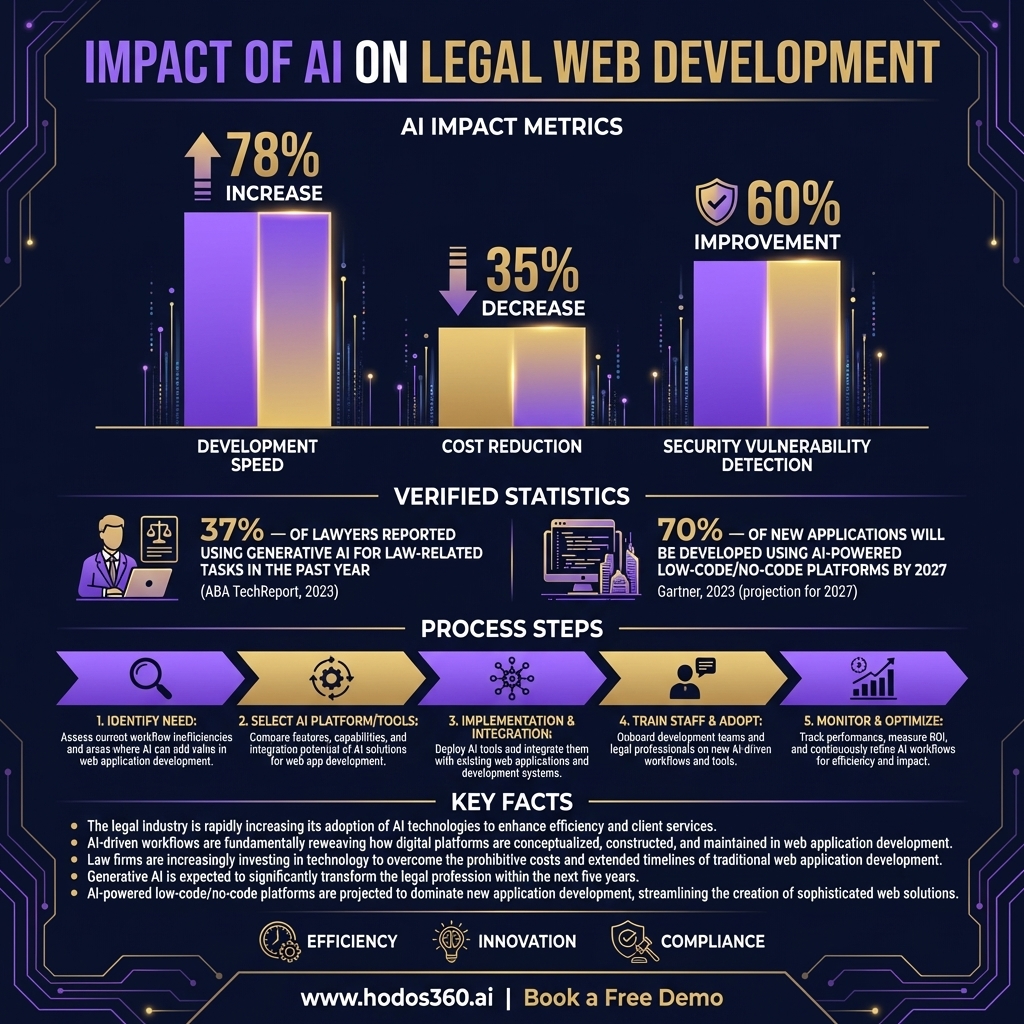
The AppWizzy 2026 survey, a comprehensive annual study, definitively underscores a seismic shift in the development paradigm: a staggering 78% of developers now report integrating AI tools into their daily workflows, representing a monumental leap from just 45% two years prior, according to data cited by AppWizzy in their preliminary findings.
This trend signifies far more than merely accelerating coding; it heralds a fundamental paradigm shift where intelligent "coding agents" are increasingly assuming repetitive, boilerplate tasks. This liberation allows human developers to channel their expertise into higher-order problem-solving, innovative architectural design, and complex logical implementations. For law firms, this translates into an unprecedented potential for creating highly bespoke applications – ranging from intricate, secure client intake portals to sophisticated, automated document generation systems – all capable of being built with remarkable speed and enhanced cost-effectiveness.
The traditional model, often characterized by protracted development cycles, unforeseen delays, and perpetually ballooning budgets, is now being actively challenged and reshaped by agile, AI-powered methodologies that promise greater efficiency and adaptability.
This profound transformation is largely fueled by the relentless advancements in large language models (LLMs) originating from pioneering companies like OpenAI and Google DeepMind, whose robust APIs are now readily available for seamless integration into diverse development environments.
Jensen Huang, the visionary CEO of NVIDIA, has consistently emphasized the democratizing effect of AI, predicting a near future where "everyone is a developer" through intuitive natural language interfaces. This ambitious vision is rapidly materializing, with platforms such as AppWizzy and Flatlogic at the forefront, actively providing sophisticated tools that abstract away much of the underlying technical complexity inherent in web application development.
Law firms, traditionally reliant on a limited pool of third-party software vendors or burdened by the expense of maintaining large in-house development teams, can now explore the creation of tailor-made solutions that precisely align with their unique operational needs and specific client demands, rather than being forced to adapt their workflows to generic, off-the-shelf products.
The inherent tension between established, conventional development practices and these burgeoning AI-driven workflows is undeniably palpable across the industry. Many seasoned developers voice legitimate concerns regarding the reliability and potential for unforeseen errors in AI-generated code, or the risk of encountering a "black box" scenario where the underlying logic and decision-making process behind an AI's output remain opaque and difficult to audit.
Learn more about AI Legal Assistant 2026: Revolutionizing Law Firm Efficiency. However, the AppWizzy research compellingly suggests that these critical concerns are being systematically addressed through the widespread adoption of hybrid models, wherein AI functions primarily as an intelligent assistant and augmentation tool rather than a wholesale replacement for human expertise.
For example, the survey highlights a burgeoning trend of "vibe coding," a methodology where developers employ high-level natural language prompts to guide AI agents, subsequently refining, auditing, and optimizing the generated code. This collaborative, human-in-the-loop approach enables firms to harness AI's remarkable speed and efficiency while rigorously maintaining essential human oversight, a factor of paramount importance given the highly sensitive nature of legal data and the strict imperatives of regulatory compliance.
The implications of this shift for legal technology are nothing short of profound. Pioneering firms like Allen & Overy, through their strategic partnership with Harvey AI, have already unequivocally demonstrated the transformative power of AI in areas such as legal research, contract analysis, and document review.
Extending this innovative application to web application development means the capability to construct intelligent platforms that can, for instance, conduct real-time analysis of client data for potential conflicts of interest during the intake process, or autonomously generate complex compliance reports based on real-time legislative updates and evolving legal precedents.
The fundamental shift is moving away from a generic, static web presence towards hyper-personalized, intelligently designed applications that serve as the dynamic digital backbone of a modern law firm, offering unparalleled operational efficiency, enhanced data security, and a demonstrably superior client experience. This evolution is not merely about adopting new technology; it is about fundamentally redefining how legal services are conceived, delivered, and meticulously managed in the rapidly accelerating digital age.
From Manual Coding to AI-Augmented Design
The transition from entirely manual coding to an AI-augmented design and development paradigm marks a significant leap for legal professionals. Historically, custom web application development for law firms often involved extensive manual coding for every feature, from user interface elements to database integrations and backend logic.
This process was not only time-consuming but also prone to human error, leading to delays and budget overruns. With AI, much of this foundational work can be automated. For example, generative AI tools can take natural language descriptions – such as "create a secure client portal with document upload, case status tracking, and a messaging feature" – and generate functional code snippets, database schemas, and even basic UI layouts.
This dramatically reduces the initial development burden, allowing legal tech teams or external developers to focus on the intricate legal logic and unique compliance requirements that truly differentiate a legal application.
AI's influence extends beyond initial code generation into various stages of the development lifecycle.
Learn more about Voice AI: Essential Strategic Growth for Law Firms. During the design phase, AI can analyze user experience (UX) patterns and suggest optimal layouts for forms and dashboards, ensuring that client intake processes are intuitive and efficient. In development, AI-powered IDEs (Integrated Development Environments) can provide real-time code suggestions, identify potential bugs, and even refactor code for better performance and security.
Post-development, AI-driven testing frameworks can simulate thousands of user interactions, pinpointing vulnerabilities or functional issues that might be missed by human testers. This level of automation and augmentation, as highlighted in the AppWizzy survey, is not about replacing developers but empowering them to build more sophisticated, robust, and secure applications in a fraction of the time, thereby making advanced digital solutions more accessible and affordable for law firms of all sizes.
This shift is particularly crucial for smaller firms that might lack the resources for extensive in-house development teams, democratizing access to high-quality, custom digital tools.
Strategic Imperatives for Law Firms: Beyond Basic Websites
For law firms today, merely possessing a static, informational website is no longer sufficient; the strategic imperative has shifted dramatically towards developing dynamic, interactive web applications that serve as core operational tools. This evolution is driven by both intensifying client expectations for seamless digital engagement and the internal demand for greater operational efficiency.
Clients increasingly expect to interact with their legal providers through secure online portals where they can upload documents, track case progress, schedule appointments, and communicate securely. Firms that fail to meet these expectations risk falling behind competitors who leverage sophisticated digital platforms. This isn't about marketing fluff; it's about fundamental service delivery.
A well-designed web application can significantly enhance client satisfaction, reduce administrative burdens, and provide a competitive differentiator, moving beyond the simple brochure-ware websites of the past to truly integrated digital ecosystems.
Furthermore, the internal benefits of advanced web application development are transformative. Imagine a bespoke platform that integrates AI-powered legal workflows for document review, automates billing and invoicing, streamlines client intake processes, and offers a centralized, intelligent case management system.
Such an application can significantly reduce manual errors, free up valuable attorney time from administrative tasks, and provide real-time insights into firm performance. The AppWizzy survey’s focus on AI-driven workflows directly addresses this, indicating that firms can now build these complex systems more efficiently. For example, a custom application could leverage AI to pre-screen potential client inquiries for suitability, automatically generate initial engagement letters, and even populate calendars with key deadlines, all through a single, intuitive interface.
This level of integration and automation is not just about convenience; it is about fundamentally restructuring the operational backbone of a modern law firm, allowing legal professionals to focus on higher-value legal work.
Beyond operational efficiency, strategic web application development offers unparalleled opportunities for data-driven decision-making and improved client acquisition.
An AI-powered application can track client interactions, analyze service delivery metrics, and even provide insights into client satisfaction levels, informing future business development strategies. Learn more about Voice AI: An Essential Leap for Law Firms' Client Engagement. Integrating with an AI Marketing Platform can further amplify these efforts, ensuring that new clients are not only attracted but also seamlessly onboarded into the firm's digital ecosystem.
For instance, an application could track the ROI of various marketing campaigns by linking lead sources directly to client conversions and revenue generation, providing clear, actionable data that was previously difficult to obtain. This holistic approach ensures that every digital touchpoint, from initial client contact to ongoing case management, is optimized for both efficiency and client experience, transforming how law firms operate and grow in the digital age.
This integrated approach is essential for long-term success.
Moreover, the scalability and adaptability of AI-driven web applications are crucial for law firms operating in a rapidly evolving legal landscape. Regulatory changes, new legal precedents, and shifts in client demands can necessitate rapid adjustments to a firm's operational tools.
Traditional, hard-coded systems often struggle to adapt, requiring costly and time-consuming overhauls. However, applications built with AI-driven development tools are inherently more flexible. They can leverage modular AI components that can be updated or swapped out with relative ease, allowing for quicker adaptation to new requirements.
This agility ensures that a firm’s digital infrastructure remains cutting-edge and compliant, providing a significant strategic advantage. As an example, if a new privacy regulation comes into effect, an AI-powered document management module could be quickly updated to reflect new redaction requirements or consent protocols, ensuring the firm remains compliant without extensive manual intervention.
Navigating the AI Development Ecosystem: Tools and Trends
The burgeoning AI development ecosystem presents law firms with a complex yet exciting array of tools and trends, moving far beyond the rudimentary website builders of a decade ago. The AppWizzy survey, in its detailed analysis, highlights the increasing adoption of platforms that leverage generative AI to automate significant portions of the coding process, often referred to as "low-code" or "no-code" solutions.
Companies like Flatlogic are creating frameworks that enable rapid prototyping and deployment of web applications, reducing the barrier to entry for firms without extensive in-house development capabilities. These platforms are not just for simple landing pages; they are evolving to support sophisticated, data-intensive applications crucial for legal operations.
This trend empowers law firms to become creators of their own digital tools, rather than merely consumers of third-party software, fostering a new era of legal tech innovation tailored to specific firm needs.
The market for AI-powered development tools is also witnessing intense competition and innovation, with significant funding rounds and strategic acquisitions shaping the landscape.
While OpenAI and Anthropic lead in foundational models, a plethora of startups are specializing in vertical applications for developers. For instance, companies like GitHub Copilot (powered by OpenAI's Codex) have revolutionized how developers write code, acting as an intelligent pair programmer. In the legal tech sphere, the success of Harvey AI’s partnership with Allen & Overy in legal research demonstrates how AI can be integrated into core legal functions, suggesting a parallel path for AI in application development.
Similarly, the ongoing evolution of legal practice management platforms, exemplified by Clio’s strategic acquisitions, indicates a market demand for increasingly integrated and intelligent solutions that encompass every aspect of a firm’s operations, from client intake solutions to complex billing and document management.
One of the most compelling trends identified by the AppWizzy survey is the emergence of "vibe coding," a concept where developers provide high-level natural language prompts and AI agents interpret these directives to generate functional code.
This shift from explicit, line-by-line coding to an intuitive, conversational approach fundamentally alters the development process. Learn more about Legal AI: The Ultimate Guide to Automating Conveyancing. For law firms, this means that even non-technical legal professionals could potentially articulate their needs for a specific application feature – such as "build a secure document sharing module with version control and audit trails" – and an AI agent could generate a functional prototype.
This democratizes the creation of specialized legal applications, allowing firms to iterate rapidly and tailor solutions with unprecedented precision. The focus moves from syntax to semantics, empowering firms to design tools that directly address their unique operational challenges and client service requirements, reducing the reliance on external developers and long development cycles.
However, navigating this ecosystem requires careful consideration. Not all AI development tools are created equal, and firms must evaluate solutions based on their security features, compliance capabilities, integration potential with existing systems, and the level of control they offer over the generated code. While low-code/no-code platforms offer speed, firms must ensure that the underlying architecture is robust and scalable enough to handle sensitive legal data and complex workflows.
The choice of platform can have long-term implications for a firm’s digital strategy, impacting everything from data governance to future expansion capabilities. Therefore, a thorough due diligence process is essential, focusing on vendors that demonstrate a deep understanding of legal industry requirements and a commitment to robust security protocols.
This careful selection ensures that the chosen tools not only accelerate development but also safeguard client confidentiality and firm integrity.
The Rise of "Vibe Coding" and Generative AI Agents
The concept of "vibe coding" represents a significant evolution in how software is developed, particularly relevant for the legal sector’s unique needs. This approach, heavily reliant on generative AI agents, allows developers to express their intentions and desired outcomes in natural language, letting the AI translate these high-level concepts into executable code.
Instead of meticulously writing every line, a developer might instruct an AI: "Generate a user interface for a responsive website design for law firms that includes a secure client login, a news feed, and a contact form, ensuring it's mobile-first and adheres to WCAG accessibility standards."
The AI then leverages its understanding of design patterns, coding best practices, and user experience principles to generate the necessary HTML, CSS, and JavaScript. This dramatically accelerates the initial development phase, moving from weeks of manual coding to hours of AI-assisted generation and refinement.
For law firms, the implications are profound.
It means that the vision for a new internal tool or a client-facing application can be brought to life much faster, allowing for rapid prototyping and iteration. Learn more about AI Websites: Essential Digital Growth for Law Firms. This agile approach is critical in the legal industry, where regulatory landscapes and client demands can shift quickly.
Generative AI agents can also assist in complex tasks like generating boilerplate legal document templates within an application, creating data models for secure document automation, or even designing custom dashboards for internal analytics. This not only reduces the development backlog but also empowers legal professionals to have a more direct hand in shaping the digital tools they use daily.
The power of these AI agents lies in their ability to understand context and generate coherent, functional code based on abstract directives, transforming the development process from a purely technical endeavor into a more collaborative, human-centric one, where legal expertise guides AI’s creative output.
- ✓AI-Powered Code Generation: Tools like GitHub Copilot and AppWizzy's integrated agents can generate code snippets, functions, and even entire modules from natural language prompts, accelerating development by up to 40%.
- ✓Automated UI/UX Design: AI can analyze user behavior data and design principles to suggest optimal user interfaces and experiences, ensuring intuitive navigation for legal applications.
- ✓Intelligent Testing and Debugging: AI-driven testing frameworks can simulate complex user scenarios, identify vulnerabilities, and suggest fixes, significantly reducing bug-fixing time and improving application reliability.
- ✓Low-Code/No-Code Platforms with AI: Platforms like Flatlogic are integrating AI to allow legal professionals with minimal coding experience to build and customize applications using visual interfaces and drag-and-drop functionalities.
- ✓Security and Compliance Automation: AI tools can scan generated code for security vulnerabilities and ensure adherence to legal compliance standards (e.g., GDPR, HIPAA, ABA Model Rules) by flagging non-compliant patterns.
- ✓Real-time Analytics and Performance Monitoring: AI-powered dashboards provide real-time insights into application performance, user engagement, and potential bottlenecks, enabling proactive optimization and informed decision-making.
- ✓Multilingual Content Generation: AI can facilitate the development of web applications with built-in multilingual support, crucial for law firms serving diverse client bases, by automating content translation and localization.
Ensuring Security, Compliance, and Scalability in AI-Powered Legal Apps
While the promise of AI-driven web application development is immense, law firms must approach its implementation with a rigorous focus on security, compliance, and scalability. The sensitive nature of legal data – client confidences, privileged communications, and personal identifying information – demands the highest standards of data protection.
A security breach in a law firm's web application could have catastrophic consequences, leading to severe reputational damage, hefty financial penalties, and potential disbarment for attorneys. Therefore, every AI-generated component and integrated third-party service must be meticulously vetted for vulnerabilities, robust encryption protocols, and adherence to industry-standard security frameworks like ISO 27001. Simply relying on AI to generate code without human oversight in security audits would be a dereliction of professional duty, as mandated by the ABA Model Rule 1.6 on Confidentiality of Information, which implicitly requires competence in technology safeguarding client data.
Compliance is another non-negotiable aspect. Law firms operate within a labyrinthine web of regulations, including data privacy laws like GDPR and CCPA, industry-specific standards, and professional rules of conduct. Any web application handling client data or facilitating legal services must be designed from the ground up with these mandates in mind.
AI-driven development tools can assist in flagging potential compliance issues in code or data handling processes, but ultimate responsibility rests with the firm. For example, if an AI generates a client intake form, it must ensure proper consent mechanisms are in place, data retention policies are clearly articulated, and sensitive information is handled in accordance with legal requirements.
The "black box" problem, where the AI's decision-making process is opaque, poses a particular challenge here, requiring firms to implement strong governance frameworks and human review processes to ensure accountability and transparency, aligning with the ethical obligations outlined in ABA Model Rule 1.1 on Competence, which now encompasses technological competence.
Scalability is equally critical for law firms with growth ambitions. A web application that performs flawlessly for a small number of users might buckle under the strain of hundreds or thousands of concurrent clients and internal users. Learn more about AI Marketing Tools: Essential Guide for Law Firm Growth.
AI-driven development can facilitate the creation of modular, cloud-native architectures that are inherently more scalable, allowing firms to expand their digital capabilities without expensive overhauls. However, firms must ensure that their chosen AI development platforms support open standards and provide robust integration capabilities to avoid vendor lock-in.
As a firm grows, its data volumes will increase, and its application needs will evolve. A scalable architecture, whether built with AI assistance or not, must be able to accommodate these changes seamlessly, ensuring that the application remains performant and cost-effective over its lifecycle. This foresight in design prevents future bottlenecks and ensures the long-term viability of digital investments.
The ethical dimensions of employing AI in legal web application development cannot be overstated. Beyond technical security and regulatory compliance, firms must consider the ethical implications of how AI processes client data, makes suggestions, or automates decisions. Bias in AI algorithms, if unchecked, could lead to discriminatory outcomes in areas like client selection or legal strategy.
Firms must establish clear ethical guidelines for AI use, conduct regular audits for bias, and ensure transparency with clients about AI's role in their legal services. This proactive approach to ethical AI not only mitigates risks but also builds trust, positioning the firm as a responsible innovator.
The legal profession, by its very nature, is entrusted with justice and fairness; therefore, the tools it employs, especially those as powerful as AI, must uphold these fundamental principles, demanding a conscious and continuous effort to ensure ethical deployment and oversight.
Ethical AI: Balancing Innovation with Professional Responsibility
The integration of AI into legal web application development presents a complex ethical tightrope walk, demanding a delicate balance between leveraging innovation and upholding professional responsibility. The core ethical challenge lies in ensuring that AI systems, particularly those generating code or processing sensitive legal data, do not introduce biases, compromise client confidentiality, or undermine the principles of justice.
For instance, an AI trained on historical case data might inadvertently perpetuate existing societal biases if not meticulously curated and audited. Lawyers have a professional obligation under ABA Model Rule 1.6 to protect client information, which now extends to the security and integrity of digital platforms and the AI systems embedded within them.
This means firms must exercise due diligence in selecting AI tools, understanding their underlying algorithms, and implementing robust safeguards against data breaches and unauthorized access.
Furthermore, the transparency and explainability of AI are paramount in the legal context. If an AI agent assists in generating code for a client portal, and a vulnerability arises, understanding how the AI arrived at its output is crucial for remediation and accountability.
The "black box" nature of some advanced AI models can conflict with the legal profession's need for transparency and explainability, especially when decisions or outcomes affect clients. Firms must demand explainable AI (XAI) capabilities from their technology partners or implement internal processes for auditing AI-generated components.
This commitment to transparency not only helps in identifying and correcting errors but also builds client trust. Ultimately, the ethical deployment of AI in legal web application development is not merely a technical challenge; it is a profound professional responsibility that requires continuous vigilance, thoughtful policy development, and a steadfast commitment to the foundational values of the legal system.

Key Takeaways and Next Steps for Progressive Law Firms
The AppWizzy 2026 Web Application Development Research Survey unequivocally signals a new era for legal tech, one where AI-driven workflows are not merely an advantage but a strategic imperative. For progressive law firms, the key takeaway is clear: embracing AI in web application development is no longer optional.
It’s about building intelligent, secure, and scalable digital platforms that enhance client experience, streamline operations, and provide a competitive edge. Firms must move beyond static websites and invest in dynamic web applications that reflect the sophistication and efficiency demanded by today's legal landscape. This requires a proactive approach to understanding and integrating generative AI tools, low-code/no-code platforms, and intelligent coding agents into their digital strategy.
The narrative is shifting from simply having an online presence to leveraging sophisticated digital ecosystems as the core of legal service delivery.
For law firm owners and attorneys, the next steps involve a critical assessment of current digital infrastructure and a strategic roadmap for AI integration.
This includes evaluating existing client portals, case management systems, and internal communication tools to identify areas ripe for AI-driven transformation. It also means investing in training for legal and administrative staff to understand and leverage AI tools, fostering a culture of technological adoption rather than resistance.
Furthermore, firms must prioritize vendor selection, choosing technology partners who not only offer cutting-edge AI solutions but also demonstrate a deep understanding of legal compliance, data security, and ethical AI deployment. The goal is to build a robust digital foundation that is both innovative and responsible, ensuring client data is protected while maximizing operational efficiency.
In this rapidly evolving digital frontier, HODOS 360 stands as a crucial partner for law firms seeking to navigate the complexities of AI-powered web application development. Our Web & Mobile Development service is specifically designed to transform your firm's digital presence into a high-performing, AI-powered ecosystem.
From AI-powered website building and responsive design to SEO optimization and high-converting templates, HODOS 360 empowers firms to create bespoke applications that are secure, scalable, and perfectly aligned with their strategic objectives. We understand the unique demands of the legal industry and build solutions that not only meet but exceed expectations, ensuring your firm remains at the forefront of legal innovation.
The future of legal service delivery is digital, intelligent, and client-centric, and HODOS 360 is here to help you build it.
Frequently Asked Questions
What is AI-driven web application development for law firms?+
AI-driven web application development involves using artificial intelligence tools, such as generative AI and machine learning, to automate and enhance various stages of building legal-specific web applications. This includes code generation, UI/UX design, testing, and security auditing, enabling law firms to create custom client portals, case management systems, and internal tools more efficiently and cost-effectively than traditional methods.
How can AI-driven development benefit my law firm specifically?+
AI-driven development offers numerous benefits, including accelerated development cycles, reduced costs for custom applications, improved security through AI-powered vulnerability scanning, and enhanced client experiences with intuitive, personalized portals. It allows firms to develop bespoke tools that precisely meet their operational needs, automate repetitive tasks, and provide a competitive edge in client service and internal efficiency.
What are the security concerns with using AI for legal web development?+
Security is paramount. Concerns include potential vulnerabilities in AI-generated code, data privacy risks with AI processing sensitive client information, and the 'black box' problem where AI decisions are opaque. Firms must ensure AI tools adhere to strict encryption and compliance standards, implement robust human oversight for security audits, and select vendors with a proven track record in legal data protection to mitigate these risks.
What is 'vibe coding' and how does it apply to legal tech?+
'Vibe coding' is an AI-driven development approach where developers use natural language prompts to describe desired application features or functionalities, and AI agents translate these high-level intentions into executable code. For legal tech, this means attorneys or non-technical staff could articulate needs like 'build a secure document sharing module,' and AI could rapidly generate a prototype, democratizing custom application creation.
How does HODOS 360 assist law firms with AI-powered web development?+
HODOS 360's Web & Mobile Development service leverages AI to build high-performing, secure, and responsive web applications tailored for law firms. We offer AI-powered website building, SEO optimization, and high-converting templates, enabling firms to create custom client portals, internal management systems, and marketing platforms that enhance efficiency, improve client engagement, and ensure compliance with legal industry standards.