
AI Back Office: Ultimate Guide for Law Firm Efficiency
The stack of physical files on Sarah Chen's desk at Chen & Associates seemed to multiply overnight. As a managing partner of a thriving mid-sized law firm, Sarah found herself increasingly bogged down by the sheer volume of administrative tasks: client intake forms, billing queries, document generation, and calendar management. Her firm, despite its legal prowess, was struggling to scale efficiently, a common refrain across the industry. This isn't just Sarah's story; it's the quiet drama playing out in countless legal firms globally, where the promise of cutting-edge AI tools often feels distant from the day-to-day grind of the back office. Yet, a new wave of innovation is closing this gap, exemplified by startups like Lawdie, recently featured in Legal IT Insider for its mission to become the AI back office for law firms, automating everything from operational tasks to document routing. This shift signifies a pivotal moment: AI is no longer a futuristic concept but a practical necessity, profoundly reshaping the operational backbone of legal practices.
This isn't about replacing the nuanced judgment of a seasoned attorney; it’s about automating the repetitive, time-consuming administrative burdens that divert valuable legal talent. The legal industry, traditionally cautious, is now witnessing a rapid acceleration in AI adoption, spurred by competitive pressures and the desire for enhanced client service. From billing automation to sophisticated AI-powered workflows, these innovations promise to liberate legal professionals from mundane tasks, allowing them to focus on high-value strategic work. As firms grapple with mounting workloads and the imperative to deliver more for less, the strategic integration of an AI back office is emerging not just as an advantage, but as a foundational element for sustainable growth and unparalleled law firm efficiency. Ready to explore the transformative power of AI for your firm? Discover how these solutions are setting new benchmarks for productivity.
The Rise of AI in Legal Operations: Beyond the Hype
For years, discussions around AI in legal tech primarily centered on areas like e-discovery, predictive analytics, and sophisticated legal research. While these applications have undoubtedly revolutionized specific facets of practice, the real game-changer now lies in the holistic integration of AI into the back office — the engine room of any law firm. This shift reflects a maturing of AI tools, moving from niche applications to comprehensive operational platforms. According to the 2023 ABA TechReport, AI adoption among firms with 100+ attorneys jumped to nearly 30%, a significant increase driven by the tangible benefits seen in streamlining non-billable, administrative tasks. This isn't just about incremental improvements; it's about a fundamental re-architecture of how legal services are delivered, from initial client contact to final invoice, ensuring maximum law firm efficiency.
The growing market for AI back office solutions is a testament to this paradigm shift. Beyond established players like Clio, which continues to expand its practice management suite with AI enhancements, new startups like Lawdie are emerging to tackle the specific pain points of legal administration. Lawdie’s promise of automating operational tasks ranging from billing and matter management to document generation and file routing directly addresses the call for more integrated, intelligent systems. Learn more about Siri AI Revolution: Essential Legal Voice Assistant Strategies. This competitive landscape, with innovative startups like Lawdie and Vector Legal (an AI-powered law firm for startups) pushing boundaries, signifies a vibrant ecosystem where firms are increasingly finding purpose-built AI tools to enhance their capabilities. The underlying tension here is the push-pull between traditional legal methodologies and the undeniable economic and strategic advantages offered by advanced technology, a tension that firms must resolve to remain competitive.
Indeed, the narrative is no longer about whether AI will impact the legal profession, but how comprehensively and quickly firms can adapt. The 2024 Thomson Reuters Future of Legal Report highlighted that firms that prioritize technology investment are significantly outperforming their peers in revenue growth and client satisfaction. This data underscores a critical conflict: those who embrace these AI tools are building a distinct advantage, while those who delay risk falling behind. The fear with AI in a law firm is often that it replaces the human part of the job, but the reality for the back office is quite the opposite—it augments human capacity, freeing up lawyers and staff to focus on complex problem-solving and client relationships. This strategic pivot towards automating the back office is not just about cost-cutting; it’s about reimagining the very structure of a modern, efficient legal practice.
Unpacking the AI Back Office: Core Functions and Transformative Benefits
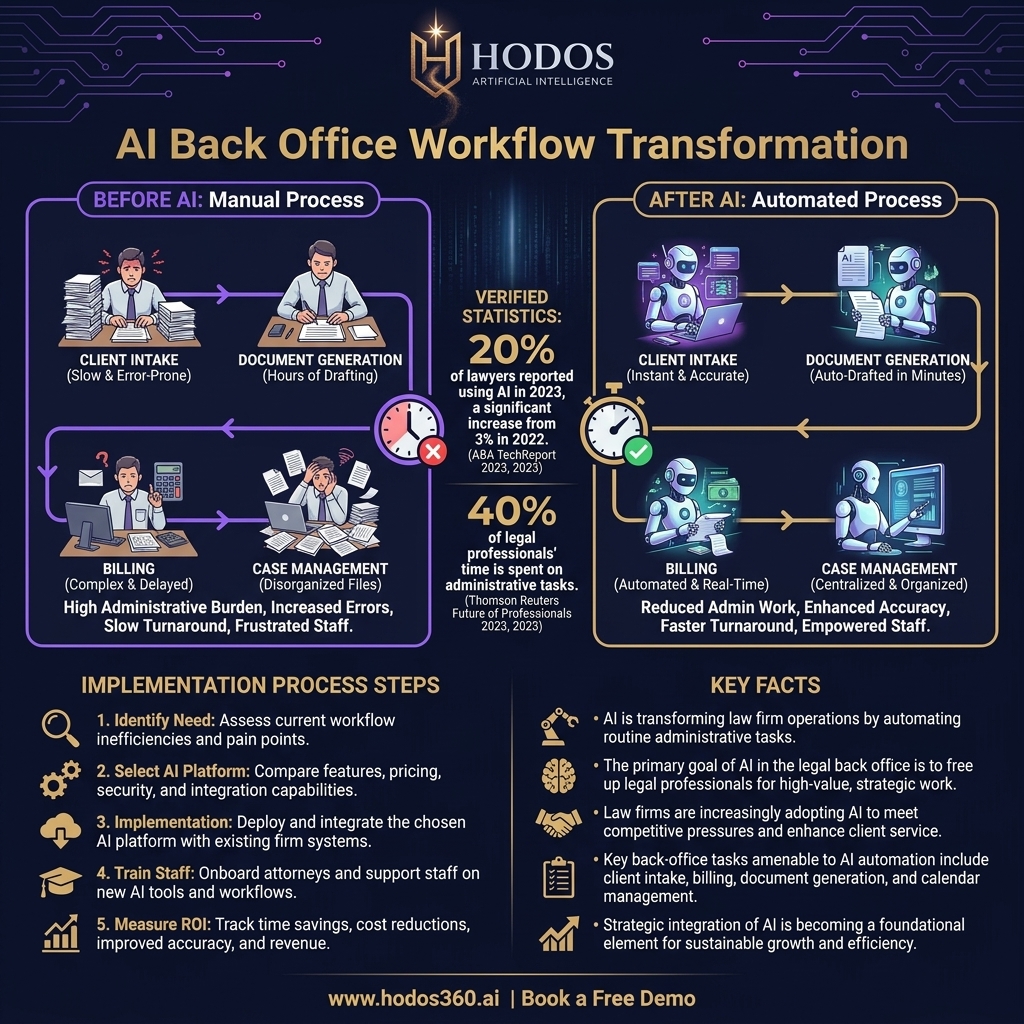
An integrated AI back office system is far more than a collection of disparate AI tools; it's a cohesive ecosystem designed to manage the entire lifecycle of a legal matter from an operational standpoint. At its core, it encompasses AI-powered case management, intelligent billing systems, streamlined client intake, advanced document automation, dynamic calendar management, and sophisticated AI-powered legal workflows. These components work synergistically to eliminate redundancies, reduce human error, and accelerate processing times, fundamentally transforming how legal firms operate. For instance, automating routine client communications through AI voice assistants can dramatically improve responsiveness and client satisfaction, a key differentiator in today's competitive market. The goal is to create a seamless, efficient operational flow that supports, rather than hinders, the delivery of high-quality legal services and maximizes law firm efficiency.
### Streamlining Client Intake and Billing with AI
The initial client engagement is often fraught with administrative friction. AI revolutionizes this process by providing intelligent lead qualification, automated data capture, and seamless onboarding. Imagine an AI voice assistant, like those offered by HODOS 360, handling 24/7 phone answering, qualifying leads based on predefined criteria, and even booking initial appointments directly into the firm’s calendar. This not only ensures no potential client is missed but also frees up paralegals and administrative staff for more complex tasks. Similarly, AI in billing can automate invoice generation, track expenses with greater accuracy, and even predict potential payment delays, allowing firms to proactively manage cash flow. Learn more about AI Voice Assistants: Essential Lessons from Chatbot Failures. A recent report by McKinsey Global Institute indicated that AI-driven automation in administrative tasks could reduce operational costs by up to 25% for service-oriented industries, a significant figure for legal firms constantly seeking to optimize their financial health.
### The Power of Document Automation and Workflow Orchestration
Document creation and management are colossal tasks in any law firm. An AI back office leverages advanced machine learning to automate the generation of contracts, pleadings, and other legal documents from customizable templates, drastically cutting down drafting time and minimizing errors. Firms are building their own internal systems or integrating third-party solutions. For example, Allen & Overy's partnership with Harvey AI showcases the potential for AI in sophisticated contract analysis and generation. Beyond document creation, AI orchestrates complex legal workflows, guiding attorneys and staff through multi-step processes, ensuring compliance and consistency. This includes everything from managing discovery phases to ensuring all necessary filings are completed on time. The integration of these AI tools ensures that every step of a matter is tracked, optimized, and executed with precision, leading to a substantial boost in overall firm productivity. Curious how HODOS 360 can tailor an AI back office solution for your specific needs?
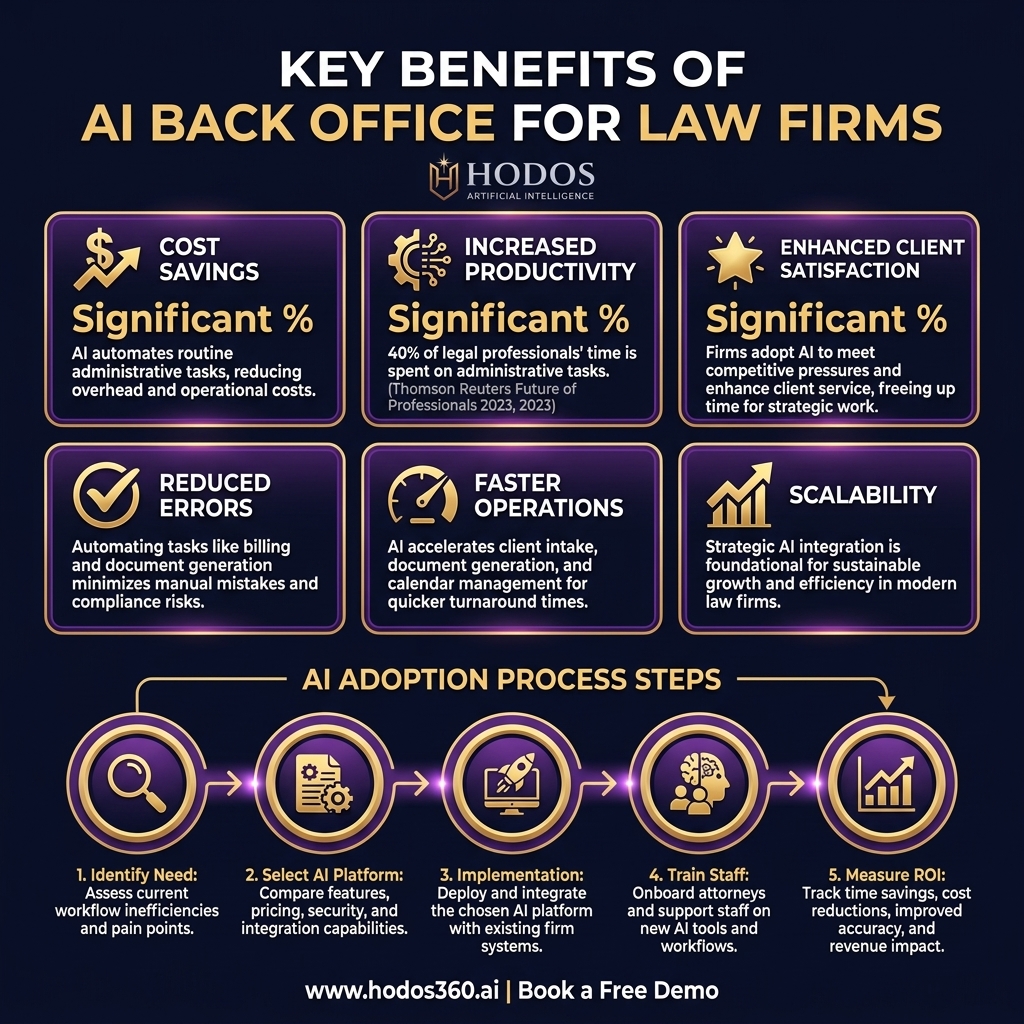
- ✓Enhanced Client Experience: AI voice assistants and automated intake ensure 24/7 availability and rapid response, delighting clients from the first interaction.
- ✓Significant Cost Reduction: Automation of repetitive tasks like billing, data entry, and document generation dramatically lowers operational overhead.
- ✓Increased Productivity: Lawyers and staff are freed from mundane administrative duties, allowing them to focus on high-value, billable legal work.
- ✓Improved Accuracy and Compliance: AI minimizes human error in document creation, data management, and adherence to regulatory requirements.
- ✓Better Data Insights: AI-powered analytics provide deeper insights into firm performance, client trends, and operational bottlenecks, informing strategic decisions.
- ✓Scalability and Growth: An AI back office enables firms to handle increased caseloads without proportionally increasing staff, facilitating sustainable growth.
- ✓Competitive Advantage: Early adopters gain a significant edge in law firm efficiency, client service, and overall market positioning.
Navigating Implementation: Strategies for Law Firms
Implementing an AI back office is a strategic undertaking that requires careful planning beyond merely selecting the right AI tools. The process often involves significant data migration, integration with existing systems, and comprehensive staff training. One of the primary challenges firms face is overcoming resistance to change, particularly among long-tenured employees who may view new technology as a threat rather than an aid. Successful implementation hinges on effective change management, clear communication about the benefits, and robust support systems. Firms should consider phased rollouts, starting with smaller pilot programs for specific functions (e.g., client intake or document automation) to build internal champions and demonstrate tangible value before a wider deployment. This iterative approach allows for adjustments and fine-tuning, ensuring the chosen AI back office solution truly meets the unique needs of the legal practice and enhances law firm efficiency.
### Data Security and Ethical Considerations in AI Adoption
The integration of AI tools into a legal firm's back office inevitably raises critical questions about data security, privacy, and professional ethics. When automating tasks involving sensitive client information, firms must ensure that the chosen AI back office solutions comply with the highest standards of cybersecurity and data protection. The American Bar Association (ABA) Model Rules of Professional Conduct, particularly Rule 1.1 (Competence) and Rule 1.6 (Confidentiality), impose obligations on attorneys regarding technological competence and the safeguarding of client information. Learn more about Ethical AI in Legal Tech: An Essential Guide for Law Firms. This means attorneys must understand the risks and benefits associated with technology, including AI, and take reasonable steps to protect client data. The evolving regulatory landscape, such as the EU AI Act, further underscores the necessity for firms to adopt AI tools responsibly, with a clear understanding of data governance, algorithmic bias, and the imperative for human oversight. Professor Andrew Perlman, CEO of Casetext and a leading voice in legal tech ethics, frequently emphasizes that technology should always enhance, not diminish, professional responsibility.
Furthermore, firms must establish clear internal policies regarding the use of AI, defining what tasks can be automated, how human review is integrated, and who is accountable for AI-generated outputs. This proactive approach helps mitigate risks and builds trust among clients and staff. Investing in secure, compliant AI tools that offer robust encryption, access controls, and regular security audits is paramount. The goal is to leverage the power of AI to boost firm productivity without compromising the ethical duties central to the legal profession. By prioritizing security and ethics from the outset, firms can confidently embrace the transformative potential of an AI back office, ensuring both innovation and integrity.
The Competitive Edge: Firms Embracing AI Now
The chasm between legal firms that embrace AI and those that hesitate is widening into a significant competitive gap. Early adopters of AI back office solutions are not just surviving; they are thriving, demonstrating superior law firm efficiency, client satisfaction, and profitability. Consider the contrast: Firm A, a forward-thinking practice, invested in an AI back office three years ago. Their client intake is fully automated, billing cycles are reduced by 40%, and lawyers spend 20% more time on billable tasks. This allows them to offer competitive rates while maintaining high margins, attracting a younger, tech-savvy clientele. In stark contrast, Firm B, hesitant to adopt new AI tools, continues to rely on manual processes. Their operational overhead remains high, client response times are slower, and they struggle with staff burnout, leading to higher attrition and a dwindling client base. This isn't a hypothetical scenario; it's the market reality, echoed in numerous industry reports.
Data from Gartner's latest Legal Tech Hype Cycle indicates that firms leveraging advanced automation and AI in their back office are reporting an average 15-20% increase in firm productivity within the first year of full implementation. This translates directly into enhanced revenue and stronger market positioning. Beyond operational gains, an AI back office facilitates superior client service. Learn more about AI Marketing Transforms Legal Web: Webflow's Vidoso Acquisition 2026. Automated communication, faster document delivery, and proactive case management create a seamless experience that clients increasingly expect. This improved client journey becomes a powerful marketing tool, complementing the efficiency gained internally. Firms are also finding that the data analytics capabilities of these AI tools provide unprecedented insights into their operations, allowing for data-driven strategic decisions, from resource allocation to service offerings. This holistic approach ensures that firms are not just performing better, but are also smarter and more adaptable.
Moreover, the integration of an AI back office can unlock new growth avenues. For instance, by automating routine tasks, firms can allocate resources to developing specialized services, expanding into new markets, or handling a higher volume of cases without compromising quality. This scalability is crucial for startups and growing firms looking to rapidly expand their footprint. The ability to quickly adapt to market demands, driven by agile AI-powered workflows, positions these firms as industry leaders. The competitive dynamic is clear: the future of legal practice belongs to those who strategically deploy AI tools to augment human capabilities, ensuring that the human part of law is elevated, not replaces, by technology. This foresight is what distinguishes market leaders from followers, ensuring sustained relevance and profitability in an increasingly tech-driven world.

Shaping the Future: Strategic Imperatives for Law Firm Leaders
The future of legal practice is inextricably linked to the intelligent adoption of AI back office solutions. For law firm leaders, the imperative is clear: embrace this technological evolution not as a threat, but as an unparalleled opportunity to redefine law firm efficiency and client value. The journey involves a commitment to continuous learning, strategic investment in robust AI tools, and fostering a culture of innovation that encourages experimentation and adaptation. As we look ahead, the integration of AI will become even more seamless, with systems predicting needs, automating complex decision trees, and providing real-time strategic insights. The firms that will thrive are those that view AI as a partner in their growth, a force multiplier that amplifies human expertise rather than replaces it. The narrative that AI replaces lawyers is a simplistic one; the more accurate story is that lawyers who use AI will replace those who don't. This strategic foresight ensures long-term viability and competitive advantage.
For firms seeking to navigate this transformative landscape, comprehensive platforms that integrate various AI capabilities are key. HODOS 360, for example, offers an AI-powered suite that not only includes an AI Law Firm Management System for back office tasks but also an AI Marketing Platform, AI Voice Assistants, and Web & Mobile Development services. Such integrated solutions provide a holistic approach to enhancing firm productivity, from client acquisition and communication to operational management and digital presence. Learn more about AI Marketing Automation: Essential Lead Flow for Law Firms. This comprehensive suite ensures that firms can build a future-proof practice, leveraging AI at every touchpoint. The focus must be on building a resilient, agile, and client-centric legal practice where technology empowers attorneys to deliver exceptional service and focus on the intricate, human-centric aspects of law. Take the decisive step towards a more efficient, profitable, and future-proof law firm.
Ultimately, the strategic imperative for legal leaders is to lead with vision. This means actively exploring and investing in AI back office solutions, understanding their capabilities, and meticulously planning their integration. It's about empowering their teams with the AI tools necessary to excel in a rapidly changing environment, ensuring that the human element—the empathy, judgment, and advocacy that define the legal profession—remains at the forefront. By proactively engaging with AI, firms can unlock unprecedented levels of law firm efficiency, reduce operational burden, and solidify their position as leaders in the evolving legal landscape. The time to act is now; the future of legal practice is being written by those who dare to innovate.
Frequently Asked Questions
What specifically does an 'AI back office' for law firms entail?+
An AI back office refers to a suite of AI-powered solutions designed to automate and optimize administrative and operational tasks within a law firm. This includes functions like client intake, billing, document generation, case management, calendar scheduling, and AI-driven workflow automation. The goal is to enhance overall law firm efficiency by reducing manual effort and human error, allowing legal professionals to focus on high-value legal work.
How do AI voice assistants integrate into a law firm's back office?+
AI voice assistants act as a virtual front desk, providing 24/7 phone answering, lead qualification, and appointment booking. They can intelligently route calls, offer multilingual support, and capture initial client information, seamlessly feeding data into the firm's case management system. This enhances client responsiveness, ensures no lead is missed, and frees up human staff for more complex interactions, boosting firm productivity.
Are there ethical concerns regarding AI in law firm operations?+
Yes, ethical considerations are paramount. Law firms must ensure AI tools comply with data security, privacy, and confidentiality regulations (e.g., ABA Model Rule 1.6). There's also the need for human oversight to prevent algorithmic bias and ensure accuracy, maintaining professional competence (ABA Model Rule 1.1). Firms should implement clear policies for AI use, emphasizing that AI augments, but does not replace, human judgment and ethical responsibility.
What is the ROI for implementing an AI back office in a law firm?+
The ROI for an AI back office can be substantial. Firms typically see significant reductions in operational costs due to automation of repetitive tasks, increased billable hours as lawyers are freed from administrative duties, and improved client satisfaction from faster, more efficient service. Enhanced data insights lead to better strategic decisions, and the overall boost in law firm efficiency and productivity translates directly into higher profitability and competitive advantage.
How can small and mid-sized law firms afford and implement these AI solutions?+
Many AI back office solutions are now offered on a scalable, subscription-based model, making them accessible to firms of all sizes. Small and mid-sized firms can start with specific modules, like AI-powered client intake or document automation, and gradually expand. Phased implementation, focusing on areas with the highest pain points, allows for manageable adoption and quick wins, demonstrating value and building internal support for further investment.