


Ethical AI in Legal Tech: An Essential Guide for Law Firms
The legal industry is currently navigating a transformative period, marked by the rapid integration of artificial intelligence into its core operations. Just recently, TipRanks highlighted Filevine’s strategic emphasis on ethical AI and autonomous systems, signaling a clear direction for the future of legal technology. This isn't merely a trend; it's a fundamental shift that demands careful consideration from law firm leaders and legal professionals alike.
As generative AI models from powerhouses like OpenAI and Google continue to advance at an astonishing pace, offering unprecedented capabilities from sophisticated legal research to automated document drafting, the ethical implications become increasingly pronounced. The promise of enhanced efficiency and reduced operational costs is compelling, yet it comes hand-in-hand with critical questions surrounding data privacy, algorithmic bias, and professional accountability.
Firms must recognize that the adoption of AI is no longer a matter of 'if,' but 'how'—and 'how' must be rooted in an unwavering commitment to ethics.
This evolving landscape necessitates a proactive approach to understanding and implementing ethical AI frameworks. The legal sector, inherently built on principles of trust, confidentiality, and justice, bears a unique responsibility to ensure that AI tools augment, rather than undermine, these foundational tenets.
Firms that embrace this challenge, integrating robust ethical guidelines into their AI strategies, will not only mitigate risks but also gain a significant competitive advantage. They will attract forward-thinking talent, foster greater client trust, and solidify their reputation as innovators committed to responsible practice. This comprehensive guide delves into the intricate balance between technological advancement and ethical stewardship, offering insights and practical strategies for law firms to confidently navigate the complex terrain of AI-powered legal services.
It's about empowering legal professionals with cutting-edge tools while upholding the highest standards of integrity and client protection.
Ready to explore how ethical AI can transform your firm? Discover HODOS 360's AI Law Firm Management solutions.
The Imperative of Ethical AI in Legal Practice
The integration of AI into legal practice raises profound ethical questions that strike at the heart of professional responsibility. At its core, the use of AI in law must align with the foundational principles enshrined in the ABA Model Rules of Professional Conduct. Rules such as Competence (Rule 1.1), Confidentiality of Information (Rule 1.6), and Supervision (Rule 5.1, 5.3) are directly impacted.
For instance, Rule 1.1 requires lawyers to keep abreast of changes in the law and its practice, including the benefits and risks associated with relevant technology. This explicitly places an obligation on attorneys to understand the limitations and potential biases of AI tools they employ.
Learn more about AI Voice Assistant: Essential for Modern Law Firm Success. As Ryan Anderson, CEO of Filevine, recently articulated, the industry is shifting towards "legal intelligence that is grounded in truth," emphasizing the need for AI systems that are not only powerful but also transparent and reliable.
The 'black box' problem, where AI's decision-making process is opaque, presents a significant challenge to the duty of competence, as lawyers must be able to explain and justify the outputs on which they rely. Without clear explainability, ensuring that AI-generated advice is sound and unbiased becomes incredibly difficult, risking the quality of legal services and potentially violating a lawyer’s ethical duties.
Beyond competence, confidentiality is paramount. AI systems often process vast amounts of sensitive client data, raising concerns about data security, privacy, and the potential for inadvertent disclosure. A breach of Rule 1.6 could have catastrophic consequences for both clients and firms. Furthermore, the risk of algorithmic bias, embedded through training data that reflects historical societal inequalities, is a critical ethical concern.
If an AI system, for example, is used in case prediction or sentencing recommendations, and its training data disproportionately represents certain demographics, it could perpetuate or even amplify existing injustices. Learn more about AI Marketing Platform Elevates Law Firms in 2026. This isn't a theoretical risk; studies by organizations like the Algorithmic Justice League have repeatedly demonstrated how biases can be unintentionally encoded into AI, leading to discriminatory outcomes.
The legal profession, committed to fairness and justice, cannot afford to ignore these risks. Firms must implement rigorous data governance strategies, ensure data anonymization where appropriate, and conduct regular audits of AI systems to detect and mitigate bias, ensuring that the pursuit of efficiency does not compromise the pursuit of equitable legal outcomes.
The competitive landscape further underscores the imperative of ethical AI. While some law firms are cautiously exploring AI, others are rapidly integrating it, creating a divide between innovators and traditionalists. Brad Blickstein of the Blickstein Group has consistently highlighted the growing pressure on law firms to adopt new technologies to remain competitive, but he also stresses the importance of managing the associated risks.
Firms that prioritize ethical implementation will not only avoid potential legal and reputational pitfalls but will also build a stronger foundation for client trust. Learn more about Legal AI Gap: Bridging the Divide for Law Firms in 2026. In a world increasingly wary of data misuse and algorithmic overreach, clients are more likely to choose firms that can transparently demonstrate their commitment to responsible technology use.
This commitment translates into a clear differentiator in a crowded market, attracting not only new clients but also top-tier talent who are seeking innovative yet ethically grounded environments. The narrative of ethical AI is therefore not one of constraint, but of strategic advantage, positioning firms at the forefront of responsible innovation.
Moreover, the ethical imperative extends to the supervision of non-lawyer personnel and the use of external AI tools. Rule 5.3 requires partners and supervising lawyers to make reasonable efforts to ensure that non-lawyers' conduct is compatible with the professional obligations of the lawyer. When AI acts as a 'non-lawyer assistant,' lawyers retain ultimate responsibility for its outputs.
This means understanding the capabilities and limitations of AI tools, verifying their work, and ensuring that they are used in a manner consistent with ethical rules. The challenge is particularly acute with advanced autonomous systems that can perform complex tasks with minimal human intervention. Learn more about AI Voice: Legal's 2026 Paradigm Shift & Innovation Catalyst.
While such systems offer immense efficiency gains, they also amplify the need for robust oversight mechanisms. Lawyers must be trained not just on how to use AI, but on how to critically evaluate its output, identify potential errors or biases, and understand the ethical boundaries within which these powerful tools operate.
This continuous education and critical engagement are essential to harness the power of AI responsibly, ensuring that technology serves justice, not the other way around.
Navigating Autonomous Legal Systems: Opportunities and Risks
Autonomous legal systems represent the cutting edge of AI in law, promising to redefine how legal tasks are performed. These systems, ranging from advanced contract drafting bots to predictive analytics platforms and intelligent e-discovery tools, are designed to operate with a high degree of independence, automating complex workflows that traditionally required significant human hours.
Companies like Harvey AI, which recently secured a significant funding round and partnered with global firms such as Allen & Overy, are at the vanguard of this movement, demonstrating how AI can act as a sophisticated research and drafting assistant. The opportunities for efficiency gains are staggering: reducing the time spent on repetitive tasks, accelerating legal research, and providing data-driven insights for litigation strategy.
Learn more about Essential AI Web Development: Build Legal Apps with Ease. A report by McKinsey & Company estimated that legal activities have a high potential for automation, with AI capable of handling up to 23% of lawyers' current tasks, freeing up attorneys to focus on higher-value, client-facing work.
This shift allows firms to deliver faster, more cost-effective services, enhancing client satisfaction and competitive positioning. The ability of these systems to quickly process and analyze vast quantities of legal data, identifying patterns and precedents that might elude human review, fundamentally changes the scale and speed of legal operations, ushering in an era of unprecedented productivity.
However, the very autonomy that makes these systems so powerful also introduces significant risks. Over-reliance on AI without adequate human oversight can lead to critical errors, particularly when systems encounter novel legal questions or ambiguous factual scenarios. The phenomenon of 'hallucination,' where generative AI produces factually incorrect or nonsensical outputs presented as truth, is a serious concern in a profession where accuracy is paramount.
Consider a scenario where an autonomous system drafts a critical clause in a contract based on a hallucinated precedent, or a predictive AI misinterprets case law, leading to flawed litigation advice. Who bears the liability for such errors? The debate around whether AI acts as a 'co-counsel' or merely a 'tool' is crucial here.
The prevailing legal consensus, reinforced by ethical rules, is that the lawyer remains ultimately responsible. Learn more about ActiveCampaign 2026: AI Marketing Unleashes Law Firm Growth. This necessitates a robust verification process for all AI-generated content and decisions. Furthermore, the security implications of feeding sensitive client data into autonomous systems are immense.
A data breach involving an AI platform could expose privileged information, violating attorney-client privilege and incurring severe reputational and financial damage. Firms must carefully vet their AI vendors, prioritizing those with stringent security protocols and a proven track record of data protection.
The Role of Human Oversight in Autonomous AI
Despite the allure of fully autonomous operations, the indispensable role of human oversight in legal AI cannot be overstated. The EU AI Act, a landmark piece of legislation, explicitly emphasizes the necessity of human supervision for high-risk AI systems, a category into which many legal AI applications would likely fall.
This legislation mandates that humans must be able to effectively oversee AI systems, intervene when necessary, and ultimately make the final decisions. For law firms, this means developing clear protocols for human review at every critical juncture of an AI-powered workflow. This isn't about distrusting the AI; it's about ensuring professional responsibility and accountability.
Attorneys must be trained to critically evaluate AI outputs, question assumptions, and apply their unique legal judgment, empathy, and understanding of nuance—qualities that AI currently lacks. The human element provides the ethical compass and the ultimate safety net, ensuring that AI tools enhance, rather than diminish, the quality and integrity of legal services.
The most effective implementation of autonomous systems will therefore be a hybrid model, where AI handles the heavy lifting of data processing and initial drafting, while human lawyers provide the strategic direction, ethical review, and client-specific customization. This collaborative approach leverages the strengths of both human and artificial intelligence, creating a synergy that drives superior legal outcomes.
Implementing these systems safely requires a strategic, phased approach. Firms should avoid a 'big bang' adoption and instead opt for controlled pilots in low-risk areas, allowing them to test the AI's performance, identify potential issues, and refine integration strategies. This iterative process, coupled with continuous monitoring and evaluation, is crucial.
For example, a firm might start by using an AI for initial document review in a non-critical litigation matter, gradually expanding its use as confidence and expertise grow. Rigorous testing involves not only checking for accuracy but also probing for biases and ethical vulnerabilities. This includes using diverse datasets for validation and stress-testing the AI with edge cases.
Moreover, continuous monitoring of AI performance metrics, user feedback, and incident reports is essential for identifying and addressing issues promptly. The legal tech market is dynamic, with new tools and updates emerging constantly. Firms must cultivate a culture of continuous learning and adaptation, staying informed about the latest advancements and regulatory changes.
By adopting a cautious yet progressive approach, law firms can harness the power of autonomous AI while effectively mitigating its inherent risks, ensuring that innovation serves the best interests of their clients and the justice system.
Building Trust: Data Governance and Transparency in AI
The bedrock of ethical AI in legal tech is robust data governance and unwavering transparency. Without these, even the most advanced AI tools can undermine client trust and expose firms to significant risks. Data governance in the AI era goes beyond traditional data management; it encompasses the entire lifecycle of data used by AI, from collection and storage to processing, analysis, and eventual deletion.
This includes ensuring data quality, as AI systems are only as good as the data they're trained on. Inaccurate, incomplete, or biased data inputs will inevitably lead to flawed or biased AI outputs. Legal firms must establish clear policies for data intake, cleansing, and validation, ensuring that the information fed into AI systems is pristine and representative.
Furthermore, privacy is paramount. Handling sensitive client information requires strict adherence to regulations like HIPAA, GDPR, and various state-specific privacy laws. AI platforms must be designed with privacy-by-design principles, incorporating anonymization, encryption, and access controls to protect privileged and confidential data. As Filevine emphasizes its commitment to "legal intelligence that is grounded in truth," this underlines the critical importance of trustworthy data as the foundation for all AI operations.
Firms must meticulously document data sources and processing methods to maintain auditability and demonstrate compliance, especially when leveraging external AI services.
Transparency in AI extends to understanding the provenance of data and the logic behind AI-driven decisions. Firms need to establish clear data lineage, providing an audit trail that shows where data came from, how it was processed, and how it influenced an AI's output. This is crucial for explainability—the ability to articulate *why* an AI made a particular recommendation or prediction.
Without this, lawyers cannot fully meet their ethical obligation of competence or adequately advise clients on AI-generated insights. For instance, if an AI-powered legal research tool suggests a certain line of argument, an attorney must be able to understand the underlying rationale and the data sources that led to that conclusion.
Companies like Thomson Reuters are investing heavily in explainable AI features within their legal research platforms, recognizing that transparency builds confidence. Law firms should demand similar features from all their AI vendors, ensuring that they are not simply accepting AI outputs at face value but are equipped to critically evaluate and, if necessary, challenge them.
This level of transparency fosters a collaborative environment where AI acts as an intelligent assistant, empowering lawyers with insights rather than dictating outcomes, thereby preserving the human element of legal judgment.
Client Confidentiality and Data Security in AI Workflows
The handling of client confidentiality and data security within AI workflows presents unique and elevated challenges. Attorney-client privilege and the duty of confidentiality are cornerstones of legal practice, and their breach can lead to severe professional and legal repercussions. When deploying AI, firms must ensure that their chosen platforms adhere to the highest security standards, including SOC 2 compliance, robust encryption protocols, and secure data residency options.
The location of data storage, particularly for cloud-based AI solutions, can have significant implications for jurisdiction and data sovereignty. Firms must understand where their client data is processed and stored and ensure it aligns with relevant regulations and client agreements. Moreover, AI systems often require access to large datasets to function effectively.
This necessitates careful anonymization or pseudonymization of sensitive client information where possible, especially for training data. Law firms should establish strict access controls, limiting who within the firm can interact with AI systems processing confidential data, and implement multi-factor authentication for all AI platform access.
Regular security audits and penetration testing of AI systems are not optional; they are essential to identify and rectify vulnerabilities before they can be exploited. Firms like Clifford Chance, known for their focus on legal innovation, have emphasized the need for bespoke security frameworks for AI, recognizing that off-the-shelf solutions may not suffice for the unique demands of legal data.
The responsibility for client data ultimately rests with the firm, regardless of the technology used, making due diligence on AI security paramount.
Beyond technical safeguards, transparency with clients about the use of AI in their matters is an ethical imperative. While specific rules vary by jurisdiction, the spirit of informed consent dictates that clients should be aware when AI tools are being used to assist in their legal work, especially if those tools handle their confidential information.
This doesn't mean providing an overly technical explanation, but rather a clear, concise disclosure about the benefits of AI (e.g., efficiency, speed) and the measures taken to protect their data and ensure ethical use. This proactive communication builds trust and manages client expectations. For instance, a firm might include a clause in its engagement letter outlining its approach to legal technology, including AI.
This approach aligns with the ABA's guidance on technology competence, which implicitly encourages lawyers to communicate effectively with clients about the tools and methods employed in their representation. By openly discussing AI's role, firms can transform potential client apprehension into confidence, demonstrating their commitment to both innovation and the highest ethical standards.
This transparency is crucial for maintaining the sacred bond of trust that underpins the attorney-client relationship, ensuring that advanced technology serves to strengthen, not erode, that bond.
Unlock the power of secure, ethical AI for your practice. Explore how HODOS 360’s AI-powered Legal Workflows can benefit your firm.
Regulatory Landscape and Compliance Challenges
The regulatory landscape surrounding AI is rapidly evolving, presenting both opportunities and significant compliance challenges for law firms. Globally, the EU AI Act stands as a landmark piece of legislation, setting a precedent by categorizing AI systems based on their risk level, from minimal to unacceptable.
Many legal AI applications, particularly those involved in predictive analytics for litigation or client intake, could fall under the 'high-risk' category, triggering stringent compliance requirements regarding data quality, human oversight, transparency, and robustness. This proactive regulatory approach from the European Union signals a global trend towards greater scrutiny of AI.
For US firms, even if not directly subject to the EU AI Act, its influence on global best practices and client expectations cannot be ignored, especially for those with international clients or operations. Moreover, various US federal agencies, such as the National Institute of Standards and Technology (NIST), have introduced frameworks like the AI Risk Management Framework, which, while voluntary, provides comprehensive guidance for managing AI-related risks.
States are also beginning to enact their own legislation, creating a complex patchwork of rules that firms must navigate. The ABA, through its various committees, is actively studying AI's impact on legal ethics and practice, with evolving opinions and guidelines that firms must monitor closely.
Staying abreast of this dynamic regulatory environment is a monumental task, yet it is essential for avoiding legal pitfalls and maintaining professional standing.
The challenge for law firms lies not only in understanding the myriad of existing and emerging regulations but also in integrating them into their operational frameworks. Compliance is not a one-time event; it requires continuous monitoring, adaptation, and internal policy development. Firms must consider establishing internal AI ethics committees or appointing a dedicated AI compliance officer to oversee the ethical deployment and use of AI tools.
These committees can be responsible for developing firm-wide AI usage policies, conducting risk assessments of new AI technologies, and ensuring adherence to both legal and ethical guidelines. For instance, a firm might develop a policy that mandates human review for all AI-generated legal advice before it is communicated to a client, or a protocol for anonymizing client data before it is used to train internal AI models.
Furthermore, the selection of AI vendors becomes a critical compliance decision. Firms must ask probing questions about a vendor's data security certifications (e.g., ISO 27001, SOC 2), data residency policies, explainability features, and their own commitment to ethical AI development. A vendor's ability to demonstrate compliance with relevant regulations, such as GDPR or CCPA, is no longer a bonus but a fundamental requirement.
This diligence is crucial because, ultimately, the firm bears the responsibility for how AI is used in its practice, regardless of whether the AI is developed in-house or provided by a third party.
Navigating Emerging AI Legislation
Navigating the labyrinth of emerging AI legislation demands a proactive and strategic approach from law firms. The speed at which AI technology is advancing often outpaces the legislative process, creating a dynamic and sometimes ambiguous regulatory environment. Firms cannot afford to wait for definitive laws to be enacted; they must anticipate future regulations and build their AI strategies with flexibility and foresight.
This involves continuous legal research into proposed legislation, white papers from regulatory bodies, and industry best practices. Subscribing to legal tech and AI policy updates from authoritative sources like the American Bar Association (ABA) and Thomson Reuters is crucial. Furthermore, firms should consider participating in industry dialogues and contributing to policy discussions, leveraging their legal expertise to help shape future regulations in a way that is both effective and practical for the legal profession.
For example, firms can engage with local bar associations to develop specific guidelines for AI use within their jurisdictions, thereby influencing the localized regulatory landscape. The goal is to avoid being caught off guard by new rules and instead to be prepared to adapt internal processes swiftly.
This proactive stance not only ensures compliance but also positions the firm as a thought leader in responsible AI adoption, enhancing its reputation and attracting clients who value forward-thinking legal counsel. The investment in understanding and influencing AI legislation is an investment in the firm's future resilience and ethical standing.
The onus is also on legal tech providers to develop solutions that are designed with compliance in mind. Law firms should prioritize partners who offer transparent, explainable, and secure AI systems that can adapt to evolving regulatory requirements. For example, a legal AI platform should ideally offer configurable settings that allow firms to adhere to different data residency requirements or to implement specific human oversight protocols mandated by jurisdiction.
The ability to generate audit trails for AI-driven decisions is another critical feature for demonstrating compliance. Firms should engage in open dialogue with their vendors, communicating their compliance needs and collaborating on solutions. This partnership approach ensures that the technology ecosystem supporting the firm is robust and adaptable.
Ultimately, the successful navigation of the AI regulatory landscape will be a collaborative effort between law firms, legal tech developers, and regulatory bodies. By fostering this collaboration, the legal profession can ensure that AI is integrated in a manner that upholds justice, protects client interests, and maintains the highest ethical standards, even as technology continues its relentless march forward.
The future of legal practice depends on this delicate balance, where innovation is tempered with responsibility and foresight.
Implementing Ethical AI: A Strategic Blueprint for Law Firms
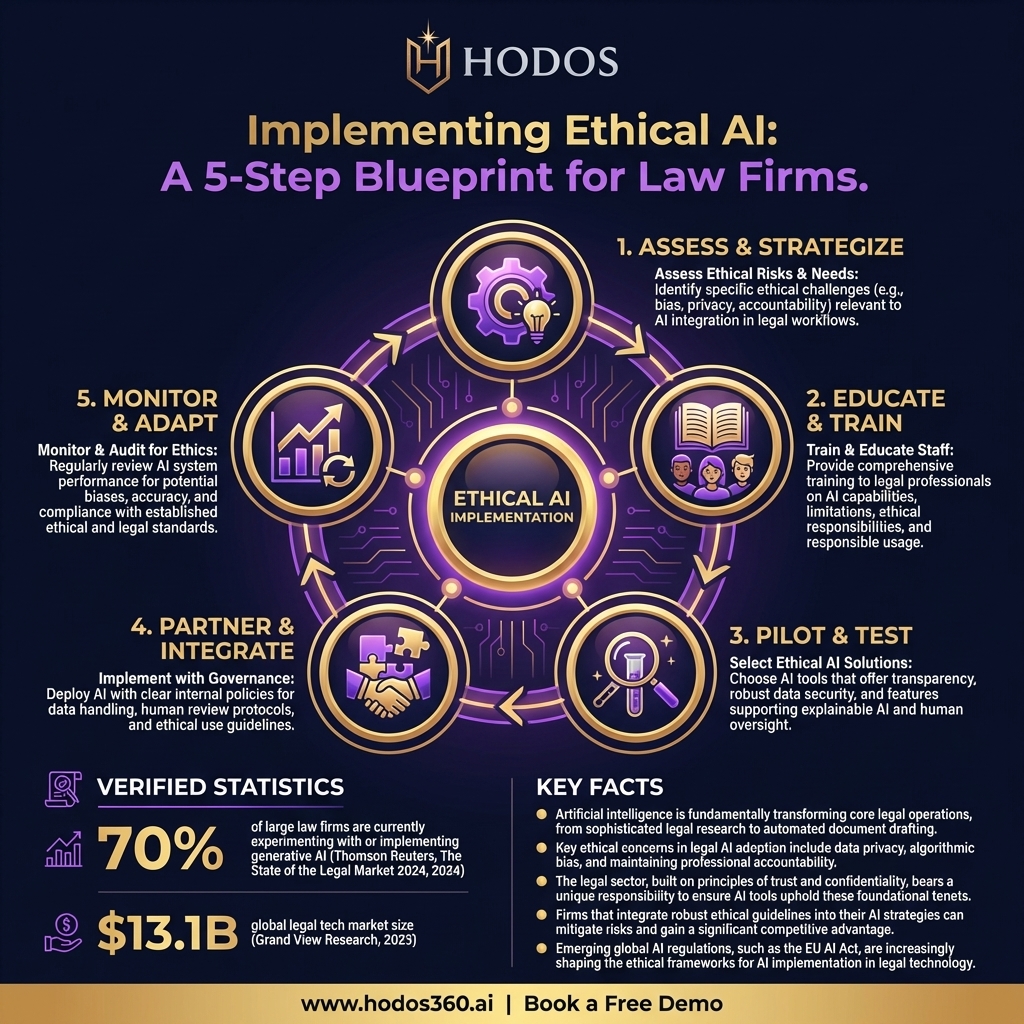
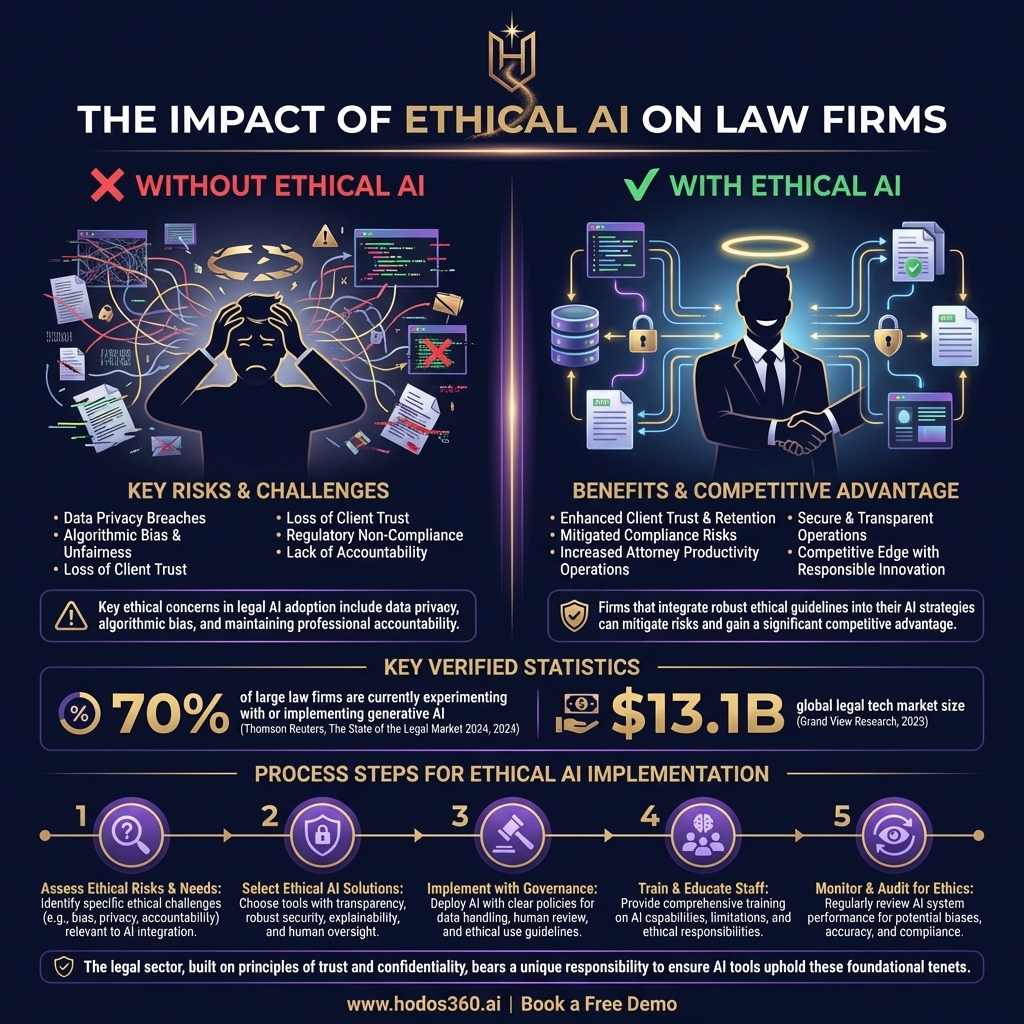
To remain competitive and relevant in the rapidly evolving legal landscape, law firms must move beyond theoretical discussions of ethical AI and develop a practical, strategic blueprint for its implementation. A 2023 report by Thomson Reuters found that while 82% of law firms anticipate using generative AI in the next 12 months, many are still grappling with how to do so responsibly.
The first step in this blueprint is a thorough assessment and strategy development. Firms need to identify specific areas where AI can ethically add value, such as streamlining document review in e-discovery, enhancing legal research efficiency, automating client intake processes, or improving case management. This assessment should involve all key stakeholders—partners, associates, paralegals, and IT staff—to ensure buy-in and to identify potential ethical pinch points unique to the firm's practice areas.
For instance, a litigation firm might prioritize AI for early case assessment, while a corporate firm might focus on contract analysis. The strategy should clearly define the firm's ethical principles for AI use, aligning them with professional obligations and client expectations. This initial phase sets the foundation for all subsequent AI initiatives, ensuring that technology adoption is purposeful and ethically guided.
The next crucial step is comprehensive education and training. It’s not enough to simply acquire AI tools; attorneys and staff must be equipped with the knowledge and skills to use them competently and ethically. This includes understanding the capabilities and limitations of specific AI platforms, recognizing potential biases, and knowing when human intervention is absolutely necessary.
Training programs should cover topics such as AI ethics, data privacy best practices, and the firm’s internal AI usage policies. For example, an attorney using an AI-powered legal research tool needs to understand its search methodology, potential for 'hallucinations,' and how to verify its sources.
Firms can partner with legal tech experts or educational institutions to develop tailored training modules. Andrew Arruda, co-founder of Ross Intelligence, has often stressed the importance of legal professionals understanding the underlying technology to leverage it effectively and responsibly. This ongoing education fosters a culture of informed AI adoption, where every user is an active participant in maintaining ethical standards.
Without proper training, even the most ethically designed AI tools can be misused, leading to unintended consequences and undermining the very purpose of their implementation.
- ✓Assess & Strategize: Identify specific, ethical use cases for AI within your firm's practice areas.
- ✓Educate & Train: Provide continuous, comprehensive training for all legal professionals on AI capabilities, limitations, and ethical guidelines.
- ✓Pilot & Test: Begin with controlled, low-risk pilot projects to evaluate AI performance and refine integration strategies.
- ✓Partner Wisely: Select legal tech vendors with proven security, transparency, and a strong commitment to ethical AI development.
- ✓Monitor & Adapt: Establish ongoing monitoring systems for AI performance, bias detection, and compliance with evolving regulations.
- ✓Develop Internal Policies: Create clear, firm-wide guidelines for AI use, data governance, and human oversight, aligning with professional ethical obligations.
- ✓Foster a Culture of Responsibility: Promote open dialogue, critical thinking, and a commitment to ethical innovation across the firm.
Following education, firms should engage in piloting and testing. Instead of a firm-wide rollout, start with controlled, low-risk pilot projects. This allows the firm to evaluate the AI's performance in a real-world setting, identify any unforeseen ethical challenges, and refine integration strategies before broader deployment.
For example, a pilot could involve using an AI document review tool on a batch of non-privileged documents or deploying an AI-powered client intake system for a specific practice group. During the pilot phase, meticulous data collection on accuracy, efficiency, and user feedback is essential.
This iterative process allows for adjustments and improvements, ensuring that the AI tool is effective, secure, and aligns with ethical guidelines. Sam Altman, CEO of OpenAI, has consistently advocated for cautious, iterative deployment of powerful AI systems, acknowledging the need for continuous learning and adaptation.
This phased approach minimizes risk, builds internal confidence, and provides valuable insights for scaling AI across the firm. It’s a practical application of the 'measure twice, cut once' principle, ensuring that AI integration is deliberate and well-informed, rather than rushed and potentially problematic.
Third-Party AI and Vendor Due Diligence
Finally, the implementation blueprint must include rigorous vendor due diligence and continuous monitoring. Most law firms will rely on third-party legal tech providers for their AI solutions. Therefore, selecting the right partners is paramount. Firms must conduct thorough due diligence, assessing not only the functionality of an AI tool but also the vendor's commitment to data security, privacy, transparency, and ethical AI development.
This includes reviewing their terms of service, data handling policies, security certifications (e.g., ISO 27001, SOC 2 Type 2), and their approach to algorithmic bias and explainability. Questions to ask include: Where is data stored? Is it encrypted? How is PII handled? Can we audit the AI's decision-making process?
Beyond initial selection, firms must establish ongoing monitoring systems for AI performance, bias detection, and compliance with evolving regulations. This means regularly reviewing audit logs, conducting internal ethics reviews, and staying updated on new legal tech developments and regulatory changes. The legal profession is dynamic, and so too must be the firm’s approach to AI governance.
By embracing ethical AI as an ongoing journey rather than a one-time project, firms can harness the transformative power of technology while upholding their core professional responsibilities, ultimately strengthening their practice and better serving their clients in the digital age. This continuous commitment ensures that AI is not just a tool for efficiency but a partner in delivering justice.

Key Takeaways and Next Steps
The legal industry stands at a critical inflection point, where the integration of AI is no longer optional but an imperative for innovation and competitive advantage. The emphasis placed by industry leaders like Filevine on ethical AI and autonomous systems underscores a fundamental truth: technological advancement must be inextricably linked with responsible stewardship.
Law firms that proactively embrace this challenge, developing comprehensive strategies for ethical AI implementation, will be best positioned to thrive. This involves a deep understanding of the ethical implications outlined in professional conduct rules, a commitment to robust data governance and transparency, and a keen awareness of the rapidly evolving regulatory landscape.
The journey of integrating AI is not without its complexities, demanding continuous learning, rigorous oversight, and a strategic partnership approach with trusted legal tech providers.
For law firms seeking to navigate this complex terrain, the path forward involves a multi-faceted approach: assessing current needs, educating teams, piloting solutions responsibly, and partnering with vendors who prioritize security and ethics.
Platforms like HODOS 360 offer comprehensive AI Law Firm Management solutions designed with these principles in mind, providing tools for case management, document automation, and AI-powered legal workflows that prioritize both efficiency and ethical compliance. The ultimate goal is to leverage AI to augment human legal capabilities, empowering attorneys to deliver higher quality, more efficient, and more accessible legal services, all while upholding the sacred trust placed in the legal profession.
By embedding ethical considerations at every stage of AI adoption, firms can unlock the full potential of this transformative technology, securing a future where innovation and integrity go hand in hand. Ready to integrate ethical AI into your firm's operations? Contact HODOS 360 for a personalized consultation on our AI Law Firm Management System.
Frequently Asked Questions
What is ethical AI in legal tech?+
Ethical AI in legal tech refers to the design, development, and deployment of AI systems in legal practice that prioritize fairness, transparency, accountability, and the protection of client rights and data. It involves mitigating biases, ensuring data privacy, maintaining human oversight, and adhering to professional ethical obligations like competence and confidentiality. The goal is to ensure AI enhances justice, rather than compromising it.
How does AI impact attorney-client privilege?+
AI impacts attorney-client privilege primarily through data handling. If confidential client information is input into an AI system without proper safeguards, or if the system's security is breached, privilege could be inadvertently waived or compromised. Firms must ensure AI platforms have robust security, strict access controls, and clear data residency policies to protect privileged communications and information from unauthorized disclosure.
Can AI replace lawyers?+
No, AI cannot fully replace lawyers. While AI excels at automating repetitive tasks, processing vast datasets, and providing predictive insights, it lacks human judgment, empathy, critical thinking for novel situations, and the ability to build client relationships. AI serves as a powerful tool to augment lawyers' capabilities, freeing them to focus on strategic advice, complex problem-solving, and the nuanced human aspects of legal practice.
What are the biggest risks of using autonomous AI in law?+
The biggest risks include over-reliance leading to critical errors or 'hallucinations,' algorithmic bias perpetuating injustice, data security breaches compromising client confidentiality, and the 'black box' problem hindering explainability. These risks can lead to professional liability, reputational damage, and erosion of client trust if not managed with stringent human oversight, robust data governance, and continuous monitoring.
How can law firms ensure compliance with AI regulations?+
Law firms can ensure compliance by establishing internal AI ethics committees, developing clear firm-wide AI usage policies, conducting thorough due diligence on AI vendors, and providing continuous training for staff. Staying updated on evolving legislation like the EU AI Act and ABA guidelines is crucial. Implementing privacy-by-design principles and maintaining audit trails for AI decisions also helps demonstrate adherence to regulatory requirements.