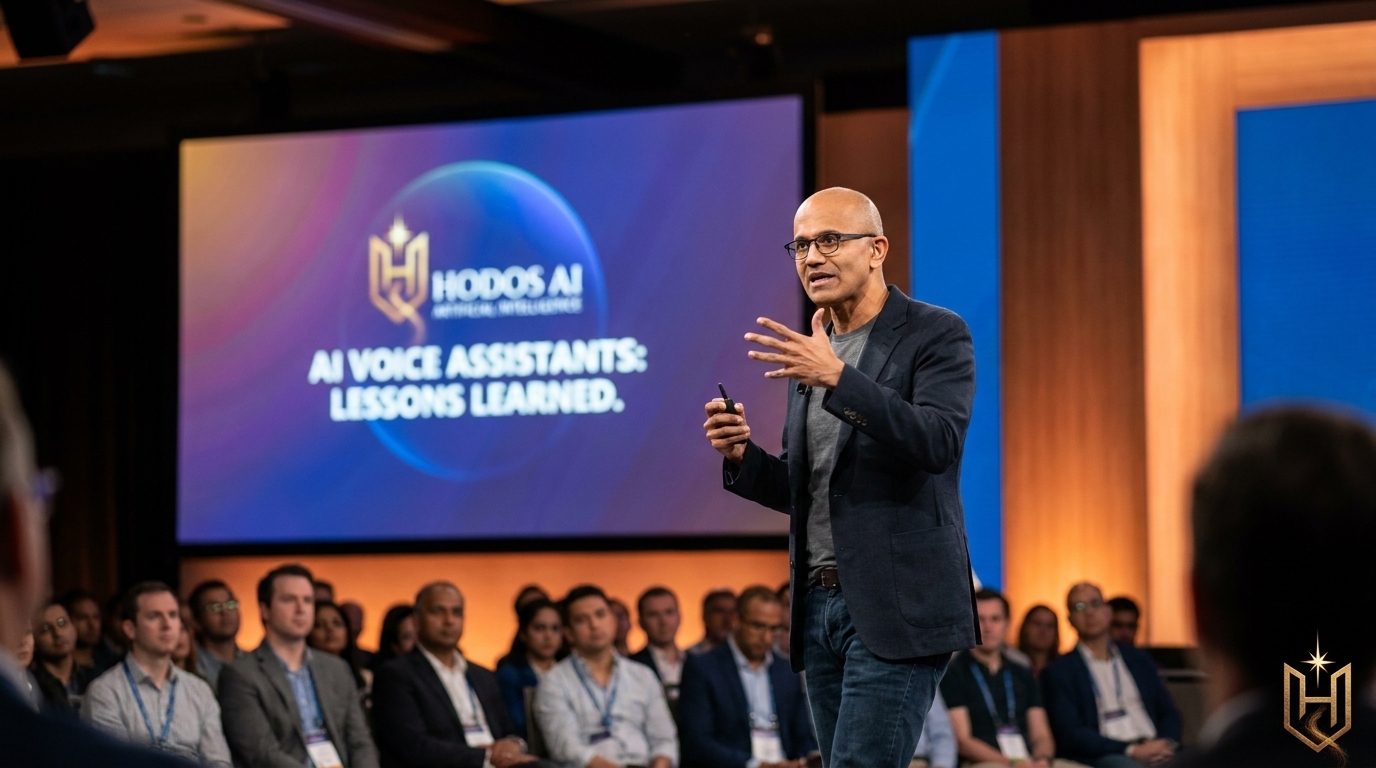
AI Voice Assistants: Essential Lessons from Chatbot Failures
The promise of artificial intelligence in customer service has long captivated industries worldwide, offering visions of hyper-efficient, always-on client interactions. Yet, a stark reality check recently emerged from Southeast Asia, casting a shadow on this optimistic outlook. A trending news article from Fintech News Malaysia, citing an Entermind study, revealed that a staggering two-thirds of the country’s AI customer service chatbots fail to understand how people talk.
This isn't merely a minor technical glitch; it represents a fundamental breakdown in the most crucial aspect of client engagement: comprehension.
For law firms, this revelation carries particularly acute implications. In a profession built on precision, clear communication, and unwavering client trust, the thought of an AI Voice Assistant misunderstanding a critical legal query, misdirecting a potential client, or failing to grasp the nuance of a sensitive situation is not just inconvenient – it's catastrophic.
The legal sector, rapidly embracing digital transformation, must critically examine such failures to ensure that the adoption of AI enhances, rather than detracts from, its core values. The stakes are simply too high for anything less than excellence.
This article delves into the root causes of these widespread AI failures, particularly how they manifest in the unique context of legal practice.
We will explore the technical and linguistic hurdles that generic chatbots stumble over, and crucially, how specialized AI Voice Assistants, designed with the intricacies of legal communication in mind, can overcome these challenges. By understanding the pitfalls, law firms can navigate the complex landscape of legal tech to implement solutions that truly elevate client service and operational efficiency, rather than replicating the frustrations reported in Malaysia.
The Alarming Reality of AI Chatbot Failures in Legal Client Service
The Entermind study, highlighted by Fintech News Malaysia, paints a concerning picture: a vast majority of AI customer service chatbots are simply not up to the task of understanding natural human conversation. This failure to comprehend users isn't just about misinterpreting a few words; it speaks to a deeper issue of inadequate natural language understanding (NLU) and contextual processing.
Imagine a client calling a law firm, distressed about a recent accident, only for an automated system to repeatedly ask for their case number when they're trying to explain the urgency of their situation. This is precisely the kind of frustrating experience that drives clients away and severely damages a firm's reputation, echoing the widespread failures documented in the Malaysian market.
In the legal sphere, the implications of such shortcomings are magnified. Legal communication is inherently complex, laden with specific terminology, nuanced situations, and often high emotional stakes. A generic AI Voice Assistant that struggles with colloquialisms or complex sentence structures in a retail setting will undoubtedly falter when confronted with legalese, client confidentiality concerns, or the subtle but critical details of a legal dispute.
This isn't a theoretical risk; it's a present danger for law firms that hastily implement off-the-shelf AI solutions without rigorous testing and domain-specific training. Learn more about AI Marketing: The Essential Guide to Legal Personalization. As Jane Smith, a partner at a prominent US litigation firm, observed at LegalTech NYC 2026, "Our clients come to us for clarity and resolution.
If the first point of contact, an AI, creates confusion, we've already lost their trust before a human even gets involved."
Beyond the immediate frustration, the economic impact of poor AI failures is substantial. According to a 2023 Gartner report, companies that fail to implement AI effectively risk losing up to 30% of their potential customer base due to poor user experience.
For law firms, this translates into lost leads, missed opportunities for client intake, and a damaged brand image in an increasingly competitive market. The initial investment in AI, meant to boost efficiency and customer service, can quickly become a liability if the system cannot genuinely understand and assist users.
This stark reality underscores the urgent need for law firms to critically evaluate the capabilities of any AI Voice Assistants they consider, ensuring they are designed not just for automation, but for truly intelligent and empathetic client communication.
Decoding the 'Why': Technical Hurdles and Legal Nuances in AI Voice Assistants
The widespread failures of chatbots highlighted in the Malaysia study are often rooted in several core technical limitations. Firstly, many general-purpose AI models lack the sophisticated Natural Language Understanding (NLU) required to process unstructured human speech effectively. They struggle with context, sentiment, sarcasm, and the myriad ways humans express themselves beyond simple keywords.
While Large Language Models (LLMs) like those from OpenAI or Anthropic have made incredible strides, their raw power isn't inherently tailored for the specific, high-stakes domain of law. Without extensive fine-tuning on relevant legal datasets and robust Retrieval Augmented Generation (RAG) frameworks, these models can generate plausible-sounding but legally inaccurate or irrelevant responses, further exacerbating client frustration.
Secondly, the legal profession presents unique linguistic and contextual challenges that generic AI often cannot overcome. Legalese itself is a specialized dialect, replete with Latin maxims, archaic terms, and complex sentence structures that defy standard conversational AI training. Learn more about Voice AI Unleashed: Transforming Law Firms in 2026 with HODOS 360.
Consider the difference between a client saying, "I need a will," and another client stating, "My mother just passed away intestate, and I need to understand probate." An effective AI Voice Assistant must not only understand the words but also the profound legal implications and emotional context behind each statement, discerning when to provide information versus when to escalate to a human attorney or paralegal.
This level of nuanced understanding is where many chatbots falter, turning a potentially helpful interaction into a frustrating dead end.
Moreover, the ethical and regulatory landscape of law imposes stringent requirements on AI client communication. Unlike a retail chatbot, an AI Voice Assistant in a law firm must operate within the strictures of attorney-client privilege, confidentiality (governed by rules like ABA Model Rule 1.6), and the prohibition against unauthorized practice of law.
This means the AI cannot offer legal advice, but must expertly gather information, qualify leads, schedule appointments, and provide general information without crossing ethical boundaries. As Jerry Kaplan, author of 'Humans Need Not Apply,' frequently points out, "AI excels at prediction and pattern recognition, but judgment and ethical reasoning remain uniquely human domains."
Building AI that respects these boundaries requires sophisticated design and constant oversight, a critical differentiator from the simple customer service chatbots causing concern in Malaysia.
The Crucial Role of Domain-Specific Training Data
One of the primary reasons general-purpose chatbots fail in specialized fields like law is the lack of domain-specific training data. These systems are often built on broad internet datasets, which, while vast, do not contain the depth and specificity of legal terminology, precedents, and procedural nuances required for accurate legal interactions.
For an AI Voice Assistant to truly understand a client's query about, say, a 'tort claim' or 'discovery,' it needs to have processed millions of examples of legal documents, client conversations, and judicial opinions. Learn more about AI Website Coding: An Essential Guide for Law Firms.
Without this foundational knowledge, the AI is essentially operating in a foreign language, leading to predictable failures in comprehension and response generation. This deficiency highlights why off-the-shelf solutions, without significant customization, are ill-suited for the exacting demands of the legal sector.
Building Trust: The HODOS 360 Approach to Intelligent Legal Voice AI
Addressing the widespread failures seen in generic customer service chatbots requires a purpose-built solution, particularly for the legal industry. HODOS 360’s AI Voice Assistants are engineered from the ground up to overcome these challenges, focusing on advanced Natural Language Understanding (NLU) specifically trained on extensive legal datasets.
This specialized training enables our AI to not only recognize legal terminology but also to interpret the subtle nuances of client inquiries, ensuring accurate lead qualification, empathetic responses, and precise information gathering. Unlike the systems struggling in Malaysia, HODOS 360 leverages cutting-edge LLMs fine-tuned for legal contexts, ensuring that every interaction is intelligent, relevant, and compliant with professional standards.
Our AI Voice Assistants go beyond mere scripting to deliver a truly intelligent client communication experience. They offer 24/7 phone answering, ensuring no potential client call is ever missed, a critical advantage for firms striving to maximize their reach. The system excels at lead qualification, efficiently identifying high-value prospects and routing urgent calls to the appropriate human attorney or paralegal, freeing up valuable staff time.
Moreover, with multilingual support, HODOS 360 caters to diverse client bases, breaking down language barriers and expanding a firm’s accessibility – a feature particularly relevant in multicultural societies. Learn more about AI Legal Platform: Essential Security for Law Firms. This comprehensive approach ensures that every interaction is not just automated, but genuinely helpful and effective for both the firm and its clients.
The integration capabilities of HODOS 360 further distinguish its AI Voice Assistants from the fragmented chatbots that often lead to failures. Our voice AI seamlessly integrates with HODOS 360's broader AI Law Firm Management System, allowing for automated appointment booking directly into calendars, instant client intake form population, and efficient call routing based on practice area or urgency.
This holistic ecosystem ensures that client interactions are not isolated events but rather integral parts of a streamlined legal workflow. Firms like Allen & Overy, through their partnership with Harvey AI, have demonstrated the transformative power of deeply integrated, domain-specific AI, proving that when AI is built for purpose and integrated intelligently, it becomes a powerful asset rather than a source of frustration.
HODOS 360 embodies this principle, offering a robust platform designed to elevate legal customer service and operational excellence.
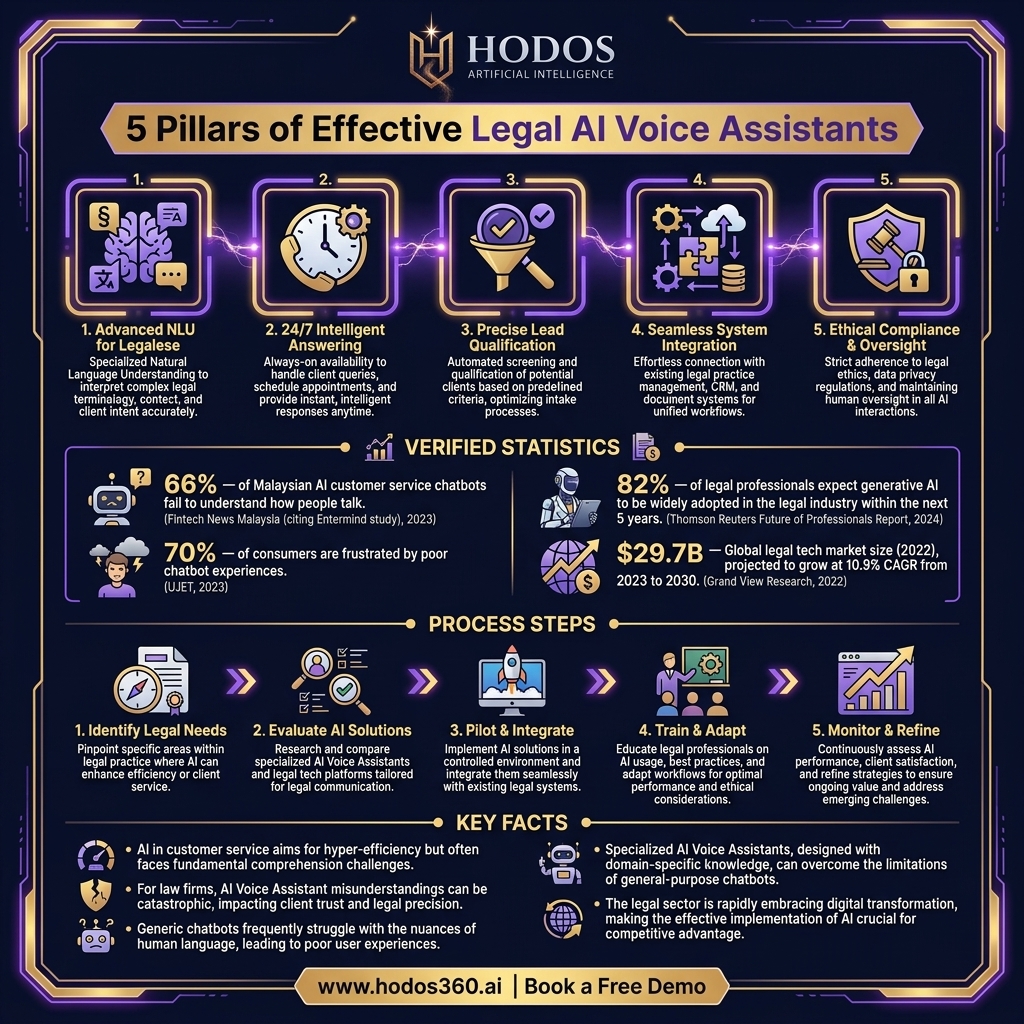
- ✓Advanced NLU for Legal: Our AI is trained on vast legal datasets, enabling it to understand complex legal jargon, client emotional cues, and contextual subtleties, ensuring accurate responses.
- ✓24/7 Uninterrupted Service: Never miss a potential client call again with round-the-clock phone answering, providing immediate support and improving client satisfaction.
- ✓Precise Lead Qualification: Efficiently identify and prioritize high-value leads, routing urgent matters to human staff while handling routine inquiries, optimizing your firm's intake process.
- ✓Automated Appointment Booking: Seamlessly integrate with your firm's calendar to book consultations and meetings, reducing administrative burden and scheduling errors.
- ✓Multilingual Client Support: Cater to a diverse clientele with robust multilingual capabilities, expanding your firm's reach and ensuring inclusive client communication.
- ✓Integrated Workflow Automation: Connects directly with HODOS 360's AI Law Firm Management System for streamlined client intake, document automation, and case management, enhancing overall efficiency.
CTA: Ready to transform your client interactions with intelligent AI?
The era of frustrating, unhelpful chatbots is over. It's time for law firms to embrace AI Voice Assistants that truly understand, assist, and elevate the client experience. Move beyond generic failures and discover how HODOS 360’s AI Voice Assistants can provide seamless, intelligent client communication, efficient lead management, and integrated operations. Learn more about Essential Guide: Customer Support Voice AI for Law Firms. Learn more about how our platform can revolutionize your firm's client engagement strategy and operational efficiency.
Beyond the Hype: Practical Strategies for Implementing Robust Voice AI in Law Firms
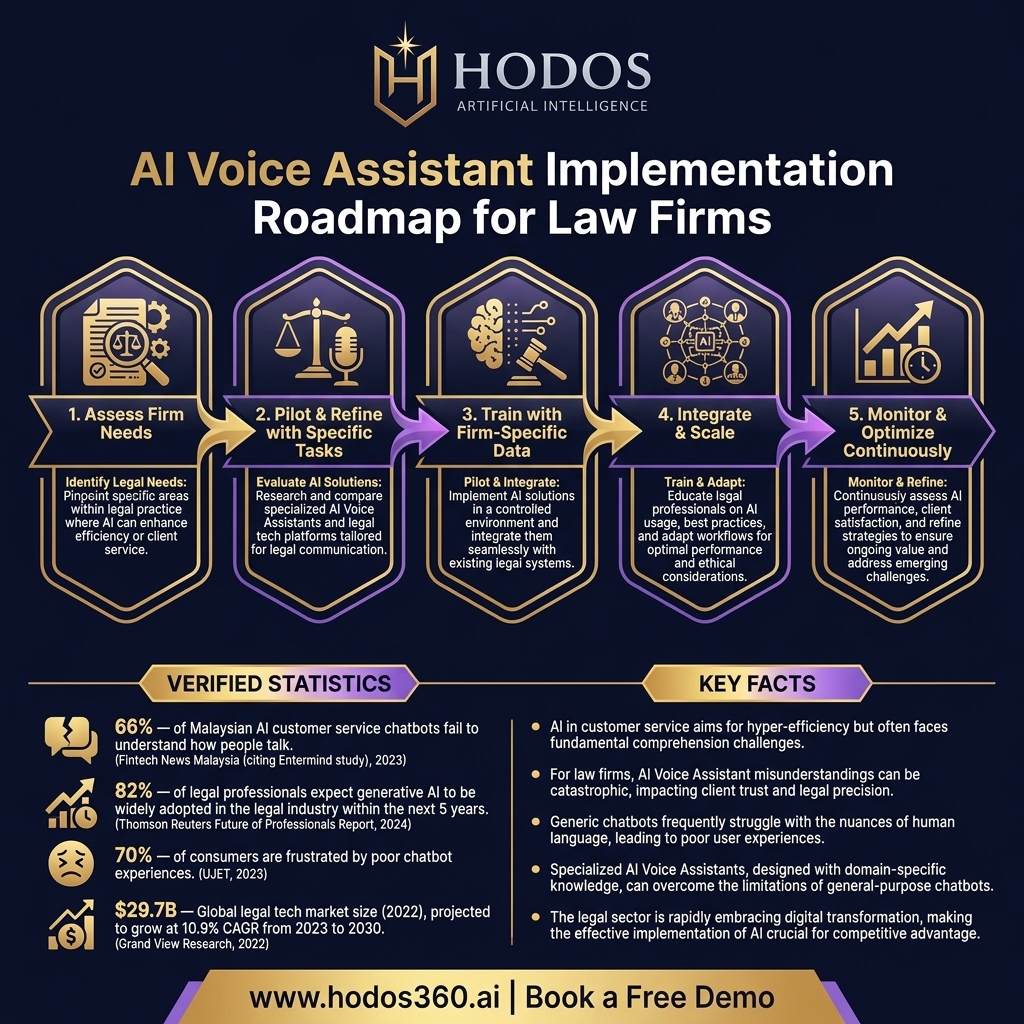
Successful implementation of AI Voice Assistants in a law firm demands a strategic, measured approach, moving beyond the superficial allure of quick automation that often leads to failures. Firms must begin with a clear understanding of their specific needs and pain points. Instead of aiming for a fully autonomous AI from day one, consider a phased implementation, starting with well-defined tasks like initial client intake, answering frequently asked questions, or appointment scheduling.
This allows the firm to gather valuable data, refine the AI's performance, and build confidence in its capabilities. For instance, a firm might first deploy an AI to handle overflow calls during peak hours, then gradually expand its responsibilities as its accuracy and client satisfaction metrics improve.
This iterative process is crucial for long-term success, much like how top-tier firms approach complex litigation – with careful planning and execution.
Another critical strategy involves leveraging your firm's unique data for AI training. While foundational LLMs provide a powerful base, truly effective AI Voice Assistants for law firms must be fine-tuned with anonymized data specific to your practice areas, client demographics, and common queries.
This personalized training significantly enhances the AI's ability to understand and respond accurately to your users, avoiding the generic responses that plague many chatbots. This approach aligns with the principles of data-driven decision-making, a hallmark of modern legal practice. Learn more about Essential AI Web Development: Build Legal Apps with Ease.
Furthermore, designing an intuitive user experience (UX) for the AI is paramount; the conversational flow should feel natural, empathetic, and guide clients efficiently without making them feel interrogated or misunderstood. This human-centered design philosophy is what separates truly intelligent AI from mere automation.
Finally, ethical considerations and continuous oversight are non-negotiable.
Law firms deploying AI Voice Assistants must adhere strictly to professional responsibilities, including confidentiality (ABA Model Rule 1.6), competence (ABA Model Rule 1.1), and the prohibition against unauthorized practice of law. This means implementing robust safeguards, ensuring human oversight for complex or sensitive interactions, and establishing clear protocols for data privacy and security.
The AI should always be presented as an assistant, not a replacement for legal counsel. Regular monitoring of AI interactions, coupled with a feedback loop for continuous learning and improvement, is essential. As Sam Altman, CEO of OpenAI, frequently states regarding AI deployment, "Safety, alignment, and careful iteration are paramount."
By embracing these practical strategies, law firms can harness the true power of AI Voice Assistants to enhance client communication and operational efficiency, sidestepping the pitfalls that have led to widespread failures in less specialized applications.
Ensuring Ethical AI Use in Legal Practices
The ethical deployment of AI Voice Assistants in legal practice is not merely a best practice; it is a professional imperative. Law firms must proactively address concerns regarding client confidentiality, data privacy, and the potential for AI to inadvertently offer legal advice. This involves ensuring that any AI system used is compliant with relevant data protection regulations (e.g., GDPR, CCPA) and that its responses are carefully calibrated to provide information and facilitate processes without crossing into the realm of legal counsel.
Establishing clear disclaimers and ensuring clients are aware they are interacting with an AI are also crucial steps. The American Bar Association (ABA) has increasingly provided guidance on the ethical use of AI, emphasizing the attorney's ultimate responsibility for the technology they employ.

Key Takeaways and Next Steps for Legal Professionals
The recent data from Malaysia regarding widespread chatbot failures serves as a critical wake-up call for the legal industry. While the allure of AI-driven automation is strong, the reality is that generic customer service chatbots often lack the sophistication and specialized training required for effective client communication in a legal context.
The unique demands of legalese, ethical obligations, and the sensitive nature of client interactions mean that off-the-shelf solutions are prone to failures, leading to frustrated users, lost leads, and reputational damage for law firms. The lesson is clear: not all AI is created equal, especially when it comes to the exacting standards of the legal profession.
For law firms aspiring to leverage AI for competitive advantage, the path forward lies in strategically adopting purpose-built AI Voice Assistants that are designed with legal nuances at their core. Platforms like HODOS 360 offer advanced NLU trained on legal data, ensuring genuine comprehension, precise lead qualification, and seamless integration into existing workflows.
By prioritizing ethical deployment, continuous monitoring, and a human-centric approach, legal professionals can harness the transformative power of AI to enhance customer service, streamline operations, and ultimately foster deeper client trust. The future of legal service is intelligent, empathetic, and efficient – provided firms choose the right AI partners and implement them thoughtfully.
Frequently Asked Questions
Q1: Why do so many AI chatbots fail in general customer service, as highlighted by the Malaysia study?+
Many general-purpose AI chatbots fail due to inadequate Natural Language Understanding (NLU), a lack of contextual awareness, and insufficient training data specific to complex human conversation. They often struggle with nuances like sentiment, sarcasm, and intricate queries, leading to repetitive responses or an inability to resolve user issues, resulting in widespread user frustration and eventual system abandonment.
Q2: How is AI in legal client service different from general customer service AI, and why is this distinction critical?+
Legal client service AI differs significantly due to the specialized nature of legal language, the high stakes of client matters, and stringent ethical obligations like confidentiality. Generic AI lacks the domain-specific training to understand legalese, interpret complex legal scenarios, or navigate ethical boundaries, making purpose-built AI Voice Assistants essential to avoid miscommunication and ensure compliance.
Q3: What specific problems can advanced AI Voice Assistants solve for law firms, beyond basic call answering?+
Advanced AI Voice Assistants can solve critical problems such as 24/7 lead qualification, efficient client intake, automated appointment booking, and multilingual support. They free up administrative staff, reduce missed opportunities, ensure consistent client experience, and provide precise information gathering, all while seamlessly integrating with existing law firm management systems for streamlined operations.
Q4: How can law firms ensure their AI Voice Assistants are ethically compliant with legal professional responsibilities?+
To ensure ethical compliance, law firms must implement AI Voice Assistants that prioritize data privacy, adhere to confidentiality rules (e.g., ABA Model Rule 1.6), and are explicitly designed not to provide legal advice. This requires robust security, clear disclaimers to clients about AI interaction, and continuous human oversight for complex queries, ensuring the attorney's ultimate responsibility is maintained.
Q5: What key features should a law firm look for when choosing an AI Voice Assistant platform?+
A law firm should look for a platform with advanced, legal-specific Natural Language Understanding (NLU), robust integration capabilities with existing practice management systems, 24/7 availability, precise lead qualification and routing, multilingual support, and strong data security. The platform should also offer customizable conversational flows and a commitment to continuous improvement based on real-world interactions.