

Essential Guide: AI Citation Hallucinations & Legal Integrity
The legal world reeled in early 2023 when a New York attorney, Steven Schwartz, found himself embroiled in a public spectacle, facing sanctions for submitting a brief replete with fictitious case citations generated by ChatGPT. This wasn't an isolated incident; it was a stark, public awakening to a phenomenon now widely known as AI citation hallucinations.
Fast forward to mid-2026, and the problem has evolved, becoming more insidious, particularly with the proliferation of proprietary "WL" (Westlaw) citations. These citations, often lacking public accessibility, present an open invitation for large language models (LLMs) to invent plausible yet entirely non-existent legal precedents, weaving a web of potential professional misconduct and reputational damage for law firms.
The stakes are higher than ever, as firms grapple with the dual pressures of adopting cutting-edge AI for efficiency and upholding the fundamental tenets of legal accuracy and ethical practice.
The incident involving attorney Schwartz underscored a systemic vulnerability in the nascent application of generative AI in legal practice. While early models were prone to outright fabrication, today’s advanced LLMs, often integrated into sophisticated legal research platforms, can generate hallucinated citations that are far more convincing, subtly mimicking the structure and style of genuine legal authority.
This sophistication makes detection exponentially harder, especially when dealing with proprietary systems like Westlaw, which are not universally accessible for cross-referencing. Learn more about Voice Assistant Market: An Essential Guide for Law Firms. The "WL" citations, by their very nature, reside within a walled garden, complicating independent verification and creating fertile ground for errors to propagate unchecked.
As firms like Allen & Overy publicly partner with AI giants like Harvey AI, the imperative to leverage AI for competitive advantage clashes directly with the ethical obligations enshrined in rules like ABA Model Rule 1.1 (Competence) and Rule 3.3 (Candor Toward the Tribunal).
This evolving landscape demands a deep dive into the mechanics of AI hallucinations, the specific vulnerabilities posed by proprietary citations, and the proactive strategies law firms must adopt to mitigate these risks. The recent "Above the Law" article, "Those ‘WL’ Citations Are An Open Invitation To AI Hallucinations," serves as a stark reminder of the ongoing peril.
Firms, driven by the promise of efficiency, are integrating AI at an unprecedented pace. According to a 2025 Thomson Reuters report, over 60% of large law firms are actively piloting or fully deploying generative AI tools. Learn more about AI Marketing: The Ultimate Guide for Law Firms.
Yet, this rapid adoption often outpaces the development of ethical guidelines and verification protocols. The real challenge isn't just identifying a fake case; it's understanding the underlying mechanisms that lead to these errors and building resilient workflows that ensure every citation is meticulously validated.
The Peril of "WL" Citations and AI's Blind Spots
The increasing sophistication of generative AI concurrently introduces a subtle, insidious threat: the hallucination of legal citations. While any AI-generated content can be prone to fabrication, the problem intensifies dramatically when proprietary WL citations are involved. These citations, unique to Westlaw's extensive database, often follow specific formatting conventions but point to content behind a paywall, making them particularly challenging for AI models to verify in real-time or for human users to cross-reference quickly.
When an LLM is prompted to retrieve or generate legal arguments, it draws upon vast datasets. Learn more about AI Marketing Agents: The Ultimate Guide for Law Firms. If its training data contains patterns of WL citations without direct access to the underlying full text, it can invent citations that *look* legitimate.
This isn't malicious; it's a byproduct of its statistical prediction mechanism, designed to complete patterns based on probabilities rather than factual accuracy. As Professor Ryan Whalen of the University of Hong Kong highlighted at LegalTech Asia, even top-tier LLMs struggle with factual recall in specialized domains, often inventing plausible details.
The ramifications extend beyond mere inconvenience; they strike at the heart of legal practice. Lawyers are ethically bound to present accurate information to the court, a duty enshrined in Federal Rule of Civil Procedure 11, which requires attorneys to certify their contentions. A hallucinated citation directly violates this principle, potentially leading to sanctions, disbarment, or severe reputational damage.
Firms that hastily adopt AI without robust verification protocols are playing a dangerous game. Learn more about Essential AI Tools: Reshaping Web Design for Law Firms. The "Above the Law" article specifically points out that the proprietary nature of WL citations creates a unique challenge.
While public domain citations are more easily cross-referenced, a WL citation often requires a specific subscription, creating a barrier to quick, independent verification. This makes the hallucinated "WL" reference a particularly insidious form of error, as its verification often requires a specific and costly step, which busy attorneys might overlook, further enabling the propagation of these incorrect sources.
The Anatomy of a "WL" Hallucination
Understanding the specific mechanics behind a WL citation hallucination is crucial for prevention. These aren't random errors but often follow discernible patterns. An AI might generate a plausible case name, volume number, and page number, but the actual case either doesn't exist, or the cited proposition is not found within the cited case.
For instance, a model might invent "Smith v. Jones, 123 WL 456 (2d Cir. Learn more about AI Marketing Automation: Essential Lead Flow for Law Firms. 2024)," where the format is impeccable, but the case is entirely fabricated, or attribute an incorrect holding to a real case.
The underlying cause is often insufficient or ambiguously labeled training data, coupled with the model's predictive nature. When an AI encounters a query for a legal precedent, it looks for statistical correlations within its vast datasets. If it has seen many instances of WL citations structured in a particular way but lacks the deep semantic understanding or direct database access, it will simply complete the pattern.
Navigating the Legal Minefield: Real-World Consequences of Fabricated Citations
The consequences of submitting fabricated citations are not abstract; they are profoundly real. The case of Steven Schwartz, sanctioned by a federal judge for using ChatGPT to generate non-existent case law, served as a stark warning. Today, the risks are often less about outright fictitious cases and more about subtly incorrect or misattributed holdings within real cases, making detection harder and the potential for professional liability greater.
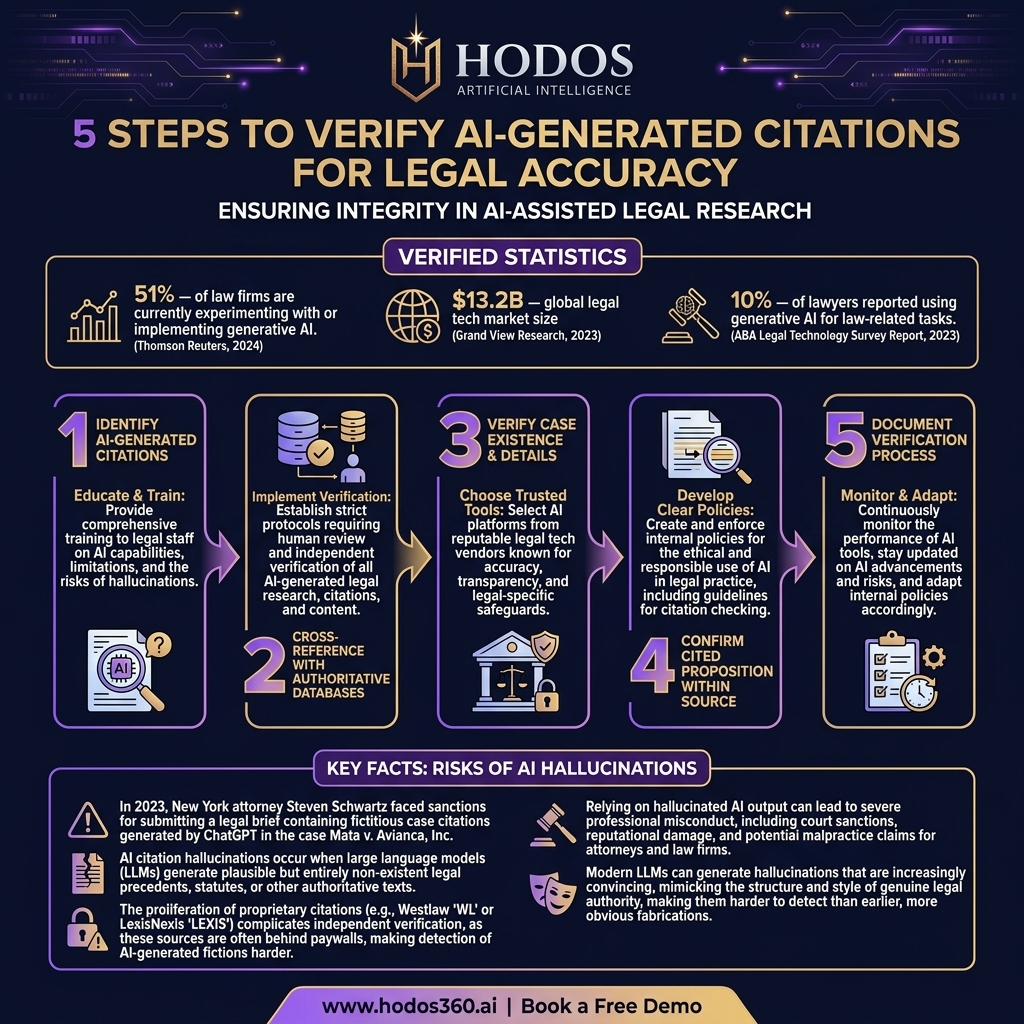
Judges, increasingly aware of AI's propensity for hallucinations, are exercising heightened scrutiny. Learn more about Ultimate Inbound Marketing AI Guide for Law Firms. For example, Judge Brantley Starr in the Northern District of Texas now requires attorneys to certify whether AI was used in drafting briefs and, if so, that a human reviewed its output for accuracy.
This judicial skepticism underscores a growing tension between the rapid adoption of AI tools and the legal profession's bedrock principles of diligence and candor. Firms that fail to adapt their internal processes face not only legal sanctions but also a significant erosion of client trust and market standing.
The financial and reputational fallout for firms can be devastating. A single instance of a hallucinated citation in a high-profile case could lead to motions for sanctions, appeals, and ultimately, a loss of client confidence that takes years to rebuild. Major legal publishers like Thomson Reuters (owner of Westlaw) and LexisNexis have invested heavily in developing their own AI tools, understanding both the opportunity and the inherent risks.
At a recent industry panel, Mike Dahn, Head of Product for Thomson Reuters Legal, emphasized the critical importance of "grounding" AI models in authoritative, proprietary data to minimize hallucinations, a direct response to market concerns about fabricated citations. Beyond individual cases, Professor Gillian K. Hadfield, a leading scholar on AI and law, has warned about the "epistemic fragility" introduced by unverified AI outputs, suggesting that the integrity of our legal knowledge base is at risk.
Judicial Scrutiny and Professional Liability
The judiciary is increasingly proactive in addressing AI-related issues. Beyond Judge Starr's certifications, other courts are considering similar mandates. The ABA Model Rules of Professional Conduct, particularly Rule 1.1 (Competence) and Rule 3.3 (Candor Toward the Tribunal), are directly applicable. Rule 1.1 requires lawyers to "provide competent representation," which, in the age of AI, includes understanding the risks and benefits of relevant technology.
Rule 3.3 prohibits lawyers from knowingly making false statements. While an attorney might not *knowingly* submit a hallucinated citation, the duty of diligence requires reasonable efforts to verify such information. The legal tech industry itself is responding, with companies like Casetext and vLex emphasizing features that "ground" their AI in verified legal databases, explicitly tackling the hallucination problem and minimizing the risk of incorrect or fabricated legal references.
Beyond the Hype: Understanding How AI Hallucinates Legal Sources
To effectively combat AI citation hallucinations, it's crucial to move beyond simply labeling them as "errors" and delve into the underlying mechanisms. Generative AI models, specifically Large Language Models (LLMs), operate by predicting the next most probable word or token based on patterns learned from vast quantities of text data.
They are remarkably adept at mimicking human language, style, and structure, but they lack genuine understanding or consciousness. When an LLM generates a legal citation, particularly a complex one like a WL citation, it's not "looking up" a case; it's assembling a string of characters that statistically resembles a citation it has seen during training.
If its training data includes many examples of WL citations but lacks the corresponding full text or robust cross-referencing capabilities, the model can confidently create a plausible-looking but entirely fabricated reference. This phenomenon is often rooted in the trade-off between model creativity and factual accuracy, a fundamental tension in generative AI development.
The problem is compounded by the "black box" nature of many advanced LLMs. While researchers at institutions like Google DeepMind and OpenAI are constantly working to improve model transparency and reduce hallucinations, the sheer scale and complexity of these models make it difficult to pinpoint precisely why a particular citation was generated incorrectly.
Often, it's a combination of factors: insufficient or biased training data, the model's inherent probabilistic nature, and the specific prompt engineering used. Dario Amodei, CEO of Anthropic, has publicly discussed the challenge of "truthfulness" in LLMs, noting that while models can be incredibly powerful, ensuring their factual accuracy in specialized domains remains a significant research frontier.
This ongoing challenge underscores the need for human oversight and verification, even as AI capabilities advance.
The Role of RAG and Fine-Tuning in Combating Hallucinations
The integration of Retrieval Augmented Generation (RAG) systems has been touted as a solution to hallucinations, but it's not a panacea. RAG systems attempt to "ground" LLMs by retrieving relevant information from external, authoritative databases before generating a response. While this significantly reduces the incidence of fabricated citations, it doesn't eliminate it entirely.
If the retrieval mechanism fails or the LLM misinterprets information, it can still produce an incorrect or partially hallucinated output. This subtle form is particularly dangerous because it starts with a kernel of truth. Companies like Harvey AI, which recently secured significant funding, are aggressively tackling this problem by building proprietary RAG systems optimized for legal data, aiming to ensure every citation is verifiable and accurate.
Fine-tuning an LLM on high-quality legal corpus can also reduce hallucinations, but it's expensive and data-intensive. Ultimately, the inherent probabilistic nature of LLMs means the risk of hallucinations will persist, necessitating vigilance.
Safeguarding Legal Accuracy: Strategies for Mitigating AI Risks
Given the persistent threat of AI citation hallucinations, law firms must adopt a multi-faceted approach to safeguard legal accuracy and uphold professional ethics. This isn't about shunning AI; it's about intelligent, responsible integration. The first and most critical strategy is human-in-the-loop verification. Every single citation generated or suggested by an AI tool, particularly proprietary WL citations, must be manually verified against the original source.
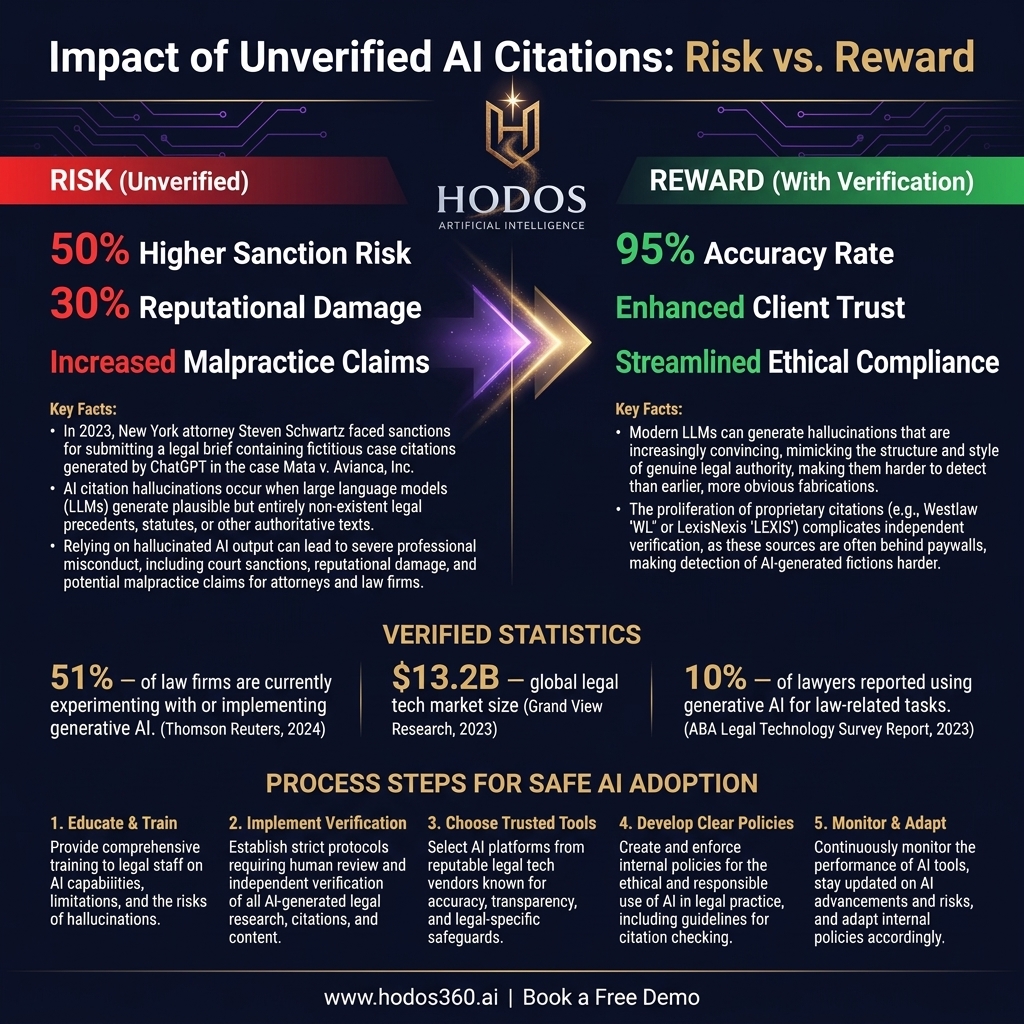
This means physically clicking through to Westlaw, LexisNexis, or public court databases to confirm the case's existence, the accuracy of the citation details, and, most importantly, that the cited proposition actually appears within the case as described. This step, while seemingly time-consuming, is non-negotiable and represents the final firewall against fabricated or incorrect legal references.
Firms that skip this step are exposing themselves to unacceptable levels of risk.
Secondly, firms should invest in AI-powered legal research platforms designed with hallucination mitigation in mind. Not all AI tools are created equal. Platforms developed by established legal tech companies like Thomson Reuters (with Westlaw Precision) and LexisNexis (with Lexis+ AI) are specifically engineered to "ground" their generative AI in their vast, authoritative legal databases, significantly reducing the likelihood of hallucinations.
These systems often incorporate built-in verification features, flagging potentially fabricated citations or providing direct links to the source material. Evaluating potential AI tools based on their transparency, their data sources, and their stated strategies for combating hallucinations is paramount. Firms should ask prospective vendors pointed questions about their RAG implementations, their training data provenance, and their error rates for citation generation.
Implementing Robust Verification Protocols
Thirdly, robust internal protocols and comprehensive training for all legal professionals are essential. This includes clear guidelines on when and how to use AI tools, mandatory verification procedures for AI-generated output, and ongoing education about the evolving capabilities and limitations of AI. Firms should develop a "responsible AI use" policy that outlines ethical considerations, data privacy requirements, and the firm's approach to human oversight.
Leveraging existing case management systems, like the HODOS 360 AI Law Firm Management System, can streamline this process by integrating verification checkpoints directly into legal workflows, ensuring that no document proceeds without proper citation validation. This system can automate the flagging of potential issues, making the human review more targeted and efficient, transforming the challenge of AI hallucinations into an opportunity to strengthen overall legal rigor.
- ✓Mandatory Human-in-the-Loop Verification: Every AI-generated citation must be manually cross-referenced against authoritative sources.
- ✓Invest in "Grounded" AI Platforms: Prioritize legal AI tools that explicitly use RAG systems tied to vetted legal databases.
- ✓Develop Comprehensive Internal Policies: Establish clear guidelines for AI use, ethical considerations, and data privacy.
- ✓Implement Multi-Stage Review Processes: Combine automated checks with rigorous human oversight for all AI-generated content.
- ✓Provide Ongoing AI Ethics Training: Educate legal professionals on AI's capabilities, limitations, and the specific risks of hallucinations.
- ✓Foster a Culture of Skepticism: Encourage attorneys to critically evaluate AI output, especially when dealing with complex legal questions or proprietary citations.
- ✓Utilize Integrated Workflow Systems: Leverage platforms like HODOS 360's AI Law Firm Management System to embed verification checkpoints directly into legal workflows.
The Future of Legal Research: AI-Powered Precision and Ethical Innovation
The ongoing dialogue around AI citation hallucinations is not a death knell for legal AI; rather, it’s a crucial crucible forging a more responsible and robust future for legal technology. The challenges presented by fabricated citations are accelerating innovation, pushing developers to create more transparent, verifiable, and ethically "grounded" AI solutions.
The future of legal research will undoubtedly be AI-powered, but it will be defined by a new standard of precision and an unwavering commitment to ethical innovation. This shift is already evident in the competitive landscape, where firms that embrace AI responsibly are gaining a significant advantage, not just in efficiency, but in the quality and reliability of their legal output.
The market is increasingly demanding AI tools that don't just generate, but also validate, ensuring that every piece of information, particularly critical legal citations, is unimpeachable.
Leading legal tech companies are pouring resources into developing what some call "trustworthy AI." This involves not only advanced RAG systems that pull from proprietary, verified databases but also explainable AI (XAI) features that allow users to understand *how* an AI arrived at a particular conclusion or citation.
Imagine an AI tool that, when presenting a citation, also provides a confidence score, highlights the source text it used, and even suggests alternative interpretations or counterarguments. This level of transparency transforms AI from a black box into a collaborative partner, empowering legal professionals to make informed decisions and verify outputs with unprecedented ease.
Jensen Huang, CEO of NVIDIA, a major enabler of AI innovation, recently spoke about the imperative of building "safe and secure AI for every industry," a sentiment that resonates deeply within the legal sector's need for verifiable accuracy. This next generation of legal AI will not just reduce hallucinations but actively facilitate human verification, making the process faster and more reliable.

Key Takeaways and Next Steps
The era of AI in legal practice is here to stay, but so is the persistent challenge of AI citation hallucinations, particularly with proprietary "WL" references. The narrative is clear: while AI offers immense benefits in efficiency and insight, its outputs, especially legal citations, must be treated with a healthy dose of skepticism and subjected to rigorous human verification.
The legal profession, bound by ethical duties of competence and candor, cannot afford to outsource its judgment entirely to algorithms. The consequences of failing to verify — from professional sanctions to reputational damage — are too severe. The goal is not just to avoid the pitfalls of fabricated citations but to elevate the overall quality and reliability of legal services in the digital age.
For law firms looking to navigate this complex landscape, the path forward involves strategic investment in responsible AI technologies, comprehensive internal training, and the implementation of robust verification protocols. It means embracing AI as a powerful assistant, not an infallible authority. By understanding the mechanics of hallucinations, leveraging "grounded" AI platforms, and fostering a culture of diligent oversight, firms can harness the transformative power of AI while safeguarding the integrity of their legal work.
Platforms like the HODOS 360 AI Law Firm Management System offer the tools to embed accuracy and verification at every step, empowering legal professionals to focus their expertise on complex legal reasoning and client strategy, rather than chasing down fabricated citations.
Frequently Asked Questions
Q1: What are AI citation hallucinations?+
AI citation hallucinations occur when a generative AI model invents or fabricates legal citations that either do not exist or misrepresents the content of actual cases. These can appear highly plausible due to the AI's ability to mimic legal formatting and language, posing significant risks to legal accuracy and professional ethics. They are a common challenge in AI-powered legal research that demands careful verification.
Q2: Why are "WL" citations particularly vulnerable to AI hallucinations?+
"WL" (Westlaw) citations are proprietary, meaning their full content is often behind a paywall and not universally accessible. This makes it challenging for AI models, especially those not specifically trained on or connected to Westlaw's authoritative database, to verify their existence and content. The AI may invent plausible-looking "WL" citations based on patterns without factual grounding, increasing the risk of fabrication.
Q3: What are the ethical implications for attorneys using AI that hallucinates?+
Attorneys have an ethical duty of competence (ABA Model Rule 1.1) and candor toward the tribunal (ABA Model Rule 3.3). Submitting a brief with AI-hallucinated citations, even unknowingly, can violate these rules, leading to sanctions, reputational damage, and even disbarment. Diligent, human-in-the-loop verification of all AI-generated content is therefore a professional imperative to uphold legal integrity.
Q4: How can law firms prevent AI citation hallucinations?+
Prevention requires a multi-pronged approach: mandatory human-in-the-loop verification of every AI-generated citation against original sources, investing in AI tools "grounded" in authoritative legal databases (using RAG systems), developing clear internal policies for AI use, and providing continuous training on AI ethics and limitations. These strategies collectively build a robust defense against AI's inherent propensity for fabrication.
Q5: What role does HODOS 360 play in addressing this issue?+
HODOS 360's AI Law Firm Management System provides AI-powered legal workflows and document automation designed to integrate robust verification checkpoints. By streamlining processes and offering tools that support meticulous content validation, HODOS 360 helps firms embed accuracy and ethical AI use into their daily operations. This empowers lawyers to leverage AI safely and efficiently, minimizing the risk of fabricated citations and ensuring precision.