


AI Defence: The Ultimate Guide to Next-Gen Litigation Tools
The legal industry is witnessing a seismic shift, powered by an unprecedented wave of artificial intelligence innovation. Just last week, the news broke of Turbo Law's significant USD 3.8 million seed funding round, a clear signal from investors that AI defence litigation tools are not just a nascent trend, but the definitive next frontier for legal practice.
This substantial investment, reported by LawFuel.com, underscores a broader market confidence in specialized AI applications that promise to fundamentally transform how law firms manage, strategize, and execute defence cases. It’s a narrative mirroring the competitive tension seen across the tech world, from the rivalry between OpenAI’s Sam Altman and Anthropic’s Dario Amodei in general AI development, to the focused battles within legal tech between established giants like Thomson Reuters and nimble startups like Turbo Law and Harvey AI.
Firms that embrace this technological evolution are not just staying competitive; they are redefining the very parameters of legal excellence and client service, setting a new standard for efficiency and strategic depth in an increasingly complex legal world.
This funding injection into Turbo Law isn’t an isolated incident but rather a microcosm of a larger trend, as venture capital pours into legal technology that promises tangible ROI.
According to a 2024 report by the Thomson Reuters Institute, investment in legal tech startups grew by over 30% year-over-year, with AI-driven solutions for litigation and contract review leading the charge. This surge is driven by a clear demand from law firm owners and attorneys who are grappling with escalating operational costs, the imperative for greater efficiency, and the need to manage ever-increasing volumes of data in discovery.
The traditional methods of legal defence, often manual, time-consuming, and resource-intensive, are proving insufficient in the face of modern litigation's complexities. The pressure to innovate is palpable, and firms are looking to AI to provide the strategic edge required to win cases, manage caseloads effectively, and attract top talent.
This shift is creating a divide: firms that actively seek and integrate these advanced tools are poised for exponential growth, while those clinging to legacy systems risk being outpaced and outmaneuvered in a rapidly evolving market.
For legal professionals, the implications extend far beyond mere automation.
AI defence litigation tools are not simply about doing things faster; they're about doing them smarter, with a level of precision and insight previously unimaginable. From predictive analytics that forecast case outcomes to sophisticated e-discovery platforms that sift through terabytes of data in minutes, AI is empowering lawyers to focus on high-value strategic thinking rather than administrative burdens.
This transformation is particularly critical in defence litigation, where the stakes are often high, and the margin for error is razor-thin. The ability to quickly identify critical evidence, assess potential risks, and build robust defence strategies can be the deciding factor in securing a favorable outcome for clients.
As we delve deeper into this new era, understanding the capabilities and strategic applications of these AI tools becomes paramount for any law firm aiming to thrive in the 21st century legal landscape. The question is no longer *if* AI will impact your practice, but *how* you will leverage it to your firm's advantage.
The Rise of AI Defence Litigation Tools: Turbo Law's Impact and Market Dynamics
The recent USD 3.8 million funding round for Turbo Law, as highlighted by LawFuel.com, serves as a powerful testament to the growing investor confidence in specialized AI defence litigation tools. This infusion of capital signals a pivotal moment, validating the market's demand for intelligent systems capable of navigating the intricate landscape of legal defence.
Turbo Law, founded by legal tech visionary Dr. Elara Vance, is developing a platform that leverages advanced machine learning to analyze case precedents, predict judicial outcomes, and identify optimal defence strategies with remarkable accuracy. Vance, a former litigator herself, recognized the immense pressure on defence attorneys to process vast amounts of information under tight deadlines, often leading to missed opportunities or inefficient resource allocation.
Her vision for Turbo Law was to create an AI co-pilot that augments human legal expertise, not replaces it, allowing lawyers to focus on the nuanced art of advocacy rather than the laborious science of data sifting. This approach resonates deeply within the legal community, which has long sought solutions that genuinely enhance, rather than disrupt, the core practice of law.
This investment landscape is fiercely competitive, with a mix of established players and agile startups vying for market share. While Turbo Law carves out its niche in defence, companies like Harvey AI, backed by a significant partnership with Allen & Overy, continue to expand their general-purpose legal AI capabilities, often touching upon litigation support.
Clio, a leader in practice management, has also made strategic acquisitions to integrate AI features into its comprehensive platform, recognizing that the future lies in seamless, integrated solutions. The market drama unfolds as these entities push the boundaries of what's possible, fueled by venture capital firms eager to capitalize on the estimated $20 billion legal tech market, projected to grow at a CAGR of 15% through 2030, according to a recent McKinsey report.
Learn more about Flowise for Law Firms: Essential Guide to Visual AI Workflows. This growth isn't just about new tools; it's about a fundamental re-evaluation of legal operations, where efficiency, accuracy, and strategic foresight become paramount. Firms that fail to acknowledge this shift, often due to inertia or a reluctance to invest, risk falling behind their more technologically adept counterparts, creating a stark divide in legal service delivery and client outcomes.
Historically, legal research and discovery have been the most time-consuming and expensive aspects of defence litigation. Attorneys and paralegals would spend countless hours manually reviewing documents, cross-referencing statutes, and identifying relevant case law. This process was not only prone to human error but also created significant bottlenecks, particularly in complex cases involving massive datasets.
The advent of AI defence litigation tools directly addresses these pain points. For instance, advanced e-discovery platforms powered by AI can process millions of documents in a fraction of the time it would take human reviewers, flagging anomalies, identifying key individuals, and categorizing information with unparalleled speed and consistency.
This capability is crucial, especially in light of Federal Rules of Civil Procedure 26(b)(1), which emphasizes proportionality in discovery, making efficient data handling a legal and strategic imperative. The ability to rapidly identify and analyze critical evidence, assess potential risks, and even predict the likelihood of success based on historical data allows defence teams to build stronger, more data-driven arguments, moving from reactive responses to proactive strategies.
This transformation is not merely incremental; it's a paradigm shift that redefines the very foundation of legal defence, empowering lawyers with insights that were once unattainable.
Beyond Efficiency: How AI Redefines Legal Strategy and Outcomes
The true promise of AI defence litigation tools extends far beyond mere operational efficiency; they are fundamentally reshaping legal strategy, offering insights that were once the exclusive domain of highly experienced, and often expensive, senior partners. AI's ability to analyze vast repositories of legal data – including past case outcomes, judicial tendencies, and opposing counsel's historical strategies – provides a predictive edge that was previously unimaginable.

Firms can now leverage these tools to conduct sophisticated risk assessments, identifying potential vulnerabilities in a case before they become critical issues. For example, an AI system might flag an obscure precedent from a decade ago that, when combined with current facts, significantly alters the probability of success, allowing defence teams to pivot their strategy proactively.
This level of foresight empowers lawyers to make more informed decisions, allocate resources more effectively, and negotiate from a position of strength, ultimately leading to superior client outcomes. The strategic advantage gained by such foresight is becoming a non-negotiable differentiator in competitive legal markets.
### AI's Role in Evidence Discovery and Analysis One of the most profound impacts of AI in defence litigation is its transformative role in evidence discovery and analysis.
The sheer volume of electronically stored information (ESI) in modern litigation demands tools that can process data at scale. Traditional e-discovery, while digital, often relied on keyword searches and human review, which could be slow, costly, and prone to human bias or oversight. AI-powered platforms, however, utilize advanced algorithms to perform concept searching, sentiment analysis, and even identify communication patterns that human reviewers might miss.
Learn more about AI Specialist Unveiled: Essential Guide for Law Firms. For instance, in a complex corporate defence case involving millions of emails and documents, AI can quickly pinpoint relevant communications, identify key custodians, and even flag potentially privileged information, significantly reducing review time and costs.
This is particularly relevant given the obligations under ABA Model Rule 1.1, Comment [8], which emphasizes a lawyer's duty to keep abreast of changes in the law and its practice, including the benefits and risks associated with relevant technology. Neglecting these advanced tools could be seen as a failure to provide competent representation in an era where technology offers clear advantages.
Furthermore, AI's analytical capabilities extend to identifying relationships and anomalies within evidence that might be too subtle for the human eye. Consider a fraud defence case where an AI system can cross-reference financial transactions, communication logs, and employee movements to construct a timeline of events, revealing inconsistencies or patterns that bolster the defence's narrative.
This detailed, data-driven approach not only strengthens the factual basis of a defence but also enhances the credibility of the legal team in court. The integration of AI into these critical phases of litigation transforms the discovery process from a burdensome necessity into a strategic advantage, allowing defence attorneys to build more robust, evidence-backed arguments.
HODOS 360's AI Law Firm Management System, with its integrated document automation and AI-powered legal workflows, exemplifies how these technologies streamline such complex processes, from initial client intake to the final stages of litigation, ensuring that critical information is always accessible and actionable.
Navigating the AI Legal Landscape: Challenges and Ethical Imperatives
While the benefits of AI defence litigation tools are undeniable, their adoption is not without significant challenges and ethical considerations that legal professionals must navigate carefully. One primary concern revolves around data privacy and security. Legal firms handle highly sensitive client information, and the integration of AI tools necessitates robust cybersecurity measures to protect this data from breaches or misuse.
The potential for AI systems to inadvertently expose confidential information or be vulnerable to sophisticated cyberattacks requires a proactive approach to data governance and compliance with regulations such as the GDPR or state-specific privacy laws. Furthermore, the "black box" nature of some advanced AI algorithms, where the decision-making process is not transparent, raises questions about accountability and explainability.
If an AI system makes a recommendation that leads to an adverse outcome, understanding *why* that recommendation was made is crucial for legal professionals who bear the ultimate responsibility for their clients' cases. This necessitates a careful selection of AI tools that offer transparency and allow for human oversight and intervention.
### Ethical Considerations and Responsible AI Adoption Beyond data security, ethical considerations are at the forefront of the responsible adoption of AI in legal defence. Bias in AI systems, often stemming from biased training data, is a critical concern. If an AI is trained on historical legal data that reflects societal biases, it could perpetuate or even amplify those biases in its analysis and recommendations, leading to unfair or discriminatory outcomes.
For instance, an AI tool used for predictive analytics might disproportionately advise against certain defence strategies for specific demographic groups if its training data contained such patterns. Learn more about AI Marketing: The Essential Legal Firm Growth Blueprint. This directly conflicts with the foundational principles of justice and fairness, and with ABA Model Rule 8.4, which prohibits conduct prejudicial to the administration of justice.
Law firms must therefore exercise due diligence in vetting AI tools, understanding their data sources, and implementing safeguards to mitigate bias. This often involves working with developers to ensure diverse and representative datasets, and continuously auditing AI outputs for fairness and accuracy. The human element remains indispensable in overseeing AI, ensuring that technology serves justice, not undermines it.
Another significant ethical debate centers on the impact of AI on legal employment and the nature of legal work itself. While AI is often framed as an augmentation tool, there are legitimate concerns about job displacement, particularly for tasks traditionally performed by junior lawyers and paralegals, such as document review or basic legal research.
However, many legal tech leaders, including Andrew Arruda, co-founder of ROSS Intelligence (before its acquisition), have consistently argued that AI will transform roles rather than eliminate them, freeing up legal professionals to focus on more complex, strategic, and client-facing activities. The challenge for law firms is to invest in upskilling their workforce, training attorneys and staff to effectively collaborate with AI tools, interpret their outputs, and leverage them for strategic advantage.
This shift requires a cultural transformation within firms, moving from a fear of technology to an embrace of it as a partner in delivering superior legal services. Firms that proactively manage this transition, focusing on continuous learning and adapting their operational models, will be better positioned to harness the full potential of AI while upholding their ethical obligations.
Implementing AI: A Strategic Blueprint for Law Firms
For law firms ready to harness the power of AI defence litigation tools, a strategic and phased implementation approach is crucial. The first step involves a thorough assessment of the firm's current operational pain points, technological infrastructure, and specific litigation needs. This self-assessment should identify areas where AI can deliver the most immediate and significant impact, such as automating repetitive tasks in e-discovery, enhancing legal research capabilities, or streamlining client intake processes.
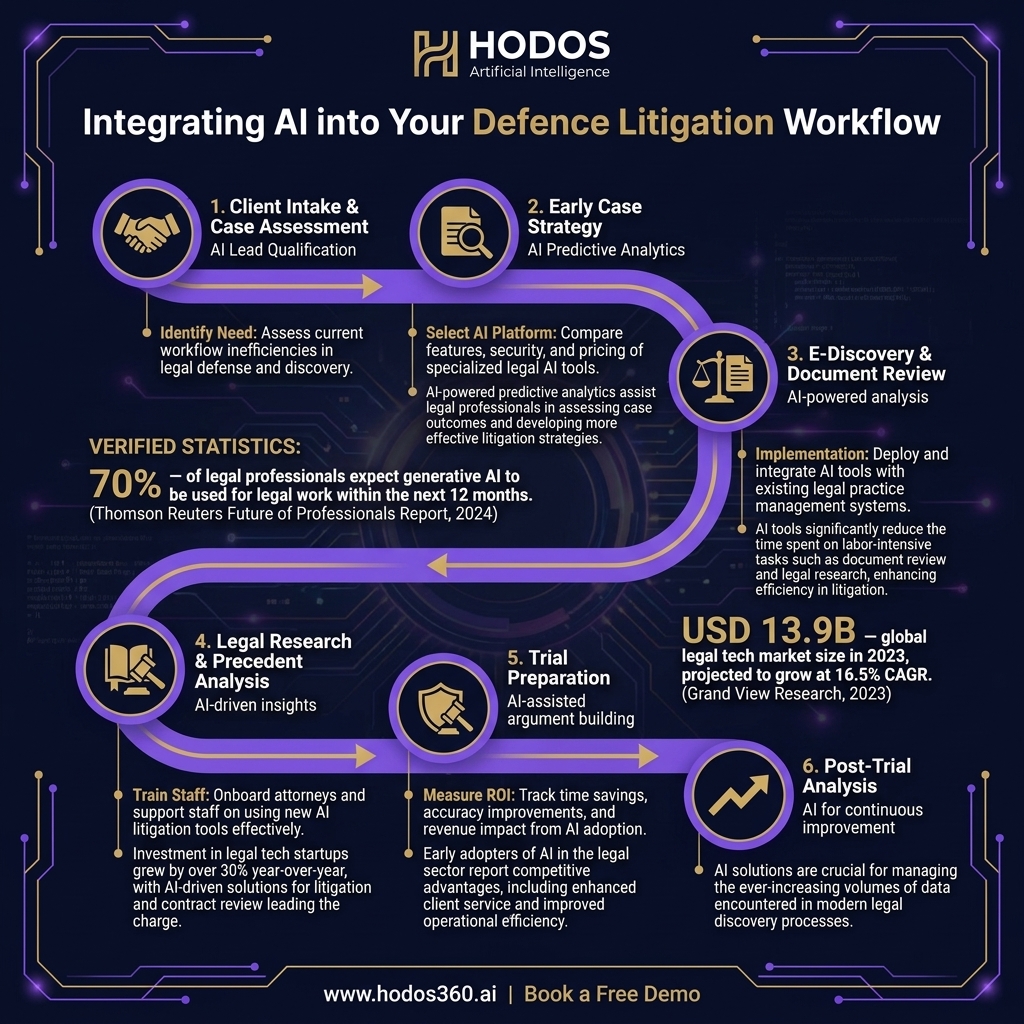
Firms should not aim for a 'big bang' adoption but rather start with pilot programs in specific practice areas or for particular case types. For instance, a firm specializing in complex corporate defence might first implement an AI-powered document review tool for a large-scale class action lawsuit.
This allows for controlled testing, gathering of feedback, and refinement of processes before wider deployment. Key stakeholders, including managing partners, IT leads, and practising attorneys, must be involved from the outset to ensure buy-in and address any resistance to change, fostering a culture of innovation.
### Maximizing ROI with Integrated Legal Tech Solutions Maximizing the return on investment (ROI) from AI implementation requires more than just purchasing software; it demands integration and strategic alignment with the firm's overall business objectives. Standalone AI tools, while powerful, often fall short if they don't seamlessly integrate with existing practice management, billing, and document management systems.
This is where comprehensive platforms like HODOS 360 offer a distinct advantage, providing an AI Law Firm Management System that integrates case management, billing, client intake, and document automation with AI-powered legal workflows. Learn more about Essential AI Website Optimization for Law Firms: Beyond WordPress Basics.
Such integrated solutions reduce data silos, improve data consistency, and ensure that AI insights are actionable across the entire legal process. For example, an AI-qualified lead generated by a 24/7 AI Voice Assistant can flow directly into the client intake system, trigger document automation for initial retainers, and populate the case management system, all without manual data entry.
This end-to-end automation not only boosts efficiency but also frees up valuable attorney time, allowing them to focus on complex legal analysis and client interaction, directly impacting the firm's profitability and capacity for growth.
Furthermore, successful AI implementation hinges on robust training and ongoing support for legal professionals.
It's not enough to provide the tools; attorneys and staff need to understand *how* to use them effectively, interpret their outputs, and integrate them into their daily workflows. This includes training on ethical AI use, understanding potential biases, and knowing when human judgment must override algorithmic recommendations.
Firms should invest in continuous learning programs, workshops, and access to expert support to ensure that their teams are confident and proficient in leveraging AI. The goal is to create a symbiotic relationship between human expertise and artificial intelligence, where each augments the other. Firms that prioritize this human-in-the-loop approach, fostering an environment where technology is seen as an enabler rather than a threat, will be the ones that truly unlock the transformative potential of AI, driving unprecedented levels of productivity, strategic depth, and client satisfaction in their defence litigation practices.

The Future of Legal Practice: AI as a Transformative Partner
The narrative of AI in legal practice is no longer one of speculation but of tangible transformation, particularly within the realm of AI defence litigation tools. The success stories of firms that have embraced these technologies, coupled with significant investment rounds like Turbo Law’s, underscore a clear message: AI is not merely a tool for efficiency, but a strategic imperative for any law firm aiming for sustained success in the 21st century.
The future of legal practice will be defined by an intelligent partnership between human legal expertise and sophisticated artificial intelligence. This synergy will enable lawyers to handle increasingly complex cases with greater precision, speed, and strategic depth, ultimately enhancing access to justice and improving outcomes for clients.
Firms that view AI as a foundational investment in their future, rather than a discretionary expense, are already positioning themselves as leaders in a rapidly evolving legal landscape. This proactive adoption ensures not only competitive advantage but also builds a more resilient, adaptable, and forward-thinking legal practice capable of navigating future challenges and opportunities.
The trajectory of legal technology suggests a future where AI will become even more integrated, intuitive, and indispensable. We can anticipate further advancements in natural language processing, allowing AI to understand legal nuances with even greater sophistication, and in predictive analytics, offering more granular insights into judicial behavior and case probabilities.
The competition among legal tech startups, fueled by continued investment, will drive innovation at an accelerated pace, bringing increasingly specialized and powerful tools to market. Learn more about AI Voice Assistant: Essential for Modern Law Firms. For law firm owners and attorneys, the key takeaway is not to be overwhelmed by the pace of change, but to embrace a mindset of continuous learning and strategic adoption.
Engaging with platforms that offer modular, scalable AI solutions, and fostering a culture of technological literacy within the firm, will be critical. This approach ensures that as AI evolves, your firm remains at the cutting edge, leveraging every advantage to serve clients better and build a more prosperous practice.
Ultimately, the journey towards an AI-powered legal future is about empowerment. It’s about empowering attorneys to reclaim time from administrative burdens, empowering firms to make data-driven decisions, and empowering clients with more efficient, effective, and strategically sound legal defence. The initial apprehension surrounding AI is giving way to a clear understanding of its potential to augment human capabilities, fostering a future where legal professionals are not replaced, but elevated.
By strategically adopting AI defence litigation tools and integrating them into their core operations, law firms can navigate the complexities of modern litigation with unparalleled confidence, securing their position at the forefront of legal innovation and client service. The time to act is now; the future of law is intelligent, and it's here.
- ✓Enhanced Efficiency: AI tools automate repetitive tasks like document review and legal research, significantly reducing time and operational costs.
- ✓Strategic Foresight: Predictive analytics powered by AI offer insights into case outcomes, judicial tendencies, and optimal defence strategies.
- ✓Improved Accuracy: AI minimizes human error in data analysis, ensuring greater precision in evidence handling and legal arguments.
- ✓Data-Driven Decisions: Firms can leverage AI to make informed choices based on comprehensive analysis of vast legal datasets.
- ✓Resource Optimization: Freeing up attorney time from administrative tasks allows focus on high-value legal strategy and client interaction.
- ✓Competitive Advantage: Early adopters gain a significant edge in service delivery, client attraction, and overall market positioning.
- ✓Scalability: AI solutions enable firms to handle larger caseloads and more complex litigation without proportional increases in human resources.
Frequently Asked Questions
What are AI defence litigation tools?+
AI defence litigation tools are specialized software applications that leverage artificial intelligence, machine learning, and natural language processing to assist law firms in defending legal cases. They automate tasks like e-discovery, legal research, document review, and provide predictive analytics to inform strategic decisions, ultimately enhancing efficiency and improving case outcomes for defence attorneys.
How do AI tools improve litigation outcomes?+
AI tools improve outcomes by providing data-driven insights, reducing human error, and accelerating critical processes. They can identify patterns in vast datasets, predict judicial tendencies, and flag crucial evidence or risks that human reviewers might miss. This allows defence teams to build stronger, more proactive strategies, negotiate effectively, and present more compelling arguments in court, leading to more favorable results.
What are the primary concerns with adopting AI in legal defence?+
Key concerns include data privacy and security, as highly sensitive client information is processed by AI. Ethical issues like algorithmic bias, which could perpetuate historical injustices, are also paramount. Additionally, the 'black box' nature of some AI raises questions about accountability and explainability. Law firms must address these through robust data governance, bias mitigation, and human oversight.
Can small law firms afford AI defence solutions?+
Yes, AI defence solutions are increasingly accessible to small law firms. While some enterprise solutions are costly, many providers offer scalable, cloud-based platforms with tiered pricing. The ROI often justifies the investment, as AI significantly reduces operational costs, enhances productivity, and allows smaller firms to compete more effectively with larger counterparts by leveraging advanced technology without prohibitive overheads.
How does AI integrate with existing law firm systems?+
Modern AI legal tools are designed for seamless integration. Many offer APIs (Application Programming Interfaces) that allow them to connect with existing practice management, billing, and document management systems. Integrated platforms, like HODOS 360's AI Law Firm Management System, provide a unified ecosystem where AI-powered features enhance existing workflows, ensuring data consistency and eliminating silos across firm operations.