


Flowise for Law Firms: Essential Guide to Visual AI Workflows
The legal landscape, traditionally cautious, is now at the precipice of an AI-driven transformation, pushing firms to seek bespoke solutions beyond off-the-shelf software. Consider Eleanor Vance, the visionary managing partner at Sterling & Associates, a mid-sized firm in Chicago. For years, Eleanor observed her firm grappling with the inefficiencies of manual document review and inconsistent client intake, despite investing in various legal tech tools.
She knew that true competitive advantage wouldn't come from generic platforms, but from AI tailored precisely to her firm's unique practice areas and client base. The challenge, however, was the prohibitive cost and complexity of hiring dedicated AI developers or relying on closed-source systems that offered limited customization.
This tension between the urgent need for advanced AI and the practical hurdles of implementation is a narrative playing out across law firms globally, from boutique practices to Am Law 100 giants.
The advent of open-source, visual low-code platforms like Flowise is rapidly changing this dynamic, offering a compelling pathway for legal professionals like Eleanor to build sophisticated AI solutions without deep coding expertise.
Flowise, a powerful open-source platform, enables firms to visually construct AI agents and Retrieval-Augmented Generation (RAG) workflows, democratizing access to custom generative AI development. This capability is no longer a luxury reserved for the tech giants; it's becoming an essential tool for legal innovation. As firms navigate a market where clients demand greater efficiency and transparency, the ability to rapidly prototype, deploy, and iterate on AI solutions tailored to specific legal challenges — from complex litigation support to automated regulatory compliance checks — is paramount.
This shift marks a pivotal moment, empowering legal teams to move from passive consumers of technology to active creators of their own AI-powered future, directly addressing the pain points that Eleanor Vance and countless other legal leaders face daily.
This comprehensive guide delves into how Flowise is poised to revolutionize legal operations, offering a detailed exploration of its capabilities for law firms.
We will examine how this visual low-code platform facilitates the creation of custom AI agents for tasks like client intake and document automation, and how it enables the development of advanced RAG workflows for precise legal research. By leveraging its intuitive interface and robust backend, legal professionals can design AI applications that integrate seamlessly with their existing systems, enhancing efficiency, accuracy, and client satisfaction.
The focus is on practical implementation, strategic advantages, and navigating the nuances of integrating powerful, customizable AI into the demanding environment of modern legal practice. Discover how your firm can harness these cutting-edge tools to stay ahead in a rapidly evolving legal market.
The Rise of Visual Low-Code AI in Legal Practice
The legal industry's embrace of technology has historically been characterized by caution, but the tide is turning with the accelerated adoption of low-code and no-code platforms. This trend, prominently featured at events like LegalTech NYC 2026, where discussions often revolved around empowering non-technical users, has now extended its reach to the realm of Artificial Intelligence.
For law firms, this signifies a paradigm shift: the ability to design and deploy AI solutions without the need for extensive programming knowledge. Gartner predicts that low-code development will account for over 65% of all application development activity by 2024, a testament to its growing influence across sectors, including specialized fields like law.
Learn more about AI Marketing Intelligence: The Ultimate Guide for Law Firms. The move towards visual programming environments is particularly crucial for legal professionals, whose core expertise lies in law, not in Python or JavaScript. This accessibility removes a significant barrier to entry, allowing firms to experiment with and implement AI at a pace previously unimaginable.
Flowise, as an open-source visual low-code platform, sits at the forefront of this revolution for legal tech. It empowers law firms to build sophisticated AI agents and RAG workflows by simply dragging and dropping components, connecting them in an intuitive graphical interface. This contrasts sharply with traditional AI development, which often involves complex coding, extensive data science teams, and significant financial investment.
For instance, a firm looking to automate initial client inquiries might once have needed to commission a custom software project costing hundreds of thousands of dollars and taking months to develop. Learn more about Privilege & AI: The Ultimate Guide After US v. Heppner. With Flowise, a legal operations manager or even a tech-savvy paralegal can prototype and deploy a functional AI agent within days or weeks, significantly reducing time-to-market and cost.
This agility is vital in a competitive legal market where rapid innovation can translate directly into client acquisition and retention, as noted by legal tech thought leaders like Noah Waisberg, co-founder of CaseText.
The strategic advantage of leveraging a platform like Flowise extends beyond mere cost savings. It fosters internal innovation, allowing legal teams to directly address their unique operational bottlenecks with custom-built AI. Instead of adapting to generic software, firms can create AI solutions that are perfectly aligned with their specific workflows, compliance requirements, and client service philosophies.
This level of customization ensures higher efficacy and user adoption. Learn more about AI Litigation Workflows: Essential for Modern Law Firms. Furthermore, the open-source nature of Flowise means continuous community-driven improvements and transparency, offering a degree of flexibility and control often absent in proprietary systems.
This fosters a collaborative ecosystem where legal professionals can learn from and contribute to a shared knowledge base, accelerating the overall advancement of legal AI. The ability to iterate quickly and adapt to evolving legal needs is a powerful differentiator for forward-thinking law firms.
The shift towards visual, low-code AI development platforms is not just about making technology easier; it's about fundamentally reshaping how legal services are delivered and managed. By enabling firms to build their own AI workflows, these tools promote a culture of self-sufficiency and innovation. They bridge the gap between legal expertise and technological capability, allowing firms to design intelligent systems that truly understand and respond to legal nuances.
This empowerment is critical for remaining competitive in an era where AI is no longer a distant future but a present necessity. Learn more about AI Web Design: Essential for Law Firms in the Agentic Era. Law firms that embrace visual low-code platforms are not just adopting new tools; they are investing in a future where their internal expertise is magnified by intelligent automation, leading to greater efficiency, accuracy, and ultimately, superior client outcomes.
The power to design, build, and deploy custom AI is now within reach for every law firm.
Empowering Law Firms with Custom AI Agents
The concept of AI agents represents a significant leap forward in automation for the legal sector. Unlike simple scripts or chatbots, AI agents are designed to perform complex, multi-step tasks, often involving decision-making and interaction with various systems. For law firms, this translates into AI entities capable of handling everything from initial client qualification and appointment booking to preliminary document analysis and legal research summaries.
Imagine an AI agent that can sift through incoming inquiries, identify potential conflicts of interest by cross-referencing internal databases, and then schedule a consultation with the appropriate attorney—all autonomously. Learn more about Voice AI Assistants: The Ultimate Law Firm Advantage. This level of sophisticated automation, previously the domain of large enterprises with dedicated R&D budgets, is now accessible to firms of all sizes thanks to platforms like Flowise, which simplifies the building of these intricate agents through its intuitive visual interface.
A recent ABA Legal Technology Survey Report highlighted that firms leveraging AI for administrative tasks reported an average efficiency gain of 25%, underscoring the tangible benefits.
Flowise simplifies the creation of these custom AI agents by providing modular building blocks that represent different AI capabilities, such as natural language processing (NLP), database queries, or external API calls. Legal professionals can visually connect these blocks to define the agent's logic and workflow.
For example, a client intake agent built with Flowise might start with an NLP component to understand a prospective client's query, then connect to a firm's CRM to check for existing client relationships, and finally, integrate with a calendaring system to book an initial consultation.
This visual approach democratizes the power of generative AI, allowing legal teams to rapidly prototype and deploy agents tailored to their specific needs. Learn more about AI-Native Law Firms: An Essential Guide to Legal Innovation. This flexibility is a stark contrast to the 'one-size-fits-all' limitations of many proprietary legal software solutions, offering a true competitive advantage.
Firms can create agents that not only manage routine tasks but also learn and adapt, continuously improving efficiency.
The applications of custom AI agents in law firms are vast and continue to expand. Beyond client intake, firms can develop agents for document automation, generating initial drafts of contracts, motions, or letters based on specific parameters and precedents. Other agents can be designed for rudimentary case management support, such as tracking deadlines, alerting attorneys to upcoming court dates, or organizing case-related communications.
The power lies in customization: a corporate law firm might build an agent specialized in M&A due diligence, while a personal injury firm could focus on agents for managing client communications and evidence collection. Platforms like Flowise, often integrating with frameworks such as Langchain or CrewAI, provide the underlying architecture to make these complex AI workflows manageable and scalable.
This bespoke approach ensures that the AI truly serves the firm's unique operational needs, rather than requiring the firm to adapt its operations to the AI.
The strategic adoption of custom AI agents represents a significant differentiator for law firms in a crowded market. Firms that proactively invest in building these tailored solutions are better positioned to enhance client satisfaction through faster response times, reduce operational costs by automating repetitive tasks, and free up attorneys to focus on high-value, complex legal work.
This isn't just about efficiency; it's about elevating the quality of legal service. As evidenced by the success of firms like Allen & Overy with their partnership with Harvey AI, custom AI solutions offer a glimpse into the future of legal practice. By utilizing visual low-code platforms, firms can now achieve similar levels of bespoke AI integration without the massive upfront investment, making advanced AI development accessible and actionable.
This empowers firms to innovate from within, shaping their own AI destiny and securing a competitive edge for years to come.
Ready to transform your firm's operations with custom AI? Discover how HODOS 360's Web & Mobile Development can help you build and integrate powerful AI solutions tailored for your legal practice.
Streamlining Client Intake and Lead Qualification
One of the most immediate and impactful applications of Flowise-built AI agents is in streamlining client intake and lead qualification. Traditional intake processes are often bottlenecks, characterized by missed calls, delayed responses, and inefficient manual screening, leading to lost prospective clients. An AI agent can provide 24/7 multilingual support, pre-screen leads based on specific legal criteria, gather essential information, and even book appointments directly into an attorney's calendar.

For instance, an agent could ask a series of qualifying questions regarding a personal injury claim, immediately identifying if the case meets the firm's criteria and then seamlessly routing the qualified lead to the appropriate lawyer. This not only significantly improves response times but also ensures that attorneys spend their valuable time on genuinely promising cases, enhancing the firm's overall efficiency and client conversion rates.
Firms that have adopted such systems report a dramatic reduction in administrative overhead and a marked improvement in client satisfaction from the very first interaction.
Revolutionizing Legal Research with Retrieval-Augmented Generation (RAG)
While Large Language Models (LLMs) like those from Open AI offer impressive general knowledge and language generation capabilities, their application in legal research often faces a critical limitation: the risk of hallucinations and a lack of specific, verifiable legal context. This is where Retrieval-Augmented Generation (RAG), a cutting-edge genai technique, emerges as a game-changer for law firms.
RAG combines the generative power of LLMs with the precision of information retrieval. Instead of relying solely on an LLM's pre-trained knowledge, a RAG system first retrieves relevant information from a designated, authoritative knowledge base—such as a firm's internal case precedents, proprietary legal databases, statutes, or internal memos—and then uses this retrieved context to inform the LLM's response.
This significantly enhances the accuracy, reliability, and trustworthiness of AI-generated legal insights, making it an indispensable tool for rigorous legal research and analysis. The ethical implications of AI in law, especially concerning the accuracy and confidentiality of information, are paramount, as highlighted by ABA Model Rule 1.1 on Competence, which implicitly requires attorneys to understand the tools they use.
Flowise provides an excellent platform for law firms to visually build and manage RAG workflows. Legal professionals can design systems that ingest and index their firm's private document repositories, ensuring that any AI-generated responses are grounded in the firm's specific, confidential, and highly relevant data.
This is crucial for maintaining attorney-client privilege and ensuring data security, a core concern for any legal entity. For instance, a litigation team facing a complex class-action lawsuit could develop a Flowise-powered RAG system that pulls information exclusively from their internal database of similar past cases, expert witness testimonies, and relevant court filings.
When an attorney queries the system about a specific legal precedent or strategy, the RAG agent retrieves the most pertinent internal documents and then uses an LLM to synthesize an answer, complete with citations to the original sources. This process drastically reduces research time, enhances the depth of analysis, and minimizes the risk of relying on generalized or incorrect information from public LLMs.
The strategic advantage of implementing custom RAG workflows cannot be overstated. By leveraging their proprietary data, law firms can create a unique institutional intelligence that is inaccessible to competitors. This not only improves the quality and speed of legal research but also transforms how knowledge is managed and disseminated within the firm.
Instead of hours spent manually searching through archives, attorneys can obtain precise, context-aware answers in minutes. This capability is particularly impactful for specialized practice areas where deep, niche knowledge is critical. The integration of Flowise with advanced vector databases and embedding models allows for highly efficient semantic search, meaning the system understands the *meaning* of a query, not just keywords.
This nuanced understanding is essential for complex legal questions, ensuring that the AI retrieves truly relevant information, even if the exact phrasing isn't present in the source documents. Companies like AnythingLLM and Dify are also exploring similar capabilities, but Flowise offers the visual low-code flexibility that makes it particularly appealing for non-developer legal teams.
The implications of RAG extend beyond just research; it also significantly enhances document automation and review processes. Imagine an AI system that, when drafting a contract, automatically pulls the most current clauses from the firm’s precedent library, ensuring consistency and compliance. Or an agent that reviews a lengthy discovery document, identifying key entities and anomalies by comparing it against a corpus of similar documents from previous cases.
This level of intelligent automation, powered by Flowise-built RAG systems, reduces human error, accelerates turnaround times, and allows attorneys to focus on the strategic aspects of their work rather than the repetitive. As the volume of digital information continues to explode, the ability to effectively and accurately leverage internal knowledge via RAG will be a defining characteristic of leading law firms, ensuring they remain at the forefront of legal innovation and client service.
This empowers legal teams to extract maximum value from their vast stores of data, turning information into actionable intelligence.
Enhancing Document Automation and Review
The synergy between Flowise-built RAG systems and document automation is profound. Law firms generate and process an enormous volume of documents, from contracts and briefs to discovery materials. A RAG-powered agent can dramatically enhance these processes. For example, when drafting a new client agreement, the agent can access a firm's internal repository of approved clauses, ensuring legal accuracy and consistency while reducing drafting time from hours to minutes.
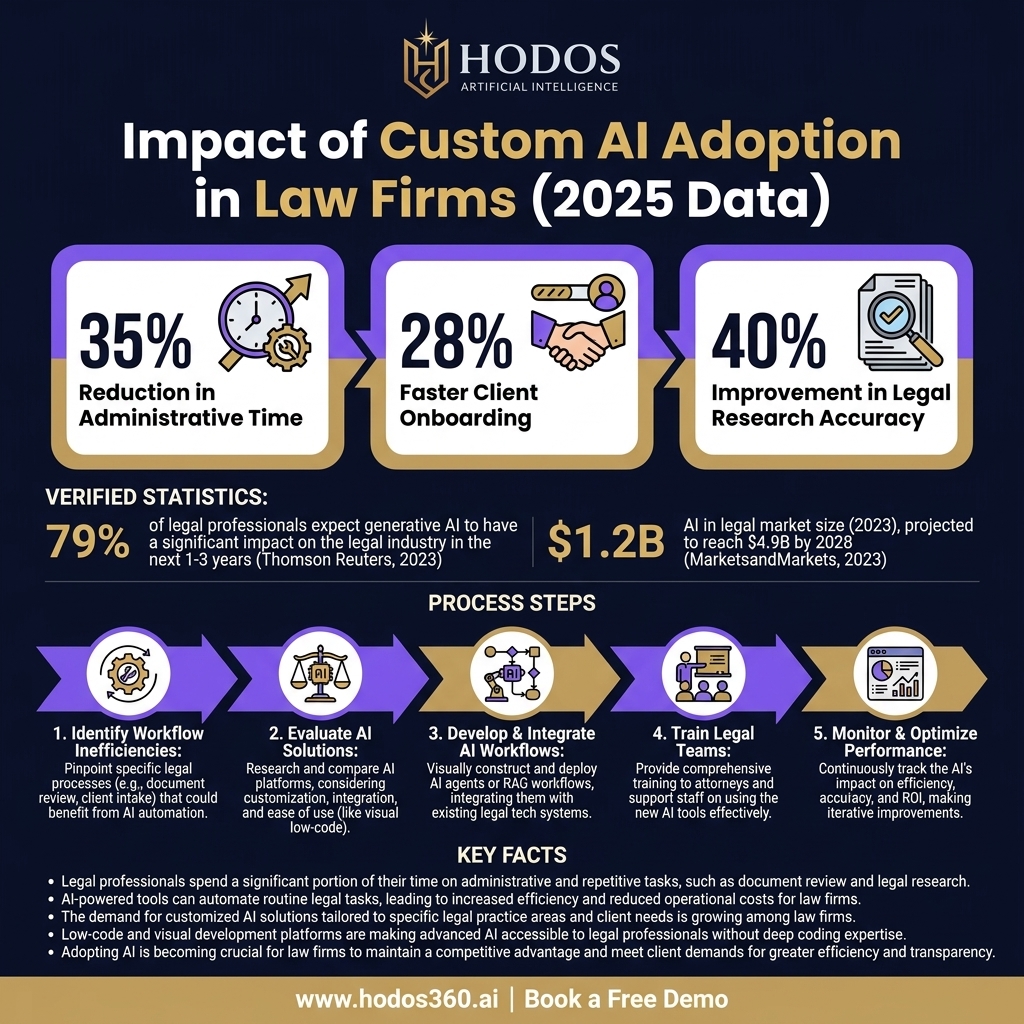
In the context of document review, particularly for e-discovery, a RAG system can quickly identify relevant documents and extract key information (e.g., dates, parties, specific legal terms) by comparing them against the firm’s knowledge base and case-specific criteria. This targeted approach not only accelerates the review process but also significantly reduces costs and minimizes the risk of human error, ensuring compliance with Federal Rules of Civil Procedure concerning discovery obligations.
The ability to automate the generation of highly accurate, context-specific documents while simultaneously streamlining the review of vast datasets represents a transformative leap in legal operations.
The Practicalities: Integration, Security, and Scalability for Legal Tech
While the promise of visual low-code AI like Flowise is compelling, the practicalities of integrating such development platforms into a law firm's existing tech ecosystem are paramount. Law firms operate within a highly regulated environment where data security, client confidentiality, and compliance are non-negotiable. Integrating an open-source tool requires careful consideration of its architecture, deployment options, and ongoing maintenance.
Firms must ensure that any AI solution, regardless of its origin, adheres to stringent data protection regulations such as GDPR, CCPA, and, crucially, to the ethical obligations outlined in professional conduct rules like ABA Model Rule 1.6 on Confidentiality of Information. This often means deploying Flowise on secure, private cloud infrastructure or on-premise, rather than relying on public cloud instances, to maintain absolute control over sensitive legal data.
The technical setup and ongoing oversight are critical for mitigating risks and ensuring robust system performance.
The modular nature of Flowise, however, is a significant advantage in addressing these practical concerns. Its components can be easily integrated with existing legal practice management software, CRM systems, and document repositories through APIs. This means a Flowise-built AI agent for client intake can feed directly into a firm's existing case management system, or a RAG workflow can pull data from an established Westlaw or LexisNexis subscription, alongside internal documents.
This flexibility allows firms to augment their current tools rather than replacing them entirely, minimizing disruption and maximizing return on investment. Furthermore, the platform's ability to create custom connectors means it can adapt to unique data sources and proprietary systems, ensuring seamless data flow and operational continuity.
The key is a well-planned integration strategy, often requiring expertise in web development and secure system architecture to ensure all components work harmoniously and securely.
Scalability is another critical consideration for law firms aiming to grow their AI capabilities. As a firm expands its practice areas or client base, its AI solutions must be able to handle increased data volumes and user demands without compromising performance. Flowise, being built on modern technologies and designed for modularity, inherently supports scalability.
Firms can start with a single AI agent for a specific task and gradually expand their AI infrastructure, adding more agents or complex AI workflows as needed. This incremental approach allows for controlled growth and continuous optimization. However, achieving this scalability and maintaining high levels of security and performance often requires specialized technical guidance.
This is where strategic partners become invaluable.
Unlock the full potential of custom AI for your law firm. Explore HODOS 360's AI Law Firm Management System to see how integrated AI solutions can streamline your entire practice.
Partnering with experts who understand both legal tech and secure web development is crucial for firms looking to leverage platforms like Flowise effectively. HODOS 360, through its Web & Mobile Development services, assists law firms in deploying, customizing, and maintaining such advanced AI solutions. This includes ensuring robust infrastructure, implementing stringent security protocols, and developing custom integrations that align with a firm's specific needs and compliance requirements.
Their expertise ensures that the promise of open-source AI translates into reliable, secure, and high-performing applications that truly enhance a firm's operational capabilities. By bridging the gap between innovative open-source tools and the demanding requirements of legal practice, firms can confidently embrace the future of AI-powered legal services, knowing their data and operations are in expert hands.
This proactive approach to AI development and integration is what distinguishes leading firms in today's competitive landscape.
Navigating the Open-Source Ecosystem: Flowise vs. Proprietary Tools
The choice between open-source platforms like Flowise and proprietary legal AI tools presents a classic 'build vs. buy' dilemma for law firms. Proprietary solutions often offer out-of-the-box functionality, dedicated vendor support, and integrated features, but they come with vendor lock-in, limited customization, and recurring licensing fees that can escalate.
Open-source, conversely, provides unparalleled flexibility, cost-effectiveness (no licensing fees), and transparency, allowing firms to scrutinize and adapt the code to their precise needs. However, it typically requires more internal technical expertise for setup, maintenance, and support, though a vibrant community and external development partners can mitigate this.
For firms prioritizing deep customization, data control, and long-term adaptability, Flowise offers a compelling alternative. It allows firms to own their AI infrastructure and evolve it with their practice, rather than being beholden to a vendor's product roadmap. The decision ultimately hinges on a firm's internal technical capabilities, its strategic objectives, and its willingness to invest in custom AI development for a truly tailored solution.

Key Takeaways for Forward-Thinking Legal Professionals
The journey into advanced legal AI, particularly with powerful visual low-code platforms like Flowise, is not merely about adopting new technology; it's about fundamentally rethinking how legal services are delivered and managed. For forward-thinking legal professionals, the core takeaway is the immense strategic advantage offered by custom AI agents and RAG workflows.
These tools empower firms to move beyond generic automation, crafting bespoke solutions that precisely address their unique operational challenges, enhance client satisfaction, and unlock new efficiencies. From revolutionizing client intake and document automation to supercharging legal research with verifiable, context-aware insights, the potential for transformation is vast.
Firms that embrace this approach are not just keeping pace; they are actively shaping the future of their practice, building internal capabilities that will serve as a competitive differentiator for years to come. The era of 'one-size-fits-all' legal tech is giving way to an age of tailored, intelligent systems, and Flowise stands as a beacon for this new frontier.
For law firms considering how to integrate these powerful capabilities, the path forward involves a strategic, phased approach. Start by identifying key pain points where AI workflows can deliver immediate value, such as automating repetitive administrative tasks or improving the initial client engagement process. Experiment with prototyping AI agents using Flowise’s intuitive visual interface, leveraging its open-source nature to build and iterate quickly.
Crucially, prioritize data security and compliance from the outset, ensuring that any custom AI solution respects client confidentiality and adheres to professional ethical standards. Finally, recognize that while Flowise democratizes AI development, successful deployment and long-term maintenance often benefit from expert guidance. Partners like HODOS 360, with their specialized Web & Mobile Development services, can provide the essential technical support and strategic insights needed to transform these innovative tools into robust, reliable, and high-performing assets for your firm.
This collaboration ensures that your firm not only adopts cutting-edge AI but also integrates it seamlessly and securely into the fabric of your legal practice, securing a significant competitive advantage.
- ✓Flowise Empowers Customization: Leverage its visual low-code interface to build AI agents and RAG workflows tailored to your firm's specific needs, avoiding generic solutions.
- ✓Enhance Client Intake: Deploy AI agents for 24/7 lead qualification, appointment booking, and initial client screening, improving response times and conversion.
- ✓Revolutionize Legal Research: Utilize RAG systems to ground LLM responses in your firm's proprietary documents and authoritative legal databases, ensuring accuracy and reducing hallucinations.
- ✓Streamline Document Processes: Automate document generation, contract analysis, and e-discovery review, significantly reducing manual effort and human error.
- ✓Prioritize Security & Compliance: Implement open-source AI solutions on secure, private infrastructure, ensuring adherence to data protection regulations and ethical obligations.
- ✓Foster Internal Innovation: Empower legal professionals to actively participate in AI development, fostering a culture of technological self-sufficiency and continuous improvement.
- ✓Seek Expert Integration: Partner with specialized legal tech developers, such as HODOS 360, to ensure robust, scalable, and secure deployment of custom AI solutions.
Frequently Asked Questions
What is Flowise and how can it benefit my law firm?+
Flowise is an open-source, visual low-code platform that allows law firms to build custom AI agents and Retrieval-Augmented Generation (RAG) workflows without extensive coding. It benefits firms by enabling tailored solutions for client intake, document automation, and legal research, leading to increased efficiency, reduced costs, and enhanced client satisfaction. Its visual interface makes advanced AI accessible to legal professionals, accelerating innovation within the firm.
Can Flowise integrate with our existing legal software and databases?+
Yes, Flowise is designed for modularity and can integrate with existing legal practice management systems, CRMs, and document repositories through APIs and custom connectors. This allows firms to leverage their current tech stack while augmenting it with powerful AI capabilities. Secure integration ensures seamless data flow and operational continuity, making your existing investments more powerful and efficient.
How does Flowise ensure data security and client confidentiality for law firms?+
As an open-source platform, Flowise offers transparency and flexibility in deployment. Law firms can host Flowise on private cloud infrastructure or on-premise servers, giving them complete control over their sensitive legal data. This approach helps ensure compliance with data protection regulations like GDPR and CCPA, as well as ethical obligations regarding client confidentiality (e.g., ABA Model Rule 1.6). Proper setup and ongoing maintenance are key.
What are AI agents and RAG workflows, and how do they apply to legal practice?+
AI agents are autonomous programs that perform multi-step tasks, such as qualifying leads or automating document drafts. RAG (Retrieval-Augmented Generation) combines LLMs with your firm's private knowledge base to provide accurate, context-aware answers for legal research. Together, they streamline operations, enhance research accuracy, and free up attorneys for higher-value tasks, transforming how legal services are delivered and managed.
Is technical expertise required to use Flowise effectively in a law firm?+
While Flowise is a low-code platform designed for visual development, some technical understanding is beneficial for optimal deployment, customization, and maintenance. Firms may choose to develop in-house expertise or partner with specialized legal tech development services, such as HODOS 360's Web & Mobile Development, to ensure robust integration, security, and scalability. This hybrid approach maximizes the benefits of open-source AI.