


AI Intake: The Essential Guide for Modern Law Firms
Just two years ago, Eleanor Vance, a managing partner at the mid-sized litigation firm Sterling & Hayes, watched a significant portion of potential client leads slip through the cracks. Manual intake processes, rife with redundant data entry and slow response times, meant that by the time her team connected with a prospect, they had often moved on to a more agile competitor.
This wasn't just an inefficiency; it was a drain on revenue and morale, a stark illustration of the friction between traditional legal practices and modern client expectations. Today, Sterling & Hayes stands as a testament to transformative change, having leveraged advanced AI intake systems to revolutionize their client acquisition.
This shift isn't unique to Sterling & Hayes. A recent deep dive by IndexBox, highlighted in their "Law Firm AI Intake Adoption Report 2026," reveals a compelling narrative: the legal industry is at a pivotal inflection point. The report underscores a dramatic acceleration in the adoption of automated legal software, particularly in client-facing functions.
This trend is fueled by an increasingly competitive landscape where clients expect seamless, digital-first interactions, and firms are under immense pressure to optimize every operational facet. The tension between firms clinging to outdated methods and those embracing the future is palpable, shaping the very definition of a successful legal practice.
For law firm owners, attorneys, and legal professionals navigating this evolving ecosystem, understanding and strategically implementing AI intake is no longer a luxury but an imperative. This comprehensive guide will delve into the strategic advantages, best practices, and ethical considerations surrounding AI-powered client intake. We'll explore how these cutting-edge legal AI tools are not merely automating tasks but fundamentally reshaping client relationships, enhancing operational efficiency, and driving sustainable growth.
The goal is to equip you with the insights needed to not only adopt but truly master this transformative technology, ensuring your firm remains competitive and client-centric in the digital age. If you're ready to modernize your firm's operations and elevate client service, it's time to explore the power of AI.
Discover how a comprehensive AI Law Firm Management System can transform your firm.
The Evolving Landscape of Legal AI Intake and Its Imperative
The journey from basic online contact forms to sophisticated AI intake systems has been swift and profound. Early legal technology offered incremental improvements, but the advent of Generative AI has unleashed a paradigm shift. Consider the trajectory of companies like Clio, which, through strategic acquisitions and continuous innovation, has consistently pushed the envelope in practice management.
Now, specialized client intake software powered by AI is moving beyond simple data collection, offering intelligent pre-screening, automated conflict checks, and dynamic information gathering. This evolution is not just about digitizing existing processes; it's about fundamentally redesigning the client acquisition funnel for unprecedented efficiency and accuracy.
This rapid evolution is underpinned by a clear market demand. Clients today are accustomed to instant gratification and personalized digital experiences across all industries. They expect their legal providers to offer similar seamless onboarding. The ABA's annual TechReport, for instance, indicated a significant leap in AI adoption among lawyers, with roughly 30% reporting usage in 2024 (published in 2025), a substantial increase from just 11% two years prior.
The IndexBox report for 2026 further solidifies this trend, projecting even higher rates as firms recognize the non-negotiable need for advanced legal tech adoption. Firms that ignore this shift risk alienating a new generation of tech-savvy clients and falling behind competitors who embrace automated legal software.
Modern AI-powered legal workflows in intake are capable of far more than just gathering names and numbers. Learn more about Voice AI: The Essential Shift for Modern Law Firms. They can conduct initial lead qualification, routing high-value prospects directly to the appropriate attorney while providing self-service options for routine inquiries.
Crucially, these systems can perform preliminary conflict-of-interest checks against vast internal and external databases, significantly reducing the risk of ethical breaches and saving countless hours of manual review. This means attorneys can dedicate their valuable time to complex legal analysis and client advocacy, rather than administrative drudgery, a critical advantage in a demanding profession.
The competitive imperative cannot be overstated. Major players are already setting the pace; consider Allen & Overy's groundbreaking partnership with Harvey AI, which demonstrated the power of advanced AI in legal research and document review. While Harvey focuses on back-end legal work, the philosophy of leveraging AI for a competitive edge extends directly to client intake.
Firms that hesitate in adopting robust AI intake solutions face a growing chasm between their operational capabilities and those of their AI-enabled counterparts. This creates a challenging "disruption vs. tradition" scenario, where firms must either innovate or risk becoming obsolete in a rapidly transforming legal market.
The choice for a modern firm is clear: embrace the future of legal automation or be left behind.
Beyond Efficiency: Strategic Advantages of AI-Powered Client Intake
While efficiency gains are often the primary driver for adopting AI intake, the strategic advantages extend far beyond mere time savings. At its core, AI-powered intake fundamentally elevates the client experience. Imagine a prospective client receiving an immediate, personalized response to an inquiry, guided through an intuitive digital questionnaire, and having their case pre-qualified within minutes, even outside of business hours.
This 24/7 availability, often powered by AI Voice Assistants for phone answering and lead qualification, creates a highly responsive, client-centric first impression. As one legal tech CEO, Jack Newton of Clio, has often emphasized, client satisfaction is paramount, and a frictionless onboarding process is the first step in building lasting trust and loyalty.
Beyond the immediate client interaction, AI intake systems are powerful engines for data-driven insights. Every interaction, every piece of information collected, contributes to a rich dataset that can inform critical business decisions. Firms can track lead sources, analyze conversion rates by practice area, identify emerging client demographics, and even predict future legal needs based on historical data.
This granular insight is invaluable for refining firm management systems, optimizing marketing campaigns through an AI Marketing Platform, and strategically allocating resources. Understanding the true ROI of different intake channels allows firms to make informed investments and achieve targeted growth, moving beyond anecdotal evidence to concrete data.
Risk mitigation is another profound strategic advantage. Learn more about AI-Powered Legal Tech: The Essential Guide for Modern Firms. Manual intake processes are inherently prone to human error, particularly when conducting thorough conflict-of-interest checks. An AI intake system, integrated with comprehensive firm databases and external legal resources, can perform these checks with unparalleled speed and accuracy, flagging potential conflicts that a human might overlook.
This reduces the risk of ethical violations, malpractice claims, and reputational damage. Furthermore, by standardizing the collection of crucial client identification information, AI intake aids in compliance with regulatory requirements, such as anti-money laundering (AML) protocols, ensuring adherence to the highest professional standards as outlined in ethical guidelines like ABA Model Rule 1.1 (Competence), which mandates lawyers to stay abreast of the benefits and risks associated with relevant technology.
Ultimately, AI intake is a powerful catalyst for scalability and sustainable growth. For firms looking to expand their client base without proportionally increasing their administrative overhead, AI offers a compelling solution. By automating repetitive tasks, firms can handle a significantly higher volume of inquiries and new client matters with their existing staff, or even optimize staffing levels.
This ability to "scale" and "automate" operations, a common theme among industry leaders, translates directly into increased profitability and market share. The return on investment (ROI) from reduced administrative costs, improved lead conversion, and enhanced client retention makes AI intake a strategic imperative for any firm aspiring to thrive in the modern legal landscape.
Tailoring AI Intake Solutions to Firm Needs
The market for legal AI tools is diverse, offering a spectrum of solutions ranging from standalone specialized intake platforms to comprehensive, integrated AI Law Firm Management System suites. The key to successful adoption lies in a meticulous assessment of your firm's specific needs and existing technological infrastructure.

A boutique firm specializing in a niche area, for instance, might prioritize deep customization for specific questionnaires, while a high-volume personal injury firm might focus on speed and automated routing. Evaluating factors like practice areas, average client volume, complexity of conflict checks, and current tech stack compatibility is crucial.
Selecting the right solution involves more than just feature comparison; it requires understanding the vendor's commitment to ongoing development, data security, and client support. Learn more about AI Web Development: Essential Collaboration for Law Firms. Many platforms offer flexible APIs, enabling seamless integration with existing CRM, billing, and document management systems, minimizing disruption.
A thorough due diligence process, including demos and pilot programs, is essential to ensure the chosen client intake software aligns perfectly with your firm's strategic objectives and operational realities, rather than forcing a square peg into a round hole.
Implementing AI Intake: Best Practices and Pitfalls to Avoid
Successful implementation of AI intake demands a structured, thoughtful approach, rather than a mere plug-and-play installation. A critical first step is establishing a pilot program within a specific practice group, allowing for controlled testing and refinement. Engaging key stakeholders—from senior partners to administrative staff—from the outset is vital to foster buy-in and address potential resistance to change.
This human element is often where technology adoption falters; a clear communication strategy, emphasizing the benefits to individual roles and the firm as a whole, can mitigate friction and ensure smoother transitions. Firms like Sterling & Hayes found that early involvement of their lead paralegal, Sarah Chen, in designing the new workflows was instrumental in firm-wide acceptance.
Data migration and seamless integration are often the most technically challenging aspects of adopting new client intake software. Ensuring that existing client data, contacts, and historical information can be accurately and securely transferred to the new system is paramount. Furthermore, the AI intake platform must integrate fluidly with other essential firm management systems, such as billing, calendaring, and document automation tools, to avoid creating new data silos.
Robust API capabilities are a non-negotiable requirement for a truly unified AI-powered legal workflows environment, as fragmented systems negate many of the efficiency gains AI promises. It's not just about getting the data in, but ensuring it flows effortlessly across your entire operational ecosystem.
Beyond initial setup, AI intake requires a commitment to continuous improvement and refinement.
AI models learn and perform best when trained on firm-specific data and continually provided with feedback. Learn more about AI-Powered Web Development: The Essential Guide for Law Firms. This means establishing feedback loops from attorneys and staff using the system, regularly reviewing performance metrics, and making iterative adjustments to the AI's logic and processes.
The notion that AI is a "set it and forget it" solution is a dangerous misconception; rather, it's a dynamic tool that evolves with your firm's needs and the changing legal landscape. This ongoing optimization ensures the system remains highly effective and adapts to new types of inquiries or legal challenges.
However, several pitfalls can derail even the most well-intentioned legal tech adoption. Over-automating without sufficient human oversight can lead to impersonal client interactions or missed nuances in complex cases. Neglecting robust data security measures can expose sensitive client information, leading to severe ethical and legal repercussions.
Poor user adoption, often stemming from inadequate training or a lack of perceived benefits by staff, can render an expensive system largely unused. Finally, choosing a solution that lacks scalability or flexibility will inevitably lead to future bottlenecks. The most successful implementations strike a balance between automation and human judgment, ensuring technology serves to augment, not replace, the invaluable expertise of legal professionals.
Data Privacy and Ethical Considerations in AI Intake
The integration of AI intake systems into legal practices brings paramount ethical and data privacy considerations that firms must diligently address. Protecting client confidentiality is a cornerstone of the legal profession, enshrined in principles like ABA Model Rule 1.6 (Confidentiality of Information). Firms deploying AI must ensure that their chosen platforms adhere to the highest standards of data encryption, secure storage, and access controls.
Compliance with evolving data protection regulations, such as GDPR in Europe or CCPA in California, is not merely a legal obligation but an ethical imperative, requiring rigorous due diligence on vendor security protocols and data handling practices.
Beyond security, the potential for algorithmic bias in AI intake systems demands careful scrutiny.
Learn more about AI Phone Assistant: Essential Guide for Modern Law Firms. If an AI is trained on historical data that reflects existing societal biases, it could inadvertently perpetuate or even amplify discriminatory outcomes in client qualification or case assessment. Leaders in responsible AI development, such as Dario Amodei of Anthropic or Sam Altman of OpenAI, consistently emphasize the need for transparency, fairness, and accountability in AI design.
Law firms must actively audit their AI systems for bias, ensuring that the technology serves all clients equitably and upholds the legal profession's commitment to justice, rather than inadvertently creating new barriers.
- ✓Enhanced Security Protocols: Implement end-to-end encryption for all data in transit and at rest within the AI intake system.
- ✓Strict Access Controls: Limit access to sensitive client data based on roles and responsibilities, leveraging multi-factor authentication.
- ✓Regular Security Audits: Conduct periodic third-party security audits and penetration testing of AI intake platforms.
- ✓Vendor Due Diligence: Thoroughly vet AI intake providers for their data privacy policies, compliance certifications, and track record.
- ✓Client Consent and Transparency: Clearly inform clients about the use of AI in intake processes and obtain explicit consent for data handling.
- ✓Bias Detection and Mitigation: Regularly monitor AI algorithms for potential biases and implement strategies to ensure equitable and fair processing of all client data.
- ✓Compliance with Regulations: Ensure the AI intake system complies with relevant data protection laws (e.g., GDPR, CCPA, HIPAA) and legal professional ethical rules.
The Future of Legal Client Onboarding with AI
The horizon for legal tech adoption in client onboarding promises even more profound innovations. We can anticipate hyper-personalization, where AI intake systems adapt dynamically to each client's unique needs, offering tailored information and guiding them through a bespoke onboarding journey. Predictive analytics will become increasingly sophisticated, allowing firms to not only pre-qualify leads but also to anticipate potential case outcomes or identify cross-selling opportunities based on initial client data.
Furthermore, the integration of Generative AI will enable automated drafting of initial client agreements, engagement letters, and even preliminary legal advice (under attorney supervision), further streamlining the initial phases of legal work. This advanced capability will redefine the initial client-firm interaction, making it more efficient and insightful than ever before.
Crucially, this future does not diminish the role of the human attorney; rather, it redefines and elevates it. By offloading repetitive, administrative tasks to AI intake systems, lawyers are freed to focus on the higher-value aspects of their profession: complex problem-solving, strategic counsel, and empathetic client interaction.
The future lawyer will be an AI-augmented professional, leveraging these legal AI tools to enhance their capabilities, deepen client relationships, and deliver superior legal services. The emotional intelligence, nuanced judgment, and strategic foresight that define exceptional legal practice will become even more central, as AI handles the operational heavy lifting, allowing attorneys to be truly strategic partners.
As AI technology continues to advance, the regulatory landscape is also evolving. Learn more about AI Voice Clone: The Ultimate Guide for Law Firms. Landmark legislation, such as the EU AI Act, sets a precedent for governing AI systems, particularly those deemed "high-risk." While AI intake might not fall into the highest risk categories, firms must remain vigilant and adaptable, ensuring their chosen solutions comply with emerging legal frameworks.
Staying abreast of these legislative developments is crucial for responsible legal tech adoption, reinforcing the ethical duties of lawyers to ensure competence and compliance in their use of technology. This proactive approach ensures that innovation occurs within a robust ethical and legal framework, protecting both the firm and its clients.
Ultimately, the firms that master AI intake and integrate it seamlessly into their operations will gain an undeniable competitive edge. They will attract top talent who prefer working with cutting-edge tools, secure more clients through superior service and efficiency, and operate with unparalleled agility. This strategic advantage extends across all aspects of firm operations, from optimizing legal workflows to enhancing client experience.
Platforms like HODOS 360, which offer integrated solutions spanning AI Law Firm Management, AI Marketing, AI Voice Assistants, and Web & Mobile Development, are designed to empower law firms to achieve this level of comprehensive digital transformation, setting a new standard for what it means to be a modern, future-ready legal practice.
AI and Legal Innovation: A Broader Perspective
The transformation driven by AI intake is but one facet of a much larger wave of legal innovation sweeping across the industry. This digital revolution encompasses every aspect of law firm operations, from back-office management to client-facing interactions. Beyond streamlining client acquisition, AI is fundamentally reshaping how legal professionals conduct research, manage documents, and even engage in marketing.
The synergy between these various AI-powered solutions creates a holistic ecosystem where data flows seamlessly, intelligence is shared, and efficiency is maximized across the entire firm.
Consider the impact of AI marketing platforms that leverage data from intake to create hyper-targeted campaigns, or AI Voice Assistants that provide 24/7 client support, qualifying leads and booking appointments with unparalleled precision.
The development of AI-powered website building and responsive mobile designs ensures that a firm's digital storefront is as advanced as its internal operations. This comprehensive approach to technology, exemplified by platforms that integrate these diverse services, allows law firms to achieve true digital maturity, optimizing legal workflows, enhancing client experience, and securing a sustainable competitive advantage in a rapidly evolving legal market.

Key Takeaways and Next Steps for Law Firms
The "Law Firm AI Intake Adoption Report 2026" by IndexBox confirms what many forward-thinking legal professionals already know: AI intake is no longer a niche technology but a mainstream imperative for modern law firms. Its strategic advantages—from supercharging efficiency and enhancing the client experience to mitigating risk and enabling scalable growth—are undeniable.
Firms like Sterling & Hayes, under the leadership of partners like Eleanor Vance, are living proof that embracing this technology can fundamentally transform a practice, turning operational bottlenecks into competitive differentiators. The time for deliberation is over; the era of intelligent legal automation is here.
For law firm owners and attorneys ready to seize this opportunity, the next steps are clear and actionable. Begin by conducting a thorough internal audit of your current client intake processes to identify pain points and areas ripe for automation. Research reputable providers of automated legal software and schedule demonstrations to understand their capabilities and how they align with your firm's unique needs.
Prioritize a phased implementation, perhaps starting with a pilot program, and invest heavily in training and change management to ensure enthusiastic user adoption. Remember, successful legal tech adoption is as much about people and processes as it is about technology itself.
Embracing AI in client intake is more than just an operational upgrade; it's a strategic investment in the future resilience and prosperity of your law firm.
By leveraging the power of AI intake, you can not only streamline client onboarding but also cultivate deeper client relationships, optimize legal workflows, and position your firm at the forefront of legal innovation. Platforms like HODOS 360 offer a comprehensive suite of AI-powered services, from law firm management to marketing and voice assistants, designed to empower your firm through this transformative journey.
The future of legal practice is intelligent, efficient, and client-centric—and it starts with smart AI intake.
Frequently Asked Questions
What is AI intake for law firms?+
AI intake for law firms refers to using artificial intelligence technologies to automate and enhance the client acquisition and onboarding process. This includes tasks like initial client screening, conflict checks, data collection, document generation, and intelligent lead routing, often powered by natural language processing and machine learning to create a more efficient and personalized experience for prospective clients.
How does AI intake improve client experience?+
AI intake significantly improves client experience by offering 24/7 availability, faster response times, and a more streamlined, personalized onboarding journey. Clients benefit from intuitive digital forms, immediate pre-qualification, and quicker connection to the right legal professional, reducing frustration and building trust from the very first interaction. This modern approach meets contemporary client expectations for digital convenience.
What are the main benefits of adopting AI intake systems?+
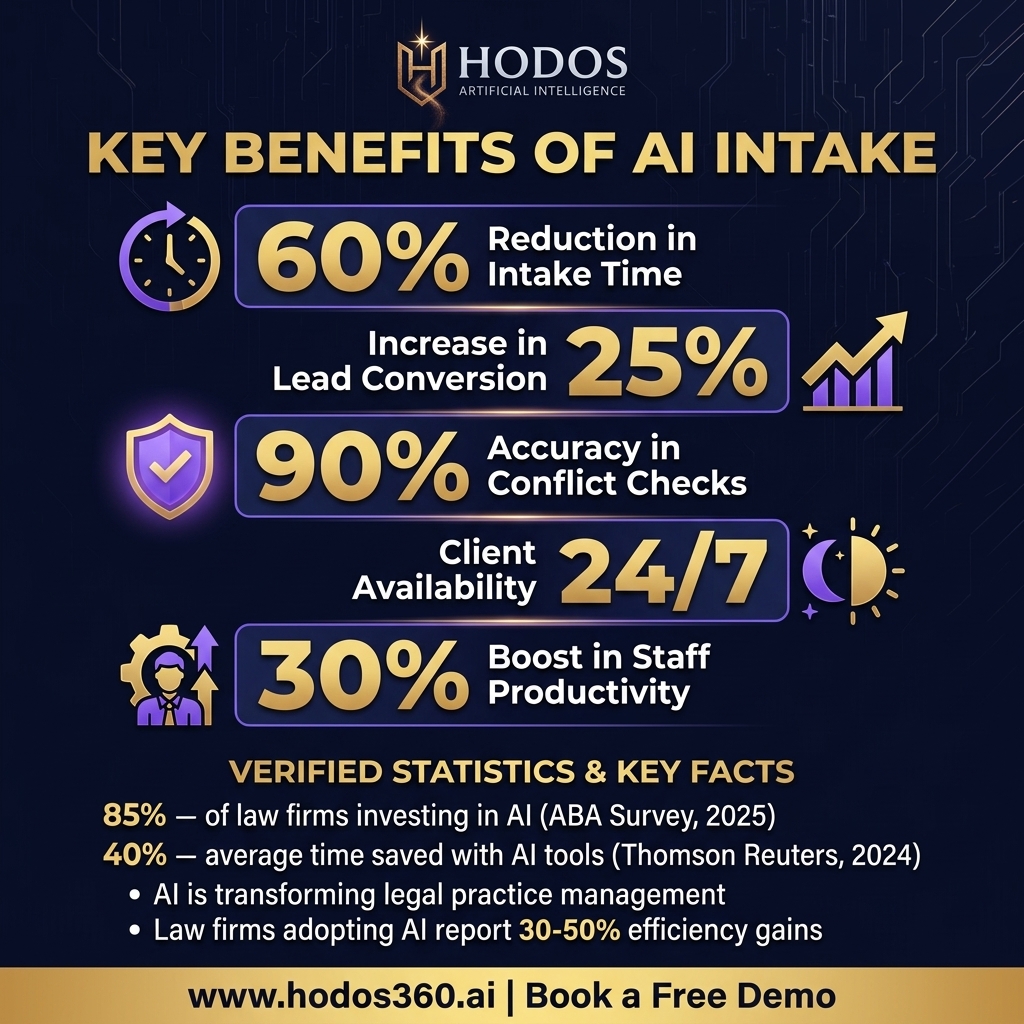
Adopting AI intake systems offers numerous benefits, including increased operational efficiency, reduced administrative burden, enhanced accuracy in conflict checks, and improved data security. Strategically, it leads to better lead conversion rates, data-driven insights for business development, scalability for growth, and a superior client experience, positioning the firm as innovative and client-centric.
Are AI intake systems secure and compliant with data privacy laws?+
Reputable AI intake systems are designed with robust security protocols, including end-to-end encryption and strict access controls, to protect sensitive client data. Firms must conduct due diligence to ensure their chosen solution complies with relevant data privacy laws like GDPR and CCPA, as well as ethical obligations such as ABA Model Rule 1.6 (Confidentiality), ensuring client information is handled securely and responsibly.
How do I choose the right AI intake solution for my firm?+
Choosing the right AI intake solution involves assessing your firm's specific needs, practice areas, client volume, and existing technology stack. Look for solutions that offer customization, seamless integration with your current systems (CRM, billing), strong security features, and excellent vendor support. Conducting pilot programs and thorough demos can help ensure the solution aligns with your strategic goals and operational realities.
Will AI intake replace human legal staff?+
No, AI intake is designed to augment, not replace, human legal staff. It automates repetitive and administrative tasks, freeing attorneys and paralegals to focus on higher-value work requiring legal judgment, strategic thinking, and empathetic client interaction. AI enhances efficiency and accuracy, allowing human professionals to dedicate their expertise to complex problem-solving and client advocacy, elevating the overall quality of legal service.