


AI Phone Assistant: Essential Guide for Modern Law Firms
The legal landscape, often perceived as resistant to rapid technological shifts, is currently undergoing an unprecedented digital revolution. On April 12, 2026, the tech world buzzed with news of TeleIQ’s launch of its new AI Phone Assistant, designed to transform business customer support. While TeleIQ targets a broad commercial audience, this development underscores a far more critical trajectory for law firms: the inevitable integration of sophisticated voice AI into core legal operations.
For decades, the cornerstone of legal practice has been client interaction, often beginning with the first phone call. However, traditional answering services struggle with the complexity and volume of legal inquiries, leading to missed opportunities and client frustration, particularly outside of standard business hours.
This isn't just about answering calls; it's about intelligent engagement.
Law firms, from boutique practices to multinational powerhouses, grapple with the challenge of providing consistent, high-quality, and immediate responses to prospective and existing clients. A recent survey by Thomson Reuters in late 2025 revealed that 68% of clients expect immediate responses to their inquiries, a metric traditional human-centric models often fail to meet consistently.
This gap creates a significant competitive disadvantage. Firms that embrace AI-powered solutions are not merely adopting new tools; they are fundamentally rethinking their client acquisition and service delivery models, striving for unparalleled efficiency and client satisfaction in a rapidly evolving market.
The advent of advanced AI phone assistant technologies, powered by large language models from innovators like OpenAI and Anthropic, offers a compelling solution to these perennial challenges.
These sophisticated systems go far beyond simple call routing, capable of understanding nuanced legal questions, qualifying leads, scheduling appointments, and even providing preliminary information, all while adhering to the highest standards of professionalism. This comprehensive guide will delve into how such voice AI systems are not just a luxury but an essential strategic asset, enabling law firms to enhance their operational efficiency, improve client experiences, and secure a competitive edge in the increasingly digital legal marketplace.
We will explore the capabilities, ethical considerations, and practical implementation strategies that define this transformative shift.
The Unfolding Revolution of Voice AI in Legal Services
The legal industry has long relied on human interaction as its primary mode of communication, a tradition deeply embedded in the professional ethos. However, the sheer volume of calls, the need for 24/7 availability, and the increasing complexity of client inquiries have exposed the limitations of purely human-driven systems.
The launch of advanced AI phone assistants, similar to TeleIQ's recent offering, signals a broader market trend towards automated, intelligent client engagement. This shift is not about replacing human professionals but augmenting their capabilities, allowing them to focus on high-value legal work rather than routine administrative tasks.
Consider the insights shared by Dario Amodei, CEO of Anthropic, at a recent AI ethics conference, emphasizing that responsible AI development must prioritize human-AI collaboration rather than displacement. For law firms, this means leveraging AI to handle the initial client touchpoints, ensuring that no potential client is left unheard, regardless of the hour or day.
The evolution of legal customer support has been marked by incremental changes, from simple answering machines to outsourced call centers. Learn more about Law Firm Mobile App Development: An Essential Blueprint for Growth. However, these solutions often lack the contextual understanding and sophisticated conversational abilities required for legal inquiries.
Modern AI phone assistants, built on powerful neural networks, can process natural language with remarkable accuracy, interpret intent, and access vast knowledge bases to provide relevant, pre-approved information. This capability is a game-changer for client intake automation, allowing firms to pre-qualify leads, gather essential case details, and even conduct preliminary conflict checks before a human attorney ever picks up the phone.
The ABA TechReport 2023 indicated a significant increase in law firms exploring AI for administrative tasks, with voice AI emerging as a top contender for enhancing client-facing operations, setting the stage for widespread adoption in the coming years.
The Evolution of Legal Client Communication
Historically, legal client communication was a linear process, often initiated via phone or in-person consultation. The digital age introduced email and web forms, but the expectation for immediate, intelligent interaction remained largely unmet. Today's clients, accustomed to instant gratification from services like Amazon and Netflix, expect their law firms to offer similar levels of responsiveness.
This evolving client expectation is a significant driver for the adoption of AI phone assistant technology. Firms that fail to adapt risk losing clients to competitors who offer more seamless and accessible communication channels. For example, a small personal injury firm in Austin, Texas, 'Justice Advocates LLP,' reported a 30% increase in new client consultations within six months of implementing an AI voice assistant for initial screenings, drastically improving their lead conversion rate by ensuring every inquiry received a prompt and informed response.
This transformation is also fueled by the rapid advancements in conversational AI. Learn more about AI Settlement Rates: An Essential Guide to Maximizing Outcomes. Sam Altman, CEO of OpenAI, has often highlighted the potential for AI to democratize access to information and services, a principle that profoundly applies to the legal sector.
By deploying an AI voice assistant, law firms can effectively extend their 'office hours' to 24/7, providing continuous support and information. This not only improves client satisfaction but also alleviates the administrative burden on legal staff, allowing them to focus on complex legal analysis and client advocacy.
The shift is not merely technological; it represents a fundamental rethinking of how legal services are delivered and how clients are engaged, moving towards a more responsive, efficient, and client-centric model that leverages the power of artificial intelligence.
Beyond Basic Answering: Advanced Capabilities of AI Voice Assistants for Law Firms
An AI phone assistant for a law firm is far more sophisticated than a simple chatbot or a basic call tree. These systems are engineered to handle a multitude of complex tasks, demonstrating an understanding of legal nuances that previous technologies could not achieve. Beyond merely greeting callers, they can engage in dynamic conversations, ask clarifying questions, and guide clients through structured processes.
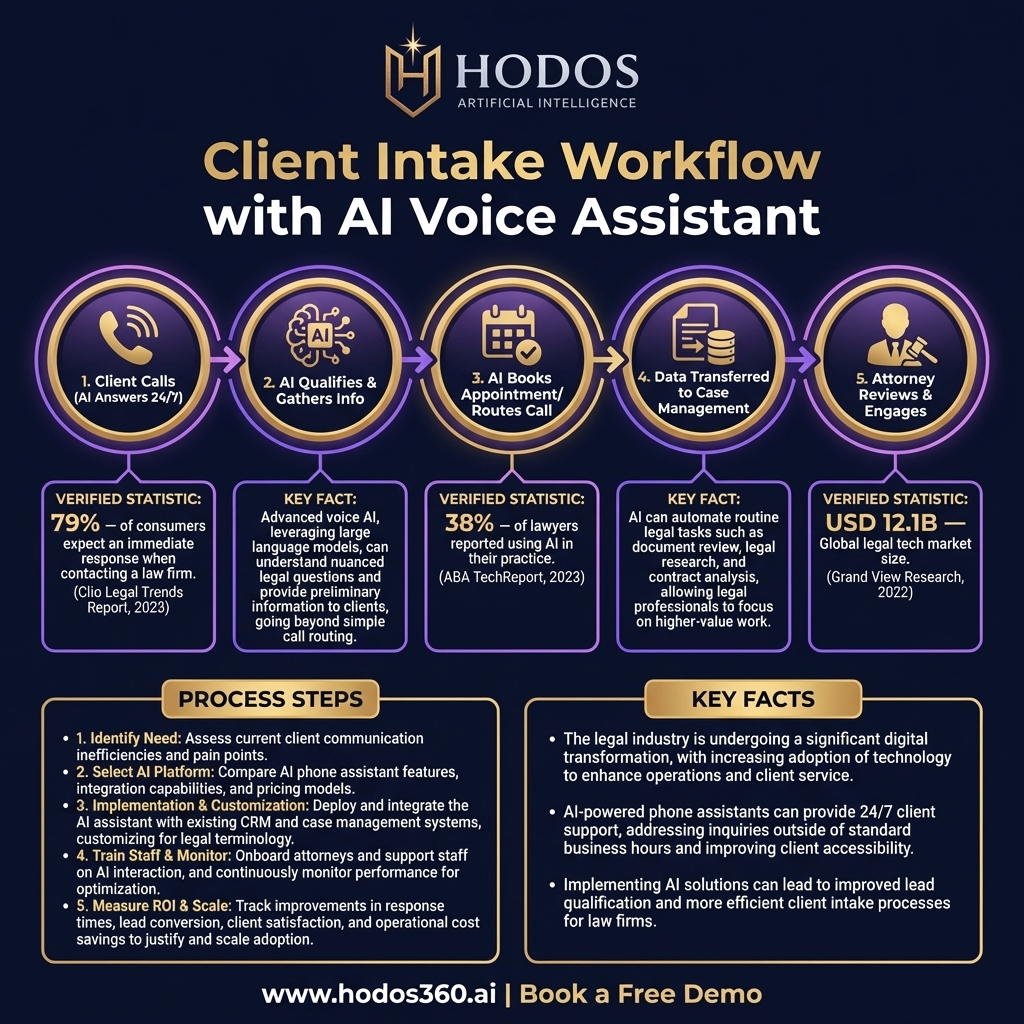
For instance, a prospective client calling about a personal injury claim can be guided through a series of questions to ascertain the nature of the injury, the date of the incident, and whether they have legal representation, all before a human attorney reviews the detailed intake form.
This level of intelligent interaction ensures that when a human does engage, they are already equipped with crucial, pre-qualified information, significantly reducing initial consultation times and improving the efficiency of the entire client intake automation process.
Furthermore, the multilingual capabilities of modern AI voice assistants are a profound advantage for firms serving diverse communities.
Learn more about Agentic AI Unleashed: 2026's Power in Legal Work. With support for dozens of languages, these systems can provide consistent, high-quality service to a broader client base, breaking down language barriers that might otherwise deter potential clients. This is particularly relevant in multicultural urban centers where law firms frequently encounter clients speaking various languages.
The ability of an AI to seamlessly switch between languages and accurately convey complex legal information ensures inclusivity and accessibility, aligning with modern legal practice's commitment to serving all members of society. This capability also extends to 24/7 legal answering, allowing firms to capture leads and assist clients at any time, ensuring that geographic or time-zone differences do not become obstacles to accessing legal help.
- ✓Intelligent Lead Qualification: AI assistants can ask targeted questions to determine the viability and urgency of a new case, filtering out unqualified leads and prioritizing high-potential clients.
- ✓Automated Appointment Booking: Seamlessly integrate with firm calendars, allowing clients to schedule consultations directly based on attorney availability, reducing administrative overhead.
- ✓Multilingual Support: Offer 24/7 assistance in multiple languages, expanding access to justice and ensuring no potential client is turned away due to language barriers.
- ✓Basic Query Answering: Provide accurate, pre-approved answers to frequently asked questions about firm services, fees, or general legal processes, freeing up staff time.
- ✓Efficient Call Routing: Intelligently direct calls to the most appropriate department or attorney based on the client's needs and the nature of their inquiry, minimizing transfers and wait times.
- ✓Initial Document Gathering: Guide clients through submitting initial documents or information securely, preparing case files even before the first human interaction.
- ✓Feedback Collection: Prompt clients for feedback on their interaction, offering valuable insights for continuous service improvement and enhancing client satisfaction.
Navigating Ethical and Professional Responsibilities with AI-Powered Client Interactions
The integration of AI phone assistant technology into legal practice, while offering immense benefits, necessitates a meticulous approach to ethical and professional responsibilities. The American Bar Association (ABA) Model Rules of Professional Conduct provide a foundational framework for attorneys, and these principles must guide the deployment of any AI system.
Specifically, Rule 1.1 on Competence requires lawyers to provide competent representation, which includes understanding the risks and benefits associated with relevant technology. This means attorneys must not only understand how an AI assistant functions but also its limitations, ensuring that critical legal advice or complex client interactions remain under human supervision.
Furthermore, Rule 5.3, Responsibilities Regarding Nonlawyer Assistance, is pertinent, as AI systems function as nonlawyer assistants. Firms must ensure that the AI's conduct is compatible with the professional obligations of the lawyer, particularly concerning the unauthorized practice of law.
One of the paramount concerns is client confidentiality, governed by ABA Model Rule 1.6. When deploying an AI voice assistant, firms must implement robust data security measures to protect sensitive client information.
Learn more about Essential AI Website Builder Guide for Law Firms. This includes end-to-end encryption, secure data storage, and compliance with all relevant data privacy regulations such as GDPR or CCPA. Firms must also clearly disclose the use of AI to clients, ensuring transparency and obtaining informed consent when necessary.
The "human conflict" here often arises from the tension between leveraging cutting-edge technology for efficiency and upholding the sacred trust of the attorney-client relationship. Jensen Huang, CEO of NVIDIA, has often spoken about the need for AI systems to be built with privacy and security by design, a principle that is non-negotiable in the legal sector.
Firms like Allen & Overy, known for their innovative partnership with Harvey AI, have publicly emphasized their rigorous internal protocols to ensure AI deployments meet stringent ethical and security standards.
Data Security and Client Confidentiality in Voice AI
Ensuring the security and confidentiality of client data processed by AI phone assistant systems is not merely an ethical obligation but a legal imperative. Breaches of client confidentiality can lead to severe professional sanctions, reputational damage, and costly litigation. Therefore, law firms must thoroughly vet any AI vendor to ensure their systems meet or exceed industry standards for data protection.
This includes compliance with ISO 27001, SOC 2 Type II, and other relevant security certifications. The architecture of the AI system should prioritize data minimization, collecting only the necessary information, and employing robust access controls to prevent unauthorized access.
Moreover, firms must establish clear protocols for how voice data is stored, processed, and eventually deleted.
Learn more about AI Voice Assistant: Essential for Modern Law Firm Success. This involves understanding the AI's data retention policies, whether conversations are transcribed and stored, and who has access to this data. Training staff on the secure use of AI tools and conducting regular security audits are also crucial components of a comprehensive data protection strategy.
For instance, the recent enforcement of the EU AI Act highlights the growing regulatory scrutiny on AI systems, particularly concerning their impact on fundamental rights like privacy. Law firms, therefore, cannot afford to treat data security as an afterthought when integrating voice AI; it must be a central pillar of their implementation strategy, demonstrating an unwavering commitment to protecting client trust and sensitive information.
Implementing AI Phone Assistants: A Strategic Imperative for Competitive Law Firms
The adoption of AI phone assistant technology is no longer a futuristic concept but a strategic imperative for law firms aiming to remain competitive and client-centric in the modern legal market. Firms that hesitate risk falling behind those embracing innovation, particularly in areas like client acquisition and service delivery.
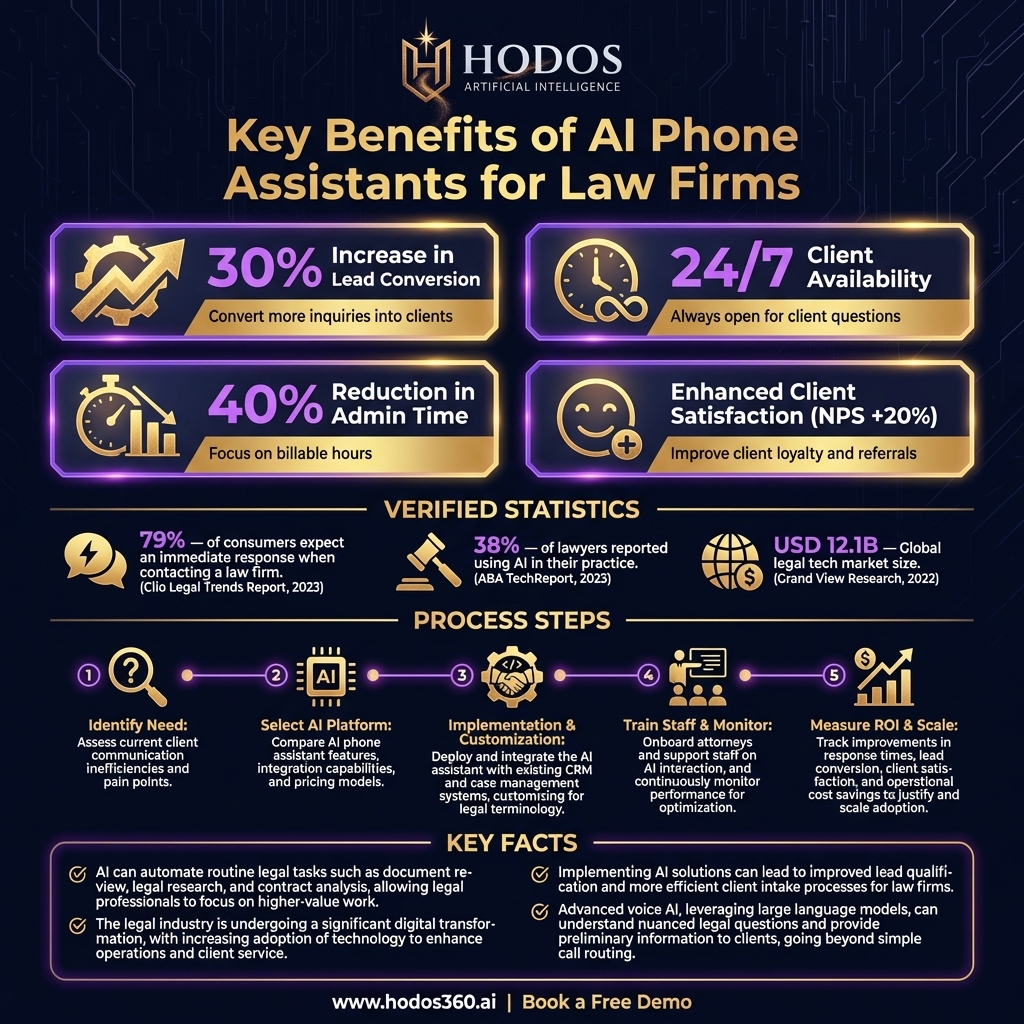
The competitive landscape is intensifying, with legal tech startups continuously introducing solutions that streamline operations and enhance client experiences. Firms that proactively implement AI-powered phone answering service solutions can realize significant operational efficiencies, reduce overhead costs associated with human call answering, and reallocate valuable human resources to higher-value legal tasks.
This strategic shift allows attorneys and paralegals to focus on complex legal analysis, client advocacy, and case strategy, rather than spending time on routine inquiries or scheduling.
Beyond cost savings, the primary driver for AI adoption is enhanced client experience. Learn more about AI Legal Research: The Ultimate Evolution of Legal Analysis.
In an era where client loyalty is increasingly tied to responsiveness and accessibility, an AI assistant provides a consistent, professional, and immediate point of contact. This 24/7 availability ensures that potential clients calling after hours or during peak periods are always met with an intelligent response, rather than voicemail or a generic answering service.
The ability to instantly qualify leads, answer FAQs, and schedule appointments significantly improves the initial client journey, fostering a positive first impression and increasing the likelihood of conversion. Firms like Clio, which recently acquired a legal intake platform, are demonstrating the market's emphasis on streamlining the client journey, and AI voice assistants are a natural extension of this focus on seamless engagement.
Measuring ROI and Client Satisfaction
Measuring the return on investment (ROI) for an AI phone assistant involves more than just cost savings; it encompasses improved client satisfaction, increased lead conversion rates, and enhanced operational efficiency. Firms should track metrics such as average call handling time, first-call resolution rates, lead qualification accuracy, and the number of appointments booked directly by the AI.
Client satisfaction can be measured through post-interaction surveys, net promoter scores (NPS), and direct feedback channels. A McKinsey report from 2024 highlighted that businesses leveraging AI for customer service reported an average 15-20% increase in customer satisfaction scores due to improved responsiveness and personalized interactions.
For law firms, this translates to tangible benefits: more qualified leads entering the pipeline, fewer missed calls, and a perception of a modern, efficient practice. The investment in AI Voice Assistants like those offered by HODOS 360, extends beyond technology; it's an investment in the firm's future growth and reputation.
Firms should establish clear KPIs before implementation and regularly review performance data to optimize the AI's functionality and ensure it aligns with strategic business goals. This data-driven approach allows firms to continually refine their AI strategy, ensuring maximum benefit and demonstrating a clear commitment to leveraging technology for superior client service and sustainable growth.
Real-World Impact: Law Firms Leveraging Voice AI for Growth
The impact of AI phone assistant technology is already being felt across the legal sector, with early adopters reporting significant gains in efficiency and client engagement. Consider the experience of 'Veritas Legal Group,' a mid-sized corporate law firm specializing in M&A. Prior to implementing an AI-powered phone answering service, their receptionists were overwhelmed with routine inquiries, often missing calls from potential high-value clients during peak hours.
After deploying an AI assistant, they saw a 40% reduction in missed calls and a 25% increase in qualified leads being routed directly to the appropriate attorneys. Sarah Chen, the firm's Managing Partner, noted at LegalTech NYC 2026, "Our AI assistant isn't just a tool; it's an extension of our team, ensuring every client feels heard and valued from the very first interaction.
It has fundamentally changed how we approach client acquisition and service delivery, allowing our human talent to focus on strategic work."
This success story is not unique. Smaller firms are leveraging AI voice assistants to punch above their weight, competing with larger entities by offering 24/7 accessibility and sophisticated intake processes without the prohibitive cost of a large administrative staff.
For solo practitioners, an AI assistant can act as a virtual receptionist, handling initial inquiries, scheduling, and basic information dissemination, freeing up invaluable time for legal work. This democratization of advanced client interaction capabilities levels the playing field, allowing firms of all sizes to enhance their operational efficiency and client satisfaction.
The shift is clear: AI phone assistant technology is transforming how law firms operate, making them more agile, responsive, and ultimately, more successful in a competitive market.

Key Takeaways and Next Steps
The emergence of sophisticated AI phone assistant technologies marks a pivotal moment for the legal industry. Far from being a mere technological novelty, these voice AI systems represent a fundamental shift in how law firms can manage client communication, streamline operations, and enhance their competitive posture.
From intelligent lead qualification and 24/7 client support to robust multilingual capabilities and efficient call routing, the benefits are clear and tangible. However, successful implementation hinges on a deep understanding of both the technological capabilities and the ethical responsibilities inherent in deploying AI within a legal context, particularly concerning client confidentiality and professional competence.
Law firms that embrace this transformation will be better positioned to meet evolving client expectations, optimize their valuable human resources, and achieve sustainable growth. The future of legal practice is one where human expertise is powerfully augmented by intelligent automation. For firms ready to explore the full potential of these transformative tools, platforms like HODOS 360 offer comprehensive AI Voice Assistants designed specifically for the nuanced demands of the legal sector.
Don't get left behind in this digital revolution. Schedule a demo today to see how HODOS 360's AI Voice Assistants can integrate seamlessly into your practice, elevating your client service and operational efficiency.
Frequently Asked Questions
What is an AI phone assistant for law firms?+
An AI phone assistant for law firms is an intelligent, automated system designed to handle client communications via phone. It uses natural language processing to understand inquiries, qualify leads, book appointments, answer FAQs, and route calls, providing 24/7 support and significantly improving efficiency and client responsiveness for legal practices.
How does an AI phone assistant benefit a law firm?+
It offers numerous benefits, including 24/7 client availability, improved lead qualification, automated appointment scheduling, reduced administrative burden on staff, enhanced client satisfaction through immediate responses, and the ability to serve multilingual clients. This leads to increased operational efficiency and a stronger competitive edge.
Are AI phone assistants ethically compliant for legal practices?+
Yes, when implemented responsibly. Firms must ensure the AI adheres to ABA Model Rules of Professional Conduct, particularly regarding competence (Rule 1.1) and confidentiality (Rule 1.6). This means clear disclosure to clients, robust data security, and human oversight for complex legal advice, ensuring ethical and professional standards are maintained.
Can an AI phone assistant handle complex legal inquiries?+
AI phone assistants excel at handling routine inquiries, qualifying leads, and gathering initial case details. While they can understand nuanced questions, complex legal advice requiring attorney judgment and strategy remains the domain of human lawyers. The AI's role is to streamline the initial stages, ensuring attorneys receive pre-qualified, well-documented cases.
What kind of ROI can a law firm expect from implementing voice AI?+
ROI for voice AI extends beyond cost savings from reduced administrative staff. Firms can expect increased lead conversion rates due to 24/7 availability, higher client satisfaction scores from improved responsiveness, and greater operational efficiency. Metrics like reduced call handling time and accurate lead routing contribute to measurable financial and reputational gains.