

AI and Junior Lawyers: The Ultimate Guide to Thriving
The headlines often paint a grim picture for the legal profession's newest entrants. A recent "Above the Law" article, provocatively titled "Why Most Legal AI Tools Make Junior Lawyers Worse, Not Better," amplified a growing anxiety: are we inadvertently eroding the foundational skills of our future legal leaders by relying too heavily on artificial intelligence?
This fear is palpable, touching on concerns that the very tasks traditionally integral to a junior lawyer's development—meticulous document review, exhaustive legal research, and the painstaking drafting of initial briefs—are now being outsourced to algorithms, leaving young associates adrift without the crucible of early career challenges.
This perspective, while highlighting a genuine risk of misapplication, overlooks the profound opportunity for transformation.
The truth, however, is far more nuanced than simple replacement or skill degradation. The real narrative unfolding across leading law firms, from Paul, Weiss to Allen & O'Very, isn't about AI making junior lawyers worse; it's about the *mismanagement* or *misunderstanding* of AI's capabilities making junior lawyers less effective.
Firms that embrace AI with strategic intent—investing in training, establishing clear ethical guidelines, and integrating these tools into sophisticated workflows—are not only enhancing their efficiency but also actively cultivating a new generation of legal talent equipped for the complexities of tomorrow. For instance, Brad Karp, Chairman of Paul, Weiss, has consistently emphasized the firm's commitment to leveraging technology to amplify human talent, rather than supplant it, a sentiment echoed by other industry leaders who see AI as a powerful co-pilot, not a substitute.
This comprehensive guide delves beyond the fear-mongering to reveal how AI and junior lawyers can not only coexist but thrive. We will explore how smart AI integration, robust ethical frameworks, and a proactive approach to skill development are redefining what it means to be a successful junior associate.
From leveraging AI for advanced legal workflows to developing critical thinking skills that complement algorithmic analysis, the path forward for the legal profession's rising stars is one of strategic adaptation and enhanced capability. The challenge is not to resist AI, but to master it, transforming potential threats into unparalleled opportunities for growth and innovation within the legal profession.
The Shifting Sands of Legal Practice: Beyond Basic Tasks
The advent of sophisticated AI tools has irrevocably altered the landscape of entry-level legal work. For decades, the path of a junior associate was paved with high-volume, often monotonous tasks: sifting through thousands of discovery documents, manually extracting data from contracts, or conducting rudimentary legal research.
Learn more about AI Legal Research: The Ultimate Evolution of Legal Analysis. Platforms like Harvey AI, which famously partnered with Allen & O'Very in a multi-million dollar deal, or Thomson Reuters' CoCounsel, are now automating much of this "grunt work." This technological leap has sparked the core concern articulated by "Above the Law"—that by removing these tasks, we deprive junior lawyers of the practical experience crucial for developing legal judgment and critical thinking.
However, this perspective often overlooks the quality versus quantity debate. While junior lawyers traditionally spent countless hours on these tasks, the learning derived was often incremental after initial exposure. As a 2023 McKinsey report, "Generative AI and the future of work in America," highlighted, generative AI excels at automating predictable, rule-based processes, freeing up human capital for tasks requiring creativity, complex problem-solving, and nuanced judgment.
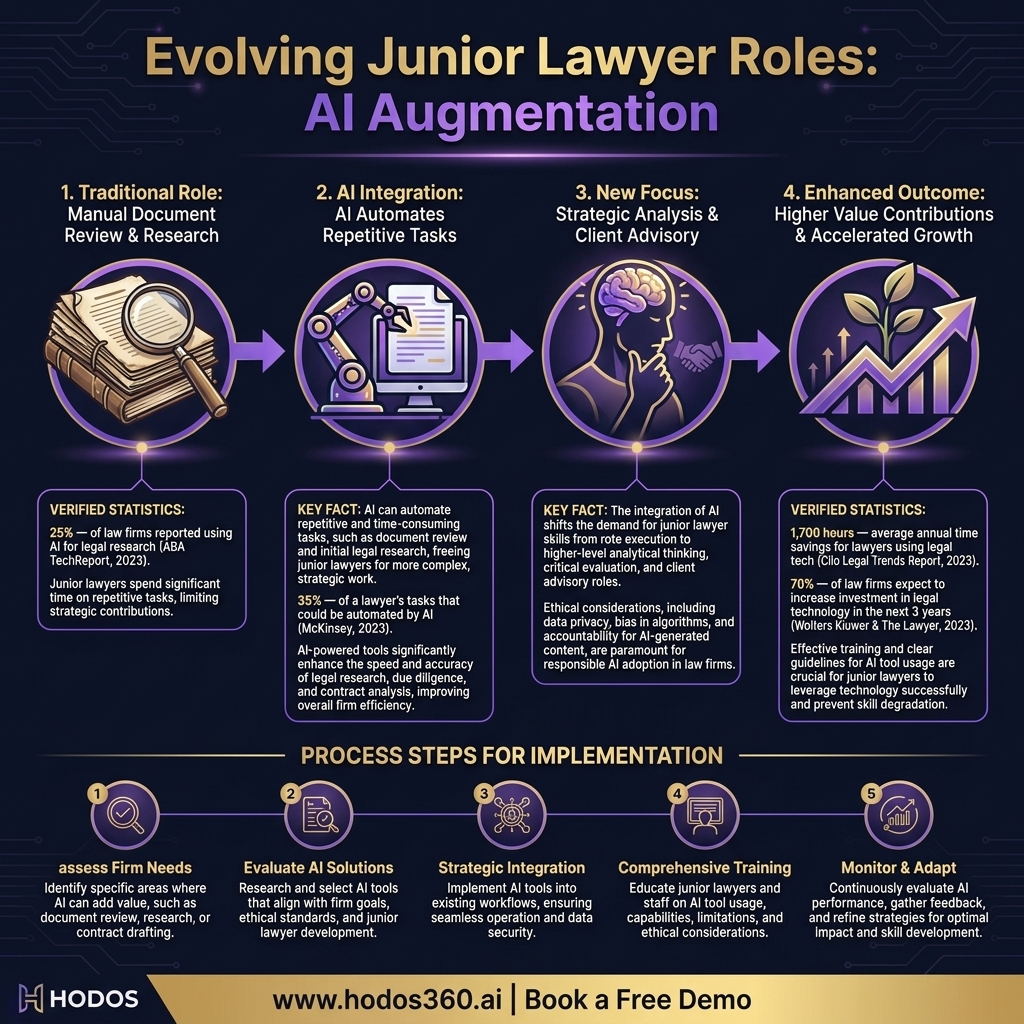
Learn more about AI Agents Marketing: Your Essential Guide for Law Firms. Instead of viewing this as a loss, forward-thinking firms recognize it as an opportunity to accelerate the development of their junior talent. By offloading the repetitive, junior lawyers can engage earlier with more complex legal issues, client strategy, and nuanced advisory roles, tasks that truly build higher-order legal skills.
Consider the case of a junior associate at a firm leveraging HODOS 360's AI Law Firm Management System. Instead of spending days manually organizing client intake forms or cross-referencing billing codes, the system automates these administrative burdens. This doesn't mean the junior lawyer isn't learning; it means their learning curve shifts from process execution to strategic oversight.
Learn more about AI Document Workflows: Revolutionize Your Firm in 2026 for Maximum ROI. They learn to *manage* the AI, to verify its output, to understand the data it processes, and to use the insights it generates to inform legal strategy.
This requires a different, arguably more advanced, set of skills—prompt engineering, critical evaluation of AI-generated content, and an understanding of data ethics—that are far more valuable in the long run than rote task completion. The paradigm shift isn't about making junior lawyers worse; it's about challenging them to become better, faster.
Those who adapt to this new reality, viewing AI as an enhancement to their intellectual arsenal rather than a threat to their job security, will emerge as the most valuable assets to their firms. Learn more about AI Voice Assistant: Essential for Modern Law Firm Success.
The future for AI and junior lawyers involves a symbiotic relationship where technology handles the volume, and human intellect provides the invaluable judgment and strategic direction.
Ready to empower your junior lawyers with cutting-edge AI? Discover how HODOS 360's AI Law Firm Management System can transform your practice, streamlining operations and freeing up your team for higher-value work.
Navigating the Ethical Labyrinth of AI Integration
The rapid proliferation of AI in legal practice has introduced a complex web of ethical challenges that junior lawyers, perhaps more than any other group, must learn to navigate. The infamous *Mata v. Avianca, Inc.* case from 2023, where a lawyer submitted a brief containing six fictitious case citations generated by ChatGPT, serves as a stark reminder of the perils of uncritical AI reliance.
Learn more about Generative AI Marketing: Law Firms' 2026 Growth Engine. This incident underscored a fundamental principle: AI tools are powerful, but they are not infallible, and the ultimate responsibility for accuracy and ethical conduct remains squarely with the human attorney. The case resonated deeply within the legal community, prompting widespread discussions about professional competence in the age of AI.
The American Bar Association (ABA) has long recognized the imperative for technological competence. Comment 8 to ABA Model Rule of Professional Conduct 1.1 (Competence) states that "To maintain the requisite knowledge and skill, a lawyer should keep abreast of changes in the law and its practice, including the benefits and risks associated with relevant technology."
This foundational rule now explicitly extends to understanding AI. For junior lawyers, this means developing a critical eye for AI output, understanding its potential for "hallucinations" or biases, and rigorously verifying any information generated by these tools. Learn more about AI Document Workflows: Unleash Firm Efficiency in 2026.
The ethical obligation to ensure accuracy, protect client confidentiality, and avoid misrepresentation is paramount, regardless of the tools used.
Beyond accuracy, data privacy and confidentiality present significant ethical hurdles. Utilizing AI tools, particularly those that process sensitive client information, demands a deep understanding of data security protocols and adherence to rules like ABA Model Rule 1.6 (Confidentiality of Information). Firms must implement robust internal policies governing AI use, including secure platforms, data anonymization techniques, and clear guidelines on what information can and cannot be fed into external AI models.
Junior lawyers must be trained not just on how to use AI, but on how to use it *ethically* and *securely*, recognizing the potential for inadvertent disclosure or data breaches.
The challenge, therefore, is not to shy away from AI due to ethical concerns, but to integrate it with a heightened sense of professional responsibility. Firms that proactively educate their associates on AI ethics, provide secure, vetted platforms, and foster a culture of critical oversight will empower their junior lawyers to harness AI's benefits while mitigating its risks. This proactive approach ensures that the legal profession upholds its core values of integrity and client protection, even as it embraces technological advancement.
The Imperative of AI Literacy and Training
To effectively navigate the ethical complexities and maximize the benefits of AI, comprehensive AI literacy and training are non-negotiable for junior lawyers. Leading firms are not just adopting AI; they are investing heavily in upskilling their workforce. For example, Allen & O'Very's initial rollout of Harvey AI was accompanied by extensive training programs designed to educate their lawyers on the tool's capabilities, limitations, and ethical considerations.
These programs go beyond mere technical instruction, delving into the nuances of prompt engineering, the importance of human review, and the firm's specific policies on AI usage.
Legal education institutions are also beginning to respond, with some law schools incorporating AI ethics and legal tech courses into their curricula. However, the onus often falls on law firms to bridge the gap between academic theory and practical application. This is where platforms like HODOS 360 become invaluable.
By offering AI-powered legal workflows that are designed with built-in ethical guardrails and verification steps, HODOS 360 guides users through responsible AI use, minimizing the potential for error and enhancing compliance. Such systems can serve as a practical training ground, teaching junior lawyers best practices in a controlled environment.
From Task Doers to Strategic Partners: Redefining Junior Roles
The most profound impact of AI on junior lawyers isn't job displacement but job transformation. As AI assumes the more repetitive and data-intensive tasks, the role of the junior associate is evolving from a "task doer" to a "strategic partner." This shift demands a re-evaluation of traditional career paths and a focus on developing skills that AI cannot replicate: nuanced legal reasoning, strategic advisory, client relationship management, and sophisticated problem-solving.
A 2024 report by Thomson Reuters, "Future of Professionals," indicated that legal professionals who leverage AI for efficiency are spending significantly more time on strategic client engagement and complex analytical work.
Junior lawyers, freed from the drudgery of manual discovery or basic contract review, can now engage with the "why" behind legal strategies much earlier in their careers. They can apply their legal minds to synthesize AI-generated insights, identify critical patterns that might be missed by human review alone, and contribute to the overarching case strategy.
This acceleration of professional development means that junior lawyers can reach a level of strategic contribution typically reserved for mid-level associates, enhancing their value to the firm and their clients. This isn't about making them worse; it's about making them more impactful, faster.
Consider a litigation associate using an AI tool for early case assessment. Instead of spending weeks manually reviewing initial documents, the AI can quickly identify key evidence, potential liabilities, and relevant precedents. The junior lawyer's role then becomes one of critical analysis: validating the AI's findings, interpreting complex legal implications, and collaborating with senior partners to formulate a robust litigation strategy. This elevated role fosters a deeper understanding of legal strategy, client objectives, and the intricate dance of courtroom proceedings, skills that are invaluable and inherently human.
Furthermore, this shift promotes a move towards value-based billing rather than purely hourly billing for commoditized tasks. When junior lawyers contribute more directly to strategic outcomes, their time becomes more valuable, allowing firms to justify higher rates for their enhanced expertise. This redefines the economic model for junior talent, moving them away from being cost centers for basic tasks to profit centers for strategic contributions. The synergy between AI and junior lawyers thus creates a more rewarding and sustainable career trajectory.
Cultivating Future-Proof Legal Skills
To thrive in this evolving landscape, junior lawyers must proactively cultivate a specific set of "future-proof" skills that complement, rather than compete with, AI capabilities. These include advanced critical thinking, ethical judgment, emotional intelligence, and sophisticated communication. While AI can analyze data, it cannot yet replicate the nuanced legal reasoning required to argue a novel point of law or empathize with a client's distress. These human-centric skills become paramount.
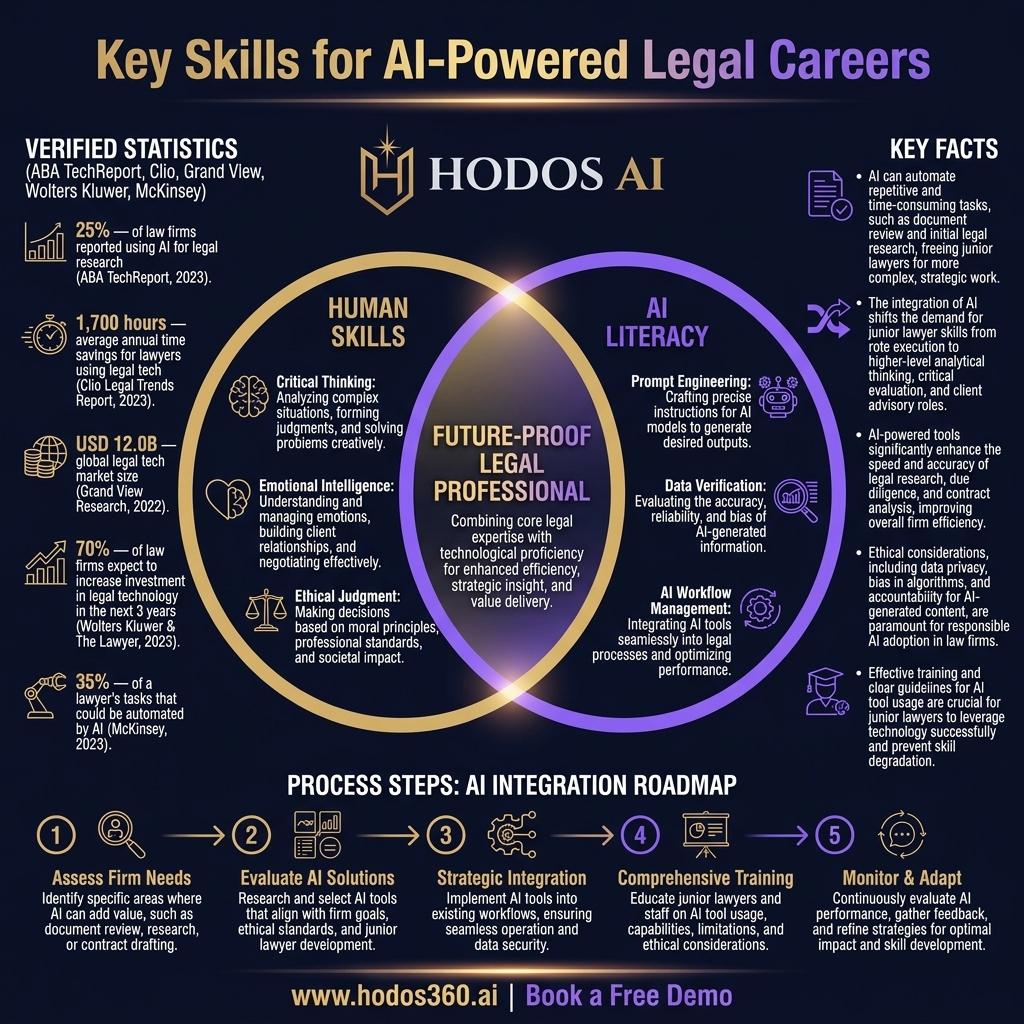
Firms can foster these skills through dedicated mentorship programs, structured professional development, and by deliberately assigning junior lawyers to projects that require higher-order thinking and client interaction. Encouraging participation in mock trials, client interviews, and strategic planning sessions, even with AI support for background tasks, is crucial. Moreover, the ability to effectively communicate with and manage AI tools—often referred to as "prompt engineering" or "AI management"—is becoming a core competency, allowing junior lawyers to extract maximum value from these sophisticated systems.
Don't let your firm fall behind in the race for efficiency and innovation. Explore HODOS 360's AI Marketing Platform and AI Voice Assistants to streamline client acquisition, enhance communication, and attract top talent who value cutting-edge tools.
The Competitive Edge: Firms Embracing AI for Talent Development
In today's fiercely competitive legal market, a firm's approach to AI is becoming a significant differentiator, not just for client acquisition but for attracting and retaining top junior talent. Firms that actively embrace and integrate AI into their operational and developmental strategies are positioning themselves as leaders, creating environments where junior lawyers feel empowered, not threatened. This progressive stance is a powerful magnet for ambitious legal graduates who understand that technological fluency is no longer optional.
Consider firms like Clifford Chance, known for its innovation lab and willingness to experiment with emerging technologies. By providing their junior lawyers with access to cutting-edge tools and training, they are not only boosting efficiency but also signaling a commitment to their associates' professional growth. This approach counters the "adapt or be automated" narrative by reframing it as "adapt and elevate." Junior lawyers at such firms gain exposure to complex legal issues and strategic decision-making much earlier, accelerating their career trajectory and making them indispensable assets.
The benefits extend beyond individual development to the firm's overall competitive standing. Data from the 2023 ABA Legal Technology Survey Report indicates a growing correlation between technology adoption and firm profitability. Firms that leverage AI for document automation, case management, and legal research can offer more competitive pricing, deliver faster results, and handle higher volumes of work without compromising quality. This efficiency directly impacts the firm's ability to attract and serve a broader client base, further solidifying its market position.
Moreover, by automating mundane tasks, firms can offer a better work-life balance for their junior associates, a critical factor in talent retention in today's demanding legal environment. Reducing the hours spent on repetitive, low-value work allows junior lawyers to focus on intellectually stimulating challenges, engage in professional development, and maintain a healthier lifestyle. This holistic approach to talent management, enabled by strategic AI integration, ensures that the firm remains attractive to the brightest minds entering the profession.
- ✓Accelerated Learning Curve: AI handles routine tasks, allowing junior lawyers to focus on complex analysis and strategic thinking earlier in their careers.
- ✓Exposure to Higher-Value Work: Transition from administrative duties to direct involvement in client strategy, negotiations, and advanced legal problem-solving.
- ✓Enhanced Research Capabilities: AI-powered tools provide rapid access to vast legal databases, enabling more comprehensive and efficient research.
- ✓Improved Document Drafting Efficiency: AI assists in generating initial drafts and identifying inconsistencies, significantly reducing drafting time and improving accuracy.
- ✓Better Work-Life Balance: Automation of repetitive tasks reduces overall workload, promoting a healthier balance between professional demands and personal life.
- ✓Development of New Tech-Savvy Skills: Junior lawyers gain proficiency in prompt engineering, AI system management, and data interpretation, becoming future-ready legal professionals.
- ✓Competitive Advantage in the Job Market: Possessing AI literacy and practical experience with legal tech makes junior lawyers highly desirable candidates for leading firms.

Key Takeaways and Next Steps for the Evolving Legal Professional
The current discourse surrounding AI and junior lawyers is often polarized, swinging between utopian visions of effortless legal practice and dystopian fears of widespread job displacement. The truth, as always, lies in the intelligent and intentional application of technology. The "Above the Law" article, while highlighting a valid concern about skill atrophy, primarily serves as a warning against the passive, uncritical adoption of AI.
It's not the tools themselves that make junior lawyers worse, but rather a lack of strategic integration, training, and ethical oversight. The future of the legal profession is not one where AI replaces human lawyers, but one where AI empowers them to achieve unprecedented levels of efficiency, insight, and strategic impact.
For junior lawyers, the path forward is clear: embrace AI as an indispensable partner. Proactively seek out training in legal tech, understand the capabilities and limitations of various AI tools, and cultivate the uniquely human skills that AI cannot replicate—critical thinking, ethical judgment, emotional intelligence, and persuasive communication.
View AI-driven automation not as a threat, but as an opportunity to elevate your role, focusing on complex legal challenges and strategic client advisory work that truly drives value. Your ability to integrate AI effectively into your practice will define your competitive edge and accelerate your professional growth.
For law firms, the imperative is to invest strategically. Implement robust AI platforms, such as HODOS 360's comprehensive suite, which offers everything from AI Law Firm Management and AI Marketing to AI Voice Assistants and Web & Mobile Development. Crucially, pair this technology investment with comprehensive training programs that instill both technical proficiency and a strong ethical framework. Foster a culture of continuous learning and innovation, where junior lawyers are encouraged to experiment responsibly with AI, contribute to policy development, and become active participants in shaping the firm's technological future.
The evolving synergy between AI and junior lawyers promises a future where legal services are delivered with greater efficiency, precision, and strategic depth. By understanding this transformation and actively participating in it, junior lawyers can secure not just their roles, but their invaluable place at the forefront of a truly modern legal profession. The time to adapt, learn, and lead with AI is now, ensuring that the next generation of legal talent is not just proficient, but truly exceptional.
Frequently Asked Questions
Will AI replace junior lawyers in the legal profession?+
No, AI is unlikely to replace junior lawyers entirely. Instead, it will transform their roles. AI excels at automating repetitive tasks like document review and basic research, freeing up junior lawyers to focus on higher-value activities such as strategic analysis, complex problem-solving, client communication, and nuanced legal reasoning. The focus is shifting from task execution to AI-augmented strategic partnership.
What skills should junior lawyers develop to stay relevant in an AI-driven legal landscape?+
Junior lawyers should prioritize developing critical thinking, ethical judgment, and emotional intelligence. Additionally, technical skills like prompt engineering, data analysis, and understanding AI tool limitations are crucial. The ability to verify AI output, manage AI workflows, and communicate complex legal concepts effectively remains paramount, complementing technological proficiency.
How can law firms effectively train junior lawyers on AI tools and ethical usage?+
Effective training involves a multi-faceted approach. Firms should provide hands-on workshops, integrate AI tools into daily workflows with guided practice, and establish clear internal policies on ethical AI use. Mentorship programs focused on AI integration, continuous professional development, and leveraging platforms like HODOS 360 with built-in ethical guardrails are also vital for practical and responsible learning.
What are the biggest ethical concerns with integrating AI into legal practice?+
Key ethical concerns include AI "hallucinations" leading to inaccurate information (as seen in *Mata v. Avianca*), data privacy and client confidentiality risks when feeding sensitive information into AI models, potential biases embedded in AI algorithms, and the ultimate responsibility for AI-generated work remaining with the human lawyer. Robust oversight, verification, and adherence to ABA Model Rules are crucial.
How can AI improve the work-life balance for junior lawyers?+
By automating time-consuming and monotonous tasks, AI can significantly reduce the workload associated with entry-level legal work. This frees up junior lawyers' time, allowing them to focus on more intellectually stimulating challenges, engage in professional development, and achieve a healthier work-life balance. It transforms their experience from repetitive drudgery to more meaningful and impactful contributions.