


AI Local Search: The Ultimate Visibility Guide for Law Firms
In the bustling legal market of Austin, Texas, Sarah Chen, a senior partner at Sterling & Associates, observed a perplexing trend. Despite their firm's sterling reputation for family law and estate planning, walk-ins and direct website referrals were dwindling. Instead, an increasing number of new clients mentioned, "Alexa recommended your firm," or "Google Maps showed you as a top result when I asked for a lawyer."
This subtle but profound shift underscored a new reality in client acquisition: the rise of AI local search. For firms like Sterling & Associates, steeped in traditional networking and organic growth, this represented a silent threat, as their well-earned reputation risked becoming digitally invisible to the very algorithms now dictating client discovery.
The legal industry, often cautious in its adoption of new technologies, found itself at a critical juncture, grappling with the imperative to master these new digital gatekeepers.
The era of simply having a website and a solid physical presence is unequivocally over. Today, a law firm's digital destiny is increasingly determined by complex artificial intelligence algorithms that power major search engines and, critically, voice assistants.
This article delves into the transformative impact of AI on local search for legal services, exploring the intricate mechanisms behind voice-activated recommendations, the evolving metrics of trust and authority, and the strategic imperatives for law firms to not just survive but truly thrive in this AI-first landscape.
We will examine how legal professionals can proactively ensure their visibility and client acquisition efforts are future-proofed against the backdrop of an evolving digital ecosystem, one that is constantly influenced by everything from new generative AI models to emerging AI regulation news.
The Silent Revolution: How AI Reshapes Local Search for Legal Services
Google's local search updates, often rolled out subtly but with far-reaching implications, are increasingly infused with advanced AI capabilities. Beyond mere keyword matching, these sophisticated AI models now interpret deep user intent, contextual nuances, and even sentiment extracted from online reviews to deliver highly personalized local recommendations.
Consider a complex query like "best divorce lawyer for high-net-worth individuals near me." This isn't just about matching keywords; it's about the AI understanding the implied need for specialized expertise, discretion, and a proven track record. The algorithms then meticulously match this nuanced intent with firms that exhibit these qualities through their comprehensive online presence, detailed practice area descriptions, and authentic client testimonials.
This shift fundamentally elevates the importance of high-quality, contextually rich, and meticulously maintained online profiles for every law firm seeking to maintain or improve its AI local search ranking.
The underlying AI systems driving these transformations are in a state of perpetual learning and refinement.
A compelling 2025 report by McKinsey & Company, titled "AI in Professional Services: The New Frontier of Client Acquisition," highlighted a significant trend: law firms that proactively embraced AI for client acquisition strategies reported an impressive 15-20% increase in qualified leads compared to their counterparts relying solely on traditional marketing methods.
Learn more about Voice AI: An Essential Leap for Law Firms' Client Engagement. This crucial data point underscores the widening chasm between firms that understand and adapt to algorithmic preferences and those that remain tethered to outdated methodologies. The competitive landscape is no longer solely defined by the rivalry among law firms; it is increasingly about optimizing for the AI gatekeepers, understanding precisely how these systems *discover*, evaluate, and rank businesses, and ensuring your firm's digital data quality is absolutely impeccable.
This profound transformation is not a theoretical concept for the distant future; it is an undeniable reality unfolding right now. At LegalTech NYC 2026, a prominent theme revolved around the imperative for law firms to transcend basic SEO and embrace what many referred to as "AI-first optimization."
Industry luminaries like Jack Newton, CEO of Clio, have consistently championed the strategic importance of technology adoption for client-centric growth, often noting that firms leveraging integrated legal tech platforms experience superior client retention and acquisition rates. The message is clear and urgent: law firms must proactively and strategically adapt their digital marketing and client acquisition strategies to align seamlessly with how AI interprets, processes, and ultimately presents local business information to potential clients.
Neglecting this paradigm shift risks significant loss of visibility and market share.
Voice Search: The New Frontier of Client Discovery
Voice search, powered by increasingly sophisticated natural language processing (NLP) models developed by tech giants like Google and pioneering AI research companies such as OpenAI, represents perhaps the most significant and rapidly evolving frontier in local client discovery. When a potential client uses a smart speaker or their smartphone to ask, "Hey Google, find me a personal injury attorney after a car accident," the AI system isn't merely compiling a list of nearby firms; it's actively making a recommendation.
This single, often exclusive, recommendation is the culmination of a complex interplay of factors, including the firm's immediate proximity, its operating hours, the aggregated sentiment from online reviews, the specificity of its service offerings, and even the speed and quality of its response to initial inquiries.
Learn more about Legal AI ROI: Maximizing Law Firm Value in 2026. Achieving the coveted "share of AI voice" – being the *sole* firm recommended by an AI assistant for a given query – is rapidly becoming the new gold standard for unparalleled local visibility and client acquisition in the legal sector.
Building Trust and Authority in the Age of AI Recommendations
AI systems, especially those tasked with recommending professional services like legal counsel, are meticulously programmed to prioritize trust and authority. For law firms, this translates into an absolute imperative to consistently demonstrate expertise, unwavering reliability, and overwhelmingly positive client experiences across every conceivable digital touchpoint.
Google's influential E-E-A-T (Experience, Expertise, Authoritativeness, Trustworthiness) framework, now more than ever heavily influenced by advanced AI interpretation, stands as paramount. Firms must ensure their online profiles – including their Google Business Profile, Yelp, Avvo, and other relevant legal directories – are not only meticulously claimed and maintained but are also replete with genuine, detailed client reviews, comprehensive service descriptions, and clear, compelling calls to action.
The absence or inadequacy of these critical signals can lead to a firm being effectively overlooked by AI algorithms, regardless of its real-world reputation or the quality of its legal services.
Consider the illustrative case of "LexConnect," a burgeoning legal tech startup that recently secured a substantial $50 million funding round to develop cutting-edge AI tools specifically designed for reputation management within the legal sector.
Dr. Learn more about Legal AI Adoption: An Essential Guide for Discerning Firms. Anya Sharma, LexConnect's visionary CEO, recently emphasized at a legal innovation summit that "AI doesn't just passively read reviews; it *understands* them. Sophisticated sentiment analysis, advanced keyword extraction, and granular topic modeling empower AI to accurately gauge a firm's true standing and client satisfaction far beyond a simplistic star rating."
This level of sophisticated algorithmic analysis means that law firms must proactively and actively manage their online reputation, responding professionally and empathetically to all reviews (both positive and negative), and strategically soliciting detailed feedback to construct a robust, AI-friendly digital footprint that resonates with algorithmic preferences.
Furthermore, the legal industry's fundamental ethical obligations, as meticulously outlined in the ABA Model Rules of Professional Conduct, Rule 7.1 (Communications Concerning a Lawyer's Services), explicitly underscore the critical need for truthful, non-misleading, and substantiated communications. This ethical imperative aligns perfectly with AI's inherent preference for factual, verifiable, and transparent information.
Law firms that consistently prioritize transparency, accuracy, and ethical representation in their online content, client interactions, and marketing collateral will inherently perform better in AI-driven local search. By adhering to these principles, they not only foster the deep trust that algorithms are specifically designed to identify and promote but also reinforce their professional integrity.
The AI Imperative: Optimizing for Conversational Voice Search
Optimizing for voice search extends far beyond the traditional, often simplistic, practice of keyword stuffing. It demands a nuanced understanding of natural language queries, the conversational patterns inherent in human speech, and the specific types of information that voice assistants prioritize in their responses. This means meticulously crafting website content, comprehensive FAQ sections, and detailed Google Business Profile descriptions that directly and concisely answer potential client questions, effectively mimicking human conversation.
Learn more about Voice AI: Essential for Law Firms, Touting Twilio's Success. For instance, instead of merely stating "Bankruptcy Lawyer," content should proactively address questions like "What are the common causes of bankruptcy for small businesses?" or "How long does a Chapter 7 bankruptcy typically take in [Specific City Name]?"
This strategic shift ensures that your firm's content is not only discoverable but also directly relevant to spoken queries, significantly enhancing its visibility.
Actionable Strategies for Law Firms to Enhance AI Local Search Visibility
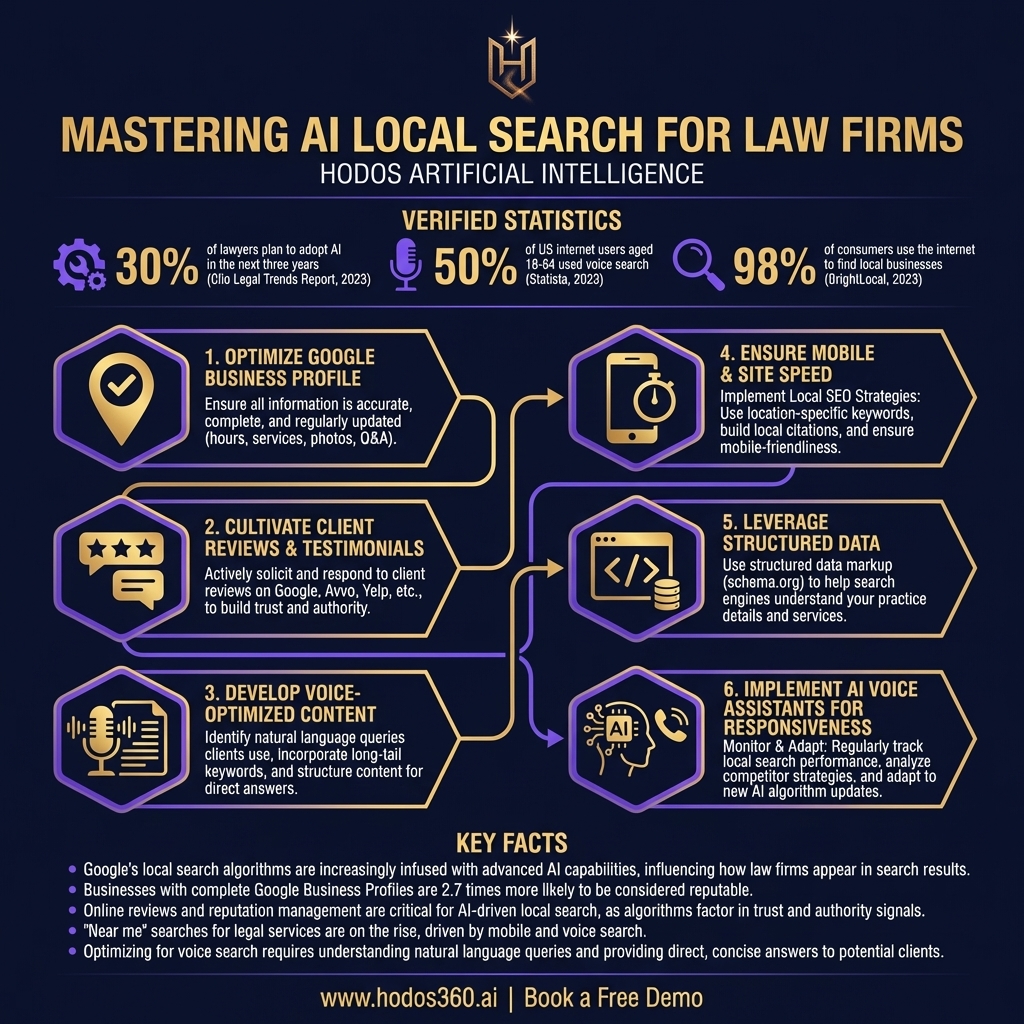
To truly master AI local search, law firms must adopt a comprehensive, multi-faceted approach. First and foremost, it is imperative to claim and meticulously optimize your Google Business Profile (GBP). This involves ensuring all information—services offered, operating hours, high-quality photos, and a robust Q&A section—is complete, accurate, and regularly updated.
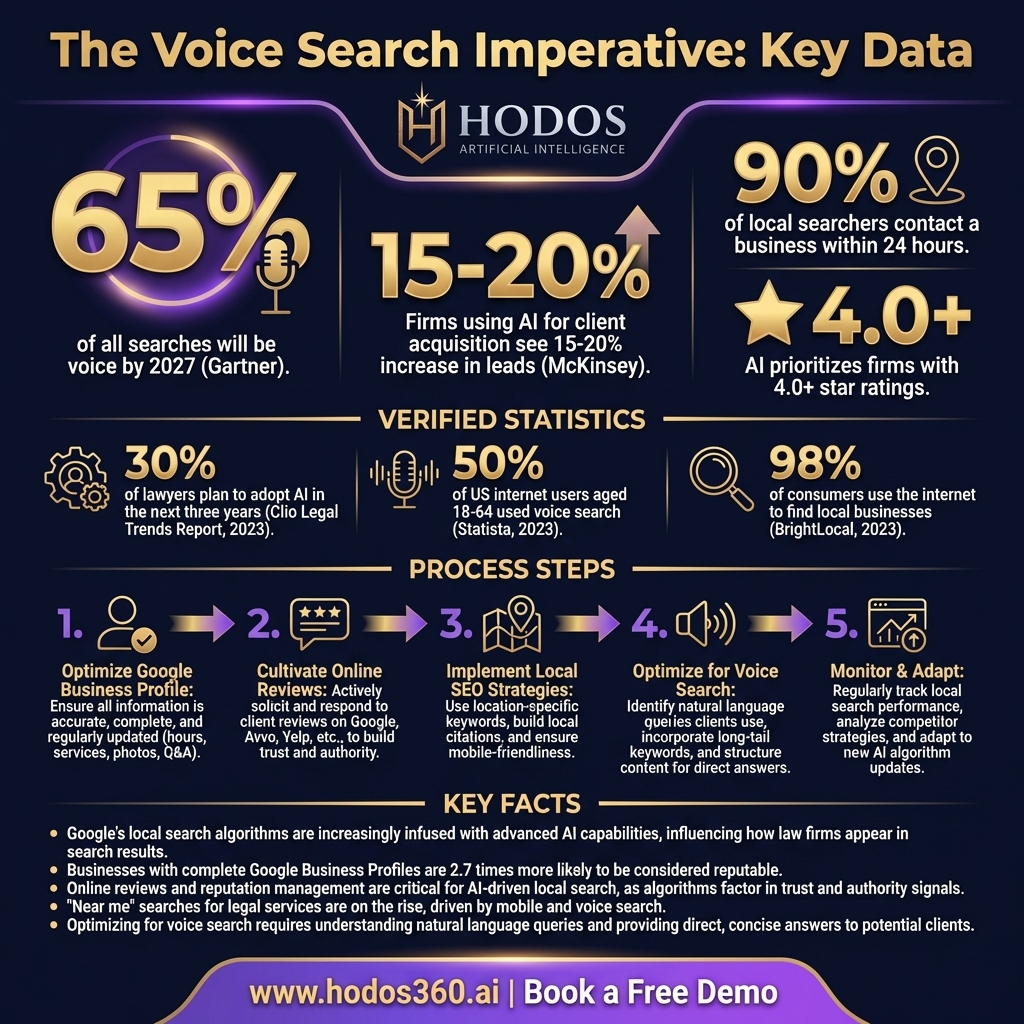
Your GBP serves as the indispensable cornerstone of your firm's local digital visibility. Second, actively cultivate genuine client reviews across a diverse range of platforms. Encourage satisfied clients to leave detailed, authentic feedback, and commit to responding thoughtfully and professionally to all reviews, whether positive or negative.
This demonstrates engagement and builds the social proof that AI algorithms value highly.
Third, strategically develop comprehensive, voice-optimized content that directly and succinctly answers common client questions. This requires moving beyond traditional keywords to embrace long-tail queries and conversational language that mirrors how people naturally speak.
Fourth, rigorously ensure your website's mobile-friendliness and fast loading speeds, as these remain critical ranking factors for both traditional search engines and AI-driven recommendations. Learn more about AI Marketing Platform Elevates Law Firms in 2026. Fifth, proactively leverage structured data (schema markup) on your website.
This technical implementation explicitly tells search engines and AI what your content is about, making it significantly easier for algorithms to understand, categorize, and present your services accurately. This direct communication with AI improves discoverability.
Finally, the most forward-thinking firms are integrating advanced AI tools into their operations.
Consider the recent announcement of Harvey AI's partnership with Allen & Overy, a major global law firm, to integrate AI-powered legal research across its practice. While this specific example focuses on internal legal processes, it powerfully illustrates the broader trend: embracing AI in all facets of practice, including client acquisition and management.
Law firms that proactively invest in sophisticated AI solutions for their marketing, client intake, and communication — such as the comprehensive AI-powered platform offered by HODOS 360 — will be the ones that truly excel and lead their markets in this evolving digital era. These tools are crucial for maintaining responsiveness, a key factor AI systems evaluate.
- ✓Optimize Google Business Profile: Ensure all details are accurate, complete, and regularly updated.
- ✓Cultivate Genuine Client Reviews: Actively solicit and professionally respond to feedback across platforms.
- ✓Develop Voice-Optimized Content: Create FAQs and content that answers conversational questions directly.
- ✓Ensure Mobile-Friendliness & Speed: Prioritize a fast, responsive website experience for all devices.
- ✓Implement Structured Data (Schema Markup): Use technical SEO to explicitly inform AI about your services.
- ✓Integrate AI Voice Assistants: Guarantee 24/7 responsiveness and efficient lead qualification.
Navigating AI Regulation and Ethical Considerations in Local Search
As AI's influence over local search deepens, so too does the scrutiny from regulators and legal ethicists. The ongoing discussions and eventual enforcement of the EU AI Act news will set a global precedent for how AI systems must operate, emphasizing transparency, fairness, and accountability.
For law firms, this means not only optimizing for current algorithms but also ensuring that their digital strategies are ethically sound and compliant with emerging AI regulation news. Misleading optimization tactics, or attempts to manipulate AI recommendations, could lead to severe penalties, reputational damage, and a breach of professional conduct.
Firms must consider how AI models attribute information and ensure their digital presence is built on verifiable, factual data, aligning with the principles of responsible AI.
Beyond external regulations, the legal profession itself is grappling with the ethical implications of AI. The Federal Rules of Civil Procedure, Rule 26(g) (Signing Disclosures and Discovery Requests, Responses, and Objections), while not directly about marketing, underscores the broader legal principle of diligence and veracity in professional communications.
This principle extends to how firms present themselves online and how they leverage AI tools. Learn more about AI Marketing Tools: Essential Guide for Law Firm Growth. As AI systems become more autonomous in their recommendations, lawyers have a heightened responsibility to ensure that their digital footprint accurately reflects their services and capabilities, avoiding any potential for deceptive practices.
This commitment to ethical AI deployment is crucial for maintaining both professional integrity and long-term trust with clients and regulatory bodies.
The dynamic interplay between technological advancement and ethical governance presents a unique challenge and opportunity. Firms that prioritize ethical AI implementation will not only gain a competitive advantage in AI local search but also reinforce their standing as trusted advisors.
This forward-thinking approach involves continuous monitoring of evolving AI best practices, staying abreast of AI regulation news, and ensuring that all AI-driven marketing and client acquisition efforts are transparent, fair, and ultimately serve the best interests of potential clients. This commitment is not merely about compliance; it's about building enduring client relationships in an AI-powered world.

Key Takeaways and Next Steps for Your Law Firm
The transformation of local search by artificial intelligence and voice technology is not a distant prediction; it is the present reality for law firms. Firms that prioritize a proactive, AI-first approach to their digital presence will undoubtedly gain a significant and sustainable competitive edge. This involves a profound commitment to robust online reputation management, sophisticated content optimization tailored for conversational queries, and the strategic leveraging of cutting-edge AI tools to manage and enhance client interactions.
The stakes are undeniably high: those who adapt swiftly and effectively will secure their position as indispensable leaders in their local legal markets, while those who hesitate or fail to evolve risk becoming digitally invisible, losing out on critical client acquisition opportunities and diminishing their overall visibility.
For law firms navigating this increasingly complex and rapidly evolving landscape, the journey begins with a fundamental understanding that AI local search is, at its core, about trust, relevance, and unparalleled responsiveness. Investing in advanced platforms that streamline these critical processes is no longer an optional luxury but an essential strategic imperative.
Embracing comprehensive solutions that offer AI-powered legal workflows, intelligent AI marketing capabilities, and sophisticated AI voice assistants—such as the integrated suite of services offered by HODOS 360—provides the foundational infrastructure needed to master this dynamic client acquisition frontier. The future of your firm's visibility, growth, and enduring success hinges on this crucial adaptation.
Frequently Asked Questions
What is AI local search for law firms?+
AI local search refers to how artificial intelligence algorithms influence the ranking and recommendations of local businesses, including law firms, in search engine results and voice assistant responses. It goes beyond traditional keywords, considering factors like user intent, online reviews, service specificity, and responsiveness to determine local visibility and relevance.
How do voice assistants impact legal client acquisition?+
Voice assistants significantly impact client acquisition by providing direct, often single, recommendations for legal services based on spoken queries. Firms that optimize for conversational language, maintain excellent online reputations, and offer 24/7 responsiveness are more likely to achieve the 'share of AI voice,' becoming the preferred choice for potential clients using voice search.
What is 'share of AI voice' and why is it important?+
The 'share of AI voice' refers to the instance where a law firm is the *sole* business recommended by an AI voice assistant in response to a local query. It's crucial because voice search often provides only one or two options, making that exclusive recommendation incredibly valuable for driving client leads and establishing market dominance in AI-driven client discovery.
How can law firms build trust with AI algorithms?+
Law firms build trust with AI algorithms by maintaining comprehensive, accurate Google Business Profiles, cultivating numerous positive and detailed client reviews, providing transparent and verifiable service information, and ensuring responsiveness to inquiries. Adhering to ethical marketing practices and demonstrating genuine expertise also signals trustworthiness to AI systems.
What are the first steps a law firm should take to optimize for AI local search?+
Begin by claiming and fully optimizing your Google Business Profile with rich details and photos. Next, actively encourage clients to leave reviews and respond to all feedback. Then, audit your website content to ensure it answers common client questions conversationally, making it friendly for both traditional and voice search. Finally, consider implementing AI tools for enhanced client communication.