

AI Personal Assistant: Essential Privacy & Efficiency for Law Firms
The digital landscape of September 2026 is abuzz with the recent launch of Meta's Muse, an ambitious new AI personal assistant designed to autonomously manage tasks ranging from sending emails to booking travel. This groundbreaking development, widely reported by outlets like SuaraGarut.ID, showcases the accelerating pace of AI innovation. Meta's CEO, Mark Zuckerberg, has long championed the vision of highly capable AI agents, and Muse represents a significant stride towards that future, promising unparalleled convenience for users by being capable of accessing other apps and acting on a person's behalf. However, the excitement surrounding such a powerful, general-purpose AI assistant is tempered by immediate and substantial privacy concerns, particularly when considering its application within the highly regulated and confidential world of legal practice. For law firms, the question isn't if AI will transform operations, but how to integrate these powerful tools responsibly and securely.
While the consumer market eagerly anticipates the capabilities of an AI agent that can autonomously handle personal logistics, law firm owners and managing partners must critically evaluate the implications for client confidentiality, data security, and ethical compliance. The very features that make Muse appealing – its ability to access other apps and act on a person's behalf – pose significant risks when handling sensitive legal documents, client communications, or case details. The legal industry, bound by stringent regulations like the ABA Model Rules of Professional Conduct, demands an approach to AI that prioritizes security and ethical governance above all else. This article delves into how law firms can leverage the transformative potential of voice AI and AI personal assistant technologies while meticulously safeguarding client data and maintaining professional integrity, exploring the distinction between general AI tools and specialized legal solutions.
The Rise of AI Personal Assistants: Meta's Muse and Beyond
Meta's launch of Muse signifies a pivotal moment in the evolution of AI personal assistants. Unlike earlier, more rudimentary voice assistants, Muse is introduced as an advanced AI agent capable of carrying out complex, multi-step tasks rather than simply generating responses. It’s designed to learn user preferences, anticipate needs, and proactively manage aspects of daily life, from scheduling appointments to drafting communications. This move by Meta, a tech giant with vast resources, underscores the industry's push towards creating truly autonomous AI agents. Figures like OpenAI's Sam Altman and Anthropic's Dario Amodei have consistently articulated a future where AI agents become indispensable, seamlessly integrated into our digital and physical lives, prompting a race among tech leaders to develop the most capable and user-friendly platforms. The competitive landscape is intense, with significant investment flowing into this sector; for instance, OpenAI's reported $6.6 billion raise in 2024 further fueled the development of advanced AI models and agents.
However, the very autonomy and broad access that define Muse's capabilities are precisely what trigger alarm bells in the legal sector. An AI personal assistant that can access other applications and operate on a user's behalf inherently collects and processes vast amounts of personal and potentially sensitive data. Learn more about AI Web Development: The Ultimate Advantage for Law Firms. The SuaraGarut.ID article, among others, highlighted privacy concerns that arose even during internal development at Meta. For a law firm, this level of data exposure is untenable. Client information, case strategies, and privileged communications are not merely 'personal data'; they are the bedrock of legal practice, protected by attorney-client privilege and strict confidentiality agreements. The challenge lies in harnessing the immense power of these AI agents without compromising the foundational principles of legal ethics and client trust. Law firms must consider how an AI agent, even one as capable as Muse, can be used responsibly when it comes to handling sensitive information.
General-Purpose vs. Legal-Specific AI Agents
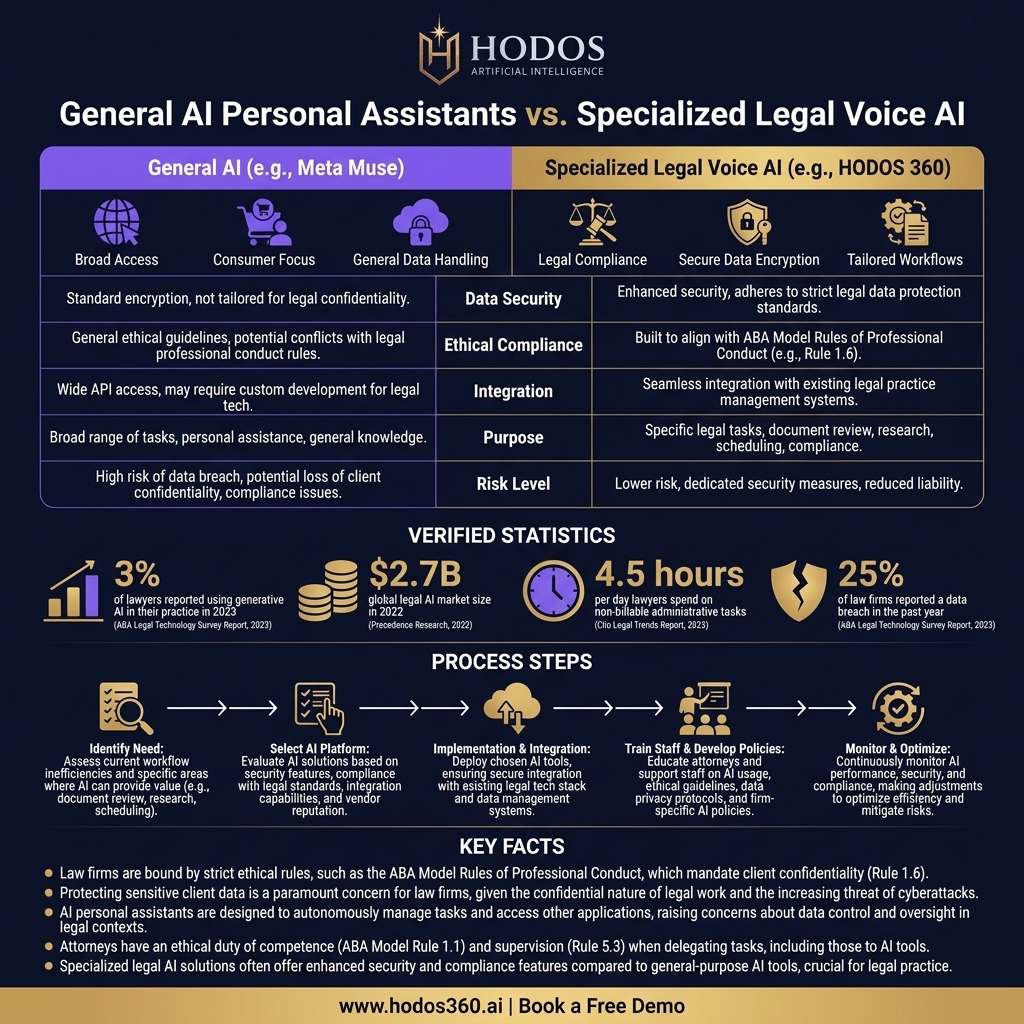
The fundamental distinction between a general-purpose AI personal assistant like Meta's Muse and a specialized legal AI solution is paramount. While Muse is designed for broad applicability across various personal and professional tasks, a legal-specific AI voice assistant is purpose-built with the unique demands of law firms in mind. This includes inherent safeguards for data privacy, adherence to legal compliance standards, and an understanding of legal terminology and workflows. General AI agents, while impressive in their versatility, often lack the granular control and robust security protocols required to meet legal industry standards. They are not designed to navigate the complexities of attorney-client privilege or the intricacies of jurisdictional data regulations.
Conversely, a specialized legal AI solution integrates directly into the firm's existing infrastructure, offering features like secure client intake, automated appointment booking, and intelligent call routing, all while maintaining strict confidentiality. Learn more about Legaltech Rundown: Essential AI Features Transforming Law Firms. These systems are developed with legal ethics and regulatory compliance as core design principles. For example, a legal AI voice assistant would be trained on legal data sets, understand the nuances of legal queries, and offer features like secure data encryption and auditable interaction logs, crucial for demonstrating compliance. The choice between a broad AI personal assistant and a targeted legal AI solution is not merely about functionality; it's about mitigating risk and building trust in a profession where confidentiality is paramount.
Navigating Privacy and Ethical Minefields in Legal AI
The introduction of advanced AI agents like Muse intensifies the spotlight on data privacy and ethical considerations within the legal sector. Law firms operate under a strict fiduciary duty to protect client information, a responsibility enshrined in rules such as ABA Model Rule 1.6: Confidentiality of Information. The use of any AI personal assistant that processes client data must be rigorously vetted to ensure it meets these obligations. A report by Thomson Reuters in 2024 indicated that over 60% of law firms identified data security as their top technology concern, a figure that continues to rise with the proliferation of AI tools. The risk of data breaches, whether through vulnerabilities in third-party AI systems or inadvertent data sharing by an AI agent, is a tangible threat that could lead to severe reputational damage, regulatory penalties, and even malpractice claims.
Beyond data security, ethical considerations extend to issues of bias, transparency, and accountability. Learn more about AI Marketing Stack: Essential Tools, Real ROI for Law Firms. Can an AI agent make unbiased decisions when qualifying leads or routing calls? How transparent are its algorithms, and who is accountable if the AI makes an error or misinterprets a client's request, especially if it's autonomously sending emails or booking travel on behalf of a lawyer? The EU AI Act, which is nearing full enforcement, sets a global precedent for regulating AI, particularly in high-risk sectors. Law firms must proactively assess their AI tools against these emerging regulatory frameworks, ensuring their chosen solutions are not only efficient but also ethically sound and legally compliant. This requires due diligence in vendor selection and a clear understanding of how an AI personal assistant processes, stores, and protects data.
Regulatory Landscape and Compliance
The legal industry is not merely subject to general data protection laws like GDPR or CCPA; it also faces specific professional conduct rules. The responsible adoption of AI requires adherence to these multi-layered regulations. For instance, Federal Rule of Civil Procedure 26(b)(1) on the scope of discovery and Federal Rule of Evidence 502 on attorney-client privilege are critical when considering how AI tools might handle or store sensitive information. A general AI personal assistant, designed for broad consumer use, is unlikely to be built with these specific legal nuances in mind, increasing the risk of non-compliance. Law firms must look for AI solutions that offer customizable data retention policies, robust access controls, and encryption standards that meet or exceed industry benchmarks.
Furthermore, the concept of 'competence' under ABA Model Rule 1.1 now extends to technological competence. Learn more about AI Marketing: The Ultimate Guide to Self-Optimizing Law Firms. Attorneys have an ethical obligation to understand the benefits and risks of technology, including AI, that they use in their practice. This means not only understanding what an AI personal assistant can do but also its limitations, security vulnerabilities, and potential for ethical pitfalls. Firms must implement comprehensive training programs for their staff on AI usage and establish clear internal policies to govern the interaction between human legal professionals and AI agents. This proactive approach to regulatory compliance and ethical governance is not just a best practice; it is a professional imperative in the age of advanced AI.
--- Empower Your Firm with Secure AI. Discover HODOS 360's Voice AI Solutions Today! ---
Transforming Legal Workflows with Specialized Voice AI
While the broad capabilities of an AI personal assistant like Muse present challenges for law firms, specialized voice AI solutions offer tailored benefits without compromising security or ethics. These platforms are engineered from the ground up to address the specific needs of the legal industry, providing features that enhance efficiency, improve client experience, and streamline operations. Consider the daily administrative burden on legal staff: managing phone calls, qualifying leads, scheduling appointments, and routing inquiries. A recent Gartner report projected that by 2027, generative AI will automate 30% of administrative tasks, representing a significant opportunity for law firms to reallocate human resources to higher-value legal work. Specialized voice AI is at the forefront of this transformation, acting as a highly efficient and perpetually available front office.
For instance, an AI voice assistant designed for law firms can provide 24/7 phone answering, ensuring no potential client call goes unanswered, even outside business hours. Learn more about AI Legal Drafting: The Ultimate Guide to Relativity's Gavel Acquisition. This capability is crucial for lead qualification, as it allows the AI to gather essential information from callers, pre-screen cases based on firm criteria, and direct urgent inquiries to the appropriate attorney. The AI can also autonomously book appointments directly into the firm's calendar, reducing friction in the intake process. This level of automation not only boosts responsiveness but also significantly improves client satisfaction by providing immediate assistance. Firms that adopted early AI solutions, such as Allen & Overy's partnership with Harvey AI for legal research, have already reported substantial efficiency gains, showing the impact of specialized AI integration.
- ✓24/7 Client Engagement: Ensures no prospective client is missed, capturing leads and providing immediate assistance around the clock, significantly boosting lead conversion rates.
- ✓Advanced Lead Qualification: AI voice assistants can intelligently pre-screen callers, gathering critical information and assessing case viability against firm-specific criteria before connecting with a human attorney.
- ✓Automated Appointment Booking: Seamlessly schedules consultations and meetings directly into the firm's calendar, reducing administrative overhead and improving scheduling accuracy.
- ✓Multilingual Support: Offers communication in multiple languages, broadening access for diverse client bases and enhancing the firm's reach and inclusivity.
- ✓Intelligent Call Routing: Efficiently directs calls to the correct department or individual based on caller intent or case type, optimizing internal workflows.
- ✓Reduced Administrative Burden: Frees up legal staff from repetitive phone tasks, allowing them to focus on complex legal work, thereby increasing overall firm productivity.
- ✓Enhanced Data Security & Compliance: Built with legal industry standards in mind, ensuring client confidentiality through robust encryption, access controls, and compliance with privacy regulations.
The Competitive Edge of Specialized Voice AI
In today's competitive legal market, efficiency and client experience are key differentiators. Law firms that embrace specialized voice AI gain a significant competitive edge. Imagine a scenario where a boutique law firm, using a platform like HODOS 360's AI Voice Assistants, can handle the call volume of a much larger firm without increasing headcount. This scalability is invaluable, particularly for growing practices. Moreover, the data collected by these AI agents during client interactions can provide invaluable insights into client needs, common inquiries, and service gaps, enabling firms to refine their offerings and marketing strategies. This analytics capability moves beyond simple call logs, offering deep insights into client behavior and conversion pathways.
This strategic advantage is not just about cost savings; it's about elevating the entire client journey. Learn more about Law Firm Return on Investment: Maximize AI in 2026. From the initial point of contact, clients experience a professional, responsive, and efficient service, setting a positive tone for their engagement with the firm. This level of service is increasingly what clients expect in a digitally-driven world. By automating the initial touchpoints, attorneys can dedicate their valuable time to complex legal analysis and client advocacy, rather than administrative tasks. This shift not only improves job satisfaction for legal professionals but also directly contributes to higher client retention rates and stronger firm reputation in an increasingly tech-savvy market.
Strategic Implementation: Maximizing Efficiency and Security
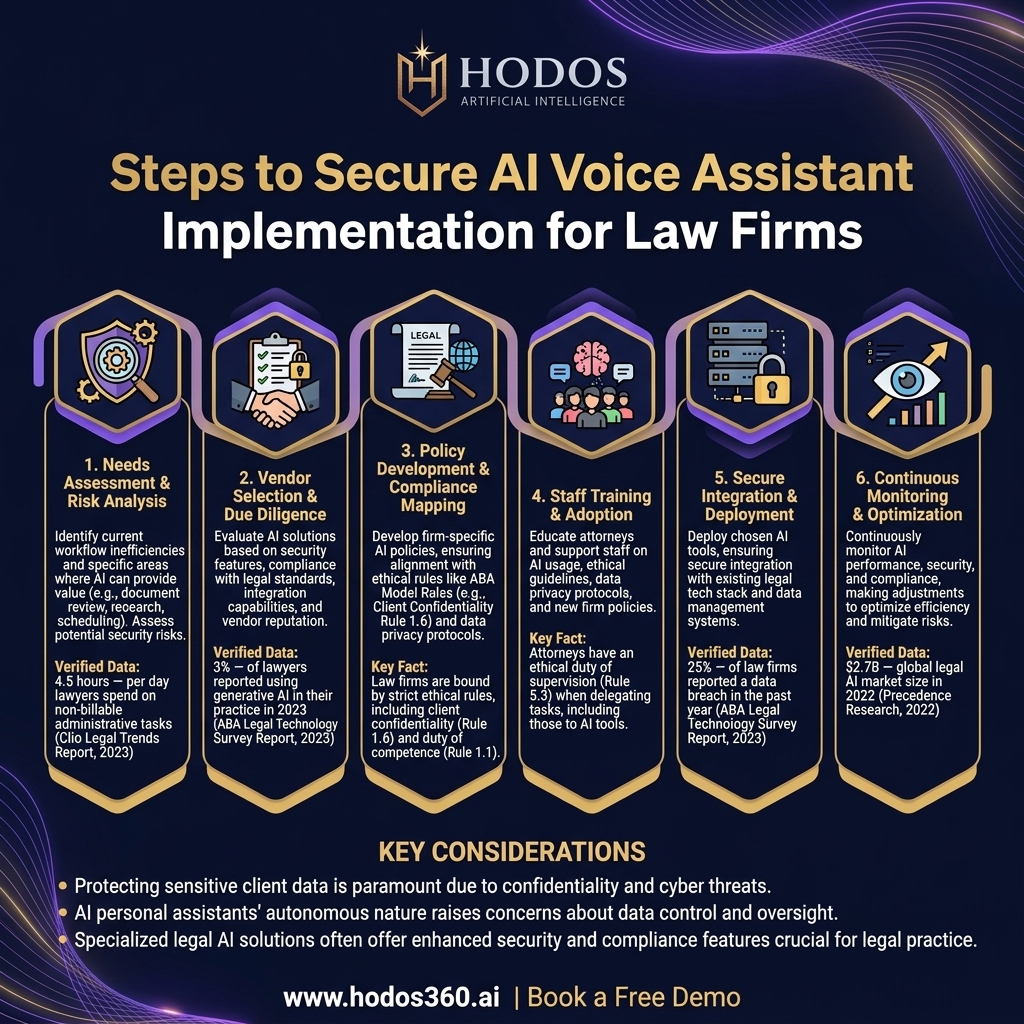
Implementing an AI personal assistant or specialized voice AI solution in a law firm requires careful strategic planning to maximize benefits while mitigating risks. The first step involves a thorough assessment of the firm's current workflows, identifying areas where an AI agent can deliver the most impact, such as client intake, initial consultations, or routine client inquiries. This assessment should also identify potential data privacy hotspots and compliance requirements. Firms should engage with legal tech experts and cybersecurity professionals to conduct a comprehensive risk analysis before integrating any new AI technology. This due diligence is crucial, especially given the complexities highlighted by the Meta Muse launch and its associated privacy concerns.
Selecting the right vendor is paramount. Law firms must look beyond generic AI offerings and choose providers with a proven track record in the legal sector, demonstrating a deep understanding of legal ethics, data security, and regulatory compliance. Key questions to ask include: What are the vendor's data encryption protocols? Where is client data stored, and who has access to it? How does the system handle attorney-client privilege? Does the AI offer auditable logs of interactions? A McKinsey report from 2023 emphasized that successful AI adoption is often correlated with robust vendor selection and a clear data governance strategy. Firms should prioritize solutions that offer transparent data handling policies and customizable security features, ensuring they align with the firm’s specific needs and jurisdictional requirements.
Best Practices for AI Adoption
Successful AI adoption within a law firm extends beyond simply purchasing a solution; it requires a holistic approach encompassing policy, training, and continuous monitoring. Firms should develop clear internal policies governing the use of AI personal assistants, outlining acceptable data inputs, interaction protocols, and escalation procedures for complex queries. Comprehensive training programs are essential to ensure that all legal professionals understand how to effectively and ethically interact with the AI, leveraging its capabilities while recognizing its limitations. This includes understanding when to transition from an AI interaction to human intervention, particularly in sensitive client matters.
Moreover, continuous monitoring and evaluation of the AI's performance are critical. This involves regularly reviewing interaction logs, client feedback, and system analytics to identify areas for improvement, detect potential biases, and ensure ongoing compliance with evolving legal and ethical standards. Law firms should treat their AI implementation as an iterative process, adapting and refining their approach based on real-world experience and feedback. This proactive and adaptive strategy will enable firms to fully realize the transformative potential of AI voice assistants, ensuring they remain at the forefront of legal innovation while upholding the highest standards of client care and professional responsibility. This strategic approach is vital to avoid pitfalls seen with more general AI agents and maintain trust.

The Future of Legal Practice: A HODOS 360 Perspective
The launch of Meta's Muse AI personal assistant is a powerful reminder of AI's accelerating capabilities and its potential to reshape every industry. For law firms, this trend presents a dual challenge: the imperative to embrace technological innovation to remain competitive, and the absolute necessity to do so within a framework of ironclad data security, client confidentiality, and ethical integrity. Generic AI tools, while impressive, often fall short of the specific demands of legal practice, particularly regarding the handling of sensitive information and adherence to professional rules. The future of legal tech lies not in broad, consumer-grade AI agents, but in specialized, purpose-built solutions that understand and respect the unique parameters of the legal world.
Platforms like HODOS 360 are at the vanguard of this specialized approach, offering AI Voice Assistants specifically designed to meet the stringent requirements of law firms. By providing 24/7 phone answering, advanced lead qualification, secure appointment booking, and multilingual support, these solutions allow law firms to enhance efficiency, improve client experience, and scale operations without compromising on privacy or ethics. The goal is to empower legal professionals, not replace them, by automating routine tasks and providing intelligent support. As the legal landscape continues to evolve, the strategic adoption of secure, specialized AI personal assistant and voice AI technologies will be the hallmark of forward-thinking firms poised for sustained success. This allows firms to confidently leverage AI's power, even as general AI agents like Muse continue to push boundaries, knowing their operations remain compliant and secure.
Frequently Asked Questions
What are the primary privacy concerns with general AI personal assistants in a legal context?+
General AI personal assistants like Meta's Muse, designed to access various apps and autonomously manage tasks, pose significant risks due to their broad data collection and processing capabilities. For law firms, this could lead to unauthorized access to sensitive client information, breaches of attorney-client privilege, and non-compliance with data protection regulations, as these systems are not inherently built with legal confidentiality standards in mind.
How can AI voice assistants improve client intake for law firms?+
Specialized AI voice assistants streamline client intake by offering 24/7 phone answering, ensuring no potential lead is missed. They can pre-qualify callers by gathering essential information, assess case viability, and automatically book appointments, significantly reducing administrative burden. This enhances responsiveness, improves the client experience from the first touchpoint, and allows legal staff to focus on more complex tasks.
What makes a specialized legal AI voice assistant different from a general one like Meta's Muse?+
A specialized legal AI voice assistant is purpose-built for law firms, incorporating robust data security, compliance features, and an understanding of legal ethics from its core design. Unlike general AI agents that operate broadly, legal-specific solutions offer granular control over data handling, secure encryption, auditable interaction logs, and are trained on legal-specific data, ensuring adherence to professional conduct rules and client confidentiality.
What legal ethical considerations should firms address before adopting AI voice assistants?+
Firms must address several ethical considerations, including client confidentiality (ABA Model Rule 1.6), technological competence (ABA Model Rule 1.1), and the duty to supervise non-lawyer assistance. This involves ensuring AI systems protect privileged information, understanding the AI's limitations and biases, and establishing clear internal policies and training for staff on responsible AI usage to prevent inadvertent ethical breaches.
How does AI voice technology integrate with existing law firm management systems?+
Specialized AI voice technology is designed for seamless integration with existing law firm management systems, including case management, billing, and calendaring software. This allows for automated data entry from client interactions, direct appointment scheduling, and synchronized client records, creating a cohesive and efficient operational ecosystem. Integration ensures data consistency and reduces manual data transfer errors, enhancing overall workflow efficiency.