
AI Receptionist: The Ultimate Guide for Law Firms
The legal industry often finds itself at the forefront of technological adoption, albeit with a cautious eye on compliance and ethical implications. Recently, a headline from inc.com, "This Startup Is Now Offering an AI Receptionist for Just $29 a Month," sent ripples through the professional services sector, particularly among small to mid-sized law firms grappling with operational costs and client responsiveness. This news, highlighting offerings from companies like ElevenLabs and Dialzara, presents a compelling, seemingly low-barrier entry point into advanced automation. However, for a law firm, the decision to integrate an AI receptionist is far more nuanced than simply subscribing to the cheapest plan. It involves a strategic evaluation of capabilities, ethical safeguards, and seamless integration into complex legal workflows, extending well beyond a basic monthly subscription.
While the allure of a $29 AI receptionist is undeniable for any small business looking to cut costs, the legal profession demands a level of sophistication and reliability that generic solutions often cannot provide. The stakes are higher: client confidentiality, professional communication, and the precise handling of sensitive legal inquiries. Firms must consider if a basic startup offering truly understands the intricacies of legal client intake, conflict checks, and ethical obligations, or if it merely provides a glorified answering machine. This article delves into what law firms truly need from an AI voice assistant, distinguishing between superficial cost savings and genuine, transformative value that enhances client experience and operational efficiency, rather than compromising it. The goal is not just to start using AI, but to implement it intelligently and strategically.
Beyond the $29 Hype: What Law Firms Really Need in an AI Receptionist
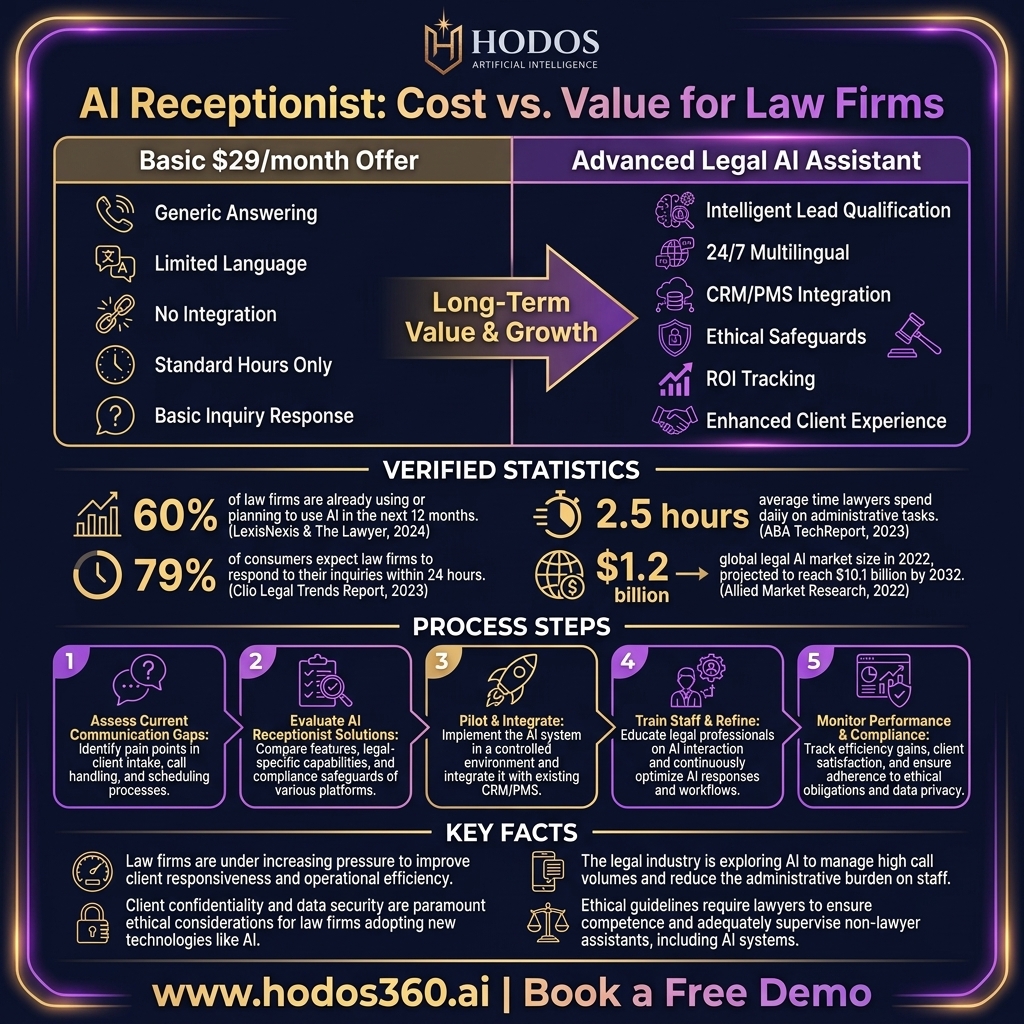
The inc.com article sparked considerable discussion, underscoring the rapid advancement and accessibility of voice AI technologies. Companies like ElevenLabs, known for their advanced voice synthesis, are indeed offering solutions that can mimic human speech with remarkable accuracy, while others like Dialzara are positioning themselves as budget-friendly options starting at just $29 a month. For a general small business, these plans might suffice for basic call routing or answering frequently asked questions. However, for a law firm, the nuances of client interaction are paramount. A generic AI receptionist may answer a call, but can it truly qualify a lead, understand the urgency of a legal matter, or navigate complex ethical disclosures required before engaging with a potential client? The difference between a simple automated service and a sophisticated legal AI assistant is vast, particularly when considering the reputational and financial implications of mishandled client communications.
Legal professionals understand that first impressions are critical. A prospective client calling a law firm is often in a vulnerable or urgent situation, seeking expert guidance. Learn more about Essential Website Accessibility Tools for Law Firms. An AI receptionist for a law firm must go beyond sounding human; it must perform functions that uphold the firm's professional standards. This includes intelligent lead qualification, understanding case types (e.g., personal injury, family law, corporate litigation), and knowing when to escalate to a human attorney or paralegal. It must also integrate seamlessly with existing case management systems to schedule appointments, gather initial client information securely, and even perform preliminary conflict checks—a task far more complex than simple calendar booking. The setup for such a system is not a one-time, generic configuration but a bespoke process tailored to the firm’s specific practice areas, ethical guidelines, and internal protocols. As Sam Altman, CEO of OpenAI, has often emphasized regarding AI deployment, the real value comes from careful integration and application, not just the underlying technology.
Ethical Considerations and Data Security in Voice AI
One of the most critical differentiators for law firms is the ethical imperative. The American Bar Association (ABA) Model Rules of Professional Conduct, particularly Rule 1.1 (Competence) and Rule 1.6 (Confidentiality of Information), directly impact how an AI receptionist can be deployed. Can a $29 service guarantee the confidentiality of initial client inquiries? Does it have robust data encryption and privacy protocols that meet legal industry standards? Firms must ensure that any voice AI assistant is not only intelligent but also compliant with stringent data protection regulations like HIPAA (for health-related legal matters) or state bar ethics opinions on cloud computing and client data. The risk of a data breach or an ethical lapse due to an inadequately secured or improperly configured AI system far outweighs any short-term cost savings. The "basic" plans often lack the enterprise-grade security features and compliance certifications essential for legal operations.
The sophisticated AI receptionist designed for law firms, like those offered by HODOS 360, prioritizes security and compliance from the ground up. This involves secure data handling, encrypted communications, and audit trails to ensure accountability. Learn more about Gemini AI for Law Firms: An Essential Strategic Guide. Firms must ask critical questions about where data is stored, who has access, and what safeguards are in place. The cost of a breach, both in terms of reputation and potential legal penalties, far exceeds the minimal savings of a cheap AI receptionist. As Dario Amodei, CEO of Anthropic, has highlighted in discussions about AI safety, responsible deployment in sensitive sectors like legal requires far more than just functional technology; it demands a deep understanding of domain-specific risks and robust mitigation strategies. This is where the true investment in a legal-specific AI solution pays dividends, ensuring peace of mind alongside enhanced efficiency.
The Transformative Impact of Voice AI on Legal Client Relations
Beyond cost, the strategic value of an advanced AI receptionist lies in its capacity to fundamentally transform client relations. In an era where clients expect instant communication and seamless experiences, a 24/7 AI voice assistant can be a game-changer. According to a 2023 Thomson Reuters report on the State of U.S. Small Law Firms, client acquisition and retention remain top challenges, with client service being a primary differentiator. An AI that can answer calls, qualify leads, and book appointments round-the-clock ensures that no potential client is lost due to missed calls or after-hours inquiries. This immediate responsiveness significantly enhances the client experience, setting a firm apart in a competitive market. Imagine a potential client searching for legal help at 10 PM; an AI assistant can capture their details, understand their needs, and schedule an initial consultation, ensuring the firm is the first point of contact, rather than a competitor.
Furthermore, the ability of AI voice assistants to provide multilingual support is crucial in today's diverse society. Learn more about AI Development: The Essential Blueprint for Law Firm Innovation. Firms in metropolitan areas or those serving specific demographics can use AI to communicate effectively with clients in their native languages, breaking down barriers and fostering trust. This capability, often missing from basic AI receptionist plans, reflects a commitment to inclusivity and client-centric service. The AI can intelligently route calls to specific attorneys based on practice area, language preference, or urgency, optimizing firm resources and ensuring clients reach the right expert promptly. This level of sophisticated call routing and personalized interaction elevates the role of the AI receptionist from a simple answering machine to a strategic client engagement tool, significantly contributing to the firm's client intake automation and overall operational efficiency. This is not just about answering the phone; it's about intelligent, empathetic, and efficient client engagement.
Automating Client Intake and Lead Qualification with Precision
The true power of an advanced AI receptionist for law firms is in its ability to automate the laborious and time-consuming process of client intake and lead qualification with precision. Instead of a human receptionist spending valuable time on initial screening calls, the AI can be programmed to ask specific, qualifying questions based on the firm's criteria. This includes gathering essential contact information, understanding the nature of the legal issue, assessing potential conflicts of interest, and even providing preliminary information about the firm's services or fees. This not only streamlines the intake process but also ensures that attorneys and paralegals only engage with genuinely qualified leads, optimizing their billable hours and reducing administrative overhead.
Consider the example of a busy personal injury firm. A constant stream of calls requires rapid assessment to identify viable cases. Learn more about Essential Website Design: Powering Law Firm Growth in 2026. An AI voice assistant can quickly ascertain if an injury occurred, when, and under what circumstances, then categorize the lead and schedule an appointment with the appropriate attorney, all while adhering to the firm's specific intake protocols. This level of intelligent lead qualification is far superior to a generic answering service and directly impacts the firm's bottom line. It transforms the initial client interaction from a bottleneck into an efficient, data-rich process, allowing firms to scale their operations without proportionally increasing their administrative staff. This proactive approach to client engagement is a stark contrast to the reactive, often overwhelmed approach of firms relying solely on human receptionists during peak hours.
Integrating AI Voice Assistants: A Strategic Imperative for Modern Law Firms
For modern law firms, the integration of AI voice assistants is rapidly becoming a strategic imperative, not just a technological luxury. The real challenge and opportunity lie in how seamlessly these tools can integrate with a firm’s existing technological ecosystem. A standalone AI receptionist, no matter how advanced, will have limited impact if it cannot communicate with the firm’s case management system, billing software, or document automation platforms. The true value emerges when the AI can feed qualified lead information directly into a CRM, update client profiles in real-time, or automatically trigger the generation of initial client engagement letters. This interconnectedness transforms disparate tools into a cohesive, intelligent operational framework.
Firms like Allen & Overy, through their partnership with Harvey AI, have demonstrated the immense potential of deeply integrated AI solutions in legal research and document review. Learn more about AI-Powered WordPress: The Ultimate Guide for Law Firms. While voice AI operates at the client-facing front, the principle of integration remains the same: the technology must augment, not complicate, existing workflows. A robust AI voice assistant should offer API access or direct integrations with popular legal tech platforms, allowing for a unified view of client interactions and case progress. Without this, firms risk creating data silos and fragmented processes, negating the very efficiency gains AI promises. The investment in a comprehensive platform, such as HODOS 360's AI Law Firm Management System, which includes integrated voice assistants, ensures that every piece of the technological puzzle works in concert, from initial client contact to final case resolution.
The Synergy of AI Voice Assistants with Broader Legal Tech
The power of an AI receptionist is amplified exponentially when it operates in synergy with other legal technology solutions. Imagine an AI voice assistant that not only qualifies a lead but also, upon successful qualification, automatically initiates a client intake workflow within a firm's AI Law Firm Management System. This could involve auto-populating client data, assigning the case to a specific attorney, and even triggering the generation of initial retainer agreements using document automation. This level of integration moves beyond simple call handling to become a core component of the firm's operational backbone, significantly reducing manual data entry and potential errors. According to the 2024 Clio Legal Trends Report, firms leveraging technology across multiple operational areas consistently report higher revenue growth and client satisfaction.
Furthermore, the data collected by an AI voice assistant can feed into a firm's AI Marketing Platform, providing invaluable insights into lead sources, client demographics, and common inquiries. Learn more about AI Legal Tech: The Essential Guide to Funding and Growth. This allows for more targeted marketing campaigns, optimizing ROI tracking and content generation. For instance, if the AI identifies a surge in calls related to specific legal issues, the marketing team can quickly create AI video creation or social media content addressing those needs. This holistic approach, where an AI receptionist is not an isolated tool but an integral part of a firm's comprehensive tech strategy, unlocks unprecedented levels of efficiency and growth. It's about creating an intelligent ecosystem where every client interaction contributes to a smarter, more responsive, and more profitable law firm, aligning with the vision of Jensen Huang, CEO of Nvidia, who often speaks about the power of interconnected AI systems.
Navigating the Market: Choosing the Right AI Receptionist for Your Firm
With the market for AI receptionists expanding rapidly, driven by the proliferation of affordable voice AI solutions, law firms face the challenge of distinguishing between basic offers and truly robust, legal-specific platforms. While the $29/month startup offering from inc.com might be appealing for its low entry point, firms must look beyond the initial cost to evaluate total cost of ownership, scalability, and the depth of features. Key considerations include the natural language processing (NLP) capabilities—does the AI sound robotic, or can it genuinely understand context, tone, and complex legal jargon? Customization is also crucial: can the AI be tailored to specific firm scripts, intake forms, and ethical disclosures, or is it a one-size-fits-all solution? The ability to customize ensures that the AI reflects the firm's brand voice and adheres to its unique operational protocols.
Furthermore, firms must assess integration capabilities with existing systems. A truly effective AI receptionist should seamlessly connect with case management, CRM, and calendaring software. Scalability is another vital factor; as a firm grows, can the AI system handle increased call volumes and evolving needs without requiring a complete overhaul or incurring prohibitive costs? Security and compliance, as discussed, are non-negotiable for legal professionals. Firms should inquire about data encryption, privacy policies, and adherence to industry-specific regulations. While some offers might seem attractive with their "basic" plans, they often lack the sophisticated setup and ongoing support required for the demanding legal environment. Investing in a platform that offers comprehensive support and continuous updates, ensuring it evolves with both technology and legal requirements, is paramount for long-term success. This strategic evaluation ensures that the chosen AI receptionist is an asset, not a liability, for the firm's future.
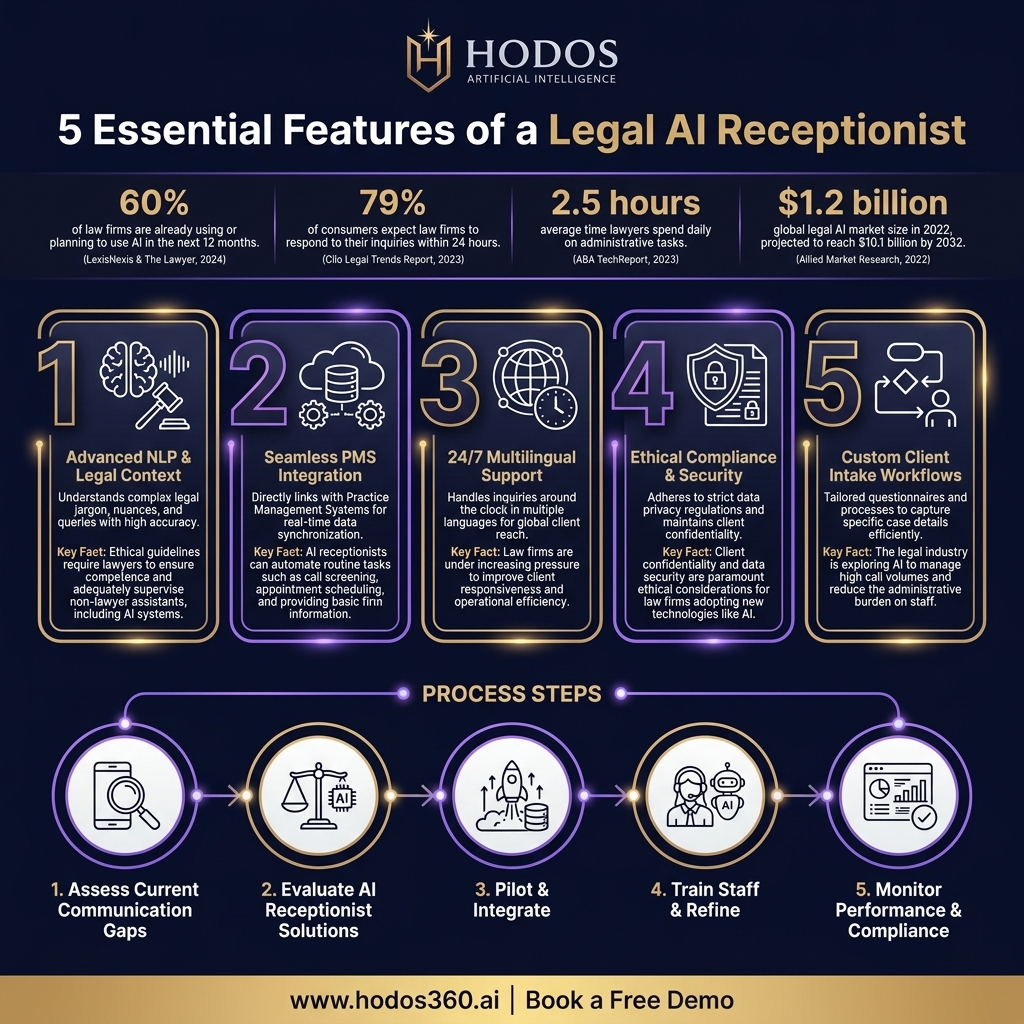
- ✓Advanced Natural Language Processing (NLP): Ensures the AI understands complex legal inquiries and client nuances, not just keywords.
- ✓Seamless Integration: Connects with existing legal tech stacks (case management, CRM, billing) for unified workflows and data synchronization.
- ✓Customizable Workflows: Allows firms to tailor scripts, intake questions, and call routing based on specific practice areas and ethical guidelines.
- ✓24/7 Multilingual Support: Provides round-the-clock availability and communicates effectively with diverse client bases.
- ✓Robust Data Security & Compliance: Adheres to strict legal industry standards for client confidentiality and data protection (e.g., ABA Model Rules).
- ✓Intelligent Lead Qualification: Accurately screens potential clients, gathers essential information, and directs qualified leads to the appropriate attorney.
- ✓Scalability & Ongoing Support: Grows with the firm's needs and offers continuous updates, maintenance, and technical assistance.

Key Takeaways and Next Steps for Law Firms
The emergence of affordable AI receptionist offers like the $29/month service from startups such as ElevenLabs and Dialzara marks a significant milestone in legal tech accessibility. However, for law firms, the decision to adopt voice AI must transcend mere cost considerations. It's about a strategic investment in technology that enhances client experience, streamlines operations, and maintains the highest standards of professional conduct and data security. The true value of an AI receptionist for legal professionals lies in its ability to handle complex client interactions with empathy and precision, integrate seamlessly into existing workflows, and provide robust security measures that protect sensitive information.
Firms considering an AI receptionist should conduct thorough due diligence, prioritizing solutions that offer advanced NLP, comprehensive integration capabilities, and a commitment to legal compliance. Look for platforms that can be customized to your firm's specific needs, rather than generic plans. The goal is to leverage AI not just to cut costs, but to fundamentally transform how your firm operates, serves clients, and positions itself for future growth. By carefully evaluating the market and understanding the distinct requirements of the legal profession, firms can harness the power of AI voice assistants to unlock unprecedented levels of efficiency and client satisfaction, ensuring they remain competitive in an evolving legal landscape. This strategic approach will differentiate firms that merely adopt technology from those that truly innovate.