


Strategic AI Tools Adoption: Essential Guide for Law Firms
The legal tech landscape, once characterized by a rush towards any new AI offering, is now entering a phase of profound maturation. Jeffrey Chivers, CEO of Syllo, recently articulated this shift, stating that law firms will become “more selective and discerning” in adopting AI tools.
This sentiment, highlighted by Law.com, marks a critical inflection point: the era of speculative experimentation is yielding to a demand for strategic, proven solutions. No longer is it enough for a tool to simply claim 'AI-powered'; firms are rigorously scrutinizing capabilities, integration potential, and tangible returns on investment.
This shift reflects a maturing market where the early adopters have shared their lessons, both triumphs and pitfalls, paving the way for a more calculated approach to technological integration across the legal sector.
This discernment is driven by an increasing understanding that while AI holds immense promise for transforming legal practice—from automating mundane tasks to enhancing complex legal analysis—its implementation is not without its challenges.
Firms that rushed into unvetted solutions often encountered issues ranging from data security vulnerabilities and integration headaches to a lack of demonstrable ROI. Conversely, firms like Allen & Overy, through their strategic partnership with Harvey AI, have showcased the profound efficiencies and competitive advantages that well-chosen AI can deliver.
This dichotomy underscores the urgent need for a framework that enables law firms to navigate the intricate AI marketplace with clarity and confidence, ensuring that their investments genuinely propel them forward rather than merely adding to their tech stack complexity.
As the competitive pressures on law firms intensify, coupled with clients demanding greater efficiency and transparency, the strategic adoption of AI tools becomes paramount.
This comprehensive guide delves into the nuances of this discerning approach, offering insights into identifying genuine value, mitigating risks, and fostering an AI-ready culture within your firm. We will explore the latest trends, real-world applications, and the critical considerations necessary for law firm owners and attorneys to make informed decisions about their AI strategy, ensuring that every technological step taken is a strategic stride towards enhanced productivity, improved client outcomes, and sustainable growth.
Ready to refine your firm's AI strategy? Explore HODOS 360's integrated legal AI solutions today.
The Shifting Landscape of Legal AI Adoption
Jeffrey Chivers' observation from Syllo is more than just a passing comment; it encapsulates a fundamental shift in how the legal industry views and procures technology. The initial 'gold rush' mentality, where firms eagerly experimented with new AI tools regardless of their long-term viability, is being replaced by a more sober, strategic assessment.
This evolution is partly fueled by the experiences of early adopters. For instance, while many firms initially invested in generic AI solutions, those that succeeded, such as Allen & Overy with their bespoke Harvey AI deployment, demonstrated the power of tailored applications. These success stories contrast sharply with firms that faced integration nightmares or discovered their chosen AI tools failed to deliver on grandiose promises, leading to disillusionment and wasted resources.
This divergence has instilled a cautious yet determined approach among firms, prioritizing discernment over mere adoption.
The evolution of AI capabilities itself, particularly in the realm of generative AI legal, has significantly contributed to this discerning approach. Early AI tools primarily focused on automation of repetitive tasks like e-discovery or basic document review.
Today, advanced large language models (LLMs) from pioneers like OpenAI (GPT-4) and Anthropic (Claude 3) have opened doors to far more complex applications, including sophisticated contract drafting, nuanced legal research, and even predictive analytics for litigation outcomes. Learn more about AI Chatbot Builders: Transform Your Law Firm in 2026.
The ABA TechReport 2023 indicated a steady increase in AI adoption, yet also highlighted a growing demand for specialized legal LLMs that understand the intricate language and context of law. This shift means that firms are no longer just looking for tools that *can* do something, but for tools that *excel* in specific legal domains, offering precision and reliability that generic AI often lacks.
This heightened discernment is also a direct response to the escalating pressures on law firms. Clients are increasingly demanding greater efficiency, transparent billing, and innovative service delivery, forcing firms to re-evaluate their operational models. AI, when strategically implemented, offers a powerful means to meet these demands, reducing overheads, enhancing service quality, and unlocking new revenue streams.
However, the stakes are high: a misstep in AI adoption can lead to significant financial losses, reputational damage, and even ethical breaches. The ABA Model Rules of Professional Conduct, particularly Rule 1.1, Comment 8, which mandates technological competence, underscores the ethical imperative for lawyers to understand the benefits and risks associated with technology.
This makes the selection process not just a business decision, but a professional obligation, compelling firms to be exceptionally selective in their AI investments.
Beyond the Hype: Practical Applications of Generative AI
While the buzz around generative AI can sometimes overshadow its practical utility, its real-world applications in legal practice are becoming increasingly tangible and transformative. Beyond the well-established efficiencies in document review efficiency, where AI can sift through vast quantities of data in a fraction of the time a human would, generative AI is now revolutionizing front-end processes like client intake automation.
Platforms like HODOS 360's AI Law Firm Management System leverage generative AI to streamline initial client queries, automate conflict checks, and even draft initial engagement letters, drastically reducing the administrative burden and accelerating the onboarding process. This frees up paralegals and junior associates to focus on more substantive legal work, enhancing overall firm productivity and client satisfaction.
Furthermore, generative AI empowers lawyers by acting as an intelligent assistant, rather than a replacement. It can rapidly synthesize complex legal precedents, draft initial versions of motions or briefs, and even identify potential arguments or counter-arguments based on extensive legal databases. Learn more about Voice AI Revolution 2026: Agentic Platforms Transform Law Firms.
For instance, a litigation boutique might utilize AI to analyze historical case law and predict potential outcomes, thereby informing strategic decisions. Corporate firms, on the other hand, could deploy AI for rapid due diligence, automatically identifying critical clauses in M&A documents or flagging regulatory compliance issues.
This shift allows attorneys to dedicate more time to high-value, strategic thinking, client counseling, and complex problem-solving—areas where human intellect and empathy remain irreplaceable. The goal isn't just to save time, but to elevate the quality and depth of legal services offered, creating a competitive advantage in a rapidly evolving market.
Navigating the AI Tool Selection Maze
In an increasingly crowded market of legal AI solutions, the ability to discern and select the right tools is paramount. The first crucial step involves a rigorous internal assessment: firms must identify their specific pain points and strategic objectives rather than being swayed by the latest technological fads.
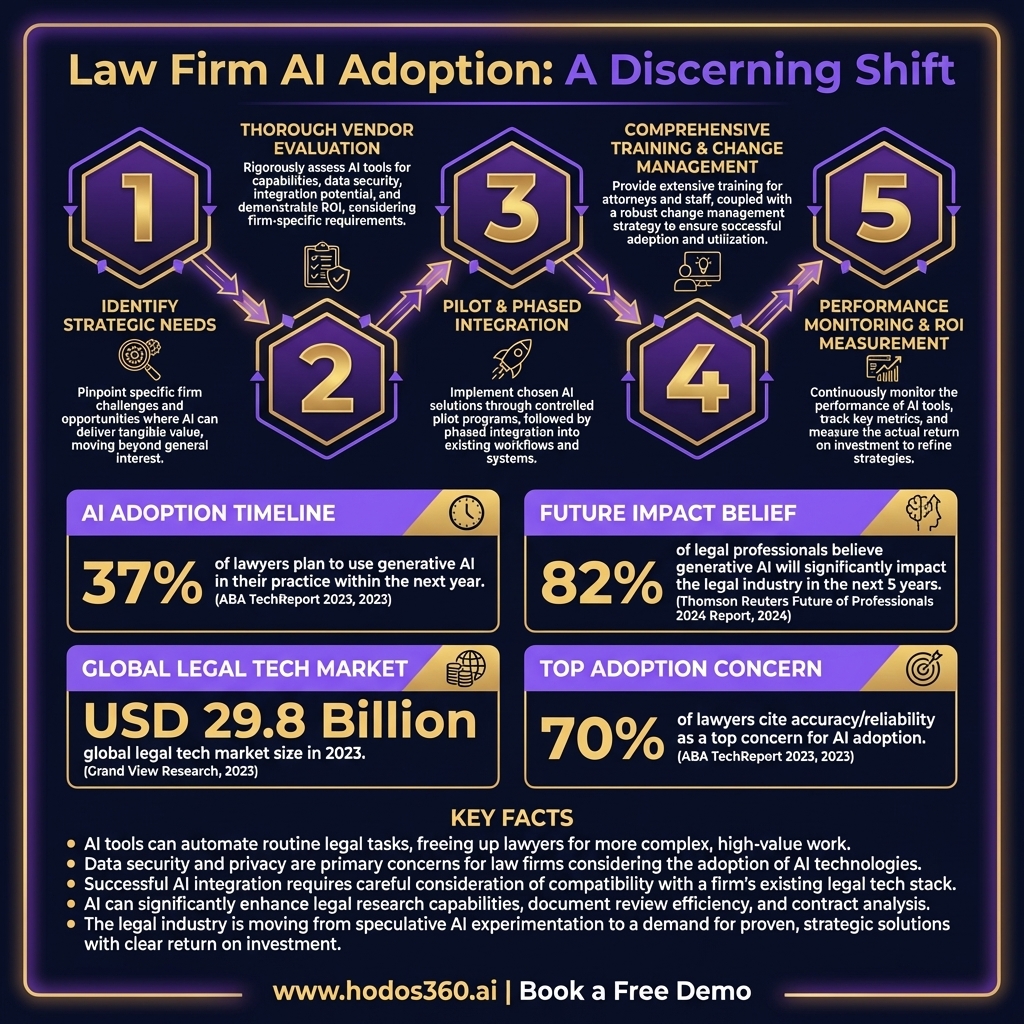
Is the primary bottleneck in case management, billing, client communication, or document generation? A corporate firm might prioritize AI for contract analysis and compliance, while a personal injury firm might seek advanced AI for lead qualification and automated client communication. Without a clear understanding of internal needs, even the most sophisticated AI tool can become an expensive, underutilized asset.
This initial self-reflection forms the bedrock of a truly firm technology strategy, ensuring that AI investments are purpose-driven and aligned with overarching business goals.
Once needs are identified, thorough vendor due diligence becomes critical. The market is rife with AI providers, but not all are created equal.
Firms must meticulously evaluate potential vendors on several fronts: the robustness of their data security protocols (especially vital given the sensitive nature of legal data), the explainability of their AI models (understanding *how* an AI arrives at a conclusion is crucial for legal accountability), and their integration capabilities with existing practice management systems and document management systems.
A tool that cannot seamlessly integrate risks creating new data silos and workflow inefficiencies, negating any potential benefits. Furthermore, examining a vendor's track record, client testimonials, and commitment to ongoing support and development provides invaluable insight into their reliability and long-term viability. Learn more about Generative AI Marketing: Law Firms' 2026 Growth Engine.
Pilot programs with clear, measurable success metrics are an excellent way to test the waters before a firm-wide commitment.
Understanding the diverse landscape of AI technologies is also key to effective selection. Artificial intelligence is not a monolithic entity; it encompasses various sub-fields, each with distinct applications.
Machine learning algorithms, for instance, excel at predictive analytics, identifying patterns in large datasets to forecast case outcomes or client behavior. Natural Language Processing (NLP) is crucial for tasks like contract abstraction, legal research, and sentiment analysis. Generative AI, as discussed, focuses on content creation, from drafting documents to generating marketing copy.
A discerning firm will understand which type of AI best addresses their specific needs, avoiding the trap of applying a general-purpose tool to a specialized problem. This nuanced understanding ensures that firms invest in solutions that are fit-for-purpose and deliver genuine value. Struggling to identify the right AI solutions for your firm?
Book a free consultation with HODOS 360 experts to chart your strategic path.
- ✓Data Security & Privacy Compliance: Ensure the AI tool adheres to stringent data protection regulations (e.g., GDPR, CCPA, HIPAA) and maintains client confidentiality through robust encryption and access controls.
- ✓Seamless Integration: Verify compatibility with your existing Practice Management System (PMS), Document Management System (DMS), and other essential legal software to avoid data silos and workflow disruptions.
- ✓Scalability and Future-Proofing: Choose solutions that can grow with your firm, handling increasing data volumes and evolving legal challenges, and are regularly updated to incorporate new AI advancements.
- ✓Intuitive User Experience & Training: Prioritize tools with user-friendly interfaces and comprehensive training resources to ensure high adoption rates among attorneys and staff, minimizing the learning curve.
- ✓Vendor Support & Track Record: Evaluate the provider's reputation, responsiveness of their support team, and commitment to customer success, including clear SLAs and dedicated account management.
- ✓Comprehensive Cost-Benefit Analysis: Beyond the initial price, consider the total cost of ownership, including implementation, training, and ongoing maintenance, weighed against projected ROI in terms of time savings, error reduction, and revenue growth.
- ✓Ethical AI Guidelines & Bias Mitigation: Investigate the vendor's approach to ethical AI, ensuring their models are designed to minimize bias, maintain fairness, and comply with professional responsibility rules.
Integrating AI: From Pilot to Pervasive Practice
The journey from selecting an AI tool to its pervasive integration across a law firm is less about technology and more about change management. Successful implementation hinges on strong leadership buy-in and the cultivation of dedicated AI champions within the firm. Without visible support from senior partners, even the most promising AI solution can languish.
Firms need to establish cross-functional teams that include attorneys, paralegals, IT professionals, and administrative staff to guide the implementation process, gather feedback, and address concerns. A study by Thomson Reuters on legal tech adoption consistently highlights that firms with a clear change management strategy and engaged leadership are significantly more likely to realize the full benefits of their technology investments, avoiding the common pitfall of user resistance and underutilization.
Crucially, integrating AI demands a significant investment in training and upskilling for legal professionals. The notion that AI will simply 'do the work' is a misconception; rather, it augments human capabilities, requiring a new set of skills from lawyers and support staff. AI literacy is rapidly becoming a core competency, encompassing not just how to operate the tools, but also how to critically interpret AI outputs, identify potential biases or inaccuracies, and integrate AI-generated insights ethically into legal workflows.
Firms must move beyond one-off training sessions, embracing continuous education programs that evolve with the technology. Learn more about AI Marketing: Law Firms Slash $225K Tools in 2026. This empowers professionals to leverage AI effectively, fostering a culture of innovation where technology is seen as an enabler, not a threat, thereby maximizing the return on AI tools adoption.
Underpinning any successful AI integration is a robust data strategy. AI models are inherently data-hungry, and their effectiveness is directly proportional to the quality, accessibility, and ethical sourcing of the data they are trained on. Law firms, with their vast repositories of client information, case files, and legal documents, sit on a goldmine of data.
However, this data often resides in disparate systems, riddled with inconsistencies, or siloed within individual departments. Before deploying AI, firms must undertake a comprehensive data audit, ensuring data cleanliness, standardization, and secure accessibility. This often involves breaking down internal data silos and establishing firm-wide data governance policies, a foundational step that directly impacts the accuracy, reliability, and ethical integrity of any AI system implemented.
Crafting a Firm-Specific AI Strategy
A crucial aspect of discerning AI implementation is recognizing that a one-size-fits-all approach is ineffective. Each law firm, whether a large corporate entity or a boutique practice, possesses unique operational structures, client bases, and strategic goals. Therefore, crafting a firm-specific AI strategy is paramount. This involves defining clear objectives and Key Performance Indicators (KPIs) for each AI initiative.
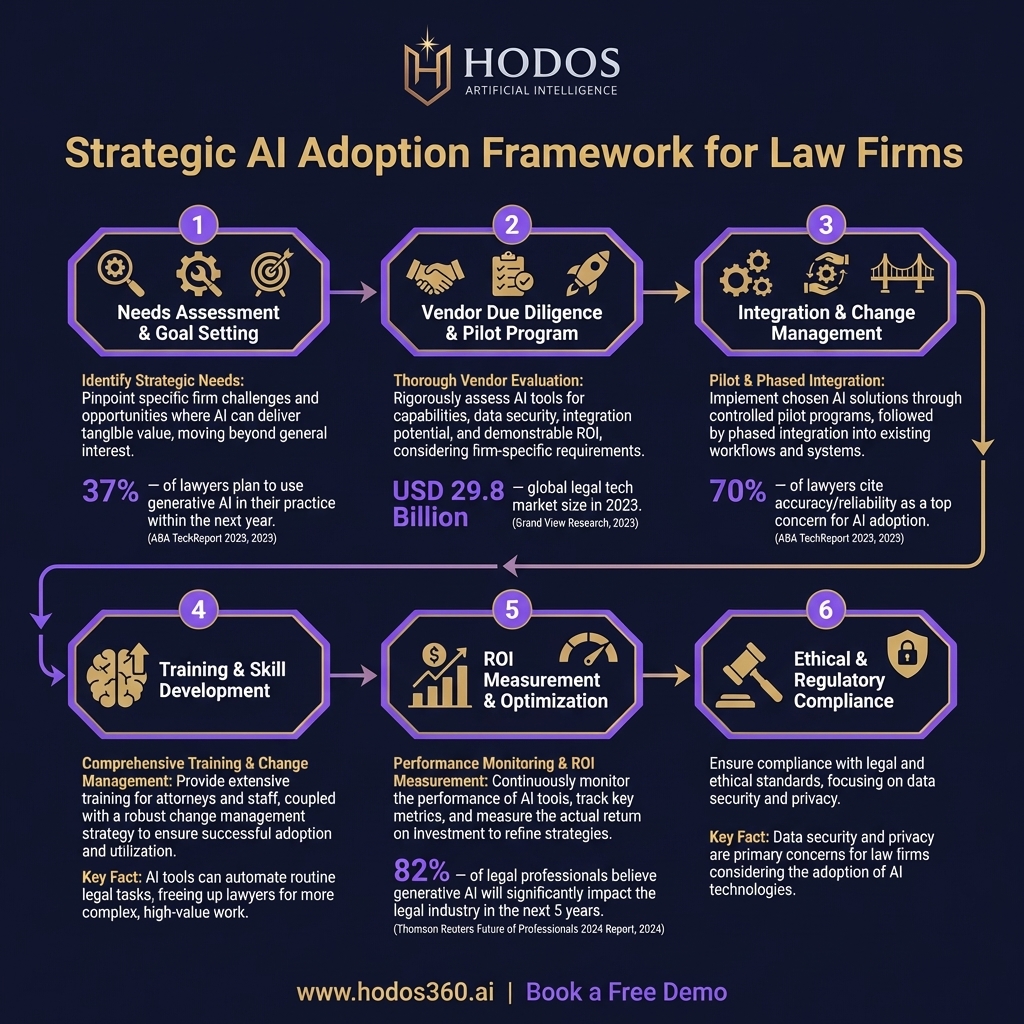
For example, a litigation firm might focus its AI efforts on enhancing e-discovery processes and improving the accuracy of motion drafting, with KPIs centered on reducing discovery costs and increasing success rates of preliminary motions. Conversely, a real estate firm might prioritize AI for contract review and due diligence, measuring success by the speed of transaction closing and error reduction.
This tailored approach ensures that AI investments are directly linked to tangible business outcomes and address the specific needs of the firm's practice areas.
Implementing AI effectively often begins with a phased rollout, starting with pilot projects designed to test the technology's efficacy and gather user feedback in a controlled environment.
Learn more about AI Legal Revolution: Corporate Use Jumps 87% by 2026. Rather than attempting a firm-wide overhaul, select a specific department or practice group to trial a new AI tool, setting clear, measurable goals for the pilot phase. This iterative process allows firms to refine their implementation strategy, identify potential challenges, and demonstrate early successes before scaling.
For instance, a firm might pilot a generative AI tool for initial legal research in one specific practice area, collecting feedback on accuracy, ease of use, and time savings. This data-driven approach, coupled with continuous feedback loops from the end-users, is essential for building internal confidence in the technology and ensuring broader adoption.
It transforms the AI journey from a speculative gamble into a strategic, evidence-based progression.
Measuring ROI and Future-Proofing Your Firm
The ultimate validation of any AI tools adoption strategy lies in its measurable Return on Investment (ROI). Beyond the initial excitement, firms must rigorously track how AI contributes to their bottom line. ROI extends beyond simple cost savings from automation; it encompasses revenue generation through increased capacity (e.g., handling more cases with the same headcount), improved client satisfaction leading to repeat business and referrals, and significant risk reduction through enhanced compliance and error detection.
Specific metrics might include reduced time spent on administrative tasks, increased billable hours, improved accuracy in document review, or a higher success rate in lead conversion. Firms like Kirkland & Ellis, known for their proactive approach to technology, consistently analyze these metrics to ensure their AI investments are not just expenditures but strategic drivers of profitability and competitive advantage.
This data-driven approach is crucial for justifying continued investment and refining future AI strategies.
In an increasingly competitive legal landscape, effective AI utilization is becoming a significant differentiator, influencing both talent acquisition and client retention. Firms that master the integration of AI will not only operate more efficiently but also attract top legal talent seeking technologically advanced environments.
Furthermore, clients are increasingly drawn to firms that demonstrate innovation and efficiency, viewing these attributes as indicators of superior service. Learn more about AI Legal Research: The Ultimate Evolution of Legal Analysis. The conflict between firms that embrace disruption and those clinging to tradition is becoming starker; those hesitant to adopt AI risk falling behind, not just in operational efficiency but in market perception.
The legal tech market is dynamic, with new startups emerging and acquisitions reshaping the landscape (e.g., Clio's continued strategic acquisitions), making continuous monitoring and adaptation essential for maintaining a competitive edge.
Future-proofing a law firm in the age of AI involves more than just implementing the latest tools; it requires a proactive and adaptive mindset.
This includes continuous monitoring of the evolving AI landscape, anticipating new technological advancements, and adapting strategy accordingly. It also means staying abreast of regulatory changes, such as the enforcement of the EU AI Act, which will significantly impact how AI is developed and deployed globally.
Firms must build agile compliance frameworks into their AI adoption strategies from the outset, ensuring that their technological advancements align with current and future legal and ethical standards. This forward-looking approach safeguards against obsolescence and ensures that the firm remains resilient and competitive in an ever-changing environment, transforming potential threats into opportunities for growth and innovation.
Ethical and Regulatory Compliance in AI Use
The discerning adoption of AI tools in law firms must be inextricably linked with a robust commitment to ethical and regulatory compliance. The potential for AI to introduce biases, compromise data privacy, or breach client confidentiality is a significant concern that cannot be overlooked. Lawyers have a professional duty to understand these risks, as outlined in ABA Formal Opinion 507, which specifically addresses "The Use of Generative Artificial Intelligence in the Practice of Law," emphasizing the lawyer's duties of confidentiality, competence, and supervision.
Firms must implement strict protocols for data input and output, ensuring that sensitive client information is never exposed to unsecure or public AI models. Furthermore, they must actively work to mitigate algorithmic bias, recognizing that AI systems trained on historical data can perpetuate and even amplify societal inequalities if not carefully managed and monitored.
Beyond internal ethical considerations, the external regulatory environment for AI is rapidly evolving and becoming increasingly complex. The EU AI Act, set to be fully enforced in the coming years, represents a landmark piece of legislation that categorizes AI systems by risk level and imposes stringent requirements on developers and deployers, particularly for high-risk applications.
While this act is European, its influence is global, setting a precedent for future regulations and impacting any firm dealing with European clients or data. Firms must proactively integrate compliance frameworks into their AI strategies, conducting regular audits, implementing impact assessments, and ensuring transparency in AI decision-making.
Failure to adhere to these evolving standards can result in severe legal penalties, significant financial fines, and irreparable damage to a firm's reputation, making ethical and regulatory foresight an indispensable component of successful AI adoption.

Key Takeaways and Next Steps
The legal industry has undeniably moved beyond the initial AI hype cycle into a phase defined by strategic, discerning adoption. Law firms are no longer just experimenting; they are meticulously evaluating and integrating AI tools that promise tangible value, measurable ROI, and seamless integration into their intricate operations.
Success in this new era hinges on a holistic approach: understanding your firm's unique needs, conducting rigorous vendor due diligence, fostering a culture of AI literacy through continuous training, and proactively addressing ethical and regulatory considerations. The future of legal practice belongs to those who view AI not as a silver bullet, but as a powerful, carefully selected instrument to enhance human expertise, drive efficiency, and deliver unparalleled client service.
The journey towards an AI-powered future is continuous, demanding adaptability, foresight, and a commitment to strategic innovation. Ready to make discerning AI choices that propel your firm forward? Visit HODOS 360 to explore our comprehensive suite of AI-powered solutions, from management systems to marketing platforms and voice assistants, designed for the modern law firm.
Schedule a demo today and transform your practice.
Frequently Asked Questions
Why are law firms becoming more discerning in AI adoption?+
Law firms are shifting from early experimentation to strategic investment due to lessons learned from initial adoptions. They now prioritize measurable ROI, seamless integration, data security, and ethical compliance. The market's maturation, coupled with heightened client demands for efficiency, compels firms to select AI tools that offer proven, tangible benefits rather than just novel features, as highlighted by industry leaders like Syllo CEO Jeffrey Chivers.
What are the key considerations for selecting an AI tool for a law firm?+
Key considerations include identifying specific firm needs, conducting thorough vendor due diligence on data security and integration capabilities, and understanding the different types of AI (e.g., generative AI, NLP, machine learning) to ensure the tool is fit-for-purpose. Firms must also evaluate scalability, user-friendliness, vendor support, and conduct a comprehensive cost-benefit analysis before commitment.
How can generative AI practically benefit law firms today?+
Generative AI offers practical benefits such as streamlining client intake and conflict checks, automating initial document drafting (e.g., contracts, briefs), enhancing legal research by synthesizing complex information, and improving due diligence processes. It acts as an intelligent assistant, freeing up attorneys for higher-value strategic work, thereby increasing efficiency, reducing administrative burden, and improving overall service delivery.
What role does ethical compliance play in AI adoption for legal practices?+
Ethical compliance is paramount. Firms must address potential AI biases, ensure client data privacy and confidentiality, and maintain the lawyer's duty of supervision over AI outputs. Adherence to professional conduct rules (like ABA Model Rule 1.1, Comment 8, and Formal Opinion 507) and evolving regulations such as the EU AI Act is crucial to mitigate legal risks, financial penalties, and reputational damage, making it a non-negotiable aspect of AI strategy.
How can law firms measure the ROI of their AI investments?+
Measuring ROI involves tracking various metrics beyond simple cost savings. Firms should evaluate reductions in administrative time, increases in billable hours, improvements in document accuracy, higher client satisfaction rates, and enhanced lead conversion success. By setting clear KPIs for each AI initiative and continuously monitoring these performance indicators, firms can ensure their AI investments are driving profitability and competitive advantage, justifying further strategic integration.